drive FIAT QUBO 2010 1.G Owner's Manual
[x] Cancel search | Manufacturer: FIAT, Model Year: 2010, Model line: QUBO, Model: FIAT QUBO 2010 1.GPages: 230, PDF Size: 4.38 MB
Page 85 of 230
❒The signals sent out by the sensors can be altered
by dirt, snow or ice deposited on the sensors or
by ultrasound systems (e.g. truck pneumatic brakes
or pneumatic drills) near the vehicle.
❒The parking sensors work properly with the swing
doors closed. If they are open, they can cause the
system to send false signals: always close the
rear doors.
WARNING
The ultimate responsibility when
par
king and carrying out other
dangerous manoeuvres still rests with the
driver.When parking, make sure that no-one is
standing in the area, especially children or
animals. Parking sensors are designed to assist
drivers; however, you must always concentrate
fully during potentially dangerous manoeuvres,
even if carried out at low speeds.
RADIO
(for versions/markets, where provided)
Read the Supplement attached to this Owner's
Handbook for the operation of the radio with
CD/MP3 player (for versions/markets, where
provided).
LIGHT SETUP
The system consists of:
❒radio power wires
❒front speaker wires (located in wing mirror panels)
❒speaker wires in front door panels
❒rear speaker wires (located next to parcel shelf )
(for versions/markets, where provided)
❒radio housing
❒antenna wires.
84
KNOW YOUR
VEHICLE
SAFETY
ST
ARTING AND
DRIVING
WARNING LIGHTS
AND MESSAGES
IN AN EMERGENCY
SERVICING AND
MAINTENANCE
TECHNICAL
SPECIFICATIONS
INDEX
Page 94 of 230
SBR SYSTEM
The vehicle is equipped with the SBR (Seat Belt
Reminder) system, which warns the driver and the
front passenger if their seat belt is not fastened,
as follows:
❒warning light
comes on and the buzzer sounds
continuously for the first 6 seconds;
❒warning light
blinks and intermittent activation
of the beeper for the next 90 seconds.
For permanent deactivation, contact a Fiat
Dealership.
The SBR system can also be reactivated through the
setup menu.
PRETENSIONERS
To increase the protective efficiency of the front seat
belts, the vehicle is fitted with pretensioners. These
devices, in the event of a violent head-on crash or
side impact, rewind the seat belts a few centimetres.
In this way, they ensure that the belts fit tightly to
the wearer before the restraining action begins.
The seat belt reel locks to indicate that the
pretensioner has cut in; the seat belt cannot be
drawn back up even when guided manually.
IMPORTANT To obtain the highest degree of
protection from the action of the pretensioners,
wear the seat so it fits snugly over the chest and
hips.
A small amount of smoke may be produced when the
pretensioners cut in. This smoke is not toxic and
does not indicate a fire.
The pretensioner does not require any maintenance
or lubrication. Anything that modifies its original
conditions invalidates its efficiency. If, due to unusual
natural events (floods, sea storms, etc.), the device
has been affected by water and mud, it absolutely
must be replaced.
93
KNOW YOUR
VEHICLE
SAFETY
STARTING AND
DRIVING
W
ARNING LIGHTS
AND MESSAGES
IN AN EMERGENCY
SERVICING AND
MAINTENANCE
TECHNICAL
SPECIFICATIONS
INDEX
Page 95 of 230
WARNING
The pretensioner can be used only once.
G
o to a Fiat Dealership to have it
replaced after it has been deployed. Consult the
card in the glove box to check the status of
the pretensioners. Go to a Fiat Dealership to
have the device replaced when the expiration
date approaches.
Operations which lead to knocks,
vibrations or localised heating (over 100°C
for a maximum of 6 hours) in the area
around the pretensioners may cause damage or
trigger them.These devices are not affected by
vibrations caused by irregularities of the road
surface or low obstacles such as kerbs, etc .
Contact a Fiat Dealership for any assistance.
LOAD LIMITERS
(for versions/markets, where provided)
To increase passenger safety, the front and rear (for
versions/markets where provided) seat belt reels
contain a load limiter which controls the force acting
on the chest and shoulders during the belt
restraining action in the event of a head-on collision.GENERAL INSTRUCTIONS FOR USING
THE SEAT BELTS
The driver is responsible for respecting (and ensuring
that all the other passengers also respect) the local
laws in force regarding the use of seat belts. Always
fasten the seat belts before setting off.
Seat belts must also be worn by expectant mothers:
the risk of injury in the event of an accident is greatly
reduced for them and the unborn child if they are
wearing a seat belt. Pregnant women must position
the lower part of the belt very low down so that
it passes over the hips and under the abdomen (see
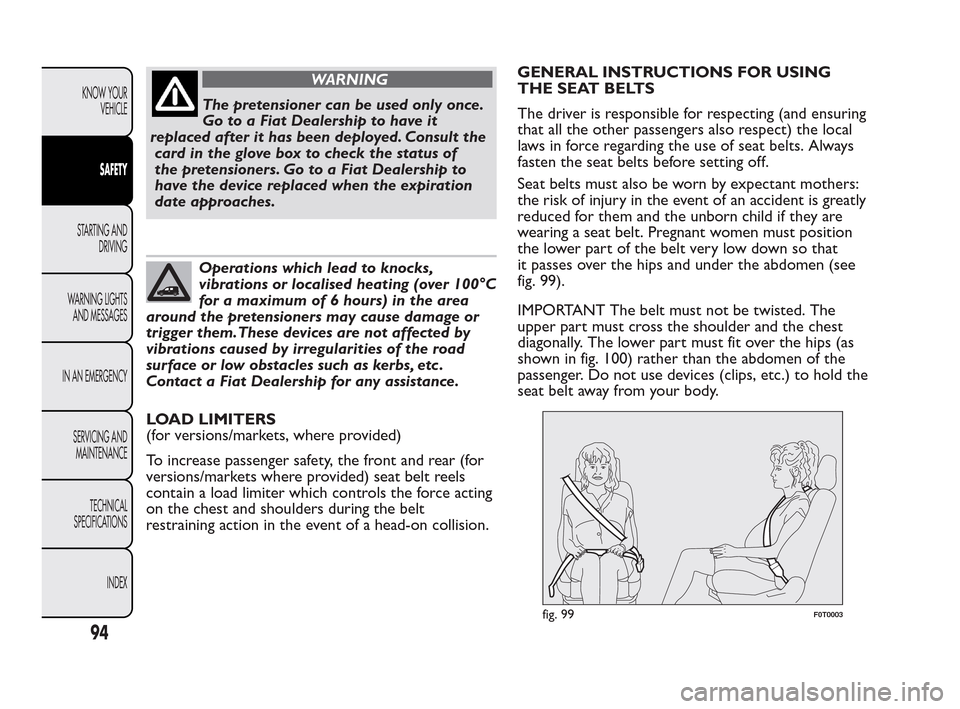
fig. 99).
IMPORTANT The belt must not be twisted. The
upper part must cross the shoulder and the chest
diagonally. The lower part must fit over the hips (as
shown in fig. 100) rather than the abdomen of the
passenger. Do not use devices (clips, etc.) to hold the
seat belt away from your body.
fig. 99F0T0003
94
KNOW YOUR
VEHICLE
SAFETY
STARTING AND
DRIVING
W
ARNING LIGHTS
AND MESSAGES
IN AN EMERGENCY
SERVICING AND
MAINTENANCE
TECHNICAL
SPECIFICATIONS
INDEX
Page 106 of 230
FRONT AIRBAGS
The vehicle is fitted with front airbags for driver and
passenger (for versions/markets where provided).
The front driver/passenger airbags (for versions/
markets, where provided) are designed to protect
the front-seat occupants in the event of head-on
crashes of medium-high severity, by placing the bag
between the occupant and the steering wheel or
dashboard.
Non-activation in other types of crash (side-on
collisions, rear shunts, roll-overs, etc.) is therefore
not a sign of system malfunction.
An electronic control unit causes the bag to inflate, if
necessary, in the event of a head-on crash.
The bag will inflate instantaneously, placing itself
between the front occupant's body and the
structures which could cause injury. It will deflate
immediately afterwards.
Front driver/passenger airbags (for versions/markets,
where provided) are not a replacement for, but
rather a complement to, the seat belts, which should
be worn at all times as specified by law in Europe
and most non-European countries.
In the event of an impact, someone not wearing a
seat belt will move forward and come into contact
with the bag which is still opening. The protection
offered by the bag is reduced in such a case.
Front airbags may not be activated in the following
situations:❒head-on impacts against highly deformable objects
that do not affect the front surface of the vehicle
(e.g. front wing hitting a guard rail);
❒vehicle getting wedged under other vehicles or
protective barriers (e.g. trucks or guard rails);
they could not provide any additional protection
compared with seat belts, so their activation would
not be worthwhile. In these cases, non-deployment
of the airbag does not necessarily indicate a system
malfunction.
WARNING
Do not apply stickers or other objects to
t
he steering wheel, the dashboard in
the passenger side airbag area and the seats.
Do not place objects (e.g. mobile phones) on the
passenger side dashboard because these could
interfere with the correct opening of the airbag
and cause severe injur y to occupants.
The front driver and passenger airbags are designed
and calibrated to best protect front-seat passengers
wearing seat belts. The volume of the front airbags at
maximum inflation fills most of the space between
the steering wheel and the driver and between
the dashboard and the passenger.
The airbags are not deployed in the event of small
head-on collisions (for which the withholding action
of the seat belts is sufficient). Seat belts must always
105
KNOW YOUR
VEHICLE
SAFETY
STARTING AND
DRIVING
W
ARNING LIGHTS
AND MESSAGES
IN AN EMERGENCY
SERVICING AND
MAINTENANCE
TECHNICAL
SPECIFICATIONS
INDEX
Page 107 of 230
be worn. In the event of head-on collisions, they
ensure the correct positioning of the occupant.
FRONT AIRBAG DRIVER'S SIDE
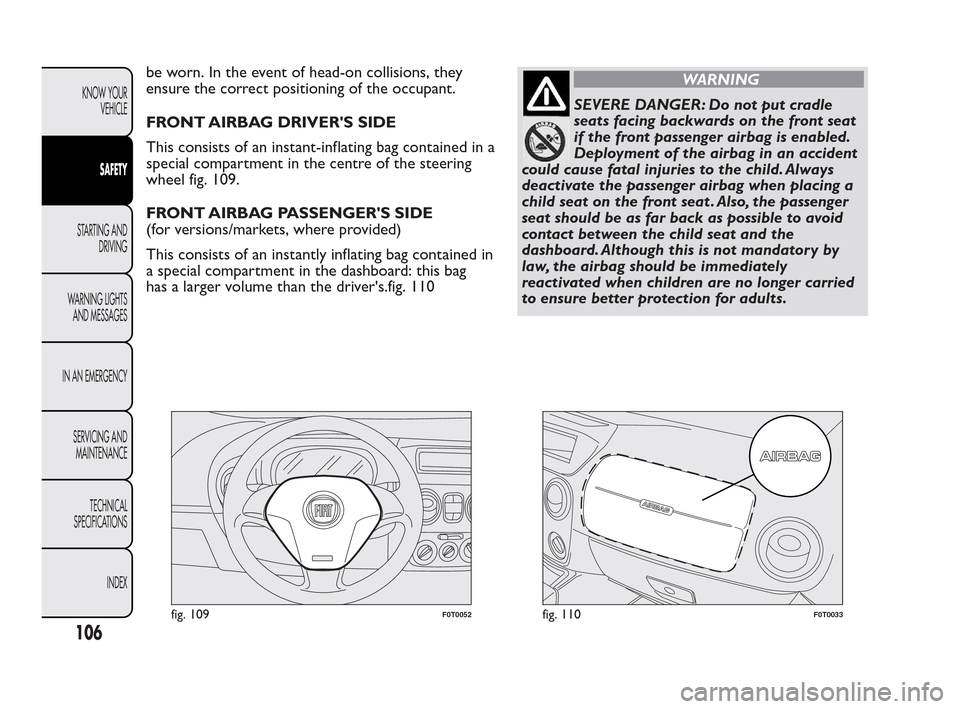
This consists of an instant-inflating bag contained in a
special compartment in the centre of the steering
wheel fig. 109.
FRONT AIRBAG PASSENGER'S SIDE
(for versions/markets, where provided)
This consists of an instantly inflating bag contained in
a special compartment in the dashboard: this bag
has a larger volume than the driver's.fig. 110WARNING
SEVERE DANGER: Do not put cradle
seat
s facing backwards on the front seat
if the front passenger airbag is enabled.
Deployment of the airbag in an accident
could cause fatal injuries to the child. Always
deactivate the passenger airbag when placing a
child seat on the front seat . Also, the passenger
seat should be as far back as possible to avoid
contact between the child seat and the
dashboard. Although this is not mandatory by
law, the airbag should be immediately
reactivated when children are no longer carried
to ensure better protection for adults.
fig. 109F0T0052fig. 110F0T0033
106
KNOW YOUR
VEHICLE
SAFETY
STARTING AND
DRIVING
W
ARNING LIGHTS
AND MESSAGES
IN AN EMERGENCY
SERVICING AND
MAINTENANCE
TECHNICAL
SPECIFICATIONS
INDEX
Page 108 of 230
MANUAL DEACTIVATION OF
PASSENGER'S FRONT AIRBAG AND SIDE
BAG
(for versions/markets, where provided)
Whenever a child needs to be carried on the front
seat, the passenger's front airbag and side bags
(for versions/markets where provided) can be
deactivated.
The warning light
on the instrument panel stays
on until the passenger's front airbag and side bags
(for versions/markets where provided) are
reactivated.
IMPORTANT Refer to "Digital display" and
“Multifunction display” in the “Know your vehicle”
section to manually deactivate the passenger's front
airbag and side bags (for versions/markets, where
provided).
SIDE BAGS
(for versions/markets, where provided)
On some versions, the vehicle may be fitted with
driver and passenger's front side bags.
Side bags protect occupants from side-on crashes of
medium/high severity by placing the bag between
the occupant and the internal parts of the side
structure of the vehicle.
Non-activation of side bags in other types of
collisions (head-on collisions, rear shunts, roll-overs,
etc...) is not an indication of system malfunction.
An electronic control unit causes the bags to inflate
in the event of a side-on collision. The bags inflate
instantaneously, placing themselves between the
occupant's body and the structures which could
cause injury. They deflate immediately afterwards.
Side bags are not a replacement of, but rather a
complement to, seat belts, which you are
recommended to wear at all times, as specified by
law in Europe and most non-European countries.
For this reason, the seat belt must be worn at all
times. In the case of side-on collisions, the seat belts
hold occupants in the correct position and prevent
them from being thrown out of the car by a very
violent collision.
107
KNOW YOUR
VEHICLE
SAFETY
STARTING AND
DRIVING
W
ARNING LIGHTS
AND MESSAGES
IN AN EMERGENCY
SERVICING AND
MAINTENANCE
TECHNICAL
SPECIFICATIONS
INDEX
Page 113 of 230
IMPORTANT With the engine cold, the accelerator
pedal must be fully released when you turn the
ignition key to AVV.
If the engine does not start at the first attempt,
return the ignition key to STOP before repeating the
procedure.
If the
warning light stays on when the ignition key
is at MAR, turn the key to STOP and then back to
MAR; if the warning light remains on, try with the
other keys provided with the car.
Contact a Fiat Dealership if the engine still does not
start.
Warning lightwill blink for 60
seconds after starting or during prolonged
cranking to indicate a fault to the glow
plug heating system. Use the vehicle normally if
the engine starts, but go to a Fiat Dealership
as soon as possible.
HOW TO WARM UP THE ENGINE AFTER IT
HAS JUST STARTED
Proceed as follows:
❒drive off slowly, letting the engine turn at medium
revs. Do not accelerate abruptly;
❒do not demand to performance for the first few
kilometres. Wait until the engine coolant gauge
starts moving.EMERGENCY STARTING
Go to a Fiat Dealership immediately if warning light
comes on steady on the instrument panel.
Never jump start the engine by pushing,
towing or driving downhill.This could
cause fuel to flow into the catalytic
converter and damage it beyond repair.
STOPPING THE ENGINE
Turn the ignition key to STOP while the engine is
idling.
IMPORTANT After a long drive, you should allow
the engine to “catch its breath” before turning it off
by letting it idle to allow the temperature in the
engine compartment to fall.
A quick burst on the accelerator before
turning off the engine serves absolutely no
practical purpose; it wastes fuel and is
especially damaging to turbocharged engines.
112
KNOW YOUR
VEHICLE
SAFETY
STARTING AND
DRIVING
WARNING LIGHTS
AND
MESSAGES
IN AN EMERGENCY
SERVICING AND
MAINTENANCE
TECHNICAL
SPECIFICATIONS
INDEX
Page 116 of 230
USING THE GEARBOX
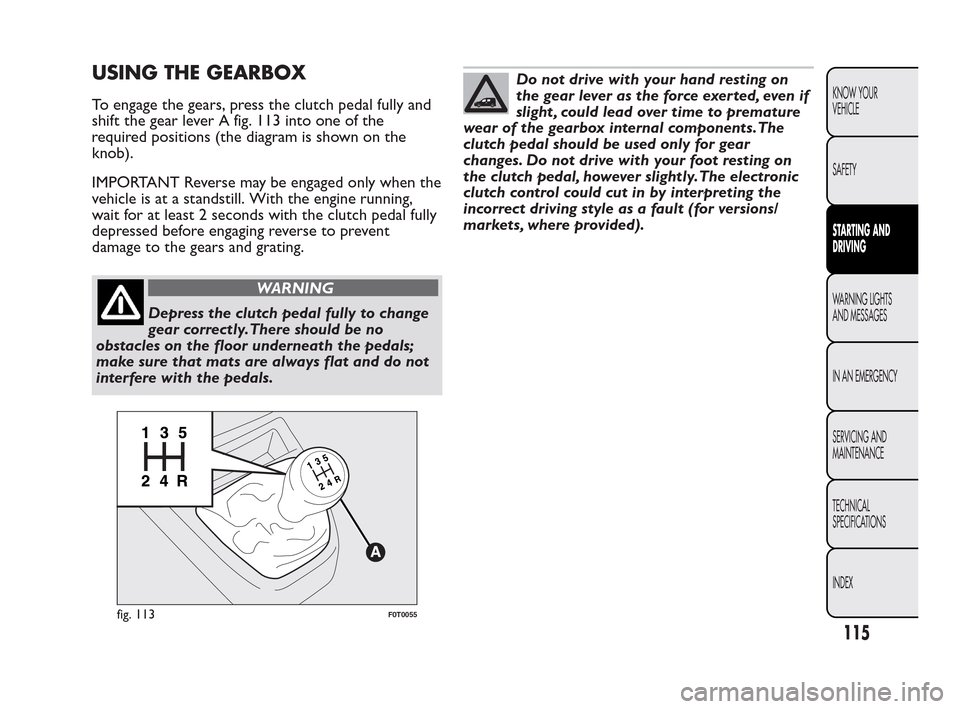
To engage the gears, press the clutch pedal fully and
shift the gear lever A fig. 113 into one of the
required positions (the diagram is shown on the
knob).
IMPORTANT Reverse may be engaged only when the
vehicle is at a standstill. With the engine running,
wait for at least 2 seconds with the clutch pedal fully
depressed before engaging reverse to prevent
damage to the gears and grating.
WARNING
Depress the clutch pedal fully to change
gear
correctly.There should be no
obstacles on the floor underneath the pedals;
make sure that mats are always flat and do not
interfere with the pedals.
Do not drive with your hand resting on
the gear lever as the force exerted, even if
slight , could lead over time to premature
wear of the gearbox internal components.The
clutch pedal should be used only for gear
changes. Do not drive with your foot resting on
the clutch pedal, however slightly.The electronic
clutch control could cut in by interpreting the
incorrect driving style as a fault (for versions/
markets, where provided).
fig. 113F0T0055
115
KNOW YOUR
VEHICLE
SAFETY
STARTING AND
DRIVING
WARNING LIGHTS
AND
MESSAGES
IN AN EMERGENCY
SERVICING AND
MAINTENANCE
TECHNICAL
SPECIFICATIONS
INDEX
Page 120 of 230
SNOW CHAINS
The use of snow chains should be in compliance with
local regulations.
Snow chains may be fitted only to the front wheel
tyres (drive wheels).
Check the tension of the chains after the first few
metres have been driven.
Keep your speed down when snow chains
are fitted: do not exceed 50 km/h. Avoid
potholes, steps and pavements and also
avoid driving for long distances on roads not
covered with snow to avoid damaging the car and
the road surface.
PROLONGED VEHICLE INACTIVITY
If the vehicle needs to be off the road for longer than
one month, the following precautions must be
taken:
❒park the vehicle indoors in a dry and, if possible,
well-ventilated place;
❒engage a gear and check that the handbrake is not
on;
❒disconnect the battery negative terminal and check
the charge (see “Battery” in the “Maintenance and
care”);
❒clean and protect the painted parts using
protective wax;
❒clean and protect the shiny metal parts using
special compounds readily available;
❒sprinkle talcum powder on the rubber windscreen
and rear window wiper blades and lift them off the
glass;
❒slightly open the windows;
❒cover the vehicle with a piece of fabric or
perforated plastic sheet. Do not use compact
plastic tarpaulins, which prevent humidity from
evaporating from the surface of the vehicle;
❒inflate tyres to +0.5 bar above the normal specified
pressure and check it at intervals;
❒do not drain the engine cooling system.
119
KNOW YOUR
VEHICLE
SAFETY
STARTING AND
DRIVING
WARNING LIGHTS
AND
MESSAGES
IN AN EMERGENCY
SERVICING AND
MAINTENANCE
TECHNICAL
SPECIFICATIONS
INDEX
Page 124 of 230
ABS SYSTEM FAULT (amber)
When the ignition key is turned to MAR, the warning
light turns on but should go off after a few seconds.
The warning light comes on when the system is
either not working properly or not available. In this
case the braking system maintains its own unaltered
efficiency but without the advantage of the ABS
system. Drive carefully and go to a Fiat Dealership as
soon as possible.
A specific message is displayed on certain versions.
EBD FAULT (red/amber)
Simultaneous lighting of warning lights
and
with the engine running indicates an EBD system
fault or that the system is not available. In this case,
the rear wheels may suddenly lock and the vehicle
may swerve when braking sharply. Drive very
carefully to a Fiat Dealership to have the system
inspected immediately.
A specific message is displayed on certain versions.
ESP/TRACTION PLUS SYSTEM
FAULT (amber)
When the ignition key is turned to MAR, the warning
light turns on but should go off after a few seconds.
If the warning light does not go off, or stays on
together with the LED on the ASR OFF button when
travelling, contact a Fiat Dealership.
A specific message is displayed on certain versions.
NoteFlashing of the warning light while driving
indicates the action of the ESP system.
LOW ENGINE OIL PRESSURE (red)
When the ignition key is turned to MAR, the warning
light switches on, but it should go out as soon as
the engine is started.
The warning light turns on and stays on constantly
(in versions/markets, where provided) along with the
message on the display when the system detects
that engine oil pressure is low.
123
KNOW YOUR
VEHICLE
SAFETY
STARTING AND
DRIVING
WARNING LIGHTS
AND
MESSAGES
IN AN EMERGENCY
SERVICING
AND
MAINTENANCE
TECHNICAL
SPECIFICATIONS
INDEX