Door FIAT QUBO 2010 1.G Owner's Guide
[x] Cancel search | Manufacturer: FIAT, Model Year: 2010, Model line: QUBO, Model: FIAT QUBO 2010 1.GPages: 230, PDF Size: 4.38 MB
Page 112 of 230
STARTING AND DRIVING
STARTING THE ENGINE
The vehicle is fitted with an immobiliser: if the engine
fails to start, see the paragraph on “The Fiat CODE
system” in the “Knowing your vehicle” section.
The engine may be noisier during the first few
seconds of operation, particularly after a long period
of inactivity. This is due to the hydraulic tappets,
the timing system chosen for petrol engine versions
to reduce the number of servicing interventions,
and affects neither functionality nor reliability.
It is advisable not to demand maximum
performance from your vehicle (e.g.
excessive acceleration, long distances at
high speeds, excessive intense braking, etc .) during
the initial period of use.
When the engine is switched off never
leave the key on (at MAR) to prevent
unnecessary consumption and draining
the battery.
WARNING
It is dangerous to have the engine
runnin
g indoors.The engine takes in
oxygen and discharges carbon dioxide, carbon
monoxide and other toxic gases.
WARNING
Remember that the brake booster and
elect
ric power steering are not
operational until the engine has been started,
so you need to apply much more force than
usual to the brake pedal and steering wheel.
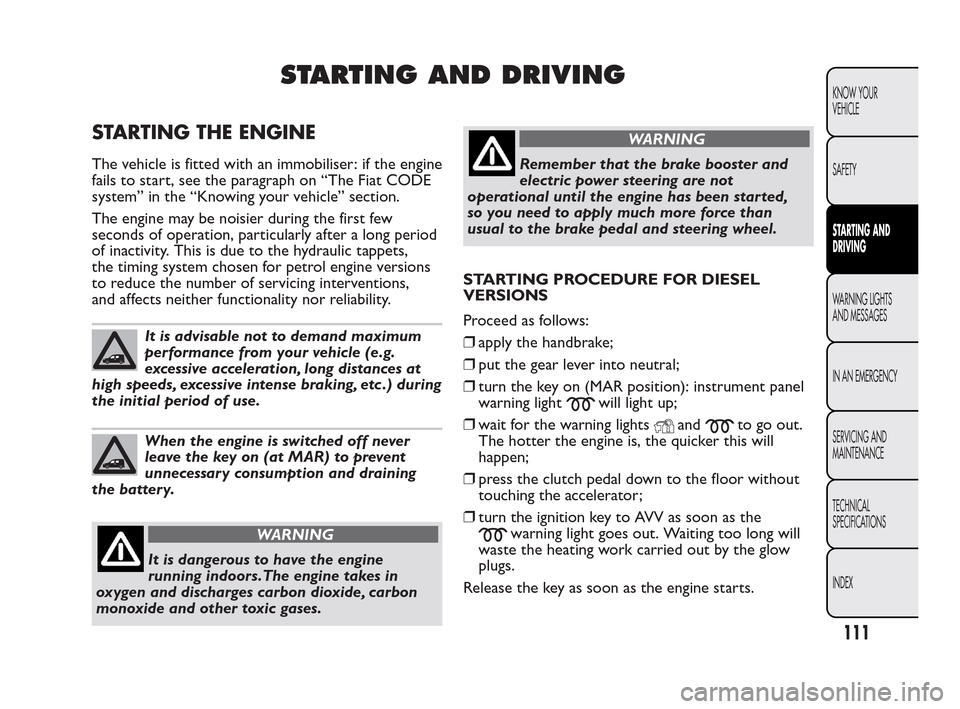
STARTING PROCEDURE FOR DIESEL
VERSIONS
Proceed as follows:
❒apply the handbrake;
❒put the gear lever into neutral;
❒turn the key on (MAR position): instrument panel
warning light
will light up;
❒wait for the warning lights
andto go out.
The hotter the engine is, the quicker this will
happen;
❒press the clutch pedal down to the floor without
touching the accelerator;
❒turn the ignition key to AVV as soon as the
warning light goes out. Waiting too long will
waste the heating work carried out by the glow
plugs.
Release the key as soon as the engine starts.
111
KNOW YOUR
VEHICLE
SAFETY
STARTING AND
DRIVING
WARNING LIGHTS
AND
MESSAGES
IN AN EMERGENCY
SERVICING AND
MAINTENANCE
TECHNICAL
SPECIFICATIONS
INDEX
Page 120 of 230
SNOW CHAINS
The use of snow chains should be in compliance with
local regulations.
Snow chains may be fitted only to the front wheel
tyres (drive wheels).
Check the tension of the chains after the first few
metres have been driven.
Keep your speed down when snow chains
are fitted: do not exceed 50 km/h. Avoid
potholes, steps and pavements and also
avoid driving for long distances on roads not
covered with snow to avoid damaging the car and
the road surface.
PROLONGED VEHICLE INACTIVITY
If the vehicle needs to be off the road for longer than
one month, the following precautions must be
taken:
❒park the vehicle indoors in a dry and, if possible,
well-ventilated place;
❒engage a gear and check that the handbrake is not
on;
❒disconnect the battery negative terminal and check
the charge (see “Battery” in the “Maintenance and
care”);
❒clean and protect the painted parts using
protective wax;
❒clean and protect the shiny metal parts using
special compounds readily available;
❒sprinkle talcum powder on the rubber windscreen
and rear window wiper blades and lift them off the
glass;
❒slightly open the windows;
❒cover the vehicle with a piece of fabric or
perforated plastic sheet. Do not use compact
plastic tarpaulins, which prevent humidity from
evaporating from the surface of the vehicle;
❒inflate tyres to +0.5 bar above the normal specified
pressure and check it at intervals;
❒do not drain the engine cooling system.
119
KNOW YOUR
VEHICLE
SAFETY
STARTING AND
DRIVING
WARNING LIGHTS
AND
MESSAGES
IN AN EMERGENCY
SERVICING AND
MAINTENANCE
TECHNICAL
SPECIFICATIONS
INDEX
Page 125 of 230
WARNING
If the warning lightturns on when
the car is travelling (on certain versions
together with the message on the display) stop
the engine immediately and contact a Fiat
Dealership.
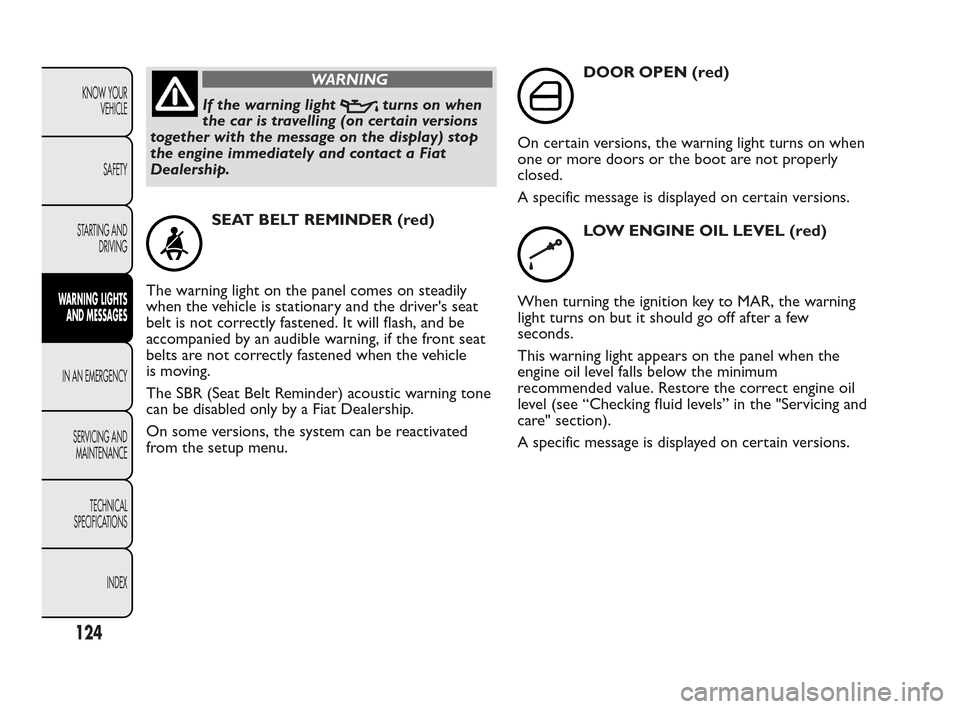
SEAT BELT REMINDER (red)
The warning light on the panel comes on steadily
when the vehicle is stationary and the driver's seat
belt is not correctly fastened. It will flash, and be
accompanied by an audible warning, if the front seat
belts are not correctly fastened when the vehicle
is moving.
The SBR (Seat Belt Reminder) acoustic warning tone
can be disabled only by a Fiat Dealership.
On some versions, the system can be reactivated
from the setup menu.
DOOR OPEN (red)
On certain versions, the warning light turns on when
one or more doors or the boot are not properly
closed.
A specific message is displayed on certain versions.
LOW ENGINE OIL LEVEL (red)
When turning the ignition key to MAR, the warning
light turns on but it should go off after a few
seconds.
This warning light appears on the panel when the
engine oil level falls below the minimum
recommended value. Restore the correct engine oil
level (see “Checking fluid levels” in the "Servicing and
care" section).
A specific message is displayed on certain versions.
124
KNOW YOUR
VEHICLE
SAFETY
STARTING AND
DRIVING
WARNING LIGHTS
AND
MESSAGES
IN AN EMERGENCY
SERVICING
AND
MAINTENANCE
TECHNICAL
SPECIFICATIONS
INDEX
Page 149 of 230
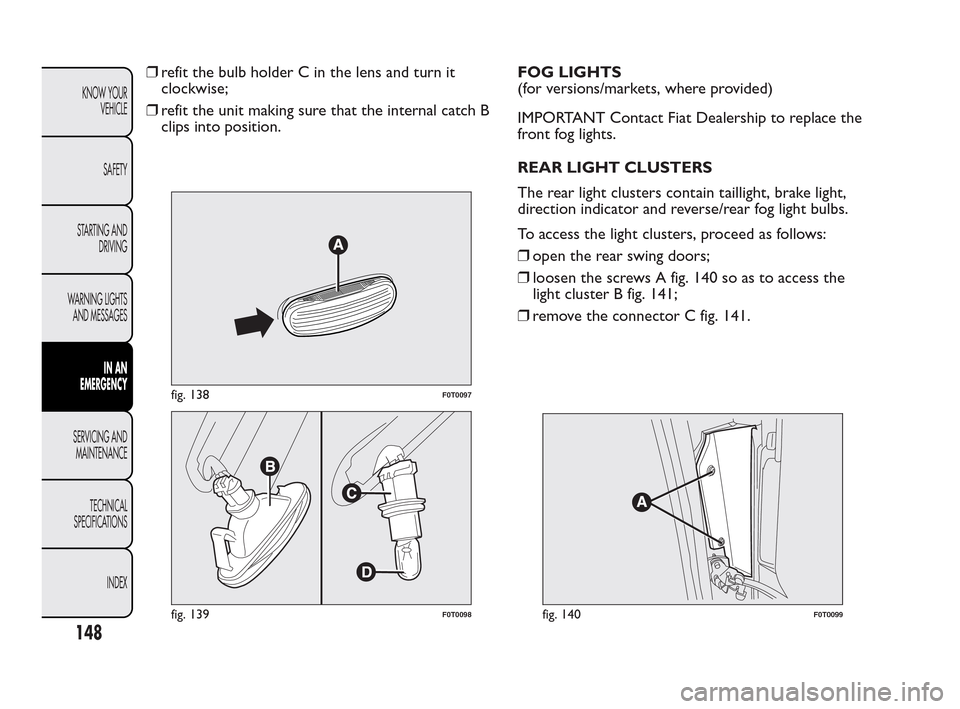
❒refit the bulb holder C in the lens and turn it
clockwise;
❒refit the unit making sure that the internal catch B
clips into position.FOG LIGHTS
(for versions/markets, where provided)
IMPORTANT Contact Fiat Dealership to replace the
front fog lights.
REAR LIGHT CLUSTERS
The rear light clusters contain taillight, brake light,
direction indicator and reverse/rear fog light bulbs.
To access the light clusters, proceed as follows:
❒open the rear swing doors;
❒loosen the screws A fig. 140 so as to access the
light cluster B fig. 141;
❒remove the connector C fig. 141.
fig. 138F0T0097
fig. 139F0T0098fig. 140F0T0099
148
KNOW YOUR
VEHICLE
SAFETY
STARTING AND
DRIVING
WARNING LIGHTS
AND MESSAGES
IN AN
EMERGENCY
SERVICING AND
MAINTENANCE
TECHNICAL
SPECIFICA
TIONS
INDEX
Page 162 of 230
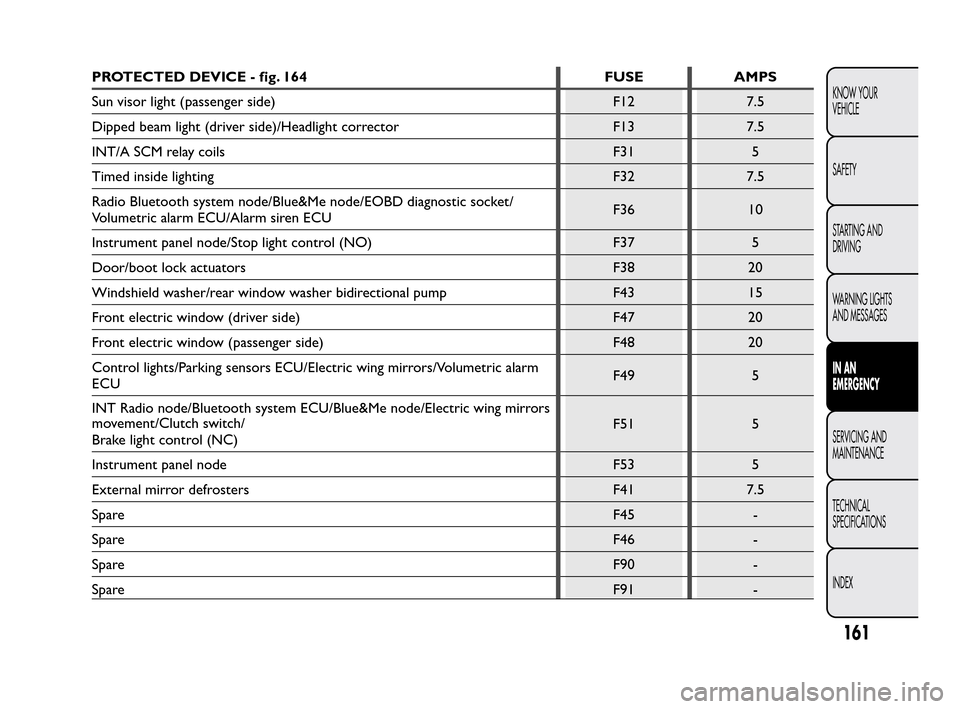
PROTECTED DEVICE - fig. 164 FUSE AMPS
Sun visor light (passenger side) F12 7.5
Dipped beam light (driver side)/Headlight corrector F13 7.5
INT/A SCM relay coils F31 5
Timed inside lighting F32 7.5
Radio Bluetooth system node/Blue&Me node/EOBD diagnostic socket/
Volumetric alarm ECU/Alarm siren ECUF36 10
Instrument panel node/Stop light control (NO) F37 5
Door/boot lock actuators F38 20
Windshield washer/rear window washer bidirectional pump F43 15
Front electric window (driver side) F47 20
Front electric window (passenger side) F48 20
Control lights/Parking sensors ECU/Electric wing mirrors/Volumetric alarm
ECUF49 5
INT Radio node/Bluetooth system ECU/Blue&Me node/Electric wing mirrors
movement/Clutch switch/
Brake light control (NC)F51 5
Instrument panel node F53 5
External mirror defrosters F41 7.5
SpareF45 -
SpareF46 -
SpareF90 -
SpareF91 -
161
KNOW YOUR
VEHICLE
SAFETY
STARTING AND
DRIVING
WARNING LIGHTS
AND MESSAGES
IN AN
EMERGENCY
SERVICING AND
MAINTENANCE
TECHNICAL
SPECIFICA
TIONS
INDEX
Page 170 of 230
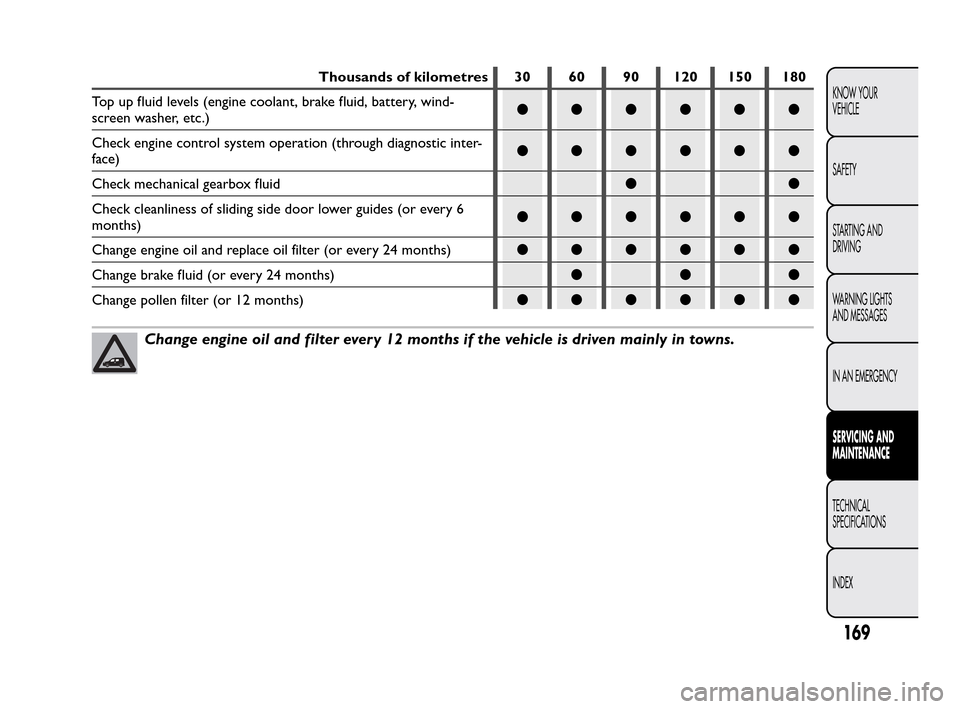
Thousands of kilometres 30 60 90 120 150 180
Top up fluid levels (engine coolant, brake fluid, battery, wind-
screen washer, etc.)●●●●●●
Check engine control system operation (through diagnostic inter-
face)●●●●●●
Check mechanical gearbox fluid●●
Check cleanliness of sliding side door lower guides (or every 6
months)●●●●●●
Change engine oil and replace oil filter (or every 24 months)●●●●●●
Change brake fluid (or every 24 months)●●●
Change pollen filter (or 12 months)●●●●●●
Change engine oil and filter every 12 months if the vehicle is driven mainly in towns.
169
KNOW YOUR
VEHICLE
SAFETY
STARTING AND
DRIVING
WARNING LIGHTS
AND MESSAGES
IN AN EMERGENCY
SERVICING AND
MAINTENANCE
TECHNICAL
SPECIFICA
TIONS
INDEX
Page 171 of 230
REGULAR CHECKS
Every 1,000 km or before long journeys, check and, if
necessary, top up:
❒engine coolant level;
❒brake fluid level;
❒windscreen washer fluid level;
❒tyre inflation pressure and condition;
❒operation of lighting system (headlamps, direction
indicators, hazard warning lights, etc.);
❒operation of screen wash/wipe system and
positioning/wear of windscreen/rear window wiper
blades.
Check and top up, if required, the engine oil level
every 3,000 km.
You are recommended to use PETRONAS
LUBRICANTS products, which have been designed
and produced specifically for Fiat vehicles (see
“Capacities” table in the “Technical specifications”
section).
HEAVY USAGE OF THE VEHICLE
Should prevailing use of the vehicle be under one of
the following specially heavy conditions:
❒towing a trailer or caravan;
❒dusty roads;
❒short, repeated journeys (less than 7-8 km) at
sub-zero outside temperatures;
❒engine often idling, or driving long distances at low
speed (e.g. door to door deliveries) or long period
of idleness;
❒urban trips;
perform the following inspections more frequently
than shown on the Scheduled Servicing Plan:
❒check front disc brake pad condition and wear;
❒check cleanliness of bonnet and boot locks,
cleanliness and lubrication of linkage;
❒visually inspect the conditions of: engine, gearbox,
transmission, pipes and tubes (exhaust - fuel -
brakes), rubber parts (boots, sleeves, bushes, etc.);
❒check battery charge status and fluid (electrolyte)
level (refer to "Battery - Check state of charge
and electrolyte level" paragraph in this chapter);
❒visually inspect condition of the auxiliary drive
belts;
170
KNOW YOUR
VEHICLE
SAFETY
STARTING AND
DRIVING
WARNING LIGHTS
AND MESSAGES
IN AN EMERGENCY
SERVICING AND
MAINTENANCE
TECHNICAL
SPECIFICA
TIONS
INDEX
Page 180 of 230
USEFUL ADVICE FOR EXTENDING THE
LIFE OF YOUR BATTERY
To avoid draining your battery and make it last
longer, follow these instructions closely:
❒when you park the vehicle, ensure the doors, boot
and bonnet are closed properly so that the ceiling
lights do not stay on;
❒turn off the ceiling lights, although the car does
have an automatic system for switching off internal
lights;
❒do not keep accessories (e.g. sound system, hazard
lights, etc.) switched on for a long time when the
engine is not running;
❒before performing any operation on the electrical
system, disconnect the battery negative cable;
❒make sure that battery terminals are always be
perfectly tight.
IMPORTANT If the battery remains with the charge
below 50% for a long time it becomes damaged
through sulphation and its starting capacity is
reduced.
The battery is also more prone to the risk of freezing
(at temperatures as high as -10°C).
Refer to the paragraph "Vehicle inactivity" in "Starting
and driving" if the vehicle is left parked for a long
time.
If, after buying the vehicle, you want to install
electric accessories which require permanent electric
supply (alarm, etc.) contact the Fiat Dealershipwhose qualified personnel, in addition to suggesting
the most suitable devices, will evaluate the overall
electric absorption, checking whether the vehicle
electric system is capable of withstanding the load
required, or whether it should be integrated with
a more powerful battery.
Since these devices continue to use electricity even
when the engine is off, they gradually run down
the battery.
179
KNOW YOUR
VEHICLE
SAFETY
STARTING AND
DRIVING
WARNING LIGHTS
AND MESSAGES
IN AN EMERGENCY
SERVICING AND
MAINTENANCE
TECHNICAL
SPECIFICA
TIONS
INDEX
Page 185 of 230
BODY
PROTECTION FROM ATMOSPHERIC
ELEMENTS
The main causes of corrosion are the following:
❒atmospheric pollution
❒salty air and humidity (coastal areas, or hot humid
climates)
❒seasonal environment conditions.
The abrasive action of wind-borne atmospheric dust
and sand, as well as mud and gravel raised by other
cars is also not to be underestimated.
Fiat used the best manufacturing technologies on
your vehicle to effectively protect the bodywork
against corrosion.
These are the most important:
❒painting products and systems which give the
vehicle particular resistance to corrosion and
abrasion;
❒use of galvanised (or pre-treated) steel sheets,
with high resistance to corrosion;
❒spraying the underbody, engine compartment,
wheelhouse internal parts and other parts with
highly protective wax products;❒spraying of plastic materials for protective
purposes in the most exposed points: under the
doors, inside the mudguard, along the edges, etc.
❒use of “open” boxed sections to prevent
condensation and pockets of moisture from
triggering rust inside.
VEHICLE BODY AND UNDERBODY
WARRANTY
Your vehicle is covered by warranty against
perforation due to rust of any original element of the
structure or body.
For the general terms of this warranty, refer to your
Warranty Booklet.
ADVICE FOR PRESERVING THE
BODYWORK
Paint
Paintwork does not only serve an aesthetic purpose,
but also protects the underlying sheet metal.
Touch up abrasions and scratches immediately to
prevent the formation of rust. Use only original paint
products for touch-ups (see “Bodywork paint
identification plate” in the “Technical specifications”
section).
Normal care for paintwork consists of washing the
car; how often depends on the conditions and
environment where the car is used.
184
KNOW YOUR
VEHICLE
SAFETY
STARTING AND
DRIVING
WARNING LIGHTS
AND MESSAGES
IN AN EMERGENCY
SERVICING AND
MAINTENANCE
TECHNICAL
SPECIFICA
TIONS
INDEX
Page 186 of 230
For example, it is advisable to wash the vehicle more
often in areas with high atmospheric pollution or if
you are travelling on roads sprinkled with salt.
To wash the vehicle properly, proceed as follows:
❒wash the body using a low pressure jet of water;
❒wipe a sponge with a slightly soapy solution over
the bodywork, frequently rinsing with the sponge;
❒rinse well with water and dry with a jet of air or a
chamois leather.
If you put the vehicle through a car
wash, take heed of the following:
❒remove the antenna from the roof so it does not
get damaged;
❒the car wash should use water added to a soapy
solution;
❒rinse thoroughly to avoid soap marks staying on
the bodywork or less visible parts.
Some car washes with old-style blades
and/or in a poor state of repair can
damage the paintwork, facilitating the
formation of lines that give the paint a dull/misty
appearance, especially on dark colours. If this
happens, lightly polish the paintwork with
appropriate products.
Dry the less visible parts particularly carefully, such
as the door frames, bonnet and the headlight frames,
where water may stagnate more easily. It is a good
idea to leave the vehicle outdoors for a while after
washing it to give water time to evaporate.Do not wash the vehicle after it has been left in the
sun or with the bonnet hot: this may alter the shine
of the paintwork.
Exterior plastic parts should be cleaned in the same
way as the rest of the vehicle. Where possible, do
not park the vehicle under trees; the resinous
substances released by many species give the paint a
dull appearance and increase the possibility of rust.
IMPORTANT Bird droppings should be washed
off immediately and thoroughly as the acid
they contain is particularly aggressive.
Detergents cause water pollution.The
vehicle should be washed in areas
equipped for collecting and purifying the
liquid used in the washing process.
Windows
Use specific detergents to clean the windows. Also
use clean cloths to avoid scratching the glass or
altering the transparency.
IMPORTANT Wipe the rear window gently with a
cloth in the direction of the filaments to avoid
damaging the heating device.
Engine compartment
At the end of each winter, thoroughly wash the
engine compartment, taking care to avoid spraying
the water jet directly onto the electronic control
185
KNOW YOUR
VEHICLE
SAFETY
STARTING AND
DRIVING
WARNING LIGHTS
AND MESSAGES
IN AN EMERGENCY
SERVICING AND
MAINTENANCE
TECHNICAL
SPECIFICA
TIONS
INDEX