MAR FIAT QUBO 2010 1.G Manual Online
[x] Cancel search | Manufacturer: FIAT, Model Year: 2010, Model line: QUBO, Model: FIAT QUBO 2010 1.GPages: 230, PDF Size: 4.38 MB
Page 183 of 230
WINDSCREEN/REAR WINDOW
WIPERS
(for versions/markets, where provided)
BLADES
Regularly clean the rubber part using appropriate
products; TUTELA PROFESSIONAL SC 35 is
recommended.
Replace the blades if the rubber edge is misshapen or
worn. In any event, it is advisable to replace them
approximately once a year.
A few simple precautions can reduce the possibility
of damage to the blades:
❒make sure that the rubber part is not stuck to the
windscreen at sub-zero temperatures. Use an
antifreeze product to release it if required;
❒remove any snow from the glass: in addition to
protecting the blades, this prevents the electric
motor from overheating;
❒do not operate the windscreen and rear window
wipers on dry glass.
WARNING
Driving with worn wiper blades is a
ser
ious hazard, because visibility is
reduced in bad weather.Replacing the windscreen wiper blades
Proceed as follows:
❒lift up the windscreen wiper arm and position the
blade so that it forms a 90° angle with the arm;
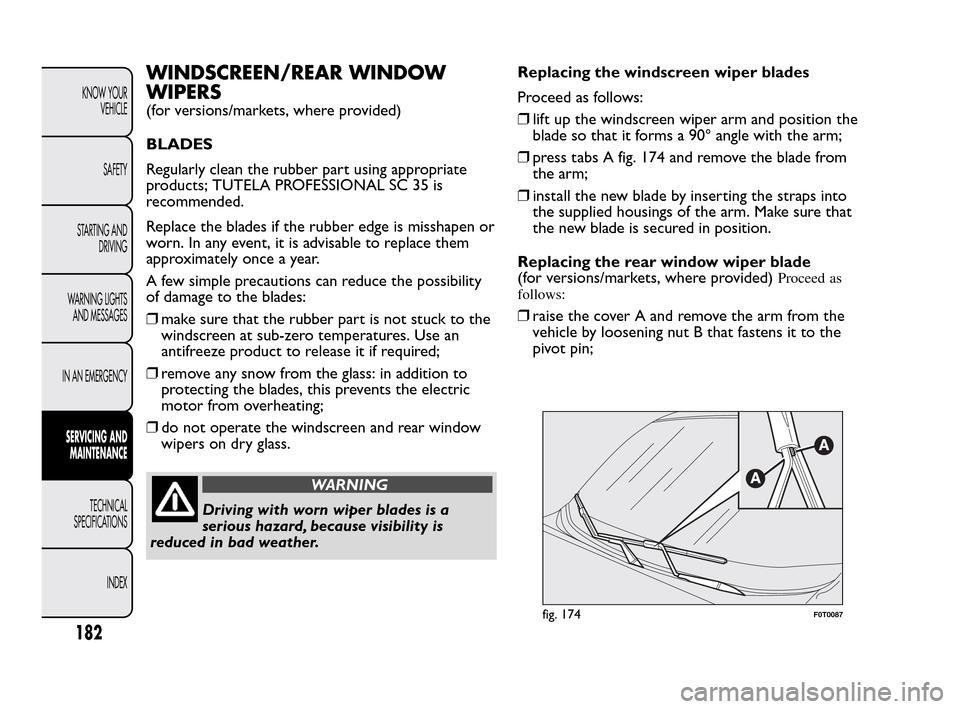
❒press tabs A fig. 174 and remove the blade from
the arm;
❒install the new blade by inserting the straps into
the supplied housings of the arm. Make sure that
the new blade is secured in position.
Replacing the rear window wiper blade
(for versions/markets, where provided)
Proceed as
follows:
❒raise the cover A and remove the arm from the
vehicle by loosening nut B that fastens it to the
pivot pin;
fig. 174F0T0087
182
KNOW YOUR
VEHICLE
SAFETY
STARTING AND
DRIVING
WARNING LIGHTS
AND MESSAGES
IN AN EMERGENCY
SERVICING AND
MAINTENANCE
TECHNICAL
SPECIFICA
TIONS
INDEX
Page 184 of 230
❒correctly position the new arm and tighten the nut
fully;
❒lower the cover.
SPRAY NOZZLES
If the jet is not coming out, firstly check that there is
fluid in the windscreen/rear window reservoir (for
versions/markets where provided) (see “Checking
levels” in this section).
Then check that the nozzle holes are not clogged;
use a needle to unblock them if necessary.
Windscreen (washer)
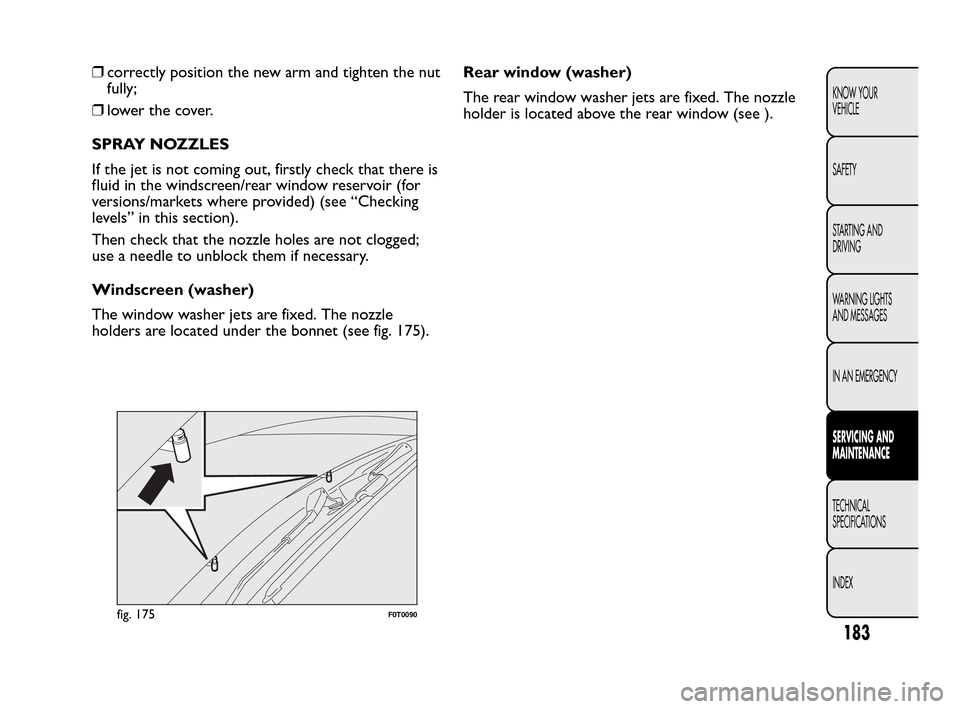
The window washer jets are fixed. The nozzle
holders are located under the bonnet (see fig. 175).Rear window (washer)
The rear window washer jets are fixed. The nozzle
holder is located above the rear window (see ).
fig. 175F0T0090
183
KNOW YOUR
VEHICLE
SAFETY
STARTING AND
DRIVING
WARNING LIGHTS
AND MESSAGES
IN AN EMERGENCY
SERVICING AND
MAINTENANCE
TECHNICAL
SPECIFICA
TIONS
INDEX
Page 186 of 230
For example, it is advisable to wash the vehicle more
often in areas with high atmospheric pollution or if
you are travelling on roads sprinkled with salt.
To wash the vehicle properly, proceed as follows:
❒wash the body using a low pressure jet of water;
❒wipe a sponge with a slightly soapy solution over
the bodywork, frequently rinsing with the sponge;
❒rinse well with water and dry with a jet of air or a
chamois leather.
If you put the vehicle through a car
wash, take heed of the following:
❒remove the antenna from the roof so it does not
get damaged;
❒the car wash should use water added to a soapy
solution;
❒rinse thoroughly to avoid soap marks staying on
the bodywork or less visible parts.
Some car washes with old-style blades
and/or in a poor state of repair can
damage the paintwork, facilitating the
formation of lines that give the paint a dull/misty
appearance, especially on dark colours. If this
happens, lightly polish the paintwork with
appropriate products.
Dry the less visible parts particularly carefully, such
as the door frames, bonnet and the headlight frames,
where water may stagnate more easily. It is a good
idea to leave the vehicle outdoors for a while after
washing it to give water time to evaporate.Do not wash the vehicle after it has been left in the
sun or with the bonnet hot: this may alter the shine
of the paintwork.
Exterior plastic parts should be cleaned in the same
way as the rest of the vehicle. Where possible, do
not park the vehicle under trees; the resinous
substances released by many species give the paint a
dull appearance and increase the possibility of rust.
IMPORTANT Bird droppings should be washed
off immediately and thoroughly as the acid
they contain is particularly aggressive.
Detergents cause water pollution.The
vehicle should be washed in areas
equipped for collecting and purifying the
liquid used in the washing process.
Windows
Use specific detergents to clean the windows. Also
use clean cloths to avoid scratching the glass or
altering the transparency.
IMPORTANT Wipe the rear window gently with a
cloth in the direction of the filaments to avoid
damaging the heating device.
Engine compartment
At the end of each winter, thoroughly wash the
engine compartment, taking care to avoid spraying
the water jet directly onto the electronic control
185
KNOW YOUR
VEHICLE
SAFETY
STARTING AND
DRIVING
WARNING LIGHTS
AND MESSAGES
IN AN EMERGENCY
SERVICING AND
MAINTENANCE
TECHNICAL
SPECIFICA
TIONS
INDEX
Page 188 of 230
PLASTIC PARTS
It is advisable to clean interior plastic parts with a
damp cloth and a solution of water and non-abrasive
mild soap. To remove grease and tough stains, use
products designed specifically for cleaning plastics.
These have no solvents and have been designed
so that they do not alter the appearance and colour
of the components.
IMPORTANT Never use spirits or petroleum to
clean the instrument panel glass.REAL LEATHER STEERING WHEEL/GEAR
LEVER KNOB/HANDBRAKE
(for versions/markets, where provided)
These components must be cleaned with mild soap
and water only. Never use alcohol or alcohol-based
products.
Read the product label carefully before using specific
products for cleaning the interiors: make sure the
product does not contain spirits or alcohol-based
substances.
If, when cleaning the windscreen with special
products, window cleaner accidentally drips onto the
leather of the steering wheel/gear lever knob/hand
brake, wipe away immediately and then wash the
affected area with mild soap and water.
IMPORTANT Be careful when installing a steering
wheel locking device not to damage the leather
upholstery.
187
KNOW YOUR
VEHICLE
SAFETY
STARTING AND
DRIVING
WARNING LIGHTS
AND MESSAGES
IN AN EMERGENCY
SERVICING AND
MAINTENANCE
TECHNICAL
SPECIFICA
TIONS
INDEX
Page 189 of 230
TECHNICAL SPECIFICATIONS
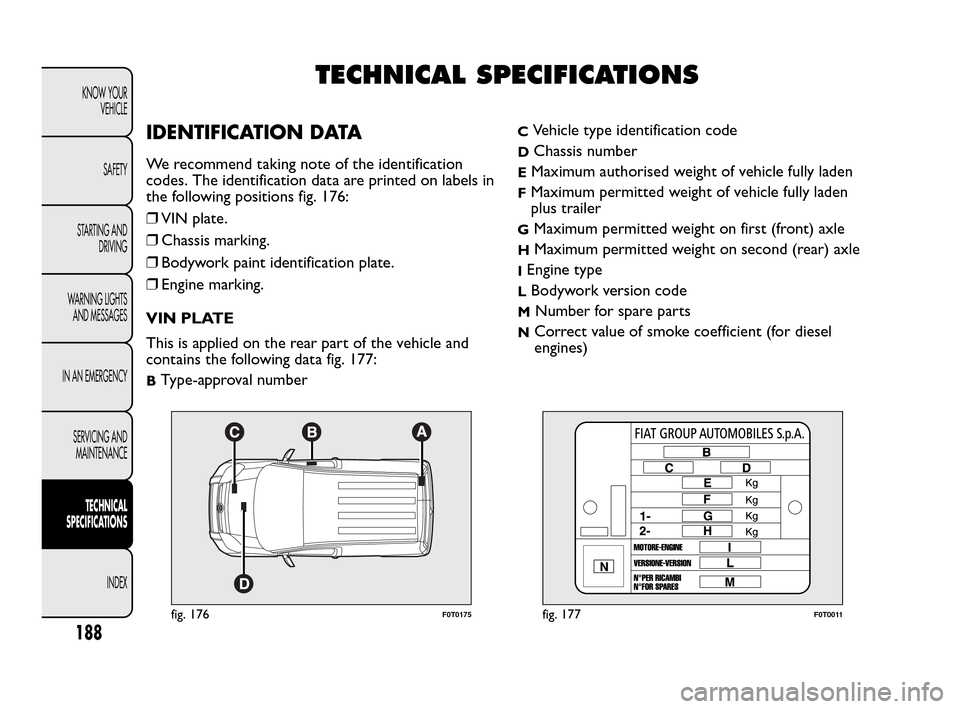
IDENTIFICATION DATA
We recommend taking note of the identification
codes. The identification data are printed on labels in
the following positions fig. 176:
❒VIN plate.
❒Chassis marking.
❒Bodywork paint identification plate.
❒Engine marking.
VIN PLATE
This is applied on the rear part of the vehicle and
contains the following data fig. 177:
BType-approval number
CVehicle type identification code
DChassis number
EMaximum authorised weight of vehicle fully laden
FMaximum permitted weight of vehicle fully laden
plus trailer
GMaximum permitted weight on first (front) axle
HMaximum permitted weight on second (rear) axle
IEngine type
LBodywork version code
MNumber for spare parts
NCorrect value of smoke coefficient (for diesel
engines)
fig. 176F0T0175fig. 177F0T0011
188
KNOW YOUR
VEHICLE
SAFETY
STARTING AND
DRIVING
WARNING LIGHTS
AND MESSAGES
IN AN EMERGENCY
SERVICING AND
MAINTENANCE
TECHNICAL
SPECIFICA
TIONS
INDEX
Page 190 of 230
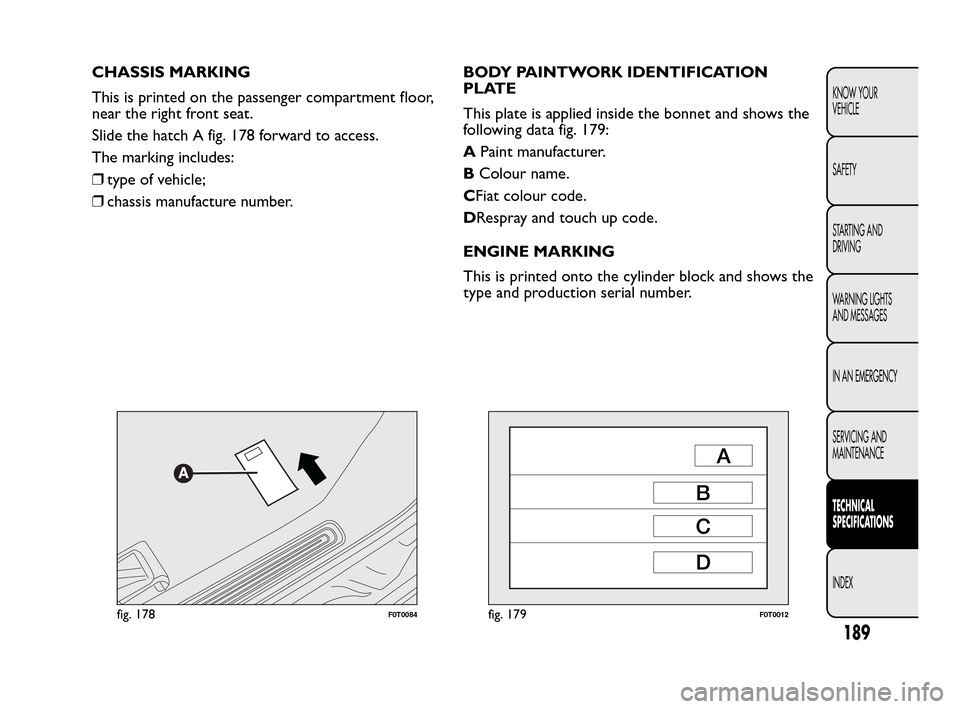
CHASSIS MARKING
This is printed on the passenger compartment floor,
near the right front seat.
Slide the hatch A fig. 178 forward to access.
The marking includes:
❒type of vehicle;
❒chassis manufacture number.BODY PAINTWORK IDENTIFICATION
PLATE
This plate is applied inside the bonnet and shows the
following data fig. 179:
APaint manufacturer.
BColour name.
CFiat colour code.
DRespray and touch up code.
ENGINE MARKING
This is printed onto the cylinder block and shows the
type and production serial number.
fig. 178F0T0084fig. 179F0T0012
189
KNOW YOUR
VEHICLE
SAFETY
STARTING AND
DRIVING
WARNING LIGHTS
AND MESSAGES
IN AN EMERGENCY
SERVICING AND
MAINTENANCE
TECHNICAL
SPECIFICA
TIONS
INDEX
Page 194 of 230
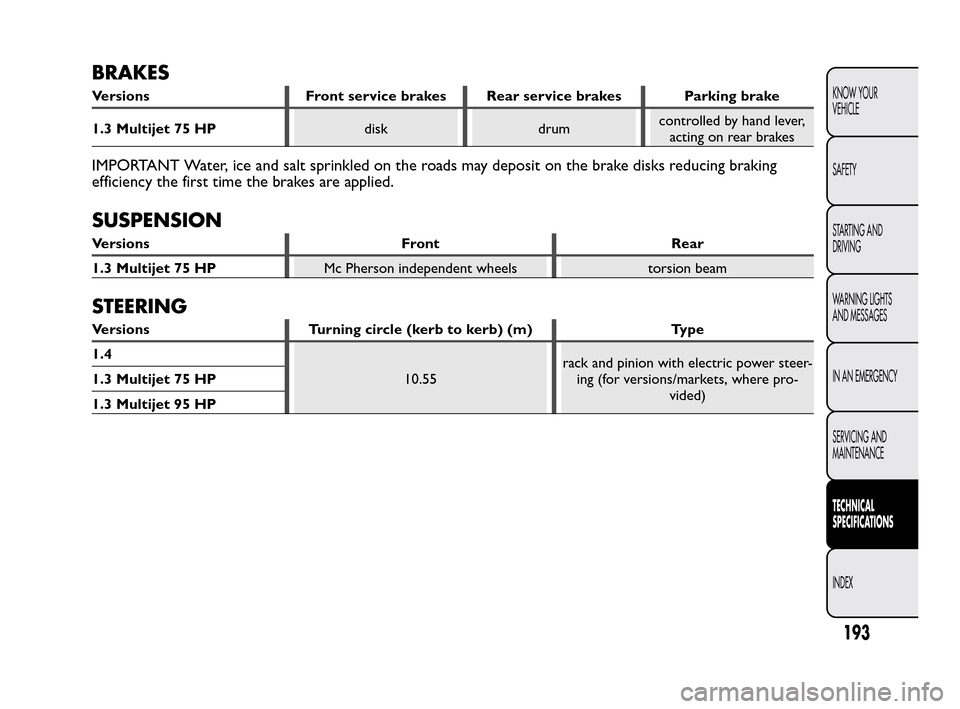
BRAKES
Versions Front service brakes Rear service brakes Parking brake
1.3 Multijet 75 HPdisk drumcontrolled by hand lever,
acting on rear brakes
IMPORTANT Water, ice and salt sprinkled on the roads may deposit on the brake disks reducing braking
efficiency the first time the brakes are applied.
SUSPENSION
Versions Front Rear
1.3 Multijet 75 HPMc Pherson independent wheels torsion beam
STEERING
Versions Turning circle (kerb to kerb) (m) Type
1.4
10.55rack and pinion with electric power steer-
ing (for versions/markets, where pro-
vided) 1.3 Multijet 75 HP
1.3 Multijet 95 HP
193
KNOW YOUR
VEHICLE
SAFETY
STARTING AND
DRIVING
WARNING LIGHTS
AND MESSAGES
IN AN EMERGENCY
SERVICING AND
MAINTENANCE
TECHNICAL
SPECIFICA
TIONS
INDEX
Page 198 of 230
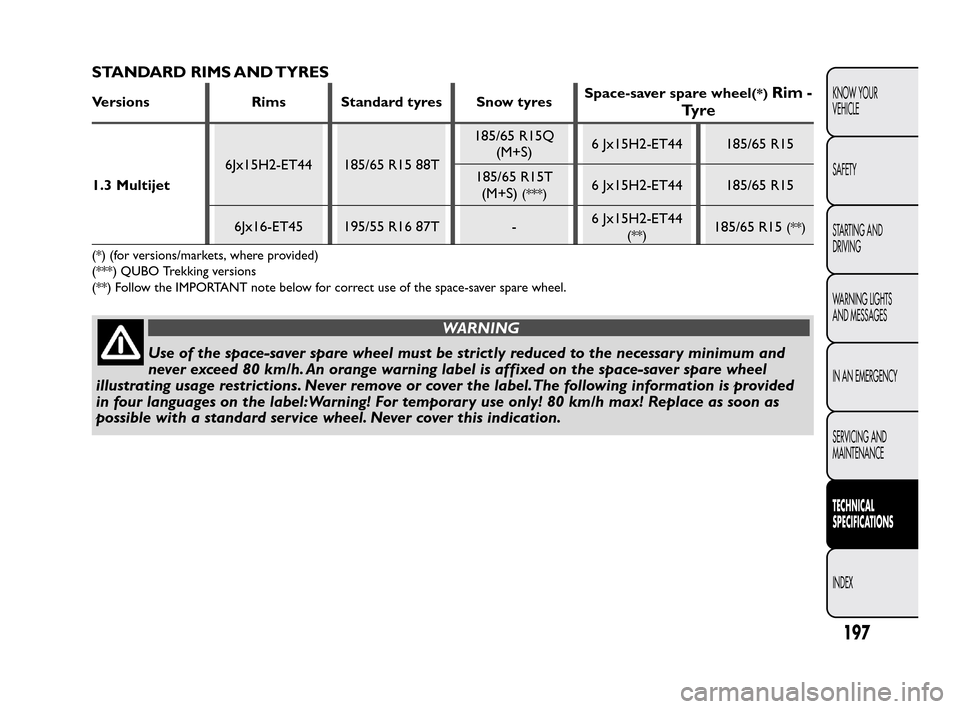
STANDARD RIMS AND TYRES
Versions Rims Standard tyres Snow tyresSpace-saver spare wheel(*)Rim -
Ty r e
1.3 Multijet6Jx15H2-ET44 185/65 R15 88T185/65 R15Q
(M+S)6 Jx15H2-ET44 185/65 R15
185/65 R15T
(M+S)(***)6 Jx15H2-ET44 185/65 R15
6Jx16-ET45 195/55 R16 87T -6 Jx15H2-ET44
(**)185/65 R15(**)
(*) (for versions/markets, where provided)
(***) QUBO Trekking versions
(**) Follow the IMPORTANT note below for correct use of the space-saver spare wheel.
WARNING
Use of the space-saver spare wheel must be strictly reduced to the necessary minimum and
n
ever exceed 80 km/h. An orange warning label is affixed on the space-saver spare wheel
illustrating usage restrictions. Never remove or cover the label.The following information is provided
in four languages on the label:Warning! For temporary use only! 80 km/h max! Replace as soon as
possible with a standard service wheel. Never cover this indication.
197
KNOW YOUR
VEHICLE
SAFETY
STARTING AND
DRIVING
WARNING LIGHTS
AND MESSAGES
IN AN EMERGENCY
SERVICING AND
MAINTENANCE
TECHNICAL
SPECIFICA
TIONS
INDEX
Page 199 of 230
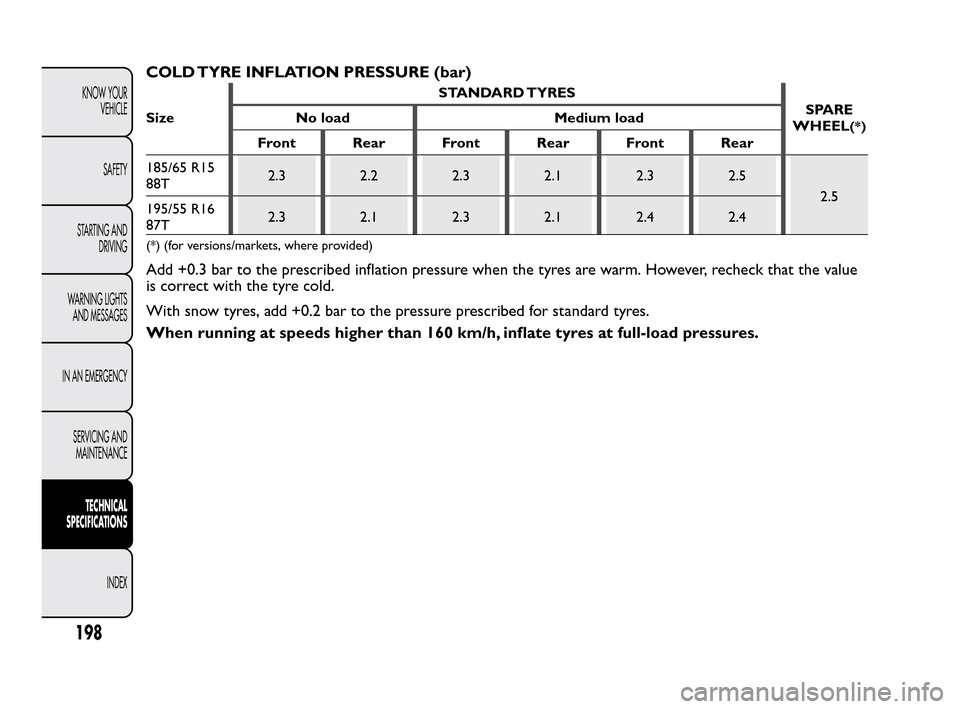
COLD TYRE INFLATION PRESSURE (bar)
SizeSTANDARD TYRES
SPARE
WHEEL(*)No load Medium load
Front Rear Front Rear Front Rear
185/65 R15
88T2.3 2.2 2.3 2.1 2.3 2.5
2.5
195/55 R16
87T2.3 2.1 2.3 2.1 2.4 2.4
(*) (for versions/markets, where provided)
Add +0.3 bar to the prescribed inflation pressure when the tyres are warm. However, recheck that the value
is correct with the tyre cold.
With snow tyres, add +0.2 bar to the pressure prescribed for standard tyres.
When running at speeds higher than 160 km/h, inflate tyres at full-load pressures.
198
KNOW YOUR
VEHICLE
SAFETY
STARTING AND
DRIVING
WARNING LIGHTS
AND MESSAGES
IN AN EMERGENCY
SERVICING AND
MAINTENANCE
TECHNICAL
SPECIFICA
TIONS
INDEX
Page 200 of 230
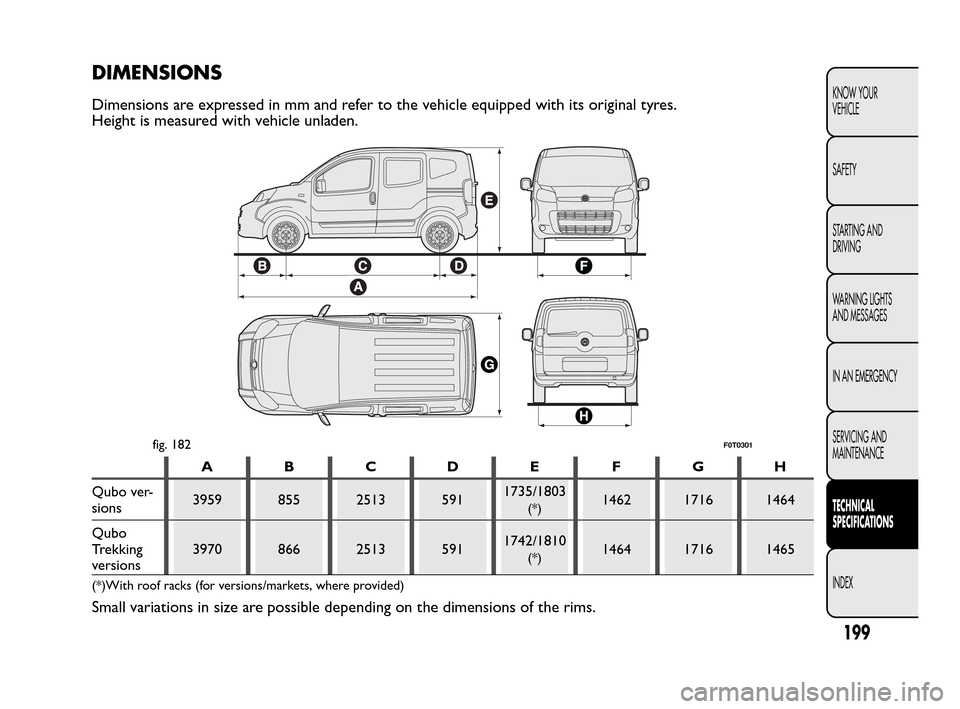
DIMENSIONS
Dimensions are expressed in mm and refer to the vehicle equipped with its original tyres.
Height is measured with vehicle unladen.
ABCDE FGH
Qubo ver-
sions3959 855 2513 5911735/1803
(*)1462 1716 1464
Qubo
Trekking
versions3970 866 2513 5911742/1810
(*)1464 1716 1465
(*)With roof racks (for versions/markets, where provided)
Small variations in size are possible depending on the dimensions of the rims.
fig. 182F0T0301
199
KNOW YOUR
VEHICLE
SAFETY
STARTING AND
DRIVING
WARNING LIGHTS
AND MESSAGES
IN AN EMERGENCY
SERVICING AND
MAINTENANCE
TECHNICAL
SPECIFICA
TIONS
INDEX