towing FIAT QUBO 2010 1.G Owners Manual
[x] Cancel search | Manufacturer: FIAT, Model Year: 2010, Model line: QUBO, Model: FIAT QUBO 2010 1.GPages: 230, PDF Size: 4.38 MB
Page 113 of 230
IMPORTANT With the engine cold, the accelerator
pedal must be fully released when you turn the
ignition key to AVV.
If the engine does not start at the first attempt,
return the ignition key to STOP before repeating the
procedure.
If the
warning light stays on when the ignition key
is at MAR, turn the key to STOP and then back to
MAR; if the warning light remains on, try with the
other keys provided with the car.
Contact a Fiat Dealership if the engine still does not
start.
Warning lightwill blink for 60
seconds after starting or during prolonged
cranking to indicate a fault to the glow
plug heating system. Use the vehicle normally if
the engine starts, but go to a Fiat Dealership
as soon as possible.
HOW TO WARM UP THE ENGINE AFTER IT
HAS JUST STARTED
Proceed as follows:
❒drive off slowly, letting the engine turn at medium
revs. Do not accelerate abruptly;
❒do not demand to performance for the first few
kilometres. Wait until the engine coolant gauge
starts moving.EMERGENCY STARTING
Go to a Fiat Dealership immediately if warning light
comes on steady on the instrument panel.
Never jump start the engine by pushing,
towing or driving downhill.This could
cause fuel to flow into the catalytic
converter and damage it beyond repair.
STOPPING THE ENGINE
Turn the ignition key to STOP while the engine is
idling.
IMPORTANT After a long drive, you should allow
the engine to “catch its breath” before turning it off
by letting it idle to allow the temperature in the
engine compartment to fall.
A quick burst on the accelerator before
turning off the engine serves absolutely no
practical purpose; it wastes fuel and is
especially damaging to turbocharged engines.
112
KNOW YOUR
VEHICLE
SAFETY
STARTING AND
DRIVING
WARNING LIGHTS
AND
MESSAGES
IN AN EMERGENCY
SERVICING AND
MAINTENANCE
TECHNICAL
SPECIFICATIONS
INDEX
Page 119 of 230
TOWING TRAILERS
IMPORTANT
The vehicle must be provided with a type-approved
tow hitch and adequate electrical system to tow
trailers. Installation must be performed by specialised
personnel who will issue the required papers for
travelling on roads.
Install any specific and/or additional rear-view mirrors
in accordance with the highway code of the country
in which you are travelling.
Remember that when towing a trailer, steep hills are
harder to climb, braking distances increase and
overtaking takes longer depending on the overall
weight of the trailer.
Engage a low gear when driving downhill, rather than
constantly using the brake.
The weight of the trailer on the vehicle tow hitch
will reduce the loading capacity of the vehicle by the
same amount.
Consider the weight at full load, including accessories
and luggage, to make sure you do not exceed the
maximum towable weight (shown in the log book).
Respect each country's speed limits for vehicles
towing trailers. In all cases, the top speed must not
exceed 80 km/h.
WARNING
The ABS with which the vehicle may be
equipped
will not control the braking
system of the trailer. Particular caution is
therefore required on slippery roads.
WARNING
Never modify the braking system of the
v
ehicle to control the trailer brake.
The trailer braking system must be fully
independent from the hydraulic system of the
vehicle.
118
KNOW YOUR
VEHICLE
SAFETY
STARTING AND
DRIVING
WARNING LIGHTS
AND
MESSAGES
IN AN EMERGENCY
SERVICING AND
MAINTENANCE
TECHNICAL
SPECIFICATIONS
INDEX
Page 123 of 230
WARNING
Failure of the warning lightis
indicated by warning light
.In
addition, the air bag system automatically
disables the passenger air bags (both front and
side air bags, for versions/markets, where
provided). Contact a Fiat Dealership
immediately to have the system checked.
OVERHEATED ENGINE COOLANT
(red)
When the ignition key is turned to MAR, the warning
light turns on but should go off after a few seconds.
The warning light turns on when the engine is
overheated.
If the warning light comes on, proceed as follows:
❒When travelling normally: stop the vehicle, stop
the engine and check that the coolant level in
the vessel is not under the MIN line. If it is, wait
for a few minutes to allow the engine to cool
down, then slowly and carefully open the vessel
cap. Top up with coolant fluid making sure that the
liquid level is included between the MIN and
MAX lines on the vessel. Also check for leaks. Go
to a Fiat Dealership if the warning light comeson again when the engine is next started.
❒If the vehicle is used under demanding conditions
(e.g. towing trailers uphill or fully loaded): slow
down and, if the light stays on, stop the vehicle.
Stop for two or three minutes with the engine
running and slightly accelerated to assist better
coolant circulation. Then switch the engine off.
Check correct fluid level in the vessel as described
above.
IMPORTANT On particularly demanding journeys, it
is advisable to keep the engine on and slightly
accelerated for a few minutes before switching it off.
A specific message is displayed on certain versions.
LOW BATTERY CHARGE (red)
The warning light comes on when the ignition key is
turned to MAR, but it should go out as soon as
the engine has started (with the engine running at
idle speed a brief delay before going out is
acceptable).
If the warning light stays on, contact a Fiat
Dealership immediately.
A specific message is displayed on certain versions.
122
KNOW YOUR
VEHICLE
SAFETY
STARTING AND
DRIVING
WARNING LIGHTS
AND
MESSAGES
IN AN EMERGENCY
SERVICING
AND
MAINTENANCE
TECHNICAL
SPECIFICATIONS
INDEX
Page 133 of 230
WARNING
This procedure must be performed by
e
xperts because incorrect actions may
cause considerable electrical discharge.
Furthermore, battery fluid is poisonous and
corrosive: avoid contact with skin and eyes.
Keep naked flames and lit cigarettes away from
the battery. Do not create sparks.
BUMP STARTING
Never bump start the engine by pushing, towing or
driving downhill. This could cause fuel to flow into
the catalytic converter and damage it beyond repair.
IMPORTANT Remember that the brake booster
and the power steering system are not active until
the engine is started, so you will need to apply much
more force to the brake pedal or steering wheel.
CHANGING A TYRE
The vehicle is originally equipped with the Fix&Go
automatic quick tyre repair kit (see instructions
in the next chapter). As an alternative, the vehicle
may have a normal-sized spare wheel.
Changing the wheel and correct use of the jack and
spare wheel require some precautions, which are
listed below.
WARNING
The spare wheel (for versions/markets,
w
here provided) is specific for your
vehicle.Therefore, it must not be used on other
models. Do not use spare wheels of other
models on your vehicle.The spare wheel must
be used only in an emergency. Use of the spare
wheel must kept to the minimum necessary.
132
KNOW YOUR
VEHICLE
SAFETY
STARTING AND
DRIVING
WARNING LIGHTS
AND MESSAGES
IN AN
EMERGENCY
SERVICING AND
MAINTENANCE
TECHNICAL
SPECIFICA
TIONS
INDEX
Page 165 of 230
LIFTING THE VEHICLE
If the vehicle needs to be lifted, go to a Fiat
Dealership which is equipped with the arm hoist or
workshop lift.
TOWING THE VEHICLE
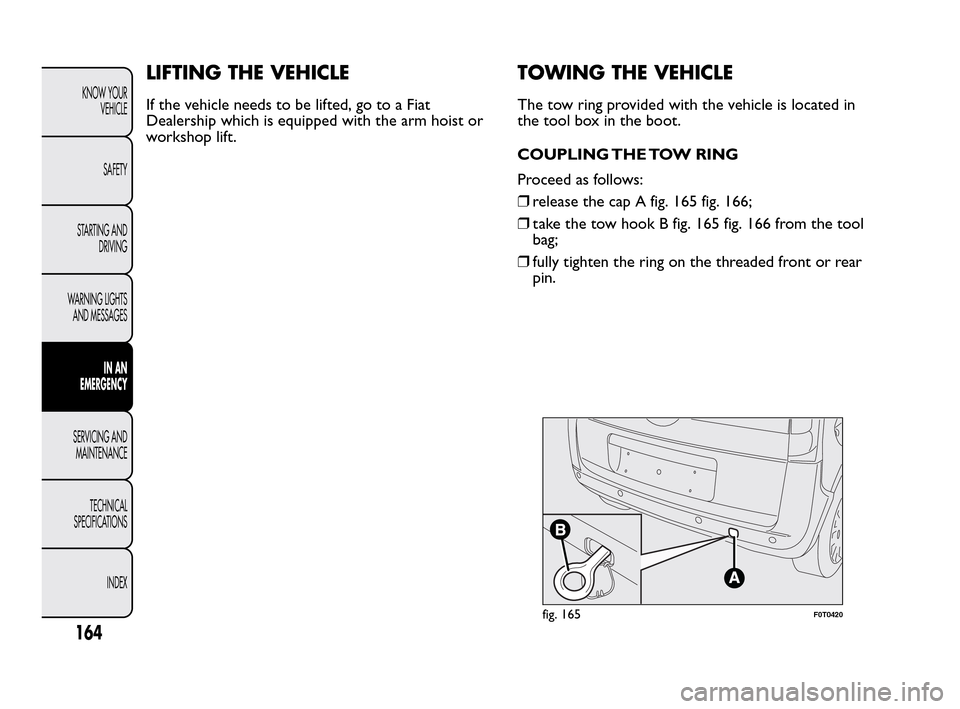
The tow ring provided with the vehicle is located in
the tool box in the boot.
COUPLING THE TOW RING
Proceed as follows:
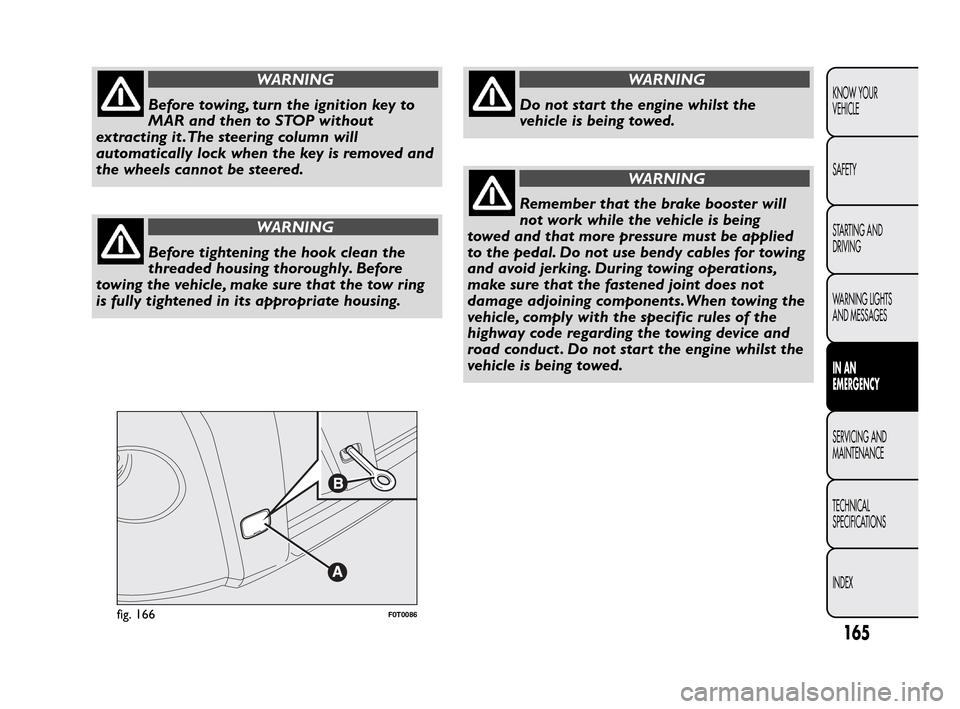
❒release the cap A fig. 165 fig. 166;
❒take the tow hook B fig. 165 fig. 166 from the tool
bag;
❒fully tighten the ring on the threaded front or rear
pin.
fig. 165F0T0420
164
KNOW YOUR
VEHICLE
SAFETY
STARTING AND
DRIVING
WARNING LIGHTS
AND MESSAGES
IN AN
EMERGENCY
SERVICING AND
MAINTENANCE
TECHNICAL
SPECIFICA
TIONS
INDEX
Page 166 of 230
WARNING
Before towing, turn the ignition key to
M
ARandthentoSTOPwithout
extracting it .The steering column will
automatically lock when the key is removed and
the wheels cannot be steered.
WARNING
Before tightening the hook clean the
t
hreaded housing thoroughly. Before
towing the vehicle, make sure that the tow ring
is fully tightened in its appropriate housing.
WARNING
Do not start the engine whilst the
v
ehicle is being towed.
WARNING
Remember that the brake booster will
n
ot work while the vehicle is being
towed and that more pressure must be applied
to the pedal. Do not use bendy cables for towing
and avoid jerking. During towing operations,
make sure that the fastened joint does not
damage adjoining components.When towing the
vehicle, comply with the specific rules of the
highway code regarding the towing device and
road conduct . Do not start the engine whilst the
vehicle is being towed.
fig. 166F0T0086
165
KNOW YOUR
VEHICLE
SAFETY
STARTING AND
DRIVING
WARNING LIGHTS
AND MESSAGES
IN AN
EMERGENCY
SERVICING AND
MAINTENANCE
TECHNICAL
SPECIFICA
TIONS
INDEX
Page 167 of 230
The front and rear tow hooks should be
used only for emergencies on the road.You
are allowed to tow the car for short
distances using an appropriate device in
accordance with the highway code (a rigid bar),
to move the vehicle on the road in readiness
for towing or transporting via a breakdown
vehicle.Tow hooks MUST NOT be used to tow
vehicles off the road or where there are obstacles
and/or for towing operations using cables or
other non-rigid devices. Respecting the above
conditions, towing must take place with the two
vehicles (one towing, the other towed) aligned
as much as possible along the same centre line.
166
KNOW YOUR
VEHICLE
SAFETY
STARTING AND
DRIVING
WARNING LIGHTS
AND MESSAGES
IN AN
EMERGENCY
SERVICING AND
MAINTENANCE
TECHNICAL
SPECIFICA
TIONS
INDEX
Page 168 of 230
SERVICING AND MAINTENANCE
SCHEDULED SERVICING
Correct servicing is essential for ensuring long
vehicle life under the best conditions.
This is why Fiat has planned a series of checks and
services every 30,000 km.
It is, however, important to remember that
scheduled servicing does not completely cover all the
requirements of the car: even in the initial period
before 30,000 km, and then subsequently between
one service and another, ordinary care is always
required such as routine checks involving topping up
fluid level, checking tyre pressures etc.
IMPORTANT The Scheduled Servicing Plan coupons
are set out by the Manufacturer. Failure to comply
with the schedule may invalidate the warranty.Scheduled Servicing is performed by all Fiat
Dealerships at given times.
If, during each part of the service, the need arises for
additional replacements or repairs, these may be
carried out only with the explicit agreement of the
Customer.
IMPORTANT It is advisable to inform a Fiat Dealer
of any small operating irregularities without waiting
for the next service.
The interval between scheduled services must be
reduced if your vehicle is used frequently for towing
trailers.
167
KNOW YOUR
VEHICLE
SAFETY
STARTING AND
DRIVING
WARNING LIGHTS
AND MESSAGES
IN AN EMERGENCY
SERVICING AND
MAINTENANCE
TECHNICAL
SPECIFICA
TIONS
INDEX
Page 171 of 230
REGULAR CHECKS
Every 1,000 km or before long journeys, check and, if
necessary, top up:
❒engine coolant level;
❒brake fluid level;
❒windscreen washer fluid level;
❒tyre inflation pressure and condition;
❒operation of lighting system (headlamps, direction
indicators, hazard warning lights, etc.);
❒operation of screen wash/wipe system and
positioning/wear of windscreen/rear window wiper
blades.
Check and top up, if required, the engine oil level
every 3,000 km.
You are recommended to use PETRONAS
LUBRICANTS products, which have been designed
and produced specifically for Fiat vehicles (see
“Capacities” table in the “Technical specifications”
section).
HEAVY USAGE OF THE VEHICLE
Should prevailing use of the vehicle be under one of
the following specially heavy conditions:
❒towing a trailer or caravan;
❒dusty roads;
❒short, repeated journeys (less than 7-8 km) at
sub-zero outside temperatures;
❒engine often idling, or driving long distances at low
speed (e.g. door to door deliveries) or long period
of idleness;
❒urban trips;
perform the following inspections more frequently
than shown on the Scheduled Servicing Plan:
❒check front disc brake pad condition and wear;
❒check cleanliness of bonnet and boot locks,
cleanliness and lubrication of linkage;
❒visually inspect the conditions of: engine, gearbox,
transmission, pipes and tubes (exhaust - fuel -
brakes), rubber parts (boots, sleeves, bushes, etc.);
❒check battery charge status and fluid (electrolyte)
level (refer to "Battery - Check state of charge
and electrolyte level" paragraph in this chapter);
❒visually inspect condition of the auxiliary drive
belts;
170
KNOW YOUR
VEHICLE
SAFETY
STARTING AND
DRIVING
WARNING LIGHTS
AND MESSAGES
IN AN EMERGENCY
SERVICING AND
MAINTENANCE
TECHNICAL
SPECIFICA
TIONS
INDEX
Page 227 of 230
Replacing the battery ................ 178
Replacing the rear window
wiper blade................................ 182
Replacing the windscreen
wiper blades .............................. 182
Rev counter.................................. 13
Right-hand indicator
warning light.............................. 130
Rim Protector............................. 196
Rims and tyres ............................ 194
Roof rack/ski rack ....................... 72
Roof rails....................................... 72
Rubber lines ................................ 181
Saving fuel ................................... 116
Seat belt reminder ..................... 124
Seat belts
– Use ........................................... 91
Seats
– Accessing front seats............ 31
– Foldaway passenger seat...... 29
– Front seats .............................. 28
Securing your load ...................... 70
Side bags .............................. 107-108
Side bags
– Side bag................................... 108Side lights - tail lights
(changing a bulb) ...................... 146
Side lights - tail lights ................. 45
Side lights/tail lights ................... 146
– Warning light ......................... 129
Side/tail lights warning light ..... 129
Snow chains................................. 119
Snow tyres................................... 114
Spare wheel ................................. 194
Speedometer ............................... 13
Spray nozzles .............................. 183
Starting procedure for
diesel versions .......................... 111
Starting the engine.... 111-131-132
Steering ........................................ 193
Steering lock ................................ 12
Steering wheel ............................. 34
Stopping the engine ................... 112
Sun visors ..................................... 56
Suspension ................................... 193
Symbols ......................................... 5
Tail lights/rear fog light
(changing a bulb) ...................... 149
Third brake lights (changing
a bulb)......................................... 150
Third brake lights ....................... 150Tool bag ....................................... 134
Towing the vehicle ..................... 164
Towing trailers ............................ 118
Traction Plus system .................. 80
Transmission ....................... 115-192
Trip computer ............................. 26
Tyres ............................................. 194
Universal Isofix seat
compliance with child seat
use............................................... 104
Useful advice for extending
the life of your battery ........... 179
VIN plate .................................... 188
Warning lights and
messages .................................... 120
Washer fluid for
windscreen/rear window ....... 175
Water in diesel fuel filter
warning light.............................. 127
Weights ........................................ 201
Wheel geometry........................ 194
Wheels and tyres ....................... 180
Wheels ......................................... 194
Window cleaning ........................ 47
226
KNOW YOUR
VEHICLE
SAFETY
STARTING AND
DRIVING
WARNING LIGHTS
AND MESSAGES
IN AN EMERGENCY
SERVICING AND
MAINTENANCE
TECHNICAL
SPECIFICATIONS
INDEX