stop start FIAT QUBO 2014 1.G Owner's Manual
[x] Cancel search | Manufacturer: FIAT, Model Year: 2014, Model line: QUBO, Model: FIAT QUBO 2014 1.GPages: 231, PDF Size: 5.01 MB
Page 74 of 231
FAILURE INDICATIONS
ABS failure
ABS failure is indicated by warning light
in the
instrument panel coming on (together with the
appropriate message on the multifunction display on
some versions) (see “Warning lights and messages”).
In this case, the braking system will work as normal,
but without the extra capacity offered by the ABS
system. Drive carefully to the nearest Fiat Dealership
to have the system checked.
EBD failure
ABS failure is indicated by warning lightand
in
the instrument panel coming on (together with the
appropriate message on the multifunction display
on some versions) (see “Warning lights and
messages”).
In this case, the rear wheels may suddenly lock and
the vehicle may swerve when braking sharply. Drive
carefully to the nearest Fiat Dealership to have
the system checked.
WARNING
If only warning light
lights up in the
instrument panel (with a message in the
multifunction display on some versions), stop
the vehicle immediately and contact the nearest
Fiat Dealership. Fluid leaking from the
hydraulic system will compromise the operation
of the braking system, whether it is of the
conventional type or with ABS.
70KNOW YOUR
VEHICLE
SAFETY
STARTING AND
DRIVING
WARNING LIGHTS
AND MESSAGES
IN AN EMERGENCY
SERVICING AND
MAINTENANCE
TECHNICAL
SPECIFICATIONS
INDEX
Page 81 of 231
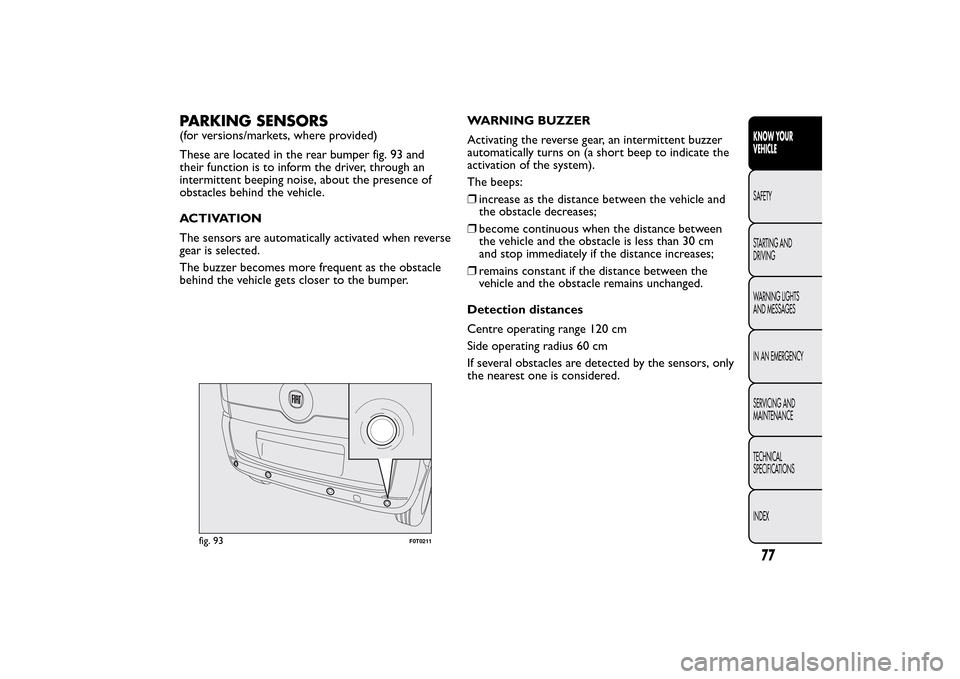
PARKING SENSORS(for versions/markets, where provided)
These are located in the rear bumper fig. 93 and
their function is to inform the driver, through an
intermittent beeping noise, about the presence of
obstacles behind the vehicle.
ACTIVATION
The sensors are automatically activated when reverse
gear is selected.
The buzzer becomes more frequent as the obstacle
behind the vehicle gets closer to the bumper.WARNING BUZZER
Activating the reverse gear, an intermittent buzzer
automatically turns on (a short beep to indicate the
activation of the system).
The beeps:
❒increase as the distance between the vehicle and
the obstacle decreases;
❒become continuous when the distance between
the vehicle and the obstacle is less than 30 cm
and stop immediately if the distance increases;
❒remains constant if the distance between the
vehicle and the obstacle remains unchanged.
Detection distances
Centre operating range 120 cm
Side operating radius 60 cm
If several obstacles are detected by the sensors, only
the nearest one is considered.
fig. 93
F0T0211
77KNOW YOUR
VEHICLESAFETY
STARTING AND
DRIVING
WARNING LIGHTS
AND MESSAGES
IN AN EMERGENCY
SERVICING AND
MAINTENANCE
TECHNICAL
SPECIFICATIONS
INDEX
Page 87 of 231
FUEL CUT-OFF SYSTEMThis system is triggered after a collision as follows by:
❒the interruption of the fuel supply with the engine
consequently cutting out;
❒automatically unlocking the doors
❒turning on the lights inside the vehicle.
When the system has been triggered, the message
“Fuel cut off, see handbook” is displayed on some
versions.
Check carefully for fuel leaks, for instance in the
engine compartment, under the vehicle or near the
tank area.
After a crash, turn the ignition key to STOP to avoid
draining the battery.
The following procedure should be carried out to
restore the correct operation of the vehicle:
❒turn the ignition key to the ON position;
❒turn on the right direction indicator;
❒turn off the right direction indicator;
❒turn on the left direction indicator;
❒turn off the left direction indicator;
❒turn on the right direction indicator;
❒turn off the right direction indicator;
❒turn on the left direction indicator;
❒turn off the left direction indicator;
❒turn the ignition key to the OFF position.
WARNING
If, after an impact , you smell fuel or
notice leaks from the fuel system, do not
reactivate the system to avoid the risk of fire.
83KNOW YOUR
VEHICLESAFETY
STARTING AND
DRIVING
WARNING LIGHTS
AND MESSAGES
IN AN EMERGENCY
SERVICING AND
MAINTENANCE
TECHNICAL
SPECIFICATIONS
INDEX
Page 110 of 231
WARNING
Airbags may be deployed if another
vehicle crashes into yours if the key is
inserted and on, even if the engine is not
running and your vehicle is standing. For this
reason, children must never sit on the front
seat , even if when standing. On the other hand,
if the key is inser ted and at STOP, none of the
safety devices (airbag or pretensioners) will
be deployed in a collision. Non-deployment of
the devices in this case does not indicate a
system fault .
WARNING
Have the airbag system checked by a
Fiat Dealership if the car was stolen, if
theft was attempted, or if the car was subjected
to vandalism or flooding.
WARNING
When the ignition key is turned to MAR,
the warning light
(with passenger's
front airbag activated) comes on and flashes for
a few seconds to remind you that the
passenger's airbag will be deployed in a crash,
after which it should go off.
WARNING
The airbag deployment threshold is
higher than that of the pretensioners.
For collisions in the range between the two
thresholds, it is normal for only the
pretensioners to be activated.
WARNING
Airbags do not replace seat belts, but
increase their efficiency. Furthermore,
since front airbags are not deployed in
low-speed head-on collisions, side-on impacts,
rear-end shunts or roll-overs, the passengers are
protected only by the seat belts which must
therefore be fastened at all times.
106KNOW YOUR
VEHICLE
SAFETY
STARTING AND
DRIVING
WARNING LIGHTS
AND MESSAGES
IN AN EMERGENCY
SERVICING AND
MAINTENANCE
TECHNICAL
SPECIFICATIONS
INDEX
Page 112 of 231
❒press the clutch pedal down to the floor without
touching the accelerator;
❒turn the ignition key to AVV as soon as the
warning light goes out. Waiting too long will
waste the heating work carried out by the glow
plugs.
Release the key as soon as the engine starts.
IMPORTANT With the engine cold, the accelerator
pedal must be fully released when you turn the
ignition key to AVV.
If the engine does not start at the first attempt,
return the ignition key to STOP before repeating the
procedure.
If thewarning light stays on when the ignition key
is at MAR, turn the key to STOP and then back to
MAR; if the warning light remains on, try with the
other keys provided with the car.
Contact a Fiat Dealership if the engine still does not
start.
Warning light
will blink for 60
seconds after star ting or during prolonged
cranking to indicate a fault to the glow
plug heating system. Use the vehicle normally if
the engine starts, but go to a Fiat Dealership
as soon as possible.
HOW TO WARM UP THE ENGINE AFTER IT
HAS JUST STARTED
Proceed as follows:
❒drive off slowly, letting the engine turn at medium
revs. Do not accelerate abruptly;
❒do not demand to performance for the first few
kilometres. Wait until the engine coolant gauge
starts moving.
108KNOW YOUR
VEHICLE
SAFETYSTARTING AND
DRIVINGWARNING LIGHTS
AND MESSAGES
IN AN EMERGENCY
SERVICING AND
MAINTENANCE
TECHNICAL
SPECIFICATIONS
INDEX
Page 113 of 231
EMERGENCY STARTING
Go to a Fiat Dealership immediately if warning light
comes on steady on the instrument panel.
Never jump start the engine by pushing,
towing or coasting downhill.This could
cause fuel to flow into the catalytic
conver ter and damage it beyond repair.STOPPING THE ENGINE
Turn the ignition key to STOP while the engine is
idling.
IMPORTANT After a long drive, you should allow
the engine to “catch its breath” before turning it off
by letting it idle to allow the temperature in the
engine compartment to fall.
A quick burst on the accelerator before
stopping the engine serves no practical
purpose; it wastes fuel and is especially
damaging to turbocharged engines.
109KNOW YOUR
VEHICLE
SAFETYSTARTING AND
DRIVINGWARNING LIGHTS
AND MESSAGES
IN AN EMERGENCY
SERVICING AND
MAINTENANCE
TECHNICAL
SPECIFICATIONS
INDEX
Page 115 of 231
PARKING THE CAR
Proceed as follows:
❒stop the engine and engage the handbrake;
❒engage a gear (1
stgear if parked uphill or reverse if
facing downhill) and leave the wheels turned.
If the vehicle is parked on a steep slope, it is
advisable to block the wheels with a wedge or stone.
To prevent draining the battery, do not leave the
ignition key turned to MAR. Always remove the key
when you leave the vehicle.
Never leave children unattended in the vehicle.
Always remove the ignition key when leaving the
vehicle, and take it with you.
SNOW TYRESA Fiat Dealership will be happy to provide advice
concerning the most suitable type of tyre for your
requirements.
For the type, pressures and specifications of the
snow tyre to be used, follow carefully the
instructions given in the “Wheels” paragraph of the
“Technical specifications” section.
The winter performance of these tyres is
considerably reduced when the tread thickness is less
than 4 mm. If this is the case, replace them.
Due to their specific features, the performance of
snow tyres is much lower than that of standard tyres
in normal conditions or on long motorway stretches.
You should therefore use them only in the
conditions for which they were designed.
111KNOW YOUR
VEHICLE
SAFETYSTARTING AND
DRIVINGWARNING LIGHTS
AND MESSAGES
IN AN EMERGENCY
SERVICING AND
MAINTENANCE
TECHNICAL
SPECIFICATIONS
INDEX
Page 118 of 231
Electric devices
Only use electrical devices for the amount of time
needed. The heated rear window, additional
headlights, windscreen/rear window wipers and
heater fan need a considerable amount of energy,
therefore increasing fuel consumption (by up to 25%
in the urban cycle).
Climate control system
The air conditioner leads to higher fuel consumption
(on average up to +20%). If the temperature outside
is not too extreme, try and use the air vents.
Spoilers
The use of non-certified spoilers may adversely affect
aerodynamics and fuel consumption.DRIVING STYLE
The main driving styles that affect fuel consumption
are listed below.
Starting
Do not warm up the engine at low or high revs when
the vehicle is stationary; this causes the engine to
warm up more slowly, thereby increasing fuel
consumption and emissions. It is advisable to set off
immediately and slowly, avoiding high revs: this allows
the engine to warm up more quickly.
Unnecessary actions
Avoid revving up when stationary at traffic lights or
before stopping the engine. The latter action, like
double declutching, is unnecessary and increases
consumption and pollution.
Gear selection
Use a higher gear as soon as traffic and road
conditions allow. Using a low gear for faster
acceleration will increase fuel consumption.
In the same way, improper use of a high gear
increases fuel consumption, emissions and engine
wear.
Top speed
Fuel consumption increases considerably with speed.
Maintain a constant speed, avoiding unnecessary
114KNOW YOUR
VEHICLE
SAFETYSTARTING AND
DRIVINGWARNING LIGHTS
AND MESSAGES
IN AN EMERGENCY
SERVICING AND
MAINTENANCE
TECHNICAL
SPECIFICATIONS
INDEX
braking and acceleration, which cost in terms of both
fuel consumption and emissions.
Page 122 of 231
WARNING LIGHTS AND MESSAGES
WARNING LIGHTS AND MESSAGESThe warning light (where allowed by the instrument
panel) is associated to a specific message and/or
acoustic tone. These indications are brief and
precautionary and as such must not be considered as
exhaustive and/or alternative to the information
contained in the Owner's Handbook, which you are
recommended to read carefully in all cases. Always
refer to the information in this chapter in the event
of a failure indication.
IMPORTANT The fault indicators appearing on the
display are divided into two categories: very serious
and less serious failures.
Serious failures prompt a prolonged cycle of signals.
Less serious failures prompt a shorter cycle of
signals.
Press MENU ESC to stop the warning cycle in both
cases. Instrument panel warning light (or the symbol
on the display) will stay on until the cause of the
failure is eliminated.
LOW BRAKE FLUID
(red)/HANDBRAKE ENGAGED (red)
When the ignition key is turned to MAR, the warning
light turns on but should go off after a few seconds.
Low brake fluid
The warning light turns on when the level of the
brake fluid in the reservoir falls below the minimum
level, possibly due to a leak in the circuit.
A specific message is displayed on certain versions.
WARNING
If the warning light
turns on when
travelling (on cer tain versions together
with the message on the display) stop the
vehicle immediately and contact Fiat
Dealership.
118KNOW YOUR
VEHICLE
SAFETY
STARTING AND
DRIVING
WARNING LIGHTS
AND MESSAGESIN AN EMERGENCY
SERVICING AND
MAINTENANCE
TECHNICAL
SPECIFICATIONS
INDEX
Page 124 of 231
WARNING
Failure of the warning light
is
indicated by warning light.In
addition, the air bag system automatically
disables the passenger air bags (both front and
side air bags, for versions/markets, where
provided). Contact a Fiat Dealership
immediately to have the system checked.
OVERHEATED ENGINE COOLANT
(red)
When the ignition key is turned to MAR, the warning
light turns on but should go off after a few seconds.
The warning light turns on when the engine is
overheated.If the warning light comes on, proceed as follows:
❒When travelling normally: stop the vehicle, stop
the engine and check that the coolant level in
the vessel is not under the MIN line. If it is, wait
for a few minutes to allow the engine to cool
down, then slowly and carefully open the vessel
cap. Top up with coolant fluid making sure that the
liquid level is included between the MIN and
MAX lines on the vessel. Also check for leaks. Go
to a Fiat Dealership if the warning light comes
on again when the engine is next started.
❒If the vehicle is used under demanding conditions
(e.g. towing trailers uphill or fully loaded): slow
down and, if the light stays on, stop the vehicle.
Stop for two or three minutes with the engine
running and slightly accelerated to assist better
coolant circulation. Then switch the engine off.
Check correct fluid level in the vessel as described
above.
IMPORTANT On particularly demanding journeys, it
is advisable to keep the engine on and slightly
accelerated for a few minutes before switching it off.
A specific message is displayed on certain versions.
120KNOW YOUR
VEHICLE
SAFETY
STARTING AND
DRIVING
WARNING LIGHTS
AND MESSAGESIN AN EMERGENCY
SERVICING AND
MAINTENANCE
TECHNICAL
SPECIFICATIONS
INDEX