battery FIAT QUBO 2015 1.G User Guide
[x] Cancel search | Manufacturer: FIAT, Model Year: 2015, Model line: QUBO, Model: FIAT QUBO 2015 1.GPages: 231, PDF Size: 5.01 MB
Page 121 of 231
PROLONGED VEHICLE INACTIVITYIf the vehicle needs to be off the road for longer than
one month, the following precautions must be
taken:
❒park the vehicle indoors in a dry and, if possible,
well-ventilated place;
❒engage a gear and check that the handbrake is not
on;
❒disconnect the battery negative terminal and check
the charge (see “Battery” in the “Maintenance and
care”);
❒clean and protect the painted parts using
protective wax;
❒clean and protect the shiny metal parts using
special compounds readily available;❒sprinkle talcum powder on the rubber windscreen
and rear window wiper blades and lift them off the
glass;
❒slightly open the windows;
❒cover the vehicle with a piece of fabric or
perforated plastic sheet. Do not use compact
plastic tarpaulins, which prevent humidity from
evaporating from the surface of the vehicle;
❒inflate tyres to +0.5 bar above the normal specified
pressure and check it at intervals;
❒do not drain the engine cooling system.
117KNOW YOUR
VEHICLE
SAFETYSTARTING AND
DRIVINGWARNING LIGHTS
AND MESSAGES
IN AN EMERGENCY
SERVICING AND
MAINTENANCE
TECHNICAL
SPECIFICATIONS
INDEX
Page 125 of 231
LOW BATTERY CHARGE (red)
The warning light comes on when the ignition key is
turned to MAR, but it should go out as soon as
the engine has started (with the engine running at
idle speed a brief delay before going out is
acceptable).
If the warning light stays on, contact a Fiat
Dealership immediately.
A specific message is displayed on certain versions.ABS SYSTEM FAULT (amber)
When the ignition key is turned to MAR, the warning
light turns on but should go off after a few seconds.
The warning light comes on when the system is
either not working properly or not available. In this
case the braking system maintains its own unaltered
efficiency but without the advantage of the ABS
system. Drive carefully and go to a Fiat Dealership as
soon as possible.
A specific message is displayed on certain versions.
EBD FAULT (red/amber)
Simultaneous lighting of warning lights
and
with the engine running indicates an EBD system
fault or that the system is not available. In this case,
the rear wheels may suddenly lock and the vehicle
may swerve when braking sharply. Drive very
carefully to a Fiat Dealership to have the system
inspected immediately.
A specific message is displayed on certain versions.
ESP/TRACTION PLUS SYSTEM
FAULT (amber)
When the ignition key is turned to MAR, the warning
light turns on but should go off after a few seconds.
If the warning light does not go off, or stays on
together with the LED on the ASR OFF button when
travelling, contact a Fiat Dealership.
A specific message is displayed on certain versions.
NoteFlashing of the warning light while driving
indicates the action of the ESP system.
121KNOW YOUR
VEHICLE
SAFETY
STARTING AND
DRIVINGWARNING LIGHTS
AND MESSAGESIN AN EMERGENCY
SERVICING AND
MAINTENANCE
TECHNICAL
SPECIFICATIONS
INDEX
Page 133 of 231
IN AN EMERGENCY
In an emergency, we recommend that you call the freephone number found in the Warranty
Booklet.You can also go to the www.fiat.com website to find your nearest Fiat Dealership.STARTING THE ENGINEGo to a Fiat Dealership immediately if warning light
comes on steady on the instrument panel.
JUMP STARTING
If the battery is flat, the engine may be started using
an auxiliary battery with capacity either the same
or a little higher than the flat one.
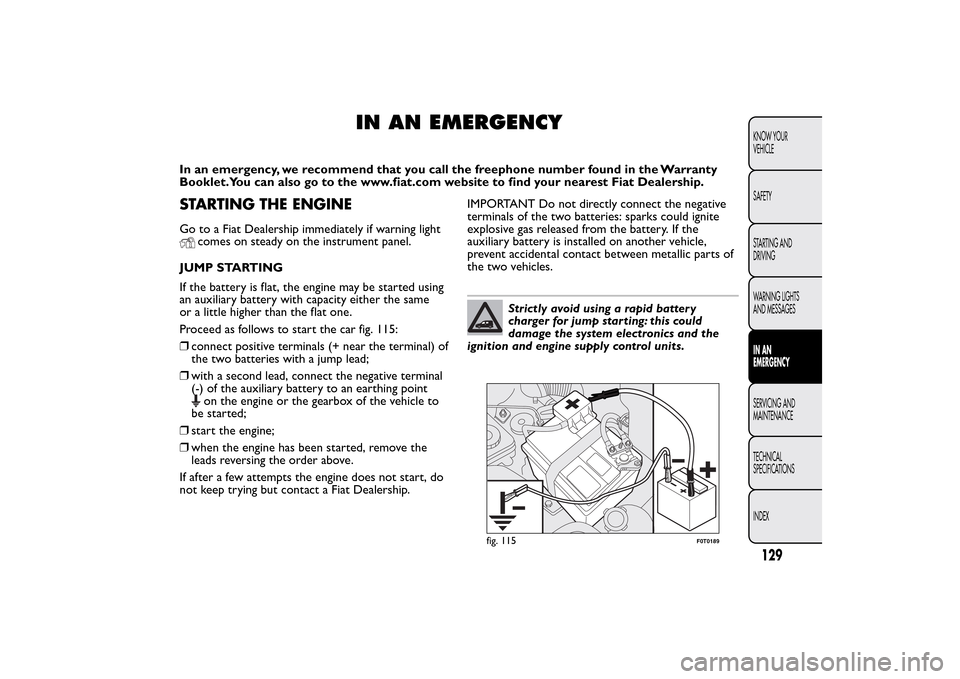
Proceed as follows to start the car fig. 115:
❒connect positive terminals (+ near the terminal) of
the two batteries with a jump lead;
❒with a second lead, connect the negative terminal
(-) of the auxiliary battery to an earthing pointon the engine or the gearbox of the vehicle to
be started;
❒start the engine;
❒when the engine has been started, remove the
leads reversing the order above.
If after a few attempts the engine does not start, do
not keep trying but contact a Fiat Dealership.IMPORTANT Do not directly connect the negative
terminals of the two batteries: sparks could ignite
explosive gas released from the battery. If the
auxiliary battery is installed on another vehicle,
prevent accidental contact between metallic parts of
the two vehicles.
Strictly avoid using a rapid battery
charger for jump starting: this could
damage the system electronics and the
ignition and engine supply control units.
fig. 115
F0T0189
129KNOW YOUR
VEHICLE
SAFETY
STARTING AND
DRIVING
WARNING LIGHTS
AND MESSAGESIN AN
EMERGENCYSERVICING AND
MAINTENANCE
TECHNICAL
SPECIFICATIONS
INDEX
Page 134 of 231
WARNING
This procedure must be performed by
experts because incorrect actions may
cause considerable electrical discharge.
Furthermore, batter y fluid is poisonous and
corrosive: avoid contact with skin and eyes.
Keep naked flames and lit cigarettes away from
the battery. Do not create sparks.
BUMP STARTING
Never bump start the engine by pushing, towing or
driving downhill. This could cause fuel to flow into
the catalytic converter and damage it beyond repair.
IMPORTANT Remember that the brake booster
and the power steering system are not active until
the engine is started, so you will need to apply much
more force to the brake pedal or steering wheel.
CHANGING A TYREThe vehicle is originally equipped with the Fix&Go
automatic quick tyre repair kit (see instructions
in the next chapter). As an alternative, the vehicle
may have a normal-sized spare wheel.
Changing the wheel and correct use of the jack and
spare wheel require some precautions, which are
listed below.
WARNING
The spare wheel (for versions/markets,
where provided) is specific for your
vehicle.Therefore, it must not be used on other
models. Do not use spare wheels of other
models on your vehicle.The spare wheel must
be used only in an emergency. Use of the spare
wheel must kept to the minimum necessar y.
130KNOW YOUR
VEHICLE
SAFETY
STARTING AND
DRIVING
WARNING LIGHTS
AND MESSAGES
IN AN
EMERGENCY
SERVICING AND
MAINTENANCE
TECHNICAL
SPECIFICATIONS
INDEX
Page 161 of 231
ENGINE BAY FUSE BOX
The fuse box is on the right-hand side of the engine.
Removing the fuse box lid
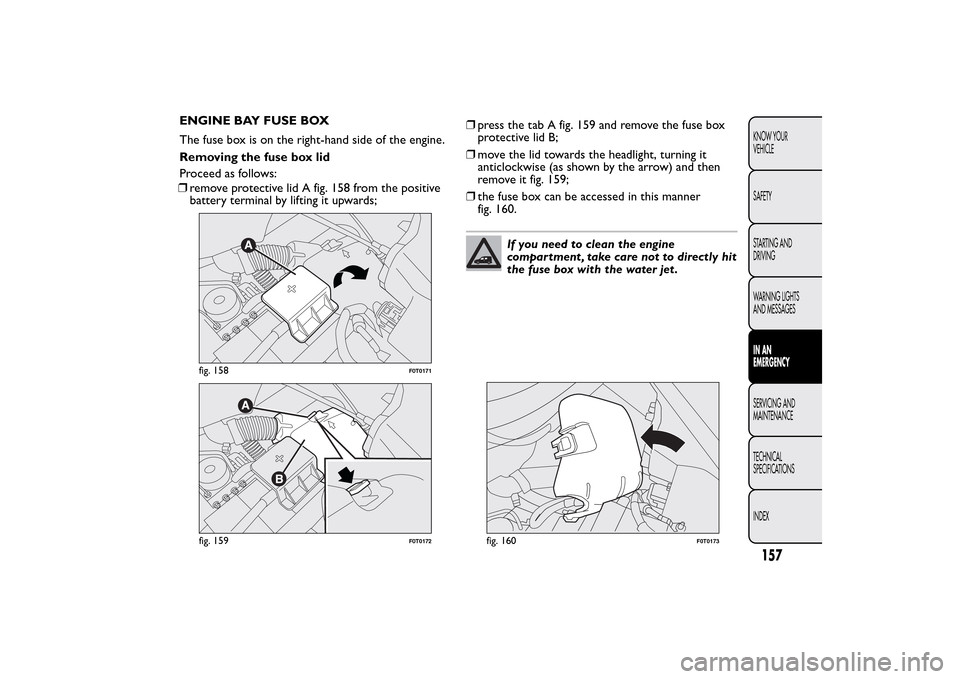
Proceed as follows:
❒remove protective lid A fig. 158 from the positive
battery terminal by lifting it upwards;❒press the tab A fig. 159 and remove the fuse box
protective lid B;
❒move the lid towards the headlight, turning it
anticlockwise (as shown by the arrow) and then
remove it fig. 159;
❒the fuse box can be accessed in this manner
fig. 160.
If you need to clean the engine
compartment , take care not to directly hit
the fuse box with the water jet .
fig. 158
F0T0171
fig. 159
F0T0172
fig. 160
F0T0173
157KNOW YOUR
VEHICLE
SAFETY
STARTING AND
DRIVING
WARNING LIGHTS
AND MESSAGESIN AN
EMERGENCYSERVICING AND
MAINTENANCE
TECHNICAL
SPECIFICATIONS
INDEX
Page 168 of 231
RECHARGING THE BATTERYIMPORTANT The battery recharging procedure is
provided for information purposes only. You are
recommended to go to a Fiat Dealership to have this
operation performed.
We recommend recharging the battery slowly for
approximately 24 hours at low amperage. A
prolonged recharge might damage the battery.
Charge the battery as follows:
❒disconnect battery negative terminal;
❒connect the charger cables to the battery
terminals, observing the polarity;
❒turn on the charger;
❒when you have finished, turn the charger off before
disconnecting it from the battery;
❒reconnect battery negative terminal.
WARNING
Battery fluid is poisonous and corrosive:
avoid contact with your skin and eyes.
The batter y must be recharged in a ventilated
place away from naked flames or possible
sources of sparks to avoid the risk of explosion
and fire.
WARNING
Do not tr y to recharge a frozen batter y;
defrost it first to prevent the risk of
explosion. If the battery was frozen, have it
inspected by specialised personnel before
recharging to check that the internal elements
are not damaged and that the casing is not
cracked, which could cause poisonous, corrosive
acid to leak.
164KNOW YOUR
VEHICLE
SAFETY
STARTING AND
DRIVING
WARNING LIGHTS
AND MESSAGES
IN AN
EMERGENCY
SERVICING AND
MAINTENANCE
TECHNICAL
SPECIFICATIONS
INDEX
Page 174 of 231
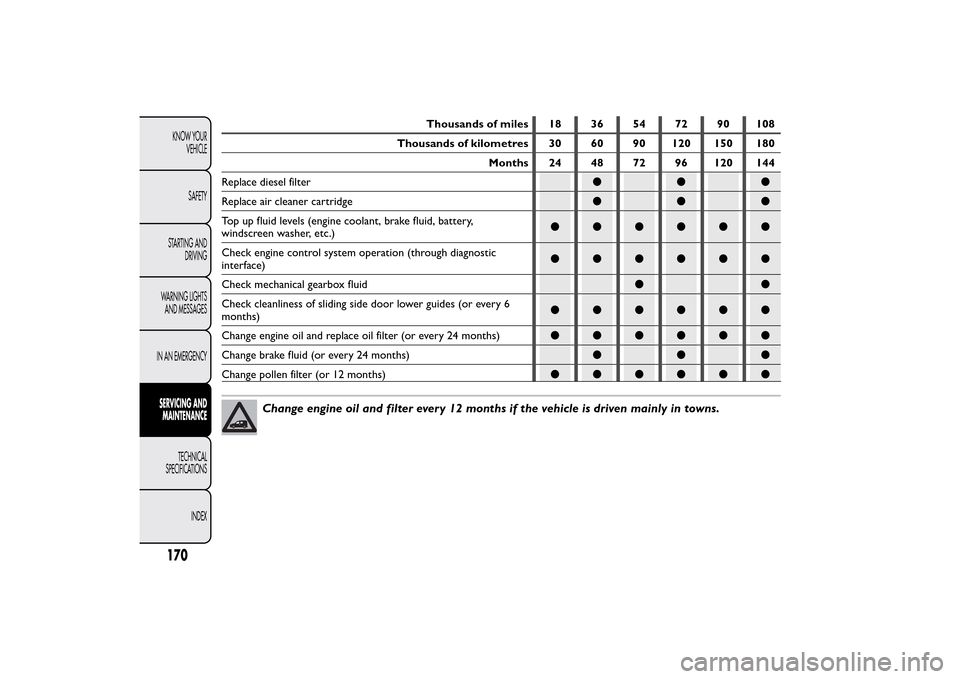
Thousands of miles 18 36 54 72 90 108
Thousands of kilometres 30 60 90 120 150 180
Months 24 48 72 96 120 144
Replace diesel filter●●●
Replace air cleaner cartridge●●●
Top up fluid levels (engine coolant, brake fluid, battery,
windscreen washer, etc.)●●●●●●
Check engine control system operation (through diagnostic
interface)●●●●●●
Check mechanical gearbox fluid●●
Check cleanliness of sliding side door lower guides (or every 6
months)●●●●●●
Change engine oil and replace oil filter (or every 24 months)●●●●●●
Change brake fluid (or every 24 months)●●●
Change pollen filter (or 12 months)●●●●●●
Change engine oil and filter ever y 12 months if the vehicle is driven mainly in towns.
170KNOW YOUR
VEHICLE
SAFETY
STARTING AND
DRIVING
WARNING LIGHTS
AND MESSAGES
IN AN EMERGENCY
SERVICING AND
MAINTENANCE
TECHNICAL
SPECIFICATIONS
INDEX
Page 176 of 231
❒visually inspect conditions of: engine, gearbox,
transmission, pipes and hoses (exhaust - fuel
system - brakes) and rubber elements (boots -
sleeves - bushes - etc.);
❒check battery charge status and fluid (electrolyte)
level (refer to "Battery - Check state of charge
and electrolyte level" paragraph in this chapter);
❒visually inspect condition of the auxiliary drive
belts;
❒check and, if necessary, replace pollen filter, in
particular it should be replaced if there is a
noticeable decrease in the passenger compartment
air intake flow rate.
❒check and, if necessary, replace air filter.
CHECKING LEVELS
When topping up, take care not to mix up
the various types of fluids: they are not
compatible with each other and could
seriously damage the vehicle.
WARNING
Never smoke while working in the
engine compar tment : inflammable gases
and vapours may be present , constituting a fire
risk.
172KNOW YOUR
VEHICLE
SAFETY
STARTING AND
DRIVING
WARNING LIGHTS
AND MESSAGES
IN AN EMERGENCY
SERVICING AND
MAINTENANCE
TECHNICAL
SPECIFICATIONS
INDEX
Page 177 of 231
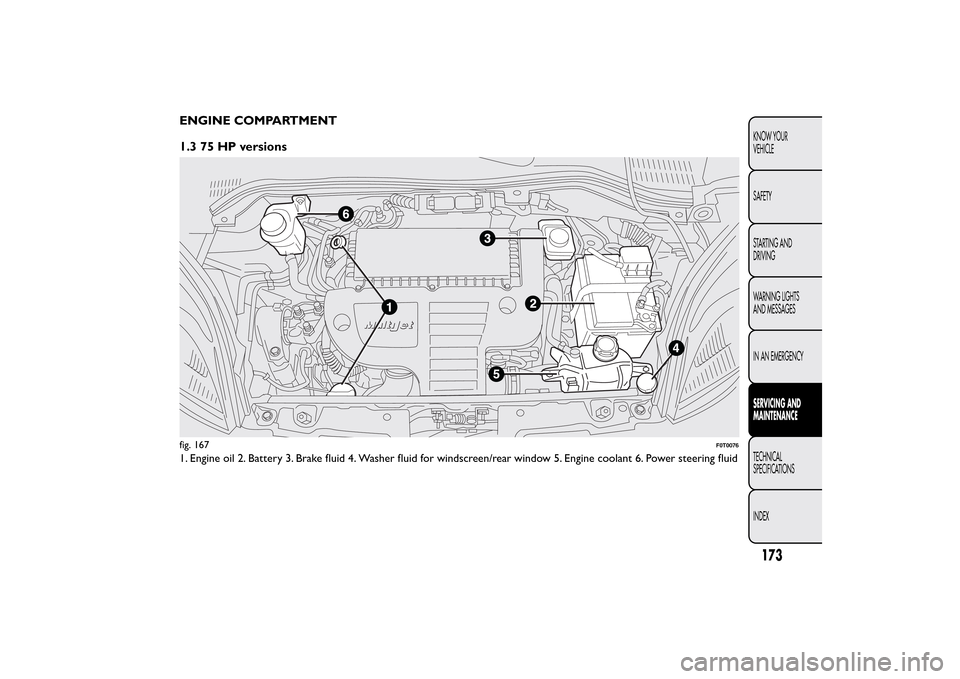
ENGINE COMPARTMENT
1.3 75 HP versions1. Engine oil 2. Battery 3. Brake fluid 4. Washer fluid for windscreen/rear window 5. Engine coolant 6. Power steering fluidfig. 167
F0T0076
173KNOW YOUR
VEHICLE
SAFETY
STARTING AND
DRIVING
WARNING LIGHTS
AND MESSAGES
IN AN EMERGENCYSERVICING AND
MAINTENANCETECHNICAL
SPECIFICATIONS
INDEX
Page 184 of 231
AIR CLEANER/ POLLEN FILTERHave the air cleaner or the pollen filter replaced by a
Fiat Dealership.
BATTERYThe battery is of the “limited maintenance” type:
under normal conditions of use, the electrolyte does
not need topping up with distilled water.
It does, however, need to be checked regularly at a
Fiat Dealership or by specialist personnel to make
sure it is working properly.
WARNING
The battery fluid is poisonous and
corrosive. Avoid contact with the skin
and eyes. Keep naked flames and sources of
sparks away from the battery: risk of explosion
and fire.
WARNING
Running the battery with an excessively
low liquid level will damage the battery
beyond repair and even cause an explosion.
REPLACING THE BATTERY
If required, replace the battery with an original spare
part with the same specifications.
If a battery with different specifications is fitted, the
service intervals given in the “Scheduled Servicing
Plan” will no longer be valid.
180KNOW YOUR
VEHICLE
SAFETY
STARTING AND
DRIVING
WARNING LIGHTS
AND MESSAGES
IN AN EMERGENCY
SERVICING AND
MAINTENANCE
TECHNICAL
SPECIFICATIONS
INDEX