belt FIAT QUBO 2015 1.G User Guide
[x] Cancel search | Manufacturer: FIAT, Model Year: 2015, Model line: QUBO, Model: FIAT QUBO 2015 1.GPages: 231, PDF Size: 5.01 MB
Page 96 of 231
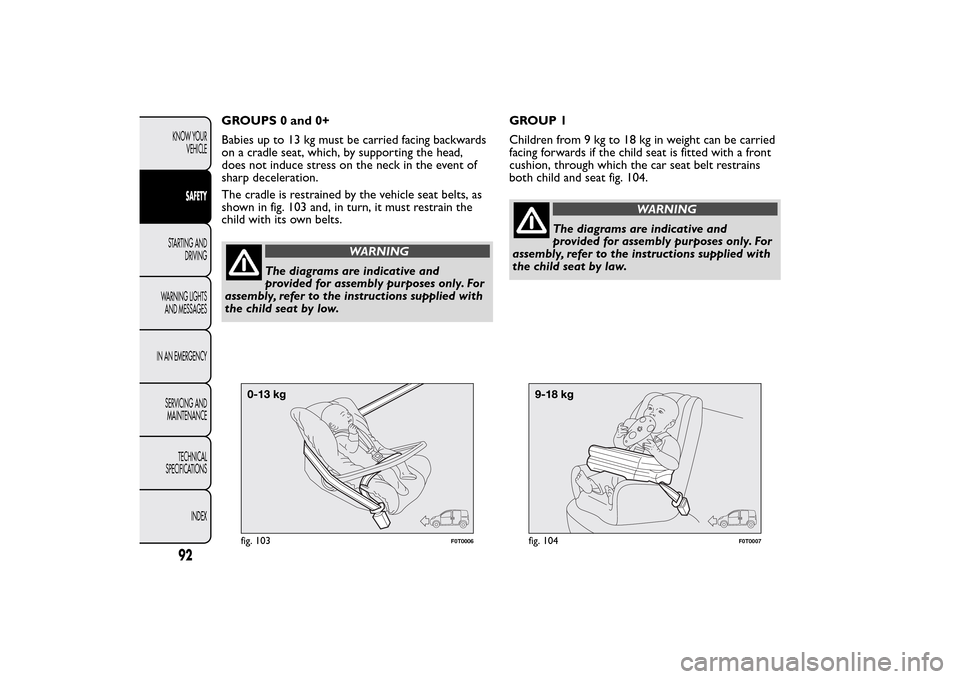
GROUPS 0 and 0+
Babies up to 13 kg must be carried facing backwards
on a cradle seat, which, by supporting the head,
does not induce stress on the neck in the event of
sharp deceleration.
The cradle is restrained by the vehicle seat belts, as
shown in fig. 103 and, in turn, it must restrain the
child with its own belts.
WARNING
The diagrams are indicative and
provided for assembly purposes only. For
assembly, refer to the instructions supplied with
the child seat by low.GROUP 1
Children from 9 kg to 18 kg in weight can be carried
facing forwards if the child seat is fitted with a front
cushion, through which the car seat belt restrains
both child and seat fig. 104.
WARNING
The diagrams are indicative and
provided for assembly purposes only. For
assembly, refer to the instructions supplied with
the child seat by law.
fig. 103
F0T0006
fig. 104
F0T0007
92KNOW YOUR
VEHICLE
SAFETY
STARTING AND
DRIVING
WARNING LIGHTS
AND MESSAGES
IN AN EMERGENCY
SERVICING AND
MAINTENANCE
TECHNICAL
SPECIFICATIONS
INDEX
Page 97 of 231
WARNING
Some child restraint systems for weight
groups 0 and 1 have a rear attachment
to the car seat belts and their own seat belts for
securing the child. Due to their weight , they
may be dangerous if incorrectly mounted (e.g. if
fastened to the vehicle seat belts placing a
cushion in between). Follow the assembly
instructions carefully.
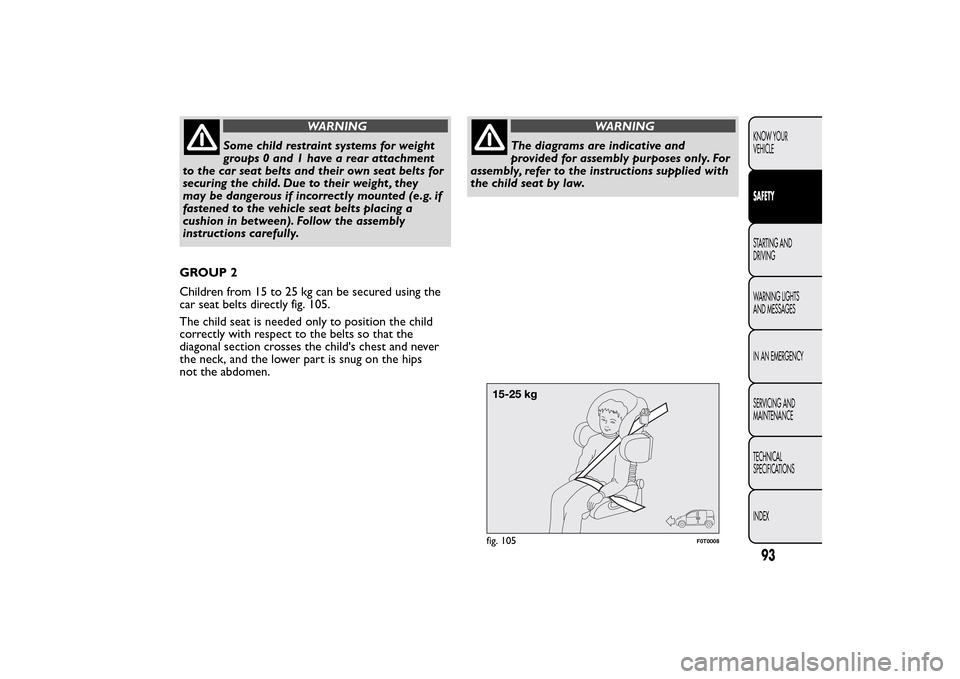
GROUP 2
Children from 15 to 25 kg can be secured using the
car seat belts directly fig. 105.
The child seat is needed only to position the child
correctly with respect to the belts so that the
diagonal section crosses the child's chest and never
the neck, and the lower part is snug on the hips
not the abdomen.
WARNING
The diagrams are indicative and
provided for assembly purposes only. For
assembly, refer to the instructions supplied with
the child seat by law.
fig. 105
F0T0008
93KNOW YOUR
VEHICLESAFETYSTARTING AND
DRIVING
WARNING LIGHTS
AND MESSAGES
IN AN EMERGENCY
SERVICING AND
MAINTENANCE
TECHNICAL
SPECIFICATIONS
INDEX
Page 98 of 231
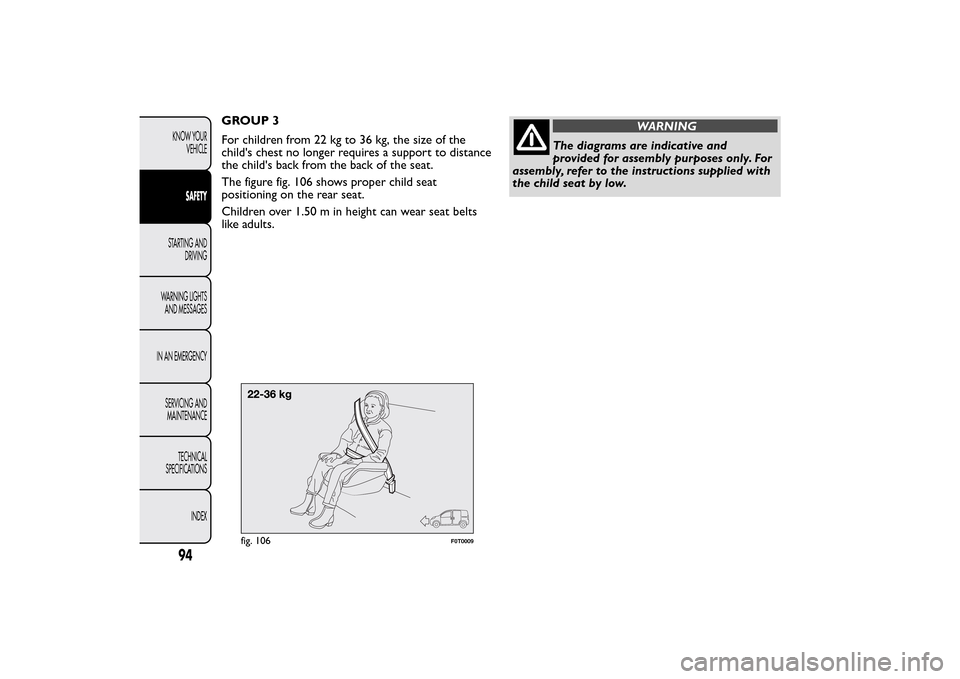
GROUP 3
For children from 22 kg to 36 kg, the size of the
child's chest no longer requires a support to distance
the child's back from the back of the seat.
The figure fig. 106 shows proper child seat
positioning on the rear seat.
Children over 1.50 m in height can wear seat belts
like adults.
WARNING
The diagrams are indicative and
provided for assembly purposes only. For
assembly, refer to the instructions supplied with
the child seat by low.
fig. 106
F0T0009
94KNOW YOUR
VEHICLE
SAFETY
STARTING AND
DRIVING
WARNING LIGHTS
AND MESSAGES
IN AN EMERGENCY
SERVICING AND
MAINTENANCE
TECHNICAL
SPECIFICATIONS
INDEX
Page 100 of 231
Below is a summary of the rules of safety to
be followed when carrying children:
❒Install the child seats on the rear seat, which is the
most protected position in the event of an
accident.
❒If the passenger's air bag is deactivated, always
check the amber warning light
on the
instrument panel to make sure that it has actually
been deactivated.
❒Carefully follow the instructions that came with
the child seat, which the manufacturer must supply
by law. Keep the instructions in the vehicle along
with the other papers and this handbook. Do
not use child seats without instructions.
❒Always check the seat belt is well fastened by
pulling on it.
❒Only one child is to be strapped into each seat;
never carry two children using one child seat.
❒Always check the seat belts do not rest on the
child's neck.
❒While travelling, do not let the child sit incorrectly
or release the belts.
❒Never carry children on your lap, even newborns.
No-one can hold a child in the event of an
accident.
❒In the event of an accident, replace the child seat
with a new one.
WARNING
Do not arrange child seats on the front
seat in cars fitted with passenger's air
bag. Children must never travel on the front
seat .
96KNOW YOUR
VEHICLE
SAFETY
STARTING AND
DRIVING
WARNING LIGHTS
AND MESSAGES
IN AN EMERGENCY
SERVICING AND
MAINTENANCE
TECHNICAL
SPECIFICATIONS
INDEX
Page 101 of 231
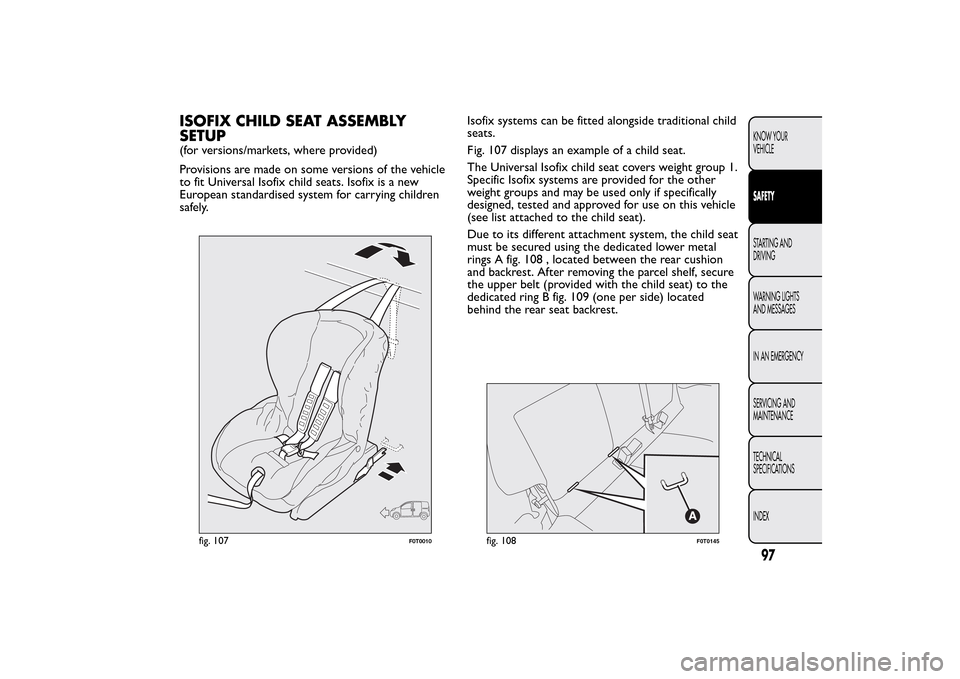
ISOFIX CHILD SEAT ASSEMBLY
SETUP(for versions/markets, where provided)
Provisions are made on some versions of the vehicle
to fit Universal Isofix child seats. Isofix is a new
European standardised system for carrying children
safely.Isofix systems can be fitted alongside traditional child
seats.
ig. 107 displays an example of a child seat.
The Universal Isofix child seat covers weight group 1.
Specific Isofix systems are provided for the other
weight groups and may be used only if specifically
designed, tested and approved for use on this vehicle
(see list attached to the child seat).
Due to its different attachment system, the child seat
must be secured using the dedicated lower metal
rings A fig. 108 , located between the rear cushion
and backrest. After removing the parcel shelf, secure
the upper belt (provided with the child seat) to the
dedicated ring B fig. 109 (one per side) located
behind the rear seat backrest.
fig. 107
F0T0010
fig. 108
F0T0145
97KNOW YOUR
VEHICLESAFETYSTARTING AND
DRIVING
WARNING LIGHTS
AND MESSAGES
IN AN EMERGENCY
SERVICING AND
MAINTENANCE
TECHNICAL
SPECIFICATIONS
INDEX
F
Page 104 of 231
FRONT AIRBAGSThe vehicle is fitted with front airbags for driver and
passenger (for versions/markets where provided).
The front driver/passenger airbags (for versions/
markets, where provided) are designed to protect
the front-seat occupants in the event of head-on
crashes of medium-high severity, by placing the bag
between the occupant and the steering wheel or
dashboard.
Non-activation in other types of crash (side-on
collisions, rear shunts, roll-overs, etc.) is therefore
not a sign of system malfunction.
An electronic control unit causes the bag to inflate, if
necessary, in the event of a head-on crash.The bag will inflate instantaneously, placing itself
between the front occupant's body and the
structures which could cause injury. It will deflate
immediately afterwards.
Front driver/passenger airbags (for versions/markets,
where provided) are not a replacement for, but
rather a complement to, the seat belts, which should
be worn at all times as specified by law in Europe
and most non-European countries.
In the event of an impact, those not wearing a seat
belt will move forward and come into contact with
the bag which is still inflating. The protection offered
by the bag is compromised in these circumstances.
Front airbags may not be activated in the following
situations:
❒head-on impacts against highly deformable objects
that do not affect the front surface of the vehicle
(e.g. front wing hitting a guard rail);
❒jamming of the vehicle underneath other vehicles
or protective barriers (e.g. underneath a truck or
a guard rail); in this case, the bags would offer
no additional protection with respect to the seat
belt and their deployment is unnecessary. Lack
of deployment in such cases is consequently not
the sign of a fault.
100KNOW YOUR
VEHICLE
SAFETY
STARTING AND
DRIVING
WARNING LIGHTS
AND MESSAGES
IN AN EMERGENCY
SERVICING AND
MAINTENANCE
TECHNICAL
SPECIFICATIONS
INDEX
Page 105 of 231
WARNING
Do not apply stickers or other objects to
the steering wheel, the dashboard in
the passenger side airbag area and the seats.
Do not place objects (e.g. mobile phones) on the
passenger side dashboard because these could
interfere with the correct opening of the airbag
and cause severe injur y to occupants.The front driver and passenger airbags are designed
and calibrated to best protect front-seat passengers
wearing seat belts. The volume of the front airbags at
maximum inflation fills most of the space between
the steering wheel and the driver and between
the dashboard and the passenger.
The airbags are not deployed in the event of small
head-on collisions (for which the withholding action
of the seat belts is sufficient). Seat belts must always
be worn. In the event of head-on collisions, they
ensure the correct positioning of the occupant.
101KNOW YOUR
VEHICLESAFETYSTARTING AND
DRIVING
WARNING LIGHTS
AND MESSAGES
IN AN EMERGENCY
SERVICING AND
MAINTENANCE
TECHNICAL
SPECIFICATIONS
INDEX
Page 107 of 231
MANUAL DEACTIVATION OF
PASSENGER'S FRONT AIRBAG AND SIDE
BAG
(for versions/markets, where provided)
Whenever a child needs to be carried on the front
seat, the passenger's front airbag and side bags
(for versions/markets where provided) can be
deactivated.
The warning light
on the instrument panel stays
on until the passenger's front airbag and side bags
(for versions/markets where provided) are
reactivated.
IMPORTANT Refer to "Digital display" and
“Multifunction display” in the “Know your vehicle”
section to manually deactivate the passenger's front
airbag and side bags (for versions/markets, where
provided).
SIDE BAGS(for versions/markets, where provided)
On some versions, the vehicle may be fitted with
driver and passenger's front side bags.
Side bags protect occupants from side-on crashes of
medium/high severity by placing the bag between
the occupant and the internal parts of the side
structure of the vehicle.
Non-activation of side bags in other types of
collisions (head-on collisions, rear shunts, roll-overs,
etc...) is not an indication of system malfunction.
An electronic control unit causes the bags to inflate
in the event of a side-on collision. The bags inflate
instantaneously, placing themselves between the
occupant's body and the structures which could
cause injury. They deflate immediately afterwards.
Side bags are not a replacement of, but rather a
complement to, seat belts, which you are
recommended to wear at all times, as specified by
law in Europe and most non-European countries.
For this reason, the seat belt must be worn at all
times. In the case of side-on collisions, the seat belts
hold occupants in the correct position and prevent
them from being thrown out of the car by a very
violent collision.
103KNOW YOUR
VEHICLESAFETYSTARTING AND
DRIVING
WARNING LIGHTS
AND MESSAGES
IN AN EMERGENCY
SERVICING AND
MAINTENANCE
TECHNICAL
SPECIFICATIONS
INDEX
Page 110 of 231
WARNING
Airbags may be deployed if another
vehicle crashes into yours if the key is
inserted and on, even if the engine is not
running and your vehicle is standing. For this
reason, children must never sit on the front
seat , even if when standing. On the other hand,
if the key is inser ted and at STOP, none of the
safety devices (airbag or pretensioners) will
be deployed in a collision. Non-deployment of
the devices in this case does not indicate a
system fault .
WARNING
Have the airbag system checked by a
Fiat Dealership if the car was stolen, if
theft was attempted, or if the car was subjected
to vandalism or flooding.
WARNING
When the ignition key is turned to MAR,
the warning light
(with passenger's
front airbag activated) comes on and flashes for
a few seconds to remind you that the
passenger's airbag will be deployed in a crash,
after which it should go off.
WARNING
The airbag deployment threshold is
higher than that of the pretensioners.
For collisions in the range between the two
thresholds, it is normal for only the
pretensioners to be activated.
WARNING
Airbags do not replace seat belts, but
increase their efficiency. Furthermore,
since front airbags are not deployed in
low-speed head-on collisions, side-on impacts,
rear-end shunts or roll-overs, the passengers are
protected only by the seat belts which must
therefore be fastened at all times.
106KNOW YOUR
VEHICLE
SAFETY
STARTING AND
DRIVING
WARNING LIGHTS
AND MESSAGES
IN AN EMERGENCY
SERVICING AND
MAINTENANCE
TECHNICAL
SPECIFICATIONS
INDEX
Page 126 of 231
LOW ENGINE OIL PRESSURE (red)
When the ignition key is turned to MAR, the warning
light switches on, but it should go out as soon as
the engine is started.
The warning light turns on and stays on constantly
(in versions/markets, where provided) along with the
message on the display when the system detects
that engine oil pressure is low.
WARNING
If the warning light
turns on when
the car is travelling (on certain versions
together with the message on the display) stop
the engine immediately and contact a Fiat
Dealership.
SEAT BELT REMINDER (red)
The warning light on the panel comes on steadily
when the vehicle is stationary and the driver's seat
belt is not correctly fastened. It will flash, and be
accompanied by an audible warning, if the front seat
belts are not correctly fastened when the vehicle
is moving.The SBR (Seat Belt Reminder) acoustic warning tone
can be disabled only by a Fiat Dealership.
On some versions, the system can be reactivated
from the setup menu.
DOOR OPEN (red)
On certain versions, the warning light turns on when
one or more doors or the boot are not properly
closed.
A specific message is displayed on certain versions.LOW ENGINE OIL LEVEL (red)
When turning the ignition key to MAR, the warning
light turns on but it should go off after a few
seconds.
This warning light appears on the panel when the
engine oil level falls below the minimum
recommended value. Restore the correct engine oil
level (see “Checking fluid levels” in the "Servicing and
care" section).
A specific message is displayed on certain versions.
122KNOW YOUR
VEHICLE
SAFETY
STARTING AND
DRIVING
WARNING LIGHTS
AND MESSAGESIN AN EMERGENCY
SERVICING AND
MAINTENANCE
TECHNICAL
SPECIFICATIONS
INDEX