wheel FIAT QUBO 2015 1.G User Guide
[x] Cancel search | Manufacturer: FIAT, Model Year: 2015, Model line: QUBO, Model: FIAT QUBO 2015 1.GPages: 231, PDF Size: 5.01 MB
Page 77 of 231
ASR SYSTEM (Anti-Slip Regulation)
(for versions/markets, where provided)
This is a traction control system that cuts in
automatically every time one or both drive wheels
slip.
Depending on how slippery the road is, two different
control systems are activated:
❒if slipping involves both driving wheels, the ASR
function intervenes reducing the power
transmitted by the engine;
❒if the slipping only involves one of the drive
wheels, it intervenes automatically braking the
wheel that is slipping.
The action of the ASR system is especially useful in
the following conditions:
❒slipping of the inner wheel round bends due to
dynamic variations in the load of excessive
acceleration;
❒excessive power transmitted to the wheels, also in
relation to road surface conditions;
❒acceleration on slippery, snowy or icy road
surfaces;
❒in the case of loss of grip on a wet surface
(aquaplaning).
WARNING
For the correct operation of the ESP and
ASR systems, the tyres must be the
same make and type on all wheels, in perfect
condition and, above all, of the type, make and
size recommended.
MSR SYSTEM (engine drive regulation)
This is an integral part of the ASR system that, in the
event of a sudden gear down shift, cuts in and
provides torque to the engine thus preventing
excessive drive wheel drive which, especially in poor
grip conditions, can lead to a loss of stability.
73KNOW YOUR
VEHICLESAFETY
STARTING AND
DRIVING
WARNING LIGHTS
AND MESSAGES
IN AN EMERGENCY
SERVICING AND
MAINTENANCE
TECHNICAL
SPECIFICATIONS
INDEX
Page 78 of 231
Engagement/ disengagement of the ASR
system
The ASR system switches on automatically each time
the engine is started.
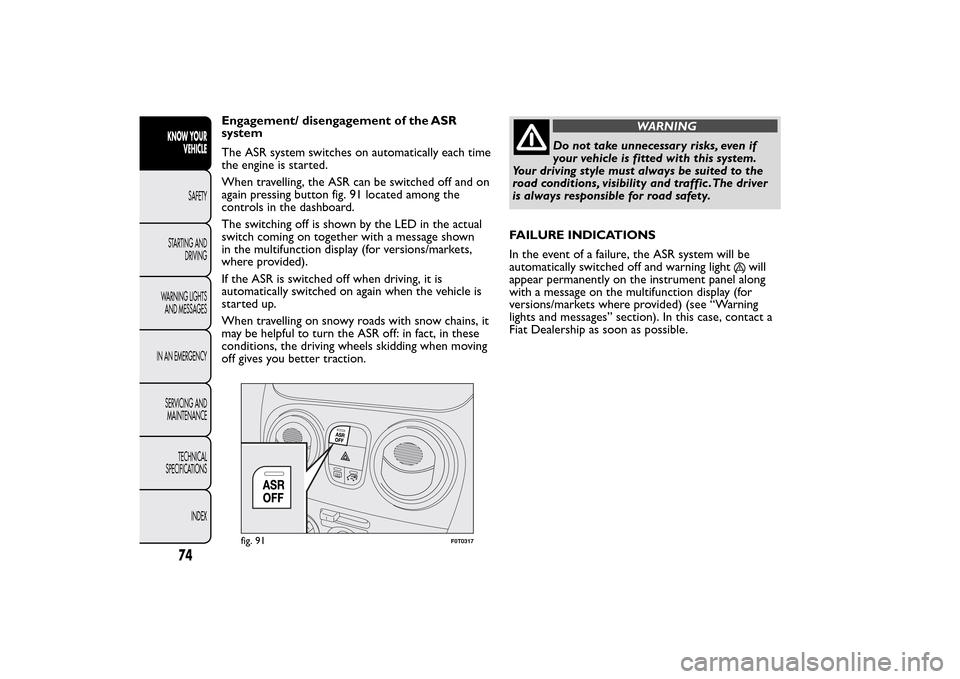
When travelling, the ASR can be switched off and on
again pressing button fig. 91 located among the
controls in the dashboard.
The switching off is shown by the LED in the actual
switch coming on together with a message shown
in the multifunction display (for versions/markets,
where provided).
If the ASR is switched off when driving, it is
automatically switched on again when the vehicle is
started up.
When travelling on snowy roads with snow chains, it
may be helpful to turn the ASR off: in fact, in these
conditions, the driving wheels skidding when moving
off gives you better traction.
WARNING
Do not take unnecessary risks, even if
your vehicle is fitted with this system.
Your driving style must always be suited to the
road conditions, visibility and traffic .The driver
is always responsible for road safety.
FAILURE INDICATIONS
In the event of a failure, the ASR system will be
automatically switched off and warning light
will
appear permanently on the instrument panel along
with a message on the multifunction display (for
versions/markets where provided) (see “Warning
lights and messages” section). In this case, contact a
Fiat Dealership as soon as possible.
fig. 91
F0T0317
74KNOW YOUR
VEHICLE
SAFETY
STARTING AND
DRIVING
WARNING LIGHTS
AND MESSAGES
IN AN EMERGENCY
SERVICING AND
MAINTENANCE
TECHNICAL
SPECIFICATIONS
INDEX
Page 79 of 231
TRACTION PLUS SYSTEM(for versions/markets, where provided)
Traction Plus is a help with driving and setting off in
poor grip conditions (snow, ice, mud, etc.) which
allows the drive force to be evenly distributed over
the same axle when both wheels are slipping.
In effect, Traction Plus acts by braking the wheels
with poor grip (or those slipping more than the
others), thereby transferring the drive force to those
which have more grip on the ground.
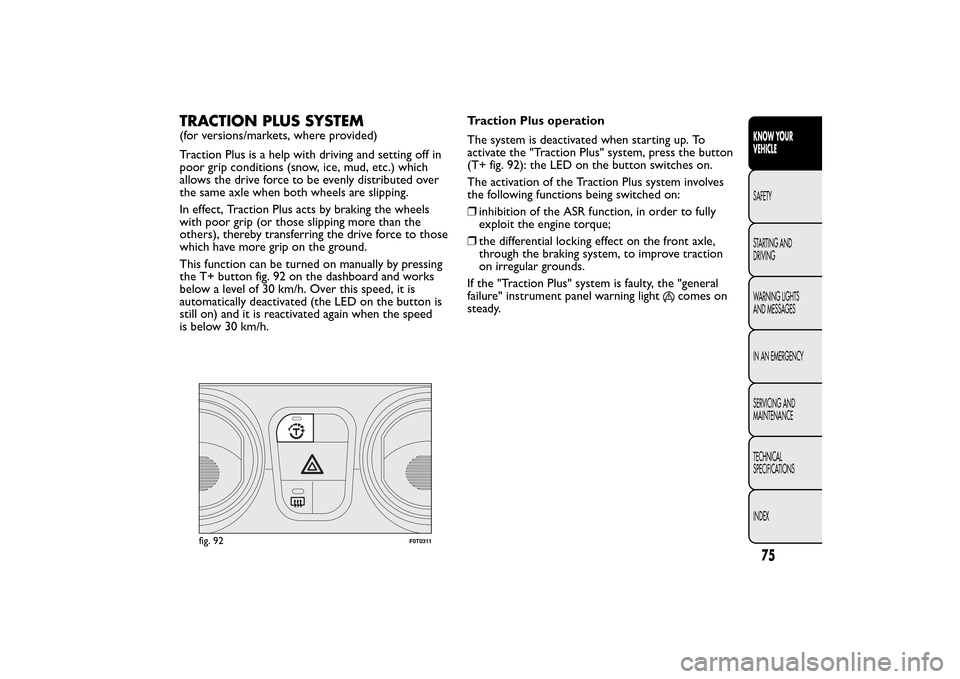
This function can be turned on manually by pressing
the T+ button fig. 92 on the dashboard and works
below a level of 30 km/h. Over this speed, it is
automatically deactivated (the LED on the button is
still on) and it is reactivated again when the speed
is below 30 km/h.Traction Plus operation
The system is deactivated when starting up. To
activate the "Traction Plus" system, press the button
(T+ fig. 92): the LED on the button switches on.
The activation of the Traction Plus system involves
the following functions being switched on:
❒inhibition of the ASR function, in order to fully
exploit the engine torque;
❒the differential locking effect on the front axle,
through the braking system, to improve traction
on irregular grounds.
If the "Traction Plus" system is faulty, the "general
failure" instrument panel warning light
comes on
steady.
fig. 92
F0T0311
75KNOW YOUR
VEHICLESAFETY
STARTING AND
DRIVING
WARNING LIGHTS
AND MESSAGES
IN AN EMERGENCY
SERVICING AND
MAINTENANCE
TECHNICAL
SPECIFICATIONS
INDEX
Page 104 of 231
FRONT AIRBAGSThe vehicle is fitted with front airbags for driver and
passenger (for versions/markets where provided).
The front driver/passenger airbags (for versions/
markets, where provided) are designed to protect
the front-seat occupants in the event of head-on
crashes of medium-high severity, by placing the bag
between the occupant and the steering wheel or
dashboard.
Non-activation in other types of crash (side-on
collisions, rear shunts, roll-overs, etc.) is therefore
not a sign of system malfunction.
An electronic control unit causes the bag to inflate, if
necessary, in the event of a head-on crash.The bag will inflate instantaneously, placing itself
between the front occupant's body and the
structures which could cause injury. It will deflate
immediately afterwards.
Front driver/passenger airbags (for versions/markets,
where provided) are not a replacement for, but
rather a complement to, the seat belts, which should
be worn at all times as specified by law in Europe
and most non-European countries.
In the event of an impact, those not wearing a seat
belt will move forward and come into contact with
the bag which is still inflating. The protection offered
by the bag is compromised in these circumstances.
Front airbags may not be activated in the following
situations:
❒head-on impacts against highly deformable objects
that do not affect the front surface of the vehicle
(e.g. front wing hitting a guard rail);
❒jamming of the vehicle underneath other vehicles
or protective barriers (e.g. underneath a truck or
a guard rail); in this case, the bags would offer
no additional protection with respect to the seat
belt and their deployment is unnecessary. Lack
of deployment in such cases is consequently not
the sign of a fault.
100KNOW YOUR
VEHICLE
SAFETY
STARTING AND
DRIVING
WARNING LIGHTS
AND MESSAGES
IN AN EMERGENCY
SERVICING AND
MAINTENANCE
TECHNICAL
SPECIFICATIONS
INDEX
Page 105 of 231
WARNING
Do not apply stickers or other objects to
the steering wheel, the dashboard in
the passenger side airbag area and the seats.
Do not place objects (e.g. mobile phones) on the
passenger side dashboard because these could
interfere with the correct opening of the airbag
and cause severe injur y to occupants.The front driver and passenger airbags are designed
and calibrated to best protect front-seat passengers
wearing seat belts. The volume of the front airbags at
maximum inflation fills most of the space between
the steering wheel and the driver and between
the dashboard and the passenger.
The airbags are not deployed in the event of small
head-on collisions (for which the withholding action
of the seat belts is sufficient). Seat belts must always
be worn. In the event of head-on collisions, they
ensure the correct positioning of the occupant.
101KNOW YOUR
VEHICLESAFETYSTARTING AND
DRIVING
WARNING LIGHTS
AND MESSAGES
IN AN EMERGENCY
SERVICING AND
MAINTENANCE
TECHNICAL
SPECIFICATIONS
INDEX
Page 106 of 231
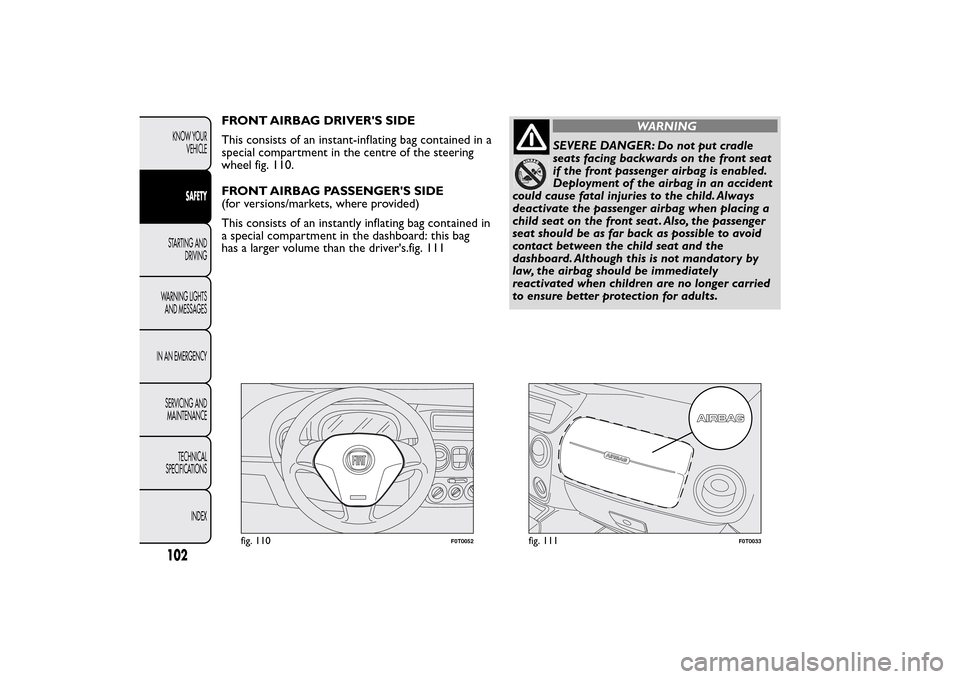
FRONT AIRBAG DRIVER'S SIDE
This consists of an instant-inflating bag contained in a
special compartment in the centre of the steering
wheel fig. 110.
FRONT AIRBAG PASSENGER'S SIDE
(for versions/markets, where provided)
This consists of an instantly inflating bag contained in
a special compartment in the dashboard: this bag
has a larger volume than the driver's.fig. 111
WARNING
SEVERE DANGER: Do not put cradle
seats facing backwards on the front seat
if the front passenger airbag is enabled.
Deployment of the airbag in an accident
could cause fatal injuries to the child. Always
deactivate the passenger airbag when placing a
child seat on the front seat . Also, the passenger
seat should be as far back as possible to avoid
contact between the child seat and the
dashboard. Although this is not mandatory by
law, the airbag should be immediately
reactivated when children are no longer carried
to ensure better protection for adults.
fig. 110
F0T0052
fig. 111
F0T0033
102KNOW YOUR
VEHICLE
SAFETY
STARTING AND
DRIVING
WARNING LIGHTS
AND MESSAGES
IN AN EMERGENCY
SERVICING AND
MAINTENANCE
TECHNICAL
SPECIFICATIONS
INDEX
Page 111 of 231
STARTING AND DRIVING
STARTING THE ENGINEThe vehicle is fitted with an immobiliser: if the engine
fails to start, see the paragraph on “The Fiat CODE
system” in the “Knowing your vehicle” section.
The engine may be noisier during the first few
seconds of operation, particularly after a long period
of inactivity. This is due to the hydraulic tappets,
the timing system chosen for petrol engine versions
to reduce the number of servicing interventions,
and affects neither functionality nor reliability.
It is advisable not to demand maximum
performance from your vehicle (e.g.
excessive acceleration, long distances at
high speeds, excessive intense braking, etc .) during
the initial period of use.When the engine is switched off never
leave the key on (at MAR) to prevent
unnecessary consumption and draining
the battery.
WARNING
It is dangerous to have the engine
running indoors.The engine takes in
oxygen and discharges carbon dioxide, carbon
monoxide and other toxic gases.
WARNING
Remember that the brake booster and
electric power steering are not
operational until the engine has been started,
so you need to apply much more force than
usual to the brake pedal and steering wheel.
STARTING PROCEDURE FOR DIESEL
VERSIONS
Proceed as follows:
❒apply the handbrake;
❒put the gear lever into neutral;
❒turn the key on (MAR position): instrument panel
warning light
will light up;
❒wait for the warning lights
and
to go out.
The hotter the engine is, the quicker this will
happen;
107KNOW YOUR
VEHICLE
SAFETYSTARTING AND
DRIVINGWARNING LIGHTS
AND MESSAGES
IN AN EMERGENCY
SERVICING AND
MAINTENANCE
TECHNICAL
SPECIFICATIONS
INDEX
Page 115 of 231
PARKING THE CAR
Proceed as follows:
❒stop the engine and engage the handbrake;
❒engage a gear (1
stgear if parked uphill or reverse if
facing downhill) and leave the wheels turned.
If the vehicle is parked on a steep slope, it is
advisable to block the wheels with a wedge or stone.
To prevent draining the battery, do not leave the
ignition key turned to MAR. Always remove the key
when you leave the vehicle.
Never leave children unattended in the vehicle.
Always remove the ignition key when leaving the
vehicle, and take it with you.
SNOW TYRESA Fiat Dealership will be happy to provide advice
concerning the most suitable type of tyre for your
requirements.
For the type, pressures and specifications of the
snow tyre to be used, follow carefully the
instructions given in the “Wheels” paragraph of the
“Technical specifications” section.
The winter performance of these tyres is
considerably reduced when the tread thickness is less
than 4 mm. If this is the case, replace them.
Due to their specific features, the performance of
snow tyres is much lower than that of standard tyres
in normal conditions or on long motorway stretches.
You should therefore use them only in the
conditions for which they were designed.
111KNOW YOUR
VEHICLE
SAFETYSTARTING AND
DRIVINGWARNING LIGHTS
AND MESSAGES
IN AN EMERGENCY
SERVICING AND
MAINTENANCE
TECHNICAL
SPECIFICATIONS
INDEX
Page 120 of 231
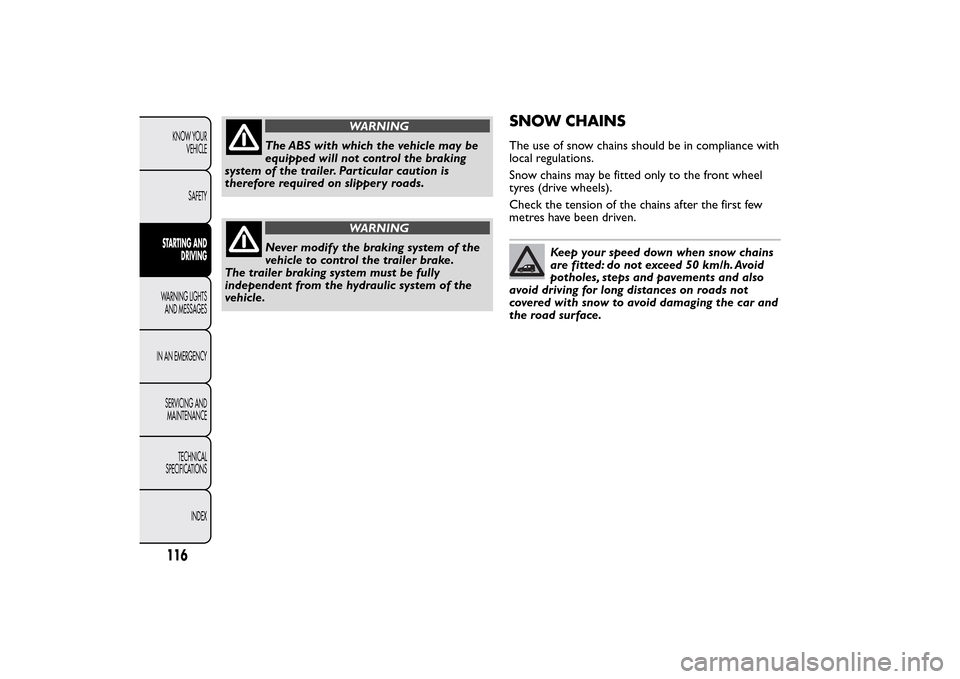
WARNING
The ABS with which the vehicle may be
equipped will not control the braking
system of the trailer. Particular caution is
therefore required on slippery roads.
WARNING
Never modify the braking system of the
vehicle to control the trailer brake.
The trailer braking system must be fully
independent from the hydraulic system of the
vehicle.
SNOW CHAINSThe use of snow chains should be in compliance with
local regulations.
Snow chains may be fitted only to the front wheel
tyres (drive wheels).
Check the tension of the chains after the first few
metres have been driven.
Keep your speed down when snow chains
are fitted: do not exceed 50 km/h. Avoid
potholes, steps and pavements and also
avoid driving for long distances on roads not
covered with snow to avoid damaging the car and
the road surface.
116KNOW YOUR
VEHICLE
SAFETYSTARTING AND
DRIVINGWARNING LIGHTS
AND MESSAGES
IN AN EMERGENCY
SERVICING AND
MAINTENANCE
TECHNICAL
SPECIFICATIONS
INDEX
Page 125 of 231
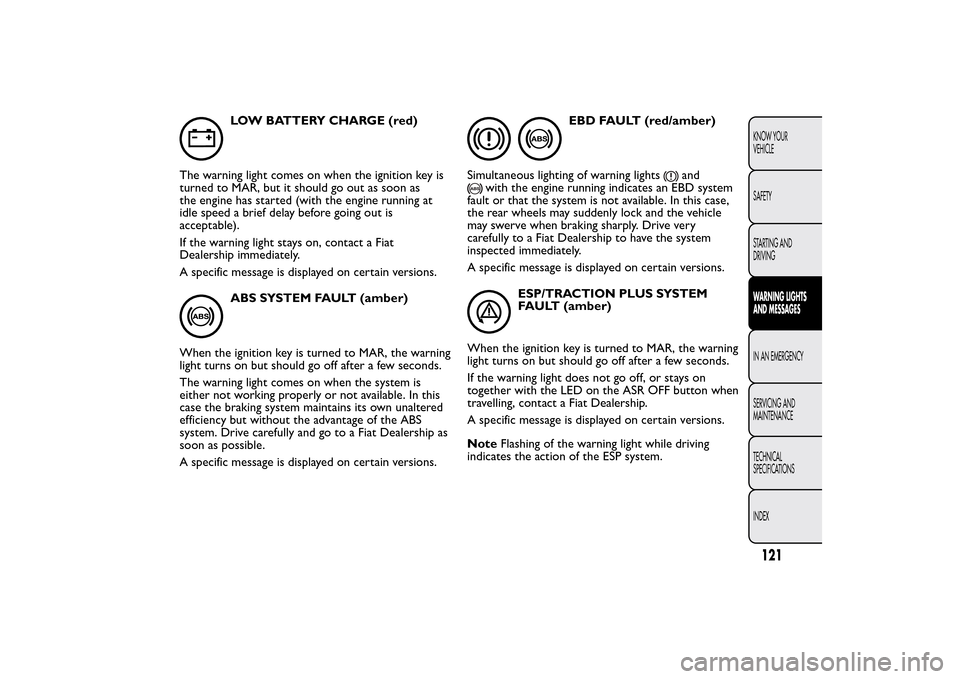
LOW BATTERY CHARGE (red)
The warning light comes on when the ignition key is
turned to MAR, but it should go out as soon as
the engine has started (with the engine running at
idle speed a brief delay before going out is
acceptable).
If the warning light stays on, contact a Fiat
Dealership immediately.
A specific message is displayed on certain versions.ABS SYSTEM FAULT (amber)
When the ignition key is turned to MAR, the warning
light turns on but should go off after a few seconds.
The warning light comes on when the system is
either not working properly or not available. In this
case the braking system maintains its own unaltered
efficiency but without the advantage of the ABS
system. Drive carefully and go to a Fiat Dealership as
soon as possible.
A specific message is displayed on certain versions.
EBD FAULT (red/amber)
Simultaneous lighting of warning lights
and
with the engine running indicates an EBD system
fault or that the system is not available. In this case,
the rear wheels may suddenly lock and the vehicle
may swerve when braking sharply. Drive very
carefully to a Fiat Dealership to have the system
inspected immediately.
A specific message is displayed on certain versions.
ESP/TRACTION PLUS SYSTEM
FAULT (amber)
When the ignition key is turned to MAR, the warning
light turns on but should go off after a few seconds.
If the warning light does not go off, or stays on
together with the LED on the ASR OFF button when
travelling, contact a Fiat Dealership.
A specific message is displayed on certain versions.
NoteFlashing of the warning light while driving
indicates the action of the ESP system.
121KNOW YOUR
VEHICLE
SAFETY
STARTING AND
DRIVINGWARNING LIGHTS
AND MESSAGESIN AN EMERGENCY
SERVICING AND
MAINTENANCE
TECHNICAL
SPECIFICATIONS
INDEX