fuel FIAT QUBO 2016 1.G Owner's Manual
[x] Cancel search | Manufacturer: FIAT, Model Year: 2016, Model line: QUBO, Model: FIAT QUBO 2016 1.GPages: 231, PDF Size: 5.02 MB
Page 131 of 231
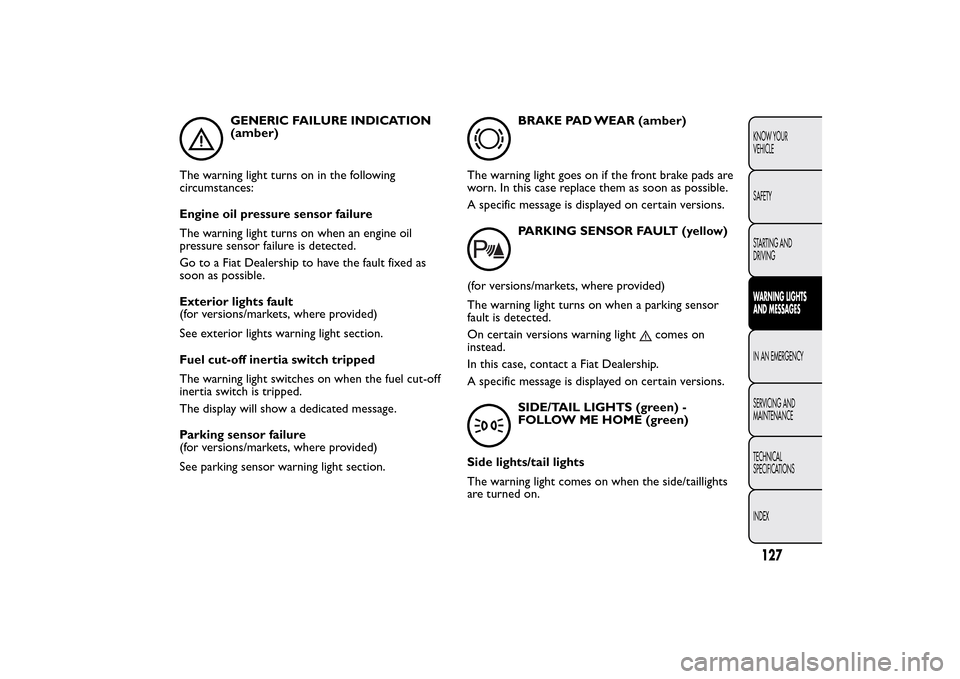
GENERIC FAILURE INDICATION
(amber)
The warning light turns on in the following
circumstances:
Engine oil pressure sensor failure
The warning light turns on when an engine oil
pressure sensor failure is detected.
Go to a Fiat Dealership to have the fault fixed as
soon as possible.
Exterior lights fault
(for versions/markets, where provided)
See exterior lights warning light section.
Fuel cut-off inertia switch tripped
The warning light switches on when the fuel cut-off
inertia switch is tripped.
The display will show a dedicated message.
Parking sensor failure
(for versions/markets, where provided)
See parking sensor warning light section.
BRAKE PAD WEAR (amber)
The warning light goes on if the front brake pads are
worn. In this case replace them as soon as possible.
A specific message is displayed on certain versions.PARKING SENSOR FAULT (yellow)
(for versions/markets, where provided)
The warning light turns on when a parking sensor
fault is detected.
On certain versions warning light
comes on
instead.
In this case, contact a Fiat Dealership.
A specific message is displayed on certain versions.
SIDE/TAIL LIGHTS (green) -
FOLLOW ME HOME (green)
Side lights/tail lights
The warning light comes on when the side/taillights
are turned on.
127KNOW YOUR
VEHICLE
SAFETY
STARTING AND
DRIVINGWARNING LIGHTS
AND MESSAGESIN AN EMERGENCY
SERVICING AND
MAINTENANCE
TECHNICAL
SPECIFICATIONS
INDEX
Page 134 of 231
WARNING
This procedure must be performed by
experts because incorrect actions may
cause considerable electrical discharge.
Furthermore, batter y fluid is poisonous and
corrosive: avoid contact with skin and eyes.
Keep naked flames and lit cigarettes away from
the battery. Do not create sparks.
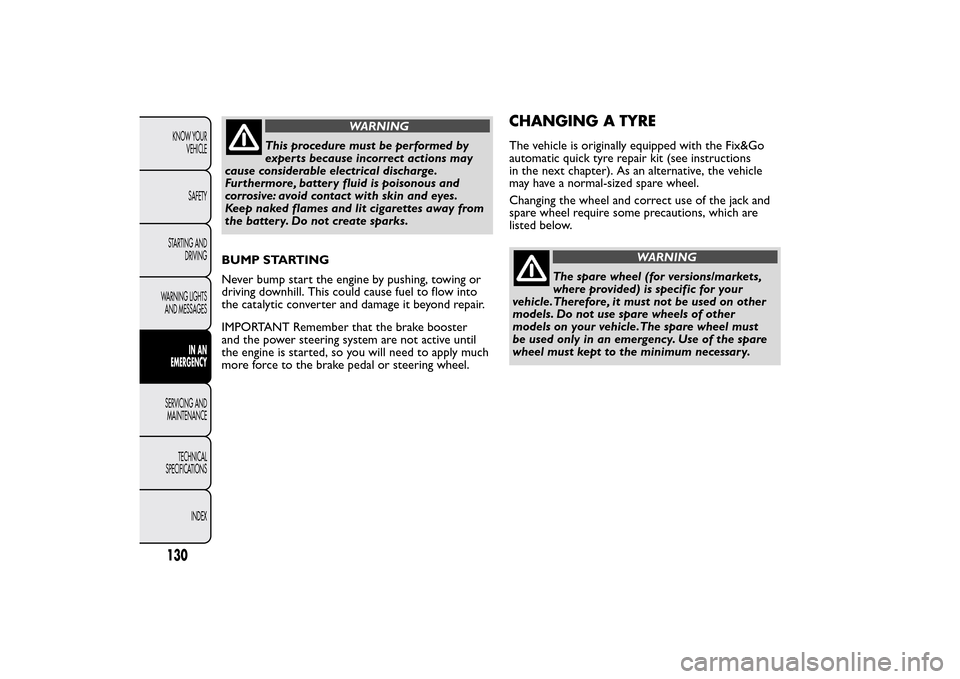
BUMP STARTING
Never bump start the engine by pushing, towing or
driving downhill. This could cause fuel to flow into
the catalytic converter and damage it beyond repair.
IMPORTANT Remember that the brake booster
and the power steering system are not active until
the engine is started, so you will need to apply much
more force to the brake pedal or steering wheel.
CHANGING A TYREThe vehicle is originally equipped with the Fix&Go
automatic quick tyre repair kit (see instructions
in the next chapter). As an alternative, the vehicle
may have a normal-sized spare wheel.
Changing the wheel and correct use of the jack and
spare wheel require some precautions, which are
listed below.
WARNING
The spare wheel (for versions/markets,
where provided) is specific for your
vehicle.Therefore, it must not be used on other
models. Do not use spare wheels of other
models on your vehicle.The spare wheel must
be used only in an emergency. Use of the spare
wheel must kept to the minimum necessar y.
130KNOW YOUR
VEHICLE
SAFETY
STARTING AND
DRIVING
WARNING LIGHTS
AND MESSAGES
IN AN
EMERGENCY
SERVICING AND
MAINTENANCE
TECHNICAL
SPECIFICATIONS
INDEX
Page 164 of 231
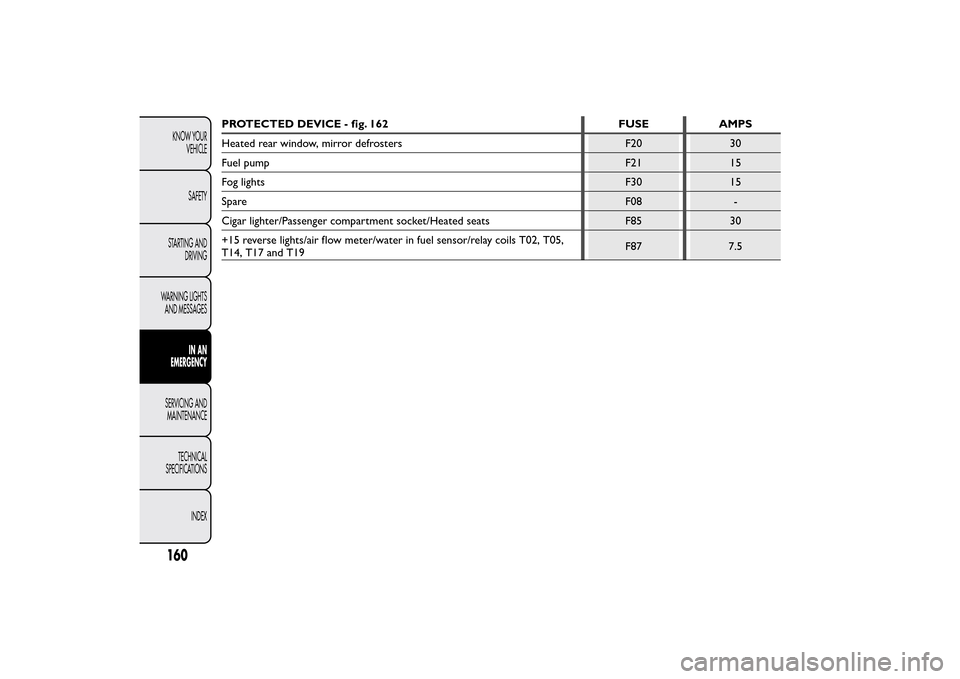
PROTECTED DEVICE - fig. 162 FUSE AMPS
Heated rear window, mirror defrosters F20 30
Fuel pump F21 15
Fog lights F30 15
SpareF08 -
Cigar lighter/Passenger compartment socket/Heated seats F85 30
+15 reverse lights/air flow meter/water in fuel sensor/relay coils T02, T05,
T14, T17 and T19F87 7.5
160KNOW YOUR
VEHICLE
SAFETY
STARTING AND
DRIVING
WARNING LIGHTS
AND MESSAGES
IN AN
EMERGENCY
SERVICING AND
MAINTENANCE
TECHNICAL
SPECIFICATIONS
INDEX
Page 173 of 231
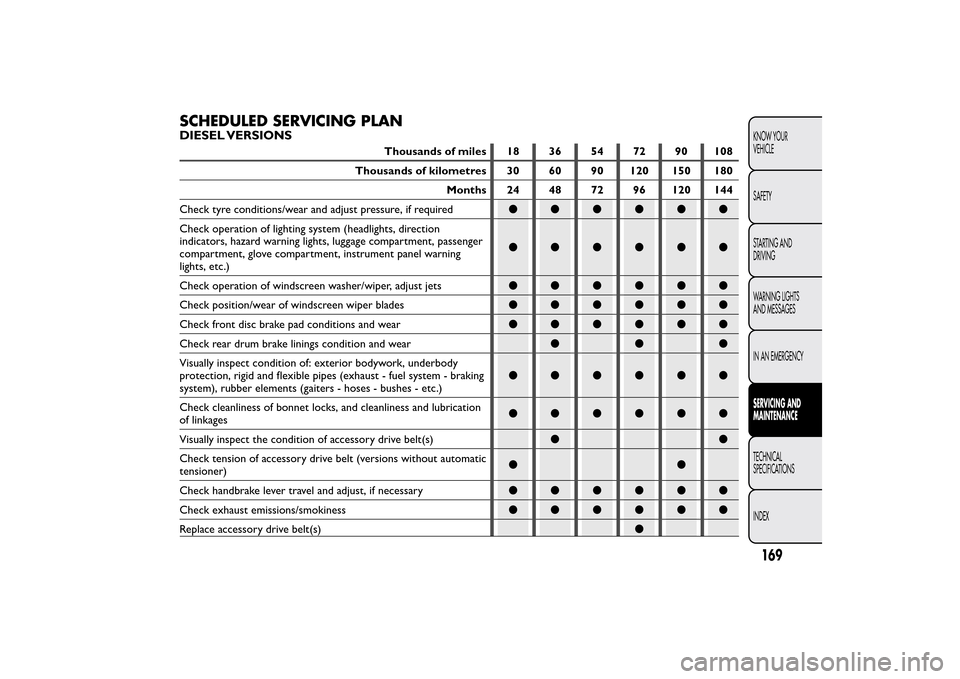
SCHEDULED SERVICING PLANDIESEL VERSIONS
Thousands of miles 18 36 54 72 90 108
Thousands of kilometres 30 60 90 120 150 180
Months 24 48 72 96 120 144
Check tyre conditions/wear and adjust pressure, if required●●●●●●
Check operation of lighting system (headlights, direction
indicators, hazard warning lights, luggage compartment, passenger
compartment, glove compartment, instrument panel warning
lights, etc.)●●●●●●
Check operation of windscreen washer/wiper, adjust jets●●●●●●
Check position/wear of windscreen wiper blades●●●●●●
Check front disc brake pad conditions and wear●●●●●●
Check rear drum brake linings condition and wear●●●
Visually inspect condition of: exterior bodywork, underbody
protection, rigid and flexible pipes (exhaust - fuel system - braking
system), rubber elements (gaiters - hoses - bushes - etc.)●●●●●●
Check cleanliness of bonnet locks, and cleanliness and lubrication
of linkages●●●●●●
Visually inspect the condition of accessory drive belt(s)●●
Check tension of accessory drive belt (versions without automatic
tensioner)●●
Check handbrake lever travel and adjust, if necessary●●●●●●
Check exhaust emissions/smokiness●●●●●●
Replace accessory drive belt(s)●
169KNOW YOUR
VEHICLE
SAFETY
STARTING AND
DRIVING
WARNING LIGHTS
AND MESSAGES
IN AN EMERGENCYSERVICING AND
MAINTENANCETECHNICAL
SPECIFICATIONS
INDEX
Page 176 of 231
❒visually inspect conditions of: engine, gearbox,
transmission, pipes and hoses (exhaust - fuel
system - brakes) and rubber elements (boots -
sleeves - bushes - etc.);
❒check battery charge status and fluid (electrolyte)
level (refer to "Battery - Check state of charge
and electrolyte level" paragraph in this chapter);
❒visually inspect condition of the auxiliary drive
belts;
❒check and, if necessary, replace pollen filter, in
particular it should be replaced if there is a
noticeable decrease in the passenger compartment
air intake flow rate.
❒check and, if necessary, replace air filter.
CHECKING LEVELS
When topping up, take care not to mix up
the various types of fluids: they are not
compatible with each other and could
seriously damage the vehicle.
WARNING
Never smoke while working in the
engine compar tment : inflammable gases
and vapours may be present , constituting a fire
risk.
172KNOW YOUR
VEHICLE
SAFETY
STARTING AND
DRIVING
WARNING LIGHTS
AND MESSAGES
IN AN EMERGENCY
SERVICING AND
MAINTENANCE
TECHNICAL
SPECIFICATIONS
INDEX
Page 188 of 231
RUBBER LINESFollow the requirements in “Scheduled Servicing
Plan” in this section carefully for brake and fuel
rubber lines.
Ozone, high temperatures and a prolonged lack of
fluid in the system may cause hardening and cracking
of the tubes, which could result in leaks. Careful
inspections are therefore necessary.
WINDSCREEN/REAR WINDOW
WIPERS(for versions/markets, where provided)
BLADES
Regularly clean the rubber part using appropriate
products; TUTELA PROFESSIONAL SC 35 is
recommended.
Replace the blades if the rubber edge is misshapen or
worn. In any event, it is advisable to replace them
approximately once a year.
A few simple precautions can reduce the possibility
of damage to the blades:
❒make sure that the rubber part is not stuck to the
windscreen at sub-zero temperatures. Use an
antifreeze product to release it if required;
❒remove any snow from the glass: in addition to
protecting the blades, this prevents the electric
motor from overheating;
❒do not operate the windscreen and rear window
wipers on dry glass.
WARNING
Driving with worn wiper blades is a
serious hazard, because visibility is
reduced in bad weather.
184KNOW YOUR
VEHICLE
SAFETY
STARTING AND
DRIVING
WARNING LIGHTS
AND MESSAGES
IN AN EMERGENCY
SERVICING AND
MAINTENANCE
TECHNICAL
SPECIFICATIONS
INDEX
Page 198 of 231
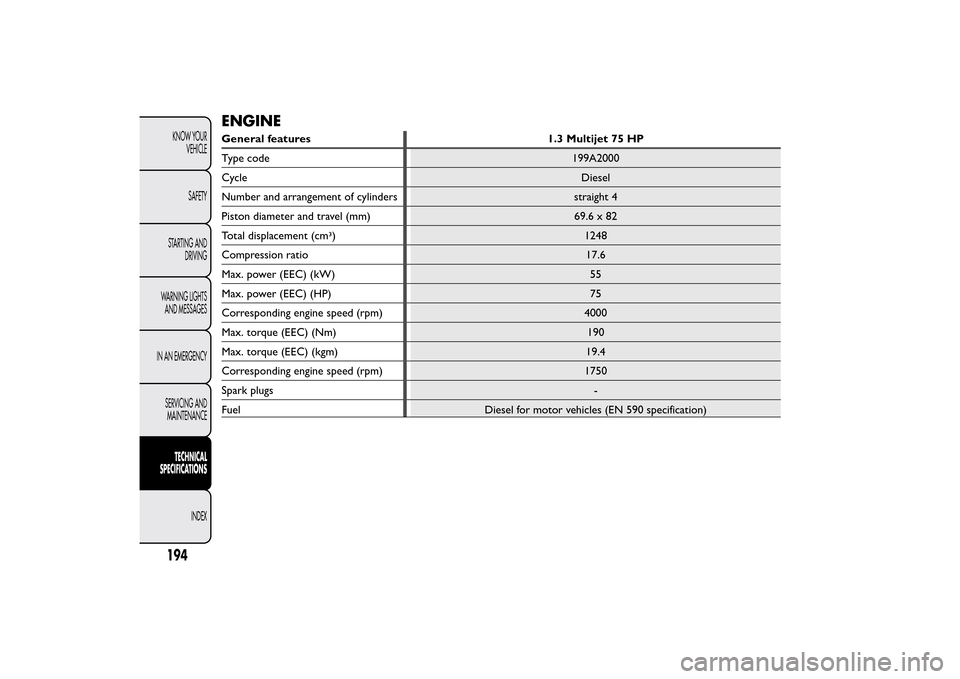
ENGINEGeneral features 1.3 Multijet 75 HP
Type code 199A2000
Cycle Diesel
Number and arrangement of cylinders straight 4
Piston diameter and travel (mm) 69.6 x 82
Total displacement (cm3) 1248
Compression ratio 17.6
Max. power (EEC) (kW) 55
Max. power (EEC) (HP) 75
Corresponding engine speed (rpm) 4000
Max. torque (EEC) (Nm) 190
Max. torque (EEC) (kgm) 19.4
Corresponding engine speed (rpm) 1750
Spark plugs -
Fuel Diesel for motor vehicles (EN 590 specification)
194KNOW YOUR
VEHICLE
SAFETY
STARTING AND
DRIVING
WARNING LIGHTS
AND MESSAGES
IN AN EMERGENCY
SERVICING AND
MAINTENANCETECHNICAL
SPECIFICATIONS
INDEX
Page 199 of 231
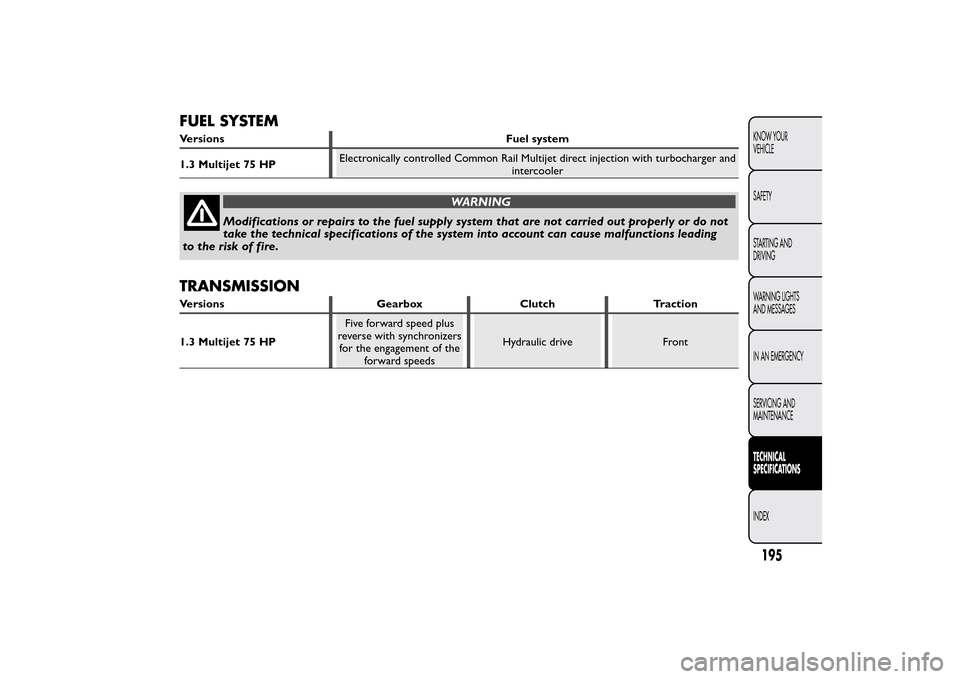
FUEL SYSTEMVersions Fuel system
1.3 Multijet 75 HPElectronically controlled Common Rail Multijet direct injection with turbocharger and
intercooler
WARNING
Modifications or repairs to the fuel supply system that are not carried out properly or do not
take the technical specifications of the system into account can cause malfunctions leading
to the risk of fire.
TRANSMISSIONVersions Gearbox Clutch Traction
1.3 Multijet 75 HPFive forward speed plus
reverse with synchronizers
for the engagement of the
forward speedsHydraulic drive Front
195KNOW YOUR
VEHICLE
SAFETY
STARTING AND
DRIVING
WARNING LIGHTS
AND MESSAGES
IN AN EMERGENCY
SERVICING AND
MAINTENANCETECHNICAL
SPECIFICATIONSINDEX
Page 208 of 231
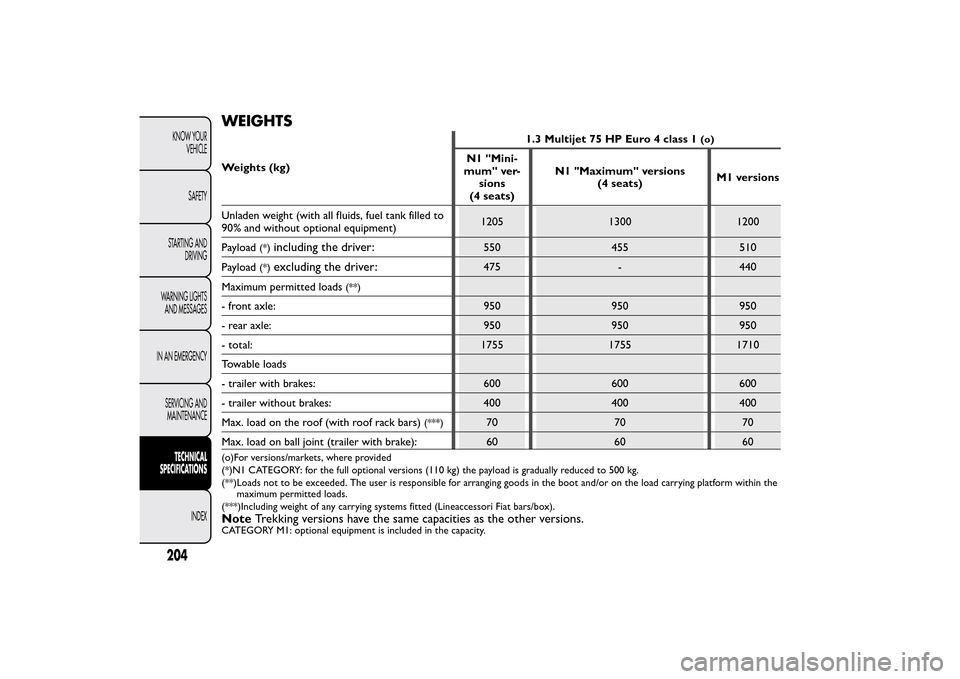
WEIGHTSWeights (kg)1.3 Multijet 75 HP Euro 4 class 1
(o)
N1 "Mini-
mum" ver-
sions
(4 seats)N1 "Maximum" versions
(4 seats)M1 versions
Unladen weight (with all fluids, fuel tank filled to
90% and without optional equipment)1205 1300 1200
Payload
(*)
including the driver:
550 455 510
Payload
(*)
excluding the driver:
475 - 440
Maximum permitted loads
(**)
- front axle: 950 950 950
- rear axle: 950 950 950
- total: 1755 1755 1710
Towable loads
- trailer with brakes: 600 600 600
- trailer without brakes: 400 400 400
Max. load on the roof (with roof rack bars)
(***)
70 70 70
Max. load on ball joint (trailer with brake): 60 60 60
(o)For versions/markets, where provided
(*)N1 CATEGORY: for the full optional versions (110 kg) the payload is gradually reduced to 500 kg.
(**)Loads not to be exceeded. The user is responsible for arranging goods in the boot and/or on the load carrying platform within the
maximum permitted loads.
(***)Including weight of any carrying systems fitted (Lineaccessori Fiat bars/box).NoteTrekking versions have the same capacities as the other versions.CATEGORY M1: optional equipment is included in the capacity.
204KNOW YOUR
VEHICLE
SAFETY
STARTING AND
DRIVING
WARNING LIGHTS
AND MESSAGES
IN AN EMERGENCY
SERVICING AND
MAINTENANCETECHNICAL
SPECIFICATIONS
INDEX
Page 209 of 231
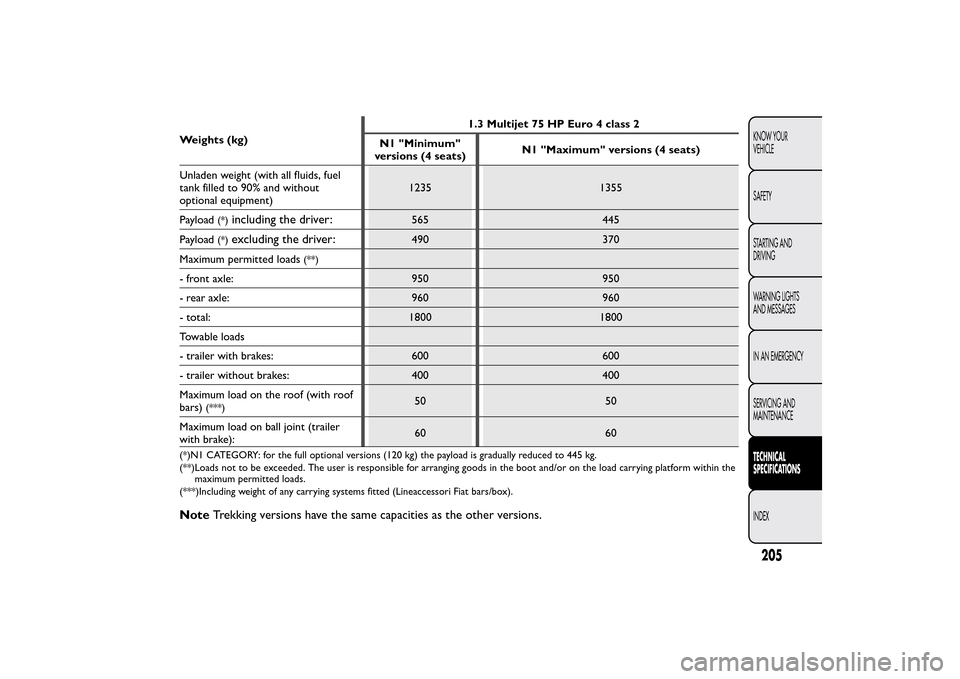
Weights (kg)1.3 Multijet 75 HP Euro 4 class 2
N1 "Minimum"
versions (4 seats)N1 "Maximum" versions (4 seats)
Unladen weight (with all fluids, fuel
tank filled to 90% and without
optional equipment)1235 1355
Payload
(*)
including the driver:
565 445
Payload
(*)
excluding the driver:
490 370
Maximum permitted loads
(**)
- front axle: 950 950
- rear axle: 960 960
- total: 1800 1800
Towable loads
- trailer with brakes: 600 600
- trailer without brakes: 400 400
Maximum load on the roof (with roof
bars)
(***)
50 50
Maximum load on ball joint (trailer
with brake):60 60
(*)N1 CATEGORY: for the full optional versions (120 kg) the payload is gradually reduced to 445 kg.
(**)Loads not to be exceeded. The user is responsible for arranging goods in the boot and/or on the load carrying platform within the
maximum permitted loads.
(***)Including weight of any carrying systems fitted (Lineaccessori Fiat bars/box).NoteTrekking versions have the same capacities as the other versions.
205KNOW YOUR
VEHICLE
SAFETY
STARTING AND
DRIVING
WARNING LIGHTS
AND MESSAGES
IN AN EMERGENCY
SERVICING AND
MAINTENANCETECHNICAL
SPECIFICATIONSINDEX