seats FIAT SCUDO 2007 2.G User Guide
[x] Cancel search | Manufacturer: FIAT, Model Year: 2007, Model line: SCUDO, Model: FIAT SCUDO 2007 2.GPages: 210, PDF Size: 3.29 MB
Page 74 of 210
73
SAFETY
DEVICES
CORRECT USE
OF THE
VEHICLE
WARNING
LIGHTS AND
MESSAGES
IN AN
EMERGENCY
VEHICLE
MAINTENANCE
TECHNICAL
SPECIFICATIONS
INDEX
DASHBOARD
AND CONTROLS
Always use this device when
transporting children.
WARNING
After engaging the child lock
on both rear doors, check for
proper engagement by trying to open
a rear door with the internal handle.
WARNING
SLIDING LUGGAGE
COVER
(where provided)
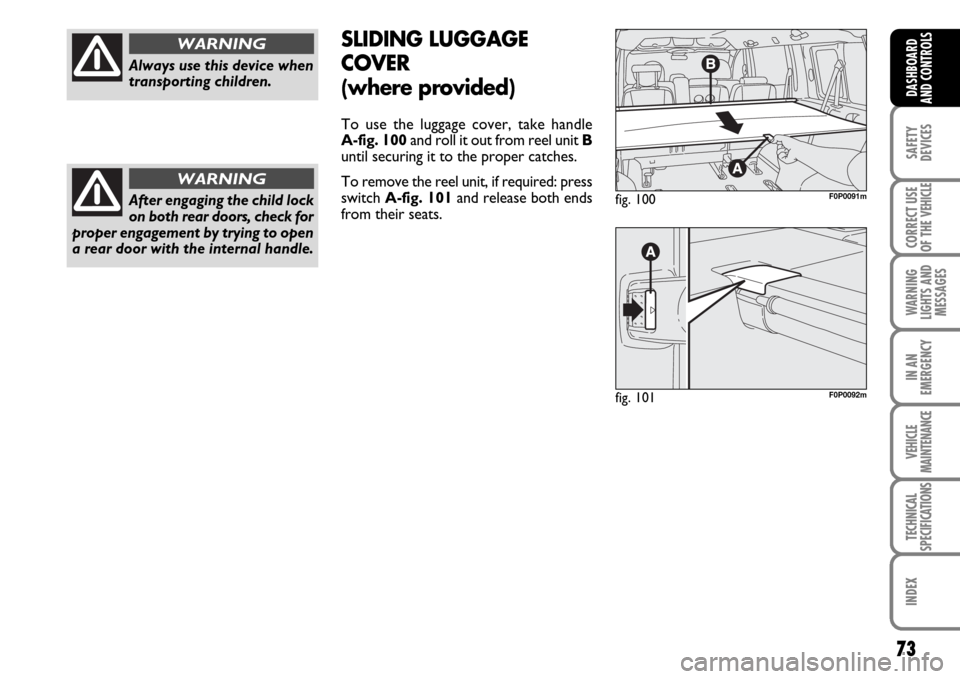
To use the luggage cover, take handle
A-fig. 100and roll it out from reel unit B
until securing it to the proper catches.
To remove the reel unit, if required: press
switch A-fig. 101and release both ends
from their seats.
fig. 100F0P0091m
fig. 101F0P0092m
Page 82 of 210
81
SAFETY
DEVICES
CORRECT USE
OF THE
VEHICLE
WARNING
LIGHTS AND
MESSAGES
IN AN
EMERGENCY
VEHICLE
MAINTENANCE
TECHNICAL
SPECIFICATIONS
INDEX
DASHBOARD
AND CONTROLS
HEADLIGHTS
ADJUSTING THE HEADLIGHT
BEAM
Proper adjustment of the headlight beams
is of vital importance for your safety and
comfort and also for the other road users.
To ensure you and other drivers have the
best visibility conditions when travelling
with the headlights on, the headlights must
be set properly. Contact Fiat Dealership
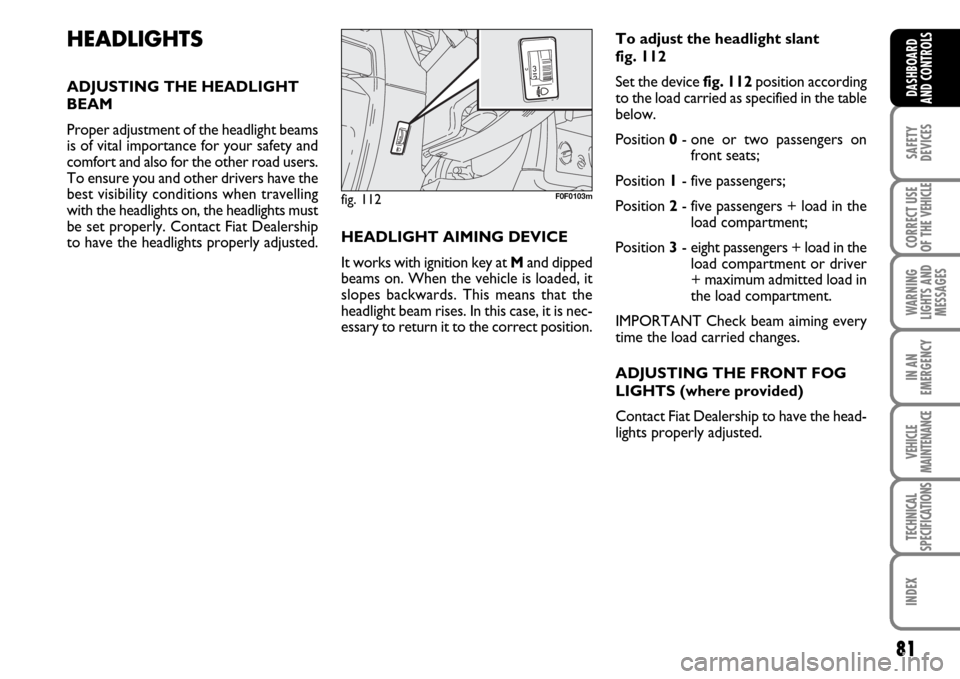
to have the headlights properly adjusted.HEADLIGHT AIMING DEVICE
It works with ignition key at Mand dipped
beams on. When the vehicle is loaded, it
slopes backwards. This means that the
headlight beam rises. In this case, it is nec-
essary to return it to the correct position.To adjust the headlight slant
fig. 112
Set the device fig. 112position according
to the load carried as specified in the table
below.
Position 0- one or two passengers on
front seats;
Position 1- five passengers;
Position 2- five passengers + load in the
load compartment;
Position 3- eight passengers + load in the
load compartment or driver
+ maximum admitted load in
the load compartment.
IMPORTANT Check beam aiming every
time the load carried changes.
ADJUSTING THE FRONT FOG
LIGHTS (where provided)
Contact Fiat Dealership to have the head-
lights properly adjusted.
fig. 112F0F0103m
Page 101 of 210
100
CORRECT USE
OF THE
VEHICLE
WARNING
LIGHTS AND
MESSAGES
IN AN
EMERGENCY
VEHICLE
MAINTENANCE
TECHNICAL
SPECIFICATIONS
IINDEX
DASHBOARD
AND CONTROLS
SAFETY
DEVICES
With front passenger’s air
bag active do not place cra-
dle child’s seats facing backwards on
the front passenger seat since the air
bag activation could cause serious in-
juries, even mortal regardless of the
seriousness of the crash. You are ad-
vised to carry children always on the
rear seat, as this is the most protect-
ed position in the case of a crash.
WARNING
SERIOUS DANGER: Never
place cradle child’s seats on
the front passenger seat of
vehicles fitted with passen-
ger’s air bag since the air
bag activation could cause
serious injuries, even mortal. You are
advised to carry children always on
the rear seat, as this is the most pro-
tected position in the case of a crash.
In any case, children’s seats must ab-
solutely not be fitted on the front seat
of vehicles with passenger’s air bag,
which during inflation could cause se-
rious injury, even mortal, regardless
of the seriousness of the crash that
triggered it.
WARNINGOver 1.50 m in height, from the point of
view of restraint systems, children are
considered as adults and wear the seat
belts normally.
Lineaccessori Fiat offers seats for each
weight group, which are the recommend-
ed choice, as they have been designed and
experimented specifically for Fiat vehicles.
Page 102 of 210
101
CORRECT USE
OF THE
VEHICLE
WARNING
LIGHTS AND
MESSAGES
IN AN
EMERGENCY
VEHICLE
MAINTENANCE
TECHNICAL
SPECIFICATIONS
INDEX
DASHBOARD
AND CONTROLS
SAFETY
DEVICES
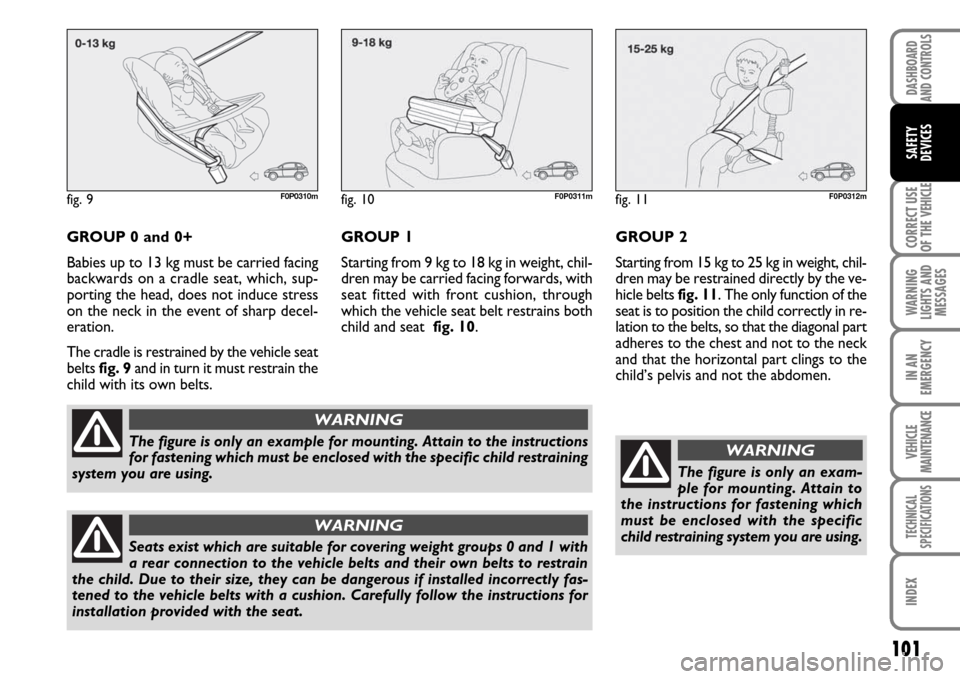
GROUP 0 and 0+
Babies up to 13 kg must be carried facing
backwards on a cradle seat, which, sup-
porting the head, does not induce stress
on the neck in the event of sharp decel-
eration.
The cradle is restrained by the vehicle seat
belts fig. 9and in turn it must restrain the
child with its own belts.
fig. 9F0P0310m
The figure is only an example for mounting. Attain to the instructions
for fastening which must be enclosed with the specific child restraining
system you are using.
WARNING
Seats exist which are suitable for covering weight groups 0 and 1 with
a rear connection to the vehicle belts and their own belts to restrain
the child. Due to their size, they can be dangerous if installed incorrectly fas-
tened to the vehicle belts with a cushion. Carefully follow the instructions for
installation provided with the seat.
WARNING
fig. 10F0P0311mfig. 11F0P0312m
GROUP 2
Starting from 15 kg to 25 kg in weight, chil-
dren may be restrained directly by the ve-
hicle belts fig. 11. The only function of the
seat is to position the child correctly in re-
lation to the belts, so that the diagonal part
adheres to the chest and not to the neck
and that the horizontal part clings to the
child’s pelvis and not the abdomen. GROUP 1
Starting from 9 kg to 18 kg in weight, chil-
dren may be carried facing forwards, with
seat fitted with front cushion, through
which the vehicle seat belt restrains both
child and seat fig. 10.
The figure is only an exam-
ple for mounting. Attain to
the instructions for fastening which
must be enclosed with the specific
child restraining system you are using.
WARNING
Page 104 of 210
PASSENGER’S AIR
BAG OFF
103
CORRECT USE
OF THE
VEHICLE
WARNING
LIGHTS AND
MESSAGES
IN AN
EMERGENCY
VEHICLE
MAINTENANCE
TECHNICAL
SPECIFICATIONS
INDEX
DASHBOARD
AND CONTROLS
SAFETY
DEVICES
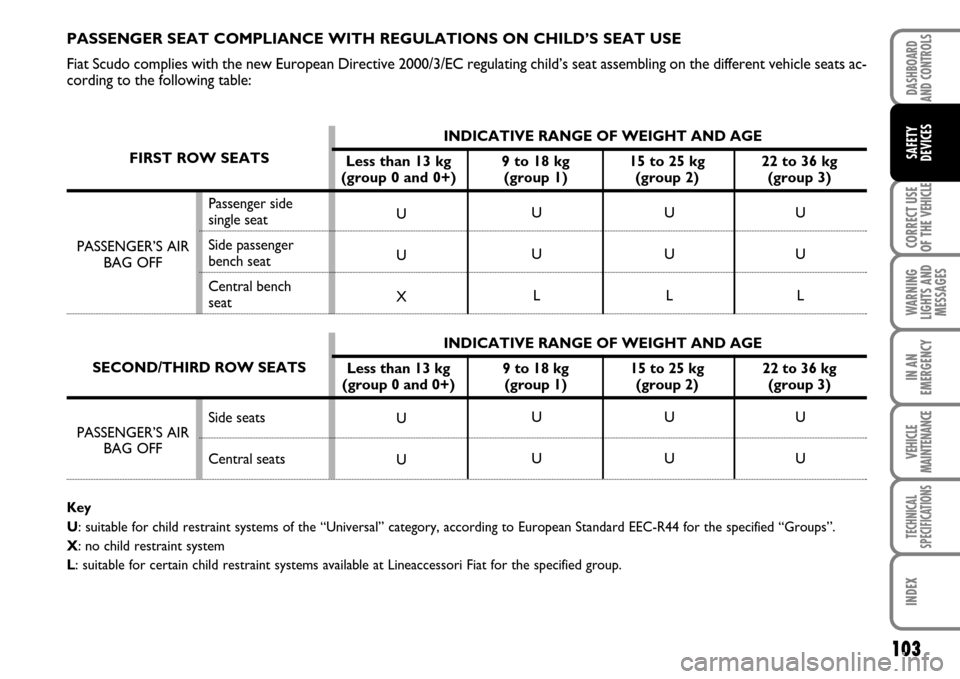
PASSENGER SEAT COMPLIANCE WITH REGULATIONS ON CHILD’S SEAT USE
Fiat Scudo complies with the new European Directive 2000/3/EC regulating child’s seat assembling on the different vehicle seats ac-
cording to the following table:
Key
U: suitable for child restraint systems of the “Universal” category, according to European Standard EEC-R44 for the specified “Groups”.
X: no child restraint system
L: suitable for certain child restraint systems available at Lineaccessori Fiat for the specified group.
U
U
X
U
UU
U
L
U
UU
U
L
U
UU
U
L
U
U
PASSENGER’S AIR
BAG OFFFIRST ROW SEATS
Passenger side
single seat
Side passenger
bench seat
Central bench
seat
Side seats
Central seats SECOND/THIRD ROW SEATS
INDICATIVE RANGE OF WEIGHT AND AGE
Less than 13 kg 9 to 18 kg 15 to 25 kg 22 to 36 kg
(group 0 and 0+) (group 1) (group 2) (group 3)
INDICATIVE RANGE OF WEIGHT AND AGE
Less than 13 kg 9 to 18 kg 15 to 25 kg 22 to 36 kg
(group 0 and 0+) (group 1) (group 2) (group 3)
Page 105 of 210
104
CORRECT USE
OF THE
VEHICLE
WARNING
LIGHTS AND
MESSAGES
IN AN
EMERGENCY
VEHICLE
MAINTENANCE
TECHNICAL
SPECIFICATIONS
IINDEX
DASHBOARD
AND CONTROLS
SAFETY
DEVICES
To sum up the safety precautions
to follow when
transporting children:
1) The recommended position for in-
stalling child’s seat is on the rear seat, as
it is the most protected in the case of a
crash.
2) If the passenger’s air bag is deactivat-
ed always check the amber warning light
on the cluster to make sure that it has ac-
tually been deactivated.
3) Attain to the instructions for fastening
the specific child restraint system which
you are using. These instructions must be
provided by the manufacturer. Keep the
child restraint system installation instruc-
tions with the vehicle documents and with
this Handbook. Never use a child restraint
system without installation instructions.4) Always check the seat belt is well fas-
tened by pulling the webbing.
5) Only one child is to be strapped to
each retaining system.
6) Always check the seat belts do not fit
around the child’s throat.
7) While travelling, do not let the child
sit incorrectly or release the belts.
8) Passengers should never carry children
on their laps. No-one, however strong
they are, can hold a child in the event of
a crash.
9) In case of an accident, replace the
child’s seat with a new one.
With front passenger’s air
bag active do not place cra-
dle child’s seats facing backwards on
the front passenger seat since the air
bag activation could cause serious in-
juries, even mortal regardless of the
seriousness of the crash. You are ad-
vised to carry children always on the
rear seat, as this is the most protect-
ed position in the case of a crash.
WARNING
Page 106 of 210
105
CORRECT USE
OF THE
VEHICLE
WARNING
LIGHTS AND
MESSAGES
IN AN
EMERGENCY
VEHICLE
MAINTENANCE
TECHNICAL
SPECIFICATIONS
INDEX
DASHBOARD
AND CONTROLS
SAFETY
DEVICES
PRESETTING FOR
MOUNTING THE
“UNIVERSAL ISOFIX”
CHILD RESTRAINT
SYSTEM
This vehicle is preset for mounting the
Universal Isofix child restraint system, a
new European standardised system for
carrying children safely.
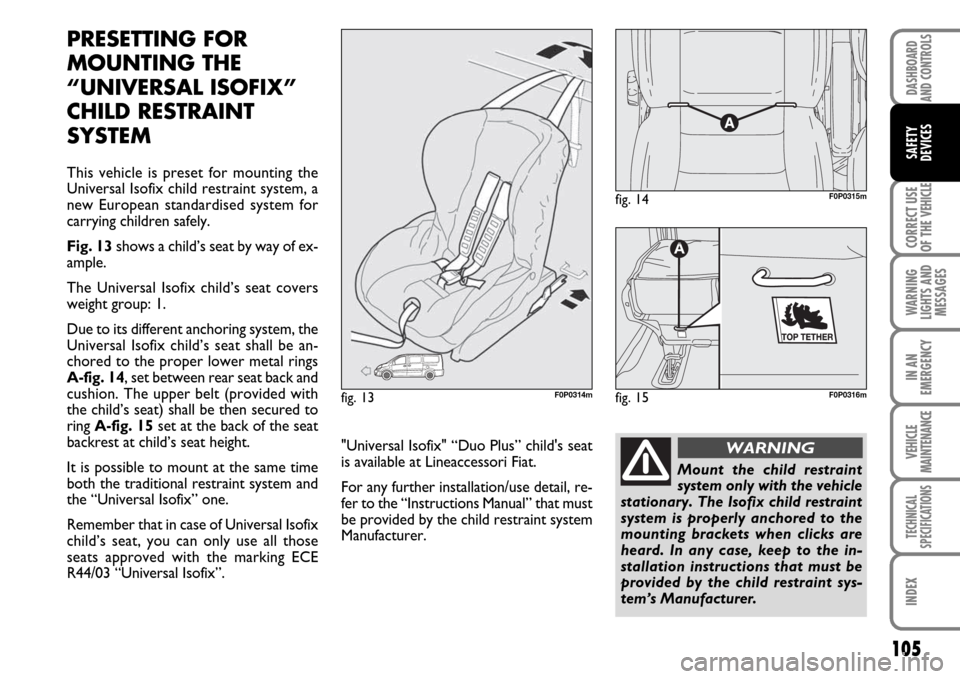
Fig. 13shows a child’s seat by way of ex-
ample.
The Universal Isofix child’s seat covers
weight group: 1.
Due to its different anchoring system, the
Universal Isofix child’s seat shall be an-
chored to the proper lower metal rings
A-fig. 14, set between rear seat back and
cushion. The upper belt (provided with
the child’s seat) shall be then secured to
ring A-fig. 15set at the back of the seat
backrest at child’s seat height.
It is possible to mount at the same time
both the traditional restraint system and
the “Universal Isofix” one.
Remember that in case of Universal Isofix
child’s seat, you can only use all those
seats approved with the marking ECE
R44/03 “Universal Isofix”.
Mount the child restraint
system only with the vehicle
stationary. The Isofix child restraint
system is properly anchored to the
mounting brackets when clicks are
heard. In any case, keep to the in-
stallation instructions that must be
provided by the child restraint sys-
tem’s Manufacturer.
WARNING"Universal Isofix" “Duo Plus” child's seat
is available at Lineaccessori Fiat.
For any further installation/use detail, re-
fer to the “Instructions Manual” that must
be provided by the child restraint system
Manufacturer.
fig. 14F0P0315m
fig. 13F0P0314mfig. 15
A
F0P0316m
Page 107 of 210
106
CORRECT USE
OF THE
VEHICLE
WARNING
LIGHTS AND
MESSAGES
IN AN
EMERGENCY
VEHICLE
MAINTENANCE
TECHNICAL
SPECIFICATIONS
IINDEX
DASHBOARD
AND CONTROLS
SAFETY
DEVICES
FRONT AIRBAGS
The vehicle is fitted with front air bags for
the driver, for the passenger and with dri-
ver’s knees air bag (where provided).
The front driver / passenger air bags and
the driver’s knees air bag (where provid-
ed) have been designed to protect the oc-
cupants in the event of head-on crashes of
medium-high severity, by placing the cush-
ion between the occupant and the steer-
ing wheel or dashboard.
Front air bags are designed to protect ve-
hicle’s occupants in front crashes and
therefore non-activation in other types of
collisions (side collisions, rear shunts, roll-
overs, etc.) is not a system malfunction.
In case of crash, an electronic control unit,
when required, triggers the inflation of the
cushion. The cushion immediately inflates,
placing itself as a protection between the
body of the front occupants and the struc-
ture that could cause injuries. Immediate-
ly after, the cushion deflates.
The front driver / passenger air bags and
the driver’s knees air bag (where provid-
ed) are not a replacement of but comple-
mentary to the use of belts, which should
always be worn, as specified by law in Eu-
rope and most non European countries.
B
B1
A
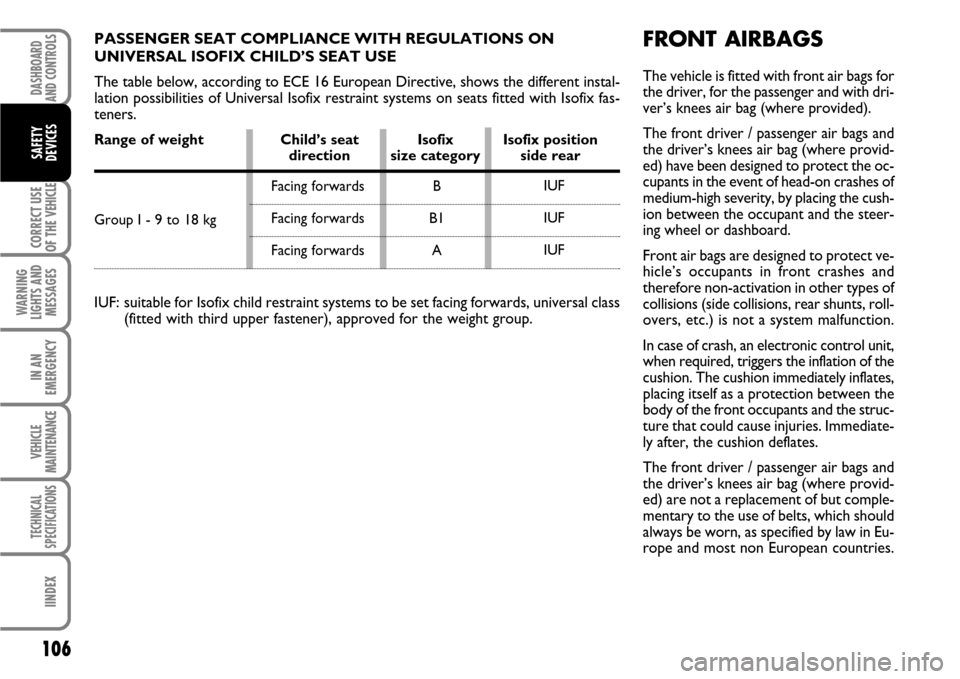
PASSENGER SEAT COMPLIANCE WITH REGULATIONS ON
UNIVERSAL ISOFIX CHILD’S SEAT USE
The table below, according to ECE 16 European Directive, shows the different instal-
lation possibilities of Universal Isofix restraint systems on seats fitted with Isofix fas-
teners.
Range of weight Child’s seat Isofix Isofix position direction size category side rear
Group I - 9 to 18 kg
IUF: suitable for Isofix child restraint systems to be set facing forwards, universal class
(fitted with third upper fastener), approved for the weight group.
IUF
IUF
IUF Facing forwards
Facing forwards
Facing forwards
Page 109 of 210
108
CORRECT USE
OF THE
VEHICLE
WARNING
LIGHTS AND
MESSAGES
IN AN
EMERGENCY
VEHICLE
MAINTENANCE
TECHNICAL
SPECIFICATIONS
IINDEX
DASHBOARD
AND CONTROLS
SAFETY
DEVICES
MANUAL DEACTIVATION OF
PASSENGER’S FRONT AIR BAG
AND SIDE BAG (where provided)
Should it be absolutely necessary to car-
ry a child on the front seat, the passenger’s
front air bag and the side bag (where pro-
vided) can be deactivated.
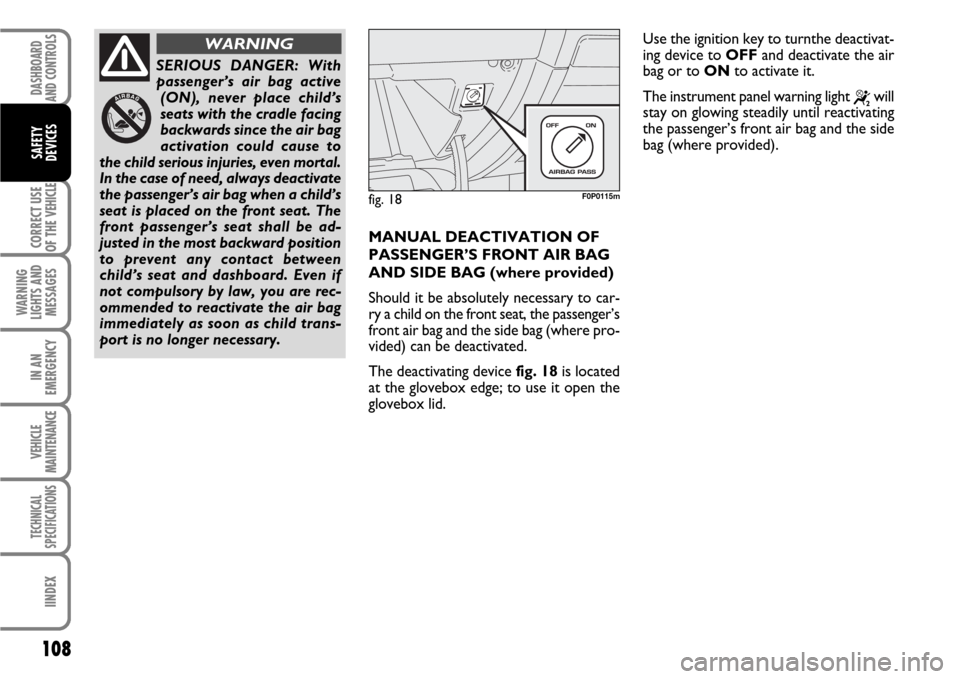
The deactivating device fig. 18is located
at the glovebox edge; to use it open the
glovebox lid.
SERIOUS DANGER: With
passenger’s air bag active
(ON), never place child’s
seats with the cradle facing
backwards since the air bag
activation could cause to
the child serious injuries, even mortal.
In the case of need, always deactivate
the passenger’s air bag when a child’s
seat is placed on the front seat. The
front passenger’s seat shall be ad-
justed in the most backward position
to prevent any contact between
child’s seat and dashboard. Even if
not compulsory by law, you are rec-
ommended to reactivate the air bag
immediately as soon as child trans-
port is no longer necessary.
WARNING
fig. 18F0P0115m
Use the ignition key to turnthe deactivat-
ing device to OFFand deactivate the air
bag or to ONto activate it.
The instrument panel warning light
“will
stay on glowing steadily until reactivating
the passenger’s front air bag and the side
bag (where provided).
Page 112 of 210
111
CORRECT USE
OF THE
VEHICLE
WARNING
LIGHTS AND
MESSAGES
IN AN
EMERGENCY
VEHICLE
MAINTENANCE
TECHNICAL
SPECIFICATIONS
INDEX
DASHBOARD
AND CONTROLS
SAFETY
DEVICES
Never rest head, arms and
elbows on the door, on the
windows and in the window bag area
to prevent possible injuries during in-
flation phase.
WARNING
Never lean head, arms and
elbows out of window.
WARNING
GENERAL WARNINGS
If when turning the key to M
the warning light ¬does not
turn on or if it stays on when travel-
ling there could be a failure in safety
systems; in this event air bags or pre-
tensioners could not trigger in case of
impact or, in a minor number of cas-
es, they could trigger accidentally.
Contact Fiat Dealership immediately
to have the system checked.
WARNING
Do not cover the backrest of
front and rear seats with
trims or covers that are not suitable
to be used with side bags.
WARNING
Never travel with objects on
your lap, in front of your
chest or with a pipe, pencil, etc. be-
tween your lips; injury may result in
the event of the air bag being trig-
gered.
WARNINGIMPORTANT The triggering of preten-
sioners, front air bags and side bags is de-
cided in a differentiated manner by the
electronic control unit, depending on the
type of crash. The failure to deploy one or
more of them does not mean that the sys-
tem is not working properly.
Always keep your hands on
the steering wheel rim when
driving, so that if the air bag is trig-
gered, it can inflate without meeting
any obstacles which could cause seri-
ous harm to you. Do not drive with
the body bent forwards, keep the seat
back rest in the erect position and
lean your back well against it.
WARNING