wheel FIAT SCUDO 2007 2.G User Guide
[x] Cancel search | Manufacturer: FIAT, Model Year: 2007, Model line: SCUDO, Model: FIAT SCUDO 2007 2.GPages: 210, PDF Size: 3.29 MB
Page 83 of 210
82
SAFETY
DEVICES
CORRECT USE
OF THE
VEHICLE
WARNING
LIGHTS AND
MESSAGES
IN AN
EMERGENCY
VEHICLE
MAINTENANCE
TECHNICAL
SPECIFICATIONS
INDEX
DASHBOARD
AND CONTROLS
ADJUSTING THE
HEADLIGHT BEAM
Proper adjustment of the headlight beams
is of vital importance for your safety and
comfort and also for the other road users.
In addition it is the subject of a precise reg-
ulation of the traffic code.
To ensure you and other drivers have the
best visibility conditions when travelling
with the headlights on, the headlights must
be set properly.
Contact Fiat Dealership to have the head-
lights properly adjusted.ABS SYSTEM
If you have never driven a vehicle with ABS
before, you should practice using the sys-
tem on slippery terrain, obviously with the
necessary safety precautions and keeping
to the Highway Code of the country you
are in. It is also a good idea to read the fol-
lowing information carefully.
The ABS system, integral with the braking
system, prevents the wheels from locking
when braking, makes the most of road grip
and gives the best control when emergency
braking under difficult road conditions.
System is completed by EBD (Electronic
Braking force Distribution), which dis-
tributes the braking action between front
and rear wheels.
IMPORTANT To have the maximum ef-
ficiency of the braking system, it is neces-
sary a setting period of about 500 km
(with new vehicle or after replacing brake
pads/discs): during this period it is better
to avoid sharp, repeated and prolonged
brakes.The ABS exploits the tyre-
road grip at the best, but it
cannot improve it; you should there-
fore take every care when driving on
slippery surfaces without taking un-
necessary risks.
WARNING
ABS SYSTEM INTERVENTION
The driver can tell the ABS system has
come into action because the brake pedal
pulsates slightly and the system gets noisi-
er: it means that the vehicle speed should
be altered to fit the type of road surface.
If the ABS system cuts in, it
is a sign that the grip be-
tween tyre and the road surface has
reached the limit: you must slow
down to match the speed to the road
grip available.
WARNING
Page 84 of 210
83
SAFETY
DEVICES
CORRECT USE
OF THE
VEHICLE
WARNING
LIGHTS AND
MESSAGES
IN AN
EMERGENCY
VEHICLE
MAINTENANCE
TECHNICAL
SPECIFICATIONS
INDEX
DASHBOARD
AND CONTROLS
FAILURE INDICATIONS
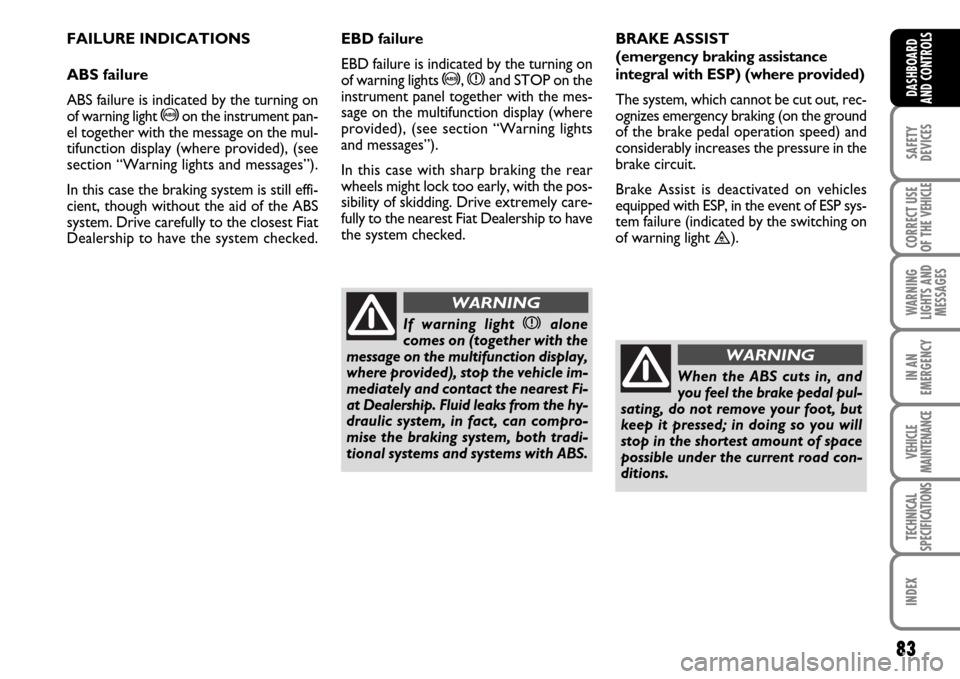
ABS failure
ABS failure is indicated by the turning on
of warning light
>on the instrument pan-
el together with the message on the mul-
tifunction display (where provided), (see
section “Warning lights and messages”).
In this case the braking system is still effi-
cient, though without the aid of the ABS
system. Drive carefully to the closest Fiat
Dealership to have the system checked.BRAKE ASSIST
(emergency braking assistance
integral with ESP) (where provided)
The system, which cannot be cut out, rec-
ognizes emergency braking (on the ground
of the brake pedal operation speed) and
considerably increases the pressure in the
brake circuit.
Brake Assist is deactivated on vehicles
equipped with ESP, in the event of ESP sys-
tem failure (indicated by the switching on
of warning light
™).
When the ABS cuts in, and
you feel the brake pedal pul-
sating, do not remove your foot, but
keep it pressed; in doing so you will
stop in the shortest amount of space
possible under the current road con-
ditions.
WARNING
EBD failure
EBD failure is indicated by the turning on
of warning lights
>, xand STOP on the
instrument panel together with the mes-
sage on the multifunction display (where
provided), (see section “Warning lights
and messages”).
In this case with sharp braking the rear
wheels might lock too early, with the pos-
sibility of skidding. Drive extremely care-
fully to the nearest Fiat Dealership to have
the system checked.
If warning light xalone
comes on (together with the
message on the multifunction display,
where provided), stop the vehicle im-
mediately and contact the nearest Fi-
at Dealership. Fluid leaks from the hy-
draulic system, in fact, can compro-
mise the braking system, both tradi-
tional systems and systems with ABS.
WARNING
Page 86 of 210
85
SAFETY
DEVICES
CORRECT USE
OF THE
VEHICLE
WARNING
LIGHTS AND
MESSAGES
IN AN
EMERGENCY
VEHICLE
MAINTENANCE
TECHNICAL
SPECIFICATIONS
INDEX
DASHBOARD
AND CONTROLS
FAILURE INDICATIONS
In case of an eventual anomaly, the ESP
system automatically disconnects itself and
on the instrument panel the warning light
™is fixed, accompanied by a beeper and
a dedicated message on the display (see
chapter “Warning lights and messages”).
In which case please seek advice, as soon
as possible, from the Fiat Dealership.
Performance of the ESP sys-
tem, in terms of active safe-
ty should not induce the driver to take
pointless and unnecessary risks. The
style of driving must in any case al-
ways be adapted to the conditions of
the road surface, visibility and traffic.
Road safety is always the driver’s re-
sponsibility.
WARNING
ASR SYSTEM (Antislip Regulator)
The ASR system controls the vehicle
drive and cuts in automatically every
time one or both driving wheels slip.
In slipping conditions, two different con-
trol systems are activated:
❒ if slipping involves both driving wheels,
the ASR function intervenes reducing
the power transmitted by the engine;
❒if the slipping involves only one driving
wheel, the ASR system cuts in auto-
matically braking the wheel that is slip-
ping. The action of the ASR system is particu-
larly helpful in the following circumstances:
❒ slipping of the inner wheel due to the
effect of dynamic load changes or ex-
cessive acceleration;
❒ too much power transmitted to the
wheels also in relation to the conditions
of the road surface;
❒ acceleration on slippery, snowy or
frozen surfaces;
❒in the case of loss of grip on a wet sur-
face (aquaplaning).
For correct operation of the
ESP and ASR systems, the
tyres must absolutely be of the same
brand and type on all wheels, in per-
fect conditions and, above all, of
type, brand and size specified.
WARNING
Page 87 of 210
86
SAFETY
DEVICES
CORRECT USE
OF THE
VEHICLE
WARNING
LIGHTS AND
MESSAGES
IN AN
EMERGENCY
VEHICLE
MAINTENANCE
TECHNICAL
SPECIFICATIONS
INDEX
DASHBOARD
AND CONTROLS
MSR system
(engine braking torque control)
It is an integral part of the ASR system that
in case of sudden gear shifting, cuts in pro-
viding torque to the engine thus prevent-
ing excessive driving wheel drive that, spe-
cially in poor grip conditions, can lead to
loss of stability.Switching the system on/off
The ASR system switches on automatically
each time the engine is started.
Switching the ESP system off will auto-
matically switch off the ASR system too.
When travelling, the ASR can be switched
off and on again by pressing switch Alo-
cated on the dashboard fig. 119.
When the ASR is switched off this is
shown by the lighting up of the led
B-fig. 119on the switch and by relevant
message on the multifunction display,
where provided.
If the ASR is switched off when travelling,
it will turn on again automatically the next
time the engine is started.
When travelling on snowy roads with
snow chains, it may be helpful to turn the
ASR off: in fact, in these conditions, slip-
ping of the driving wheels when moving off
makes it possible to obtain better drive.
The performance of the sys-
tem, in terms of active safe-
ty should not induce the driver to take
pointless and unnecessary risks.
The style of driving must in any case
always be adapted to the conditions
of the road surface, visibility and traf-
fic. Road safety is always the driver’s
responsibility.
WARNING
For correct operation of the ASR system,
the tyres must absolutely be of the same
brand and type on all wheels, in perfect
conditions and, above all, of type, brand
and size specified.
FAILURE INDICATIONS
In the event of malfunctioning, the ASR
system is automatically disconnected and
the warning light
™will come with fixed
light on the instrument panel, (see section
“Warning lights and messages”).
In this case contact Fiat Dealership as soon
as possible.
Page 107 of 210
106
CORRECT USE
OF THE
VEHICLE
WARNING
LIGHTS AND
MESSAGES
IN AN
EMERGENCY
VEHICLE
MAINTENANCE
TECHNICAL
SPECIFICATIONS
IINDEX
DASHBOARD
AND CONTROLS
SAFETY
DEVICES
FRONT AIRBAGS
The vehicle is fitted with front air bags for
the driver, for the passenger and with dri-
ver’s knees air bag (where provided).
The front driver / passenger air bags and
the driver’s knees air bag (where provid-
ed) have been designed to protect the oc-
cupants in the event of head-on crashes of
medium-high severity, by placing the cush-
ion between the occupant and the steer-
ing wheel or dashboard.
Front air bags are designed to protect ve-
hicle’s occupants in front crashes and
therefore non-activation in other types of
collisions (side collisions, rear shunts, roll-
overs, etc.) is not a system malfunction.
In case of crash, an electronic control unit,
when required, triggers the inflation of the
cushion. The cushion immediately inflates,
placing itself as a protection between the
body of the front occupants and the struc-
ture that could cause injuries. Immediate-
ly after, the cushion deflates.
The front driver / passenger air bags and
the driver’s knees air bag (where provid-
ed) are not a replacement of but comple-
mentary to the use of belts, which should
always be worn, as specified by law in Eu-
rope and most non European countries.
B
B1
A
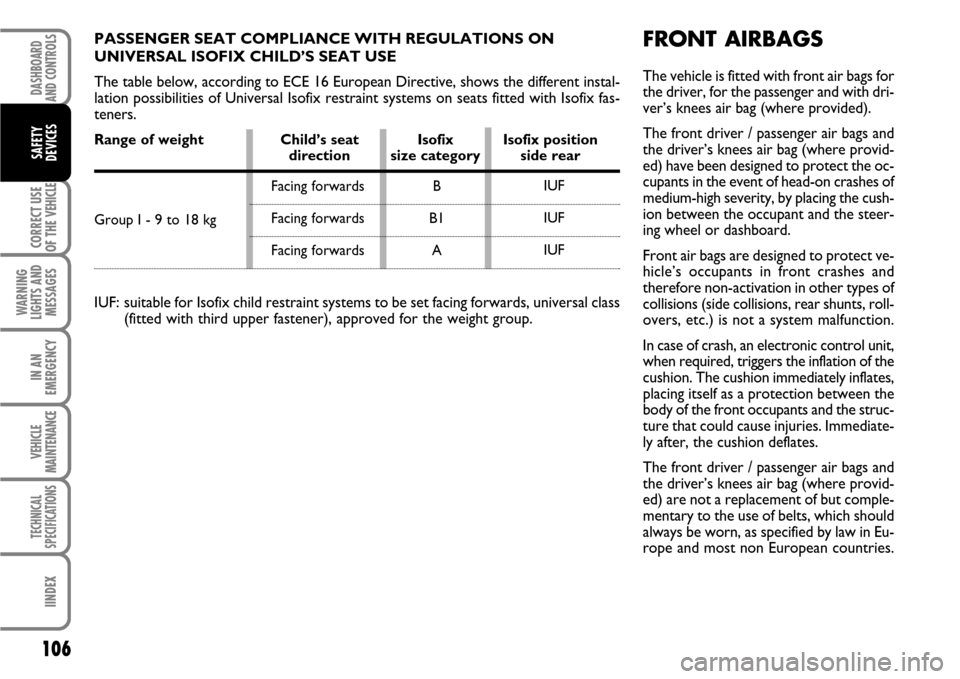
PASSENGER SEAT COMPLIANCE WITH REGULATIONS ON
UNIVERSAL ISOFIX CHILD’S SEAT USE
The table below, according to ECE 16 European Directive, shows the different instal-
lation possibilities of Universal Isofix restraint systems on seats fitted with Isofix fas-
teners.
Range of weight Child’s seat Isofix Isofix position direction size category side rear
Group I - 9 to 18 kg
IUF: suitable for Isofix child restraint systems to be set facing forwards, universal class
(fitted with third upper fastener), approved for the weight group.
IUF
IUF
IUF Facing forwards
Facing forwards
Facing forwards
Page 108 of 210
107
CORRECT USE
OF THE
VEHICLE
WARNING
LIGHTS AND
MESSAGES
IN AN
EMERGENCY
VEHICLE
MAINTENANCE
TECHNICAL
SPECIFICATIONS
INDEX
DASHBOARD
AND CONTROLS
SAFETY
DEVICES
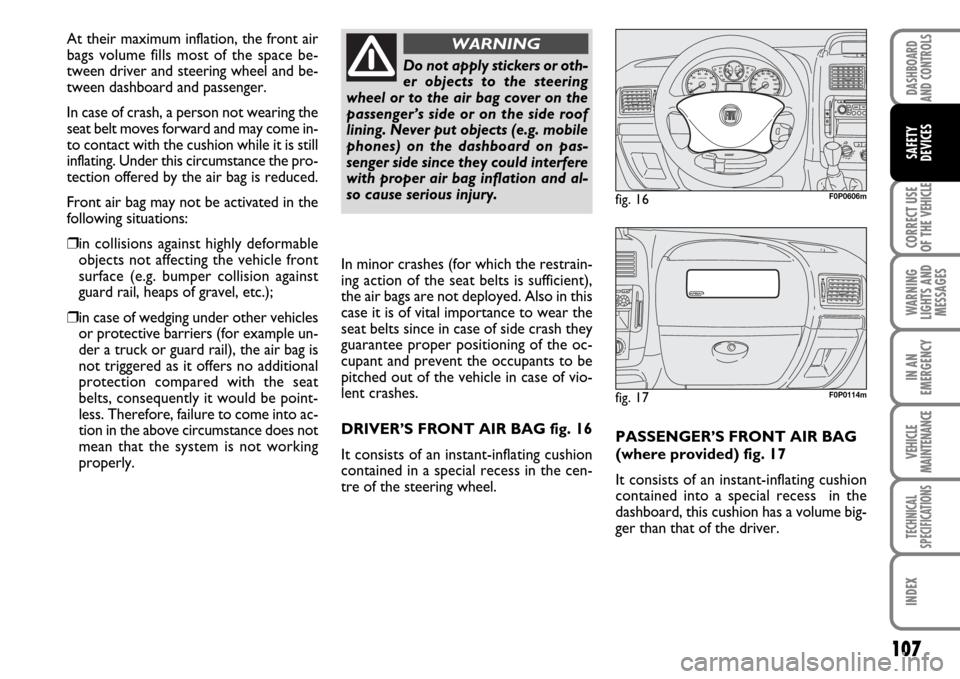
PASSENGER’S FRONT AIR BAG
(where provided) fig. 17
It consists of an instant-inflating cushion
contained into a special recess in the
dashboard, this cushion has a volume big-
ger than that of the driver.
fig. 16F0P0606m
fig. 17F0P0114m
In minor crashes (for which the restrain-
ing action of the seat belts is sufficient),
the air bags are not deployed. Also in this
case it is of vital importance to wear the
seat belts since in case of side crash they
guarantee proper positioning of the oc-
cupant and prevent the occupants to be
pitched out of the vehicle in case of vio-
lent crashes.
DRIVER’S FRONT AIR BAG fig. 16
It consists of an instant-inflating cushion
contained in a special recess in the cen-
tre of the steering wheel.
Do not apply stickers or oth-
er objects to the steering
wheel or to the air bag cover on the
passenger’s side or on the side roof
lining. Never put objects (e.g. mobile
phones) on the dashboard on pas-
senger side since they could interfere
with proper air bag inflation and al-
so cause serious injury.
WARNINGAt their maximum inflation, the front air
bags volume fills most of the space be-
tween driver and steering wheel and be-
tween dashboard and passenger.
In case of crash, a person not wearing the
seat belt moves forward and may come in-
to contact with the cushion while it is still
inflating. Under this circumstance the pro-
tection offered by the air bag is reduced.
Front air bag may not be activated in the
following situations:
❒in collisions against highly deformable
objects not affecting the vehicle front
surface (e.g. bumper collision against
guard rail, heaps of gravel, etc.);
❒in case of wedging under other vehicles
or protective barriers (for example un-
der a truck or guard rail), the air bag is
not triggered as it offers no additional
protection compared with the seat
belts, consequently it would be point-
less. Therefore, failure to come into ac-
tion in the above circumstance does not
mean that the system is not working
properly.
Page 112 of 210
111
CORRECT USE
OF THE
VEHICLE
WARNING
LIGHTS AND
MESSAGES
IN AN
EMERGENCY
VEHICLE
MAINTENANCE
TECHNICAL
SPECIFICATIONS
INDEX
DASHBOARD
AND CONTROLS
SAFETY
DEVICES
Never rest head, arms and
elbows on the door, on the
windows and in the window bag area
to prevent possible injuries during in-
flation phase.
WARNING
Never lean head, arms and
elbows out of window.
WARNING
GENERAL WARNINGS
If when turning the key to M
the warning light ¬does not
turn on or if it stays on when travel-
ling there could be a failure in safety
systems; in this event air bags or pre-
tensioners could not trigger in case of
impact or, in a minor number of cas-
es, they could trigger accidentally.
Contact Fiat Dealership immediately
to have the system checked.
WARNING
Do not cover the backrest of
front and rear seats with
trims or covers that are not suitable
to be used with side bags.
WARNING
Never travel with objects on
your lap, in front of your
chest or with a pipe, pencil, etc. be-
tween your lips; injury may result in
the event of the air bag being trig-
gered.
WARNINGIMPORTANT The triggering of preten-
sioners, front air bags and side bags is de-
cided in a differentiated manner by the
electronic control unit, depending on the
type of crash. The failure to deploy one or
more of them does not mean that the sys-
tem is not working properly.
Always keep your hands on
the steering wheel rim when
driving, so that if the air bag is trig-
gered, it can inflate without meeting
any obstacles which could cause seri-
ous harm to you. Do not drive with
the body bent forwards, keep the seat
back rest in the erect position and
lean your back well against it.
WARNING
Page 115 of 210
114
WARNING
LIGHTS AND
MESSAGES
IN AN
EMERGENCY
VEHICLE
MAINTENANCE
TECHNICAL
SPECIFICATIONS
INDEX
DASHBOARD
AND CONTROLS
SAFETY
DEVICES
CORRECT USE
OF THE VEHICLE
ENGINE
STARTING
The vehicle is fitted with an electronic en-
gine lock device: if the engine fails to start,
see the paragraph “The Fiat CODE sys-
tem” in section “Dashboard and controls”.
The engine may be noisier than usual dur-
ing the first seconds of operation, espe-
cially after it has not been used for a while.
This characteristic feature does not com-
promise functionality or reliability of the
hydraulic tappets: the timing system de-
vised to limit servicing.
We recommend that during
the initial period you do not
drive to full vehicle perfor-
mance (e.g.: excessive accel-
eration, long journeys at top speed,
sharp braking, etc.).
When the engine is switched
off never leave the key into
the ignition switch to prevent
pointless current absorption
from draining the battery.
Running the engine in con-
fined areas is extremely dan-
gerous. The engine consumes oxygen
and produces carbon monoxide
which is a highly toxic and lethal gas.
WARNING
Remember that the servo-
brake and power steering
are not operational until the engine
has been started, therefore much ef-
fort than usual is required on the
brake pedal and steering wheel.
WARNING
Dashboard and controls
Proceed as follows:
❒Ensure that the handbrake is up;
❒Put the gear lever into neutral;
❒Turn the ignition key to M: the warn-
ing light
mon the instrument panel
display will turn on;
❒Wait for the warning light mto turn
off. The hotter the engine is, the quick-
er this will happen;
❒Press the clutch pedal down to the
floor without touching the accelerator;
❒Turn the ignition key to Das soon as
warning light
mgoes out. If you wait
too long you will lose the benefit of the
work done by the glow plugs. Release
the key as soon as the engine starts.
Page 116 of 210
115
WARNING
LIGHTS AND
MESSAGES
IN AN
EMERGENCY
VEHICLE
MAINTENANCE
TECHNICAL
SPECIFICATIONS
INDEX
DASHBOARD
AND CONTROLS
SAFETY
DEVICES
CORRECT USE
OF THE VEHICLE
If the engine does not start at the first at-
tempt, return the ignition key to Sbefore
repeating starting.
If, when the ignition key is at M, the dis-
play warning light
mremains lit, turn the
key to Sand then back to M; if the warn-
ing lights remain on, try with the other
keys provided with the vehicle.
IMPORTANT Never leave the ignition key
to Mwhen the engine is off.
The warning light m will flash
for 60 seconds at start-up or
during prolonged cranking to
indicate a fault in the glow
plug heating system. You can use the
vehicle as usual if the engine starts but
you should contact Fiat Dealership as
soon as possible.
HOW TO WARM UP THE
ENGINE AFTER IT HAS JUST
STARTED
Proceed as follows:
❒Drive off slowly, letting the engine turn
at medium revs. Do not accelerate
abruptly;
❒Do not drive at full performance for the
initial kilometres. Wait until the coolant
temperature gauge starts moving.
Remember that the servo-
brake and power steering are
not operational until the en-
gine has been started, there-
fore much effort than usual is required
on the brake pedal and steering wheel.
Never bump start the engine
by pushing, towing or coast-
ing downhill as this could
cause fuel to flow into the
catalytic exhaust system and damage
it beyond repair.
STOPPING THE ENGINE
Turn the ignition key to Swhile the en-
gine is idling.
IMPORTANT After a taxing drive, you
should allow the engine to “catch its
breath” before turning it off by letting it
idle to allow the temperature in the en-
gine compartment to fall.
A quick burst on the acceler-
ator before turning off the en-
gine serves absolutely no
practical purpose, it wastes
fuel and is damaging especially to tur-
bocharged engines.
Page 117 of 210
116
WARNING
LIGHTS AND
MESSAGES
IN AN
EMERGENCY
VEHICLE
MAINTENANCE
TECHNICAL
SPECIFICATIONS
INDEX
DASHBOARD
AND CONTROLS
SAFETY
DEVICES
CORRECT USE
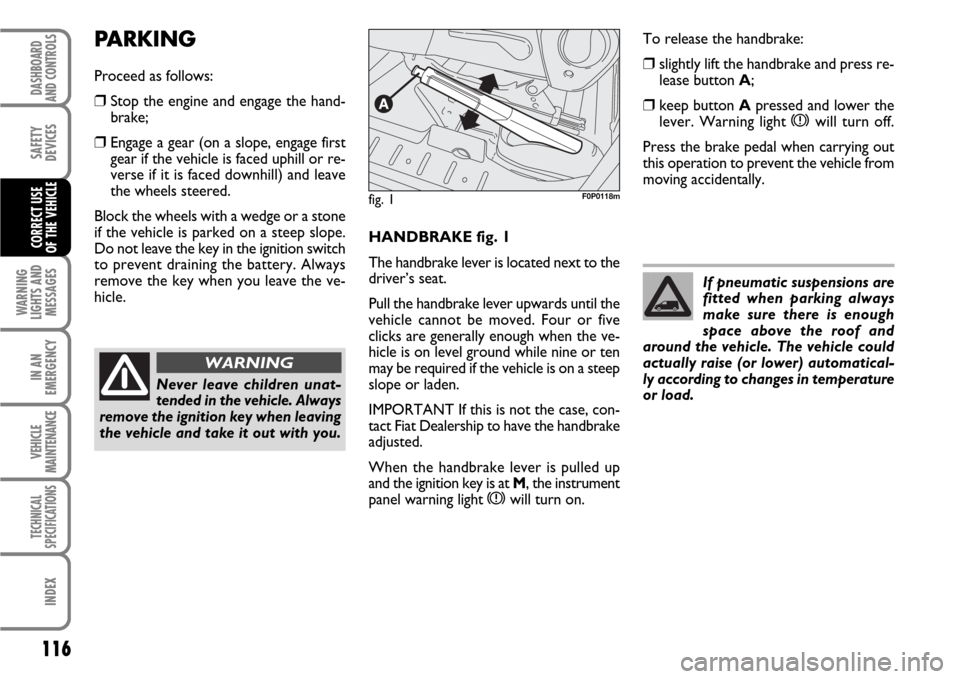
OF THE VEHICLEHANDBRAKE fig. 1
The handbrake lever is located next to the
driver’s seat.
Pull the handbrake lever upwards until the
vehicle cannot be moved. Four or five
clicks are generally enough when the ve-
hicle is on level ground while nine or ten
may be required if the vehicle is on a steep
slope or laden.
IMPORTANT If this is not the case, con-
tact Fiat Dealership to have the handbrake
adjusted.
When the handbrake lever is pulled up
and the ignition key is at M, the instrument
panel warning light
xwill turn on.
PARKING
Proceed as follows:
❒Stop the engine and engage the hand-
brake;
❒Engage a gear (on a slope, engage first
gear if the vehicle is faced uphill or re-
verse if it is faced downhill) and leave
the wheels steered.
Block the wheels with a wedge or a stone
if the vehicle is parked on a steep slope.
Do not leave the key in the ignition switch
to prevent draining the battery. Always
remove the key when you leave the ve-
hicle.
Never leave children unat-
tended in the vehicle. Always
remove the ignition key when leaving
the vehicle and take it out with you.
WARNING
fig. 1F0P0118m
To release the handbrake:
❒slightly lift the handbrake and press re-
lease button A;
❒keep button Apressed and lower the
lever. Warning light xwill turn off.
Press the brake pedal when carrying out
this operation to prevent the vehicle from
moving accidentally.
If pneumatic suspensions are
fitted when parking always
make sure there is enough
space above the roof and
around the vehicle. The vehicle could
actually raise (or lower) automatical-
ly according to changes in temperature
or load.