ESP FIAT SCUDO 2007 2.G Owner's Manual
[x] Cancel search | Manufacturer: FIAT, Model Year: 2007, Model line: SCUDO, Model: FIAT SCUDO 2007 2.GPages: 210, PDF Size: 3.29 MB
Page 115 of 210
114
WARNING
LIGHTS AND
MESSAGES
IN AN
EMERGENCY
VEHICLE
MAINTENANCE
TECHNICAL
SPECIFICATIONS
INDEX
DASHBOARD
AND CONTROLS
SAFETY
DEVICES
CORRECT USE
OF THE VEHICLE
ENGINE
STARTING
The vehicle is fitted with an electronic en-
gine lock device: if the engine fails to start,
see the paragraph “The Fiat CODE sys-
tem” in section “Dashboard and controls”.
The engine may be noisier than usual dur-
ing the first seconds of operation, espe-
cially after it has not been used for a while.
This characteristic feature does not com-
promise functionality or reliability of the
hydraulic tappets: the timing system de-
vised to limit servicing.
We recommend that during
the initial period you do not
drive to full vehicle perfor-
mance (e.g.: excessive accel-
eration, long journeys at top speed,
sharp braking, etc.).
When the engine is switched
off never leave the key into
the ignition switch to prevent
pointless current absorption
from draining the battery.
Running the engine in con-
fined areas is extremely dan-
gerous. The engine consumes oxygen
and produces carbon monoxide
which is a highly toxic and lethal gas.
WARNING
Remember that the servo-
brake and power steering
are not operational until the engine
has been started, therefore much ef-
fort than usual is required on the
brake pedal and steering wheel.
WARNING
Dashboard and controls
Proceed as follows:
❒Ensure that the handbrake is up;
❒Put the gear lever into neutral;
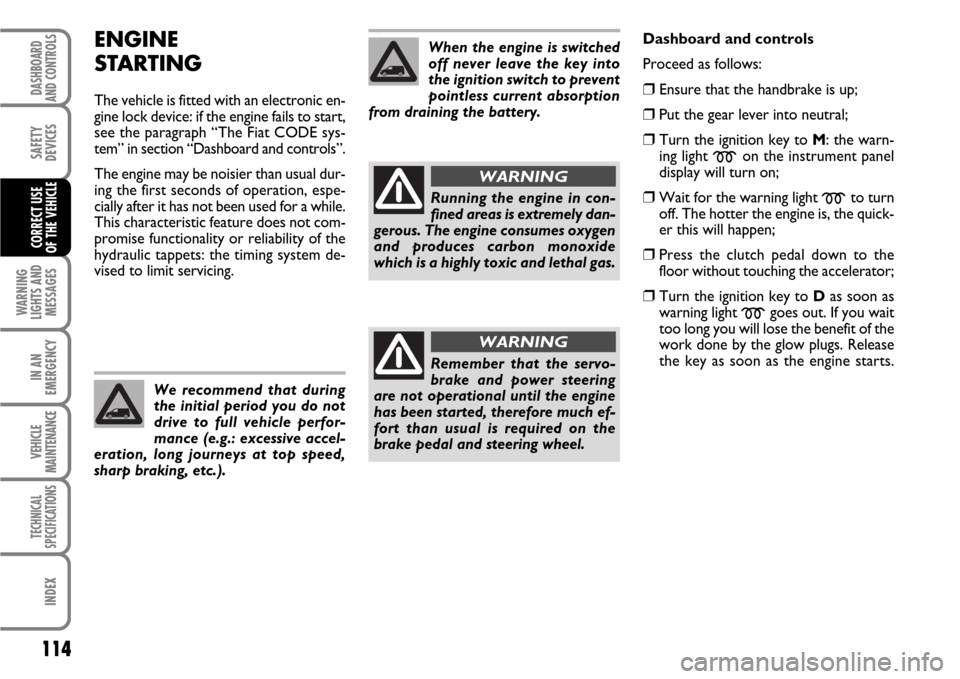
❒Turn the ignition key to M: the warn-
ing light
mon the instrument panel
display will turn on;
❒Wait for the warning light mto turn
off. The hotter the engine is, the quick-
er this will happen;
❒Press the clutch pedal down to the
floor without touching the accelerator;
❒Turn the ignition key to Das soon as
warning light
mgoes out. If you wait
too long you will lose the benefit of the
work done by the glow plugs. Release
the key as soon as the engine starts.
Page 116 of 210
115
WARNING
LIGHTS AND
MESSAGES
IN AN
EMERGENCY
VEHICLE
MAINTENANCE
TECHNICAL
SPECIFICATIONS
INDEX
DASHBOARD
AND CONTROLS
SAFETY
DEVICES
CORRECT USE
OF THE VEHICLE
If the engine does not start at the first at-
tempt, return the ignition key to Sbefore
repeating starting.
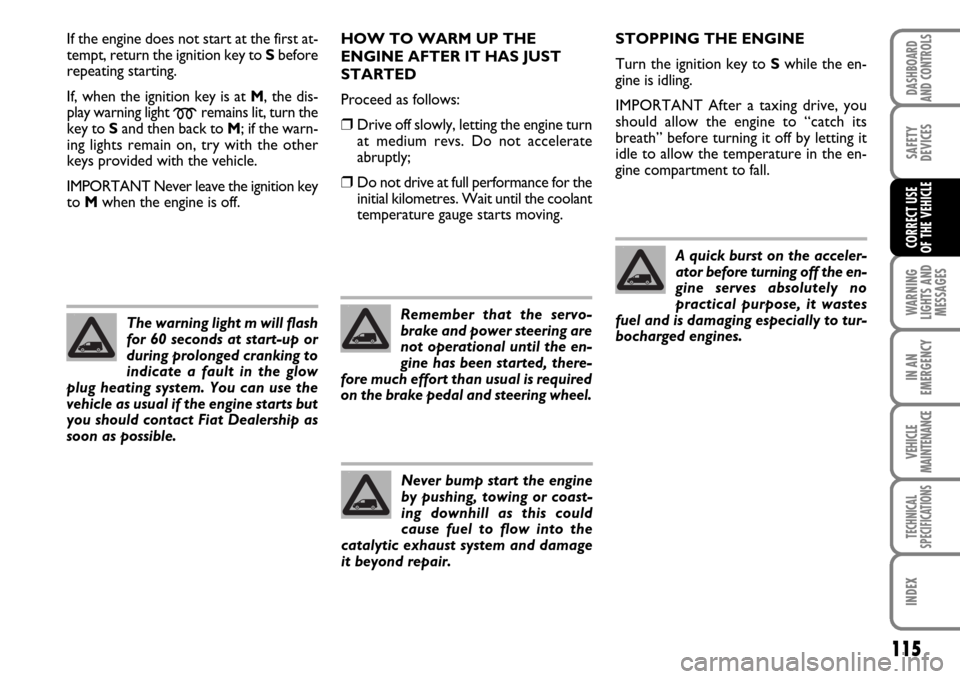
If, when the ignition key is at M, the dis-
play warning light
mremains lit, turn the
key to Sand then back to M; if the warn-
ing lights remain on, try with the other
keys provided with the vehicle.
IMPORTANT Never leave the ignition key
to Mwhen the engine is off.
The warning light m will flash
for 60 seconds at start-up or
during prolonged cranking to
indicate a fault in the glow
plug heating system. You can use the
vehicle as usual if the engine starts but
you should contact Fiat Dealership as
soon as possible.
HOW TO WARM UP THE
ENGINE AFTER IT HAS JUST
STARTED
Proceed as follows:
❒Drive off slowly, letting the engine turn
at medium revs. Do not accelerate
abruptly;
❒Do not drive at full performance for the
initial kilometres. Wait until the coolant
temperature gauge starts moving.
Remember that the servo-
brake and power steering are
not operational until the en-
gine has been started, there-
fore much effort than usual is required
on the brake pedal and steering wheel.
Never bump start the engine
by pushing, towing or coast-
ing downhill as this could
cause fuel to flow into the
catalytic exhaust system and damage
it beyond repair.
STOPPING THE ENGINE
Turn the ignition key to Swhile the en-
gine is idling.
IMPORTANT After a taxing drive, you
should allow the engine to “catch its
breath” before turning it off by letting it
idle to allow the temperature in the en-
gine compartment to fall.
A quick burst on the acceler-
ator before turning off the en-
gine serves absolutely no
practical purpose, it wastes
fuel and is damaging especially to tur-
bocharged engines.
Page 124 of 210
123
IN AN
EMERGENCY
VEHICLE
MAINTENANCE
TECHNICAL
SPECIFICATIONS
INDEX
DASHBOARD
AND CONTROLS
SAFETY
DEVICES
CORRECT USE
OF THE
VEHICLE
WARNING
LIGHTS AND
MESSAGES
GENERAL WARNINGS .................................................... 124
LOW BRAKE FLUID .......................................................... 124
HANDBRAKE ON .............................................................. 124
AIR BAG FAILURE .............................................................. 125
ENGINE COOLANT
HIGH TEMPERATURE ....................................................... 125
LOW BATTERY CHARGE ............................................... 126
LOW PRESSURE/HIGH TEMPERATURE OF
ENGINE OIL ......................................................................... 126
ELECTRIC POWER STEERING FAILURE .................... 127
INCOMPLETE DOOR LOCKING .................................. 127
SEAT BELTS NOT FASTENED ........................................ 128
EBD SYSTEM FAILURE ...................................................... 128
INJECTION SYSTEM FAILURE ........................................ 128
FRONT PASSENGER AIR BAG DEACTIVATED ....... 129
ABS SYSTEM FAILURE ....................................................... 129
STOP ........................................................................................ 129
FUEL RESERVE ..................................................................... 130
REAR FOGLIGHTS ............................................................. 130
GENERIC FAILURE ............................................................. 130ESP SYSTEM FAILURE ........................................................ 130
BRAKE PAD WEAR ........................................................... 131
FRONT FOG LIGHTS ........................................................ 131
DIPPED HEADLAMPS ........................................................ 131
REAR PNEUMATIC SUSPENSIONS ................................ 131
LEFT-HAND DIRECTION INDICATOR ...................... 131
RIGHT-HAND DIRECTION INDICATOR .................. 131
MAIN BEAM HEADLIGHTS ............................................. 131
CRUISE CONTROL ........................................................... 132
SPEED RESTRICTOR ........................................................... 132
GLOW PLUG WARMING................................................. 132
WATER IN DIESEL FUEL FILTER .................................... 132
SCHEDULED SERVICING.................................................. 132
W W
A A
R R
N N
I I
N N
G G
L L
I I
G G
H H
T T
S S
A A
N N
D D
M M
E E
S S
S S
A A
G G
E E E
S S
Page 131 of 210
130
IN AN
EMERGENCY
VEHICLE
MAINTENANCE
TECHNICAL
SPECIFICATIONS
INDEX
DASHBOARD
AND CONTROLS
SAFETY
DEVICES
CORRECT USE
OF THE
VEHICLE
WARNING
LIGHTS AND
MESSAGES
K
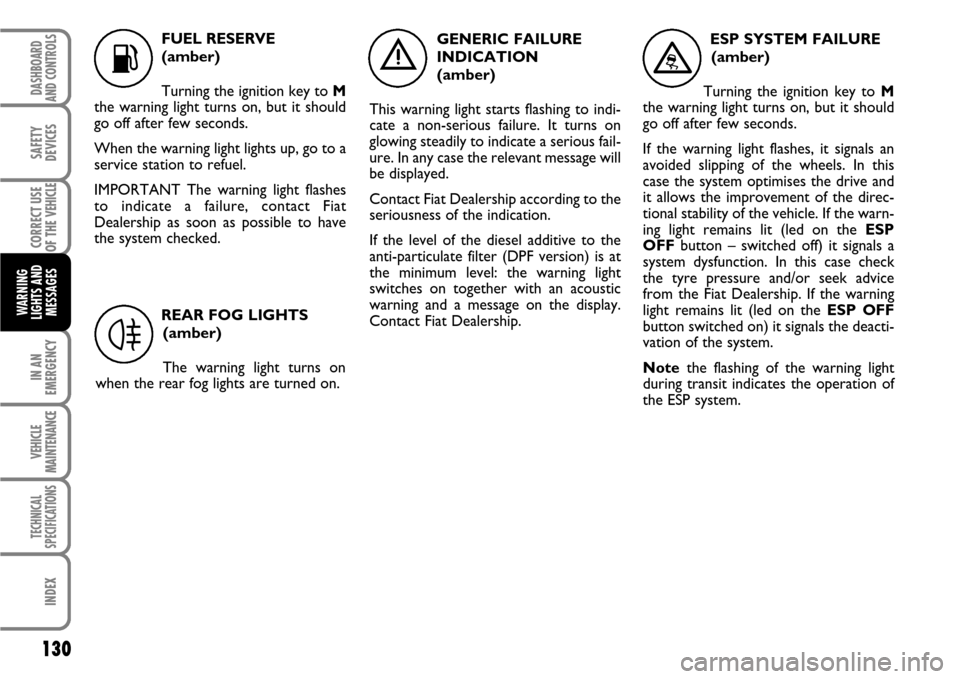
FUEL RESERVE
(amber)
Turning the ignition key to M
the warning light turns on, but it should
go off after few seconds.
When the warning light lights up, go to a
service station to refuel.
IMPORTANT The warning light flashes
to indicate a failure, contact Fiat
Dealership as soon as possible to have
the system checked.
REAR FOG LIGHTS
(amber)
The warning light turns on
when the rear fog lights are turned on.
4
GENERIC FAILURE
INDICATION
(amber)
This warning light starts flashing to indi-
cate a non-serious failure. It turns on
glowing steadily to indicate a serious fail-
ure. In any case the relevant message will
be displayed.
Contact Fiat Dealership according to the
seriousness of the indication.
If the level of the diesel additive to the
anti-particulate filter (DPF version) is at
the minimum level: the warning light
switches on together with an acoustic
warning and a message on the display.
Contact Fiat Dealership.
è
ESP SYSTEM FAILURE
(amber)
Turning the ignition key to M
the warning light turns on, but it should
go off after few seconds.
If the warning light flashes, it signals an
avoided slipping of the wheels. In this
case the system optimises the drive and
it allows the improvement of the direc-
tional stability of the vehicle. If the warn-
ing light remains lit (led on the ESP
OFFbutton – switched off) it signals a
system dysfunction. In this case check
the tyre pressure and/or seek advice
from the Fiat Dealership. If the warning
light remains lit (led on the ESP OFF
button switched on) it signals the deacti-
vation of the system.
Notethe flashing of the warning light
during transit indicates the operation of
the ESP system.
™
Page 136 of 210
135
WARNING
LIGHTS AND
MESSAGES
VEHICLE
MAINTENANCE
TECHNICAL
SPECIFICATIONS
INDEX
DASHBOARD
AND CONTROLS
SAFETY
DEVICES
CORRECT USE
OF THE
VEHICLE
IN AN
EMERGENCY
IMPORTANT Do not directly connect the
negative terminals of the two batteries:
sparks could ignite the flammable gas from
the battery. If the other battery is fitted in
another vehicle, prevent accidental con-
tacts between the metal parts of the two
vehicles.BUMP STARTING
Never bump start the engine (by pushing,
towing, or coasting downhill) as this could
cause fuel to flow into the catalytic ex-
haust system and damage it beyond repair.
IMPORTANT Remember that the brake
booster and the power steering system
are not operating until the engine is start-
ed, a greater effort will therefore be re-
quired to press the brake pedal or to turn
the steering wheel.IF A TYRE
IS PUNCTURED
GENERAL INSTRUCTIONS
Wheel changing and correct use of the
jack and spare wheel call for some pre-
cautions as listed below.
Alert other drivers that the
vehicle is stationary in com-
pliance with the regulations in force:
hazard warning lights, warning trian-
gle etc. Any passengers on board
should leave the vehicle, especially if
it is heavily laden. Passengers should
stay away from oncoming traffic
while the wheel is being changed on.
Pull the handbrake.
WARNING
Before starting to change
the wheel, deactivate the
pneumatic suspension system (where
provided). See paragraph “Pneumat-
ic suspensions” in this section.
WARNING
Page 140 of 210
139
WARNING
LIGHTS AND
MESSAGES
VEHICLE
MAINTENANCE
TECHNICAL
SPECIFICATIONS
INDEX
DASHBOARD
AND CONTROLS
SAFETY
DEVICES
CORRECT USE
OF THE
VEHICLE
IN AN
EMERGENCY
WHEN NEEDING TO
CHANGE A BULB
GENERAL INSTRUCTIONS
❒When a light is not working, check that
the corresponding fuse is intact before
changing a bulb. For the location of fus-
es, refer to the paragraph “If a fuse
blows” in this section;
❒ Before changing a bulb check the con-
tacts for oxidation;
❒ Burnt bulbs must be replaced by oth-
ers of the same type and power;
❒ Always check the height of the head-
light beam after changing a bulb.
IMPORTANT The headlight inner surface
may be lightly misted over: this is not a
fault but a natural fact due to low tem-
perature and level of air humidity. It will
disappear as soon the headlights are
turned on. The presence of drops inside
the headlights means water infiltration,
therefore contact Fiat Dealership.
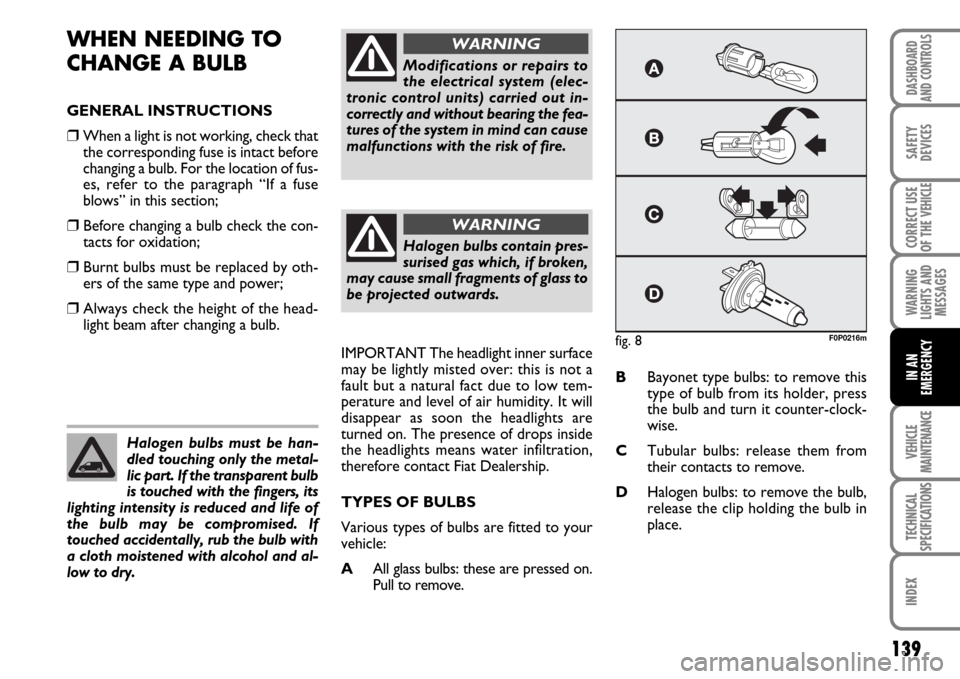
TYPES OF BULBS
Various types of bulbs are fitted to your
vehicle:
AAll glass bulbs: these are pressed on.
Pull to remove.BBayonet type bulbs: to remove this
type of bulb from its holder, press
the bulb and turn it counter-clock-
wise.
CTubular bulbs: release them from
their contacts to remove.
DHalogen bulbs: to remove the bulb,
release the clip holding the bulb in
place. Halogen bulbs must be han-
dled touching only the metal-
lic part. If the transparent bulb
is touched with the fingers, its
lighting intensity is reduced and life of
the bulb may be compromised. If
touched accidentally, rub the bulb with
a cloth moistened with alcohol and al-
low to dry.
Modifications or repairs to
the electrical system (elec-
tronic control units) carried out in-
correctly and without bearing the fea-
tures of the system in mind can cause
malfunctions with the risk of fire.
WARNING
Halogen bulbs contain pres-
surised gas which, if broken,
may cause small fragments of glass to
be projected outwards.
WARNING
fig. 8F0P0216m
Page 148 of 210
147
WARNING
LIGHTS AND
MESSAGES
VEHICLE
MAINTENANCE
TECHNICAL
SPECIFICATIONS
INDEX
DASHBOARD
AND CONTROLS
SAFETY
DEVICES
CORRECT USE
OF THE
VEHICLE
IN AN
EMERGENCY
fig. 22F0P0299m
F1
F2
F3
F4
F5
F6
F7
F8
F9
F10
F11
F12
F13
F14
F15
F16
F1715
–
5
10
30
30
5
20
10
30
15
15
5
15
30
–
40
Fuse box on the dashboard on passenger side
USERS FUSE AMPERE
Rear window wiper
Free
Airbag control unit
Headlight aiming device, diagnostic socket, ESP control unit,
ventilation, particulate filter pump, steering sensor
Power rearview mirror, passenger power window
Front window power
Ceiling lights, glovebox light
Multi-function Display, anti-theft alarm siren, sound system,
CD-Changer, Radiotelephone, trailer services control unit,
Panel workers protection control unit
Cigar lighter, load compartment outlet
Rear trimming strip, starting device, instrument panel
Diagnostic socket, anti-theft system control unit
Kit main libre, airbag control unit
Engine utilities control unit, trailer utilities control unit
Rain sensor, automatic acclimatiser instrument panel,
ventilation rear part of passenger compartment
(combined fittings)
Door locking/unlocking
Free
Rear heated window and door mirrors defroster
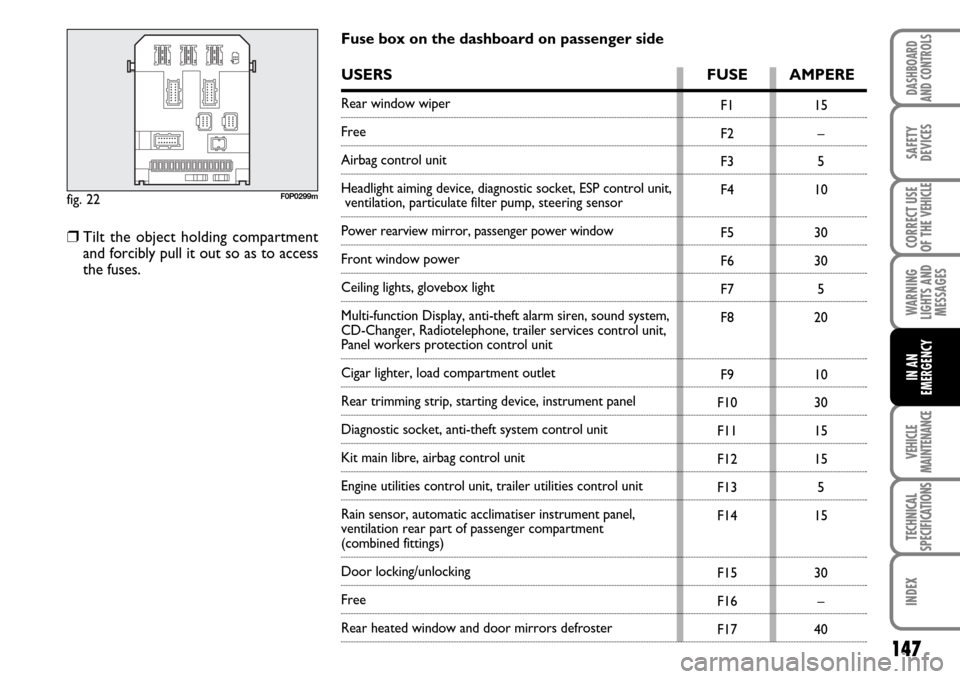
❒Tilt the object holding compartment
and forcibly pull it out so as to access
the fuses.
Page 149 of 210
148
WARNING
LIGHTS AND
MESSAGES
VEHICLE
MAINTENANCE
TECHNICAL
SPECIFICATIONS
INDEX
DASHBOARD
AND CONTROLS
SAFETY
DEVICES
CORRECT USE
OF THE
VEHICLE
IN AN
EMERGENCY
fig. 23F0P0239m
F1
F2
F3
F4
F5
F6
F7
F8
F9
F10
F11
F12
F13
F1420
15
10
20
15
10
10
20
10
30
40
30
40
30
Fuse box in engine compartment
USERS FUSE AMPERE
Engine control unit, fuel and air supply device, fan unit
Horn
Windscreen and rear window washing pump
Headlight washing pump
Fuel supply device
Secondary brake pedal contact, power steering
ABS/ESP
Ignition switch
Main brake pedal contact
Fuel and air supply device
Front ventilation
Windscreen wiper
Utilities control unit
Free
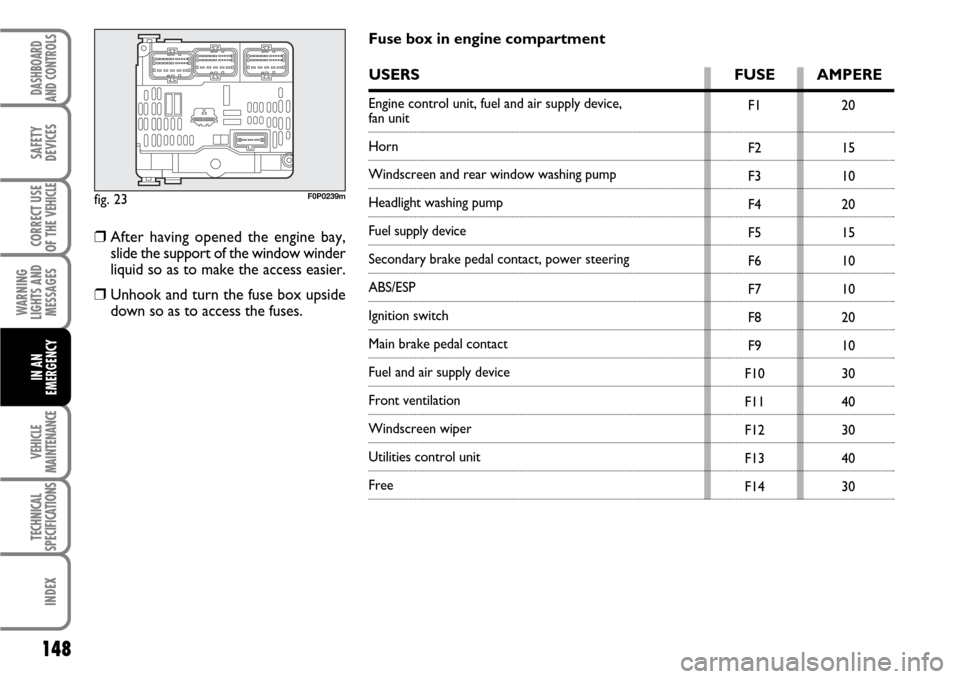
❒After having opened the engine bay,
slide the support of the window winder
liquid so as to make the access easier.
❒Unhook and turn the fuse box upside
down so as to access the fuses.
Page 161 of 210
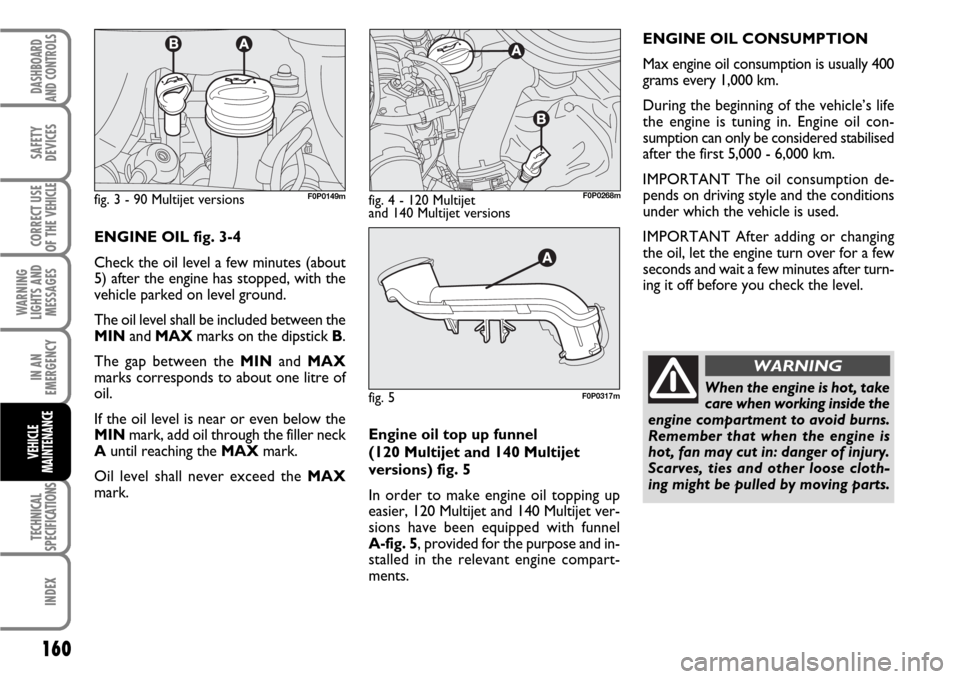
Engine oil top up funnel
(120 Multijet and 140 Multijet
versions) fig. 5
In order to make engine oil topping up
easier, 120 Multijet and 140 Multijet ver-
sions have been equipped with funnel
A-fig. 5, provided for the purpose and in-
stalled in the relevant engine compart-
ments.ENGINE OIL CONSUMPTION
Max engine oil consumption is usually 400
grams every 1,000 km.
During the beginning of the vehicle’s life
the engine is tuning in. Engine oil con-
sumption can only be considered stabilised
after the first 5,000 - 6,000 km.
IMPORTANT The oil consumption de-
pends on driving style and the conditions
under which the vehicle is used.
IMPORTANT After adding or changing
the oil, let the engine turn over for a few
seconds and wait a few minutes after turn-
ing it off before you check the level. ENGINE OIL fig. 3-4
Check the oil level a few minutes (about
5) after the engine has stopped, with the
vehicle parked on level ground.
The oil level shall be included between the
MINand MAXmarks on the dipstick B.
The gap between the MINand MAX
marks corresponds to about one litre of
oil.
If the oil level is near or even below the
MINmark, add oil through the filler neck
Auntil reaching the MAXmark.
Oil level shall never exceed the MAX
mark.
fig. 3 - 90 Multijet versionsF0P0149mF0P0268m
When the engine is hot, take
care when working inside the
engine compartment to avoid burns.
Remember that when the engine is
hot, fan may cut in: danger of injury.
Scarves, ties and other loose cloth-
ing might be pulled by moving parts.
WARNING
160
WARNING
LIGHTS AND
MESSAGES
TECHNICAL
SPECIFICATIONS
INDEX
DASHBOARD
AND CONTROLS
SAFETY
DEVICES
CORRECT USE
OF THE
VEHICLE
IN AN
EMERGENCY
VEHICLE
MAINTENANCE
fig. 4 - 120 Multijet
and 140 Multijet versions
fig. 5
F0P0317m
Page 162 of 210
161
WARNING
LIGHTS AND
MESSAGES
TECHNICAL
SPECIFICATIONS
INDEX
DASHBOARD
AND CONTROLS
SAFETY
DEVICES
CORRECT USE
OF THE
VEHICLE
IN AN
EMERGENCY
VEHICLE
MAINTENANCE
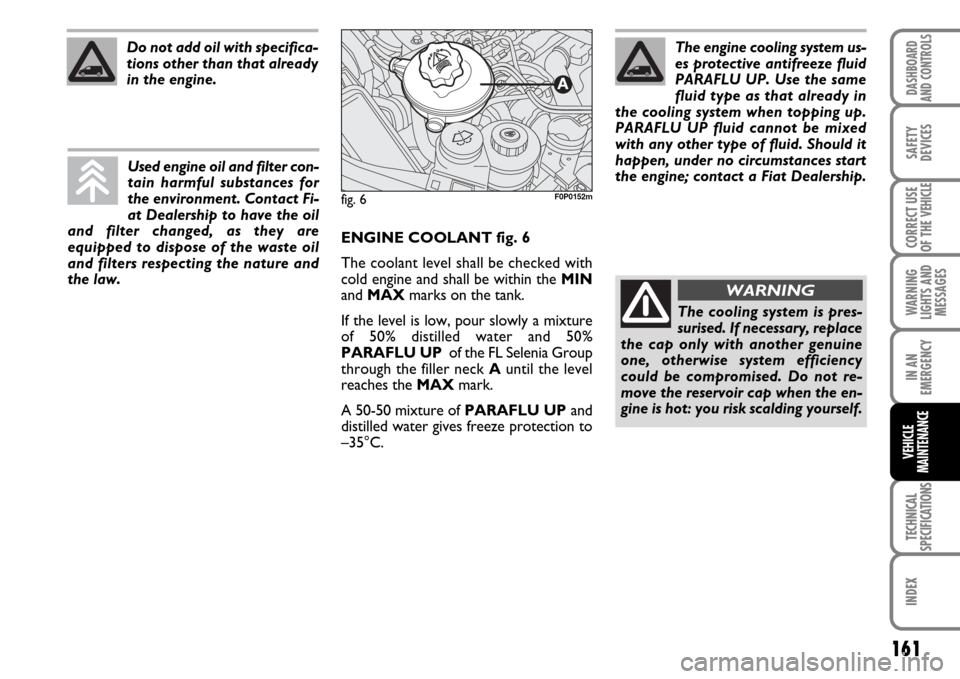
ENGINE COOLANT fig. 6
The coolant level shall be checked with
cold engine and shall be within the MIN
and MAXmarks on the tank.
If the level is low, pour slowly a mixture
of 50% distilled water and 50%
PARAFLU UP of the FL Selenia Group
through the filler neck Auntil the level
reaches the MAXmark.
A 50-50 mixture of PARAFLU UPand
distilled water gives freeze protection to
–35°C.
fig. 6F0P0152m
The engine cooling system us-
es protective antifreeze fluid
PARAFLU UP. Use the same
fluid type as that already in
the cooling system when topping up.
PARAFLU UP fluid cannot be mixed
with any other type of fluid. Should it
happen, under no circumstances start
the engine; contact a Fiat Dealership.
The cooling system is pres-
surised. If necessary, replace
the cap only with another genuine
one, otherwise system efficiency
could be compromised. Do not re-
move the reservoir cap when the en-
gine is hot: you risk scalding yourself.
WARNING
Used engine oil and filter con-
tain harmful substances for
the environment. Contact Fi-
at Dealership to have the oil
and filter changed, as they are
equipped to dispose of the waste oil
and filters respecting the nature and
the law.
Do not add oil with specifica-
tions other than that already
in the engine.