starting FIAT SCUDO 2008 2.G User Guide
[x] Cancel search | Manufacturer: FIAT, Model Year: 2008, Model line: SCUDO, Model: FIAT SCUDO 2008 2.GPages: 210, PDF Size: 3.32 MB
Page 54 of 210
53
SAFETY
DEVICES
CORRECT USE
OF THE
VEHICLE
WARNING
LIGHTS AND
MESSAGES
IN AN
EMERGENCY
VEHICLE
MAINTENANCE
TECHNICAL
SPECIFICATIONS
INDEX
DASHBOARD
AND CONTROLS
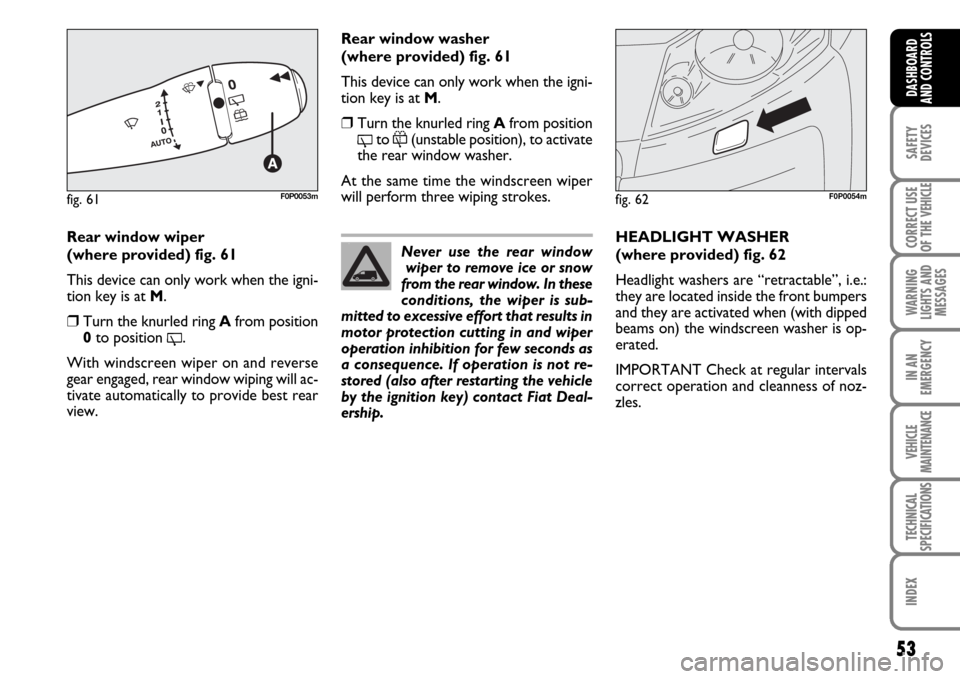
Rear window wiper
(where provided) fig. 61
This device can only work when the igni-
tion key is at M.
❒Turn the knurled ring Afrom position
0to position
'.
With windscreen wiper on and reverse
gear engaged, rear window wiping will ac-
tivate automatically to provide best rear
view.HEADLIGHT WASHER
(where provided) fig. 62
Headlight washers are “retractable”, i.e.:
they are located inside the front bumpers
and they are activated when (with dipped
beams on) the windscreen washer is op-
erated.
IMPORTANT Check at regular intervals
correct operation and cleanness of noz-
zles.
fig. 62F0P0054m
Never use the rear window
wiper to remove ice or snow
from the rear window. In these
conditions, the wiper is sub-
mitted to excessive effort that results in
motor protection cutting in and wiper
operation inhibition for few seconds as
a consequence. If operation is not re-
stored (also after restarting the vehicle
by the ignition key) contact Fiat Deal-
ership.
Rear window washer
(where provided) fig. 61
This device can only work when the igni-
tion key is at M.
❒Turn the knurled ring Afrom position
'to
&(unstable position), to activate
the rear window washer.
At the same time the windscreen wiper
will perform three wiping strokes.
fig. 61F0P0053m
Page 57 of 210
56
SAFETY
DEVICES
CORRECT USE
OF THE
VEHICLE
WARNING
LIGHTS AND
MESSAGES
IN AN
EMERGENCY
VEHICLE
MAINTENANCE
TECHNICAL
SPECIFICATIONS
INDEX
DASHBOARD
AND
CONTROLS
F0P0330m F0P0336mF0P0337m F0P0325m
F0P0328m
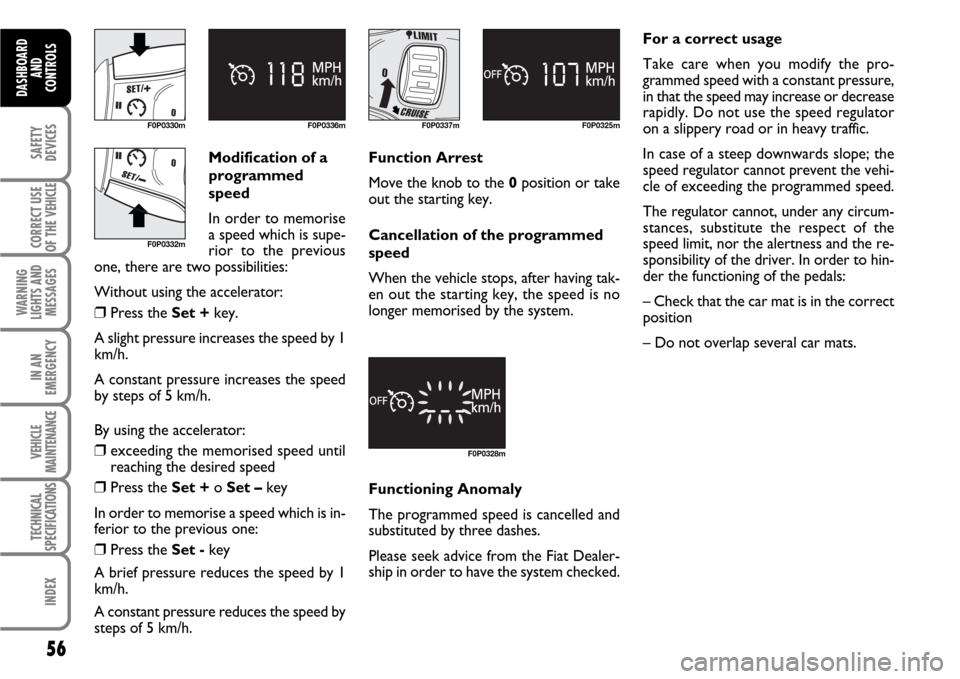
Modification of a
programmed
speed
In order to memorise
a speed which is supe-
rior to the previous
one, there are two possibilities:
Without using the accelerator:
❒Press the Set +key.
A slight pressure increases the speed by 1
km/h.
A constant pressure increases the speed
by steps of 5 km/h.
By using the accelerator:
❒exceeding the memorised speed until
reaching the desired speed
❒Press the Set + o Set –key
In order to memorise a speed which is in-
ferior to the previous one:
❒Press the Set -key
A brief pressure reduces the speed by 1
km/h.
A constant pressure reduces the speed by
steps of 5 km/h.Function Arrest
Move the knob to the 0position or take
out the starting key.
Cancellation of the programmed
speed
When the vehicle stops, after having tak-
en out the starting key, the speed is no
longer memorised by the system.
Functioning Anomaly
The programmed speed is cancelled and
substituted by three dashes.
Please seek advice from the Fiat Dealer-
ship in order to have the system checked.For a correct usage
Take care when you modify the pro-
grammed speed with a constant pressure,
in that the speed may increase or decrease
rapidly. Do not use the speed regulator
on a slippery road or in heavy traffic.
In case of a steep downwards slope; the
speed regulator cannot prevent the vehi-
cle of exceeding the programmed speed.
The regulator cannot, under any circum-
stances, substitute the respect of the
speed limit, nor the alertness and the re-
sponsibility of the driver. In order to hin-
der the functioning of the pedals:
– Check that the car mat is in the correct
position
– Do not overlap several car mats.
F0P0332m
Page 60 of 210
59
SAFETY
DEVICES
CORRECT USE
OF THE
VEHICLE
WARNING
LIGHTS AND
MESSAGES
IN AN
EMERGENCY
VEHICLE
MAINTENANCE
TECHNICAL
SPECIFICATIONS
INDEX
DASHBOARD
AND CONTROLS
F0P0333m F0P0341mF0P0345m F0P0339mF0P0342m
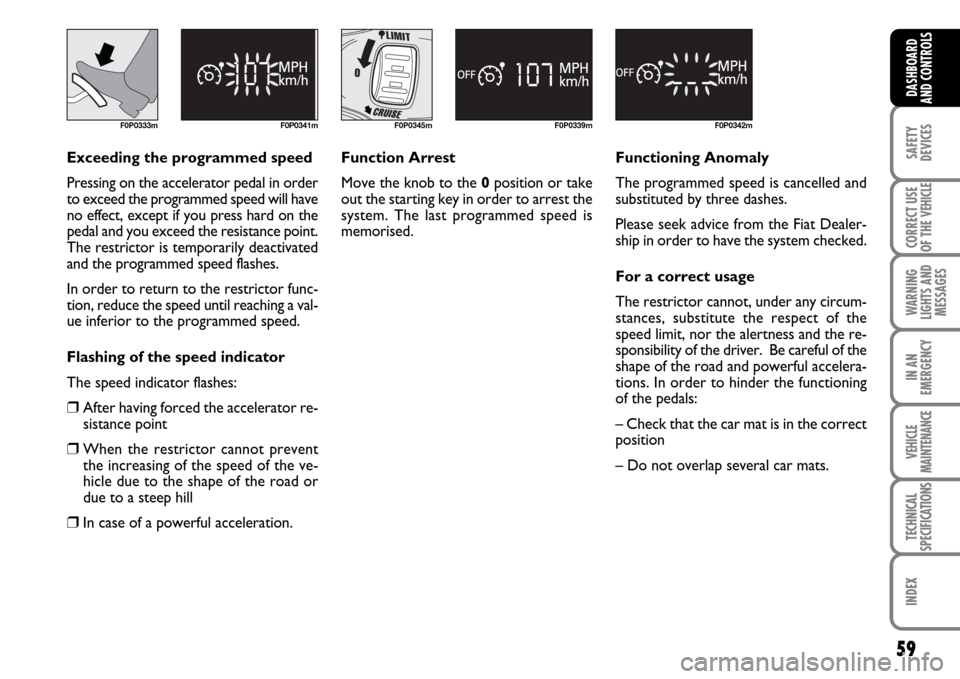
Exceeding the programmed speed
Pressing on the accelerator pedal in order
to exceed the programmed speed will have
no effect, except if you press hard on the
pedal and you exceed the resistance point.
The restrictor is temporarily deactivated
and the programmed speed flashes.
In order to return to the restrictor func-
tion, reduce the speed until reaching a val-
ue inferior to the programmed speed.
Flashing of the speed indicator
The speed indicator flashes:
❒After having forced the accelerator re-
sistance point
❒When the restrictor cannot prevent
the increasing of the speed of the ve-
hicle due to the shape of the road or
due to a steep hill
❒In case of a powerful acceleration.Function Arrest
Move the knob to the 0position or take
out the starting key in order to arrest the
system. The last programmed speed is
memorised.Functioning Anomaly
The programmed speed is cancelled and
substituted by three dashes.
Please seek advice from the Fiat Dealer-
ship in order to have the system checked.
For a correct usage
The restrictor cannot, under any circum-
stances, substitute the respect of the
speed limit, nor the alertness and the re-
sponsibility of the driver. Be careful of the
shape of the road and powerful accelera-
tions. In order to hinder the functioning
of the pedals:
– Check that the car mat is in the correct
position
– Do not overlap several car mats.
Page 62 of 210
61
SAFETY
DEVICES
CORRECT USE
OF THE
VEHICLE
WARNING
LIGHTS AND
MESSAGES
IN AN
EMERGENCY
VEHICLE
MAINTENANCE
TECHNICAL
SPECIFICATIONS
INDEX
DASHBOARD
AND CONTROLS
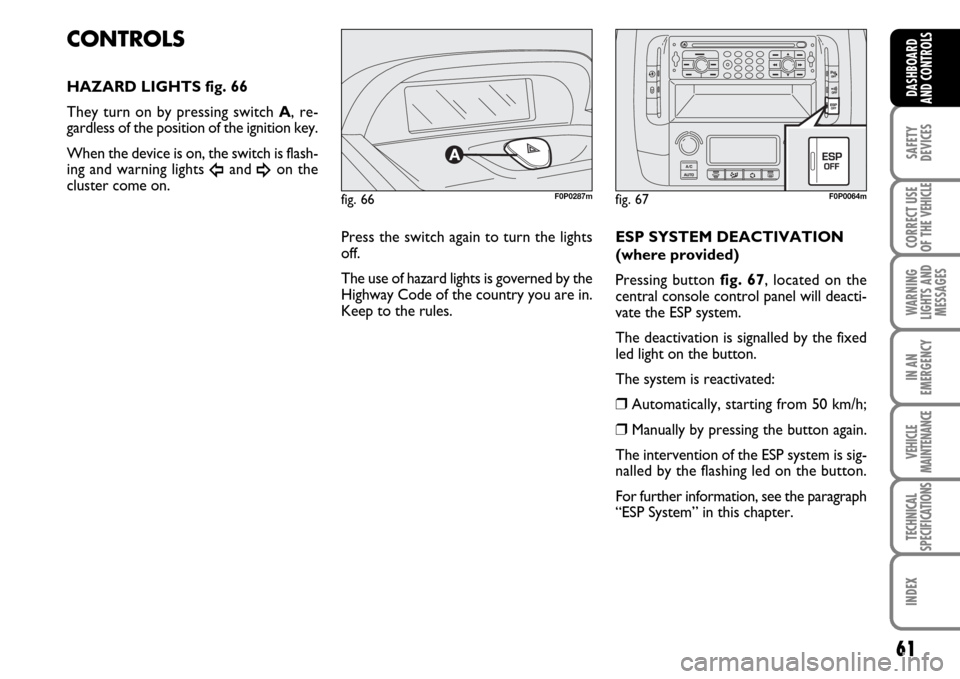
fig. 66F0P0287m
CONTROLS
HAZARD LIGHTS fig. 66
They turn on by pressing switch A, re-
gardless of the position of the ignition key.
When the device is on, the switch is flash-
ing and warning lights
Îand ¥on the
cluster come on.
ESP SYSTEM DEACTIVATION
(where provided)
Pressing button fig. 67, located on the
central console control panel will deacti-
vate the ESP system.
The deactivation is signalled by the fixed
led light on the button.
The system is reactivated:
❒Automatically, starting from 50 km/h;
❒Manually by pressing the button again.
The intervention of the ESP system is sig-
nalled by the flashing led on the button.
For further information, see the paragraph
“ESP System” in this chapter.
fig. 67F0P0064m
Press the switch again to turn the lights
off.
The use of hazard lights is governed by the
Highway Code of the country you are in.
Keep to the rules.
Page 79 of 210
78
SAFETY
DEVICES
CORRECT USE
OF THE
VEHICLE
WARNING
LIGHTS AND
MESSAGES
IN AN
EMERGENCY
VEHICLE
MAINTENANCE
TECHNICAL
SPECIFICATIONS
INDEX
DASHBOARD
AND
CONTROLS
PNEUMATIC
SUSPENSIONS
In some versions the tires rear suspen-
sions self-leveling may be included as an
optional.
According to versions suspensions can be
adjusted manually or automatically.
MANUAL ADJUSTMENT
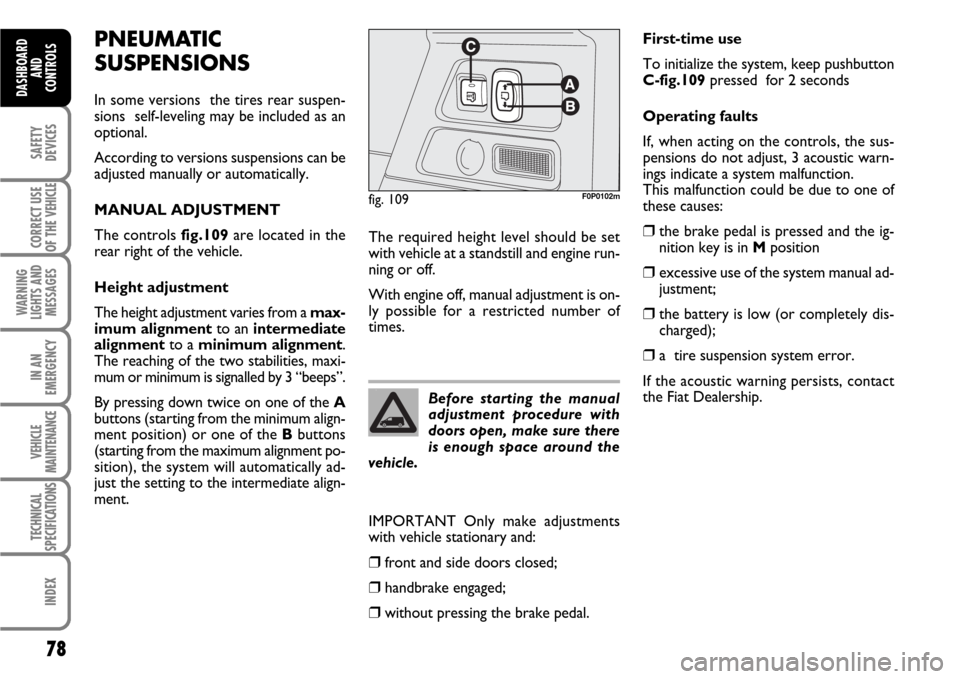
The controls fig.109are located in the
rear right of the vehicle.
Height adjustment
The height adjustment varies from a max-
imum alignmentto an intermediate
alignmentto a minimum alignment.
The reaching of the two stabilities, maxi-
mum or minimum is signalled by 3 “beeps”.
By pressing down twice on one of the A
buttons (starting from the minimum align-
ment position) or one of the Bbuttons
(starting from the maximum alignment po-
sition), the system will automatically ad-
just the setting to the intermediate align-
ment.
fig. 109F0P0102m
Before starting the manual
adjustment procedure with
doors open, make sure there
is enough space around the
vehicle.
First-time use
To initialize the system, keep pushbutton
C-fig.109pressed for 2 seconds
Operating faults
If, when acting on the controls, the sus-
pensions do not adjust, 3 acoustic warn-
ings indicate a system malfunction.
This malfunction could be due to one of
these causes:
❒the brake pedal is pressed and the ig-
nition key is in Mposition
❒excessive use of the system manual ad-
justment;
❒the battery is low (or completely dis-
charged);
❒a tire suspension system error.
If the acoustic warning persists, contact
the Fiat Dealership. The required height level should be set
with vehicle at a standstill and engine run-
ning or off.
With engine off, manual adjustment is on-
ly possible for a restricted number of
times.
IMPORTANT Only make adjustments
with vehicle stationary and:
❒front and side doors closed;
❒handbrake engaged;
❒without pressing the brake pedal.
Page 85 of 210
84
SAFETY
DEVICES
CORRECT USE
OF THE
VEHICLE
WARNING
LIGHTS AND
MESSAGES
IN AN
EMERGENCY
VEHICLE
MAINTENANCE
TECHNICAL
SPECIFICATIONS
INDEX
DASHBOARD
AND CONTROLS
fig. 113F0F0104m
ESP SYSTEM
(Electronic Stability
Program)
(where provided)
The ESP system is an electronic system
controlling the vehicle stability in the event
of tyre grip loss.
The ESP system is therefore particularly
useful when grip conditions of the road sur-
faces changes.
In addition to the ESP system and ASR sys-
tem, also the MSR system (adjusting the
engine braking torque) and the HBA sys-
tem (improving the braking force during
emergency braking) are provided.ESP SYSTEM INTERVENTION
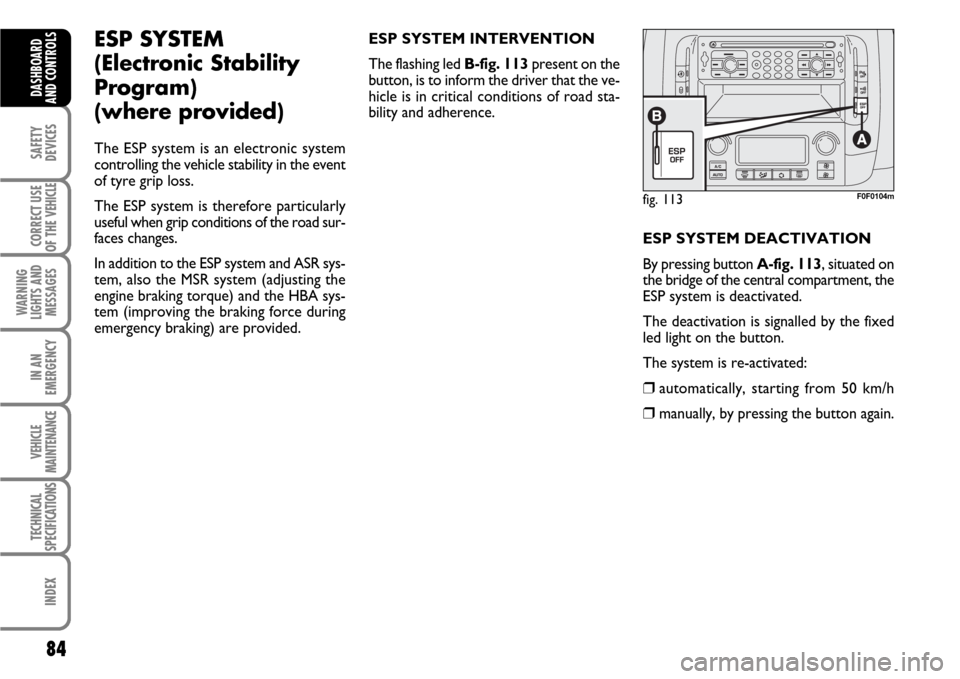
The flashing led B-fig. 113present on the
button, is to inform the driver that the ve-
hicle is in critical conditions of road sta-
bility and adherence.
ESP SYSTEM DEACTIVATION
By pressing button A-fig. 113, situated on
the bridge of the central compartment, the
ESP system is deactivated.
The deactivation is signalled by the fixed
led light on the button.
The system is re-activated:
❒automatically, starting from 50 km/h
❒manually, by pressing the button again.
Page 93 of 210
92
SAFETY
DEVICES
CORRECT USE
OF THE
VEHICLE
WARNING
LIGHTS AND
MESSAGES
IN AN
EMERGENCY
VEHICLE
MAINTENANCE
TECHNICAL
SPECIFICATIONS
INDEX
DASHBOARD
AND CONTROLS
DIESEL PARTICULATE FILTER
(DPF) (where provided)
The Diesel Particulate Filter is a mechan-
ical filter, integral with the exhaust system,
that physically traps particulates present
in the exhaust gases of Diesel engine.
The diesel particulate filter has been
adopted to eliminate almost totally par-
ticulates in compliance with current / fu-
ture law regulations.
During normal use of the vehicle, the en-
gine control unit records a set of data (e.g.:
travel time, type of route, temperatures,
etc.) and it will then calculate how much
particulates has been trapped by the filter.
Since this filter physically traps particulates,
it shall be cleaned (reclaimed) at regular
intervals by burning carbon particles.
Reclaiming procedure is controlled auto-
matically by the engine control unit ac-
cording to the filter conditions and the
conditions of use of the vehicle.
During reclaiming the following phenom-
ena could take place: idling slight increase,
fan activation, slight smoke increase, high
exhaust temperatures. These situations
shall not be considered as faults and they
do not affect vehicle performance and en-
vironment.
During normal service the
diesel particulate filter (DPF)
reaches high temperatures. Do not
therefore park the vehicle over in-
flammable materials (grass, dry leaves,
pine needles, etc.): fire hazard.
WARNING
During normal service the
catalyst reaches high tem-
peratures. Do not therefore park the
vehicle over inflammable materials
(grass, dry leaves, pine needles, etc.):
fire hazard.
WARNING
PROTECTING THE
ENVIRONMENT
The devices for curtailing diesel engine
emissions are:
❒oxidising catalytic converter;
❒ exhaust gas recirculation system
(E.G.R.);
❒diesel particulate filter (DPF) (where
provided).
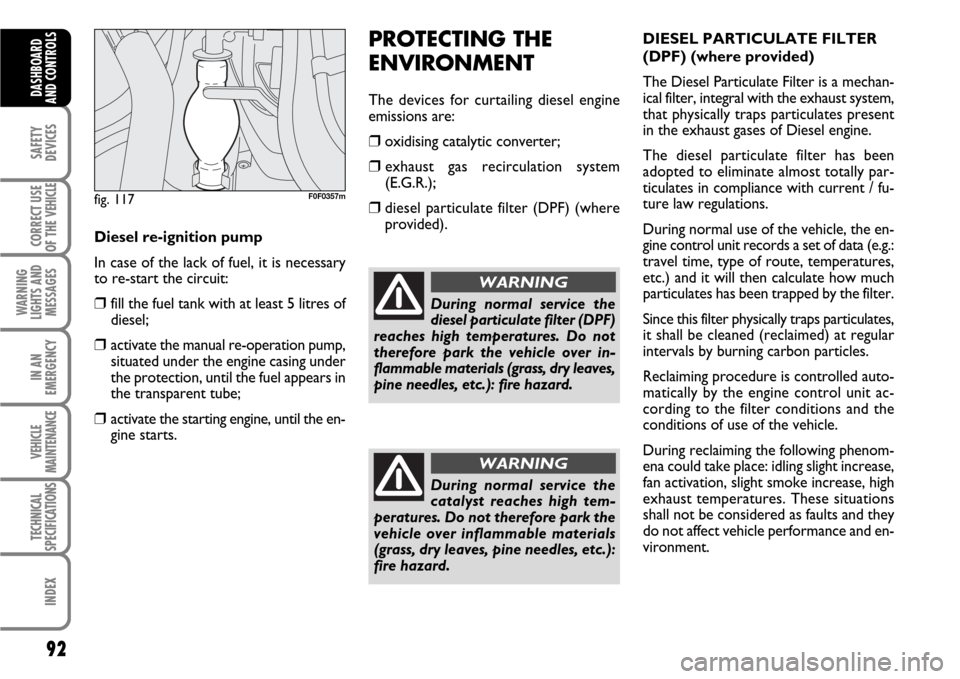
Diesel re-ignition pump
In case of the lack of fuel, it is necessary
to re-start the circuit:
❒ fill the fuel tank with at least 5 litres of
diesel;
❒ activate the manual re-operation pump,
situated under the engine casing under
the protection, until the fuel appears in
the transparent tube;
❒ activate the starting engine, until the en-
gine starts.
fig. 117F0F0357m
Page 98 of 210
97
CORRECT USE
OF THE
VEHICLE
WARNING
LIGHTS AND
MESSAGES
IN AN
EMERGENCY
VEHICLE
MAINTENANCE
TECHNICAL
SPECIFICATIONS
INDEX
DASHBOARD
AND CONTROLS
SAFETY
DEVICES
GENERAL INSTRUCTIONS FOR
USING THE SEAT BELTS
The driver must comply with (and have
the vehicle occupants follow) all the local
legal regulations concerning the use of seat
belts. Always fasten the seat belts before
starting.Seat belts are also to be worn by expec-
tant mothers: the risk of injury in the case
of accident is greatly reduced for them and
the unborn child if they are wearing a seat
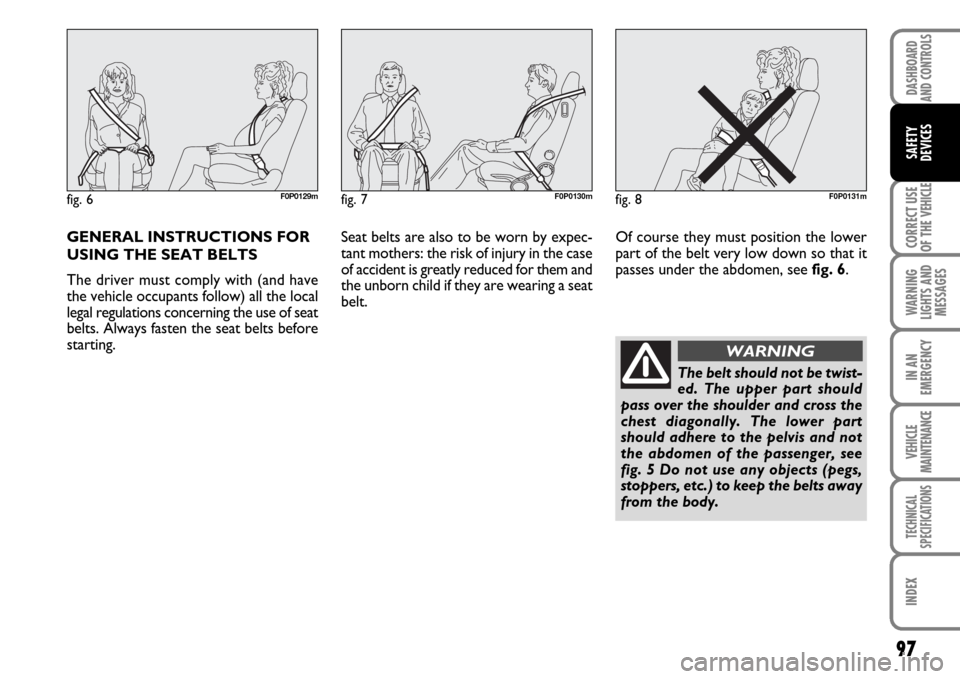
belt.Of course they must position the lower
part of the belt very low down so that it
passes under the abdomen, see fig. 6.
fig. 6F0P0129mfig. 7F0P0130mfig. 8F0P0131m
The belt should not be twist-
ed. The upper part should
pass over the shoulder and cross the
chest diagonally. The lower part
should adhere to the pelvis and not
the abdomen of the passenger, see
fig. 5 Do not use any objects (pegs,
stoppers, etc.) to keep the belts away
from the body.
WARNING
Page 102 of 210
101
CORRECT USE
OF THE
VEHICLE
WARNING
LIGHTS AND
MESSAGES
IN AN
EMERGENCY
VEHICLE
MAINTENANCE
TECHNICAL
SPECIFICATIONS
INDEX
DASHBOARD
AND CONTROLS
SAFETY
DEVICES
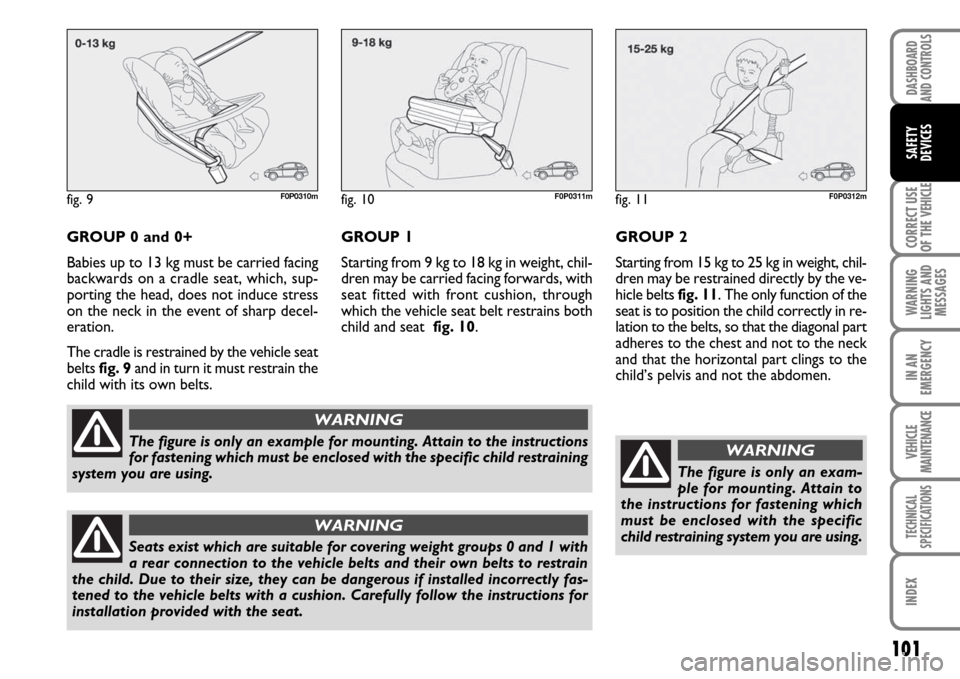
GROUP 0 and 0+
Babies up to 13 kg must be carried facing
backwards on a cradle seat, which, sup-
porting the head, does not induce stress
on the neck in the event of sharp decel-
eration.
The cradle is restrained by the vehicle seat
belts fig. 9and in turn it must restrain the
child with its own belts.
fig. 9F0P0310m
The figure is only an example for mounting. Attain to the instructions
for fastening which must be enclosed with the specific child restraining
system you are using.
WARNING
Seats exist which are suitable for covering weight groups 0 and 1 with
a rear connection to the vehicle belts and their own belts to restrain
the child. Due to their size, they can be dangerous if installed incorrectly fas-
tened to the vehicle belts with a cushion. Carefully follow the instructions for
installation provided with the seat.
WARNING
fig. 10F0P0311mfig. 11F0P0312m
GROUP 2
Starting from 15 kg to 25 kg in weight, chil-
dren may be restrained directly by the ve-
hicle belts fig. 11. The only function of the
seat is to position the child correctly in re-
lation to the belts, so that the diagonal part
adheres to the chest and not to the neck
and that the horizontal part clings to the
child’s pelvis and not the abdomen. GROUP 1
Starting from 9 kg to 18 kg in weight, chil-
dren may be carried facing forwards, with
seat fitted with front cushion, through
which the vehicle seat belt restrains both
child and seat fig. 10.
The figure is only an exam-
ple for mounting. Attain to
the instructions for fastening which
must be enclosed with the specific
child restraining system you are using.
WARNING
Page 114 of 210
113
WARNING
LIGHTS AND
MESSAGES
IN AN
EMERGENCY
VEHICLE
MAINTENANCE
TECHNICAL
SPECIFICATIONS
INDEX
DASHBOARD
AND CONTROLS
SAFETY
DEVICES
CORRECT USE
OF THE VEHICLE
ENGINE STARTING .......................................................... 114
PARKING .............................................................................. 116
USING THE MANUAL GEARBOX ................................ 117
CONTAINING RUNNING COSTS .............................. 118
SNOW TYRES ..................................................................... 121
SNOW CHAINS .................................................................. 121
VEHICLE INACTIVITY ....................................................... 122
C C
O O
R R
R R
E E
C C
T T
U U
S S
E E
O O
F F
T T
H H
E E
V V
E E
H H
I I
C C
L L
E E E