check FIAT SCUDO 2008 2.G Owner's Manual
[x] Cancel search | Manufacturer: FIAT, Model Year: 2008, Model line: SCUDO, Model: FIAT SCUDO 2008 2.GPages: 210, PDF Size: 3.32 MB
Page 111 of 210
110
CORRECT USE
OF THE
VEHICLE
WARNING
LIGHTS AND
MESSAGES
IN AN
EMERGENCY
VEHICLE
MAINTENANCE
TECHNICAL
SPECIFICATIONS
IINDEX
DASHBOARD
AND CONTROLS
SAFETY
DEVICES
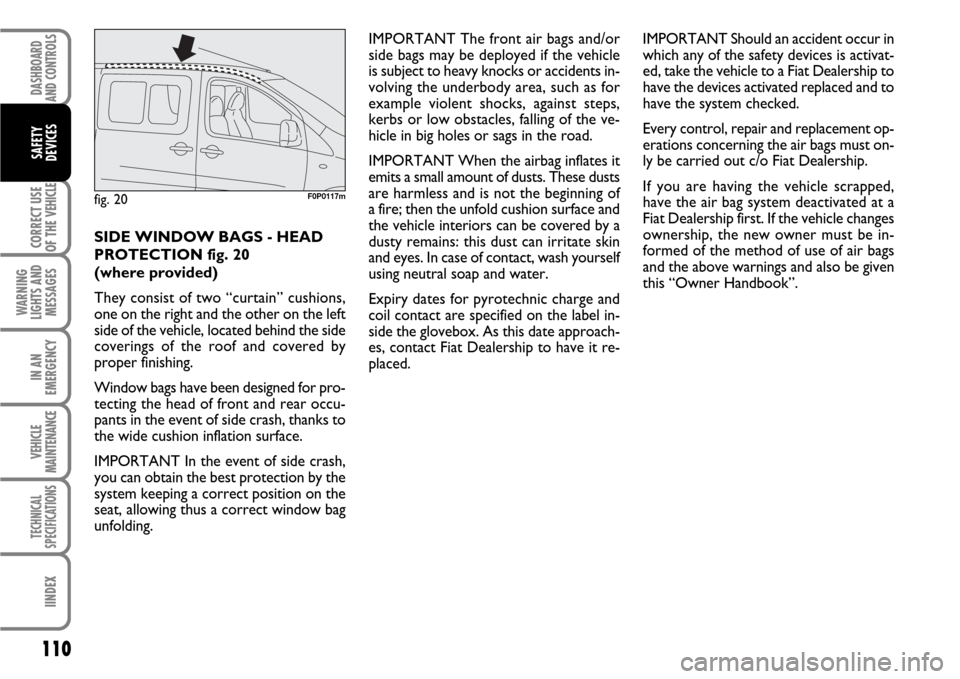
SIDE WINDOW BAGS - HEAD
PROTECTION fig. 20
(where provided)
They consist of two “curtain” cushions,
one on the right and the other on the left
side of the vehicle, located behind the side
coverings of the roof and covered by
proper finishing.
Window bags have been designed for pro-
tecting the head of front and rear occu-
pants in the event of side crash, thanks to
the wide cushion inflation surface.
IMPORTANT In the event of side crash,
you can obtain the best protection by the
system keeping a correct position on the
seat, allowing thus a correct window bag
unfolding.IMPORTANT The front air bags and/or
side bags may be deployed if the vehicle
is subject to heavy knocks or accidents in-
volving the underbody area, such as for
example violent shocks, against steps,
kerbs or low obstacles, falling of the ve-
hicle in big holes or sags in the road.
IMPORTANT When the airbag inflates it
emits a small amount of dusts. These dusts
are harmless and is not the beginning of
a fire; then the unfold cushion surface and
the vehicle interiors can be covered by a
dusty remains: this dust can irritate skin
and eyes. In case of contact, wash yourself
using neutral soap and water.
Expiry dates for pyrotechnic charge and
coil contact are specified on the label in-
side the glovebox. As this date approach-
es, contact Fiat Dealership to have it re-
placed.
fig. 20F0P0117m
IMPORTANT Should an accident occur in
which any of the safety devices is activat-
ed, take the vehicle to a Fiat Dealership to
have the devices activated replaced and to
have the system checked.
Every control, repair and replacement op-
erations concerning the air bags must on-
ly be carried out c/o Fiat Dealership.
If you are having the vehicle scrapped,
have the air bag system deactivated at a
Fiat Dealership first. If the vehicle changes
ownership, the new owner must be in-
formed of the method of use of air bags
and the above warnings and also be given
this “Owner Handbook”.
Page 112 of 210
111
CORRECT USE
OF THE
VEHICLE
WARNING
LIGHTS AND
MESSAGES
IN AN
EMERGENCY
VEHICLE
MAINTENANCE
TECHNICAL
SPECIFICATIONS
INDEX
DASHBOARD
AND CONTROLS
SAFETY
DEVICES
Never rest head, arms and
elbows on the door, on the
windows and in the window bag area
to prevent possible injuries during in-
flation phase.
WARNING
Never lean head, arms and
elbows out of window.
WARNING
GENERAL WARNINGS
If when turning the key to M
the warning light ¬does not
turn on or if it stays on when travel-
ling there could be a failure in safety
systems; in this event air bags or pre-
tensioners could not trigger in case of
impact or, in a minor number of cas-
es, they could trigger accidentally.
Contact Fiat Dealership immediately
to have the system checked.
WARNING
Do not cover the backrest of
front and rear seats with
trims or covers that are not suitable
to be used with side bags.
WARNING
Never travel with objects on
your lap, in front of your
chest or with a pipe, pencil, etc. be-
tween your lips; injury may result in
the event of the air bag being trig-
gered.
WARNINGIMPORTANT The triggering of preten-
sioners, front air bags and side bags is de-
cided in a differentiated manner by the
electronic control unit, depending on the
type of crash. The failure to deploy one or
more of them does not mean that the sys-
tem is not working properly.
Always keep your hands on
the steering wheel rim when
driving, so that if the air bag is trig-
gered, it can inflate without meeting
any obstacles which could cause seri-
ous harm to you. Do not drive with
the body bent forwards, keep the seat
back rest in the erect position and
lean your back well against it.
WARNING
Page 113 of 210
112
CORRECT USE
OF THE
VEHICLE
WARNING
LIGHTS AND
MESSAGES
IN AN
EMERGENCY
VEHICLE
MAINTENANCE
TECHNICAL
SPECIFICATIONS
IINDEX
DASHBOARD
AND CONTROLS
SAFETY
DEVICES
Remember that with the key
engaged and at M, even if
the engine is not running, the air bags
may be triggered on a stationary ve-
hicle if it is bumped by another mov-
ing vehicle. Therefore, never seat chil-
dren on the front seat even when the
vehicle is stationary. On the other
hand remember that if the key is at S,
no safety system (air bags or preten-
sioners) is triggered in the event of an
impact; in this case, failure to come
into action cannot be considered as a
sign that the system is not working
properly.
WARNING
Do not wash the seat back
rest with pressurised water
or steam (by hand or at automatic
seat washing stations).
WARNING
The front air bag is triggered
for shocks greater in magni-
tude that the pretensioners.
For impacts between these two
thresholds, it is therefore normal that
only the pretensioners are triggered.
WARNING
Do not hook rigid objects to
the coat hooks and to the
support handles.
WARNING
The air bag does not substi-
tute the seat belts, but only
increases their effectiveness.
Moreover, since the front air bags do
not come into operation in the event
of front impact at low speed, side col-
lisions, bumps from behind or over-
turning, in these circumstances the
occupants would only be protected
by the seat belts which must therefore
always be fastened.
WARNING
When the ignition key is
turned to M, the warning
light
“(with passenger’s front air bag
active) turns on and flashes for few
seconds to remind that passenger’s air
bag will be deployed in a crash, af-
ter which it should go off.
WARNING
If the vehicle has been stolen
or an attempt to steal it has
been made, if it has been subjected to
vandals or floods, have the air bag
system checked by Fiat Dealership.
WARNING
Page 119 of 210
118
WARNING
LIGHTS AND
MESSAGES
IN AN
EMERGENCY
VEHICLE
MAINTENANCE
TECHNICAL
SPECIFICATIONS
INDEX
DASHBOARD
AND CONTROLS
SAFETY
DEVICES
CORRECT USE
OF THE VEHICLE
Roof rack/ski rack
Remove the roof rack or the ski rack from
the roof as soon as they are no longer
used. These accessories lower air pene-
tration and adversely affect consumption
levels. When needing to carry particular-
ly voluminous objects, preferably use a
trailer.
Electric devices
Use electric devices only for the amount
of time needed. Rear heated window, ad-
ditional headlights, windscreen wipers and
heater fan need a considerable amount of
energy, therefore increasing the require-
ment of current increases fuel consump-
tion (up to +25% in the urban cycle).
Climate control
The air conditioner is an additional load
which greatly affects the engine leading to
higher consumption (on average up to
+20%). When the temperature outside
the vehicle permits it, use the air vents
where possible.
Spoilers
The use of non-certified aerodynamic
items may adversely affect air drag and
consumption levels.DRIVING STYLE
Starting
Do not warm the engine when the vehi-
cle is stationary or at high or low speed:
in this way the engine will warm up grad-
ually increasing consumption and emis-
sions. You should drive off slowly straight
away avoiding high revs so that the engine
will warm up more quickly.
Unnecessary actions
Avoid accelerating when waiting at traffic
lights or before switching off the engine.
This and also double declutching is ab-
solutely pointless on modern vehicles and
also increase consumption and pollution.
Gear selections
As soon as the conditions of the traffic and
road allow, use a higher gear. Using a low
gear to obtain brilliant performance in-
creases consumption.
In the same way improper use of a high
gear increases consumption, emissions an
engine wear.CONTAINING
RUNNING COSTS
Some suggestions which may help you to
keep the running costs of the vehicle
down and lower the amount of toxic emis-
sions released into the atmosphere are
given below.
GENERAL CONSIDERATIONS
Vehicle maintenance
Carry out the checks and adjustments/reg-
ulations specified in the “Service Sched-
ule”.
Tyres
Check tyre inflation pressure regularly.
Tyres should be checked at least once
every four weeks: if the pressure is too
low, fuel consumption increases as the re-
sistance to the rolling movement of the
tyre is greater.
Unnecessary loads
Do not travel with too much load.
The weight of the vehicle (specially in ur-
ban traffic) and its trim greatly effects con-
sumption and stability.
Page 122 of 210
121
WARNING
LIGHTS AND
MESSAGES
IN AN
EMERGENCY
VEHICLE
MAINTENANCE
TECHNICAL
SPECIFICATIONS
INDEX
DASHBOARD
AND CONTROLS
SAFETY
DEVICES
CORRECT USE
OF THE VEHICLE
IMPORTANT When snow tyres are used
with a max speed index below the one
that can be reached by the vehicle (in-
creased by 5%), place a notice in the pas-
senger’s compartment, plainly in the dri-
ver’s view which states the max permis-
sible speed of the snow tyres (as per EC
Directive).
All four tyres should be the same (brand
and track) to ensure greater safety when
driving and braking and better driveability.
Remember that it is inappropriate to
change the direction of rotation of tyres.SNOW CHAINS
The use of snow chains is regulated by the
legislation in force in the country the ve-
hicle is driven in.
Snow chains should only be applied to the
driving wheels (front wheels). We rec-
ommend using Lineaccessori Fiat snow
chains.
Check the tension of the chains after the
first few metres have been driven.
IMPORTANT With snow chains, use the
accelerator with extreme care to prevent
or to limit as much as possible slipping of
the driving wheels that could cause chain
breaking resulting in damages to the ve-
hicle body or mechanical components.
SNOW TYRES
Use snow tyres of the same size as the
normal tyres provided with the vehicle.
Fiat Dealership will be happy to provide
advice concerning the most suitable type
of tyre for the customer’s requirements.
The winter features of these tyres are re-
duced considerably when the tread depth
is below 4 mm. In this case, they should
be replaced.
Due to the snow tyre features, under nor-
mal conditions of use or on long motor-
way journeys, the performance of these
tyres is lower than that of normal tyres. It
is therefore necessary to limit their use to
the purposes for which they are certified.
The max speed for snow
tyres with “Q” marking is
160 km/h; 190 km/h for tyres with “T”
marking and 210 km/h for tyres with
H marking. The Road Traffic Code
speed limits must however be always
strictly observed.
WARNING
Page 123 of 210
122
WARNING
LIGHTS AND
MESSAGES
IN AN
EMERGENCY
VEHICLE
MAINTENANCE
TECHNICAL
SPECIFICATIONS
INDEX
DASHBOARD
AND CONTROLS
SAFETY
DEVICES
CORRECT USE
OF THE VEHICLE
VEHICLE INACTIVITY
If the vehicle is to be left inactive for longer
than a month, the following precautions
should be noted:
❒park the vehicle in covered, dry and if
possible well-ventilated premises;
❒engage a gear;
❒check that the handbrake is not en-
gaged;
❒disconnect the battery negative termi-
nal and check the battery charge. This
check is to be repeated every three
months. Recharge if the optical indica-
tor shows a dark colour without the
central green area;
❒clean and protect the painted parts us-
ing protective wax;
❒clean and protect the shiny metal parts
using special compounds readily avail-
able;
❒ sprinkle talcum powder on the rubber
windscreen and rear window wiper
blades and lift them off the glass;
❒slightly open the windows;
❒cover the vehicle with a cloth or per-
forated plastic sheet. Do not use sheets
of non-perforated plastic as they do not
allow moisture on the vehicle body to
evaporate;
❒inflate tyres to +0,5 bar above the nor-
mal specified pressure and check it at
intervals;
❒if you don’t disconnect the battery from
the electric system, check its charge
every month and recharge it if the op-
tical indicator shows a dark colour
without the central green area;
❒do not drain the engine cooling system.
IMPORTANT Where relevant, switch off
the vehicle alarm with the remote control.
Keep your speed down when
snow chains are fitted. Do
not exceed 50 km/h. Avoid
potholes, steps and pave-
ments and avoid also to dri-
ve for long distances on
roads not covered with snow to pre-
vent damaging the vehicle and the
roadbed.
WARNING
Page 125 of 210
124
IN AN
EMERGENCY
VEHICLE
MAINTENANCE
TECHNICAL
SPECIFICATIONS
INDEX
DASHBOARD
AND CONTROLS
SAFETY
DEVICES
CORRECT USE
OF THE
VEHICLE
WARNING
LIGHTS AND
MESSAGES
WARNING LIGHTS
AND MESSAGES
GENERAL WARNINGS
Turning on of warning light is accompa-
nied by specific message and/or by buzzer
sound where provided by instrument pan-
el. These indications are concise and
cautionaryand shall not be considered
as exhaustive and/or as an alternative to
the specifications contained in this Own-
er Handbook which shall always be read
through carefully and thoroughly. In case
of failure indication always refer to the
specifications contained in this sec-
tion.
IMPORTANT Failure indications displayed
are divided into two categories: very se-
riousand less seriousfailures.
Very seriousfailures are indicated by a
repeated and prolonged warning “cycle”.
Less seriousfailures are indicated by a lim-
ited warning “cycle”.
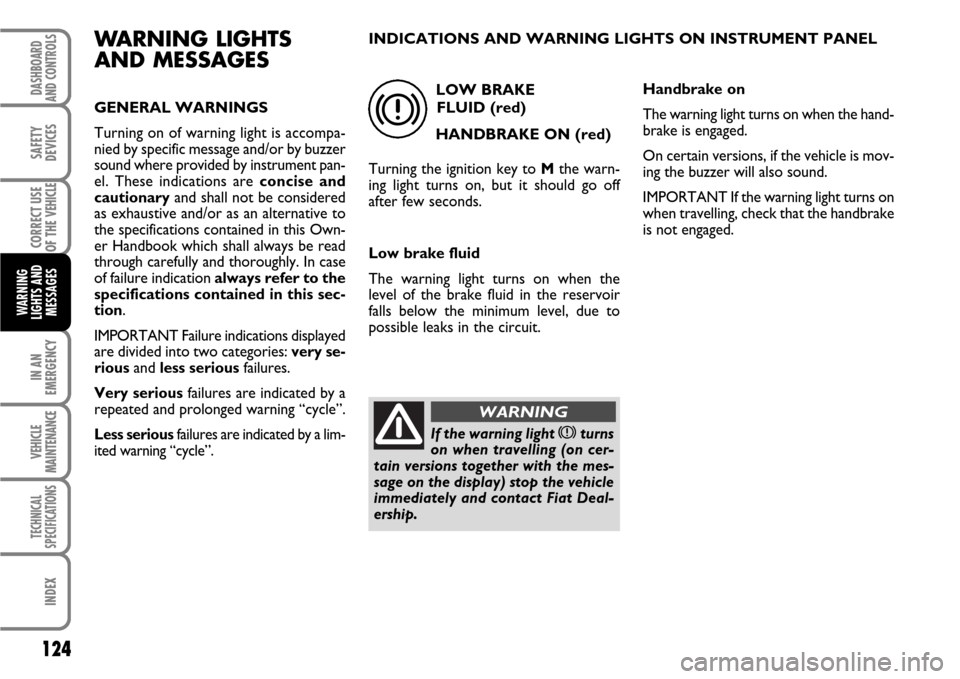
LOW BRAKE
FLUID (red)
HANDBRAKE ON (red)
Turning the ignition key to Mthe warn-
ing light turns on, but it should go off
after few seconds.
Low brake fluid
The warning light turns on when the
level of the brake fluid in the reservoir
falls below the minimum level, due to
possible leaks in the circuit.
x
If the warning light xturns
on when travelling (on cer-
tain versions together with the mes-
sage on the display) stop the vehicle
immediately and contact Fiat Deal-
ership.
WARNING
Handbrake on
The warning light turns on when the hand-
brake is engaged.
On certain versions, if the vehicle is mov-
ing the buzzer will also sound.
IMPORTANT If the warning light turns on
when travelling, check that the handbrake
is not engaged. INDICATIONS AND WARNING LIGHTS ON INSTRUMENT PANEL
Page 126 of 210
125
IN AN
EMERGENCY
VEHICLE
MAINTENANCE
TECHNICAL
SPECIFICATIONS
INDEX
DASHBOARD
AND CONTROLS
SAFETY
DEVICES
CORRECT USE
OF THE
VEHICLE
WARNING
LIGHTS AND
MESSAGES
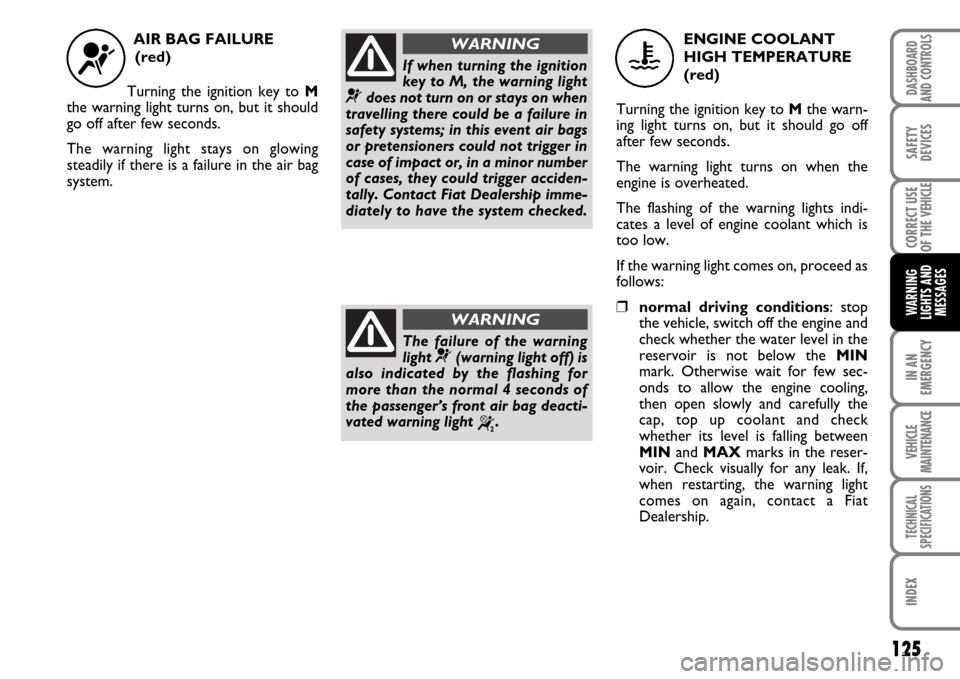
AIR BAG FAILURE
(red)
Turning the ignition key to M
the warning light turns on, but it should
go off after few seconds.
The warning light stays on glowing
steadily if there is a failure in the air bag
system.
¬If when turning the ignition
key to M, the warning light
¬does not turn on or stays on when
travelling there could be a failure in
safety systems; in this event air bags
or pretensioners could not trigger in
case of impact or, in a minor number
of cases, they could trigger acciden-
tally. Contact Fiat Dealership imme-
diately to have the system checked.
WARNING
The failure of the warning
light ¬(warning light off) is
also indicated by the flashing for
more than the normal 4 seconds of
the passenger’s front air bag deacti-
vated warning light
“.
WARNING
ENGINE COOLANT
HIGH TEMPERATURE
(red)
Turning the ignition key to Mthe warn-
ing light turns on, but it should go off
after few seconds.
The warning light turns on when the
engine is overheated.
The flashing of the warning lights indi-
cates a level of engine coolant which is
too low.
If the warning light comes on, proceed as
follows:
❒normal driving conditions: stop
the vehicle, switch off the engine and
check whether the water level in the
reservoir is not below the MIN
mark. Otherwise wait for few sec-
onds to allow the engine cooling,
then open slowly and carefully the
cap, top up coolant and check
whether its level is falling between
MINand MAXmarks in the reser-
voir. Check visually for any leak. If,
when restarting, the warning light
comes on again, contact a Fiat
Dealership.
u
Page 127 of 210
126
IN AN
EMERGENCY
VEHICLE
MAINTENANCE
TECHNICAL
SPECIFICATIONS
INDEX
DASHBOARD
AND CONTROLS
SAFETY
DEVICES
CORRECT USE
OF THE
VEHICLE
WARNING
LIGHTS AND
MESSAGES
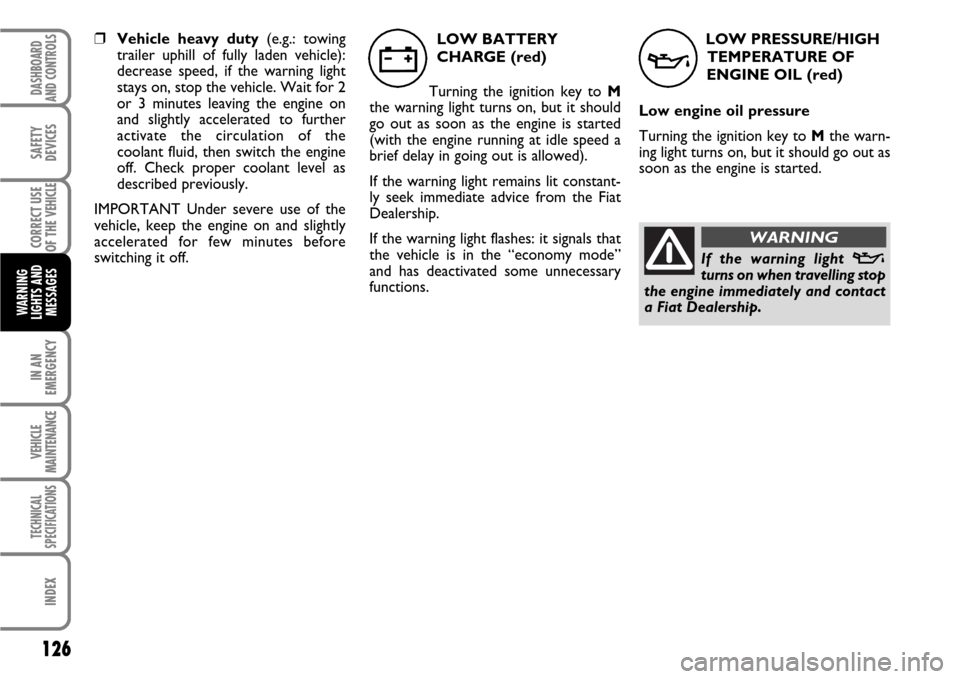
LOW PRESSURE/HIGH
TEMPERATURE OF
ENGINE OIL (red)
Low engine oil pressure
Turning the ignition key to Mthe warn-
ing light turns on, but it should go out as
soon as the engine is started.
v
If the warning light vturns on when travelling stop
the engine immediately and contact
a Fiat Dealership.
WARNING
❒Vehicle heavy duty(e.g.: towing
trailer uphill of fully laden vehicle):
decrease speed, if the warning light
stays on, stop the vehicle. Wait for 2
or 3 minutes leaving the engine on
and slightly accelerated to further
activate the circulation of the
coolant fluid, then switch the engine
off. Check proper coolant level as
described previously.
IMPORTANT Under severe use of the
vehicle, keep the engine on and slightly
accelerated for few minutes before
switching it off.LOW BATTERY
CHARGE (red)
Turning the ignition key to M
the warning light turns on, but it should
go out as soon as the engine is started
(with the engine running at idle speed a
brief delay in going out is allowed).
If the warning light remains lit constant-
ly seek immediate advice from the Fiat
Dealership.
If the warning light flashes: it signals that
the vehicle is in the “economy mode”
and has deactivated some unnecessary
functions.
w
Page 128 of 210
127
IN AN
EMERGENCY
VEHICLE
MAINTENANCE
TECHNICAL
SPECIFICATIONS
INDEX
DASHBOARD
AND CONTROLS
SAFETY
DEVICES
CORRECT USE
OF THE
VEHICLE
WARNING
LIGHTS AND
MESSAGES
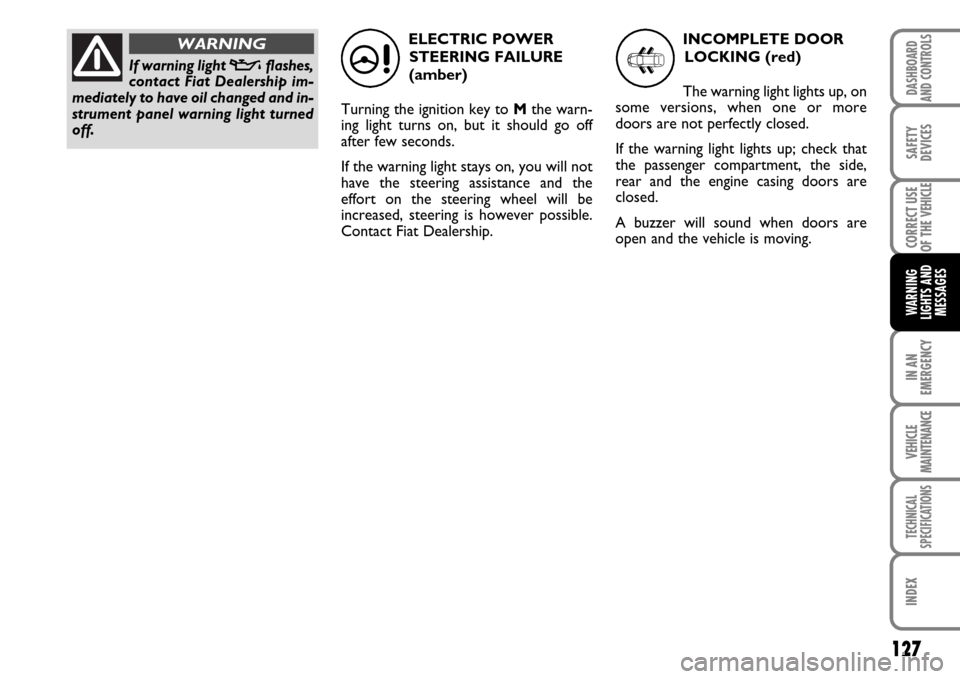
ELECTRIC POWER
STEERING FAILURE
(amber)
Turning the ignition key to Mthe warn-
ing light turns on, but it should go off
after few seconds.
If the warning light stays on, you will not
have the steering assistance and the
effort on the steering wheel will be
increased, steering is however possible.
Contact Fiat Dealership.
If warning light vflashes,
contact Fiat Dealership im-
mediately to have oil changed and in-
strument panel warning light turned
off.
WARNING
»
INCOMPLETE DOOR
LOCKING (red)
The warning light lights up, on
some versions, when one or more
doors are not perfectly closed.
If the warning light lights up; check that
the passenger compartment, the side,
rear and the engine casing doors are
closed.
A buzzer will sound when doors are
open and the vehicle is moving.
9