ABS FIAT SPIDER ABARTH 2017 User Guide
[x] Cancel search | Manufacturer: FIAT, Model Year: 2017, Model line: SPIDER ABARTH, Model: FIAT SPIDER ABARTH 2017Pages: 292, PDF Size: 9.24 MB
Page 206 of 292
To Secure The Jack
Proceed as follows:
1. Insert the wing bolt into the jack with
the jack screw pointing back, and turn
the wing bolt clockwise to temporarily
tighten it.
2. Turn the jack screw clockwise.
3. Turn the wing bolt completely to
secure the jack.
4. Insert the cover tabs and install the
cover.
Warning!A loose tire or jack thrown forward in a
collision or hard stop could endanger the
occupants of the vehicle. Always stow the
jack parts and the spare tire in the places
provided. Have the deflated (flat) tire
repaired or replaced immediately.
Maintenance
Always keep the jack clean.
Make sure the moving parts are kept
free from dirt or rust.
Make sure the screw thread is
adequately lubricated. Conditions Of Non-Use
Temperatures below -40°F (−40°C)
On sandy or muddy ground
On uneven ground
On steep roads
In extreme weather conditions
In direct contact with the engine or
for repairs under the vehicle
On boats
Jacking Instructions
Note: Make sure the jack is well
lubricated before using it.
Warning!Do not attempt to change a tire on the side
of the vehicle close to moving traffic, pull
far enough off the road to avoid being hit
when operating the jack or changing the
wheel.
Proceed as follows:
1. Stop the vehicle in a position that
does not cause any danger to traffic
and lets you change the tire in safety, as
far as possible from the edge of the
driving lane. The ground must be flat
and sufficiently compact. 2. Turn on the Hazard Warning Lights
and engage the parking brake.
3. For vehicles with automatic
transmission, place the gear selector in
PARK. For vehicles with manual
transmission, place gear selector in
REVERSE and turn the engine to OFF.
4. Stop the engine. The motor must be
kept off as long as the vehicle is lifted
off the ground.
5. Remove the jack and tools.
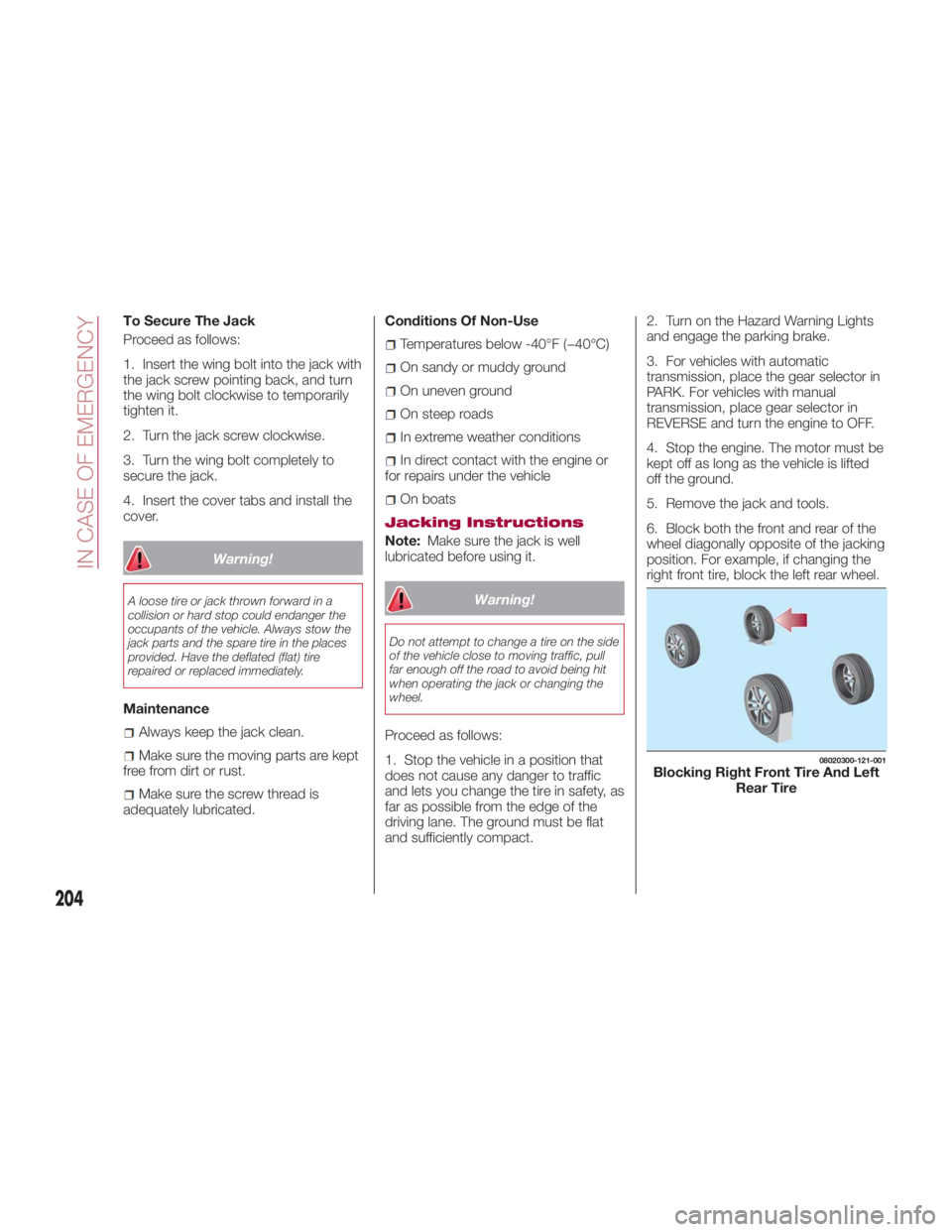
6. Block both the front and rear of the
wheel diagonally opposite of the jacking
position. For example, if changing the
right front tire, block the left rear wheel. 08020300-121-001
Blocking Right Front Tire And Left
Rear Tire
204
IN CASE OF EMERGENCY
Page 211 of 292
Tire Service Usage
Precautions
The tire sealant cannot be reused. If the
sealant has been used, or is expired,
purchase new tire sealant at an
authorized dealer.
Note: The Tire Service Kit cannot be
used in the following cases. Consult an
authorized dealer if any of these
conditions exist:
The period of effective use for the
tire sealant has expired (the period of
effectiveness is indicated on the bottle
label)
The tear or puncture in the tire
exceeds about 0.16 inches (4 mm)
The damage has occurred to an
area of the tire other than the tread
The vehicle has been driven with
nearly no air remaining in the tire
The tire has come off the wheel rim
Damage to the wheel rim has
occurred
The tire has two or more punctures Sealing A Tire With Tire
Service Kit
Warning!Do not attempt to seal a tire on the side
of the vehicle closest to traffic. Pull far
enough off the road to avoid the danger of
being hit when using the Tire Service Kit.
Do not use Tire Service Kit or drive the
vehicle under the following circumstances:
If the puncture in the tire tread is
approximately 1/4 inch (6 mm) or larger.
If the tire has any sidewall damage.
If the tire has any damage from driving
with extremely low tire pressure.
If the tire has any damage from driving
on a flat tire.
If the wheel has any damage.
If you are unsure of the condition of the
tire or the wheel.
Keep Tire Service Kit away from open
flames or heat sources.
A loose Tire Service Kit thrown forward
in a collision or hard stop could endanger
the occupants of the vehicle. Always stow
the Tire Service Kit in the place provided.
Failure to follow these warnings can result
in injuries that are serious or fatal to you,
your passengers, and others around you.
Take care not to allow the contents of
Tire Service Kit to come in contact with
hair, eyes, or clothing. Tire Service Kit
sealant is harmful if inhaled, swallowed, or absorbed through the skin. It causes skin,
eye, and respiratory irritation. Flush
immediately with plenty of water if there is
any contact with eyes or skin. Change
clothing as soon as possible, if there is any
contact with clothing.
Tire Service Kit Sealant solution contains
latex. In case of an allergic reaction or rash,
consult a physician immediately. Keep Tire
Service Kit out of reach of children. If
swallowed, rinse mouth immediately with
plenty of water and drink plenty of water.
Do not induce vomiting! Consult a
physician immediately.
U.S.A. And CANADA Markets:
Proceed as follows:
1. Pull over to a safe location and turn
on the vehicle’s Hazard Warning Lights.
2. Verify that the valve stem (on the
wheel with the deflated tire) is in a
position that is near to the ground. This
will allow the Tire Service Kit hoses to
reach the valve stem and keep the Tire
Service Kit flat on the ground. This will
provide the best positioning of the kit
when injecting the sealant into the
deflated tire and running the air pump.
Move the vehicle as necessary to place
the valve stem in this position before
proceeding.
3. Place the gear selector in REVERSE
for a manual transmission, and PARK
for automatic transmission.
209
Page 213 of 292
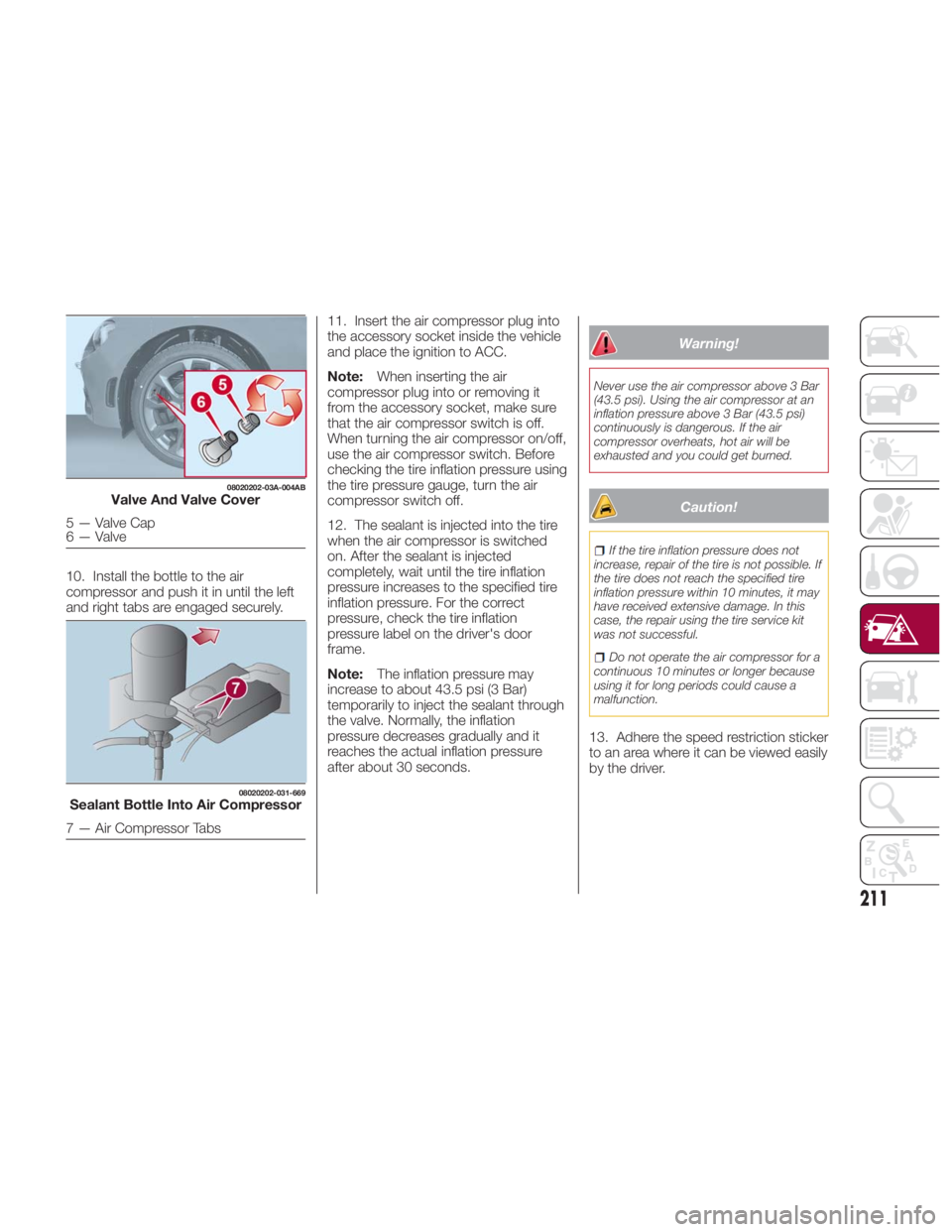
10. Install the bottle to the air
compressor and push it in until the left
and right tabs are engaged securely. 11. Insert the air compressor plug into
the accessory socket inside the vehicle
and place the ignition to ACC.
Note: When inserting the air
compressor plug into or removing it
from the accessory socket, make sure
that the air compressor switch is off.
When turning the air compressor on/off,
use the air compressor switch. Before
checking the tire inflation pressure using
the tire pressure gauge, turn the air
compressor switch off.
12. The sealant is injected into the tire
when the air compressor is switched
on. After the sealant is injected
completely, wait until the tire inflation
pressure increases to the specified tire
inflation pressure. For the correct
pressure, check the tire inflation
pressure label on the driver's door
frame.
Note: The inflation pressure may
increase to about 43.5 psi (3 Bar)
temporarily to inject the sealant through
the valve. Normally, the inflation
pressure decreases gradually and it
reaches the actual inflation pressure
after about 30 seconds. Warning!Never use the air compressor above 3 Bar
(43.5 psi). Using the air compressor at an
inflation pressure above 3 Bar (43.5 psi)
continuously is dangerous. If the air
compressor overheats, hot air will be
exhausted and you could get burned.
Caution! If the tire inflation pressure does not
increase, repair of the tire is not possible. If
the tire does not reach the specified tire
inflation pressure within 10 minutes, it may
have received extensive damage. In this
case, the repair using the tire service kit
was not successful.
Do not operate the air compressor for a
continuous 10 minutes or longer because
using it for long periods could cause a
malfunction.
13. Adhere the speed restriction sticker
to an area where it can be viewed easily
by the driver.08020202-03A-004AB
Valve And Valve Cover
5 — Valve Cap
6 — Valve 08020202-031-669
Sealant Bottle Into Air Compressor
7 — Air Compressor Tabs
211
Page 215 of 292
Sealing A Tire With Tire
Service Kit
Warning!Do not attempt to seal a tire on the side
of the vehicle closest to traffic. Pull far
enough off the road to avoid the danger of
being hit when using the Tire Service Kit.
Do not use Tire Service Kit or drive the
vehicle under the following circumstances:
If the puncture in the tire tread is
approximately 1/4 inch (6 mm) or larger.
If the tire has any sidewall damage.
If the tire has any damage from driving
with extremely low tire pressure.
If the tire has any damage from driving
on a flat tire.
If the wheel has any damage.
If you are unsure of the condition of the
tire or the wheel.
Keep Tire Service Kit away from open
flames or heat sources.
A loose Tire Service Kit thrown forward
in a collision or hard stop could endanger
the occupants of the vehicle. Always stow
the Tire Service Kit in the place provided.
Failure to follow these warnings can result
in injuries that are serious or fatal to you,
your passengers, and others around you.
Take care not to allow the contents of
Tire Service Kit to come in contact with
hair, eyes, or clothing. Tire Service Kit
sealant is harmful if inhaled, swallowed, or absorbed through the skin. It causes skin,
eye, and respiratory irritation. Flush
immediately with plenty of water if there is
any contact with eyes or skin. Change
clothing as soon as possible, if there is any
contact with clothing.
Tire Service Kit Sealant solution contains
latex. In case of an allergic reaction or rash,
consult a physician immediately. Keep Tire
Service Kit out of reach of children. If
swallowed, rinse mouth immediately with
plenty of water and drink plenty of water.
Do not induce vomiting! Consult a
physician immediately.
Mexico Market
Proceed as follows:
1. Pull over to a safe location and turn
on the vehicle’s Hazard Warning Lights.
2. Verify that the valve stem (on the
wheel with the deflated tire) is in a
position that is near to the ground. This
will allow the Tire Service Kit hoses to
reach the valve stem and keep the Tire
Service Kit flat on the ground. This will
provide the best positioning of the kit
when injecting the sealant into the
deflated tire and running the air pump.
Move the vehicle as necessary to place
the valve stem in this position before
proceeding.
3. Place the gear selector in REVERSE
for a manual transmission, or PARK for
automatic transmission. 4. Apply the parking brake with the
brake pedal pressed and turn the
engine OFF.
5. Unload passengers and cargo, then
remove the Tire Service Kit.
6. Gently shake the tire sealant. If the
bottle is shaken after the injection hose
is screwed on, tire sealant could spray
out from the injection hose. Tire sealant
contacting clothing or other objects
may be impossible to remove. Shake
the bottle before screwing on the
injection hose.
Note:
Do not shake the bottle
excessively. Otherwise, the sealant
could spray out of the injection hose,
and if the sealant contacts clothing or
other objects, you may not be able to
remove it.
The sealant hardens easily and
injecting it will be difficult under cold
weather conditions 32 °F (0 °C) or
below. Warm the sealant inside the
vehicle to facilitate injection.
7. Remove the cap from the bottle and
screw on the injection hose with the
bottle's inner cap left on to break the
inner cap.
213
Page 236 of 292
To avoid contamination from foreign
matter or moisture, use only new brake
fluid or fluid that has been in a tightly
closed container. Keep the master cylinder
reservoir cap secured at all times. Brake
fluid in a open container absorbs moisture
from the air resulting in a lower boiling
point. This may cause it to boil
unexpectedly during hard or prolonged
braking, resulting in sudden brake failure.
This could result in a collision.
Overfilling the brake fluid reservoir can
result in spilling brake fluid on hot engine
parts, causing the brake fluid to catch fire.
Brake fluid can also damage painted and
vinyl surfaces, care should be taken to
avoid its contact with these surfaces.
Do not allow petroleum based fluid to
contaminate the brake fluid. Brake seal
components could be damaged, causing
partial or complete brake failure. This could
result in a collision.
Windshield And
Headlight Washer Fluid
Inspecting Washer Fluid Level
Inspect fluid level in the washer fluid
reservoir, open the cap and add fluid if
necessary. Use plain water if washer fluid is
unavailable. But use only washer fluid in
cold weather to prevent it from freezing.
Automatic Transmission
Control Unit
The transmission oil level should only be
checked at your authorized dealer.
Battery Maintenance
To get the best service from a battery:
Keep it securely mounted.
Keep the top clean and dry.
Keep terminals and connections
clean, tight, and coated with petroleum
jelly or terminal grease.
Rinse off spilled electrolyte
immediately with a solution of water
and baking soda. If the vehicle will not be used for an
extended time, disconnect the battery
leads and charge the battery every six
weeks.
Battery Replacement
Contact your authorized dealer to
purchase a replacement battery.
Warning! Battery fluid is a corrosive acid solution
and can burn or even blind you. Do not
allow battery fluid to contact your eyes,
skin, or clothing. Do not lean over a battery
when attaching clamps. If acid splashes in
eyes or on skin, flush the area immediately
with large amounts of water. Refer to
“Jump-Starting Procedure” in “In Case Of
Emergency” for further information.
Battery gas is flammable and explosive.
Keep flame or sparks away from the
battery. Do not use a booster battery or
any other booster source with an output
greater than 12 Volts. Do not allow cable
clamps to touch each other.
Battery posts, terminals, and related
accessories contain lead and lead
compounds. Wash hands after handling. 07030901-121-001
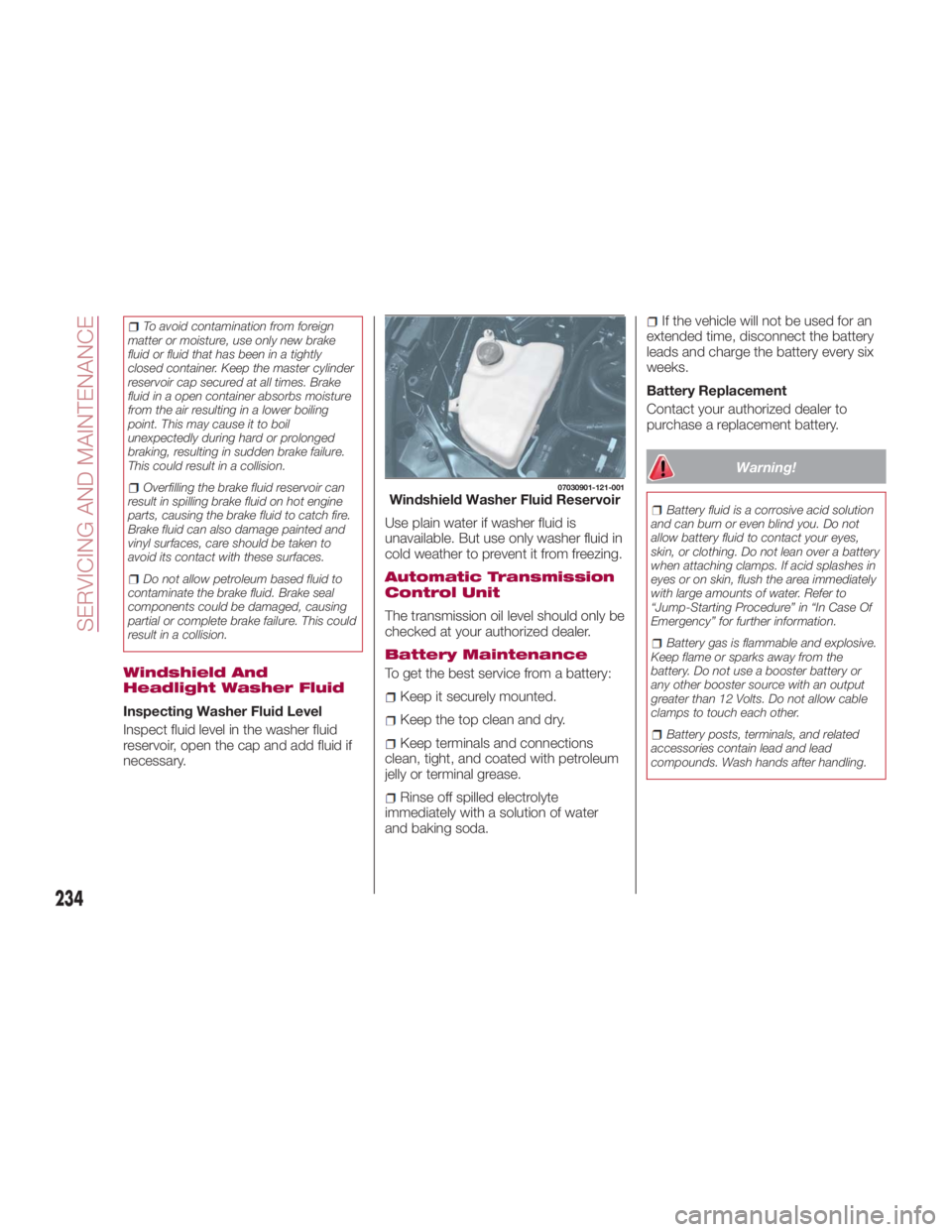
Windshield Washer Fluid Reservoir
234
SERVICING AND MAINTENANCE
Page 240 of 292
WHEELS AND TIRES Tire Safety Information
Tire safety information will cover
aspects of the following information:
Tire Markings, Tire Identification
Numbers, Tire Terminology and
Definitions, Tire Pressures, and Tire
Loading.
Tire Markings Note:
P (Passenger) — Metric tire sizing is
based on U.S. design standards.
P-Metric tires have the letter “P”
molded into the sidewall preceding the
size designation. Example:
P215/65R15 95H.
European — Metric tire sizing is
based on European design standards.
Tires designed to this standard have
the tire size molded into the sidewall
beginning with the section width. The
letter "P" is absent from this tire size
designation. Example: 215/
65R15 96H.
LT (Light Truck) — Metric tire sizing
is based on U.S. design standards.
The size designation for LT-Metric tires
is the same as for P-Metric tires except
for the letters “LT” that are molded into
the sidewall preceding the size
designation. Example: LT235/85R16. Temporary spare tires are designed
for temporary emergency use only.
Temporary high pressure compact
spare tires have the letter “T” or “S”
molded into the sidewall preceding the
size designation. Example:
T145/80D18 103M.
High flotation tire sizing is based on
U.S. design standards and it begins
with the tire diameter molded into the
sidewall. Example: 31x10.5 R15 LT.0601085395US
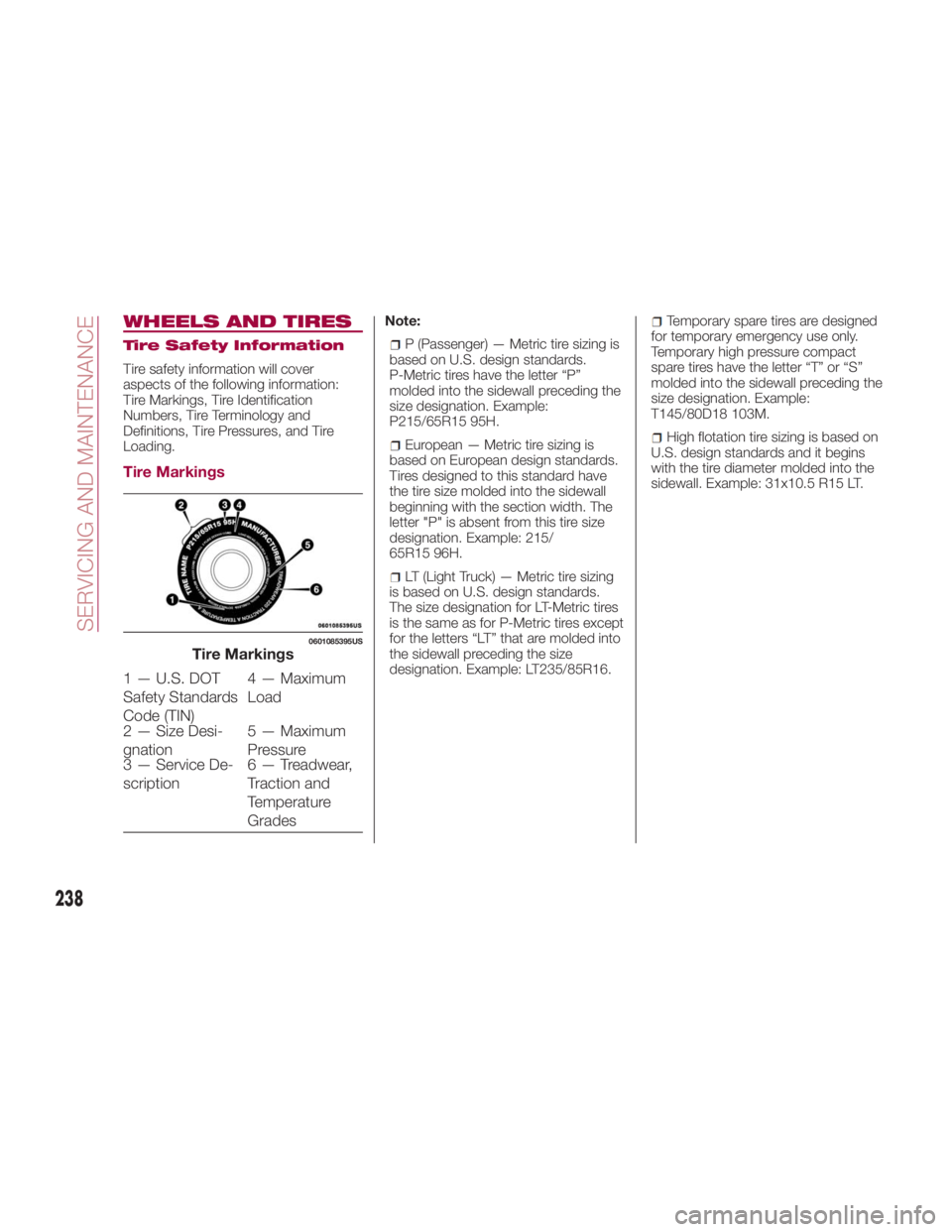
Tire Markings
1 — U.S. DOT
Safety Standards
Code (TIN) 4 — Maximum
Load
2 — Size Desi-
gnation 5 — Maximum
Pressure
3 — Service De-
scription 6 — Treadwear,
Traction and
Temperature
Grades
238
SERVICING AND MAINTENANCE
Page 242 of 292
EXAMPLE:
Service Description:
95 = Load
Index
– A numerical code associated with the maximum load a tire can carry
H = Speed Symbol
– A symbol indicating the range of speeds at which a tire can carry a load corresponding to its load index under
certain operating conditions
– The maximum speed corresponding to the speed symbol should only be achieved under specified operating
conditions (i.e., tire pressure, vehicle loading, road conditions, and posted speed limits)
Load Identification:
Absence of the following load identification symbols on the sidewall of the tire indicates a Standard Load (SL) tire:
XL = Extra load (or reinforced) tire, or
LL = Light load tire or
C, D, E, F, G = Load range associated with the maximum load a tire can carry at a specified pressure
Maximum Load – Maximum load indicates the maximum load this tire is designed to carry
Maximum Pressure – Maximum pressure indicates the maximum permissible cold tire inflation pressure for this tire
240
SERVICING AND MAINTENANCE
Page 283 of 292
Puerto Rico And U.S.
Virgin Islands
Customer Service Chrysler International
Services LLC
P.O. Box 191857
San Juan 00919-1857
Tel.: (787) 782-5757
Fax: (787) 782-3345
Customer Assistance
For The Hearing Or
Speech Impaired
(TDD/TTY)
To assist customers who have hearing
difficulties, the manufacturer has
installed special TDD
(Telecommunication Devices for the
Deaf) equipment at its customer center.
Any hearing or speech impaired
customer, who has access to a TDD or
a conventional teletypewriter (TTY) in
the United States, can communicate
with the manufacturer by dialing
1-800-380-CHRY.
Canadian residents with hearing
difficulties that require assistance can
use the special needs relay service
offered by Bell Canada. For TTY
teletypewriter users, dial 711 and for
Voice callers, dial 1-800-855-0511 to
connect with a Bell Relay Service
operator. Service Contract
You may have purchased a service
contract for a vehicle to help protect
you from the high cost of unexpected
repairs after the manufacturer's New
Vehicle Limited Warranty expires. The
manufacturer stands behind only the
manufacturer's service contracts. If you
purchased a manufacturer's service
contract, you will receive Plan
Provisions and an Owner Identification
Card in the mail within three weeks of
the vehicle delivery date. If you have
any questions about the service
contract, call the manufacturer's
Service Contract National Customer
Hotline at 1-800-521-9922 (Canadian
residents, call (800) 465-2001 English /
(800) 387-9983 French).
The manufacturer will not stand behind
any service contract that is not the
manufacturer's service contract. It is
not responsible for any service contract
other than the manufacturer's service
contract. If you purchased a service
contract that is not a manufacturer's
service contract, and you require
service after the manufacturer's New
Vehicle Limited Warranty expires,
please refer to the contract documents,
and contact the person listed in those
documents.
We appreciate that you have made a
major investment when you purchased
the vehicle. An authorized dealer has
also made a major investment in facilities, tools, and training to assure
that you are absolutely delighted with
the ownership experience. You will be
pleased with their sincere efforts to
resolve any warranty issues or related
concerns.
Warning!Engine exhaust (internal combustion
engines only), some of its constituents, and
certain vehicle components contain, or
emit, chemicals known to the State of
California to cause cancer and birth
defects, or other reproductive harm. In
addition, certain fluids contained in vehicles
and certain products of component wear
contain, or emit, chemicals known to the
State of California to cause cancer and
birth defects, or other reproductive harm.
281
Page 286 of 292
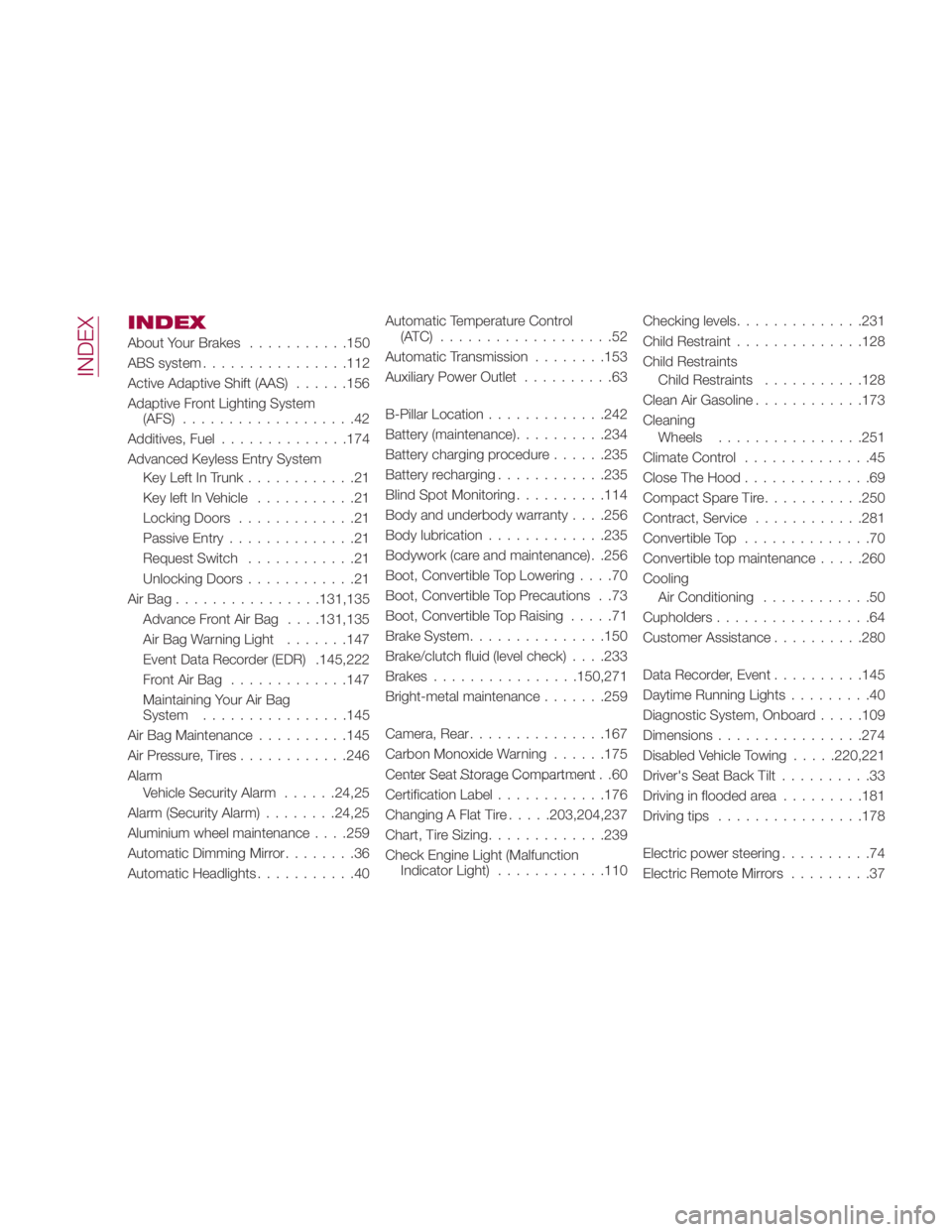
INDEX About Your Brakes .......... .150
ABS system ............... .112
Active Adaptive Shift (AAS) ..... .156
Adaptive Front Lighting System
(AFS) ...................42
Additives, Fuel ............. .174
Advanced Keyless Entry System
Key Left In Trunk ............21
Key left In Vehicle ...........21
Locking Doors .............21
Passive Entry ..............21
Request Switch ............21
Unlocking Doors ............21
AirBag............... .131,135
Advance Front Air Bag . . . .131,135
Air Bag Warning Light ...... .147
Event Data Recorder (EDR) .145,222
FrontAirBag ............ .147
Maintaining Your Air Bag
System ............... .145
Air Bag Maintenance ......... .145
Air Pressure, Tires ........... .246
Alarm
Vehicle Security Alarm ..... .24,25
Alarm (Security Alarm) ....... .24,25
Aluminium wheel maintenance . . . .259
Automatic Dimming Mirror ........36
Automatic Headlights ...........40 Automatic Temperature Control
(ATC) ...................52
Automatic Transmission ....... .153
Auxiliary Power Outlet ..........63
B-Pillar Location ............ .242
Battery (maintenance) ......... .234
Battery charging procedure ..... .235
Battery recharging ........... .235
Blind Spot Monitoring ......... .114
Body and underbody warranty . . . .256
Body lubrication ............ .235
Bodywork (care and maintenance). .256
Boot, Convertible Top Lowering ....70
Boot, Convertible Top Precautions . .73
Boot, Convertible Top Raising .....71
Brake System .............. .150
Brake/clutch fluid (level check) . . . .233
Brakes ............... .150,271
Bright-metal maintenance ......
.259
Camera,
Rear ..............
.167
Carbon Monoxide Warning ..... .175
Center Seat Storage Compartment .......................60
Certification Label ........... .176
Changing A Flat Tire .... .203,204,237
Chart, Tire Sizing ............ .239
Check Engine Light (Malfunction
Indicator Light) ........... .110 Checking levels ............. .231
Child Restraint ............. .128
Child Restraints
Child Restraints .......... .128
Clean Air Gasoline ........... .173
Cleaning
Wheels ............... .251
Climate Control ..............45
Close The Hood ..............69
Compact Spare Tire .......... .250
Contract, Service ........... .281
Convertible Top ..............70
Convertible top maintenance .... .260
Cooling
Air Conditioning ............50
Cupholders .................64
Customer Assistance ......... .280
Data Recorder, Event ......... .145
Daytime Running Lights .........40
Diagnostic System, Onboard .... .109
Dimensions ............... .274
Disabled Vehicle Towing .... .220,221
Driver's Seat Back Tilt ..........33
Driving in flooded area ........ .181
Driving tips ............... .178
Electric power steering ..........74
Electric Remote Mirrors .........37
INDEX