engine oil FIAT SPIDER ABARTH 2017 User Guide
[x] Cancel search | Manufacturer: FIAT, Model Year: 2017, Model line: SPIDER ABARTH, Model: FIAT SPIDER ABARTH 2017Pages: 292, PDF Size: 9.24 MB
Page 233 of 292
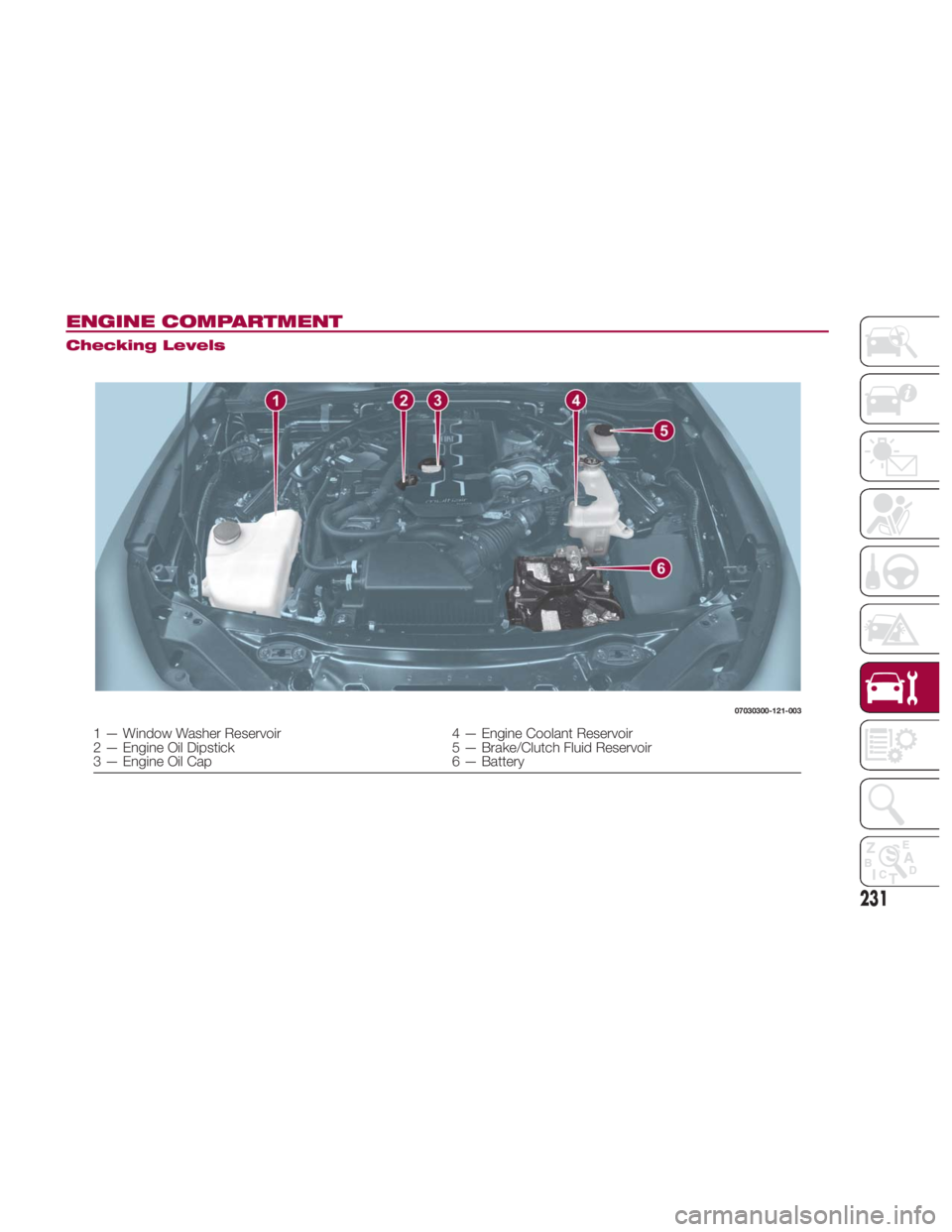
ENGINE COMPARTMENT Checking Levels 07030300-121-003
1 — Window Washer Reservoir 4 — Engine Coolant Reservoir
2 — Engine Oil Dipstick 5 — Brake/Clutch Fluid Reservoir
3 — Engine Oil Cap 6 — Battery
231
Page 234 of 292
Engine Oil
Warning!Be very careful when working in the
engine compartment when the engine is
hot: you may get burned.
Do not get too close to the radiator
cooling fan: the electric fan may start;
danger of injury.
Loose clothing might be pulled by
moving parts.
Recommended Oil
Refer to “Fluids And Lubricants” in
“Technical Specifications” for further
information.
Inspecting engine oil level
Proceed as follows:
1. Be sure the vehicle is on a level
surface.
2. Warm up the engine to normal
operating temperature.
3. Turn it off and wait at least five
minutes for the oil to return to the
sump.
4. Pull out the dipstick, wipe it clean,
and reinsert it fully. 5. Pull the dipstick out again and
examine the level. The level is normal if
it is between Low and Full. If it is near
or below Low, open the engine oil
cap/filler 2 and add enough oil to bring
the level to Full.
Note: Do not overfill the engine oil.
This may cause engine damage.
6. Make sure the O-ring on the dipstick
is positioned properly before reinserting
the dipstick.
7. Reinsert the dipstick fully.
Engine oil consumption
During the initial period of use the
engine oil consumption conditions
should stabilize after the first 3000 –
3500 miles (5000 – 6000 km). Engine Coolant
Warning! Turn vehicle off and disconnect the fan
motor lead before working near the radiator
cooling fan.
You or others can be badly burned by
hot engine coolant (antifreeze) or steam
from your radiator. If you see or hear steam
coming from under the hood, do not open
the hood until the radiator has had time to
cool. Never open a cooling system
pressure cap when the radiator or coolant
bottle is hot.
Keep hands, tools, clothing, and jewelry
away from the radiator cooling fan when
the hood is raised. The fan starts
automatically and may start at any time,
whether the engine is running or not.
When working near the radiator cooling
fan, disconnect the fan motor lead or turn
the ignition to the OFF mode. The fan is
temperature controlled and can start at any
time the ignition is in the ON mode.
You or others can be badly burned by
hot engine coolant (antifreeze) or steam
from your radiator. If you see or hear steam
coming from under the hood, do not open
the hood until the radiator has had time to
cool. Never try to open a cooling system
pressure cap when the radiator is hot. 07030403-121-001
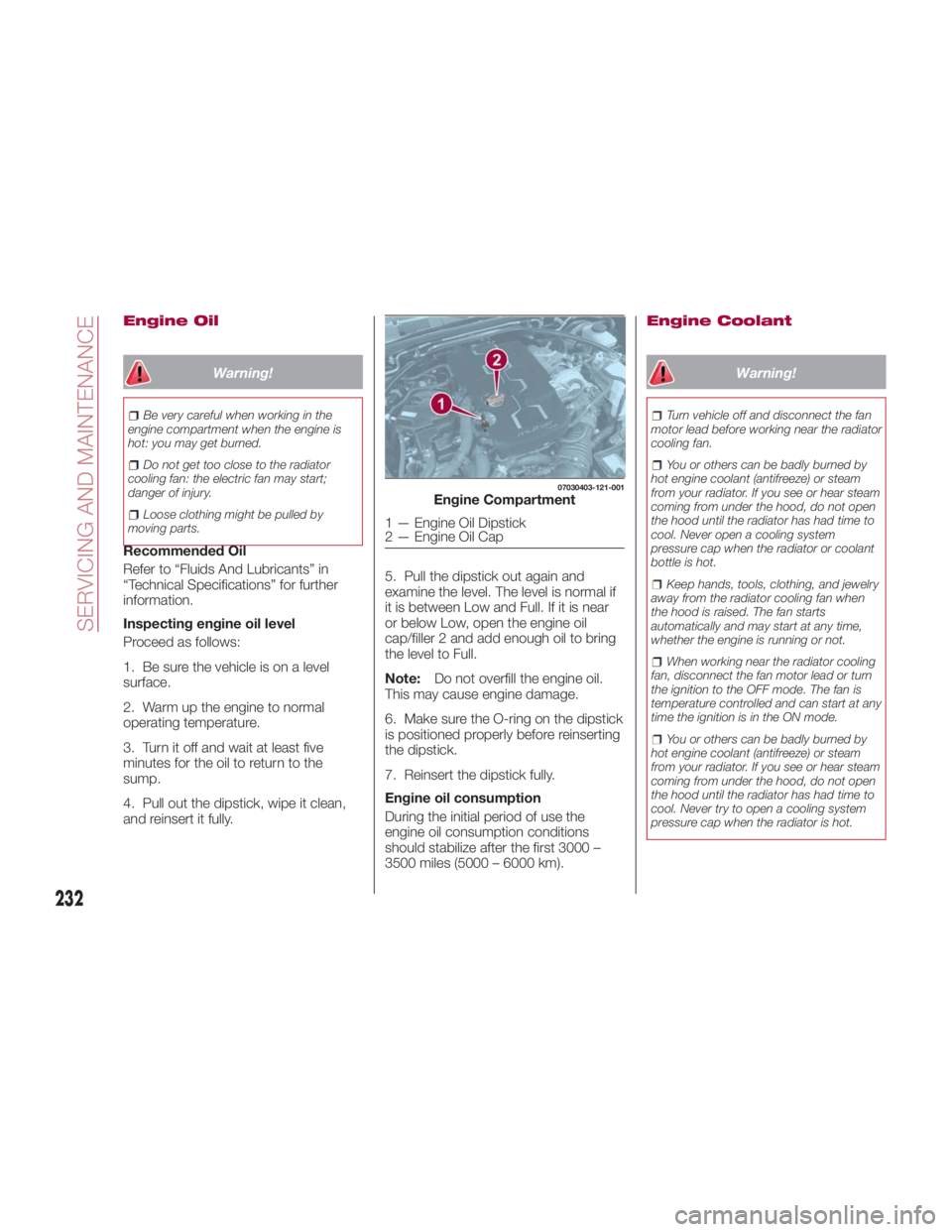
Engine Compartment
1 — Engine Oil Dipstick
2 — Engine Oil Cap
232
SERVICING AND MAINTENANCE
Page 236 of 292
To avoid contamination from foreign
matter or moisture, use only new brake
fluid or fluid that has been in a tightly
closed container. Keep the master cylinder
reservoir cap secured at all times. Brake
fluid in a open container absorbs moisture
from the air resulting in a lower boiling
point. This may cause it to boil
unexpectedly during hard or prolonged
braking, resulting in sudden brake failure.
This could result in a collision.
Overfilling the brake fluid reservoir can
result in spilling brake fluid on hot engine
parts, causing the brake fluid to catch fire.
Brake fluid can also damage painted and
vinyl surfaces, care should be taken to
avoid its contact with these surfaces.
Do not allow petroleum based fluid to
contaminate the brake fluid. Brake seal
components could be damaged, causing
partial or complete brake failure. This could
result in a collision.
Windshield And
Headlight Washer Fluid
Inspecting Washer Fluid Level
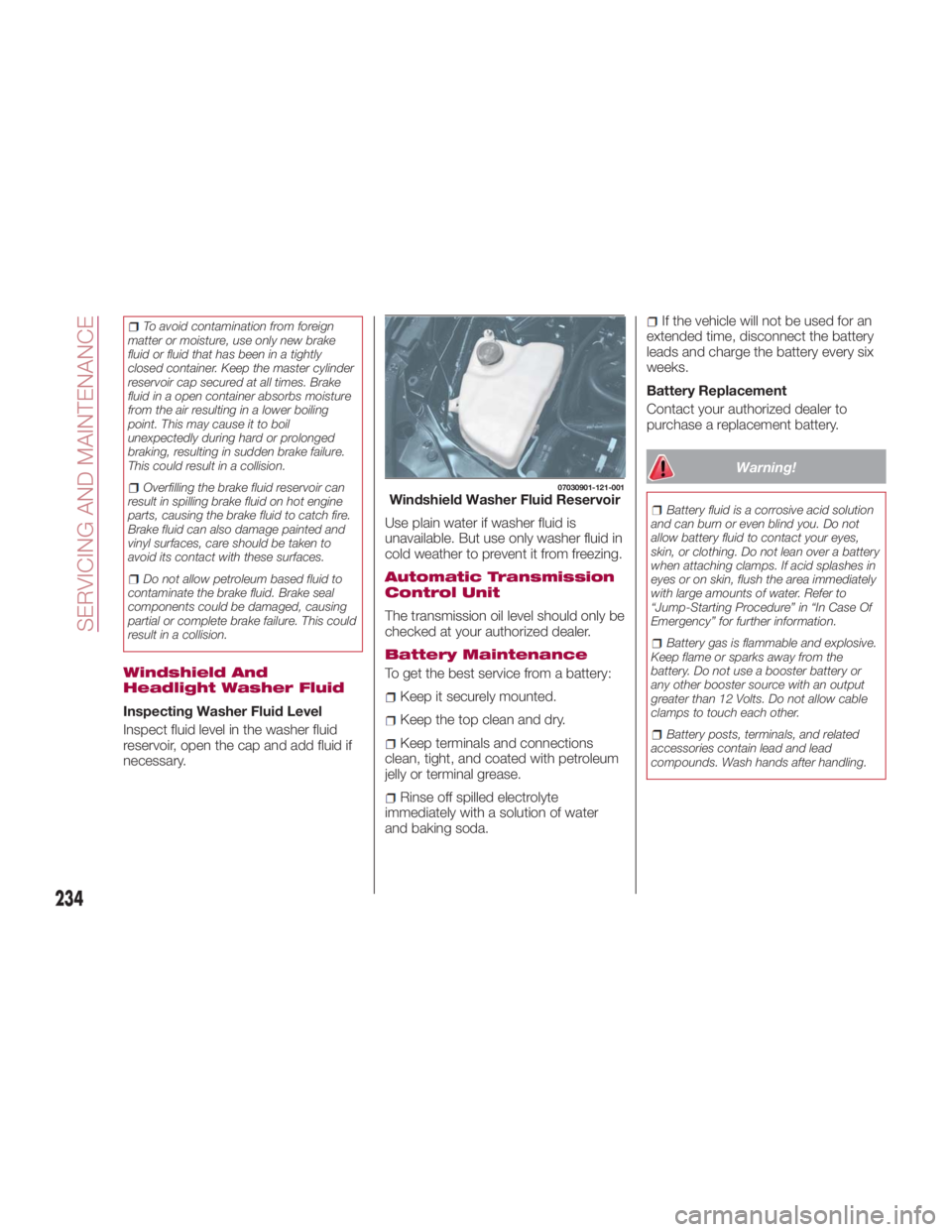
Inspect fluid level in the washer fluid
reservoir, open the cap and add fluid if
necessary. Use plain water if washer fluid is
unavailable. But use only washer fluid in
cold weather to prevent it from freezing.
Automatic Transmission
Control Unit
The transmission oil level should only be
checked at your authorized dealer.
Battery Maintenance
To get the best service from a battery:
Keep it securely mounted.
Keep the top clean and dry.
Keep terminals and connections
clean, tight, and coated with petroleum
jelly or terminal grease.
Rinse off spilled electrolyte
immediately with a solution of water
and baking soda. If the vehicle will not be used for an
extended time, disconnect the battery
leads and charge the battery every six
weeks.
Battery Replacement
Contact your authorized dealer to
purchase a replacement battery.
Warning! Battery fluid is a corrosive acid solution
and can burn or even blind you. Do not
allow battery fluid to contact your eyes,
skin, or clothing. Do not lean over a battery
when attaching clamps. If acid splashes in
eyes or on skin, flush the area immediately
with large amounts of water. Refer to
“Jump-Starting Procedure” in “In Case Of
Emergency” for further information.
Battery gas is flammable and explosive.
Keep flame or sparks away from the
battery. Do not use a booster battery or
any other booster source with an output
greater than 12 Volts. Do not allow cable
clamps to touch each other.
Battery posts, terminals, and related
accessories contain lead and lead
compounds. Wash hands after handling. 07030901-121-001
Windshield Washer Fluid Reservoir
234
SERVICING AND MAINTENANCE
Page 237 of 292
BATTERY
RECHARGING BATTERY CHARGING
PROCEDURE
Warning!Battery fluid is a corrosive acid solution
and can burn or even blind you. Do not
allow battery fluid to contact your eyes,
skin, or clothing. Do not lean over a battery
when attaching clamps. If acid splashes in
eyes or on skin, flush the area immediately
with large amounts of water. Refer to
“Jump-Starting Procedure” in “In Case Of
Emergency” for further information.
Battery gas is flammable and explosive.
Keep flame or sparks away from the
battery. Do not use a booster battery or
any other booster source with an output
greater than 12 Volts. Do not allow cable
clamps to touch each other.
Battery posts, terminals, and related
accessories contain lead and lead
compounds. Wash hands after handling. Caution!It is essential when replacing the cables
on the battery that the positive cable is
attached to the positive post and the
negative cable is attached to the negative
post. Battery posts are marked positive (+)
and negative (-) and are identified on the
battery case. Cable clamps should be tight
on the terminal posts and free of corrosion.
If a “fast charger” is used while the
battery is in the vehicle, disconnect both
vehicle battery cables before connecting
the charger to the battery. Do not use a
“fast charger” to provide starting voltage.
Charge battery as follows:
Before recharging the battery, turn off
all accessories and turn the engine off
by placing the ignition in the OFF mode.
Disconnect the negative battery
cable.
Connect the charger cables to the
battery terminals, observing the polarity
(+,–).
Turn on the charger.
When finished, turn the charger off
before disconnecting the battery.
Reconnect the negative battery
terminal. MAINTENANCE
PROCEDURES The following pages contain
instructions on the required
maintenance from the technical
personnel who designed the vehicle.
In addition to these specific
maintenance instructions specified for
routine scheduled servicing, there are
other components which may require
periodic maintenance or replacement
over the vehicle’s life cycle.
Body Lubrication
Ensure that the locks and bodywork
junction points, including components
such as the seat guides, door hinges
(and rollers), trunk and hood are
periodically lubricated with lithium
based grease to ensure correct, silent
operation and to protect them from rust
and wear.
Thoroughly clean the components,
eliminating every trace of dirt and dust.
After lubricating, eliminate excess oil
and grease. Also pay particular
attention to the hood closing devices,
to ensure correct operation.
During operations on the hood, be sure
to perform with the engine cold, also
remember to check, clean and lubricate
the locking, release and safety devices.
Make sure the hood's secondary latch
keeps the hood from opening when the
primary latch is released.
235
Page 263 of 292
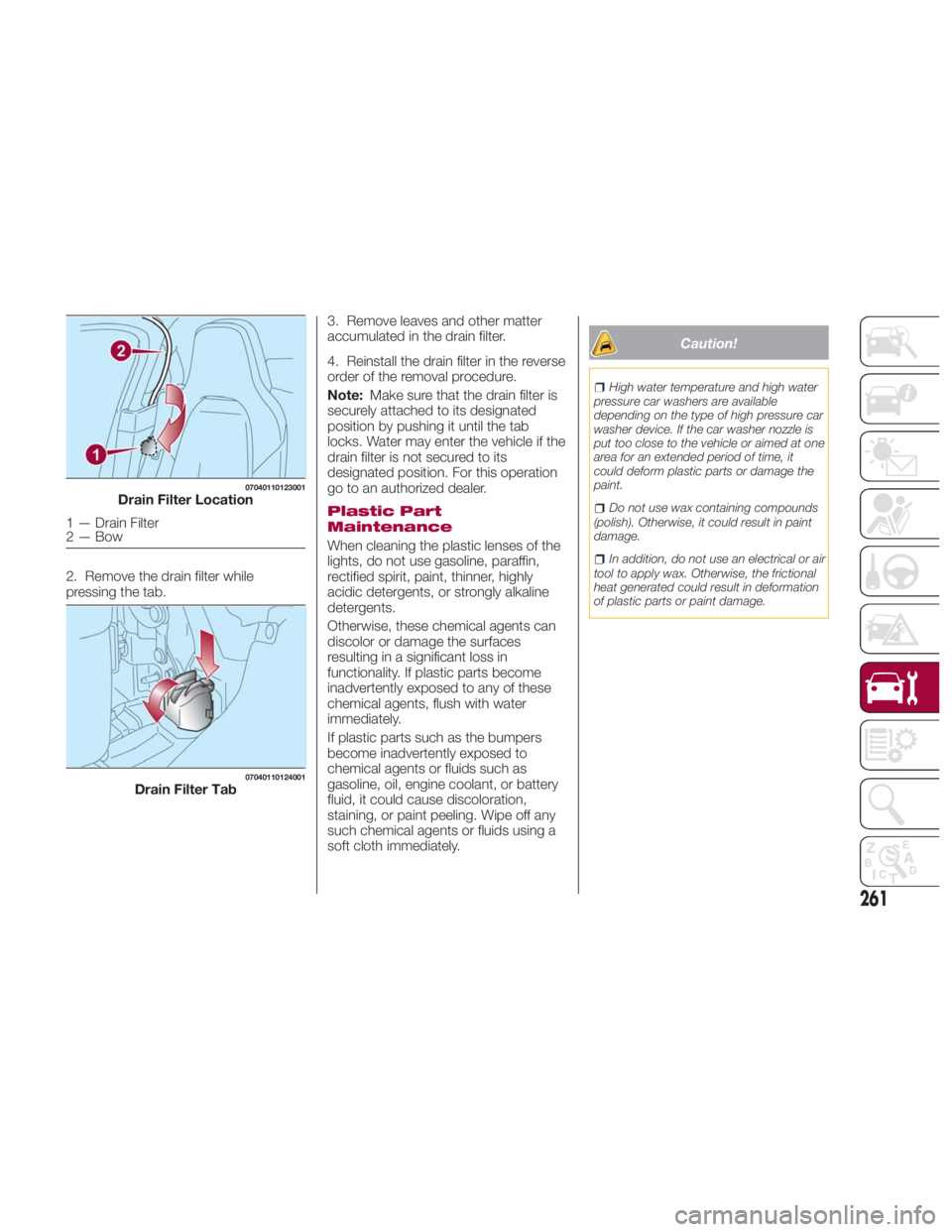
2. Remove the drain filter while
pressing the tab. 3. Remove leaves and other matter
accumulated in the drain filter.
4. Reinstall the drain filter in the reverse
order of the removal procedure.
Note: Make sure that the drain filter is
securely attached to its designated
position by pushing it until the tab
locks. Water may enter the vehicle if the
drain filter is not secured to its
designated position. For this operation
go to an authorized dealer.
Plastic Part
Maintenance
When cleaning the plastic lenses of the
lights, do not use gasoline, paraffin,
rectified spirit, paint, thinner, highly
acidic detergents, or strongly alkaline
detergents.
Otherwise, these chemical agents can
discolor or damage the surfaces
resulting in a significant loss in
functionality. If plastic parts become
inadvertently exposed to any of these
chemical agents, flush with water
immediately.
If plastic parts such as the bumpers
become inadvertently exposed to
chemical agents or fluids such as
gasoline, oil, engine coolant, or battery
fluid, it could cause discoloration,
staining, or paint peeling. Wipe off any
such chemical agents or fluids using a
soft cloth immediately. Caution! High water temperature and high water
pressure car washers are available
depending on the type of high pressure car
washer device. If the car washer nozzle is
put too close to the vehicle or aimed at one
area for an extended period of time, it
could deform plastic parts or damage the
paint.
Do not use wax containing compounds
(polish). Otherwise, it could result in paint
damage.
In addition, do not use an electrical or air
tool to apply wax. Otherwise, the frictional
heat generated could result in deformation
of plastic parts or paint damage.07040110123001
Drain Filter Location
1 — Drain Filter
2 — Bow 07040110124001
Drain Filter Tab
261
Page 277 of 292
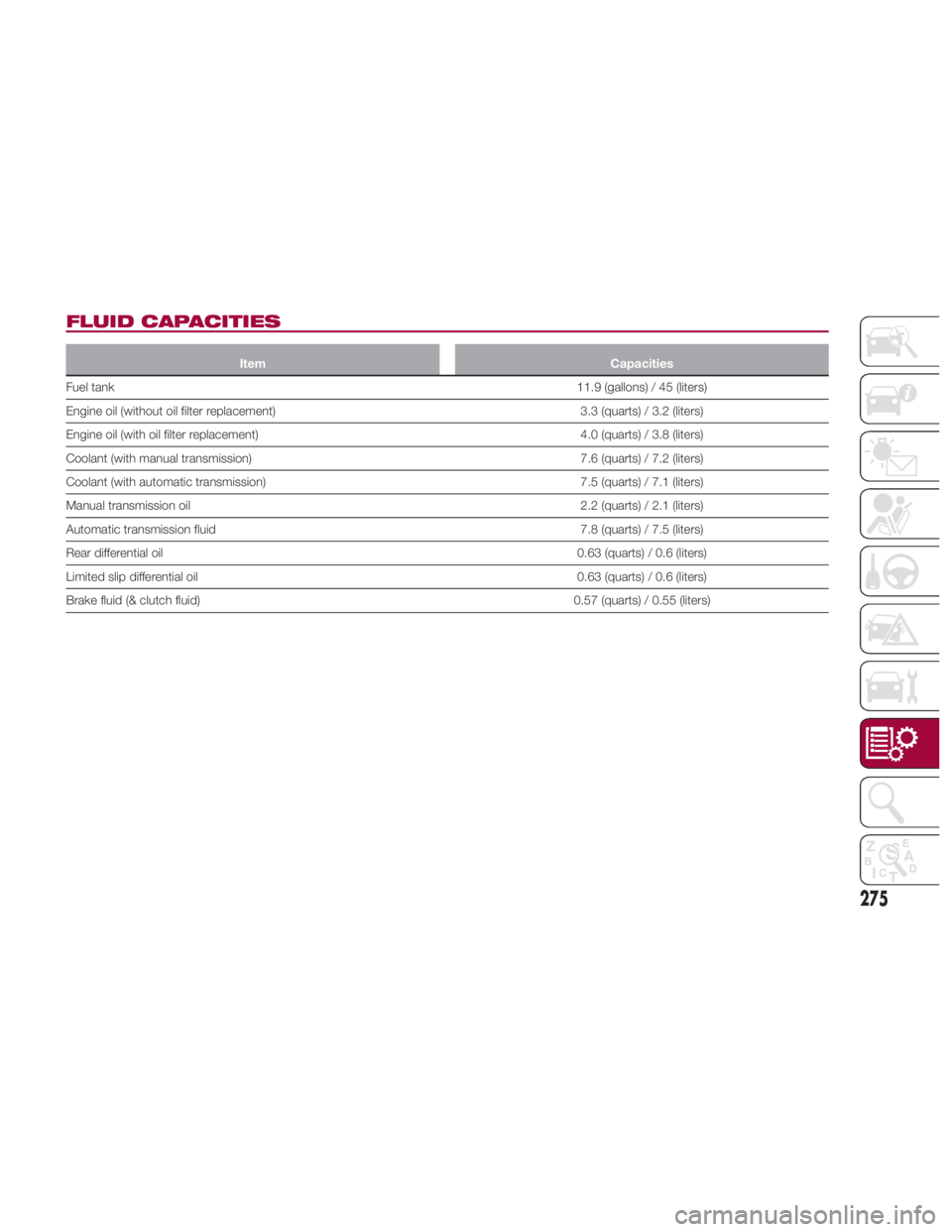
FLUID CAPACITIES Item Capacities
Fuel tank 11.9 (gallons)
/ 45 (liters)
Engine oil (without oil filter replacement) 3.3 (quarts) / 3.2 (liters)
Engine oil (with oil filter replacement) 4.0 (quarts) / 3.8 (liters)
Coolant (with manual transmission) 7.6 (quarts) / 7.2 (liters)
Coolant (with automatic transmission) 7.5 (quarts) / 7.1 (liters)
Manual transmission oil 2.2 (quarts) / 2.1 (liters)
Automatic transmission fluid 7.8 (quarts) / 7.5 (liters)
Rear differential oil 0.63 (quarts) / 0.6 (liters)
Limited slip differential oil 0.63 (quarts) / 0.6 (liters)
Brake fluid (& clutch fluid) 0.57 (quarts) / 0.55 (liters)
275
Page 278 of 292
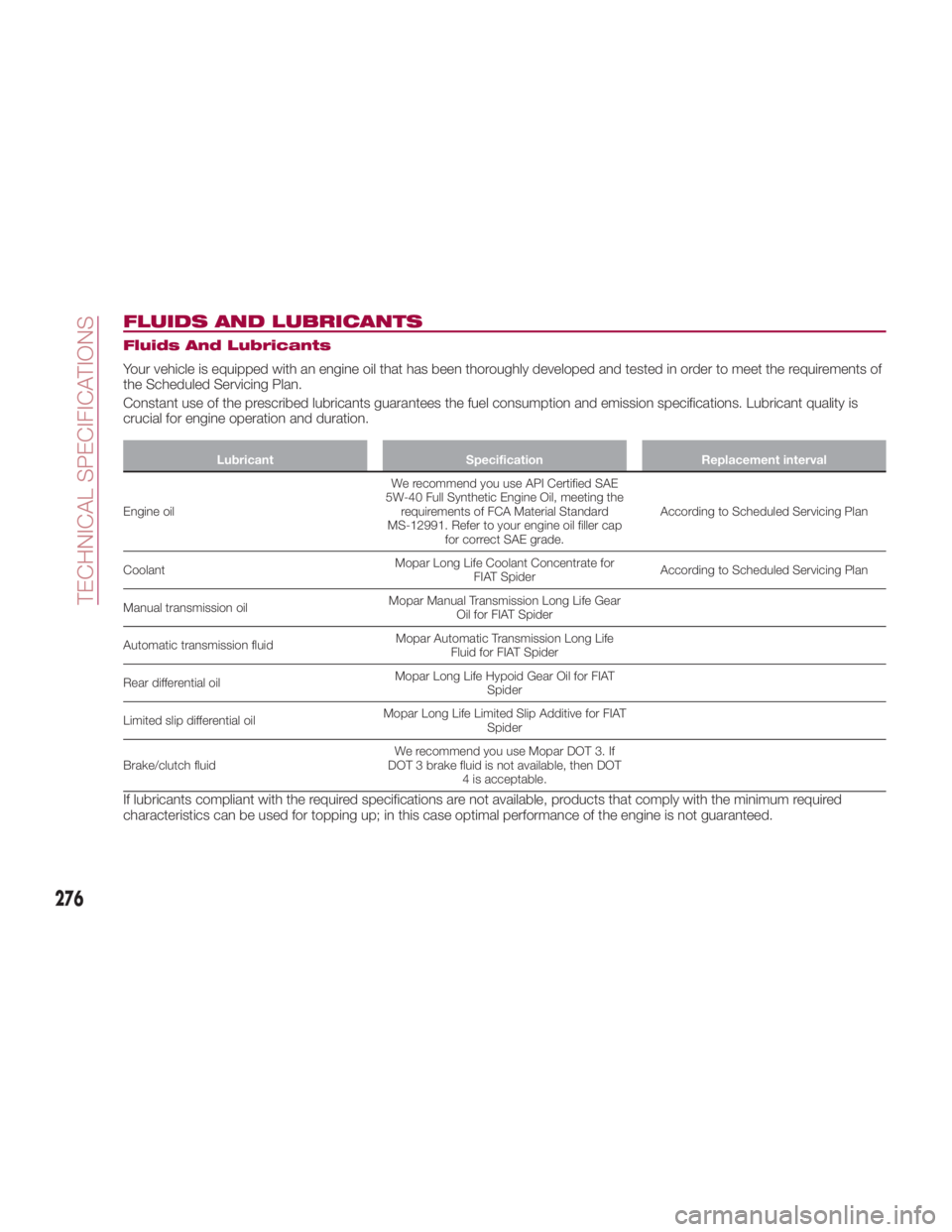
FLUIDS AND LUBRICANTS Fluids And Lubricants
Your vehicle is equipped with an engine oil that has been thoroughly developed and tested in order to meet the requirements of
the Scheduled Servicing Plan.
Constant use of the prescribed lubricants guarantees the fuel consumption and emission specifications. Lubricant quality is
crucial for engine operation and duration. Lubricant Specification Replacement interval
Engine oil W e
recommend you use API Certified SAE
5W-40 Full Synthetic Engine Oil, meeting the
requirements of FCA Material Standard
MS-12991. Refer to your engine oil filler cap
for correct SAE grade. According to Scheduled Servicing Plan
Coolant Mopar Long Life Coolant Concentrate for
FIAT Spider According to Scheduled Servicing Plan
Manual transmission oil Mopar Manual Transmission Long Life Gear
Oil for FIAT Spider
Automatic transmission fluid Mopar Automatic Transmission Long Life
Fluid for FIAT Spider
Rear differential oil Mopar Long Life Hypoid Gear Oil for FIAT
Spider
Limited slip differential oil Mopar Long Life Limited Slip Additive for FIAT
Spider
Brake/clutch fluid We recommend you use Mopar DOT 3. If
DOT 3 brake fluid is not available, then DOT
4 is acceptable.
If lubricants compliant with the required specifications are not available, products that comply with the minimum required
characteristics can be used for topping up; in this case optimal performance of the engine is not guaranteed.
276
TECHNICAL SPECIFICATIONS
Page 287 of 292
Electronic Brake Control System
Traction Control System ..... .112
Electronic Speed Control (Cruise
Control) ................ .159
Emergency fuel filler door release . .176
Emergency Key ..............16
Emergency, In Case Of ........ .208
Hazard Warning Flasher ..... .184
Jacking ......... .203,204,237
Jump Starting ........... .217
Overheating ............ .219
Towing ............. .220,221
Emission control system .........74
Emission Control System
Maintenance ............. .110
Engine .................. .269
Exhaust Gas Caution ....... .175
Fails To Start ............ .218
Flooded, Starting ......... .218
Jump Starting ........... .217
Overheating ............ .219
Starting ............. .20,218
Engine compartment ......... .231
Engine coolant (level check) ..... .232
Engine oil (level check) ........ .232
Environment protection systems ....74
Essential information ............3
Ethanol .................. .173
Event Data Recorder ......... .145 Exhaust Gas Caution ......... .175
Exterior Lights ...............38
Flash-To-Pass ...............40
Flashers
Hazard Warning .......... .184
Turn Signal ...............41
Flooded Engine Starting ....... .218
Fluid And Lubricants ......... .276
Fluid Capacities ............ .275
Fog Lights ..................41
Follow Me Home .............40
Front lights (light bulbs) ........
.187
Fr
ont Wipers
Wiper Operation ...........42
Fuel
Additives .............. .174
Clean Air .............. .173
Ethanol ............... .173
Materials Added .......... .174
Methanol .............. .173
Fuel Consumption Display ........85
Fuel Economy Monitor ..........84
Fuel filler cap .............. .175
Fuel filler door .............. .175
Fuse block (engine compartment) . .197
Fuse block (interior) .......... .201
Fuses (interior) ............. .195
Fuses (underhood) ........... .196 Gasoline, Clean Air .......... .173
Gasoline, Reformulated ....... .173
Gear selector positions ........ .154
GVWR .................. .176
Hazard Warning Flasher ....... .184
Hazardous driving ........... .178
Head Restraints ..............34
Headlight ..................38
Headlights
Adjusting The Headlight Abroad .......................42
High Beam ...............40
Passing .................40
Heavy-duty use of the vehicle
(scheduled servicing) ....... .225
HomeLink (Garage Door Opener) . . .58
Hood Release ...............68
How to use this manual ..........3
Identification Data ........... .266
Inside Rearview Mirror ..........36
Instrument Cluster Display
Information Display ....... .76,77
Interior Lights ................62
Interiors ................. .262
Internal Equipment ............60
Jack Location .............. .203
Jack Operation ....... .203,204,237
Jump Starting .............. .217