manual transmission FIAT SPIDER ABARTH 2017 Owner's Manual
[x] Cancel search | Manufacturer: FIAT, Model Year: 2017, Model line: SPIDER ABARTH, Model: FIAT SPIDER ABARTH 2017Pages: 292, PDF Size: 9.24 MB
Page 206 of 292
To Secure The Jack
Proceed as follows:
1. Insert the wing bolt into the jack with
the jack screw pointing back, and turn
the wing bolt clockwise to temporarily
tighten it.
2. Turn the jack screw clockwise.
3. Turn the wing bolt completely to
secure the jack.
4. Insert the cover tabs and install the
cover.
Warning!A loose tire or jack thrown forward in a
collision or hard stop could endanger the
occupants of the vehicle. Always stow the
jack parts and the spare tire in the places
provided. Have the deflated (flat) tire
repaired or replaced immediately.
Maintenance
Always keep the jack clean.
Make sure the moving parts are kept
free from dirt or rust.
Make sure the screw thread is
adequately lubricated. Conditions Of Non-Use
Temperatures below -40°F (−40°C)
On sandy or muddy ground
On uneven ground
On steep roads
In extreme weather conditions
In direct contact with the engine or
for repairs under the vehicle
On boats
Jacking Instructions
Note: Make sure the jack is well
lubricated before using it.
Warning!Do not attempt to change a tire on the side
of the vehicle close to moving traffic, pull
far enough off the road to avoid being hit
when operating the jack or changing the
wheel.
Proceed as follows:
1. Stop the vehicle in a position that
does not cause any danger to traffic
and lets you change the tire in safety, as
far as possible from the edge of the
driving lane. The ground must be flat
and sufficiently compact. 2. Turn on the Hazard Warning Lights
and engage the parking brake.
3. For vehicles with automatic
transmission, place the gear selector in
PARK. For vehicles with manual
transmission, place gear selector in
REVERSE and turn the engine to OFF.
4. Stop the engine. The motor must be
kept off as long as the vehicle is lifted
off the ground.
5. Remove the jack and tools.
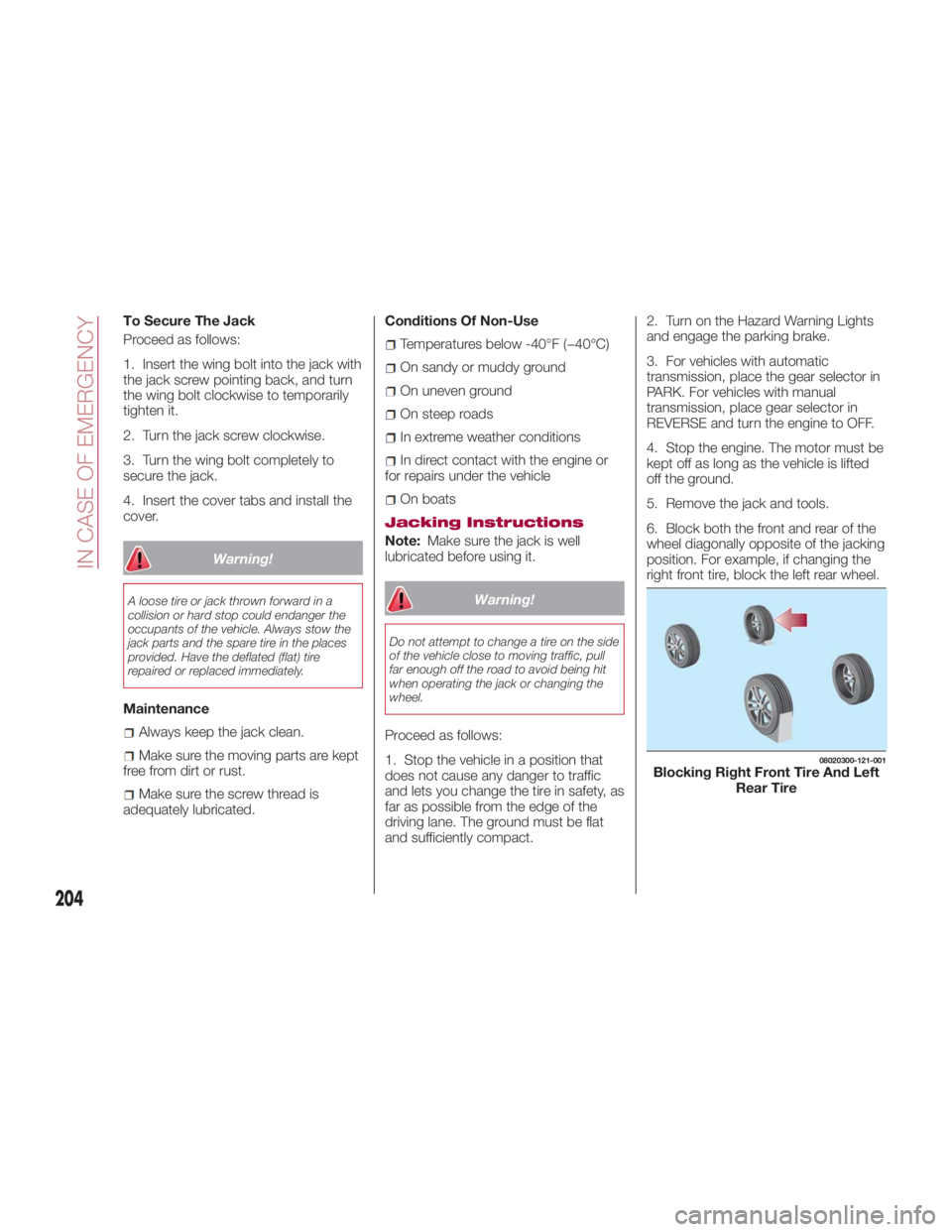
6. Block both the front and rear of the
wheel diagonally opposite of the jacking
position. For example, if changing the
right front tire, block the left rear wheel. 08020300-121-001
Blocking Right Front Tire And Left
Rear Tire
204
IN CASE OF EMERGENCY
Page 211 of 292
Tire Service Usage
Precautions
The tire sealant cannot be reused. If the
sealant has been used, or is expired,
purchase new tire sealant at an
authorized dealer.
Note: The Tire Service Kit cannot be
used in the following cases. Consult an
authorized dealer if any of these
conditions exist:
The period of effective use for the
tire sealant has expired (the period of
effectiveness is indicated on the bottle
label)
The tear or puncture in the tire
exceeds about 0.16 inches (4 mm)
The damage has occurred to an
area of the tire other than the tread
The vehicle has been driven with
nearly no air remaining in the tire
The tire has come off the wheel rim
Damage to the wheel rim has
occurred
The tire has two or more punctures Sealing A Tire With Tire
Service Kit
Warning!Do not attempt to seal a tire on the side
of the vehicle closest to traffic. Pull far
enough off the road to avoid the danger of
being hit when using the Tire Service Kit.
Do not use Tire Service Kit or drive the
vehicle under the following circumstances:
If the puncture in the tire tread is
approximately 1/4 inch (6 mm) or larger.
If the tire has any sidewall damage.
If the tire has any damage from driving
with extremely low tire pressure.
If the tire has any damage from driving
on a flat tire.
If the wheel has any damage.
If you are unsure of the condition of the
tire or the wheel.
Keep Tire Service Kit away from open
flames or heat sources.
A loose Tire Service Kit thrown forward
in a collision or hard stop could endanger
the occupants of the vehicle. Always stow
the Tire Service Kit in the place provided.
Failure to follow these warnings can result
in injuries that are serious or fatal to you,
your passengers, and others around you.
Take care not to allow the contents of
Tire Service Kit to come in contact with
hair, eyes, or clothing. Tire Service Kit
sealant is harmful if inhaled, swallowed, or absorbed through the skin. It causes skin,
eye, and respiratory irritation. Flush
immediately with plenty of water if there is
any contact with eyes or skin. Change
clothing as soon as possible, if there is any
contact with clothing.
Tire Service Kit Sealant solution contains
latex. In case of an allergic reaction or rash,
consult a physician immediately. Keep Tire
Service Kit out of reach of children. If
swallowed, rinse mouth immediately with
plenty of water and drink plenty of water.
Do not induce vomiting! Consult a
physician immediately.
U.S.A. And CANADA Markets:
Proceed as follows:
1. Pull over to a safe location and turn
on the vehicle’s Hazard Warning Lights.
2. Verify that the valve stem (on the
wheel with the deflated tire) is in a
position that is near to the ground. This
will allow the Tire Service Kit hoses to
reach the valve stem and keep the Tire
Service Kit flat on the ground. This will
provide the best positioning of the kit
when injecting the sealant into the
deflated tire and running the air pump.
Move the vehicle as necessary to place
the valve stem in this position before
proceeding.
3. Place the gear selector in REVERSE
for a manual transmission, and PARK
for automatic transmission.
209
Page 215 of 292
Sealing A Tire With Tire
Service Kit
Warning!Do not attempt to seal a tire on the side
of the vehicle closest to traffic. Pull far
enough off the road to avoid the danger of
being hit when using the Tire Service Kit.
Do not use Tire Service Kit or drive the
vehicle under the following circumstances:
If the puncture in the tire tread is
approximately 1/4 inch (6 mm) or larger.
If the tire has any sidewall damage.
If the tire has any damage from driving
with extremely low tire pressure.
If the tire has any damage from driving
on a flat tire.
If the wheel has any damage.
If you are unsure of the condition of the
tire or the wheel.
Keep Tire Service Kit away from open
flames or heat sources.
A loose Tire Service Kit thrown forward
in a collision or hard stop could endanger
the occupants of the vehicle. Always stow
the Tire Service Kit in the place provided.
Failure to follow these warnings can result
in injuries that are serious or fatal to you,
your passengers, and others around you.
Take care not to allow the contents of
Tire Service Kit to come in contact with
hair, eyes, or clothing. Tire Service Kit
sealant is harmful if inhaled, swallowed, or absorbed through the skin. It causes skin,
eye, and respiratory irritation. Flush
immediately with plenty of water if there is
any contact with eyes or skin. Change
clothing as soon as possible, if there is any
contact with clothing.
Tire Service Kit Sealant solution contains
latex. In case of an allergic reaction or rash,
consult a physician immediately. Keep Tire
Service Kit out of reach of children. If
swallowed, rinse mouth immediately with
plenty of water and drink plenty of water.
Do not induce vomiting! Consult a
physician immediately.
Mexico Market
Proceed as follows:
1. Pull over to a safe location and turn
on the vehicle’s Hazard Warning Lights.
2. Verify that the valve stem (on the
wheel with the deflated tire) is in a
position that is near to the ground. This
will allow the Tire Service Kit hoses to
reach the valve stem and keep the Tire
Service Kit flat on the ground. This will
provide the best positioning of the kit
when injecting the sealant into the
deflated tire and running the air pump.
Move the vehicle as necessary to place
the valve stem in this position before
proceeding.
3. Place the gear selector in REVERSE
for a manual transmission, or PARK for
automatic transmission. 4. Apply the parking brake with the
brake pedal pressed and turn the
engine OFF.
5. Unload passengers and cargo, then
remove the Tire Service Kit.
6. Gently shake the tire sealant. If the
bottle is shaken after the injection hose
is screwed on, tire sealant could spray
out from the injection hose. Tire sealant
contacting clothing or other objects
may be impossible to remove. Shake
the bottle before screwing on the
injection hose.
Note:
Do not shake the bottle
excessively. Otherwise, the sealant
could spray out of the injection hose,
and if the sealant contacts clothing or
other objects, you may not be able to
remove it.
The sealant hardens easily and
injecting it will be difficult under cold
weather conditions 32 °F (0 °C) or
below. Warm the sealant inside the
vehicle to facilitate injection.
7. Remove the cap from the bottle and
screw on the injection hose with the
bottle's inner cap left on to break the
inner cap.
213
Page 220 of 292
To jump start the vehicle, follow this
procedure:
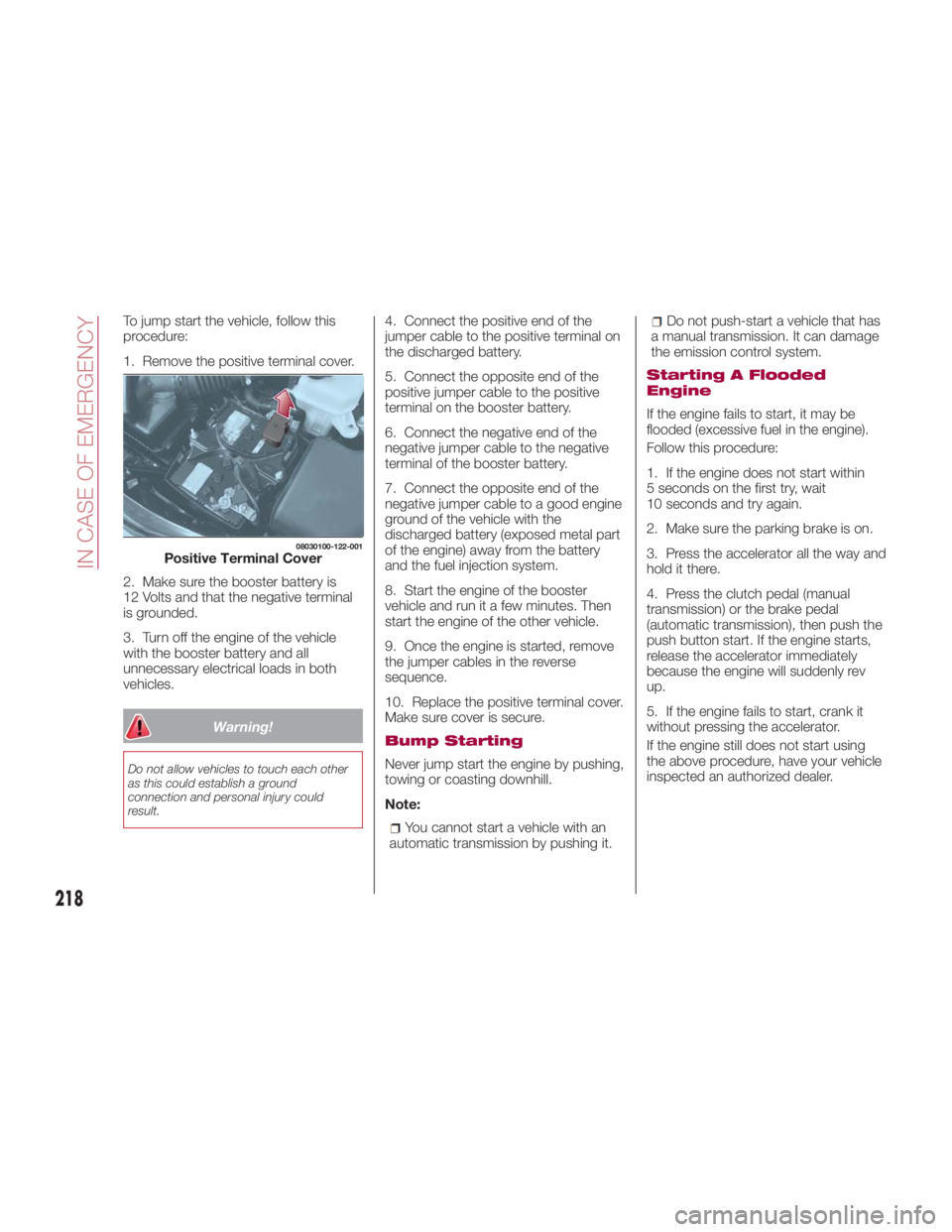
1. Remove the positive terminal cover.
2. Make sure the booster battery is
12 Volts and that the negative terminal
is grounded.
3. Turn off the engine of the vehicle
with the booster battery and all
unnecessary electrical loads in both
vehicles.
Warning!Do not allow vehicles to touch each other
as this could establish a ground
connection and personal injury could
result. 4. Connect the positive end of the
jumper cable to the positive terminal on
the discharged battery.
5. Connect the opposite end of the
positive jumper cable to the positive
terminal on the booster battery.
6. Connect the negative end of the
negative jumper cable to the negative
terminal of the booster battery.
7. Connect the opposite end of the
negative jumper cable to a good engine
ground of the vehicle with the
discharged battery (exposed metal part
of the engine) away from the battery
and the fuel injection system.
8. Start the engine of the booster
vehicle and run it a few minutes. Then
start the engine of the other vehicle.
9. Once the engine is started, remove
the jumper cables in the reverse
sequence.
10. Replace the positive terminal cover.
Make sure cover is secure.
Bump Starting
Never jump start the engine by pushing,
towing or coasting downhill.
Note:
You cannot start a vehicle with an
automatic transmission by pushing it. Do not push-start a vehicle that has
a manual transmission. It can damage
the emission control system.
Starting A Flooded
Engine
If the engine fails to start, it may be
flooded (excessive fuel in the engine).
Follow this procedure:
1. If the engine does not start within
5 seconds on the first try, wait
10 seconds and try again.
2. Make sure the parking brake is on.
3. Press the accelerator all the way and
hold it there.
4. Press the clutch pedal (manual
transmission) or the brake pedal
(automatic transmission), then push the
push button start. If the engine starts,
release the accelerator immediately
because the engine will suddenly rev
up.
5. If the engine fails to start, crank it
without pressing the accelerator.
If the engine still does not start using
the above procedure, have your vehicle
inspected an authorized dealer.08030100-122-001
Positive Terminal Cover
218
IN CASE OF EMERGENCY
Page 224 of 292
If towing service is not available in an
emergency, the vehicle may be towed
with all four wheels on the ground using
the towing hook at the front of the
vehicle. Only tow the vehicle on paved
surfaces for short distances at low
speeds.
Follow these instructions when towing
the vehicle with all wheels on the
ground:
1. Shift to NEUTRAL for manual
transmission or automatic transmission.
2. Place the ignition to ACC.
3. Release the parking brake.
Note: Remember that power assist for
the brakes and steering will not be
available when the engine is not
running. EVENT DATA
RECORDER (EDR) This vehicle is equipped with an Event
Data Recorder (EDR). The main
purpose of an EDR is to record data
that will assist in understanding how a
vehicle’s systems performed under
certain crash or near crash-like
situations, such as an air bag
deployment or hitting a road obstacle.
Please refer to “Occupant Restraint
Systems” in “Safety” for further
information on the Event Data Recorder
(EDR).
222
IN CASE OF EMERGENCY
Page 272 of 292
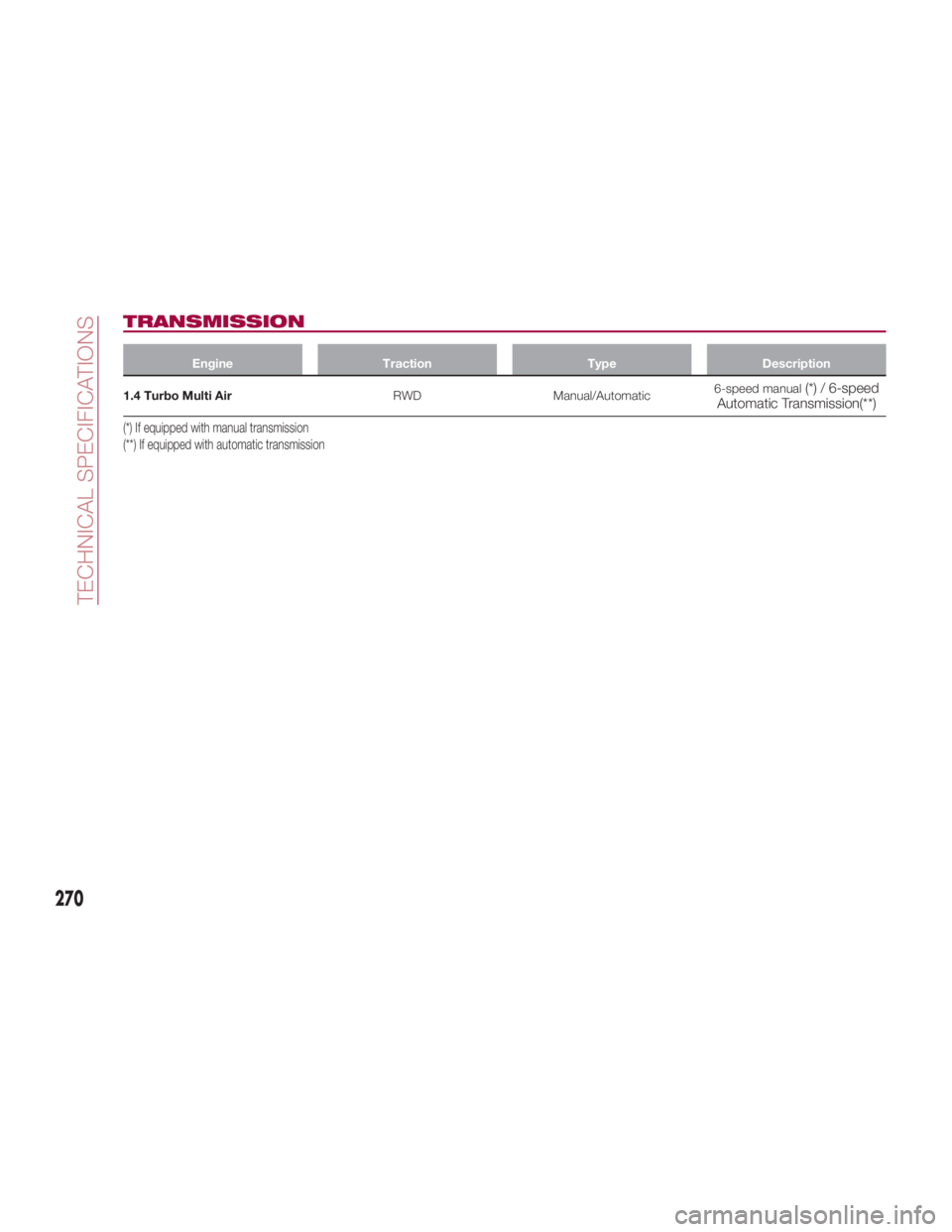
TRANSMISSION Engine Traction Type Description
1.4 Turbo Multi Air R WD Manual/Automatic 6-speed
manual
(*) / 6-speed
Automatic Transmission
(**)
(*) If equipped with manual transmission
(**) If equipped with automatic transmission
270
TECHNICAL SPECIFICATIONS
Page 276 of 292
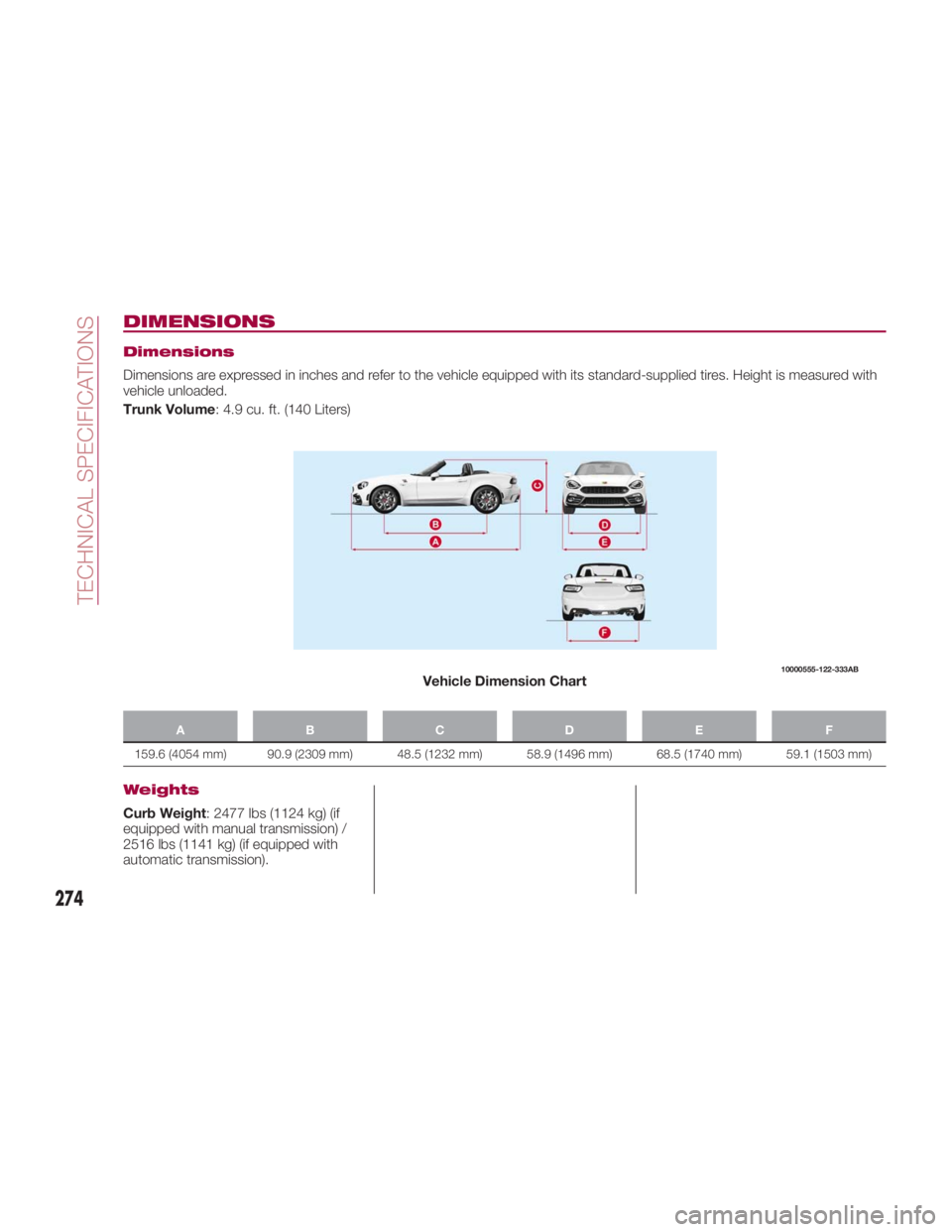
DIMENSIONS Dimensions
Dimensions are expressed in inches and refer to the vehicle equipped with its standard-supplied tires. Height is measured with
vehicle unloaded.
Trunk Volume : 4.9 cu. ft. (140 Liters)
ABCDE F
159.6 (4054 mm) 90.9 (2309 mm) 48.5 (1232 mm) 58.9 (1496 mm) 68.5 (1740 mm) 59.1 (1503 mm)
Weights
Curb Weight : 2477 lbs (1124 kg) (if
equipped with manual transmission) /
2516 lbs (1141 kg) (if equipped with
automatic transmission). 10000555-122-333AB
Vehicle Dimension Chart
274
TECHNICAL SPECIFICATIONS
Page 277 of 292
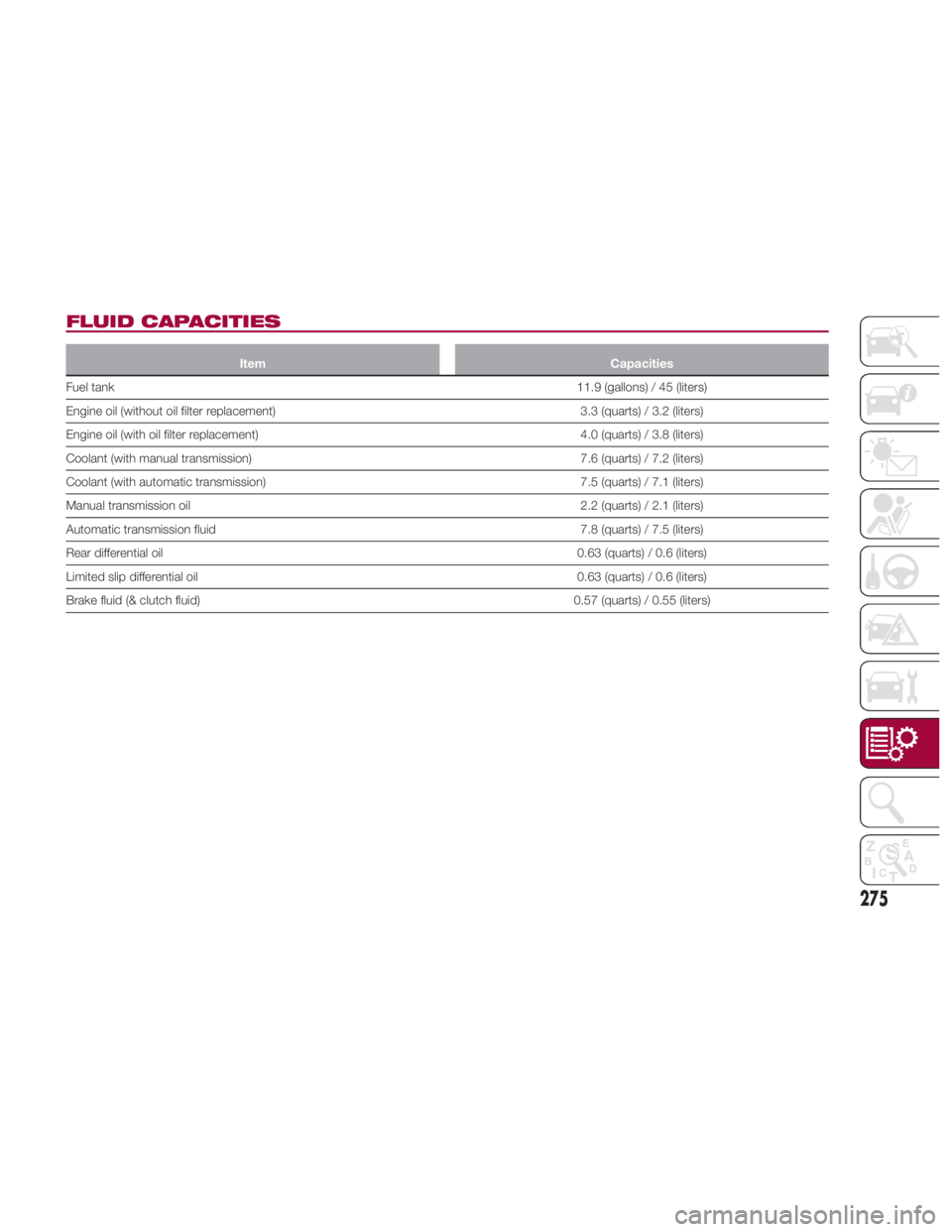
FLUID CAPACITIES Item Capacities
Fuel tank 11.9 (gallons)
/ 45 (liters)
Engine oil (without oil filter replacement) 3.3 (quarts) / 3.2 (liters)
Engine oil (with oil filter replacement) 4.0 (quarts) / 3.8 (liters)
Coolant (with manual transmission) 7.6 (quarts) / 7.2 (liters)
Coolant (with automatic transmission) 7.5 (quarts) / 7.1 (liters)
Manual transmission oil 2.2 (quarts) / 2.1 (liters)
Automatic transmission fluid 7.8 (quarts) / 7.5 (liters)
Rear differential oil 0.63 (quarts) / 0.6 (liters)
Limited slip differential oil 0.63 (quarts) / 0.6 (liters)
Brake fluid (& clutch fluid) 0.57 (quarts) / 0.55 (liters)
275
Page 278 of 292
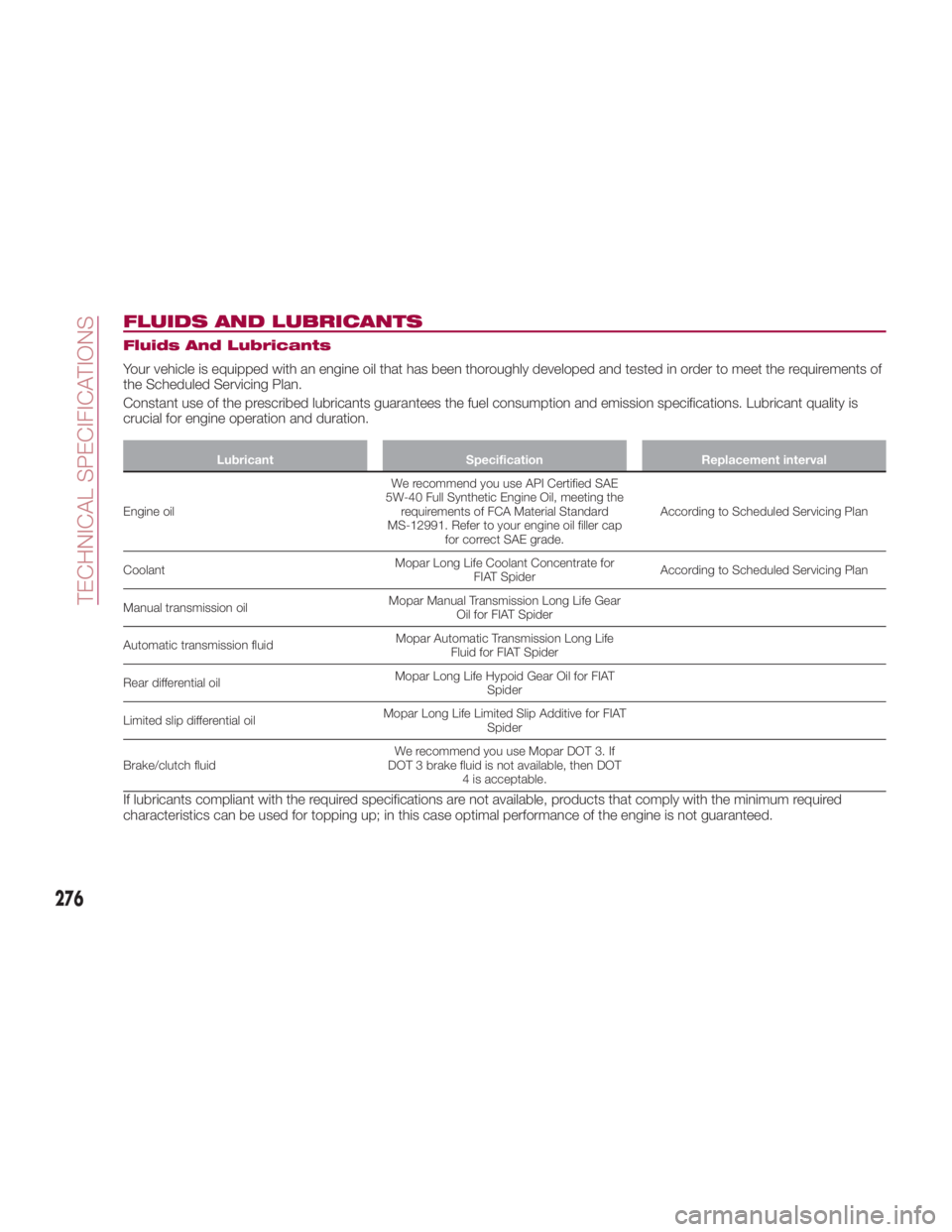
FLUIDS AND LUBRICANTS Fluids And Lubricants
Your vehicle is equipped with an engine oil that has been thoroughly developed and tested in order to meet the requirements of
the Scheduled Servicing Plan.
Constant use of the prescribed lubricants guarantees the fuel consumption and emission specifications. Lubricant quality is
crucial for engine operation and duration. Lubricant Specification Replacement interval
Engine oil W e
recommend you use API Certified SAE
5W-40 Full Synthetic Engine Oil, meeting the
requirements of FCA Material Standard
MS-12991. Refer to your engine oil filler cap
for correct SAE grade. According to Scheduled Servicing Plan
Coolant Mopar Long Life Coolant Concentrate for
FIAT Spider According to Scheduled Servicing Plan
Manual transmission oil Mopar Manual Transmission Long Life Gear
Oil for FIAT Spider
Automatic transmission fluid Mopar Automatic Transmission Long Life
Fluid for FIAT Spider
Rear differential oil Mopar Long Life Hypoid Gear Oil for FIAT
Spider
Limited slip differential oil Mopar Long Life Limited Slip Additive for FIAT
Spider
Brake/clutch fluid We recommend you use Mopar DOT 3. If
DOT 3 brake fluid is not available, then DOT
4 is acceptable.
If lubricants compliant with the required specifications are not available, products that comply with the minimum required
characteristics can be used for topping up; in this case optimal performance of the engine is not guaranteed.
276
TECHNICAL SPECIFICATIONS
Page 288 of 292
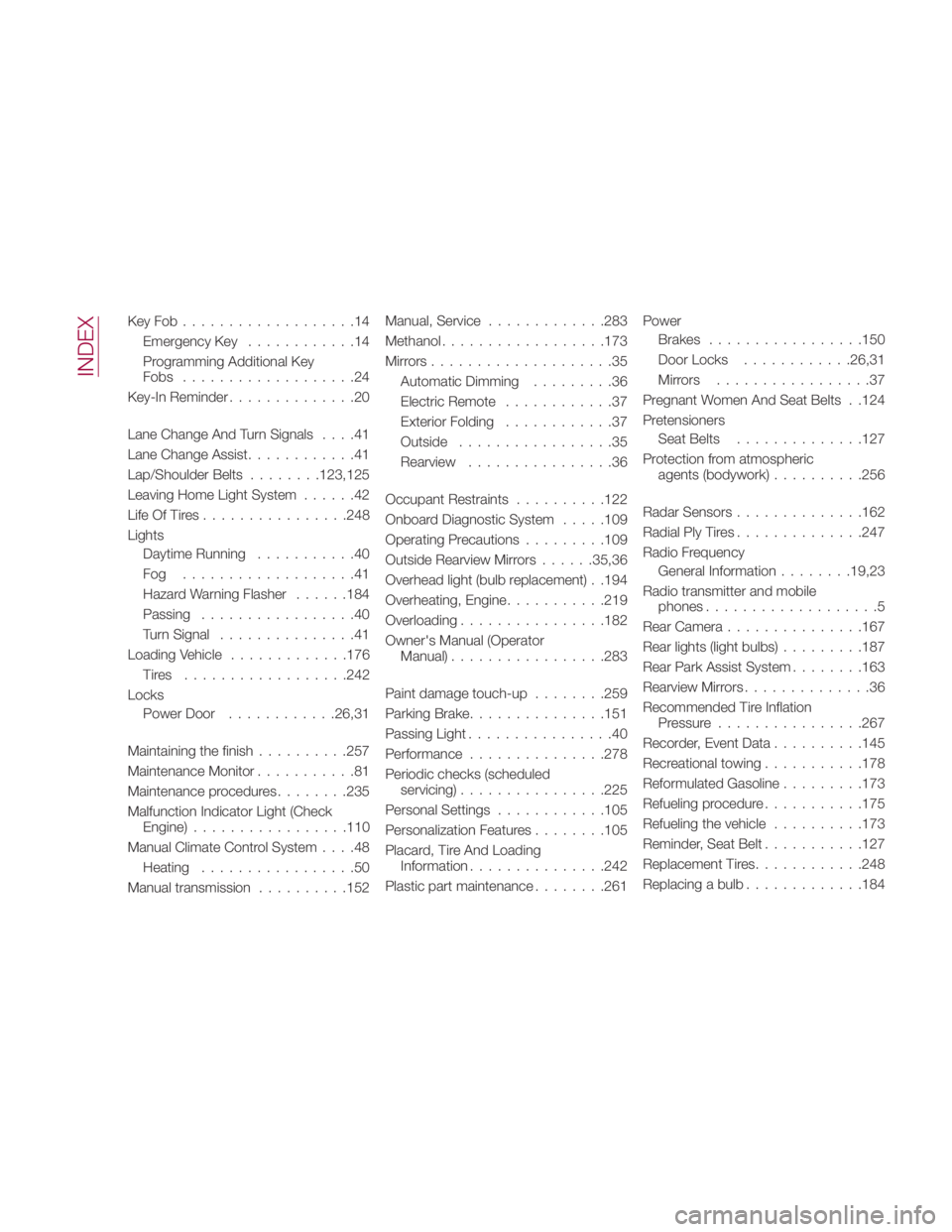
KeyFob...................14
Emergency Key ............14
Programming Additional Key
Fobs ...................24
Key-In Reminder ..............20
Lane Change And Turn Signals ....41
Lane Change Assist ............41
Lap/Shoulder Belts ....... .123,125
Leaving Home Light System ......42
Life Of Tires ............... .248
Lights
Daytime Running ...........40
Fog ...................41
Hazard Warning Flasher ..... .184
Passing .................40
Turn Signal ...............41
Loading Vehicle ............ .176
Tires ................. .242
Locks
PowerDoor ........... .26,31
Maintaining the finish ......... .257
Maintenance Monitor ...........81
Maintenance procedures ....... .235
Malfunction Indicator Light (Check
Engine) ................ .110
Manual Climate Control System ....48
Heating .................50
Manual transmission ......... .152 Manual, Service ............ .283
Methanol ................. .173
Mirrors....................35
Automatic Dimming .........36
Electric Remote ............37
Exterior Folding ............37
Outside .................35
Rearview ................36
Occupant Restraints ......... .122
Onboard Diagnostic System .... .109
Operating Precautions ........ .109
Outside Rearview Mirrors ..... .35,36
Overhead light (bulb replacement) . .194
Overheating, Engine .......... .219
Overloading ............... .182
Owner's Manual (Operator
Manual) ................ .283
Paint damage touch-up ....... .259
Parking Brake ..............
.151
Passing
Light ................ 40
Performance .............. .278
Periodic checks (scheduled
servicing) ............... .225
Personal Settings ........... .105
Personalization Features ....... .105
Placard, Tire And Loading
Information .............. .242
Plastic part maintenance ....... .261 Power
Brakes ................ .150
Door Locks ........... .26,31
Mirrors .................37
Pregnant Women And Seat Belts . .124
Pretensioners
Seat Belts ............. .127
Protection from atmospheric
agents (bodywork) ......... .256
Radar Sensors ............. .162
Radial Ply Tires ............. .247
Radio Frequency
General Information ....... .19,23
Radio transmitter and mobile
phones ...................5
Rear Camera .............. .167
Rear lights (light bulbs) ........ .187
Rear Park Assist System ....... .163
Rearview Mirrors ..............36
Recommended Tire Inflation
Pressure ............... .267
Recorder, Event Data ......... .145
Recreational towing .......... .178
Reformulated Gasoline ........ .173
Refueling procedure .......... .175
Refueling the vehicle ......... .173
Reminder, Seat Belt .......... .127
Replacement Tires ........... .248
Replacing a bulb ............ .184
INDEX