tow FIAT SPIDER ABARTH 2017 Owner's Manual
[x] Cancel search | Manufacturer: FIAT, Model Year: 2017, Model line: SPIDER ABARTH, Model: FIAT SPIDER ABARTH 2017Pages: 292, PDF Size: 9.24 MB
Page 206 of 292
To Secure The Jack
Proceed as follows:
1. Insert the wing bolt into the jack with
the jack screw pointing back, and turn
the wing bolt clockwise to temporarily
tighten it.
2. Turn the jack screw clockwise.
3. Turn the wing bolt completely to
secure the jack.
4. Insert the cover tabs and install the
cover.
Warning!A loose tire or jack thrown forward in a
collision or hard stop could endanger the
occupants of the vehicle. Always stow the
jack parts and the spare tire in the places
provided. Have the deflated (flat) tire
repaired or replaced immediately.
Maintenance
Always keep the jack clean.
Make sure the moving parts are kept
free from dirt or rust.
Make sure the screw thread is
adequately lubricated. Conditions Of Non-Use
Temperatures below -40°F (−40°C)
On sandy or muddy ground
On uneven ground
On steep roads
In extreme weather conditions
In direct contact with the engine or
for repairs under the vehicle
On boats
Jacking Instructions
Note: Make sure the jack is well
lubricated before using it.
Warning!Do not attempt to change a tire on the side
of the vehicle close to moving traffic, pull
far enough off the road to avoid being hit
when operating the jack or changing the
wheel.
Proceed as follows:
1. Stop the vehicle in a position that
does not cause any danger to traffic
and lets you change the tire in safety, as
far as possible from the edge of the
driving lane. The ground must be flat
and sufficiently compact. 2. Turn on the Hazard Warning Lights
and engage the parking brake.
3. For vehicles with automatic
transmission, place the gear selector in
PARK. For vehicles with manual
transmission, place gear selector in
REVERSE and turn the engine to OFF.
4. Stop the engine. The motor must be
kept off as long as the vehicle is lifted
off the ground.
5. Remove the jack and tools.
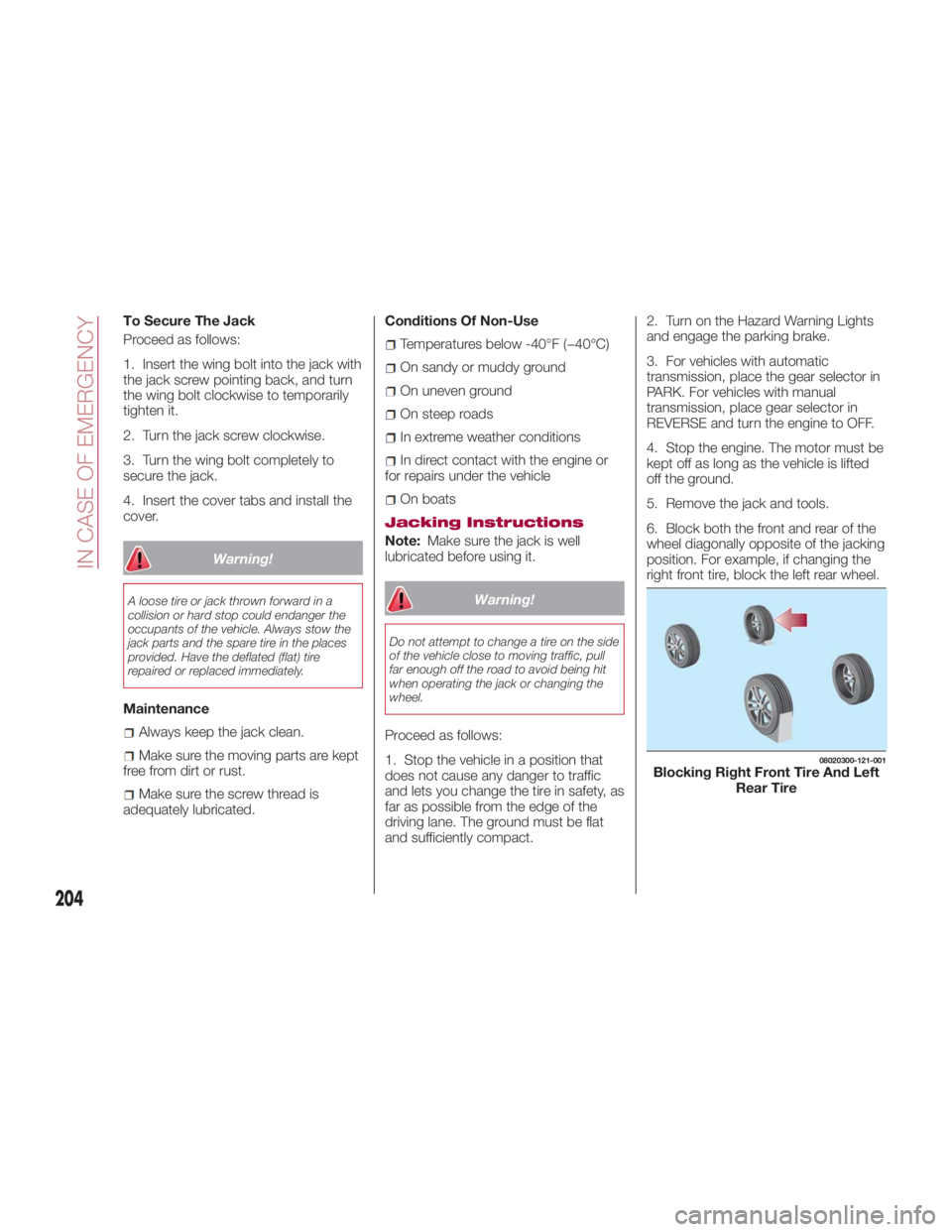
6. Block both the front and rear of the
wheel diagonally opposite of the jacking
position. For example, if changing the
right front tire, block the left rear wheel. 08020300-121-001
Blocking Right Front Tire And Left
Rear Tire
204
IN CASE OF EMERGENCY
Page 209 of 292
2. Mount the tire and install the lug
nuts with the beveled edge inward, then
tighten them by hand.
Caution!Be sure to mount the spare tire with the
valve stem facing outward. The vehicle
could be damaged if the spare tire is
mounted incorrectly.
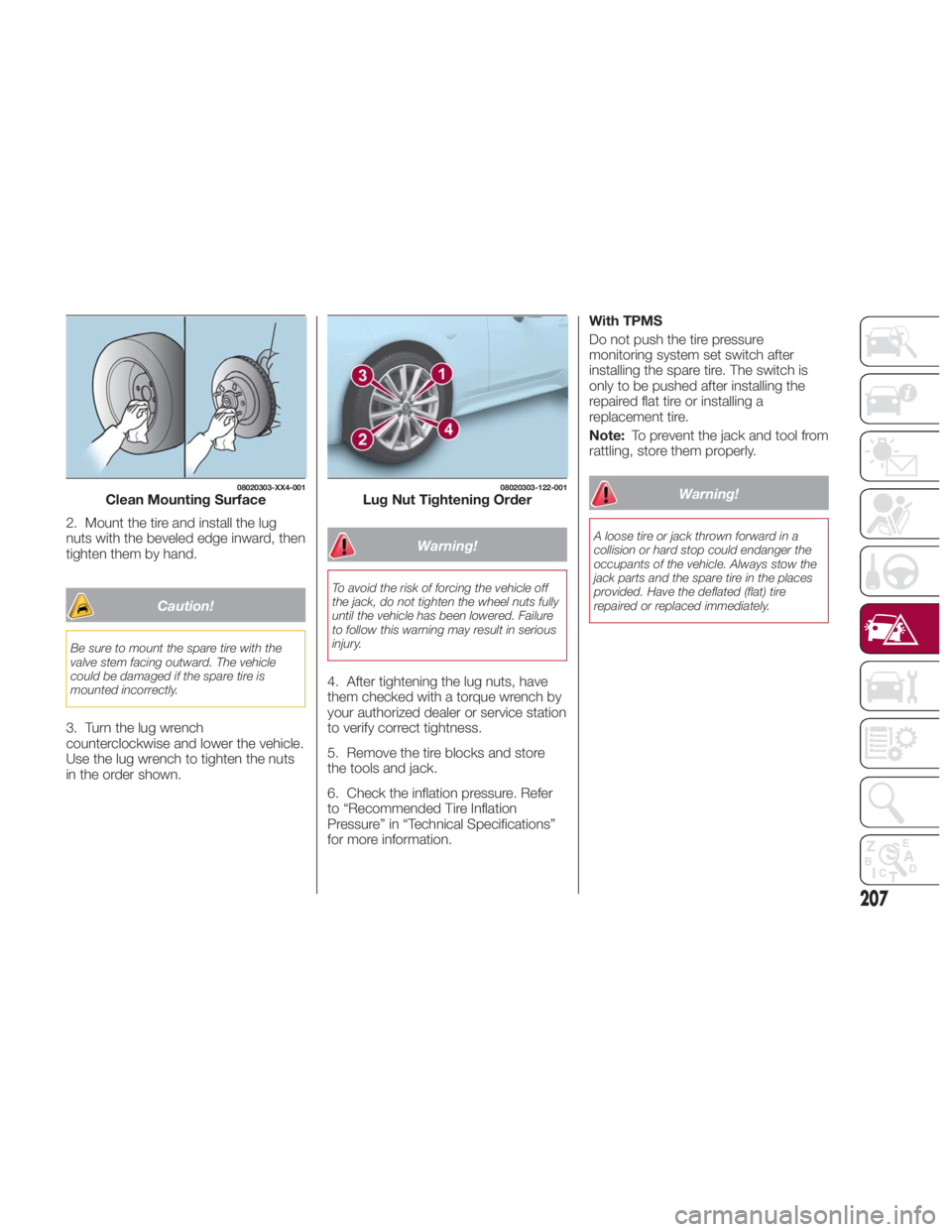
3. Turn the lug wrench
counterclockwise and lower the vehicle.
Use the lug wrench to tighten the nuts
in the order shown. Warning!To avoid the risk of forcing the vehicle off
the jack, do not tighten the wheel nuts fully
until the vehicle has been lowered. Failure
to follow this warning may result in serious
injury.
4. After tightening the lug nuts, have
them checked with a torque wrench by
your authorized dealer or service station
to verify correct tightness.
5. Remove the tire blocks and store
the tools and jack.
6. Check the inflation pressure. Refer
to “Recommended Tire Inflation
Pressure” in “Technical Specifications”
for more information. With TPMS
Do not push the tire pressure
monitoring system set switch after
installing the spare tire. The switch is
only to be pushed after installing the
repaired flat tire or installing a
replacement tire.
Note: To prevent the jack and tool from
rattling, store them properly.
Warning!A loose tire or jack thrown forward in a
collision or hard stop could endanger the
occupants of the vehicle. Always stow the
jack parts and the spare tire in the places
provided. Have the deflated (flat) tire
repaired or replaced immediately.08020303-XX4-001
Clean Mounting Surface 08020303-122-001
Lug Nut Tightening Order
207
Page 211 of 292
Tire Service Usage
Precautions
The tire sealant cannot be reused. If the
sealant has been used, or is expired,
purchase new tire sealant at an
authorized dealer.
Note: The Tire Service Kit cannot be
used in the following cases. Consult an
authorized dealer if any of these
conditions exist:
The period of effective use for the
tire sealant has expired (the period of
effectiveness is indicated on the bottle
label)
The tear or puncture in the tire
exceeds about 0.16 inches (4 mm)
The damage has occurred to an
area of the tire other than the tread
The vehicle has been driven with
nearly no air remaining in the tire
The tire has come off the wheel rim
Damage to the wheel rim has
occurred
The tire has two or more punctures Sealing A Tire With Tire
Service Kit
Warning!Do not attempt to seal a tire on the side
of the vehicle closest to traffic. Pull far
enough off the road to avoid the danger of
being hit when using the Tire Service Kit.
Do not use Tire Service Kit or drive the
vehicle under the following circumstances:
If the puncture in the tire tread is
approximately 1/4 inch (6 mm) or larger.
If the tire has any sidewall damage.
If the tire has any damage from driving
with extremely low tire pressure.
If the tire has any damage from driving
on a flat tire.
If the wheel has any damage.
If you are unsure of the condition of the
tire or the wheel.
Keep Tire Service Kit away from open
flames or heat sources.
A loose Tire Service Kit thrown forward
in a collision or hard stop could endanger
the occupants of the vehicle. Always stow
the Tire Service Kit in the place provided.
Failure to follow these warnings can result
in injuries that are serious or fatal to you,
your passengers, and others around you.
Take care not to allow the contents of
Tire Service Kit to come in contact with
hair, eyes, or clothing. Tire Service Kit
sealant is harmful if inhaled, swallowed, or absorbed through the skin. It causes skin,
eye, and respiratory irritation. Flush
immediately with plenty of water if there is
any contact with eyes or skin. Change
clothing as soon as possible, if there is any
contact with clothing.
Tire Service Kit Sealant solution contains
latex. In case of an allergic reaction or rash,
consult a physician immediately. Keep Tire
Service Kit out of reach of children. If
swallowed, rinse mouth immediately with
plenty of water and drink plenty of water.
Do not induce vomiting! Consult a
physician immediately.
U.S.A. And CANADA Markets:
Proceed as follows:
1. Pull over to a safe location and turn
on the vehicle’s Hazard Warning Lights.
2. Verify that the valve stem (on the
wheel with the deflated tire) is in a
position that is near to the ground. This
will allow the Tire Service Kit hoses to
reach the valve stem and keep the Tire
Service Kit flat on the ground. This will
provide the best positioning of the kit
when injecting the sealant into the
deflated tire and running the air pump.
Move the vehicle as necessary to place
the valve stem in this position before
proceeding.
3. Place the gear selector in REVERSE
for a manual transmission, and PARK
for automatic transmission.
209
Page 215 of 292
Sealing A Tire With Tire
Service Kit
Warning!Do not attempt to seal a tire on the side
of the vehicle closest to traffic. Pull far
enough off the road to avoid the danger of
being hit when using the Tire Service Kit.
Do not use Tire Service Kit or drive the
vehicle under the following circumstances:
If the puncture in the tire tread is
approximately 1/4 inch (6 mm) or larger.
If the tire has any sidewall damage.
If the tire has any damage from driving
with extremely low tire pressure.
If the tire has any damage from driving
on a flat tire.
If the wheel has any damage.
If you are unsure of the condition of the
tire or the wheel.
Keep Tire Service Kit away from open
flames or heat sources.
A loose Tire Service Kit thrown forward
in a collision or hard stop could endanger
the occupants of the vehicle. Always stow
the Tire Service Kit in the place provided.
Failure to follow these warnings can result
in injuries that are serious or fatal to you,
your passengers, and others around you.
Take care not to allow the contents of
Tire Service Kit to come in contact with
hair, eyes, or clothing. Tire Service Kit
sealant is harmful if inhaled, swallowed, or absorbed through the skin. It causes skin,
eye, and respiratory irritation. Flush
immediately with plenty of water if there is
any contact with eyes or skin. Change
clothing as soon as possible, if there is any
contact with clothing.
Tire Service Kit Sealant solution contains
latex. In case of an allergic reaction or rash,
consult a physician immediately. Keep Tire
Service Kit out of reach of children. If
swallowed, rinse mouth immediately with
plenty of water and drink plenty of water.
Do not induce vomiting! Consult a
physician immediately.
Mexico Market
Proceed as follows:
1. Pull over to a safe location and turn
on the vehicle’s Hazard Warning Lights.
2. Verify that the valve stem (on the
wheel with the deflated tire) is in a
position that is near to the ground. This
will allow the Tire Service Kit hoses to
reach the valve stem and keep the Tire
Service Kit flat on the ground. This will
provide the best positioning of the kit
when injecting the sealant into the
deflated tire and running the air pump.
Move the vehicle as necessary to place
the valve stem in this position before
proceeding.
3. Place the gear selector in REVERSE
for a manual transmission, or PARK for
automatic transmission. 4. Apply the parking brake with the
brake pedal pressed and turn the
engine OFF.
5. Unload passengers and cargo, then
remove the Tire Service Kit.
6. Gently shake the tire sealant. If the
bottle is shaken after the injection hose
is screwed on, tire sealant could spray
out from the injection hose. Tire sealant
contacting clothing or other objects
may be impossible to remove. Shake
the bottle before screwing on the
injection hose.
Note:
Do not shake the bottle
excessively. Otherwise, the sealant
could spray out of the injection hose,
and if the sealant contacts clothing or
other objects, you may not be able to
remove it.
The sealant hardens easily and
injecting it will be difficult under cold
weather conditions 32 °F (0 °C) or
below. Warm the sealant inside the
vehicle to facilitate injection.
7. Remove the cap from the bottle and
screw on the injection hose with the
bottle's inner cap left on to break the
inner cap.
213
Page 220 of 292
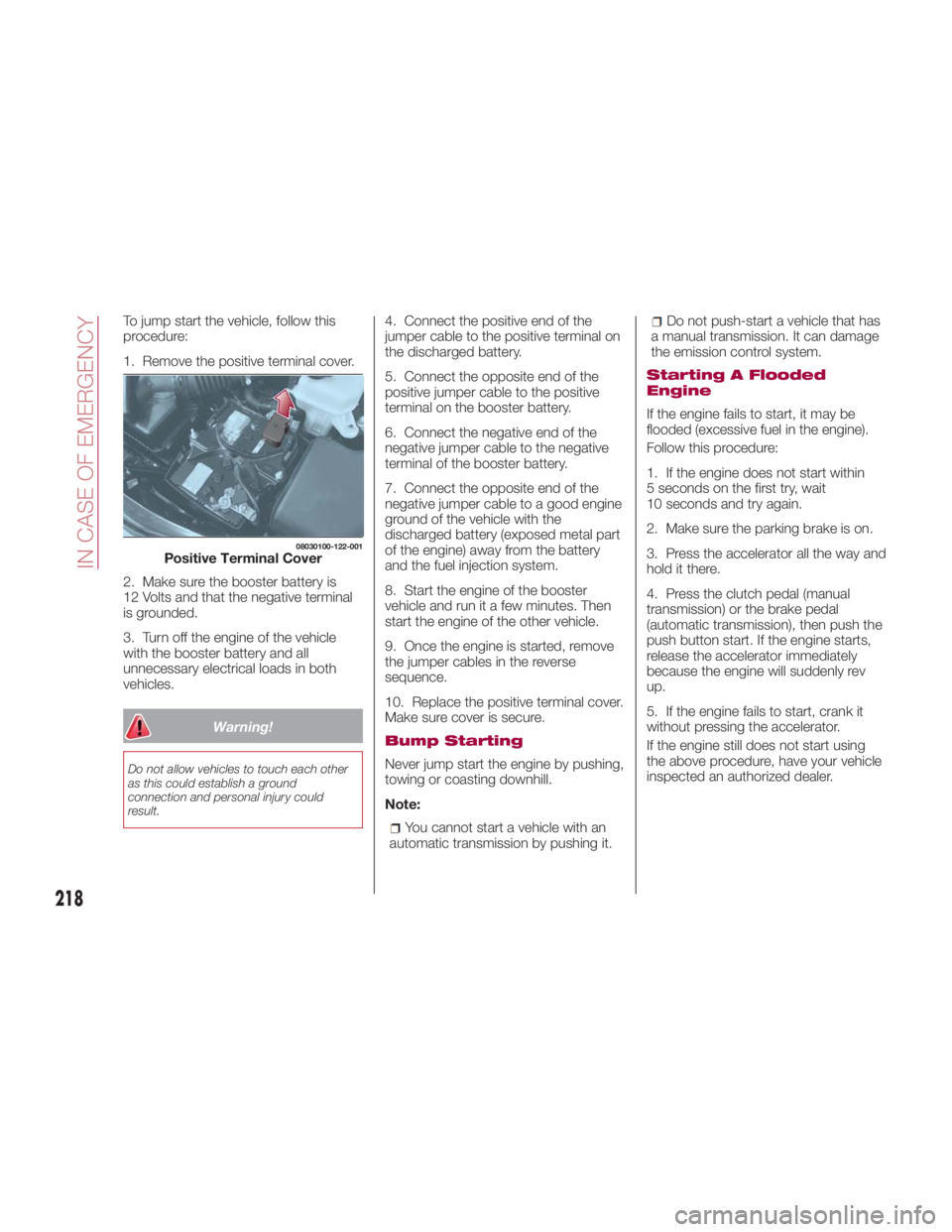
To jump start the vehicle, follow this
procedure:
1. Remove the positive terminal cover.
2. Make sure the booster battery is
12 Volts and that the negative terminal
is grounded.
3. Turn off the engine of the vehicle
with the booster battery and all
unnecessary electrical loads in both
vehicles.
Warning!Do not allow vehicles to touch each other
as this could establish a ground
connection and personal injury could
result. 4. Connect the positive end of the
jumper cable to the positive terminal on
the discharged battery.
5. Connect the opposite end of the
positive jumper cable to the positive
terminal on the booster battery.
6. Connect the negative end of the
negative jumper cable to the negative
terminal of the booster battery.
7. Connect the opposite end of the
negative jumper cable to a good engine
ground of the vehicle with the
discharged battery (exposed metal part
of the engine) away from the battery
and the fuel injection system.
8. Start the engine of the booster
vehicle and run it a few minutes. Then
start the engine of the other vehicle.
9. Once the engine is started, remove
the jumper cables in the reverse
sequence.
10. Replace the positive terminal cover.
Make sure cover is secure.
Bump Starting
Never jump start the engine by pushing,
towing or coasting downhill.
Note:
You cannot start a vehicle with an
automatic transmission by pushing it. Do not push-start a vehicle that has
a manual transmission. It can damage
the emission control system.
Starting A Flooded
Engine
If the engine fails to start, it may be
flooded (excessive fuel in the engine).
Follow this procedure:
1. If the engine does not start within
5 seconds on the first try, wait
10 seconds and try again.
2. Make sure the parking brake is on.
3. Press the accelerator all the way and
hold it there.
4. Press the clutch pedal (manual
transmission) or the brake pedal
(automatic transmission), then push the
push button start. If the engine starts,
release the accelerator immediately
because the engine will suddenly rev
up.
5. If the engine fails to start, crank it
without pressing the accelerator.
If the engine still does not start using
the above procedure, have your vehicle
inspected an authorized dealer.08030100-122-001
Positive Terminal Cover
218
IN CASE OF EMERGENCY
Page 222 of 292
TOWING THE
VEHICLE Attaching The Tow Eyes
— If Equipped
Warning!Stand clear of vehicles when pulling with
tow eyes.
Do not use a chain with a tow eye.
Chains may break, causing serious injury or
death.
Do not use a tow strap with a tow eye.
Tow straps may break or become
disengaged, causing serious injury or
death.
Failure to follow proper tow eye usage
may cause components to break resulting
in serious injury or death. Caution!The tow eye must be used exclusively
for roadside assistance operations. Only
use the tow eye with an appropriate device
in accordance with the highway code (a
rigid bar or rope) to flat tow the vehicle for
a short distance to the nearest service
location.
Tow eyes MUST NOT be used to tow
vehicles off the road or where there are
obstacles.
In compliance with the above
conditions, towing with a tow eye must
take place with two vehicles (one towing,
the other towed) aligned as much as
possible along the same center line.
Damage to your vehicle may occur if these
guidelines are not followed.
When towing, only use a facility that can
tow vehicles with low ground clearances as
extensive damage can result by using a
standard tow truck platform.
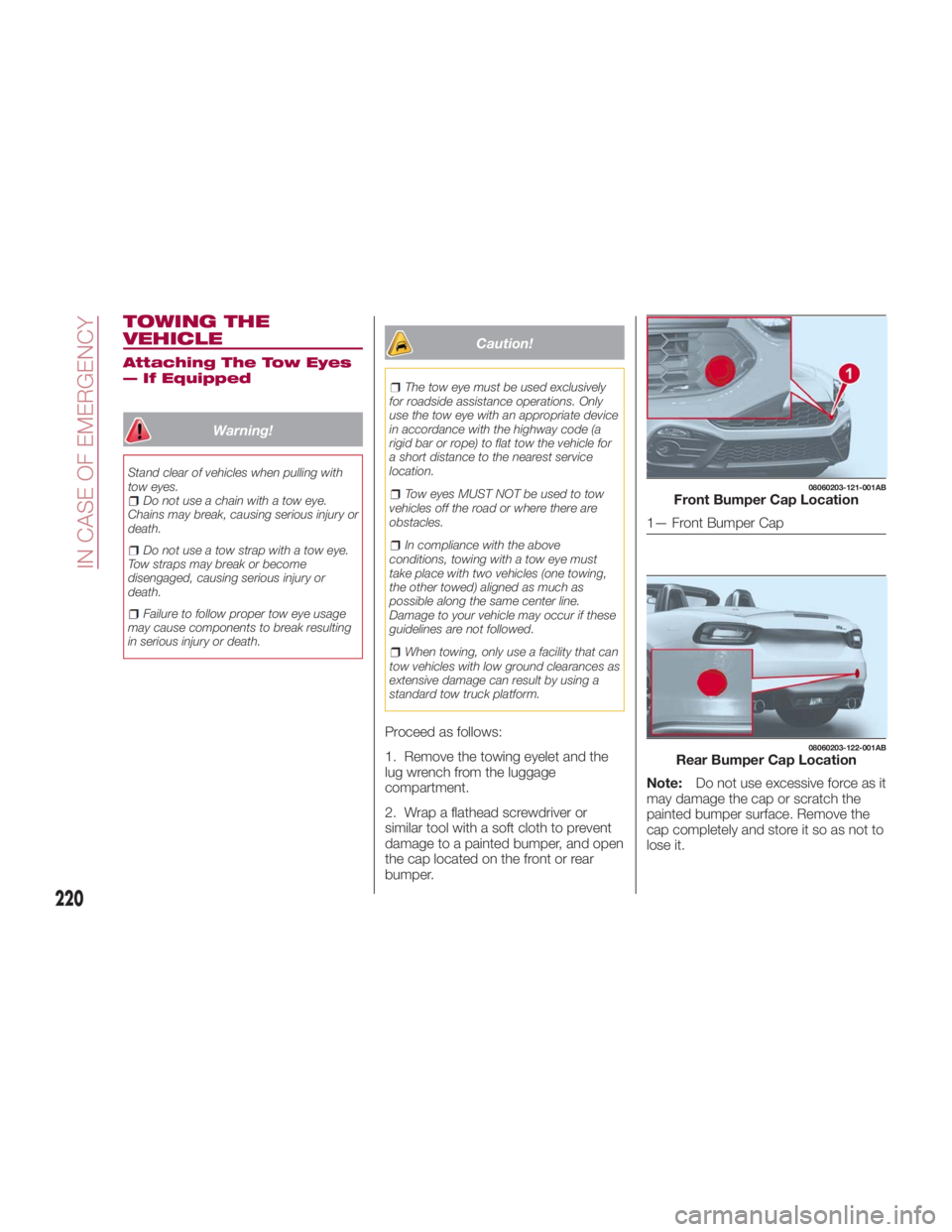
Proceed as follows:
1. Remove the towing eyelet and the
lug wrench from the luggage
compartment.
2. Wrap a flathead screwdriver or
similar tool with a soft cloth to prevent
damage to a painted bumper, and open
the cap located on the front or rear
bumper. Note: Do not use excessive force as it
may damage the cap or scratch the
painted bumper surface. Remove the
cap completely and store it so as not to
lose it. 08060203-121-001AB
Front Bumper Cap Location
1— Front Bumper Cap 08060203-122-001AB
Rear Bumper Cap Location
220
IN CASE OF EMERGENCY
Page 223 of 292
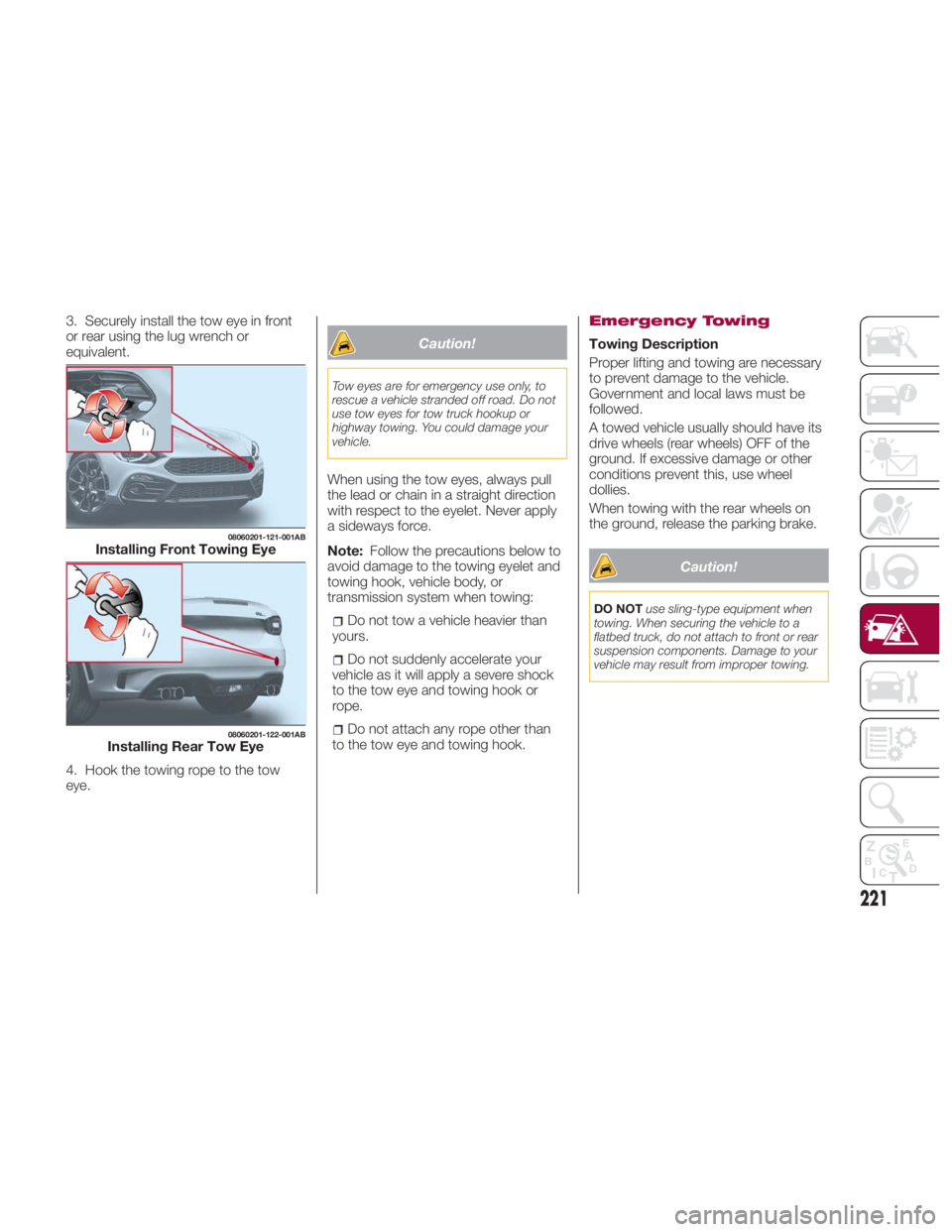
3. Securely install the tow eye in front
or rear using the lug wrench or
equivalent.
4. Hook the towing rope to the tow
eye. Caution!Tow eyes are for emergency use only, to
rescue a vehicle stranded off road. Do not
use tow eyes for tow truck hookup or
highway towing. You could damage your
vehicle.
When using the tow eyes, always pull
the lead or chain in a straight direction
with respect to the eyelet. Never apply
a sideways force.
Note: Follow the precautions below to
avoid damage to the towing eyelet and
towing hook, vehicle body, or
transmission system when towing:
Do not tow a vehicle heavier than
yours.
Do not suddenly accelerate your
vehicle as it will apply a severe shock
to the tow eye and towing hook or
rope.
Do not attach any rope other than
to the tow eye and towing hook. Emergency Towing
Towing Description
Proper lifting and towing are necessary
to prevent damage to the vehicle.
Government and local laws must be
followed.
A towed vehicle usually should have its
drive wheels (rear wheels) OFF of the
ground. If excessive damage or other
conditions prevent this, use wheel
dollies.
When towing with the rear wheels on
the ground, release the parking brake.
Caution!DO NOT use sling-type equipment when
towing. When securing the vehicle to a
flatbed truck, do not attach to front or rear
suspension components. Damage to your
vehicle may result from improper towing.08060201-121-001AB
Installing Front Towing Eye 08060201-122-001AB
Installing Rear Tow Eye
221
Page 224 of 292
If towing service is not available in an
emergency, the vehicle may be towed
with all four wheels on the ground using
the towing hook at the front of the
vehicle. Only tow the vehicle on paved
surfaces for short distances at low
speeds.
Follow these instructions when towing
the vehicle with all wheels on the
ground:
1. Shift to NEUTRAL for manual
transmission or automatic transmission.
2. Place the ignition to ACC.
3. Release the parking brake.
Note: Remember that power assist for
the brakes and steering will not be
available when the engine is not
running. EVENT DATA
RECORDER (EDR) This vehicle is equipped with an Event
Data Recorder (EDR). The main
purpose of an EDR is to record data
that will assist in understanding how a
vehicle’s systems performed under
certain crash or near crash-like
situations, such as an air bag
deployment or hitting a road obstacle.
Please refer to “Occupant Restraint
Systems” in “Safety” for further
information on the Event Data Recorder
(EDR).
222
IN CASE OF EMERGENCY
Page 245 of 292
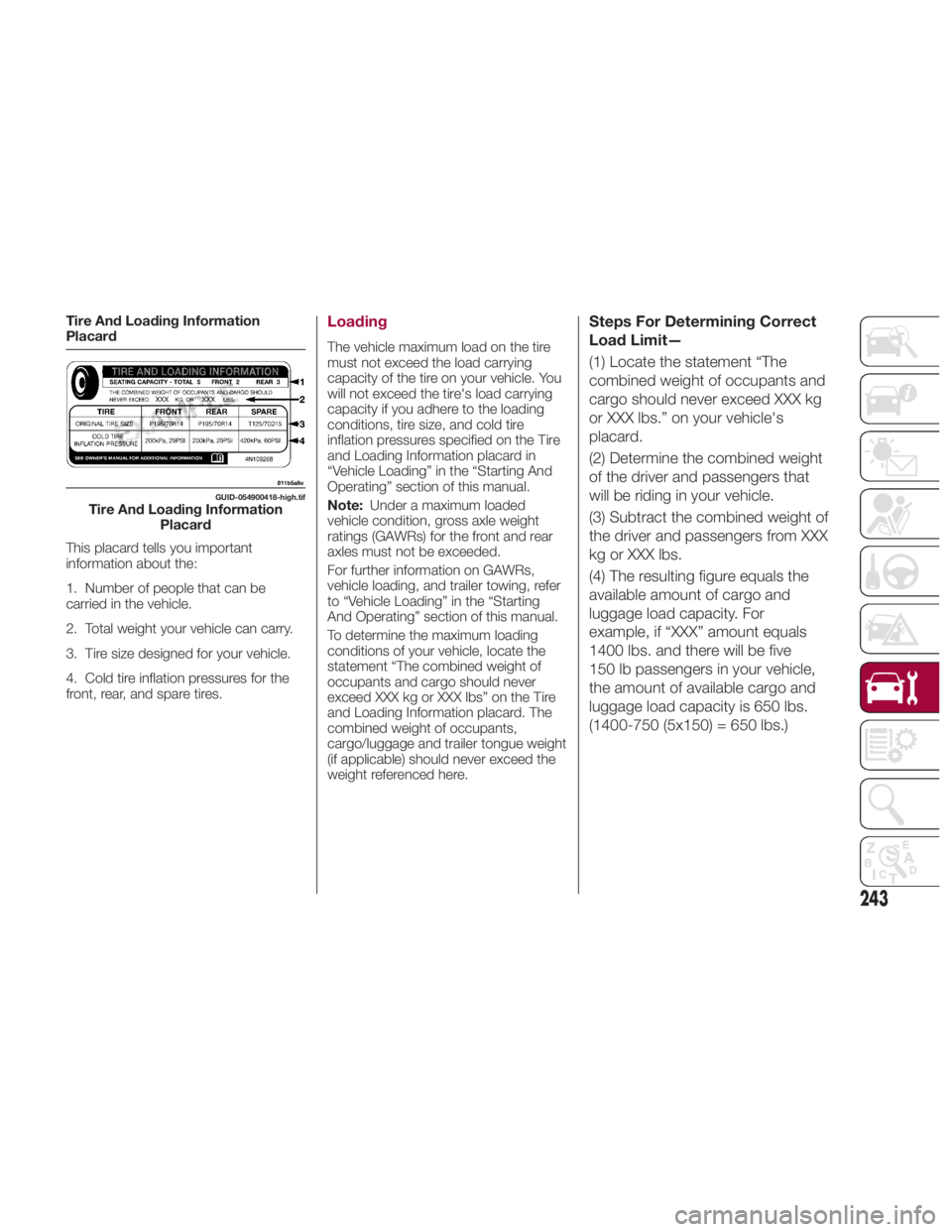
Tire And Loading Information
Placard
This placard tells you important
information about the:
1. Number of people that can be
carried in the vehicle.
2. Total weight your vehicle can carry.
3. Tire size designed for your vehicle.
4. Cold tire inflation pressures for the
front, rear, and spare tires. Loading The vehicle maximum load on the tire
must not exceed the load carrying
capacity of the tire on your vehicle. You
will not exceed the tire's load carrying
capacity if you adhere to the loading
conditions, tire size, and cold tire
inflation pressures specified on the Tire
and Loading Information placard in
“Vehicle Loading” in the “Starting And
Operating” section of this manual.
Note: Under a maximum loaded
vehicle condition, gross axle weight
ratings (GAWRs) for the front and rear
axles must not be exceeded.
For further information on GAWRs,
vehicle loading, and trailer towing, refer
to “Vehicle Loading” in the “Starting
And Operating” section of this manual.
To determine the maximum loading
conditions of your vehicle, locate the
statement “The combined weight of
occupants and cargo should never
exceed XXX kg or XXX lbs” on the Tire
and Loading Information placard. The
combined weight of occupants,
cargo/luggage and trailer tongue weight
(if applicable) should never exceed the
weight referenced here. Steps For Determining Correct
Load Limit—
(1) Locate the statement “The
combined weight of occupants and
cargo should never exceed XXX kg
or XXX lbs.” on your vehicle's
placard.
(2) Determine the combined weight
of the driver and passengers that
will be riding in your vehicle.
(3) Subtract the combined weight of
the driver and passengers from XXX
kg or XXX lbs.
(4) The resulting figure equals the
available amount of cargo and
luggage load capacity. For
example, if “XXX” amount equals
1400 lbs. and there will be five
150 lb passengers in your vehicle,
the amount of available cargo and
luggage load capacity is 650 lbs.
(1400-750 (5x150) = 650 lbs.)GUID-054900418-high.tif
Tire And Loading Information
Placard
243
Page 246 of 292
(5) Determine the combined weight
of luggage and cargo being loaded
on the vehicle. That weight may not
safely exceed the available cargo
and luggage load capacity
calculated in Step 4.
(6) If your vehicle will be towing a
trailer, load from your trailer will be
transferred to your vehicle. Consult
this manual to determine how this
reduces the available cargo and
luggage load capacity of your
vehicle. Metric Example For Load Limit
For example, if “XXX” amount equals
635 kg and there will be five 68 kg
passengers in your vehicle, the amount of available cargo and luggage load
capacity is 295 kg (635-340 (5x68) =
295 kg) as shown in step 4.
Note:
If your vehicle will be towing a trailer,
load from your trailer will be transferred
to your vehicle. The following table
shows examples on how to calculate
total load, cargo/luggage, and towing
capacities of your vehicle with varying
seating configurations and number and
size of occupants. This table is for
illustration purposes only and may not
be accurate for the seating and load
carry capacity of your vehicle.
For the following example, the
combined weight of occupants and
cargo should never exceed 865 lbs
(392 kg).
244
SERVICING AND MAINTENANCE