warning lights FIAT SPIDER ABARTH 2017 Owner's Manual
[x] Cancel search | Manufacturer: FIAT, Model Year: 2017, Model line: SPIDER ABARTH, Model: FIAT SPIDER ABARTH 2017Pages: 292, PDF Size: 9.24 MB
Page 95 of 292
Amber Warning Lights Warning Light What It Means
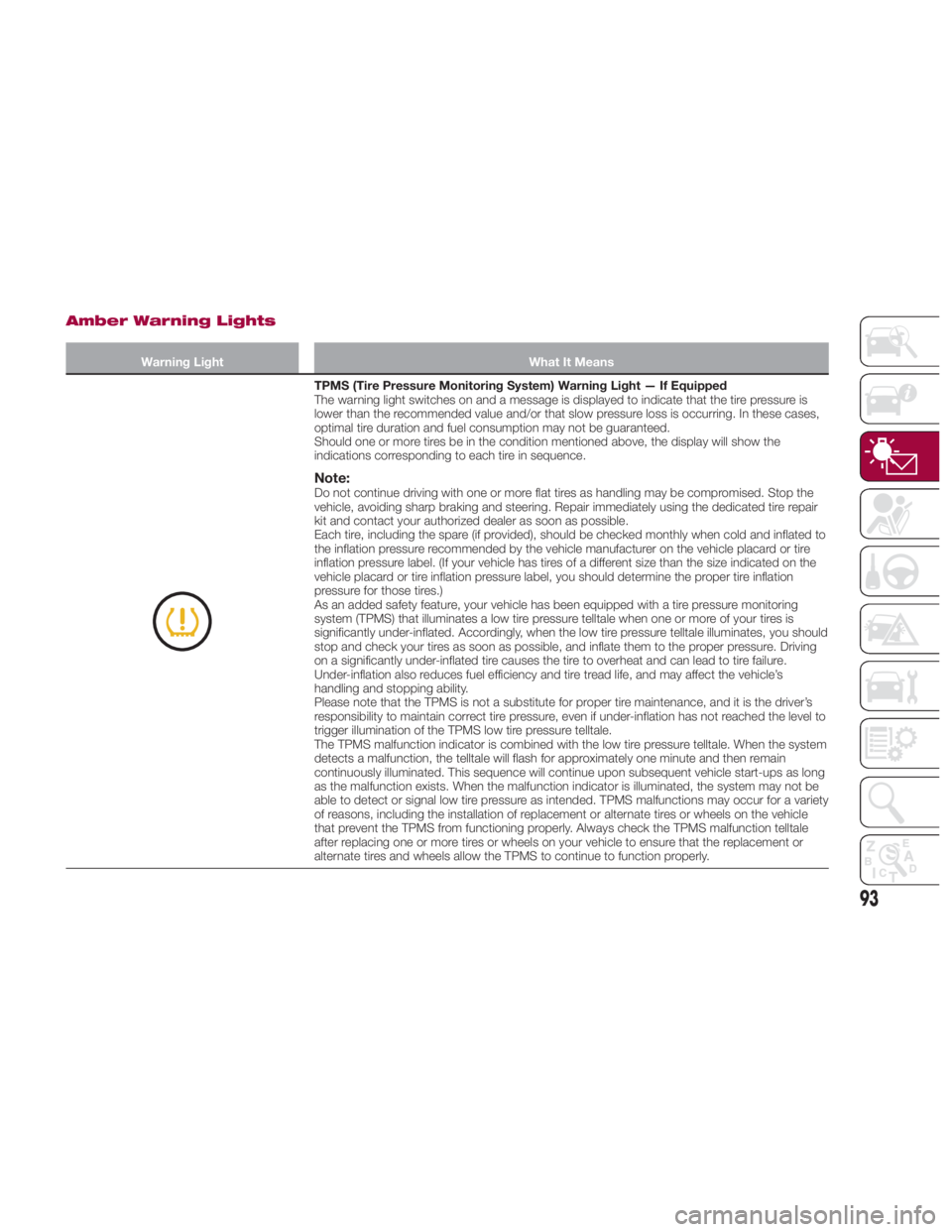
TPMS (Tire Pressure Monitoring System) Warning Light — If Equipped
The warning light switches on and a message is displayed to indicate that the tire pressure is
lower than the recommended value and/or that slow pressure loss is occurring. In these cases,
optimal tire duration and fuel consumption may not be guaranteed.
Should one or more tires be in the condition mentioned above, the display will show the
indications corresponding to each tire in sequence.
Note: Do not continue driving with one or more flat tires as handling may be compromised. Stop the
vehicle, avoiding sharp braking and steering. Repair immediately using the dedicated tire repair
kit and contact your authorized dealer as soon as possible.
Each tire, including the spare (if provided), should be checked monthly when cold and inflated to
the inflation pressure recommended by the vehicle manufacturer on the vehicle placard or tire
inflation pressure label. (If your vehicle has tires of a different size than the size indicated on the
vehicle placard or tire inflation pressure label, you should determine the proper tire inflation
pressure for those tires.)
As an added safety feature, your vehicle has been equipped with a tire pressure monitoring
system (TPMS) that illuminates a low tire pressure telltale when one or more of your tires is
significantly under-inflated. Accordingly, when the low tire pressure telltale illuminates, you should
stop and check your tires as soon as possible, and inflate them to the proper pressure. Driving
on a significantly under-inflated tire causes the tire to overheat and can lead to tire failure.
Under-inflation also reduces fuel efficiency and tire tread life, and may affect the vehicle’s
handling and stopping ability.
Please note that the TPMS is not a substitute for proper tire maintenance, and it is the driver’s
responsibility to maintain correct tire pressure, even if under-inflation has not reached the level to
trigger illumination of the TPMS low tire pressure telltale.
The TPMS malfunction indicator is combined with the low tire pressure telltale. When the system
detects a malfunction, the telltale will flash for approximately one minute and then remain
continuously illuminated. This sequence will continue upon subsequent vehicle start-ups as long
as the malfunction exists. When the malfunction indicator is illuminated, the system may not be
able to detect or signal low tire pressure as intended. TPMS malfunctions may occur for a variety
of reasons, including the installation of replacement or alternate tires or wheels on the vehicle
that prevent the TPMS from functioning properly. Always check the TPMS malfunction telltale
after replacing one or more tires or wheels on your vehicle to ensure that the replacement or
alternate tires and wheels allow the TPMS to continue to function properly.
93
Page 97 of 292
Amber Warning Lights Warning Light What It Means
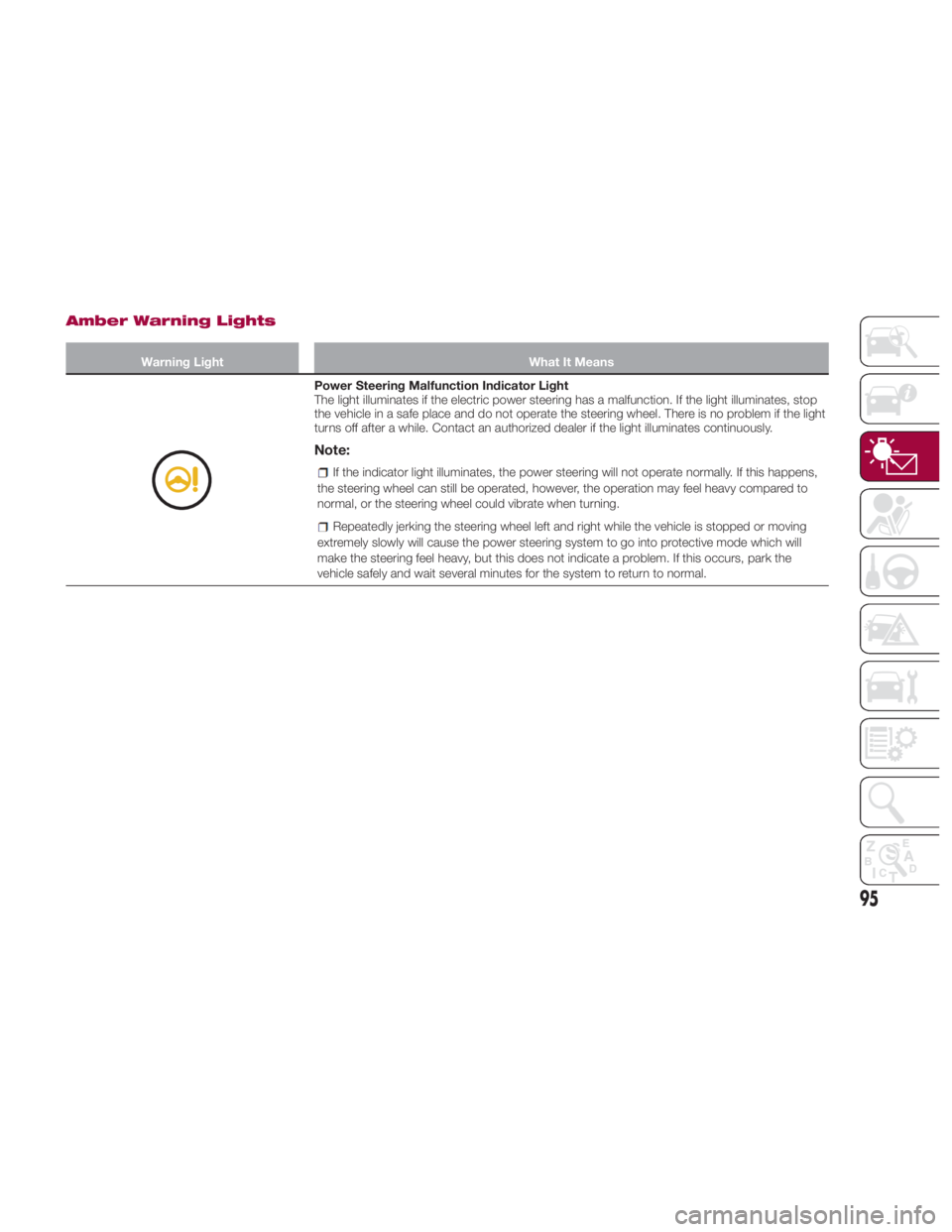
Power Steering Malfunction Indicator Light
The light illuminates if the electric power steering has a malfunction. If the light illuminates, stop
the vehicle in a safe place and do not operate the steering wheel. There is no problem if the light
turns off after a while. Contact an authorized dealer if the light illuminates continuously.
Note: If the indicator light illuminates, the power steering will not operate normally. If this happens,
the steering wheel can still be operated, however, the operation may feel heavy compared to
normal, or the steering wheel could vibrate when turning.
Repeatedly jerking the steering wheel left and right while the vehicle is stopped or moving
extremely slowly will cause the power steering system to go into protective mode which will
make the steering feel heavy, but this does not indicate a problem. If this occurs, park the
vehicle safely and wait several minutes for the system to return to normal.
95
Page 98 of 292
Amber Warning Lights Warning Light What It Means
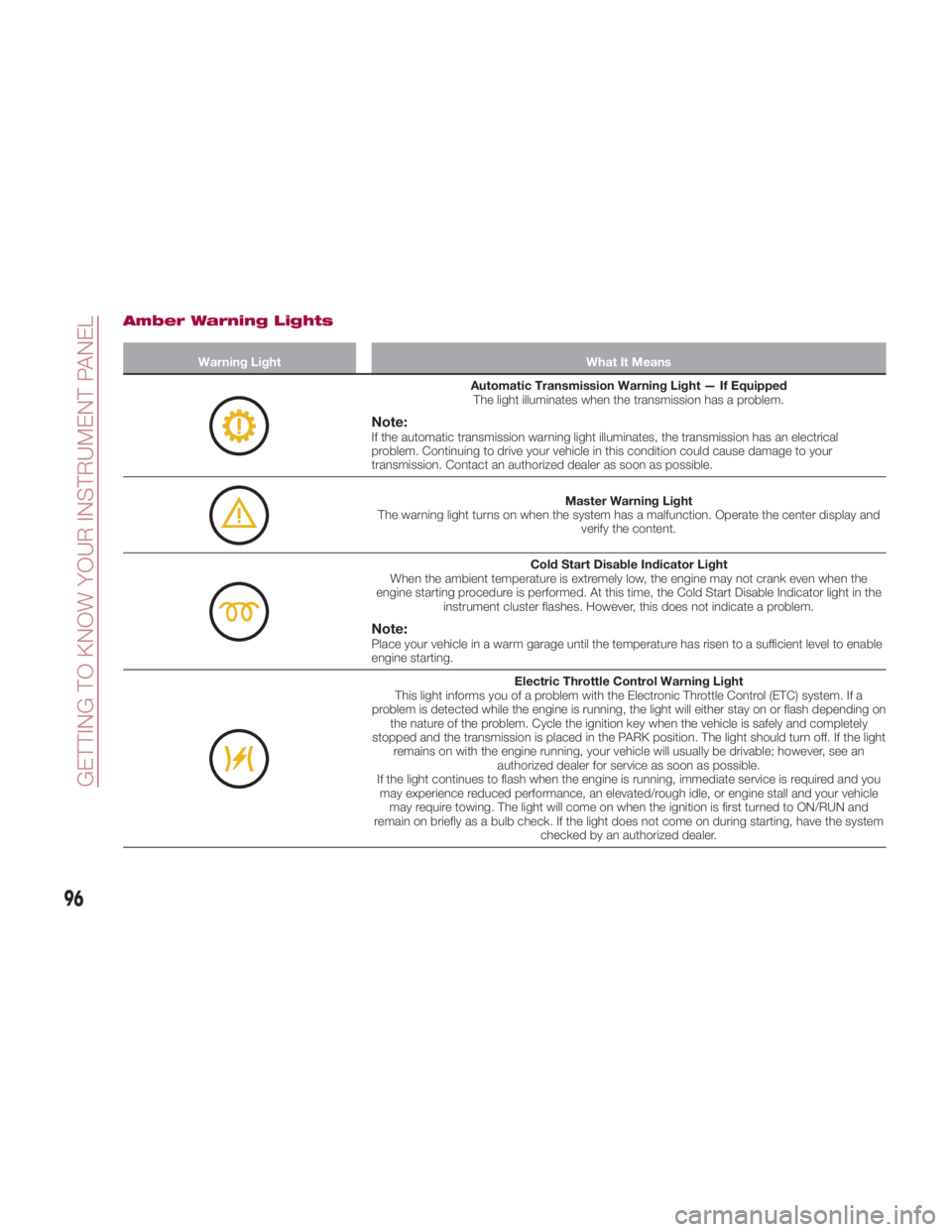
Automatic Transmission Warning Light — If Equipped
The light illuminates when the transmission has a problem.
Note: If the automatic transmission warning light illuminates, the transmission has an electrical
problem. Continuing to drive your vehicle in this condition could cause damage to your
transmission. Contact an authorized dealer as soon as possible.
Master Warning Light
The warning light turns on when the system has a malfunction. Operate the center display and
verify the content.
Cold Start Disable Indicator Light
When the ambient temperature is extremely low, the engine may not crank even when the
engine starting procedure is performed. At this time, the Cold Start Disable Indicator light in the
instrument cluster flashes. However, this does not indicate a problem.
Note: Place your vehicle in a warm garage until the temperature has risen to a sufficient level to enable
engine starting.
Electric Throttle Control Warning Light
This light informs you of a problem with the Electronic Throttle Control (ETC) system. If a
problem is detected while the engine is running, the light will either stay on or flash depending on
the nature of the problem. Cycle the ignition key when the vehicle is safely and completely
stopped and the transmission is placed in the PARK position. The light should turn off. If the light
remains on with the engine running, your vehicle will usually be drivable; however, see an
authorized dealer for service as soon as possible.
If the light continues to flash when the engine is running, immediate service is required and you
may experience reduced performance, an elevated/rough idle, or engine stall and your vehicle
may require towing. The light will come on when the ignition is first turned to ON/RUN and
remain on briefly as a bulb check. If the light does not come on during starting, have the system
checked by an authorized dealer.
96
GETTING TO KNOW YOUR INSTRUMENT PANEL
Page 99 of 292
Amber Warning Lights Warning Lights What It Means
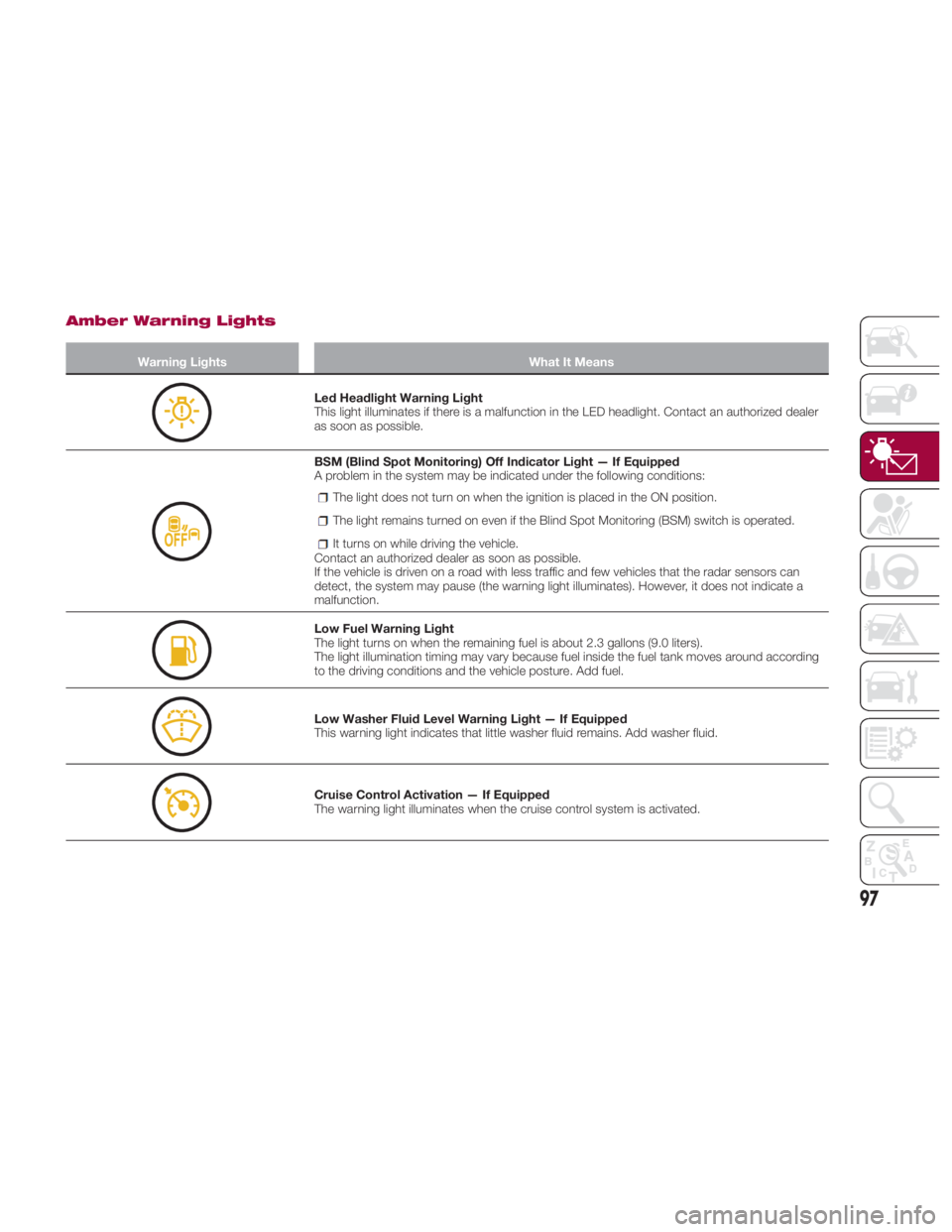
Led Headlight Warning Light
This light illuminates if there is a malfunction in the LED headlight. Contact an authorized dealer
as soon as possible.
BSM (Blind Spot Monitoring) Off Indicator Light — If Equipped
A problem in the system may be indicated under the following conditions:
The light does not turn on when the ignition is placed in the ON position.
The light remains turned on even if the Blind Spot Monitoring (BSM) switch is operated.
It turns on while driving the vehicle.
Contact an authorized dealer as soon as possible.
If the vehicle is driven on a road with less traffic and few vehicles that the radar sensors can
detect, the system may pause (the warning light illuminates). However, it does not indicate a
malfunction.
Low Fuel Warning Light
The light turns on when the remaining fuel is about 2.3 gallons (9.0 liters).
The light illumination timing may vary because fuel inside the fuel tank moves around according
to the driving conditions and the vehicle posture. Add fuel.
Low Washer Fluid Level Warning Light — If Equipped
This warning light indicates that little washer fluid remains. Add washer fluid.
Cruise Control Activation — If Equipped
The warning light illuminates when the cruise control system is activated.
97
Page 100 of 292
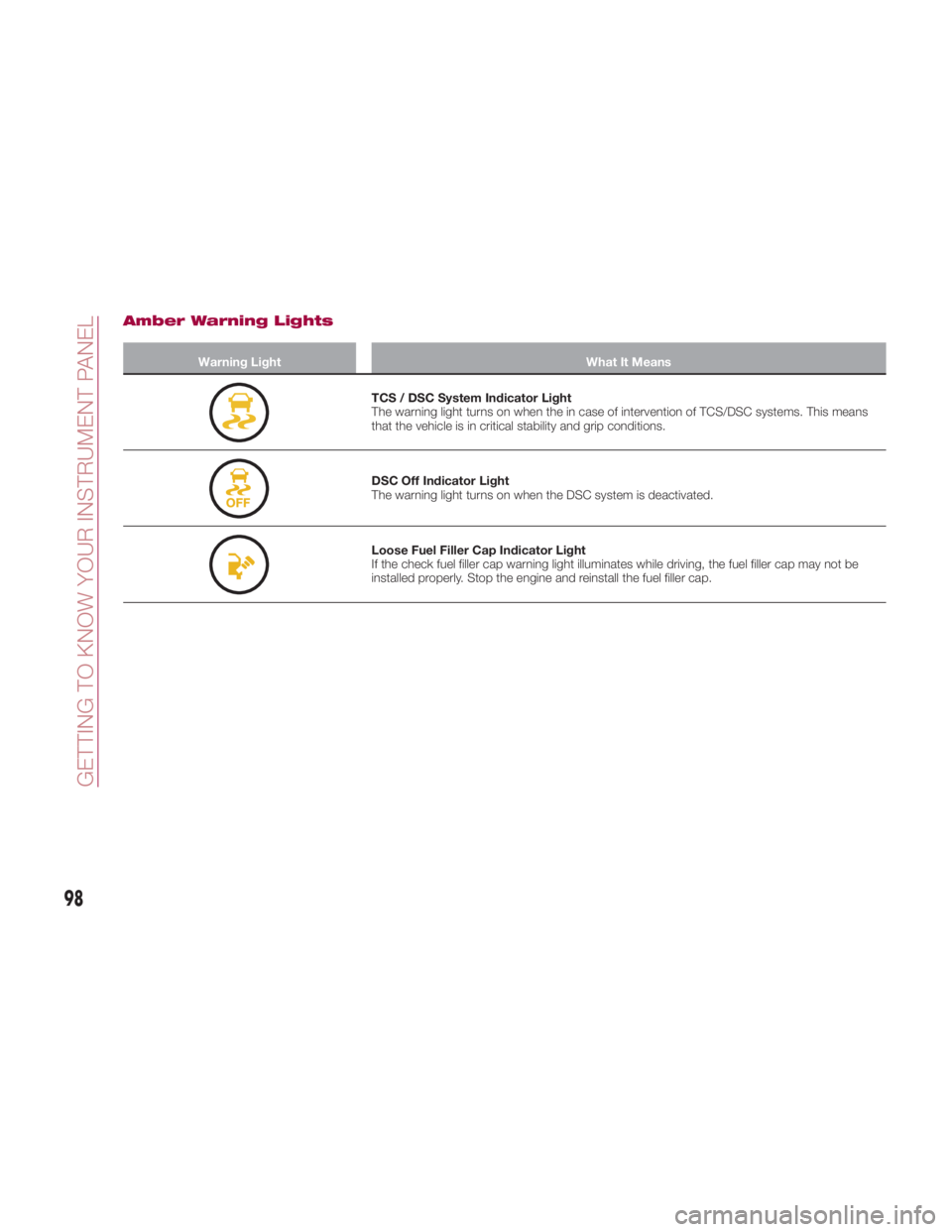
Amber Warning Lights Warning Light What It Means
TCS / DSC System Indicator Light
The warning light turns on when the in case of intervention of TCS/DSC systems. This means
that the vehicle is in critical stability and grip conditions.
DSC Off Indicator Light
The warning light turns on when the DSC system is deactivated.
Loose Fuel Filler Cap Indicator Light
If the check fuel filler cap warning light illuminates while driving, the fuel filler cap may not be
installed properly. Stop the engine and reinstall the fuel filler cap.
98
GETTING TO KNOW YOUR INSTRUMENT PANEL
Page 101 of 292
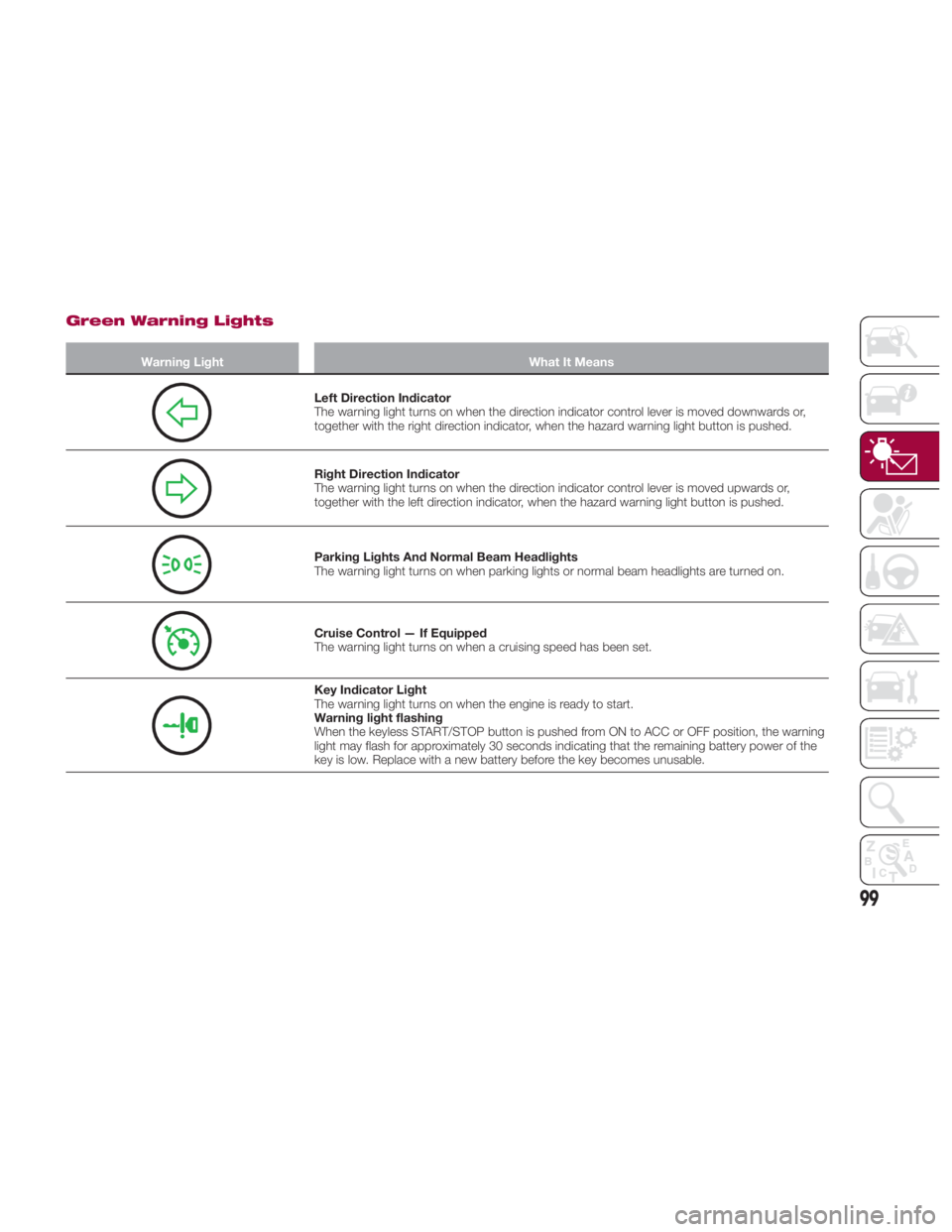
Green Warning Lights Warning Light What It Means
Left Direction Indicator
The warning light turns on when the direction indicator control lever is moved downwards or,
together with the right direction indicator, when the hazard warning light button is pushed.
Right Direction Indicator
The warning light turns on when the direction indicator control lever is moved upwards or,
together with the left direction indicator, when the hazard warning light button is pushed.
Parking Lights And Normal Beam Headlights
The warning light turns on when parking lights or normal beam headlights are turned on.
Cruise Control — If Equipped
The warning light turns on when a cruising speed has been set.
Key Indicator Light
The warning light turns on when the engine is ready to start.
Warning light flashing
When the keyless START/STOP button is pushed from ON to ACC or OFF position, the warning
light may flash for approximately 30 seconds indicating that the remaining battery power of the
key is low. Replace with a new battery before the key becomes unusable.
99
Page 102 of 292
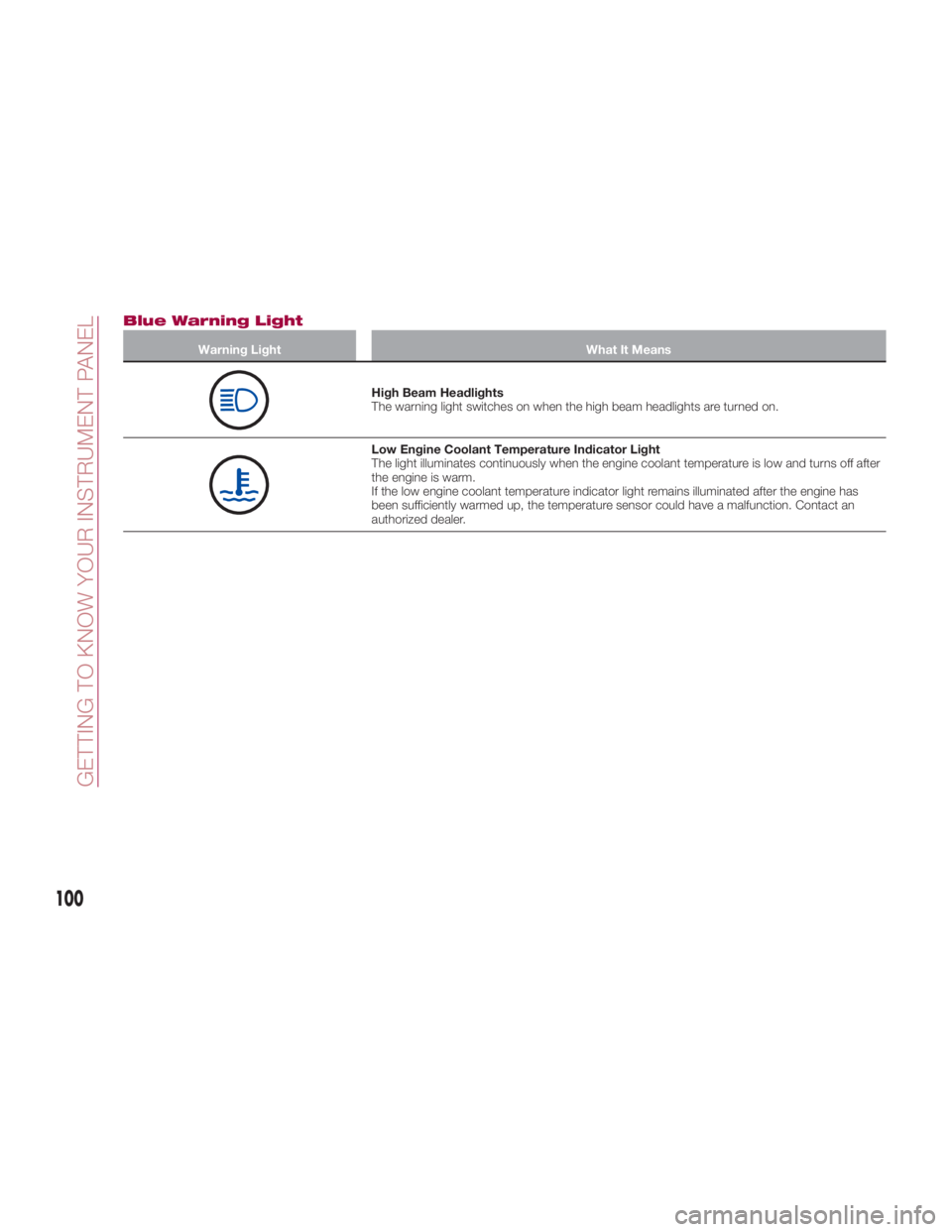
Blue Warning Light Warning Light What It Means
High Beam Headlights
The warning light switches on when the high beam headlights are turned on.
Low Engine Coolant Temperature Indicator Light
The light illuminates continuously when the engine coolant temperature is low and turns off after
the engine is warm.
If the low engine coolant temperature indicator light remains illuminated after the engine has
been sufficiently warmed up, the temperature sensor could have a malfunction. Contact an
authorized dealer.
100
GETTING TO KNOW YOUR INSTRUMENT PANEL
Page 104 of 292
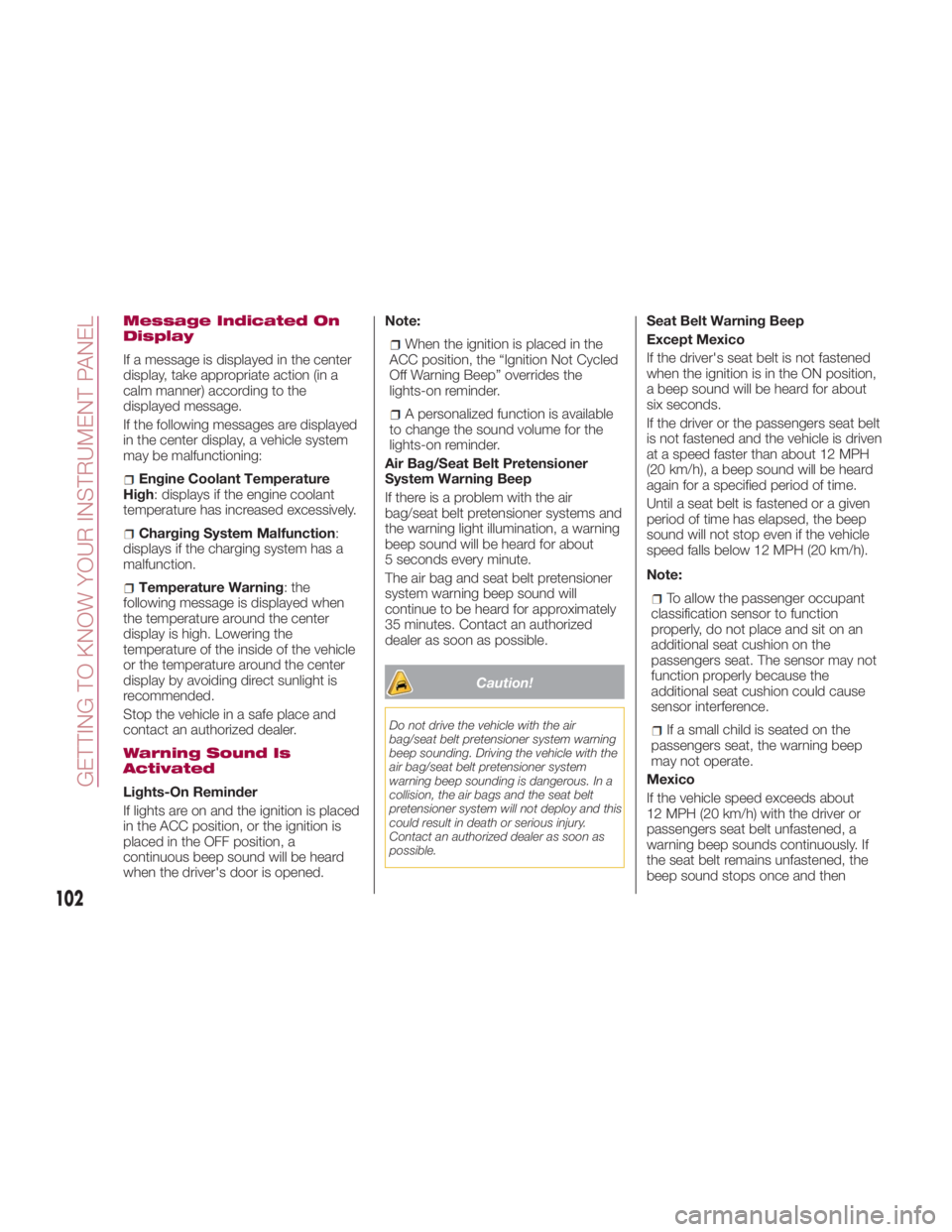
Message Indicated On
Display
If a message is displayed in the center
display, take appropriate action (in a
calm manner) according to the
displayed message.
If the following messages are displayed
in the center display, a vehicle system
may be malfunctioning:
Engine Coolant Temperature
High : displays if the engine coolant
temperature has increased excessively.
Charging System Malfunction :
displays if the charging system has a
malfunction.
Temperature Warning :the
following message is displayed when
the temperature around the center
display is high. Lowering the
temperature of the inside of the vehicle
or the temperature around the center
display by avoiding direct sunlight is
recommended.
Stop the vehicle in a safe place and
contact an authorized dealer.
Warning Sound Is
Activated
Lights-On Reminder
If lights are on and the ignition is placed
in the ACC position, or the ignition is
placed in the OFF position, a
continuous beep sound will be heard
when the driver's door is opened. Note:
When the ignition is placed in the
ACC position, the “Ignition Not Cycled
Off Warning Beep” overrides the
lights-on reminder.
A personalized function is available
to change the sound volume for the
lights-on reminder.
Air Bag/Seat Belt Pretensioner
System Warning Beep
If there is a problem with the air
bag/seat belt pretensioner systems and
the warning light illumination, a warning
beep sound will be heard for about
5 seconds every minute.
The air bag and seat belt pretensioner
system warning beep sound will
continue to be heard for approximately
35 minutes. Contact an authorized
dealer as soon as possible.
Caution!Do not drive the vehicle with the air
bag/seat belt pretensioner system warning
beep sounding. Driving the vehicle with the
air bag/seat belt pretensioner system
warning beep sounding is dangerous. In a
collision, the air bags and the seat belt
pretensioner system will not deploy and this
could result in death or serious injury.
Contact an authorized dealer as soon as
possible. Seat Belt Warning Beep
Except Mexico
If the driver's seat belt is not fastened
when the ignition is in the ON position,
a beep sound will be heard for about
six seconds.
If the driver or the passengers seat belt
is not fastened and the vehicle is driven
at a speed faster than about 12 MPH
(20 km/h), a beep sound will be heard
again for a specified period of time.
Until a seat belt is fastened or a given
period of time has elapsed, the beep
sound will not stop even if the vehicle
speed falls below 12 MPH (20 km/h).
Note:
To allow the passenger occupant
classification sensor to function
properly, do not place and sit on an
additional seat cushion on the
passengers seat. The sensor may not
function properly because the
additional seat cushion could cause
sensor interference.
If a small child is seated on the
passengers seat, the warning beep
may not operate.
Mexico
If the vehicle speed exceeds about
12 MPH (20 km/h) with the driver or
passengers seat belt unfastened, a
warning beep sounds continuously. If
the seat belt remains unfastened, the
beep sound stops once and then
102
GETTING TO KNOW YOUR INSTRUMENT PANEL
Page 109 of 292
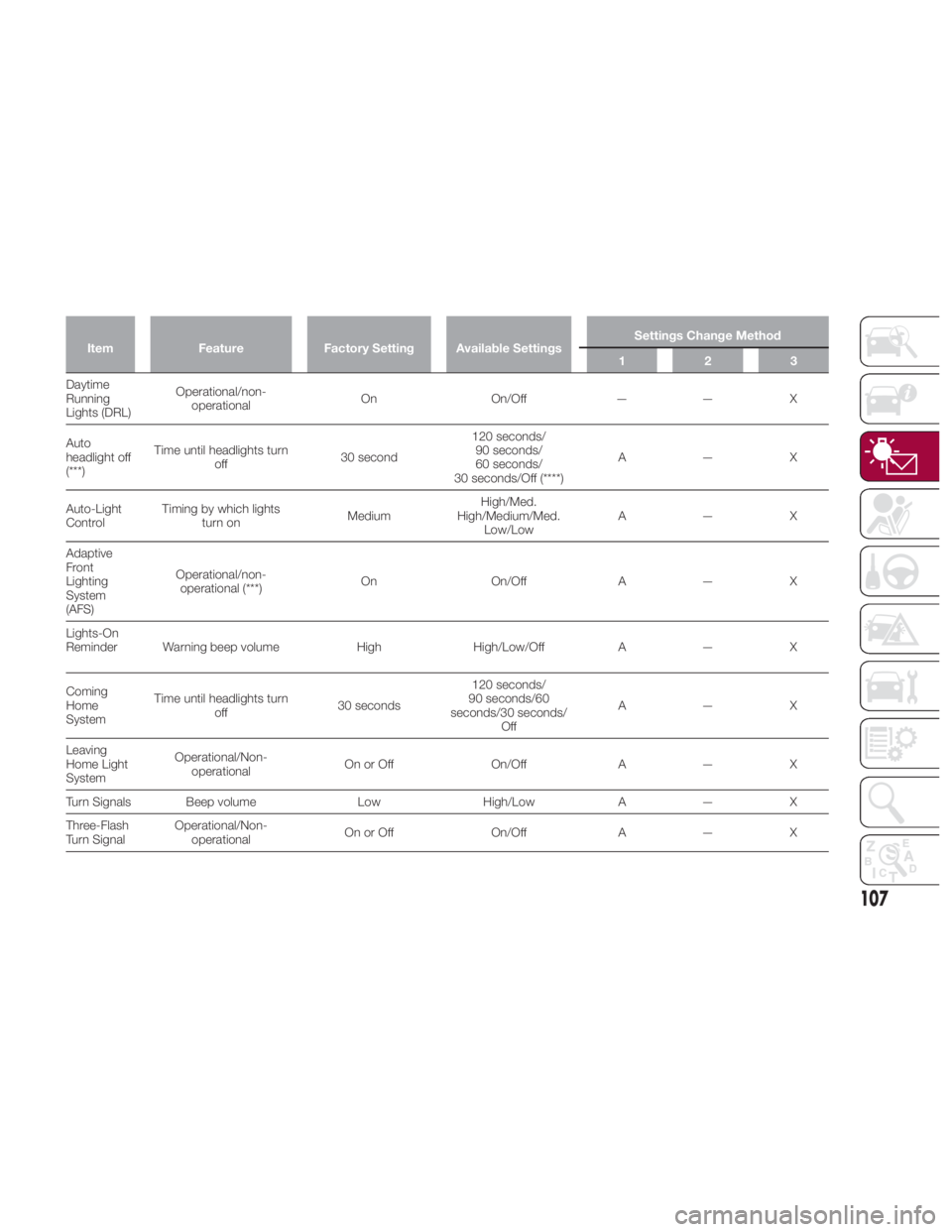
Item Feature Factory Setting Available Settings Settings Change Method
123
Daytime
Running
Lights
(DRL) Operational/non-
operational On On/Of f — — X
Auto
headlight off
(***) Time until headlights turn
off 30 second 120 seconds/
90 seconds/
60 seconds/
30 seconds/Off (****) A—X
Auto-Light
Control Timing by which lights
turn on Medium High/Med.
High/Medium/Med.
Low/Low A—X
Adaptive
Front
Lighting
System
(AFS) Operational/non-
operational (***) On On/Off A — X
Lights-On
Reminder Warning beep volume High High/Low/Off A — X
Coming
Home
System Time until headlights turn
off 30 seconds 120 seconds/
90 seconds/60
seconds/30 seconds/
Off A—X
Leaving
Home Light
System Operational/Non-
operational On or Off On/Off A — X
Turn Signals Beep volume Low High/Low A — X
Three-Flash
Turn Signal Operational/Non-
operational On or Off On/Off A — X
107
Page 114 of 292
SAFETY SYSTEMS Safety Systems
The vehicle has the following safety
systems:
Anti-lock Braking System (ABS)
Traction Contol System (TCS)
Dynamic Stability Control (DSC)
For the operation of the systems, see
the following pages.
ABS System (Anti-lock
Braking System)
The ABS control unit continuously
monitors the speed of each wheel. If
one wheel is about to lock up, the ABS
responds by automatically releasing
and reapplying that wheel's brake. The
driver will feel a slight vibration in the
brake pedal and may hear a chattering
noise from the brake system. This is
normal ABS system operation.
Continue to depress the brake pedal
without pumping the brakes. The
warning light turns on when the system
has a malfunction. Refer to “Warning
Lights And Messages” in “Getting To
Know Your Instrument Panel” for further
information. Note:
Braking distances may be longer on
loose surfaces (snow or gravel, for
example) which usually have a hard
foundation. A vehicle with a normal
braking system may require less
distance to stop under these
conditions because the tires will build
up a wedge of surface layer when the
wheels skid.
The sound of the ABS operating
may be heard when starting the engine
or immediately after starting the
vehicle; however, it does not indicate a
malfunction.
Warning!The ABS contains sophisticated
electronic equipment that may be
susceptible to interference caused by
improperly installed or high output radio
transmitting equipment. This interference
can cause possible loss of anti-lock braking
capability. Installation of such equipment
should be performed by qualified
professionals.
Pumping of the Anti-Lock Brakes will
diminish their effectiveness and may lead to
a collision. Pumping makes the stopping
distance longer. Just press firmly on your
brake pedal when you need to slow down
or stop. The ABS cannot prevent the natural
laws of physics from acting on the vehicle,
nor can it increase braking or steering
efficiency beyond that afforded by the
condition of the vehicle brakes and tires or
the traction afforded.
The ABS cannot prevent collisions,
including those resulting from excessive
speed in turns, following another vehicle
too closely, or hydroplaning.
The capabilities of an ABS equipped
vehicle must never be exploited in a
reckless or dangerous manner that could
jeopardize the user’s safety or the safety of
others.
TCS System (Traction
Control System)
Warning!The capability of the TCS must never be
tested irresponsibly and dangerously, in
such a way as to compromise personal
safety and the safety of others.
The Traction Control System (TCS)
enhances traction and safety by
controlling engine torque and braking.
When the TCS detects driving wheel
slippage, it can lower engine torque and
operate the brakes to prevent loss of
traction. This means that on a slick
surface, the engine adjusts
automatically to provide optimum
112
SAFETY