belt FIAT SPIDER ABARTH 2017 Owner's Guide
[x] Cancel search | Manufacturer: FIAT, Model Year: 2017, Model line: SPIDER ABARTH, Model: FIAT SPIDER ABARTH 2017Pages: 292, PDF Size: 9.24 MB
Page 149 of 292
CONSTANT
MONITORING The following components of the Air
Bag systems are monitored by a
diagnostic system:
Crash Sensors, And Diagnostic
Module (Sas Unit)
Front Air Bag Sensors
Air Bag Modules
Side Crash Sensors
Air Bag/Seat Belt Pretensioner
System Warning Light
Seat Belt Pretensioners
Related Wiring
With Passenger Occupant
Classification System
Passenger Air Bag Deactivation
Indicator Light
Passenger Occupant Classification
Sensor
Passenger Occupant Classification
Module — If Equipped
The diagnostic module continuously
monitors the system's readiness. This
begins when the ignition is switched
ON and continues while the vehicle is
being driven.
147
Page 151 of 292
STARTING THE
ENGINE Starting The Engine
Before starting the engine, adjust the
seat, the interior rear view mirrors, and
the door mirrors, and fasten the seat
belt correctly.
Warning!When leaving the vehicle, always remove
the key fob from the vehicle and lock your
vehicle.
Never leave children alone in a vehicle,
or with access to an unlocked vehicle.
Allowing children to be in a vehicle
unattended is dangerous for a number of
reasons. A child or others could be
seriously or fatally injured. Children should
be warned not to touch the parking brake,
brake pedal or the transmission gear
selector.
Do not leave the key fob in or near the
vehicle, or in a location accessible to
children, and do not leave the ignition of a
vehicle equipped with Advanced Keyless
Entry in the ACC or ON/RUN mode. A child
could operate power windows, other
controls, or move the vehicle.
Do not leave children or animals inside
parked vehicles in hot weather. Interior heat
build-up may cause serious injury or death. Never press the accelerator pedal for
starting the engine.
Models Equipped With A
Manual Transmission
Proceed as follows:
1. Engage the parking brake and place
the gear selector in NEUTRAL.
2. Place the start button in the ACC
mode.
3. Fully depress the clutch pedal
without touching the accelerator.
4. Place the start button in the ON
mode, push and release it as soon as
the engine starts. If the engine does not
start within 10 seconds, push the start
button to OFF mode and wait for
10-15 seconds before repeating the
starting procedure.
Models Equipped With
An Automatic
Transmission
Proceed as follows:
1. Engage the parking brake and place
the gear selector to P (PARK) or N
(NEUTRAL).
2. Fully depress the brake pedal
without touching the accelerator.
3. Place the start button in the ACC
mode. 4. Place the start button in the ON
mode, push and release it as soon as
the engine starts. If the engine does not
start within 10 seconds, push the start
button to OFF mode and wait for
10-15 seconds before repeating the
starting procedure.
Cold Weather Operation
Regarding Cold Start Disable
When the ambient temperature is
extremely low, the engine may not
crank even when the engine starting
procedure is performed. At this time,
the Cold Start Disable Indicator light in
the instrument cluster flashes. However,
this does not indicate a problem.
Perform the necessary procedures (see
“Warning lights And Messages”
paragraph in “Getting To Know Your
Instrument Panel” chapter).
Regarding Ice Breaker
When the ambient temperature is low,
the start of cranking may be delayed
after engine starting procedure is
performed. At this time, the Cold Start
Disable Indicator light in the instrument
cluster illumintes. However, this does
not indicate a problem.
Refer to your authorized dealer
regarding other related parts which are
to be input such as function name,
operating scenario (condition) of each
function, indicator operation, and user
operation/procedure information.
149
Page 227 of 292
At least monthly perform inspection
of:
Tire inflation pressures
At least twice a year (for example,
every spring and fall) perform
inspection of:
Engine coolant
Engine oil
As explained in the “Introduction”
paragraph, several procedures can be
done only by a qualified service
technician with special tools.
For details, read the separate Warranty
Booklet provided with the vehicle. If you
are unsure about any servicing or
maintenance procedure, have it done
by an authorized dealer.
There are strict environmental laws
regarding the disposal of waste oil and
fluids. Please dispose of your waste
properly and with due regard to the
environment.
We recommend that you entrust the oil
and fluid changes of your vehicle to an
authorized dealer. Periodic Checks
Every 620 miles (1,000 km) or before
long trips check and, if necessary, top
off:
Engine coolant level.
Brake fluid level.
Windshield washer fluid level.
Tire inflation pressure and condition.
Operation of lighting system
(headlights, direction indicators, hazard
warning lights, etc.).
Operation of windshield
washer/wiper system and
positioning/wear of windshield wiper
blades.
Every 1860 miles (3,000 km) check
and top off the engine oil level if
required.
Heavy-Duty Use Of The
Vehicle
If the vehicle is used under one of the
following conditions:
Dusty roads.
Short, repeated trips less than 4.4 -
5 miles ( 7-8km)atsub -zero outside
temperatures.
Engine idling for long periods of time
or driving long distances at low speeds
or long periods of inactivity. The following checks must be carried
out more often than indicated in the
Scheduled Servicing Plan:
Check front disc brake pad condition
and wear.
Check cleanliness of underhood area
and all door and trunk locks, cleanliness
and lubrication of linkage.
Visually inspect conditions of the:
engine, transmission, lines and hoses
(exhaust/fuel system/brakes) and
rubber elements (hoses/belts/etc.).
Check battery charge and battery
fluid level.
Visually inspect conditions of the
accessory drive belts.
Check and, if necessary, change
engine oil and replace oil filter.
Check and, if necessary, replace
cabin air filter.
Check and, if necessary, replace air
cleaner.
Severe Duty All Models
Change Engine Oil at 4,000 miles
(6,500 km) if the vehicle is operated in a
dusty and off road environment or is
operated predominately at idle or only
very low engine RPM’s. This type of
vehicle use is considered Severe Duty.
225
Page 231 of 292
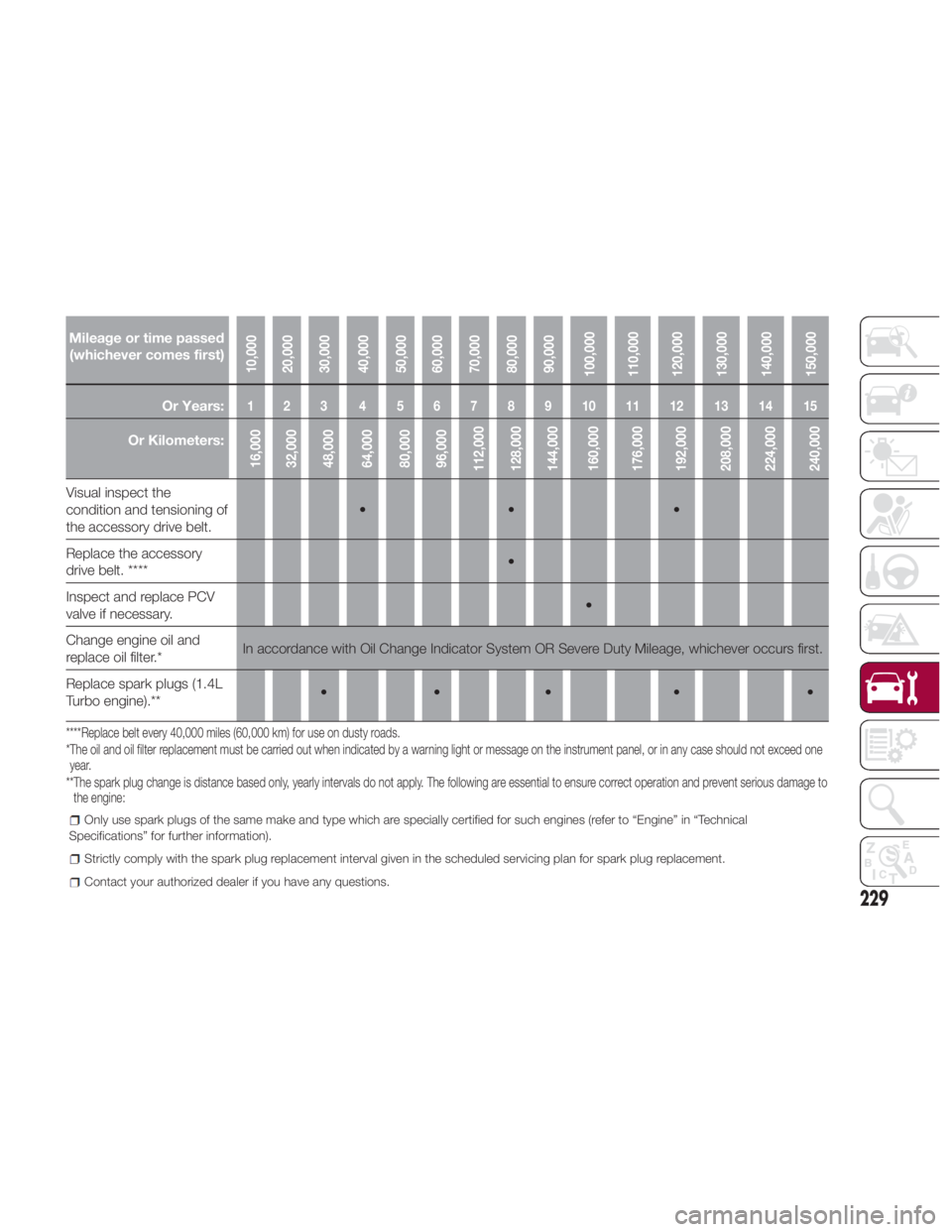
Mileage or time passed
(whichever comes first)
10,000
20,000
30,000
40,000
50,000
60,000
70,000
80,000
90,000
100,000
110,000
120,000
130,000
140,000
150,000Or Years: 123 456789101112131415
Or Kilometers:
16,000
32,000
48,000
64,000
80,000
96,000
112,000
128,000
144,000
160,000
176,000
192,000
208,000
224,000
240,000Visual inspect the
condition and tensioning of
the accessory drive belt. •• •
Replace the accessory
drive belt.
**** •
Inspect and replace PCV
valve if necessary. •
Change engine oil and
replace oil filter.
* In accordance with Oil Change Indicator System OR Severe Duty Mileage, whichever occurs first.
Replace spark plugs (1.4L
Turbo engine).
** ••• • •
****Replace belt every 40,000 miles (60,000 km) for use on dusty roads.
*The oil and oil filter replacement must be carried out when indicated by a warning light or message on the instrument panel, or in any case should not exceed one
year.
**The spark plug change is distance based only, yearly intervals do not apply. The following are essential to ensure correct operation and prevent serious damage to
the engine: Only use spark plugs of the same make and type which are specially certified for such engines (refer to “Engine” in “Technical
Specifications” for further information).
Strictly comply with the spark plug replacement interval given in the scheduled servicing plan for spark plug replacement.
Contact your authorized dealer if you have any questions.
229
Page 232 of 292
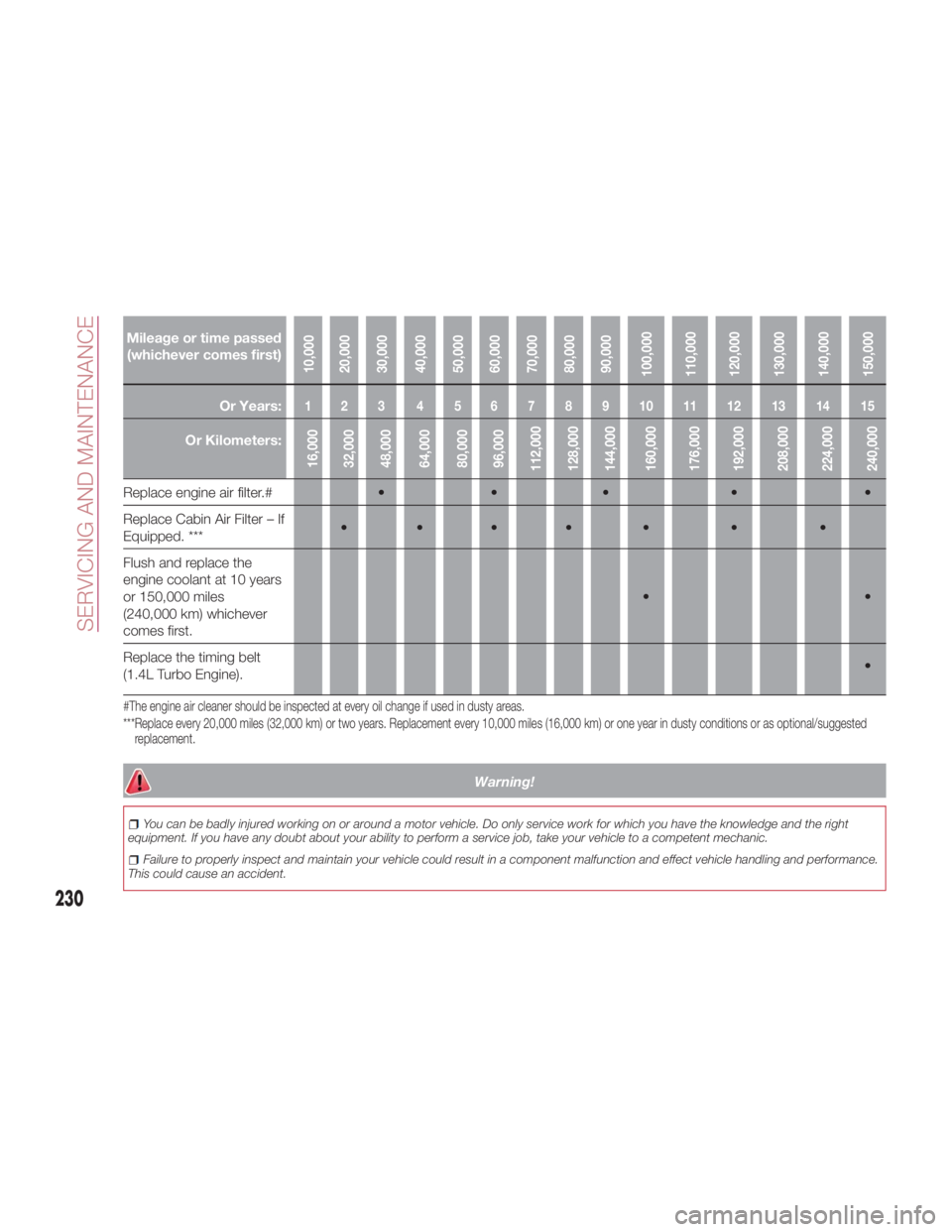
Mileage or time passed
(whichever comes first)
10,000
20,000
30,000
40,000
50,000
60,000
70,000
80,000
90,000
100,000
110,000
120,000
130,000
140,000
150,000Or Years: 123 456789101112131415
Or Kilometers:
16,000
32,000
48,000
64,000
80,000
96,000
112,000
128,000
144,000
160,000
176,000
192,000
208,000
224,000
240,000Replace engine air filter.
# ••• • •
Replace Cabin Air Filter – If
Equipped.
*** •••• • • •
Flush and replace the
engine coolant at 10 years
or 150,000 miles
(240,000 km) whichever
comes first. ••
Replace the timing belt
(1.4L Turbo Engine). •
#The engine air cleaner should be inspected at every oil change if used in dusty areas.
***Replace every 20,000 miles (32,000 km) or two years. Replacement every 10,000 miles (16,000 km) or one year in dusty conditions or as optional/suggested
replacement.
Warning!You can be badly injured working on or around a motor vehicle. Do only service work for which you have the knowledge and the right
equipment. If you have any doubt about your ability to perform a service job, take your vehicle to a competent mechanic.
Failure to properly inspect and maintain your vehicle could result in a component malfunction and effect vehicle handling and performance.
This could cause an accident.
230
SERVICING AND MAINTENANCE
Page 264 of 292
INTERIORS Seats And Fabric Parts
Warning!Do not use volatile solvents for cleaning
purposes. Many are potentially flammable,
and if used in closed areas they may cause
respiratory harm.
Do not keep aerosol cans in the car: they
might explode. Aerosol cans must not be
exposed to a temperature exceeding
122°F (50°C). When the vehicle is exposed
to sunlight the internal temperature can
greatly exceed this value.
Caution!Direct contact of air fresheners, insect
repellents, suntan lotions, or hand
sanitizers, to the plastic, painted, or
decorated surfaces of the interior may
cause permanent damage. Wipe away
immediately.
Damage caused by these type of
products may not be covered by your New
Vehicle Limited Warranty.
Rubbing the interior side of the
convertible top vigorously with a stiff brush
or cloth may cause damage. Vinyl
Remove dust and loose dirt from vinyl
with a whisk broom or vacuum cleaner.
Clean vinyl with a leather-and-vinyl
cleaner.
Fabric
Remove dust and loose dirt from fabric
with a whisk broom or vacuum cleaner.
Clean it with a mild soap solution good
for upholstery and carpets.
Remove fresh spots immediately with a
fabric spot cleaner.
To keep the fabric looking clean and
fresh, take care of it. Otherwise its color
will be affected, it can be stained easily,
and its fire-resistance may be reduced.
Note: Use only recommended cleaners
and procedures. Others may affect
appearance and fire-resistance.
Interior Panels
When the interior panels need to be
cleaned, use soft material such as a
soft cloth soaked in clean water and
wrung out well and lightly wipe off dirt
from the surface.
If a panel requires further cleaning, wipe
dirt off using a soft cloth soaked in mild
detergent (about 5% solution) and wipe
off any remaining detergent using a
cloth soaked in clean water and wrung
out well. Caution!Do not wipe leather parts using alcohol,
chlorine bleach, or organic solvents such
as thinner, benzene, or gasoline. Otherwise,
it may cause discoloration or stains.
Note:
Scratches or nicks on the panels
and metallic trim resulting from the use
of a hard brush or cloth may not be
repairable.
Be particularly careful when
cleaning high gloss panels and metallic
trim as they can be easily scratched.
Lap / Shoulder Belt
Warning!A frayed or torn belt could rip apart in a
collision and leave you with no protection.
Inspect the belt system periodically,
checking for cuts, frays, or loose parts.
Damaged parts must be replaced
immediately. Do not disassemble or modify
the system. Seat belt assemblies must be
replaced after a collision if they have been
damaged (i.e., bent retractor, torn
webbing, etc.).
262
SERVICING AND MAINTENANCE
Page 265 of 292
Clean the webbing with a mild soap
solution recommended for upholstery or
carpets. Follow instructions. Do not
bleach or dye the belts, this may
weaken them.
After cleaning the belts, thoroughly dry
the belt webbing and make sure there
is no remaining moisture before
retracting them.
Plastic And Coated
Parts
Clean interior plastic parts with a damp
cloth (if possible made from microfiber),
and a solution of water and neutral,
non-abrasive detergent.
To clean oily or persistent stains, use
specific products free from solvents and
designed to maintain the original
appearance and color of the
components.
Remove any dust using a microfiber
cloth, if necessary moistened with
water. The use of paper tissues is not
recommended as these may leave
residues. Instrument panel precautions
Prevent caustic solutions such as
perfume and cosmetic oils from
contacting the instrument panel. They
will damage and discolor the instrument
panel. If these solutions get on the
instrument panel, wipe them off
immediately.
Note: Never use alcohol, gasoline and
derivatives to clean the instrument
panel lens.
Caution!Do not use glazing agents. Glazing agents
contain ingredients which may cause
discoloration, wrinkling, cracks and peeling.
Instrument Panel Top
When cleaning, it is recommended that
you use a clean towel dampened in a
mild detergent to remove debris.
Caution!If the surface is rubbed harshly, it could
result in the surface being damaged leaving
white scratch marks. Window Interiors
If the windows become covered with an
oily, greasy, or waxy film, clean them
with glass cleaner. Follow the directions
on the container.
Note: Do not scrape or scratch the
inside of the window glass. It could
damage the thermal filaments.
Caution!When washing the inside of the window
glass, use a soft cloth dampened in
lukewarm water, gently wiping the thermal
filaments. Use of glass cleaning products
could damage the thermal filaments.
263
Page 288 of 292
KeyFob...................14
Emergency Key ............14
Programming Additional Key
Fobs ...................24
Key-In Reminder ..............20
Lane Change And Turn Signals ....41
Lane Change Assist ............41
Lap/Shoulder Belts ....... .123,125
Leaving Home Light System ......42
Life Of Tires ............... .248
Lights
Daytime Running ...........40
Fog ...................41
Hazard Warning Flasher ..... .184
Passing .................40
Turn Signal ...............41
Loading Vehicle ............ .176
Tires ................. .242
Locks
PowerDoor ........... .26,31
Maintaining the finish ......... .257
Maintenance Monitor ...........81
Maintenance procedures ....... .235
Malfunction Indicator Light (Check
Engine) ................ .110
Manual Climate Control System ....48
Heating .................50
Manual transmission ......... .152 Manual, Service ............ .283
Methanol ................. .173
Mirrors....................35
Automatic Dimming .........36
Electric Remote ............37
Exterior Folding ............37
Outside .................35
Rearview ................36
Occupant Restraints ......... .122
Onboard Diagnostic System .... .109
Operating Precautions ........ .109
Outside Rearview Mirrors ..... .35,36
Overhead light (bulb replacement) . .194
Overheating, Engine .......... .219
Overloading ............... .182
Owner's Manual (Operator
Manual) ................ .283
Paint damage touch-up ....... .259
Parking Brake ..............
.151
Passing
Light ................ 40
Performance .............. .278
Periodic checks (scheduled
servicing) ............... .225
Personal Settings ........... .105
Personalization Features ....... .105
Placard, Tire And Loading
Information .............. .242
Plastic part maintenance ....... .261 Power
Brakes ................ .150
Door Locks ........... .26,31
Mirrors .................37
Pregnant Women And Seat Belts . .124
Pretensioners
Seat Belts ............. .127
Protection from atmospheric
agents (bodywork) ......... .256
Radar Sensors ............. .162
Radial Ply Tires ............. .247
Radio Frequency
General Information ....... .19,23
Radio transmitter and mobile
phones ...................5
Rear Camera .............. .167
Rear lights (light bulbs) ........ .187
Rear Park Assist System ....... .163
Rearview Mirrors ..............36
Recommended Tire Inflation
Pressure ............... .267
Recorder, Event Data ......... .145
Recreational towing .......... .178
Reformulated Gasoline ........ .173
Refueling procedure .......... .175
Refueling the vehicle ......... .173
Reminder, Seat Belt .......... .127
Replacement Tires ........... .248
Replacing a bulb ............ .184
INDEX
Page 289 of 292
Replacing exterior light bulbs .... .187
Replacing fuses ............ .194
Replacing interior light bulbs .... .194
Reporting Safety Defects ...... .282
Restraint, Head ..............34
Restraints, Child ............ .128
Safety Defects, Reporting ...... .282
Safety Information, Tire ........ .238
safety systems ............. .112
Saving fuel and protection of the
environment ............. .178
Scheduled servicing .......... .224
Seat Belt
Energy Management Feature . . .128
Lap/Shoulder Belts ..... .123,125
Pregnant Women ......... .124
Seat Belt Extender ........ .126
Seat Belt Pretensioner ...... .127
Seat Belt Reminder ........ .127
Seat Belt Reminder .......... .127
Seat Belts ................ .122
Child Restraint ........... .128
Extender .............. .126
Front Seat .......... .122,123
Pregnant Women ......... .124
Pretensioners ........... .127
Rear Seat .............. .123
Seats .....................33 Adjustment ...............33
Heated .................33
Seatback Release ..........33
Tilting ..................33
Seats and fabric parts (cleaning) . . .262
Security Alarm
Security Alarm .......... .24,25
Sentry Key
Key Programming ..........24
Service Assistance .......... .280
Service Contract ............ .281
Service Manuals ............ .283
Shift Lever Override
.......... .156
Shift
position indication ........ .154
Shoulder Belts .......... .123,125
Signals, Turn ................41
Snow chains .............. .252
Snow Tires ............... .249
Spare Tire .......... .203,250,251
Sport Mode ............... .158
Starting ............... .20,218
Engine Fails To Start ....... .218
Starting And Operating ...... .20,218
Starting Procedures ........ .20,218
Starting the engine .......... .149
Steering ................. .273
Column Lock .............35
Tilt Column ...............35 Wheel, Tilt ...............35
Storage ...................60
Storing the vehicle ........... .255
Sun Visor ..................61
Supplemental Restraint System -
AirBag ............. .131,135
Suspensions .............. .272
Symbols ....................3
Tilt Steering Column ...........35
Tire And Loading Information
Placard ................ .242
Tire chains ................ .180
Tire Markings .............. .238
Tire Rotation .............. .253
Tire Safety Information ........ .238
Tire Service Kit ............. .208
Tires.............. .246,250,254
Aging (Life Of Tires) ........ .248
Air Pressure ............ .246
Changing ........ .203,204,237
Compact Spare .......... .250
Flat Changing ........... .208
General Information .....
.246,250
High
Speed ............
.247
Inflation Pressures ........ .246
Jacking ......... .203,204,237
Life Of Tires ............ .248
Load Capacity ........ .242,243