tires FIAT SPIDER ABARTH 2017 Owner's Guide
[x] Cancel search | Manufacturer: FIAT, Model Year: 2017, Model line: SPIDER ABARTH, Model: FIAT SPIDER ABARTH 2017Pages: 292, PDF Size: 9.24 MB
Page 254 of 292
Caution!Avoid products or automatic car washes
that use acidic solutions or strong alkaline
additives or harsh brushes. These products
and automatic car washes may damage
the wheel's protective finish. Such damage
is not covered by the New Vehicle Limited
Warranty. Only car wash soap, Mopar
Wheel Cleaner or equivalent is
recommended.
When cleaning extremely dirty wheels
including excessive brake dust, care
must be taken in the selection of tire
and wheel cleaning chemicals and
equipment to prevent damage to the
wheels. Mopar Wheel Treatment or
Mopar Chrome Cleaner or their
equivalent is recommended or select a
non-abrasive, non-acidic cleaner for
aluminum or chrome wheels. Do not
use any products on Dark Vapor or
Black Satin Chrome Wheels. They will
permanently damage this finish and
such damage is not covered by the
New Vehicle Limited Warranty. Caution!Do not use scouring pads, steel wool, a
bristle brush, metal polishes or oven
cleaner. These products may damage the
wheel's protective finish. Such damage is
not covered by the New Vehicle Limited
Warranty. Only car wash soap, Mopar
Wheel Cleaner or equivalent is
recommended.
Note: If you intend parking or storing
your vehicle for an extended period
after cleaning the wheels with wheel
cleaner, drive your vehicle for a few
minutes before doing so. Driving the
vehicle and applying the brakes when
stopping will reduce the risk of brake
rotor corrosion.
Dark Vapor Or Black Satin Chrome
Wheels
Caution!If your vehicle is equipped with Dark Vapor
or Black Satin Chrome wheels DO NOT
USE wheel cleaners, abrasives or polishing
compounds. They will permanently damage
this finish and such damage is not covered
by the New Vehicle Limited Warranty. USE
ONLY MILD SOAP AND WATER WITH A
SOFT CLOTH. Used on a regular basis; this
is all that is required to maintain this finish. Snow Chains
The use of snow chains should be in
compliance with local regulations of
each country. In certain countries, tires
marked with code M+S (Mud and
Snow) are considered as winter
equipment; therefore their use is
equivalent to that of the snow chains.
The snow chains may be applied only
to the front wheel tires. Check the
tension of the snow chains after the first
few feet have been driven.
Warning!Using tires of different size and type (M+S,
Snow) between front and rear axles can
cause unpredictable handling. You could
lose control and have a collision.
252
SERVICING AND MAINTENANCE
Page 255 of 292
Caution!To avoid damage to your vehicle or tires,
observe the following precautions:
Because of restricted traction device
clearance between tires and other
suspension components, it is important
that only traction devices in good condition
are used. Broken devices can cause
serious damage. Stop the vehicle
immediately if noise occurs that could
indicate device breakage. Remove the
damaged parts of the device before further
use.
Install device as tightly as possible and
then retighten after driving about ½ mile
(0.8 km).
Do not exceed 30 mph (48 km/h).
Drive cautiously and avoid severe turns
and large bumps, especially with a loaded
vehicle.
Do not drive for a prolonged period on
dry pavement.
Observe the traction device
manufacturer’s instructions on the method
of installation, operating speed, and
conditions for use. Always use the
suggested operating speed of the device
manufacturer’s if it is less than 30 mph
(48 km/h).
Do not use traction devices on a
compact spare tire. Caution!Using snow chains with tires with
non-original dimensions may damage the
vehicle.
Using different size or type (M+S, snow,
etc.) tires between front and rear axle may
adversely affect vehicle driveability, with the
risk of losing control of the vehicle and
resulting accidents.
Tire Rotation
Recommendations
The front and rear tires are subject to
different loads and stress due to
steering, maneuver and braking. For
this reason they are subject to uneven
wear. To resolve this problem, tires
should be rotated at the appropriate
time.
The following rotation methods must
NOT be used with one-way
unidirectional tires! This type of tires can
only be switched from the front axle to
the rear axle and vice versa, keeping
them on the same side of the vehicle.
Rotate one-way unidirectional tires
and radial tires that have an
asymmetrical tread pattern only from
front to rear, not from side to side. Tire
performance will be reduced if rotated
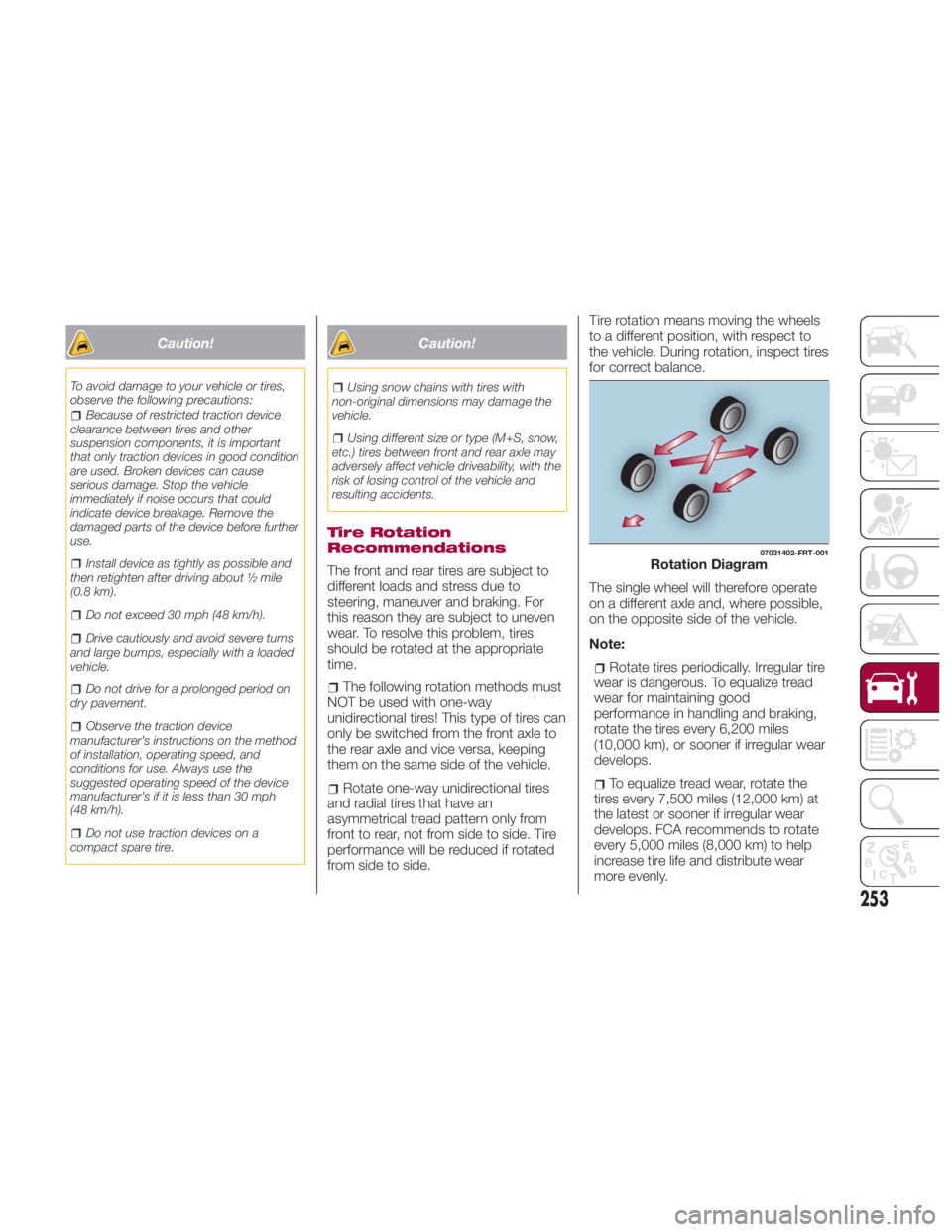
from side to side. Tire rotation means moving the wheels
to a different position, with respect to
the vehicle. During rotation, inspect tires
for correct balance.
The single wheel will therefore operate
on a different axle and, where possible,
on the opposite side of the vehicle.
Note:
Rotate tires periodically. Irregular tire
wear is dangerous. To equalize tread
wear for maintaining good
performance in handling and braking,
rotate the tires every 6,200 miles
(10,000 km), or sooner if irregular wear
develops.
To equalize tread wear, rotate the
tires every 7,500 miles (12,000 km) at
the latest or sooner if irregular wear
develops. FCA recommends to rotate
every 5,000 miles (8,000 km) to help
increase tire life and distribute wear
more evenly. 07031402-FRT-001
Rotation Diagram
253
Page 256 of 292
Because your vehicle is not
equipped with a spare tire, you cannot
do a tire rotation safely with the jack
that may come with your vehicle if so
equipped. Contact an authorized
dealer for tire rotation.
Also, inspect them for uneven wear and
damage. Abnormal wear is usually
caused by one or a combination of the
following:
Incorrect tire pressure
Improper wheel alignment
Out-of-balance wheel
Severe braking
After rotation, inflate all tire pressures to
specification and inspect the wheel nuts
for tightness.
With Tire Pressure Monitor System
(TPMS)
The TPM system must be initialized
after adjusting the tire pressure, to
make the system operate normally.
Refer to “Tire Pressure Monitoring
System” in “Safety” for further
information.
Rotate unidirectional tires and radial
tires that have an asymmetrical tread
pattern only from front to rear, not from
side to side. Tire performance will be
reduced if rotated from side to side. DEPARTMENT OF
TRANSPORTATION
UNIFORM TIRE
QUALITY GRADES The following tire grading
categories were established by the
National Highway Traffic Safety
Administration. The specific grade
rating assigned by the tire's
manufacturer in each category is
shown on the sidewall of the tires
on your vehicle.
All passenger vehicle tires must
conform to Federal safety
requirements in addition to these
grades. Treadwear
The Treadwear grade is a
comparative rating, based on the
wear rate of the tire when tested
under controlled conditions on a
specified government test course.
For example, a tire graded
150 would wear one and one-half
times as well on the government
course as a tire graded 100. The
relative performance of tires
depends upon the actual
conditions of their use, however,
and may depart significantly from the norm due to variations in driving
habits, service practices, and
differences in road characteristics
and climate. Traction Grades
The Traction grades, from highest
to lowest, are AA, A, B, and C.
These grades represent the tire's
ability to stop on wet pavement, as
measured under controlled
conditions on specified government
test surfaces of asphalt and
concrete. A tire marked C may
have poor traction performance. Warning!
The traction grade assigned to
this tire is based on straight-ahead
braking traction tests, and does
not include acceleration,
cornering, hydroplaning, or peak
traction characteristics. Temperature Grades
The Temperature grades are A (the
highest), B, and C, representing the
tire's resistance to the generation of
heat and its ability to dissipate heat,
254
SERVICING AND MAINTENANCE
Page 257 of 292
when tested under controlled
conditions on a specified indoor
laboratory test wheel.
Sustained high temperature can
cause the material of the tire to
degenerate and reduce tire life, and
excessive temperature can lead to
sudden tire failure. The grade C
corresponds to a level of
performance, which all passenger
vehicle tires must meet under the
Federal Motor Vehicle Safety
Standard No. 109. Grades B and A
represent higher levels of
performance on the laboratory test
wheel, than the minimum required
by law. Warning!
The temperature grade for this tire
is established for a tire that is
properly inflated and not
overloaded. Excessive speed,
under-inflation, or excessive
loading, either separately or in
combination, can cause heat
buildup and possible tire failure. STORING THE
VEHICLE If the vehicle is left inactive for longer
than a month, the following precautions
should be observed:
Park the vehicle in covered, dry and if
possible well-ventilated premises and
slightly open the windows.
Check that the parking brake is not
activated.
Disconnect the negative battery
terminal and check the battery charge.
Repeat this check once every three
months during storage.
If the battery is not disconnected
from the electrical system, check its
state of charge every thirty days.
Clean and protect the painted parts
using protective wax.
Clean and protect the shiny metal
parts using special compounds
available commercially.
Sprinkle talcum powder on the
windshield and rear window wiper
rubber blades and lift them off the
glass.
Cover the vehicle with a fabric or
perforated plastic sheet, paying
particular care not to damage the
painted surface by dragging any dust
that may have accumulated on it. Do
not use compact plastic sheets which do not allow humidity to evaporate from
the surface of the vehicle.
Inflate the tires at a pressure of
+7.25 psi (+0.5 bar) higher than
recommended on the tire placard and
check it periodically.
Do not drain the engine cooling
system.
Any time the vehicle is left inactive for
two weeks or more, operate the air
conditioning system with engine idling
for at least five minutes, setting external
air and with fan set to maximum speed.
This operation will ensure appropriate
lubrication for the system, thus
minimizing the possibility of damage to
the compressor when the system is
operated again.
Note: After placing the ignition in the
OFF mode and having closed the driver
side door, wait at least one minute
before disconnecting the electrical
supply from the battery. When
reconnecting the electrical supply to the
battery, make sure that the ignition in
the OFF mode and the driver side door
is closed.
255
Page 259 of 292
Damage caused by bird
dropping/insects/tree sap
Problem:
Bird droppings contain acids. If these
are not removed they can eat away the
clear and color base coat of the
vehicle's paintwork.
When insects stick to the paint surface
and decompose, corrosive compounds
form. These can erode the clear and
color base coat of the vehicle's
paintwork if they are not removed.
Tree sap will harden and adhere
permanently to the paint finish. If you
scratch the sap off while it is hard,
some vehicle paint could come off with
it.
Prevention:
It is necessary to have your vehicle
washed and waxed to preserve its finish
according to the instructions in this
section. This should be done as soon
as possible.
Bird droppings can be removed with a
soft sponge and water. If you are
travelling and these are not available, a
moistened tissue may also take care of
the problem. The cleaned area should
be waxed according to the instructions
in this section. Insects and tree sap are
best removed with a soft sponge and
water or a commercially available
chemical cleaner. Another method is to cover the affected
area with dampened newspaper for one
to two hours. After removing the
newspaper, rinse off the loosened
debris with water.
Water marks
Problem:
Rain, fog, dew, and even tap water can
contain harmful minerals such as salt
and lime. If moisture containing these
minerals settles on the vehicle and
evaporates, the minerals will
concentrate and harden to form white
rings. The rings can damage your
vehicle's finish.
Prevention:
It is necessary to wash and wax your
vehicle to preserve its finish according
to the instructions in this section. These
steps should be taken immediately after
you find water marks on your vehicle's
finish.
Paint chipping
Problem:
Paint chipping occurs when gravel
thrown in the air by another vehicle's
tires hits your vehicle.
How to avoid paint chipping:
Keeping a safe distance between you
and the vehicle ahead reduces the
chances of having your paint chipped
by flying gravel. Note:
The paint chipping zone varies with
the speed of the vehicle. For example,
when travelling at 55 mph (90 km/h),
the paint chipping zone is 164 ft
(50 m).
In low temperatures, a vehicle's
finish hardens. This increases the
chance of paint chipping.
Chipped paint can lead to rust
forming on your vehicle. Before this
happens, repair the damage by using
FCA touch-up paint according to the
instructions in this section. Failure to
repair the affected area could lead to
serious rusting and expensive repairs.
Follow all label and container directions
when using a chemical cleaner or
polish. Read all warnings and cautions.
Maintaining The Finish
Washing
To help protect the finish from rust and
deterioration, wash your vehicle
thoroughly and frequently, at least once
a month, with lukewarm or cold water.
If the vehicle is washed improperly, the
paint surface could be scratched. Here
are some examples of how scratching
could occur:
The vehicle is washed without first
rinsing off dirt and other foreign matter.
257
Page 269 of 292
RECOMMENDED
TIRE INFLATION
PRESSURE On the tire label you will find the
recommended tire inflation pressure in
both psi and kPa for the tires installed
as original equipment on the vehicle.
It is very important that the inflation
pressure of the tires on your vehicle is
maintained at the recommended
pressure.
You should check the tire pressure
regularly to insure that the proper
inflation pressure is maintained.
Note:
Tire pressures listed on the vehicle
placard or tire information label indicate
the recommended cold tire inflation
pressure, measured when the tires are
cold, after the vehicle has been parked
for at least three hours. As you drive,
the temperature in the tire warms up,
increasing the tire pressure. Always check the tire inflation
pressures on a regular basis according
to the recommended tire inflation
pressure on the tire label and in
conjunction with the information in this
Owner's Manual. Driving your vehicle
with under-inflated tires is dangerous.
Under-inflation is the most common
cause of failures in any kind of tire and
may result in severe cracking, tread
separation or “blowout”, with
unexpected loss of vehicle control and
increased risk of injury. Under-inflation
increases sidewall flexing and rolling
resistance, resulting in heat buildup
and internal damage to the tire. It
results in unnecessary tire stress,
irregular wear, loss of control and
accidents. A tire can lose up to half of
its air pressure and not appear to be
flat. It is impossible to determine
whether or not tires are properly
inflated just by looking at them. Checking Tire Pressure
Proceed as follows:
1. When you check the air pressure,
make sure the tires are cold - meaning
they are not hot from driving even a
mile.
2. Remove the cap from the valve on
one tire.
3. Firmly press a tire gauge onto the
valve.
4. Add air to achieve recommended air
pressure.
5. If you overfill the tire, release air by
pushing on the metal stem in the center
of the valve. Then recheck the pressure
with your tire gauge.
6. Replace the valve cap.
7. Visually inspect the tires to make
sure there are no nails or other objects
embedded that could poke a hole in the
tire and cause an air leak.
8. Check the sidewalls to make sure
there are no gouges, cuts, bulges,
cracks or other irregularities.
267
Page 276 of 292
DIMENSIONS Dimensions
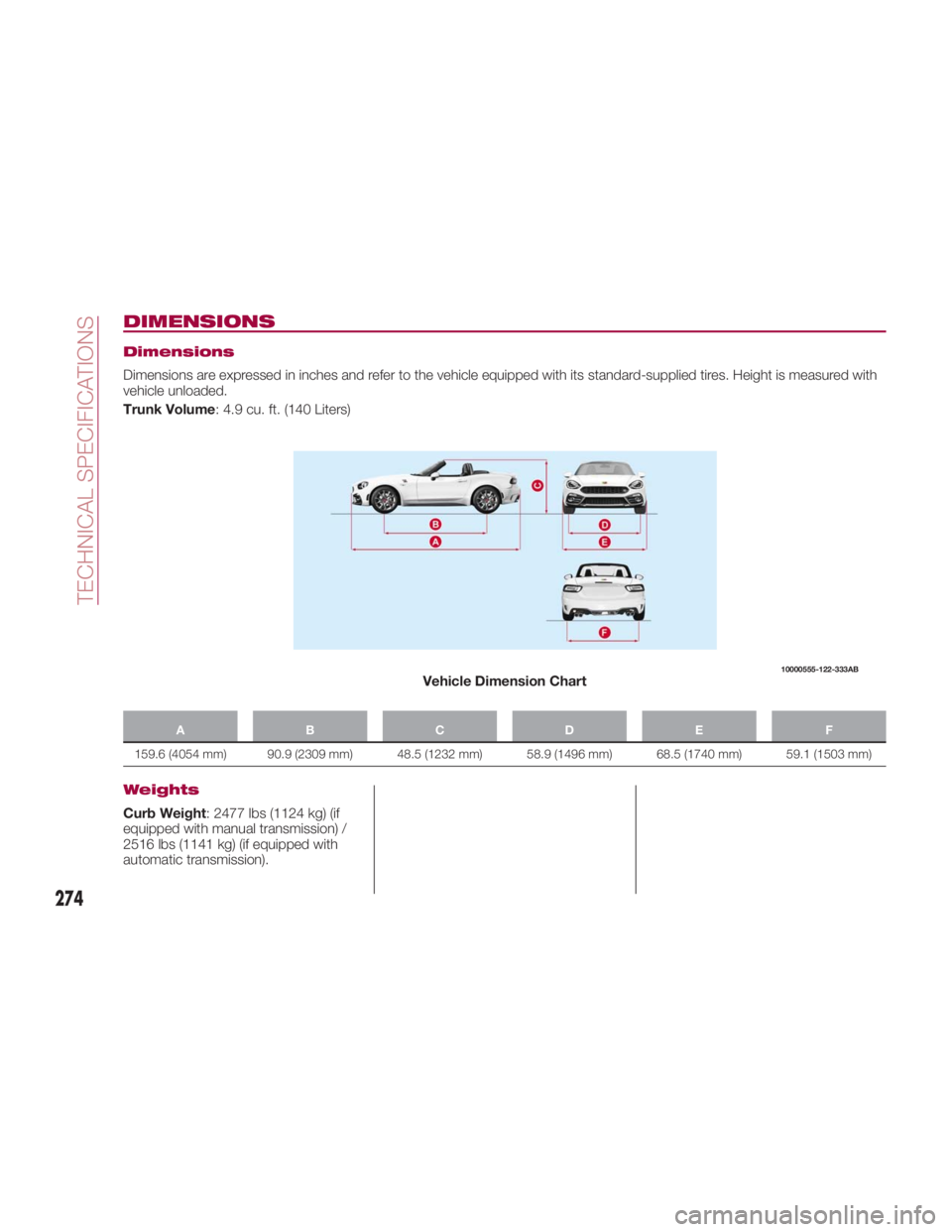
Dimensions are expressed in inches and refer to the vehicle equipped with its standard-supplied tires. Height is measured with
vehicle unloaded.
Trunk Volume : 4.9 cu. ft. (140 Liters)
ABCDE F
159.6 (4054 mm) 90.9 (2309 mm) 48.5 (1232 mm) 58.9 (1496 mm) 68.5 (1740 mm) 59.1 (1503 mm)
Weights
Curb Weight : 2477 lbs (1124 kg) (if
equipped with manual transmission) /
2516 lbs (1141 kg) (if equipped with
automatic transmission). 10000555-122-333AB
Vehicle Dimension Chart
274
TECHNICAL SPECIFICATIONS
Page 286 of 292
INDEX About Your Brakes .......... .150
ABS system ............... .112
Active Adaptive Shift (AAS) ..... .156
Adaptive Front Lighting System
(AFS) ...................42
Additives, Fuel ............. .174
Advanced Keyless Entry System
Key Left In Trunk ............21
Key left In Vehicle ...........21
Locking Doors .............21
Passive Entry ..............21
Request Switch ............21
Unlocking Doors ............21
AirBag............... .131,135
Advance Front Air Bag . . . .131,135
Air Bag Warning Light ...... .147
Event Data Recorder (EDR) .145,222
FrontAirBag ............ .147
Maintaining Your Air Bag
System ............... .145
Air Bag Maintenance ......... .145
Air Pressure, Tires ........... .246
Alarm
Vehicle Security Alarm ..... .24,25
Alarm (Security Alarm) ....... .24,25
Aluminium wheel maintenance . . . .259
Automatic Dimming Mirror ........36
Automatic Headlights ...........40 Automatic Temperature Control
(ATC) ...................52
Automatic Transmission ....... .153
Auxiliary Power Outlet ..........63
B-Pillar Location ............ .242
Battery (maintenance) ......... .234
Battery charging procedure ..... .235
Battery recharging ........... .235
Blind Spot Monitoring ......... .114
Body and underbody warranty . . . .256
Body lubrication ............ .235
Bodywork (care and maintenance). .256
Boot, Convertible Top Lowering ....70
Boot, Convertible Top Precautions . .73
Boot, Convertible Top Raising .....71
Brake System .............. .150
Brake/clutch fluid (level check) . . . .233
Brakes ............... .150,271
Bright-metal maintenance ......
.259
Camera,
Rear ..............
.167
Carbon Monoxide Warning ..... .175
Center Seat Storage Compartment .......................60
Certification Label ........... .176
Changing A Flat Tire .... .203,204,237
Chart, Tire Sizing ............ .239
Check Engine Light (Malfunction
Indicator Light) ........... .110 Checking levels ............. .231
Child Restraint ............. .128
Child Restraints
Child Restraints .......... .128
Clean Air Gasoline ........... .173
Cleaning
Wheels ............... .251
Climate Control ..............45
Close The Hood ..............69
Compact Spare Tire .......... .250
Contract, Service ........... .281
Convertible Top ..............70
Convertible top maintenance .... .260
Cooling
Air Conditioning ............50
Cupholders .................64
Customer Assistance ......... .280
Data Recorder, Event ......... .145
Daytime Running Lights .........40
Diagnostic System, Onboard .... .109
Dimensions ............... .274
Disabled Vehicle Towing .... .220,221
Driver's Seat Back Tilt ..........33
Driving in flooded area ........ .181
Driving tips ............... .178
Electric power steering ..........74
Electric Remote Mirrors .........37
INDEX
Page 288 of 292
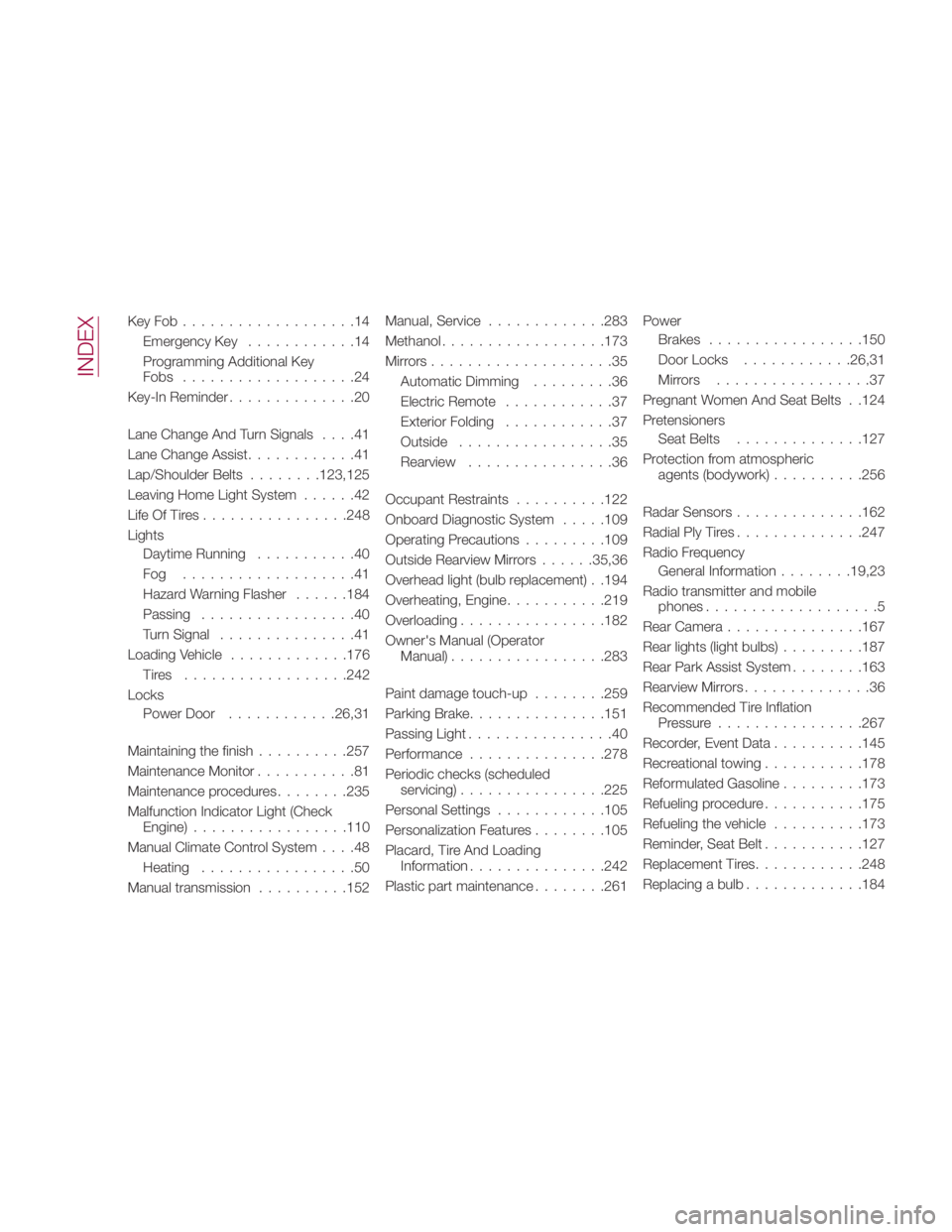
KeyFob...................14
Emergency Key ............14
Programming Additional Key
Fobs ...................24
Key-In Reminder ..............20
Lane Change And Turn Signals ....41
Lane Change Assist ............41
Lap/Shoulder Belts ....... .123,125
Leaving Home Light System ......42
Life Of Tires ............... .248
Lights
Daytime Running ...........40
Fog ...................41
Hazard Warning Flasher ..... .184
Passing .................40
Turn Signal ...............41
Loading Vehicle ............ .176
Tires ................. .242
Locks
PowerDoor ........... .26,31
Maintaining the finish ......... .257
Maintenance Monitor ...........81
Maintenance procedures ....... .235
Malfunction Indicator Light (Check
Engine) ................ .110
Manual Climate Control System ....48
Heating .................50
Manual transmission ......... .152 Manual, Service ............ .283
Methanol ................. .173
Mirrors....................35
Automatic Dimming .........36
Electric Remote ............37
Exterior Folding ............37
Outside .................35
Rearview ................36
Occupant Restraints ......... .122
Onboard Diagnostic System .... .109
Operating Precautions ........ .109
Outside Rearview Mirrors ..... .35,36
Overhead light (bulb replacement) . .194
Overheating, Engine .......... .219
Overloading ............... .182
Owner's Manual (Operator
Manual) ................ .283
Paint damage touch-up ....... .259
Parking Brake ..............
.151
Passing
Light ................ 40
Performance .............. .278
Periodic checks (scheduled
servicing) ............... .225
Personal Settings ........... .105
Personalization Features ....... .105
Placard, Tire And Loading
Information .............. .242
Plastic part maintenance ....... .261 Power
Brakes ................ .150
Door Locks ........... .26,31
Mirrors .................37
Pregnant Women And Seat Belts . .124
Pretensioners
Seat Belts ............. .127
Protection from atmospheric
agents (bodywork) ......... .256
Radar Sensors ............. .162
Radial Ply Tires ............. .247
Radio Frequency
General Information ....... .19,23
Radio transmitter and mobile
phones ...................5
Rear Camera .............. .167
Rear lights (light bulbs) ........ .187
Rear Park Assist System ....... .163
Rearview Mirrors ..............36
Recommended Tire Inflation
Pressure ............... .267
Recorder, Event Data ......... .145
Recreational towing .......... .178
Reformulated Gasoline ........ .173
Refueling procedure .......... .175
Refueling the vehicle ......... .173
Reminder, Seat Belt .......... .127
Replacement Tires ........... .248
Replacing a bulb ............ .184
INDEX
Page 289 of 292
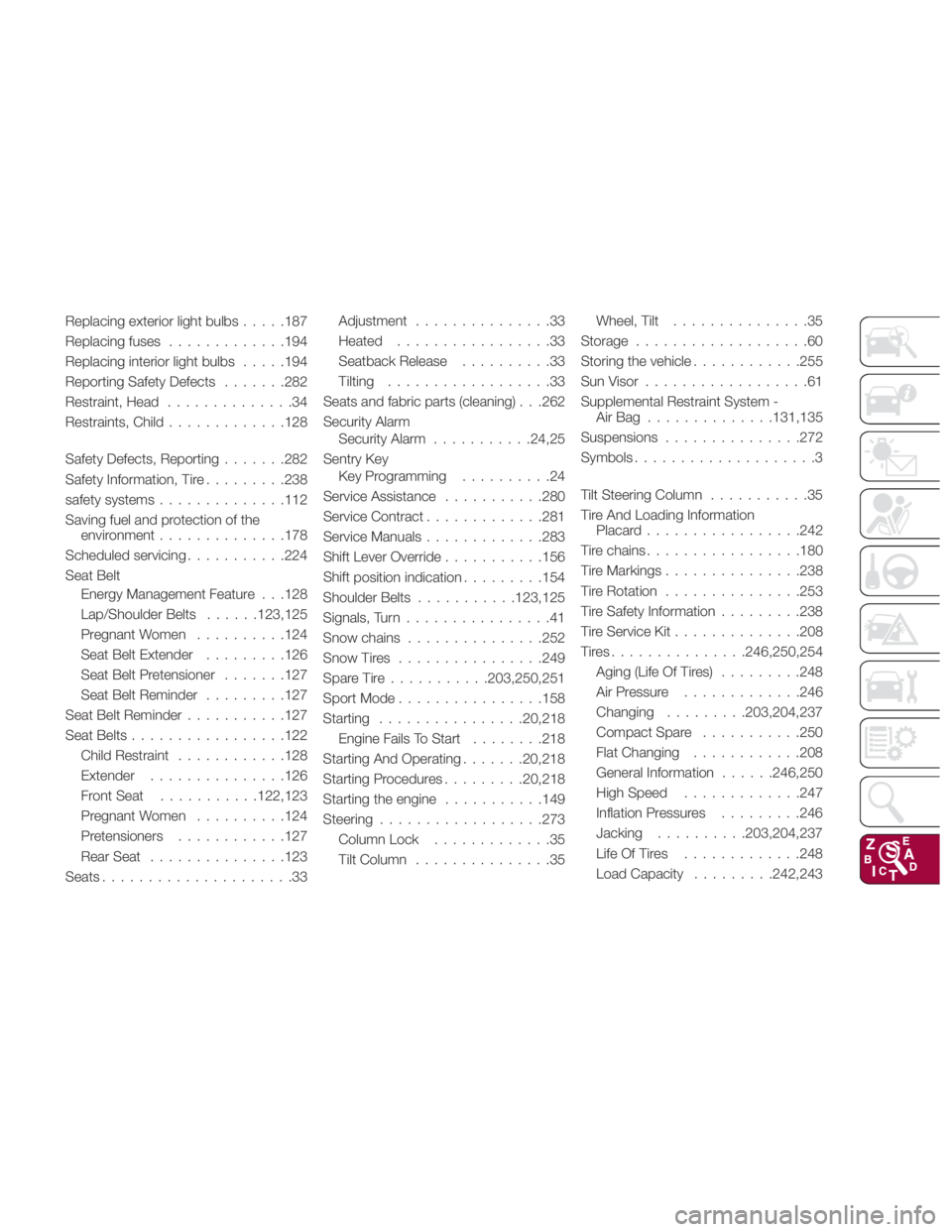
Replacing exterior light bulbs .... .187
Replacing fuses ............ .194
Replacing interior light bulbs .... .194
Reporting Safety Defects ...... .282
Restraint, Head ..............34
Restraints, Child ............ .128
Safety Defects, Reporting ...... .282
Safety Information, Tire ........ .238
safety systems ............. .112
Saving fuel and protection of the
environment ............. .178
Scheduled servicing .......... .224
Seat Belt
Energy Management Feature . . .128
Lap/Shoulder Belts ..... .123,125
Pregnant Women ......... .124
Seat Belt Extender ........ .126
Seat Belt Pretensioner ...... .127
Seat Belt Reminder ........ .127
Seat Belt Reminder .......... .127
Seat Belts ................ .122
Child Restraint ........... .128
Extender .............. .126
Front Seat .......... .122,123
Pregnant Women ......... .124
Pretensioners ........... .127
Rear Seat .............. .123
Seats .....................33 Adjustment ...............33
Heated .................33
Seatback Release ..........33
Tilting ..................33
Seats and fabric parts (cleaning) . . .262
Security Alarm
Security Alarm .......... .24,25
Sentry Key
Key Programming ..........24
Service Assistance .......... .280
Service Contract ............ .281
Service Manuals ............ .283
Shift Lever Override
.......... .156
Shift
position indication ........ .154
Shoulder Belts .......... .123,125
Signals, Turn ................41
Snow chains .............. .252
Snow Tires ............... .249
Spare Tire .......... .203,250,251
Sport Mode ............... .158
Starting ............... .20,218
Engine Fails To Start ....... .218
Starting And Operating ...... .20,218
Starting Procedures ........ .20,218
Starting the engine .......... .149
Steering ................. .273
Column Lock .............35
Tilt Column ...............35 Wheel, Tilt ...............35
Storage ...................60
Storing the vehicle ........... .255
Sun Visor ..................61
Supplemental Restraint System -
AirBag ............. .131,135
Suspensions .............. .272
Symbols ....................3
Tilt Steering Column ...........35
Tire And Loading Information
Placard ................ .242
Tire chains ................ .180
Tire Markings .............. .238
Tire Rotation .............. .253
Tire Safety Information ........ .238
Tire Service Kit ............. .208
Tires.............. .246,250,254
Aging (Life Of Tires) ........ .248
Air Pressure ............ .246
Changing ........ .203,204,237
Compact Spare .......... .250
Flat Changing ........... .208
General Information .....
.246,250
High
Speed ............
.247
Inflation Pressures ........ .246
Jacking ......... .203,204,237
Life Of Tires ............ .248
Load Capacity ........ .242,243