clutch FIAT SPIDER ABARTH 2017 Owners Manual
[x] Cancel search | Manufacturer: FIAT, Model Year: 2017, Model line: SPIDER ABARTH, Model: FIAT SPIDER ABARTH 2017Pages: 292, PDF Size: 9.24 MB
Page 4 of 292
Read This Carefully REFUELING Only refuel with unleaded gasoline with a recommended rating of 91 octane. A rating less than 87 octane is not acceptable. Do not use
gasoline containing methanol or ethanol E85. Using these mixtures may cause misfiring and handling issues, as well as damage fundamental
components of the fuel supply system.
STARTING THE ENGINE If equipped with a manual transmission : Be sure that the parking brake is engaged; place the gear selector in NEUTRAL, fully depress the
clutch pedal without pressing the accelerator, and then push the ignition button. The engine will start as soon as the ignition is pushed.
If equipped with an automatic transmission : Be sure that the parking brake is engaged and that the gear selector is in PARK (P) or
NEUTRAL (N), depress the brake pedal, and then push the ignition button. The engine will start as soon as the ignition is pushed.
PARKING ON FLAMMABLE MATERIAL The catalytic converter develops high temperatures during operation. Do not park the vehicle on grass, dry leaves, pine needles or other
flammable material: fire hazard.
RESPECTING THE ENVIRONMENT The vehicle is equipped with a system that carries out a continuous diagnosis of the emission-related components in order to help protect the
environment.
ELECTRICAL ACCESSORIES Contact your authorized dealer if you decide to add electrical accessories (with the risk of gradually draining the battery) after buying the
vehicle. They can calculate the overall electrical requirement and check that the vehicle's electric system can support the required load.
SCHEDULED SERVICING Correct maintenance of the vehicle is essential for ensuring that it maintains its performance and its safety features, its environmental
friendliness and low running costs are unchanged over time.
Page 20 of 292
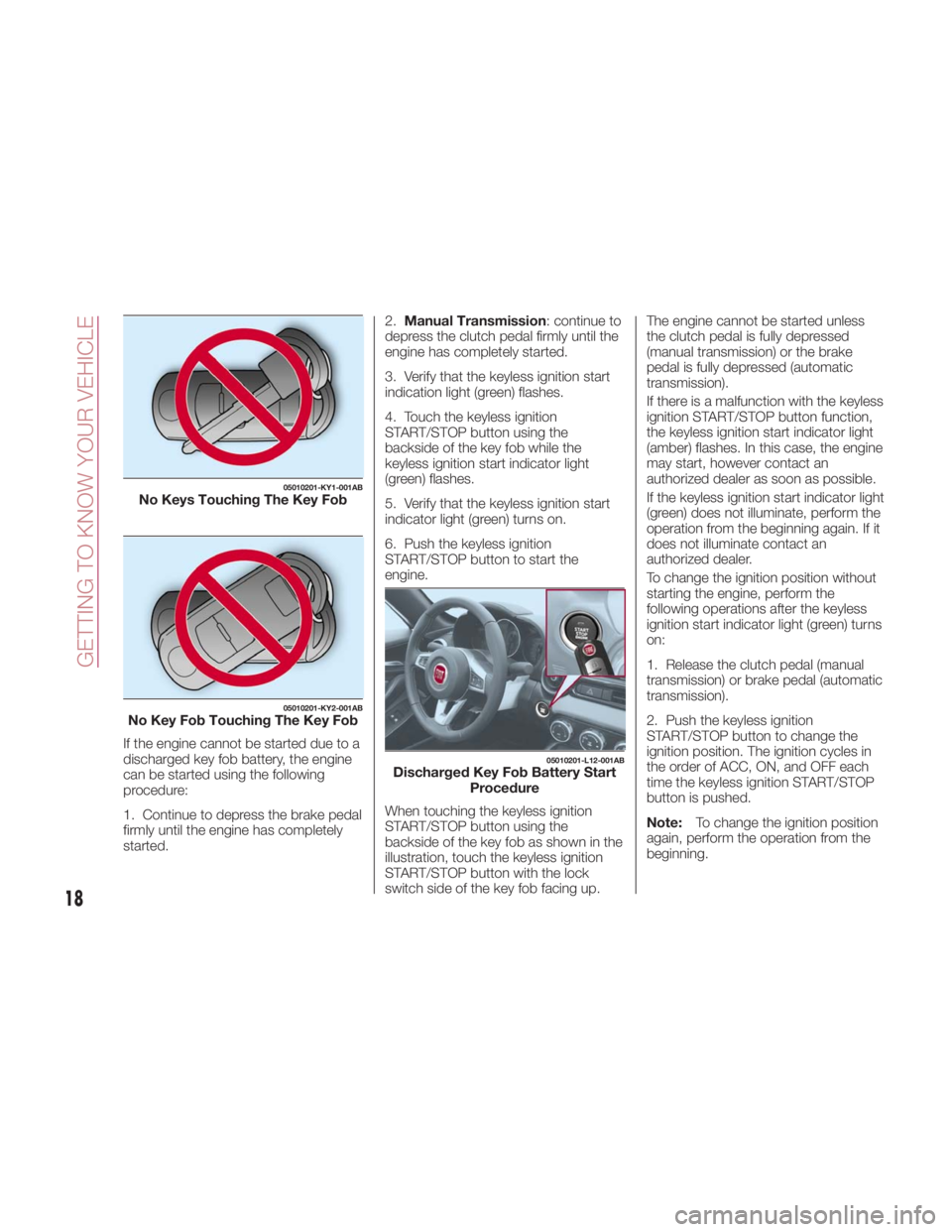
If the engine cannot be started due to a
discharged key fob battery, the engine
can be started using the following
procedure:
1. Continue to depress the brake pedal
firmly until the engine has completely
started. 2. Manual Transmission : continue to
depress the clutch pedal firmly until the
engine has completely started.
3. Verify that the keyless ignition start
indication light (green) flashes.
4. Touch the keyless ignition
START/STOP button using the
backside of the key fob while the
keyless ignition start indicator light
(green) flashes.
5. Verify that the keyless ignition start
indicator light (green) turns on.
6. Push the keyless ignition
START/STOP button to start the
engine.
When touching the keyless ignition
START/STOP button using the
backside of the key fob as shown in the
illustration, touch the keyless ignition
START/STOP button with the lock
switch side of the key fob facing up. The engine cannot be started unless
the clutch pedal is fully depressed
(manual transmission) or the brake
pedal is fully depressed (automatic
transmission).
If there is a malfunction with the keyless
ignition START/STOP button function,
the keyless ignition start indicator light
(amber) flashes. In this case, the engine
may start, however contact an
authorized dealer as soon as possible.
If the keyless ignition start indicator light
(green) does not illuminate, perform the
operation from the beginning again. If it
does not illuminate contact an
authorized dealer.
To change the ignition position without
starting the engine, perform the
following operations after the keyless
ignition start indicator light (green) turns
on:
1. Release the clutch pedal (manual
transmission) or brake pedal (automatic
transmission).
2. Push the keyless ignition
START/STOP button to change the
ignition position. The ignition cycles in
the order of ACC, ON, and OFF each
time the keyless ignition START/STOP
button is pushed.
Note: To change the ignition position
again, perform the operation from the
beginning.05010201-KY1-001AB
No Keys Touching The Key Fob 05010201-KY2-001AB
No Key Fob Touching The Key Fob 05010201-L12-001AB
Discharged Key Fob Battery Start
Procedure
18
GETTING TO KNOW YOUR VEHICLE
Page 21 of 292
Emergency Operation For Starting
The Engine
If the key warning light (red) illuminates,
or the keyless ignition start indicator
light (amber) flashes, this could indicate
that the engine may not start using the
usual starting method. Contact an
authorized dealer as soon as possible.
If this occurs, the engine can be
force-started. push and hold the
keyless ignition START/STOP button
until the engine starts.
Other procedures necessary for starting
the engine such as having the key fob
in the vehicle, and depressing the
clutch pedal (manual transmission) or
the brake pedal (automatic
transmission) are required.
Key Fob Cautions
Because the key fob uses low-intensity
radio waves, it may not function
correctly under the following conditions:
The key fob is carried with
communication devices such as cellular
phones.
The key fob contacts or is covered
by a metal object. The key fob is near electronic
devices such as personal computers.
Non-FCA genuine electronic
equipment is installed in the vehicle.
There is equipment which discharges
radio waves near the vehicle.
The key fob may consume battery
power excessively if it receives
high-intensity radio waves. Do not place
the key fob near electronic devices
such as televisions or personal
computers.
To avoid damage to the key fob, DO
NOT:
Drop the key fob.
Get the key fob wet.
Disassemble the key fob unless
replacing battery.
Expose the key fob to high
temperatures on places such as the
instrument panel or engine
compartment, under direct sunlight.
Expose the key fob to any kind of
magnetic field.
Place heavy objects on the key fob.
Put the key fob in an ultrasonic
cleaner.
Put any magnetized objects close to
the key fob. General Information
The following regulatory statement
applies to all Radio Frequency (RF)
devices equipped in this vehicle:
This device complies with Part 15 of the
FCC Rules and with Industry Canada
license-exempt RSS standard(s).
Operation is subject to the following
two conditions:
1. This device may not cause harmful
interference.
2. This device must accept any
interference received, including
interference that may cause undesired
operation.
Note: Changes or modifications not
expressly approved by the party
responsible for compliance could void
the user’s authority to operate the
equipment.
19
Page 22 of 292
IGNITION SWITCH Push Button Start
Positions
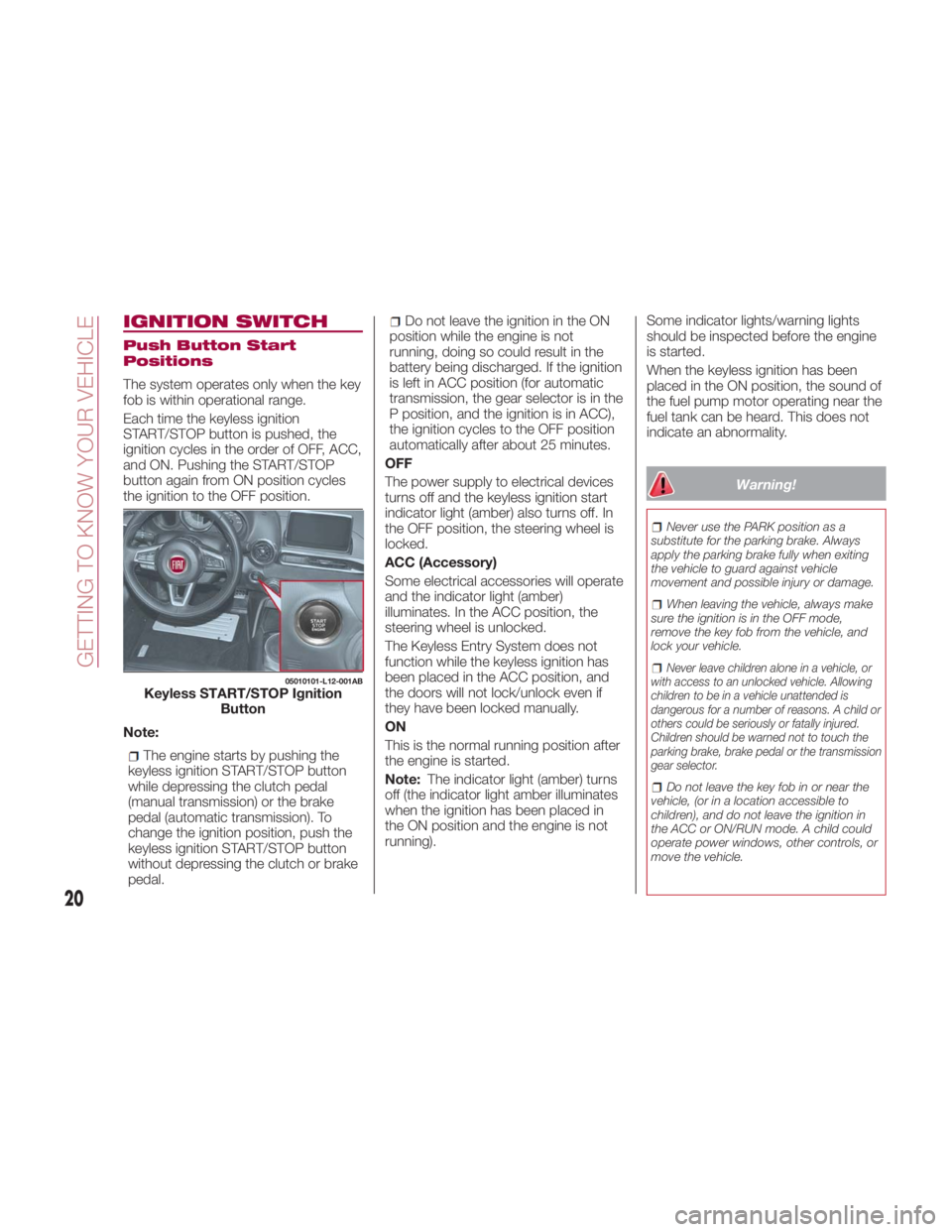
The system operates only when the key
fob is within operational range.
Each time the keyless ignition
START/STOP button is pushed, the
ignition cycles in the order of OFF, ACC,
and ON. Pushing the START/STOP
button again from ON position cycles
the ignition to the OFF position.
Note:
The engine starts by pushing the
keyless ignition START/STOP button
while depressing the clutch pedal
(manual transmission) or the brake
pedal (automatic transmission). To
change the ignition position, push the
keyless ignition START/STOP button
without depressing the clutch or brake
pedal. Do not leave the ignition in the ON
position while the engine is not
running, doing so could result in the
battery being discharged. If the ignition
is left in ACC position (for automatic
transmission, the gear selector is in the
P position, and the ignition is in ACC),
the ignition cycles to the OFF position
automatically after about 25 minutes.
OFF
The power supply to electrical devices
turns off and the keyless ignition start
indicator light (amber) also turns off. In
the OFF position, the steering wheel is
locked.
ACC (Accessory)
Some electrical accessories will operate
and the indicator light (amber)
illuminates. In the ACC position, the
steering wheel is unlocked.
The Keyless Entry System does not
function while the keyless ignition has
been placed in the ACC position, and
the doors will not lock/unlock even if
they have been locked manually.
ON
This is the normal running position after
the engine is started.
Note: The indicator light (amber) turns
off (the indicator light amber illuminates
when the ignition has been placed in
the ON position and the engine is not
running). Some indicator lights/warning lights
should be inspected before the engine
is started.
When the keyless ignition has been
placed in the ON position, the sound of
the fuel pump motor operating near the
fuel tank can be heard. This does not
indicate an abnormality.
Warning! Never use the PARK position as a
substitute for the parking brake. Always
apply the parking brake fully when exiting
the vehicle to guard against vehicle
movement and possible injury or damage.
When leaving the vehicle, always make
sure the ignition is in the OFF mode,
remove the key fob from the vehicle, and
lock your vehicle.
Never leave children alone in a vehicle, or
with access to an unlocked vehicle. Allowing
children to be in a vehicle unattended is
dangerous for a number of reasons. A child or
others could be seriously or fatally injured.
Children should be warned not to touch the
parking brake, brake pedal or the transmission
gear selector.
Do not leave the key fob in or near the
vehicle, (or in a location accessible to
children), and do not leave the ignition in
the ACC or ON/RUN mode. A child could
operate power windows, other controls, or
move the vehicle.05010101-L12-001AB
Keyless START/STOP Ignition
Button
20
GETTING TO KNOW YOUR VEHICLE
Page 151 of 292
STARTING THE
ENGINE Starting The Engine
Before starting the engine, adjust the
seat, the interior rear view mirrors, and
the door mirrors, and fasten the seat
belt correctly.
Warning!When leaving the vehicle, always remove
the key fob from the vehicle and lock your
vehicle.
Never leave children alone in a vehicle,
or with access to an unlocked vehicle.
Allowing children to be in a vehicle
unattended is dangerous for a number of
reasons. A child or others could be
seriously or fatally injured. Children should
be warned not to touch the parking brake,
brake pedal or the transmission gear
selector.
Do not leave the key fob in or near the
vehicle, or in a location accessible to
children, and do not leave the ignition of a
vehicle equipped with Advanced Keyless
Entry in the ACC or ON/RUN mode. A child
could operate power windows, other
controls, or move the vehicle.
Do not leave children or animals inside
parked vehicles in hot weather. Interior heat
build-up may cause serious injury or death. Never press the accelerator pedal for
starting the engine.
Models Equipped With A
Manual Transmission
Proceed as follows:
1. Engage the parking brake and place
the gear selector in NEUTRAL.
2. Place the start button in the ACC
mode.
3. Fully depress the clutch pedal
without touching the accelerator.
4. Place the start button in the ON
mode, push and release it as soon as
the engine starts. If the engine does not
start within 10 seconds, push the start
button to OFF mode and wait for
10-15 seconds before repeating the
starting procedure.
Models Equipped With
An Automatic
Transmission
Proceed as follows:
1. Engage the parking brake and place
the gear selector to P (PARK) or N
(NEUTRAL).
2. Fully depress the brake pedal
without touching the accelerator.
3. Place the start button in the ACC
mode. 4. Place the start button in the ON
mode, push and release it as soon as
the engine starts. If the engine does not
start within 10 seconds, push the start
button to OFF mode and wait for
10-15 seconds before repeating the
starting procedure.
Cold Weather Operation
Regarding Cold Start Disable
When the ambient temperature is
extremely low, the engine may not
crank even when the engine starting
procedure is performed. At this time,
the Cold Start Disable Indicator light in
the instrument cluster flashes. However,
this does not indicate a problem.
Perform the necessary procedures (see
“Warning lights And Messages”
paragraph in “Getting To Know Your
Instrument Panel” chapter).
Regarding Ice Breaker
When the ambient temperature is low,
the start of cranking may be delayed
after engine starting procedure is
performed. At this time, the Cold Start
Disable Indicator light in the instrument
cluster illumintes. However, this does
not indicate a problem.
Refer to your authorized dealer
regarding other related parts which are
to be input such as function name,
operating scenario (condition) of each
function, indicator operation, and user
operation/procedure information.
149
Page 152 of 292
Extended Park Starting
Note: Extended Park condition occurs
when the vehicle has not been started
or driven for at least 30 days.
1. Install a battery charger or jumper
cables to the battery to ensure a full
battery charge during the crank cycle.
2. Place the ignition in the START
mode and release it when the engine
starts.
3. If the engine fails to start within
10 seconds, place the ignition in the
STOP (OFF/LOCK) mode, wait five
seconds to allow the starter to cool,
then repeat the Extended Park Starting
procedure.
4. If the engine fails to start after eight
attempts, allow the starter to cool for at
least 10 minutes, then repeat the
procedure.
Caution!To prevent damage to the starter, do not
crank continuously for more than
10 seconds at a time. Wait 10 to
15 seconds before trying again. After Starting —
Warming Up The Engine
Proceed as follows:
1. Travel slowly, letting the engine run
at a reduced RPM, without accelerating
suddenly.
2. It is recommended to wait until the
digital engine coolant temperature
indicator starts moving before
demanding full performance.
Stopping The Engine
Proceed as follows:
1. Park the car in a position that is not
dangerous for oncoming traffic, if
equipped with manual transmission
place gear selector in FIRST (1st) or
REVERSE (R) gear, if equipped with
automatic transmission place the gear
selector to PARK (P).
2. Push and release the ignition button
to STOP the engine. BRAKE SYSTEM This vehicle has power-assisted brakes
that adjust automatically through
normal use. Should power-assist fail,
you can stop by applying greater force
than normal to the brake pedal. But the
distance required to stop will be greater
than usual.
Note: Always depress the brake pedal
with the right foot. Applying the brakes
with the unaccustomed left foot could
slow your reaction time to an
emergency situation resulting in
insufficient braking operation.
Do not drive with your foot held on the
clutch pedal or brake pedal, or hold the
clutch pedal depressed halfway
unnecessarily. Doing so could result in
the following:
The clutch and brake parts will wear
out more quickly.
The brakes can overheat and
adversely affect brake performance.
150
STARTING AND OPERATING
Page 154 of 292
Brake Pad Wear Indicator
When the disc brake pads become
worn, the built-in wear indicators
contact the rotors. This causes a
screeching noise to warn that the pads
should be replaced. When you hear this
noise contact your authorized dealer as
soon as possible.
Brake Assist
During emergency braking situations
when it is necessary to depress the
brake pedal with greater force, the
brake assist system provides braking
assistance, thus enhancing braking
performance. When the brake pedal is
depressed hard or depressed more
quickly, the brakes apply more firmly.
Note:
When the brake pedal is depressed
hard or depressed more quickly, the
pedal will feel softer but the brakes will
apply more firmly. This is a normal
effect of the brake assist operation and
does not indicate a malfunction.
When the brake pedal is depressed
hard or depressed more quickly, a
motor/pump operation noise may be
heard. This is a normal effect of the
brake assist and does not indicate a
malfunction.
The brake assist equipment does
not supersede the functionality of the
vehicle's main braking system. MANUAL
TRANSMISSION Manual Transmission
Warning!You or others could be injured if you leave
the vehicle unattended without having the
park brake fully applied. The park brake
should always be applied when the driver
is not in the vehicle, especially on an
incline.
Caution!Never drive with your foot resting on the
clutch pedal, or attempt to hold the vehicle
on a hill with the clutch pedal partially
engaged, as this will cause abnormal wear
on the clutch.
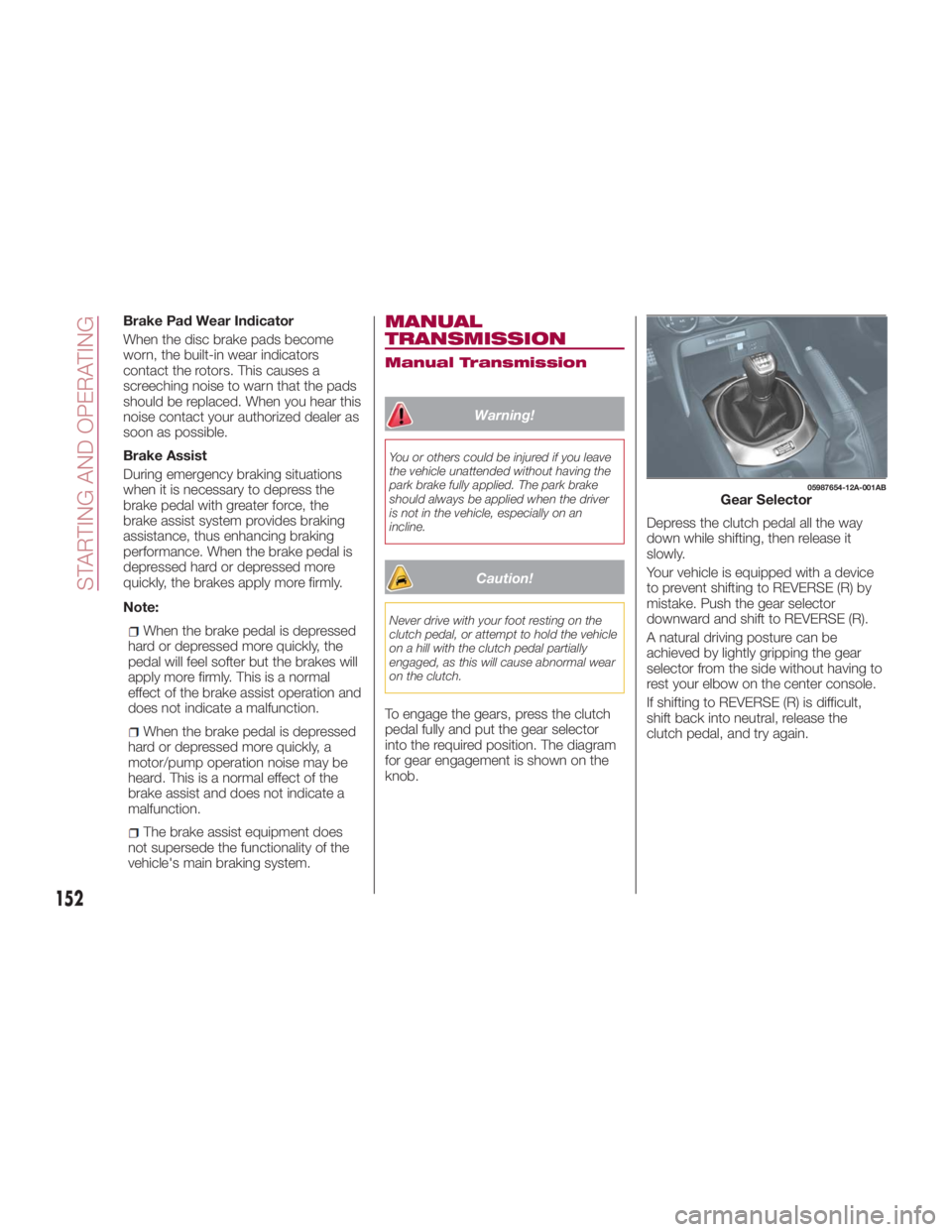
To engage the gears, press the clutch
pedal fully and put the gear selector
into the required position. The diagram
for gear engagement is shown on the
knob. Depress the clutch pedal all the way
down while shifting, then release it
slowly.
Your vehicle is equipped with a device
to prevent shifting to REVERSE (R) by
mistake. Push the gear selector
downward and shift to REVERSE (R).
A natural driving posture can be
achieved by lightly gripping the gear
selector from the side without having to
rest your elbow on the center console.
If shifting to REVERSE (R) is difficult,
shift back into neutral, release the
clutch pedal, and try again. 05987654-12A-001AB
Gear Selector
152
STARTING AND OPERATING
Page 155 of 292
With Parking Sensor System
When the gear selector is shifted to the
REVERSE (R) position with the ignition
placed in the ON mode, the parking
sensor system is activated an audible
sound is heard.
Caution!Keep your foot off the clutch pedal
except when shifting gears. Also, do not
use the clutch to hold the vehicle on an hill
or grade. Riding the clutch will cause
needless clutch wear and damage.
Do not apply any excessive lateral force
to the gear selector when changing from
fifth to fourth gear. This could lead to the
accidental selection of second gear, which
could result in damage to the transmission.
Make sure the vehicle comes to a
complete stop before shifting to REVERSE
(R). Shifting to REVERSE (R) while the
vehicle is still moving may damage the
transmission.
Reverse can only be engaged when the
vehicle is completely stationary. With the
engine running, wait at least two seconds
with the clutch pedal fully pressed before
engaging reverse to prevent damage to the
gears. AUTOMATIC
TRANSMISSION — IF
EQUIPPED Shift Interlock
This vehicle is equipped with an
interlock system that holds the
transmission gear selector in PARK (P)
unless the brakes are applied. To shift
the transmission out of PARK (P), the
ignition must be placed in the ON/RUN
mode (engine running or not) and the
brake pedal must be pressed.
Warning!It is dangerous to shift out of PARK or
NEUTRAL if the engine speed is higher
than idle speed. If your foot is not firmly
pressing the brake pedal, the vehicle could
accelerate quickly forward or in reverse.
You could lose control of the vehicle and hit
someone or something. Only shift into gear
when the engine is idling normally and your
foot is firmly pressing the brake pedal.
Unintended movement of a vehicle
could injure those in or near the vehicle. As
with all vehicles, you should never exit a
vehicle while the engine is running. Before
exiting a vehicle, always apply the park
brake, shift the transmission into PARK,
and turn the ignition OFF. When the ignition
is in the OFF mode, the transmission is
locked in PARK, securing the vehicle
against unwanted movement. When leaving the vehicle, always make
sure the ignition is in the OFF mode,
remove the key fob from the vehicle, and
lock the vehicle.
Never leave children alone in a vehicle,
or with access to an unlocked vehicle.
Allowing children to be in a vehicle
unattended is dangerous for a number of
reasons. A child or others could be
seriously or fatally injured. Children should
be warned not to touch the parking brake,
brake pedal or the transmission gear
selector.
Do not leave the key fob in or near the
vehicle (or in a location accessible to
children), and do not leave the ignition in
the ACC or ON/RUN mode. A child could
operate power windows, other controls, or
move the vehicle.
Caution!Damage to the transmission may occur if
the following precautions are not observed:
Shift into or out of PARK or REVERSE
only after the vehicle has come to a
complete stop.
Do not shift between PARK, REVERSE,
NEUTRAL, or DRIVE when the engine is
above idle speed.
Before shifting into any gear, make sure
your foot is firmly pressing the brake pedal.
153
Page 162 of 292
Deactivating Speed Control
Push the OFF/CAN button. The
warning light (amber) in the
instrument cluster turns off.
When a speed has been set :the
warning light (green) in the
instrument cluster is illuminated, push
and hold the OFF/CAN button or push
the OFF/CAN button twice to
deactivate.
When a speed has not been set :the
warning light (amber) in the
instrument cluster is illuminated, push
the OFF/CAN button to deactivate.
Setting A Desired Speed
Proceed as follows:
1. Activate the Speed Control device
by pushing the ON button. The cruise
warning light (amber) illuminates.
2. Accelerate to the desired speed,
which must be more than 25 mph
(40 km/h).
3. Set the Speed Control by pushing
the SET (-) button at the desired speed.
The Speed Control is set at the
moment the SET (-) button is pushed.
Release the accelerator pedal
simultaneously. The
warning light
(green) illuminates.
Note: The Speed Control setting
cannot be performed under the
following conditions: Automatic transmission: the gear
selector is in the PARK or NEUTRAL
position.
Manual transmission: the gear
selector is in the NEUTRAL position or
when the clutch is disengaged (clutch
is depressed).
The parking brake is applied.
Release the SET (-) button at the
desired speed, otherwise the speed will
continue decreasing while the SET (-)
button is pushed and held (except
when the accelerator pedal is
depressed).
Note:
Release the SET (-) button at the
desired speed, otherwise the speed
will continue decreasing while the SET
(-) button is pushed and held (except
when the accelerator pedal is
depressed).
On a steep grade, the vehicle may
momentarily slow down while
ascending, or speed up while
descending.
The Speed Control will cancel if the
vehicle speed decreases below
16 mph (25 km/h) when climbing a
steep incline.
The Speed Control may cancel at
about 9 mph (15 km/h) below the
preset speed such as when climbing a
long, steep incline. The vehicle’s set speed is displayed in
the instrument cluster.
Increasing Speed
To increase speed using the Speed
Control buttons:
Push the RES (+) button and hold it ,
your vehicle will accelerate. Release the
button at the desired speed.
Push the RES (+) button and release
it immediately , to adjust the set speed.
Multiple pushes of the button will
increase the set speed according to the
number of times it is pushed.
Increasing speed with a single RES
(+) button operation:
If the instrument cluster display for
vehicle speed is indicated in mph:
speed will increase in 1 mph
increments.
If the instrument cluster display for
vehicle speed is indicated in km/h:
speed will increase in 1 km/h
increments.
To increase speed using
accelerator pedal:
Press the accelerator pedal to
accelerate to the desired speed.
Push the SET (-) button and release it
immediately. This new set speed will be
saved.
160
STARTING AND OPERATING
Page 163 of 292
Note: Accelerate the vehicle to speed
up temporarily with the accelerator
pedal when the Speed Control is on.
Increasing the speed will not interfere
with, or change the set speed. Take
your foot off the accelerator to return to
the set speed.
Decreasing Speed
To decrease speed using the Speed
Control buttons:
Push the SET (-) button and hold it ,
the vehicle will gradually slow down.
Release the button at the desired
speed.
Push the SET (-) button and release
it immediately to adjust the set speed.
Multiple button pushes will decrease
the set speed according to the number
of times it is pushed.
Decreasing speed with a single SET
(-) button operation:
If the instrument cluster display for
vehicle speed is indicated in mph: the
speed will decrease in 1 mph
increments.
If the instrument cluster display for
vehicle speed is indicated in km/h: the
speed will decrease in 1 km/h
increments. Resume Speed
If any other method besides the
OFF/CAN button was used to cancel
cruising speed (such as applying the
brake pedal or pressing in the clutch
pedal) and the system is still activated,
the most recent set speed will
automatically resume when the RES (+)
button is pushed.
If vehicle speed is below 25 mph
(40 km/h), increase the vehicle speed
up to 16 mph (25 km/h) or more and
push RES (+) button.
Temporarily Canceling
The System
Warning!Leaving the Speed Control system on
when not in use is dangerous. You could
accidentally set the system or cause it to
go faster than you want. You could lose
control and have an accident. Always leave
the system OFF when you are not using it.
To temporarily cancel the system, use
one of these methods:
Slightly press the brake pedal.
Press the clutch pedal (if equipped
with a manual transmission). Push OFF/CAN button.
If the RES (+) button is pushed when
the vehicle speed is 25 mph (40 km/h)
or higher, the system reverts to the
previously set speed.
Note: If any of the following conditions
occur, the Speed Control system is
temporarily canceled:
The parking brake is applied.
Automatic Transmission: the
gear selector is in the PARK or
NEUTRAL position.
Manual Transmission: the gear
selector is in the NEUTRAL position.
Automatic Transmission: the
Speed Control cannot be canceled
while driving in manual mode (gear
selector shifted from D to M position).
Therefore, engine braking will not be
applied even if the transmission is
shifted down to a lower gear. If
deceleration is required, lower the set
speed or press the brake pedal.
When the Speed Control system is
temporarily canceled, the speed cannot
be reset.
161