Door lock FIAT STILO 2006 1.G User Guide
[x] Cancel search | Manufacturer: FIAT, Model Year: 2006, Model line: STILO, Model: FIAT STILO 2006 1.GPages: 274, PDF Size: 4.76 MB
Page 20 of 274
19
SAFETY
DEVICES
CORRECT USE
OF THE CAR
WARNING
LIGHTS AND
MESSAGES
IN AN
EMERGENCY
CAR
MAINTENANCE
TECHNICAL
SPECIFICATIONS
INDEX
DASHBOARD
AND CONTROLS
ANTI-RAISING SENSOR
The anti-raising sensor detects any ab-
normal car raising/sloping, even partial
(e.g.: attempt to remove a wheel).
This sensor can detect the smallest car
sideslip angle changes, both longitudinally
and transversally.
Sideslip angle changes lower than 0.5°/min.
(e.g.: slow tyre flattening) are not consid-
ered.
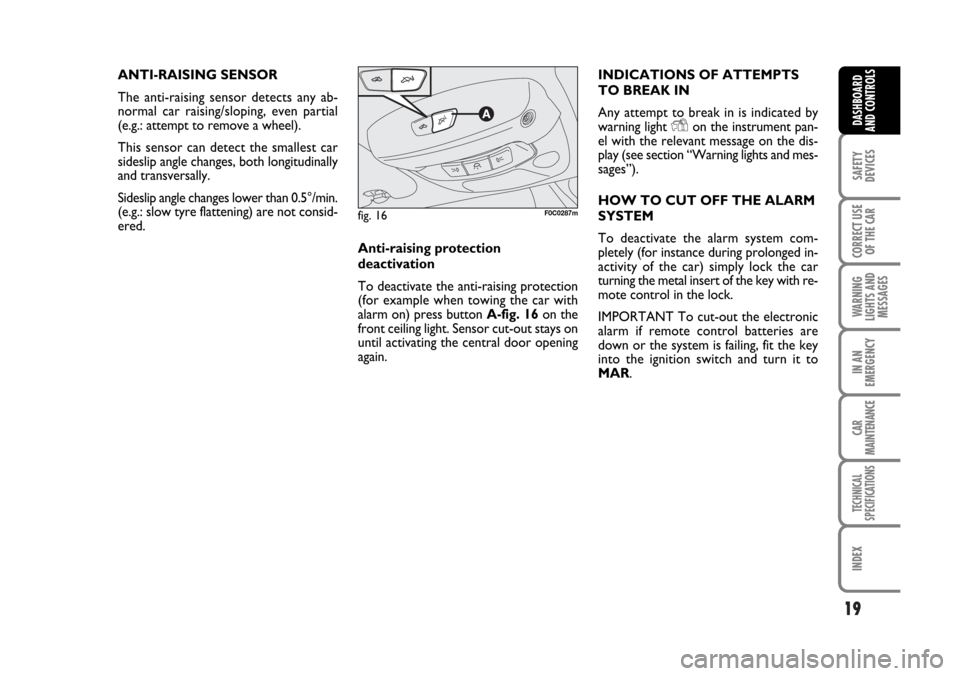
Anti-raising protection
deactivation
To deactivate the anti-raising protection
(for example when towing the car with
alarm on) press button A-fig. 16 on the
front ceiling light. Sensor cut-out stays on
until activating the central door opening
again.INDICATIONS OF ATTEMPTS
TO BREAK IN
Any attempt to break in is indicated by
warning light
Yon the instrument pan-
el with the relevant message on the dis-
play (see section “Warning lights and mes-
sages”).
HOW TO CUT OFF THE ALARM
SYSTEM
To deactivate the alarm system com-
pletely (for instance during prolonged in-
activity of the car) simply lock the car
turning the metal insert of the key with re-
mote control in the lock.
IMPORTANT To cut-out the electronic
alarm if remote control batteries are
down or the system is failing, fit the key
into the ignition switch and turn it to
MAR.
fig. 16F0C0287m
Page 21 of 274
20
SAFETY
DEVICES
CORRECT USE
OF THE CAR
WARNING
LIGHTS AND
MESSAGES
IN AN
EMERGENCY
CAR
MAINTENANCE
TECHNICAL
SPECIFICATIONS
INDEX
DASHBOARD
AND CONTROLS
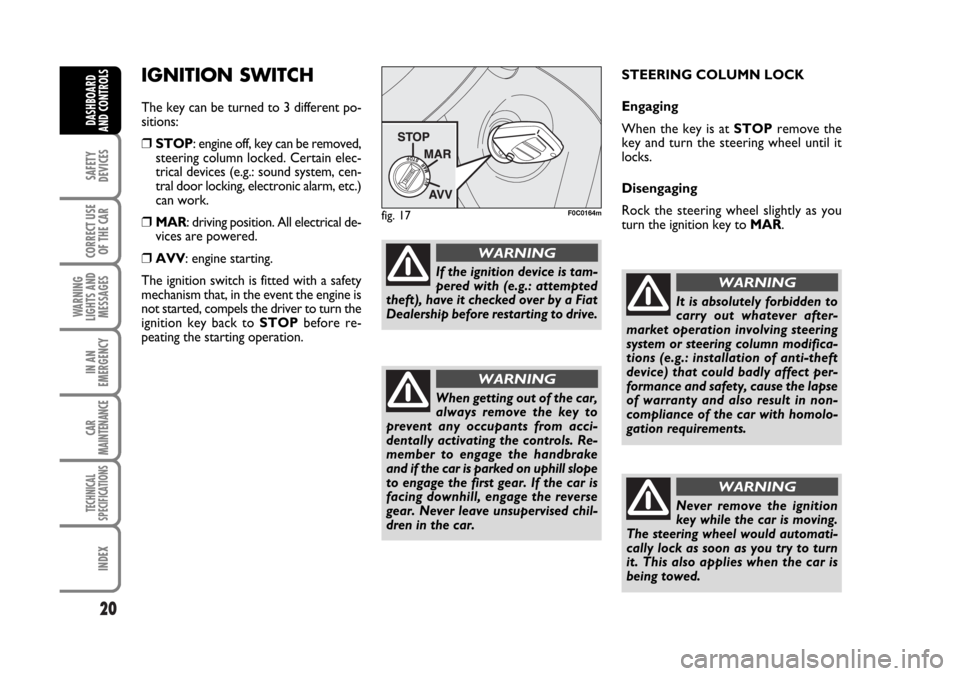
IGNITION SWITCH
The key can be turned to 3 different po-
sitions:
❒STOP: engine off, key can be removed,
steering column locked. Certain elec-
trical devices (e.g.: sound system, cen-
tral door locking, electronic alarm, etc.)
can work.
❒MAR: driving position. All electrical de-
vices are powered.
❒AVV: engine starting.
The ignition switch is fitted with a safety
mechanism that, in the event the engine is
not started, compels the driver to turn the
ignition key back to STOPbefore re-
peating the starting operation.STEERING COLUMN LOCK
Engaging
When the key is at STOPremove the
key and turn the steering wheel until it
locks.
Disengaging
Rock the steering wheel slightly as you
turn the ignition key to MAR.
fig. 17F0C0164m
If the ignition device is tam-
pered with (e.g.: attempted
theft), have it checked over by a Fiat
Dealership before restarting to drive.
WARNING
When getting out of the car,
always remove the key to
prevent any occupants from acci-
dentally activating the controls. Re-
member to engage the handbrake
and if the car is parked on uphill slope
to engage the first gear. If the car is
facing downhill, engage the reverse
gear. Never leave unsupervised chil-
dren in the car.
WARNING
It is absolutely forbidden to
carry out whatever after-
market operation involving steering
system or steering column modifica-
tions (e.g.: installation of anti-theft
device) that could badly affect per-
formance and safety, cause the lapse
of warranty and also result in non-
compliance of the car with homolo-
gation requirements.
WARNING
Never remove the ignition
key while the car is moving.
The steering wheel would automati-
cally lock as soon as you try to turn
it. This also applies when the car is
being towed.
WARNING
Page 31 of 274
30
SAFETY
DEVICES
CORRECT USE
OF THE CAR
WARNING
LIGHTS AND
MESSAGES
IN AN
EMERGENCY
CAR
MAINTENANCE
TECHNICAL
SPECIFICATIONS
INDEX
DASHBOARD
AND CONTROLS
Automatic central door locking
when travelling (Autoclose)
When activated (On), this function locks
automatically the doors when the car
speed exceeds 20 km/h.
To activate (On) or to deactivate (Off) this
function proceed as follows:
– briefly press button MODE, the display
will show the wording “Travelling”. Word-
ings On or Off will flash (according to pre-
vious setting);
– press button
Õor Ôfor setting;
– briefly press button MODEto go back
to the menu screen or press the button
for long to go back to the standard screen
without storing settings.Setting units (Units)
With this function it is possible to set the
units through three submenus: “Dis-
tances”, “Consumption” and “Tempera-
ture”.
To set the required unit proceed as fol-
lows:
– briefly press button MODE, the display
will show the three submenus;
– press button
Õor Ôto scroll the three
submenus;
– select the required submenu and then
press briefly button MODE;
– if selecting “Distances”: pressing button
MODEbriefly, the display will show “km”
or “mi” (according to previous setting);
– press button
Õor Ôfor setting;
– if selecting “Consumption”: pressing but-
ton MODEbriefly, the display will show
“km/l ”, “l/100km” or “mpg” (according to
previous setting);If set unit is “km”, the display will show fu-
el consumption in km/l or l/100km.
If set unit is “mi” the display will show fu-
el consumption in “mpg”.
– press button
Õor Ôfor setting;
– if selecting “Temperature”: pressing but-
ton MODEbriefly, the display will show
“°C” or “°F” (according to previous set-
ting);
– press button
Õor Ôto select the re-
quired level;
Page 38 of 274
37
SAFETY
DEVICES
CORRECT USE
OF THE CAR
WARNING
LIGHTS AND
MESSAGES
IN AN
EMERGENCY
CAR
MAINTENANCE
TECHNICAL
SPECIFICATIONS
INDEX
DASHBOARD
AND CONTROLS
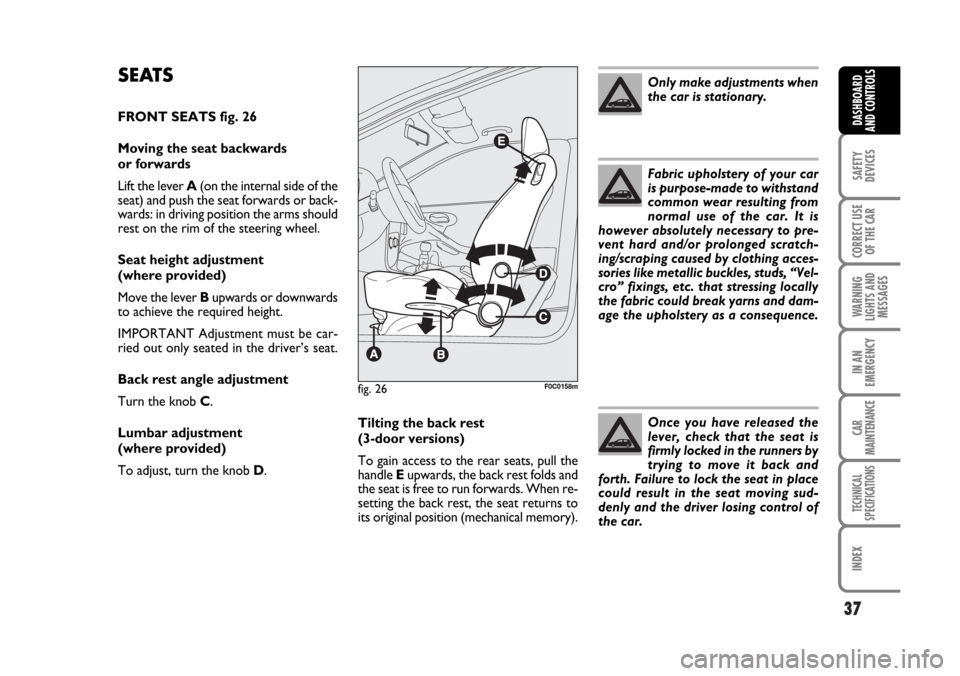
fig. 26F0C0158m
Fabric upholstery of your car
is purpose-made to withstand
common wear resulting from
normal use of the car. It is
however absolutely necessary to pre-
vent hard and/or prolonged scratch-
ing/scraping caused by clothing acces-
sories like metallic buckles, studs, “Vel-
cro” fixings, etc. that stressing locally
the fabric could break yarns and dam-
age the upholstery as a consequence.
Only make adjustments when
the car is stationary.
Once you have released the
lever, check that the seat is
firmly locked in the runners by
trying to move it back and
forth. Failure to lock the seat in place
could result in the seat moving sud-
denly and the driver losing control of
the car.Tilting the back rest
(3-door versions)
To gain access to the rear seats, pull the
handle Eupwards, the back rest folds and
the seat is free to run forwards. When re-
setting the back rest, the seat returns to
its original position (mechanical memory).
SEATS
FRONT SEATS fig. 26
Moving the seat backwards
or forwards
Lift the lever A(on the internal side of the
seat) and push the seat forwards or back-
wards: in driving position the arms should
rest on the rim of the steering wheel.
Seat height adjustment
(where provided)
Move the lever Bupwards or downwards
to achieve the required height.
IMPORTANT Adjustment must be car-
ried out only seated in the driver’s seat.
Back rest angle adjustment
Turn the knob C.
Lumbar adjustment
(where provided)
To adjust, turn the knob D.
Page 69 of 274
68
SAFETY
DEVICES
CORRECT USE
OF THE CAR
WARNING
LIGHTS AND
MESSAGES
IN AN
EMERGENCY
CAR
MAINTENANCE
TECHNICAL
SPECIFICATIONS
INDEX
DASHBOARD
AND CONTROLS
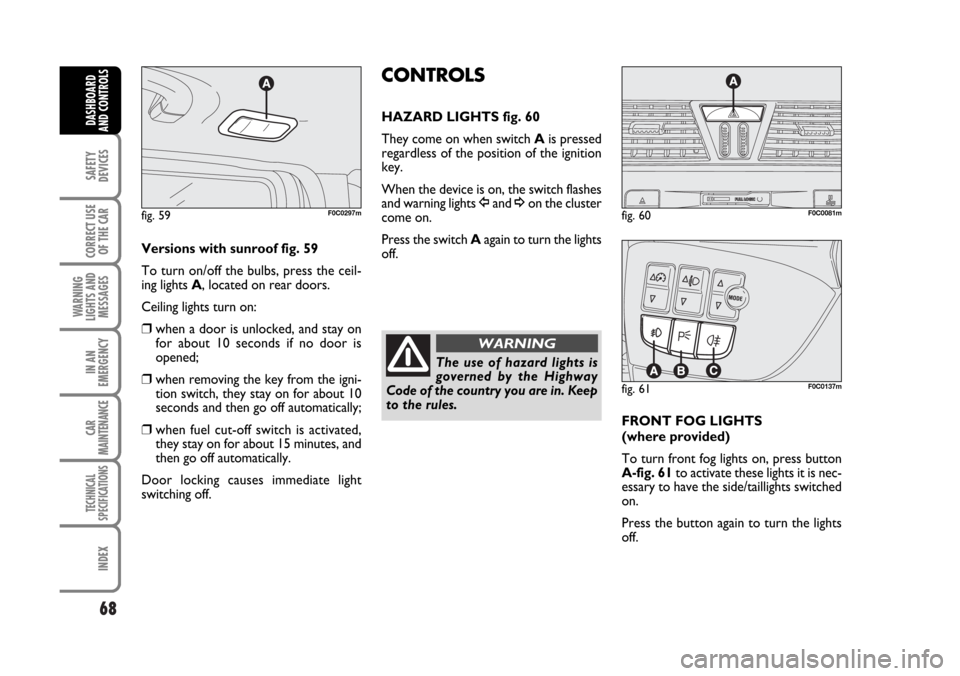
Versions with sunroof fig. 59
To turn on/off the bulbs, press the ceil-
ing lights A, located on rear doors.
Ceiling lights turn on:
❒when a door is unlocked, and stay on
for about 10 seconds if no door is
opened;
❒when removing the key from the igni-
tion switch, they stay on for about 10
seconds and then go off automatically;
❒when fuel cut-off switch is activated,
they stay on for about 15 minutes, and
then go off automatically.
Door locking causes immediate light
switching off.
CONTROLS
HAZARD LIGHTS fig. 60
They come on when switch Ais pressed
regardless of the position of the ignition
key.
When the device is on, the switch flashes
and warning lights
Îand ¥on the cluster
come on.
Press the switch Aagain to turn the lights
off.
FRONT FOG LIGHTS
(where provided)
To turn front fog lights on, press button
A-fig. 61to activate these lights it is nec-
essary to have the side/taillights switched
on.
Press the button again to turn the lights
off. fig. 59F0C0297mfig. 60F0C0081m
fig. 61F0C0137m
The use of hazard lights is
governed by the Highway
Code of the country you are in. Keep
to the rules.
WARNING
Page 70 of 274
69
SAFETY
DEVICES
CORRECT USE
OF THE CAR
WARNING
LIGHTS AND
MESSAGES
IN AN
EMERGENCY
CAR
MAINTENANCE
TECHNICAL
SPECIFICATIONS
INDEX
DASHBOARD
AND CONTROLS
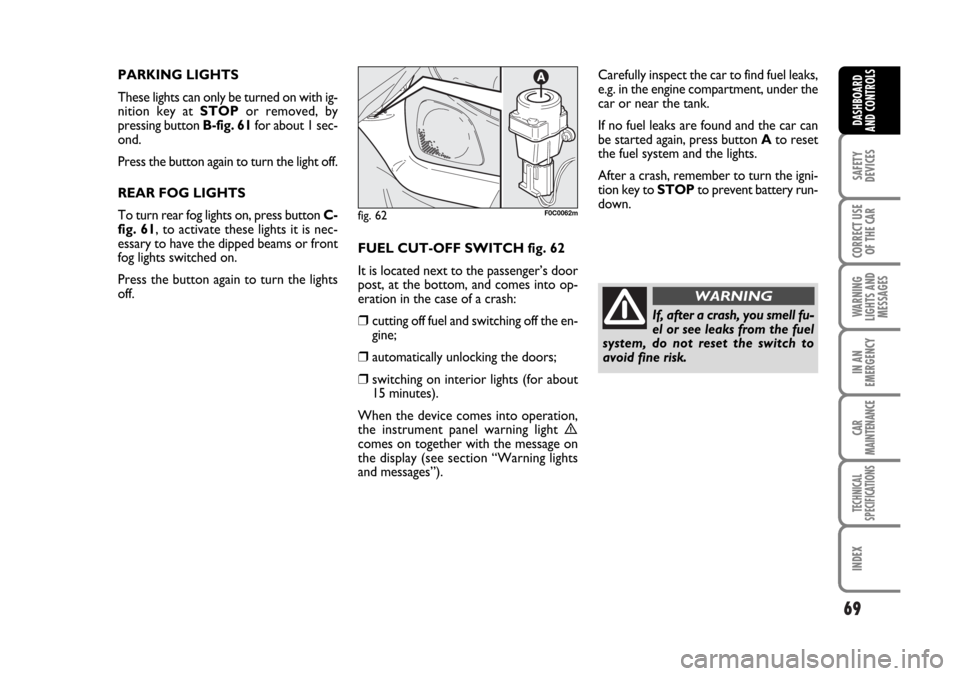
PARKING LIGHTS
These lights can only be turned on with ig-
nition key at STOPor removed, by
pressing button B-fig. 61for about 1 sec-
ond.
Press the button again to turn the light off.
REAR FOG LIGHTS
To turn rear fog lights on, press button C-
fig. 61, to activate these lights it is nec-
essary to have the dipped beams or front
fog lights switched on.
Press the button again to turn the lights
off. Carefully inspect the car to find fuel leaks,
e.g. in the engine compartment, under the
car or near the tank.
If no fuel leaks are found and the car can
be started again, press button Ato reset
the fuel system and the lights.
After a crash, remember to turn the igni-
tion key to STOPto prevent battery run-
down.
FUEL CUT-OFF SWITCH fig. 62
It is located next to the passenger’s door
post, at the bottom, and comes into op-
eration in the case of a crash:
❒cutting off fuel and switching off the en-
gine;
❒automatically unlocking the doors;
❒switching on interior lights (for about
15 minutes).
When the device comes into operation,
the instrument panel warning light
ècomes on together with the message on
the display (see section “Warning lights
and messages”).
fig. 62F0C0062m
If, after a crash, you smell fu-
el or see leaks from the fuel
system, do not reset the switch to
avoid fine risk.
WARNING
Page 75 of 274
74
SAFETY
DEVICES
CORRECT USE
OF THE CAR
WARNING
LIGHTS AND
MESSAGES
IN AN
EMERGENCY
CAR
MAINTENANCE
TECHNICAL
SPECIFICATIONS
INDEX
DASHBOARD
AND CONTROLS
On certain versions, th passenger’s sun vi-
sor is fitted, on the back, with a courtesy
mirror with a light which enables to use
the mirror also with poor sunlight.
Lift the lid Ato use the mirror.
When the ignition key is at STOP, the
light stays on for about 15 minutes: if in
this period a door or the tailgate is
opened, the light will stay on for another
15 minutes.
The passenger’s sun visor also carries the
symbols and the message concerning the
correct use of the child restraint system
with passenger’s air bag (for further in-
formation see paragraph “Front passen-
ger’s Air bag” in section “Safety”).“SKYWINDOW”
(BLADE SUNROOF)
(where provided)
This is a roof opening system consisting of
5 glass blades. The sunroof is equipped
with a sun curtain electronically con-
trolled, which has the function to prevent
sun radiation.
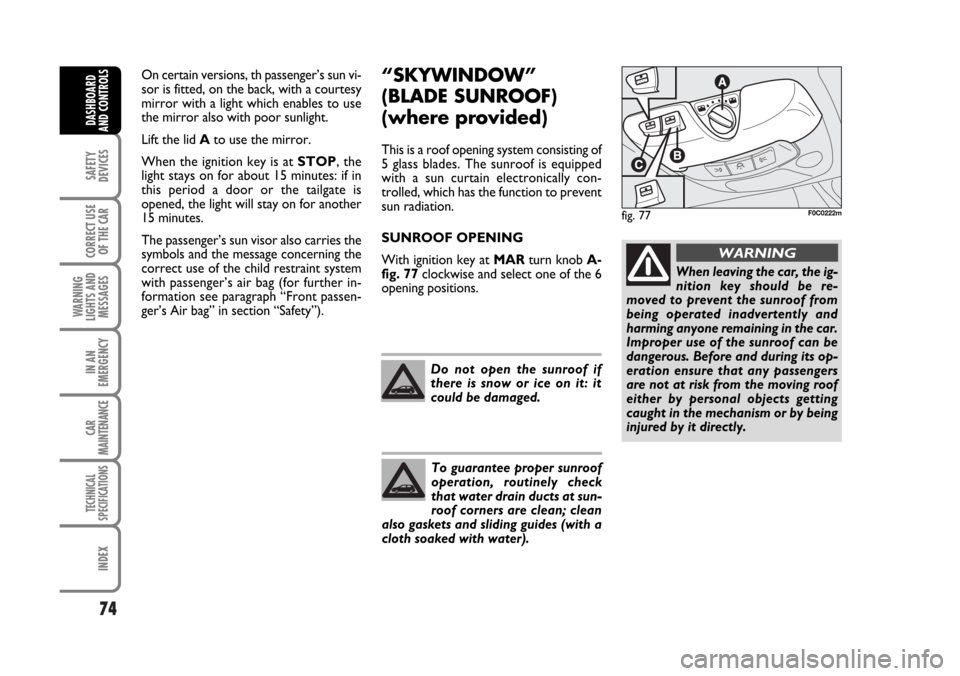
SUNROOF OPENING
With ignition key at MARturn knob A-
fig. 77clockwise and select one of the 6
opening positions.
Do not open the sunroof if
there is snow or ice on it: it
could be damaged.
To guarantee proper sunroof
operation, routinely check
that water drain ducts at sun-
roof corners are clean; clean
also gaskets and sliding guides (with a
cloth soaked with water).
fig. 77F0C0222m
When leaving the car, the ig-
nition key should be re-
moved to prevent the sunroof from
being operated inadvertently and
harming anyone remaining in the car.
Improper use of the sunroof can be
dangerous. Before and during its op-
eration ensure that any passengers
are not at risk from the moving roof
either by personal objects getting
caught in the mechanism or by being
injured by it directly.
WARNING
Page 78 of 274

77
SAFETY
DEVICES
CORRECT USE
OF THE CAR
WARNING
LIGHTS AND
MESSAGES
IN AN
EMERGENCY
CAR
MAINTENANCE
TECHNICAL
SPECIFICATIONS
INDEX
DASHBOARD
AND CONTROLS
SUNROOF OPENING/CLOSING
With key without remote control
(where provided)
Opening: turn the key clockwise in the
door revolving plug.
Closing: turn the key counterclockwise in
the door revolving plug.
With key with remote control
Opening: prolonged pressing (for more
than 2 seconds) on button
Ë.
Closing: prolonged pressing (for more
than 2 seconds) on button
Á.
When buttons
Á/Ë, are released, the
above functions are cut-off.
When opening, blades and curtain open at
the same time.
When closing, the curtain closes first and
then are closed the blades.ANTI-CRUSHING SAFETY
SYSTEM
The anti-crushing safety system fitted on
the front curtain outline is active along the
whole closing range of the curtain and cuts
into operation when an obstacle (e.g.: fin-
ger, hand, etc...) is met. This safety device
guarantees the reversal for a short sec-
tion.
In addition, the anti-crushing safety system
is active on the rear border of the first
blade and on the front outline of the sec-
ond blade: in this case it is active on the
whole closing range of the curtain and cuts
into operation when an obstacle (e.g.: fin-
ger, hand, etc...) is met. This safety device
guarantees the reversal for a short sec-
tion.
As concerns the first blade it is active on
the whole rotation range and guarantees
the reversal of the whole stroke.
After anti-crushing system activation, re-
setting can be carried out with the fol-
lowing 2 procedures:
❒pushing knob A-fig. 83upwards (reset
previously stopped movement);
❒turning knob Ato another position.INITIALISATION PROCEDURE
Sunroof shall be re-initialised after dis-
connecting the battery or if the relevant
protection fuse is blown:
❒turn knob A-fig. 81to “0” (fully
closed);
❒keep the knob pressed for over 5 sec-
onds: the sunroof will close jerkily;
❒keep the knob pressed and wait for
complete closing of the sunroof, until
the sun curtain clicks twice.
Sunroof is now initialised and it shall work
regularly. Otherwise, contact Fiat Deal-
ership.
IMPORTANT Carry out the initialisation
procedure with the engine running. If stop-
ping the initialisation procedure before
ending it, repeat it from the beginning.
Page 80 of 274
79
SAFETY
DEVICES
CORRECT USE
OF THE CAR
WARNING
LIGHTS AND
MESSAGES
IN AN
EMERGENCY
CAR
MAINTENANCE
TECHNICAL
SPECIFICATIONS
INDEX
DASHBOARD
AND CONTROLS
DOORS
CENTRAL DOOR LOCKING
SYSTEM
From the outside
With the doors closed, fit and turn the key
in one of the front door locks.
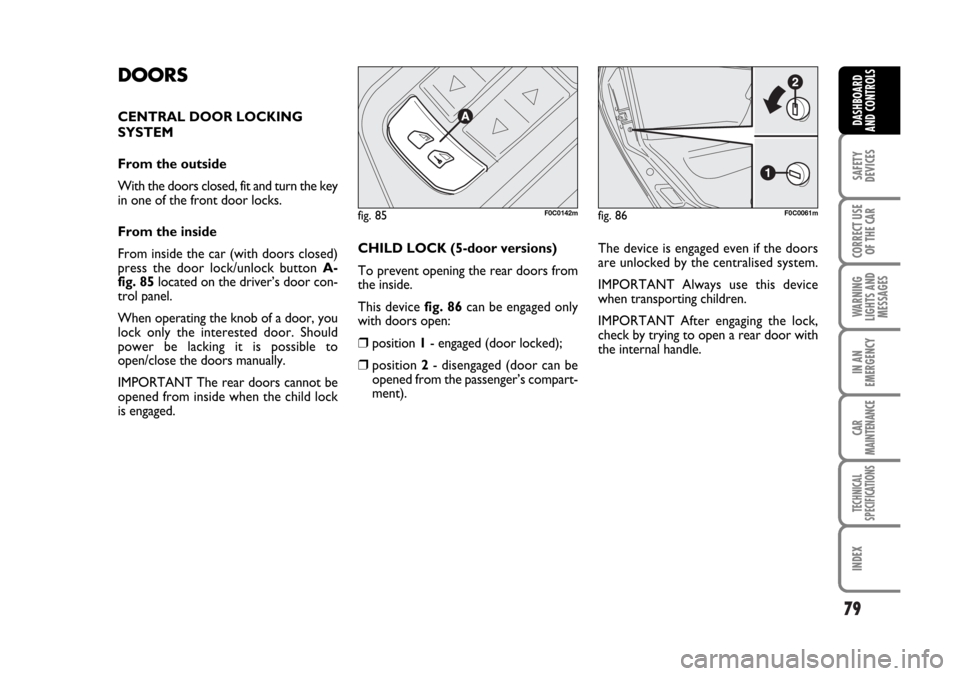
From the inside
From inside the car (with doors closed)
press the door lock/unlock button A-
fig. 85located on the driver’s door con-
trol panel.
When operating the knob of a door, you
lock only the interested door. Should
power be lacking it is possible to
open/close the doors manually.
IMPORTANT The rear doors cannot be
opened from inside when the child lock
is engaged.CHILD LOCK (5-door versions)
To prevent opening the rear doors from
the inside.
This device fig. 86can be engaged only
with doors open:
❒position 1- engaged (door locked);
❒position 2- disengaged (door can be
opened from the passenger’s compart-
ment).The device is engaged even if the doors
are unlocked by the centralised system.
IMPORTANT Always use this device
when transporting children.
IMPORTANT After engaging the lock,
check by trying to open a rear door with
the internal handle.
fig. 85F0C0142mfig. 86F0C0061m
Page 82 of 274
81
SAFETY
DEVICES
CORRECT USE
OF THE CAR
WARNING
LIGHTS AND
MESSAGES
IN AN
EMERGENCY
CAR
MAINTENANCE
TECHNICAL
SPECIFICATIONS
INDEX
DASHBOARD
AND CONTROLS
Press buttons Aor Bto open/close the
required window.
Pressing briefly one of the two buttons,
the window “jerks” , whereas a prolonged
pressing makes the window opening or
closing in “automatic continuous” mode.
When pressing again button Aor Bthe
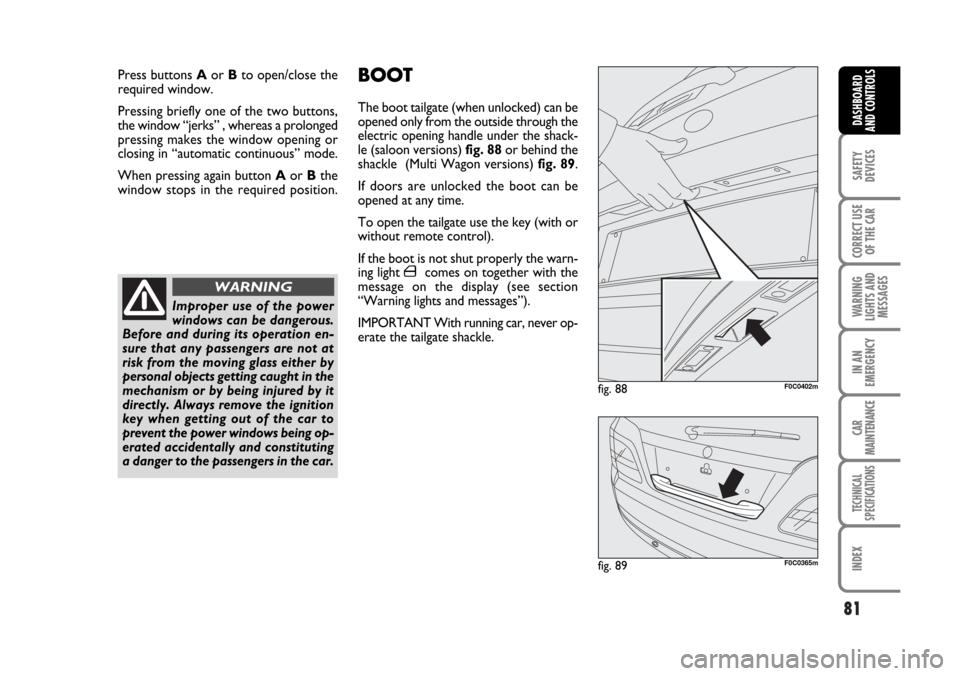
window stops in the required position.BOOT
The boot tailgate (when unlocked) can be
opened only from the outside through the
electric opening handle under the shack-
le (saloon versions) fig. 88or behind the
shackle (Multi Wagon versions) fig. 89.
If doors are unlocked the boot can be
opened at any time.
To open the tailgate use the key (with or
without remote control).
If the boot is not shut properly the warn-
ing light
´comes on together with the
message on the display (see section
“Warning lights and messages”).
IMPORTANT With running car, never op-
erate the tailgate shackle.
Improper use of the power
windows can be dangerous.
Before and during its operation en-
sure that any passengers are not at
risk from the moving glass either by
personal objects getting caught in the
mechanism or by being injured by it
directly. Always remove the ignition
key when getting out of the car to
prevent the power windows being op-
erated accidentally and constituting
a danger to the passengers in the car.
WARNING
fig. 88F0C0402m
fig. 89F0C0365m