weight FIAT STILO 2006 1.G User Guide
[x] Cancel search | Manufacturer: FIAT, Model Year: 2006, Model line: STILO, Model: FIAT STILO 2006 1.GPages: 274, PDF Size: 4.76 MB
Page 150 of 274

149
WARNING
LIGHTS AND
MESSAGES
IN AN
EMERGENCY
CAR
MAINTENANCE
TECHNICAL
SPECIFICATIONS
INDEX
DASHBOARD
AND CONTROLS
SAFETY
DEVICES
CORRECT USE
OF THE CAR
CONTAINING
RUNNING COSTS
Here are some suggestions which may
help you to keep the running costs of your
car down and lower the amount of toxic
emissions released into the atmosphere.
GENERAL CONSIDERATIONS
Car maintenance
Have checks and adjustments carried out
in accordance with the “Service schedule”.
Tyres
Check the pressure of the tyres routine-
ly at an interval of no more than 4 weeks:
if the pressure is too low, consumption
levels increase as resistance to rolling is
higher.
Unnecessary loads
Do not travel with too much luggage
stowed in the boot. The weight of the car
(especially when driving in town) and its
trim greatly affects consumption and sta-
bility.Roof rack/ski rack
Remove the roof rack or the ski rack from
the roof as soon as they are no longer
used. These accessories lower air pene-
tration and adversely affect consumption
levels. When needing to carry particular-
ly voluminous objects, preferably use a
trailer.
Electric devices
Use electric devices only for the amount
of time needed. Rear heated window, ad-
ditional headlights, windscreen wipers and
heater fan need a considerable amount of
energy, therefore increasing the require-
ment of current increases fuel consump-
tion (up to +25% in the urban cycle).Climate control
The air conditioner is an additional load
which greatly affects the engine leading to
higher consumption (on average up to
+20%). When the temperature outside
the car permits it, use the air vents where
possible.
Spoilers
The use of non-certified aerodynamic
items may adversely affect air drag and
consumption levels.
Page 152 of 274
151
WARNING
LIGHTS AND
MESSAGES
IN AN
EMERGENCY
CAR
MAINTENANCE
TECHNICAL
SPECIFICATIONS
INDEX
DASHBOARD
AND CONTROLS
SAFETY
DEVICES
CORRECT USE
OF THE CAR
TOWING TRAILERS
IMPORTANT NOTES
For towing caravans or trailers the car
must be fitted with a certified tow hook
and an adequate electric system. Installa-
tion should be carried out by specialised
personnel who release a special document
for circulation on the road.
Install any specific and/or additional rear-
view mirrors as specified by law.
Remember that when towing a trailer,
steep hills are harder to climb, the brak-
ing spaces increase and overtaking takes
longer depending on the overall weight.
Engage a low gear when driving downhill,
rather than constantly using the brake.The weight the trailer exerts on the car
tow hook reduces by the same amount
the actual car loading capacity. To make
sure the maximum towable weight is not
exceeded (given in the log book) account
should be taken of the fully laden trailer,
including accessories and personal be-
longings.
Do not exceed the speed limits of the
country you are driving in. In any case do
not exceed 100 km/h.INSTALLING THE TOW HOOK
The towing device should be fastened to
the body by specialised personnel ac-
cording to any additional and/or integra-
tive information supplied by the Manufac-
turer of the device.
The ABS system with which
the car may be fitted does
not control the trailer braking system.
Drive with extreme care on slippery
roadbeds.
WARNING
Under no circumstances
should the car brake system
be altered to control the trailer brake.
The trailer braking system must be
fully independent of the car hydraulic
system.
WARNING
Page 153 of 274

152
WARNING
LIGHTS AND
MESSAGES
IN AN
EMERGENCY
CAR
MAINTENANCE
TECHNICAL
SPECIFICATIONS
INDEX
DASHBOARD
AND CONTROLS
SAFETY
DEVICES
CORRECT USE
OF THE CAR
The towing device must meet current reg-
ulations with reference to 94/20/EC Di-
rective and subsequent amendments.
For any version the towing device used
must match the towable weight of the car
on which it is to be installed.
IMPORTANT Supplementary electric
loads other than external lights (e.g. elec-
tric brake, electric winch, etc.) shall be
used with running engine.Assembly diagram fig. 13-14
The tow hook structure must be fastened
in the points shown by the symbol
Øus-
ing a total of 6 M10 screws.
Counterplates
➀shall have a 4 mm min
thickness.
Counterplates
➁shall have a 6 mm min
thickness.
The hook should be fastened to the body
avoiding any type of drilling and trimming
of the rear bumpers that remains visible
when the hook is removed.IMPORTANT It is compulsory to fasten a
label (plainly visible) of suitable size and
material with the following wording:
MAX LOAD ON BALL 60 kg
After fitting, screw holes shall be sealed to
prevent exhaust gas inlet.
Page 173 of 274
172
WARNING
LIGHTS AND
MESSAGES
CAR
MAINTENANCE
TECHNICAL
SPECIFICATIONS
IINDEX
DASHBOARD
AND CONTROLS
SAFETY
DEVICES
CORRECT USE
OF THE CAR
IN AN
EMERGENCY
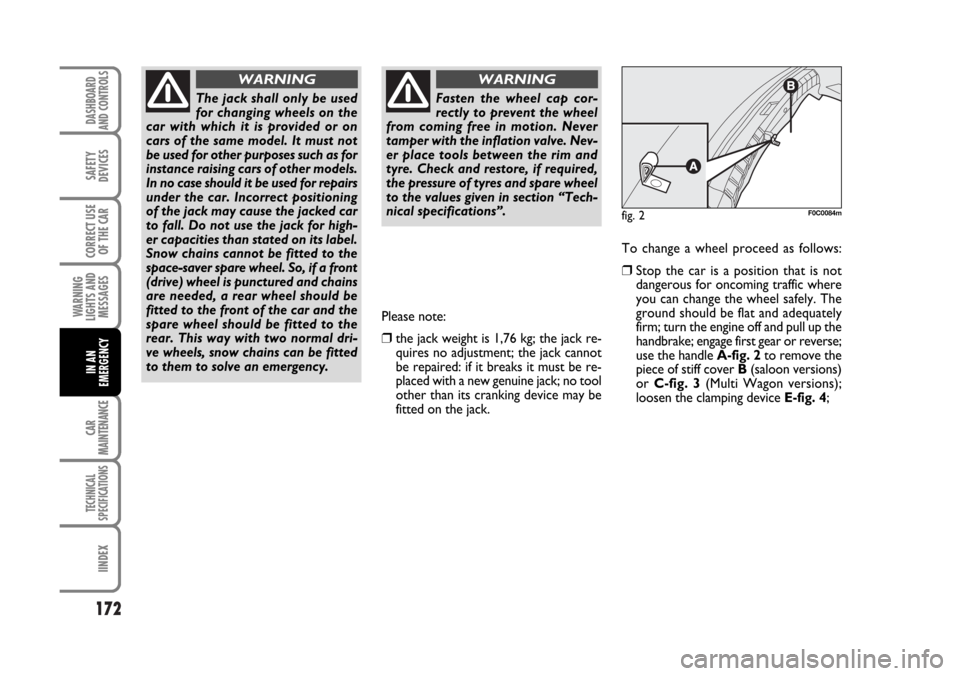
To change a wheel proceed as follows:
❒Stop the car is a position that is not
dangerous for oncoming traffic where
you can change the wheel safely. The
ground should be flat and adequately
firm; turn the engine off and pull up the
handbrake; engage first gear or reverse;
use the handle A-fig. 2to remove the
piece of stiff cover B(saloon versions)
or C-fig. 3(Multi Wagon versions);
loosen the clamping device E-fig. 4;
fig. 2F0C0084m
Please note:
❒the jack weight is 1,76 kg; the jack re-
quires no adjustment; the jack cannot
be repaired: if it breaks it must be re-
placed with a new genuine jack; no tool
other than its cranking device may be
fitted on the jack.
The jack shall only be used
for changing wheels on the
car with which it is provided or on
cars of the same model. It must not
be used for other purposes such as for
instance raising cars of other models.
In no case should it be used for repairs
under the car. Incorrect positioning
of the jack may cause the jacked car
to fall. Do not use the jack for high-
er capacities than stated on its label.
Snow chains cannot be fitted to the
space-saver spare wheel. So, if a front
(drive) wheel is punctured and chains
are needed, a rear wheel should be
fitted to the front of the car and the
spare wheel should be fitted to the
rear. This way with two normal dri-
ve wheels, snow chains can be fitted
to them to solve an emergency.
WARNING
Fasten the wheel cap cor-
rectly to prevent the wheel
from coming free in motion. Never
tamper with the inflation valve. Nev-
er place tools between the rim and
tyre. Check and restore, if required,
the pressure of tyres and spare wheel
to the values given in section “Tech-
nical specifications”.
WARNING
Page 238 of 274

237
WARNING
LIGHTS AND
MESSAGES
INDEX
DASHBOARD
AND CONTROLS
SAFETY
DEVICES
CORRECT USE
OF THE CAR
IN AN
EMERGENCY
CAR
MAINTENANCE
TECHNICAL
SPECIFICATIONS
IDENTIFICATION DATA ................................................... 238
ENGINE CODES - BODYWORK VERSIONS .............. 240
ENGINE .................................................................................... 241
FUEL FEED/IGNITION ........................................................ 243
TRANSMISSION .................................................................... 243
BRAKES ..................................................................................... 244
SUSPENSIONS......................................................................... 244
STEERING ................................................................................. 244
WHEELS .................................................................................... 245
DIMENSIONS .......................................................................... 250
PERFORMANCE ..................................................................... 253
WEIGHTS ................................................................................. 254
CAPACITIES ........................................................................... 257
FLUIDS AND LUBRICANTS ............................................... 259
FUEL CONSUMPTION ........................................................ 261
CO
2EMISSIONS .................................................................... 263
T T
E E
C C
H H
N N
I I
C C
A A
L L
S S
P P
E E
C C
I I
F F
I I
C C
A A
T T
I I
O O
N N
S S
Page 239 of 274
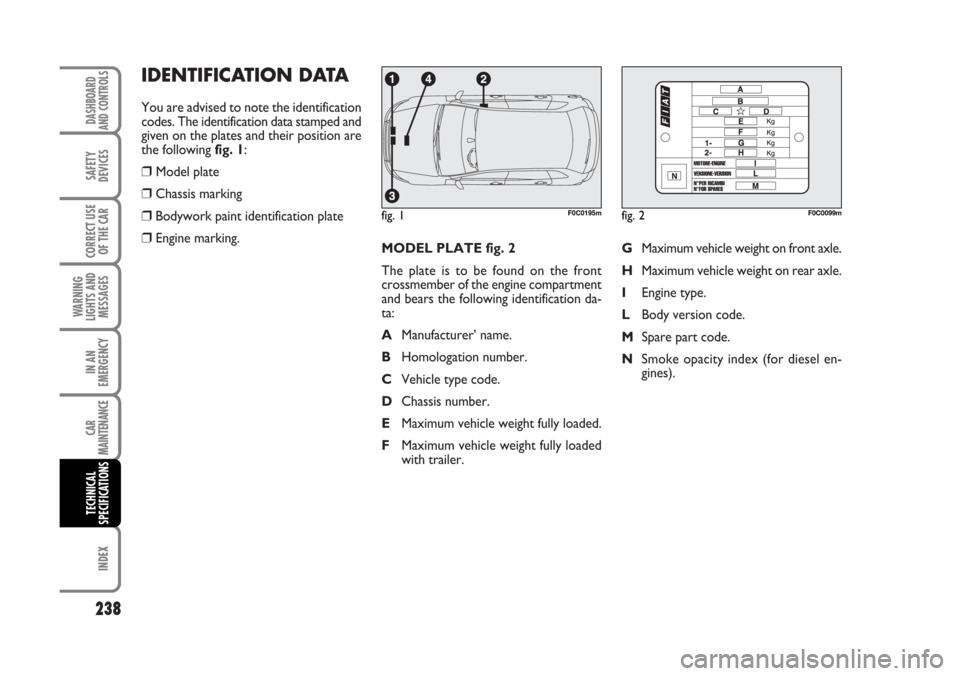
MODEL PLATE fig. 2
The plate is to be found on the front
crossmember of the engine compartment
and bears the following identification da-
ta:
AManufacturer’ name.
BHomologation number.
CVehicle type code.
DChassis number.
EMaximum vehicle weight fully loaded.
FMaximum vehicle weight fully loaded
with trailer.GMaximum vehicle weight on front axle.
HMaximum vehicle weight on rear axle.
IEngine type.
LBody version code.
MSpare part code.
NSmoke opacity index (for diesel en-
gines).
IDENTIFICATION DATA
You are advised to note the identification
codes. The identification data stamped and
given on the plates and their position are
the following fig. 1:
❒ Model plate
❒Chassis marking
❒Bodywork paint identification plate
❒Engine marking.
238
WARNING
LIGHTS AND
MESSAGES
INDEX
DASHBOARD
AND CONTROLS
SAFETY
DEVICES
CORRECT USE
OF THE CAR
IN AN
EMERGENCY
CAR
MAINTENANCE
TECHNICAL
SPECIFICATIONS
fig. 1F0C0195mfig. 2F0C0099m
Page 250 of 274

249
WARNING
LIGHTS AND
MESSAGES
INDEX
DASHBOARD
AND CONTROLS
SAFETY
DEVICES
CORRECT USE
OF THE CAR
IN AN
EMERGENCY
CAR
MAINTENANCE
TECHNICAL
SPECIFICATIONS
Multi Wagon versions
Add +0.3 bar to the prescribed inflation pressure when the tyres are warm. Recheck pressure value with cold tyres.
With snow tyres, add +0.2 bar to the inflation pressure value prescribed for standard tyres.
(*) In full load conditions = 510 kg (including driver’s weight; special equipment and remaining load distributed on rear folded seats).
195/65 R15 91T 1.9 1.9 2.1 2.3/3.0 (*)
1.416V205/55 R16 91V 2.1 2.1 2.3 2.3/3.0 (*) 4.2
215/45 R17 87W 2.3 2.3 2.7 2.5/3.0 (*)
1.616V195/65 R15 91H 1.9 1.9 2.3 2.3/3.0 (*)
1.9 Multijet 8V205/55 R16 91V 2.1 2.1 2.3 2.3/3.0 (*) 4.2
215/45 R17 87W 2.3 2.3 2.7 2.5/3.0 (*)
195/65 R15 91V 1.9 1.9 2.3 2.3/3.0 (*)
1.816V205/55 R16 91V 2.1 2.1 2.3 2.3/3.0 (*) 4.21.9 Multijet16V215/45 R17 87W 2.3 2.3 2.7 2.5/3.0 (*)STANDARD TYRES SPACE-SAVER
Size Medium load Full load SPAREWHEEL
Front Rear Front Rear
Page 255 of 274
254
WARNING
LIGHTS AND
MESSAGES
INDEX
DASHBOARD
AND CONTROLS
SAFETY
DEVICES
CORRECT USE
OF THE CAR
IN AN
EMERGENCY
CAR
MAINTENANCE
TECHNICAL
SPECIFICATIONS
1.416V1.616V1.816V
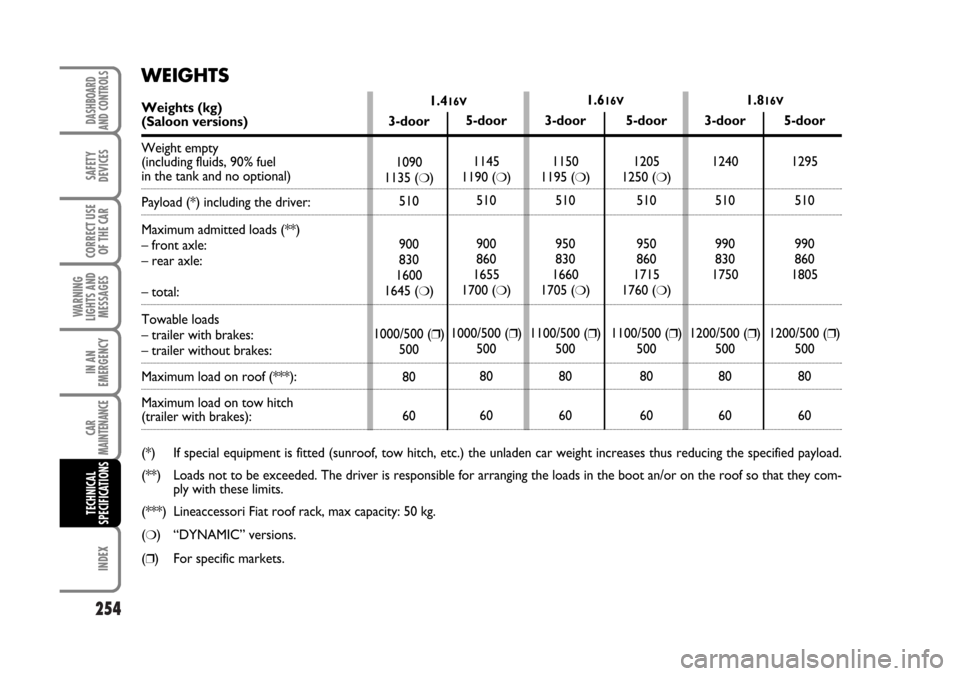
WEIGHTS
Weights (kg)(Saloon versions)
Weight empty
(including fluids, 90% fuel
in the tank and no optional)
Payload (*) including the driver:
Maximum admitted loads (**)
– front axle:
– rear axle:
– total:
Towable loads
– trailer with brakes:
– trailer without brakes:
Maximum load on roof (***):
Maximum load on tow hitch
(trailer with brakes):
(*) If special equipment is fitted (sunroof, tow hitch, etc.) the unladen car weight increases thus reducing the specified payload.
(**) Loads not to be exceeded. The driver is responsible for arranging the loads in the boot an/or on the roof so that they com-
ply with these limits.
(***) Lineaccessori Fiat roof rack, max capacity: 50 kg.
(
❍) “DYNAMIC” versions.
(
❒) For specific markets.3-door
1090
1135 (
❍)
510
900
830
1600
1645 (
❍)
1000/500 (
❒)
500
80
605-door
1145
1190 (
❍)
510
900
860
1655
1700 (
❍)
1000/500 (
❒)
500
80
603-door
1150
1195 (
❍)
510
950
830
1660
1705 (
❍)
1100/500 (
❒)
500
80
605-door
1205
1250 (
❍)
510
950
860
1715
1760 (
❍)
1100/500 (
❒)
500
80
603-door
1240
510
990
830
1750
1200/500 (❒)
500
80
605-door
1295
510
990
860
1805
1200/500 (❒)
500
80
60
Page 256 of 274
255
WARNING
LIGHTS AND
MESSAGES
INDEX
DASHBOARD
AND CONTROLS
SAFETY
DEVICES
CORRECT USE
OF THE CAR
IN AN
EMERGENCY
CAR
MAINTENANCE
TECHNICAL
SPECIFICATIONS
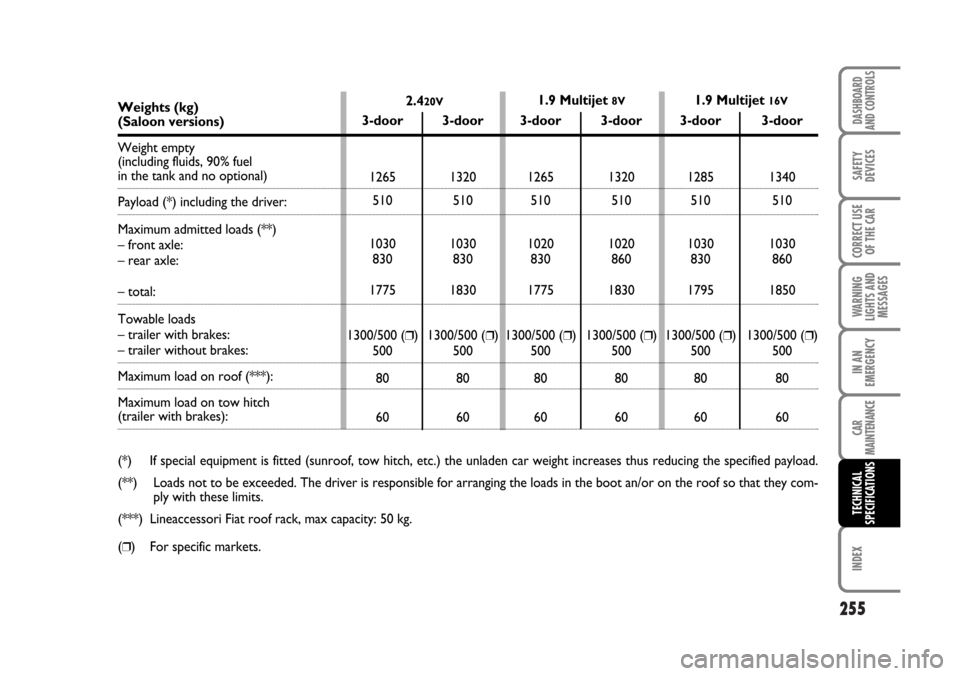
2.420V1.9 Multijet 8V1.9 Multijet 16VWeights (kg)(Saloon versions)
Weight empty
(including fluids, 90% fuel
in the tank and no optional)
Payload (*) including the driver:
Maximum admitted loads (**)
– front axle:
– rear axle:
– total:
Towable loads
– trailer with brakes:
– trailer without brakes:
Maximum load on roof (***):
Maximum load on tow hitch
(trailer with brakes):
(*) If special equipment is fitted (sunroof, tow hitch, etc.) the unladen car weight increases thus reducing the specified payload.
(**) Loads not to be exceeded. The driver is responsible for arranging the loads in the boot an/or on the roof so that they com-
ply with these limits.
(***) Lineaccessori Fiat roof rack, max capacity: 50 kg.
(
❒) For specific markets.3-door
1265
510
1030
830
1775
1300/500 (
❒)
500
80
603-door
1320
510
1030
830
1830
1300/500 (❒)
500
80
603-door
1265
510
1020
830
1775
1300/500 (❒)
500
80
603-door
1320
510
1020
860
1830
1300/500 (❒)
500
80
603-door
1285
510
1030
830
1795
1300/500 (❒)
500
80
603-door
1340
510
1030
860
1850
1300/500 (❒)
500
80
60
Page 257 of 274
256
WARNING
LIGHTS AND
MESSAGES
INDEX
DASHBOARD
AND CONTROLS
SAFETY
DEVICES
CORRECT USE
OF THE CAR
IN AN
EMERGENCY
CAR
MAINTENANCE
TECHNICAL
SPECIFICATIONS
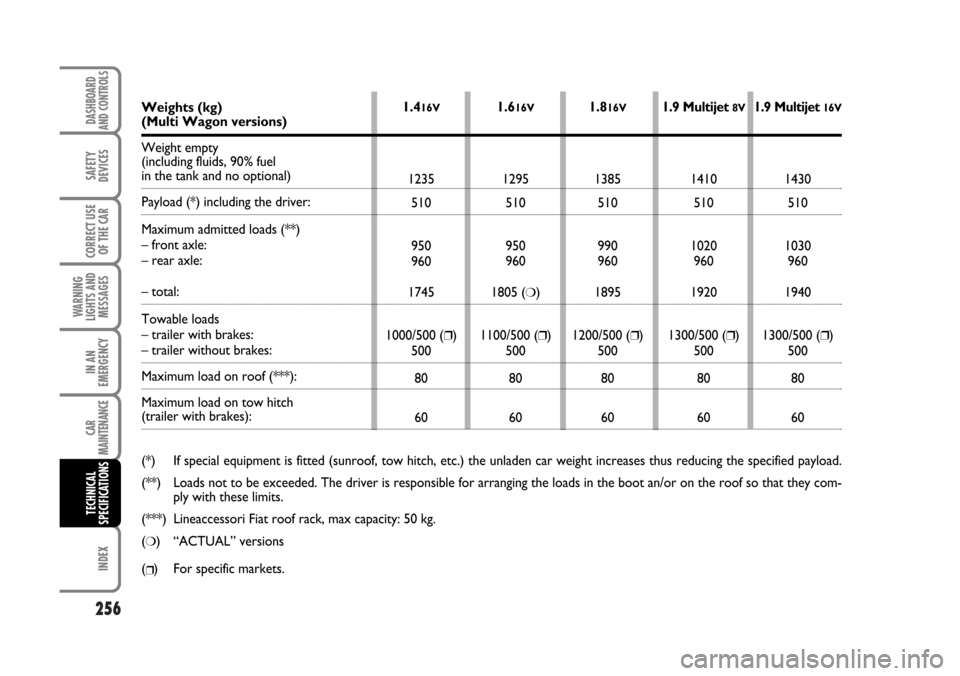
1.416V
1235
510
950
960
1745
1000/500 (
❒)
500
80
601.6
16V
1295
510
950
960
1805 (
❍)
1100/500 (
❒)
500
80
601.8
16V
1385
510
990
960
1895
1200/500 (
❒)
500
80
601.9 Multijet
8V
1410
510
1020
960
1920
1300/500 (
❒)
500
80
601.9 Multijet
16V
1430
510
1030
960
1940
1300/500 (
❒)
500
80
60
Weights (kg)(Multi Wagon versions)
Weight empty
(including fluids, 90% fuel
in the tank and no optional)
Payload (*) including the driver:
Maximum admitted loads (**)
– front axle:
– rear axle:
– total:
Towable loads
– trailer with brakes:
– trailer without brakes:
Maximum load on roof (***):
Maximum load on tow hitch
(trailer with brakes):
(*) If special equipment is fitted (sunroof, tow hitch, etc.) the unladen car weight increases thus reducing the specified payload.
(**) Loads not to be exceeded. The driver is responsible for arranging the loads in the boot an/or on the roof so that they com-
ply with these limits.
(***) Lineaccessori Fiat roof rack, max capacity: 50 kg.
(
❍) “ACTUAL” versions
(
❒) For specific markets.