battery FIAT STILO 2006 1.G Owner's Manual
[x] Cancel search | Manufacturer: FIAT, Model Year: 2006, Model line: STILO, Model: FIAT STILO 2006 1.GPages: 274, PDF Size: 4.76 MB
Page 200 of 274
199
WARNING
LIGHTS AND
MESSAGES
CAR
MAINTENANCE
TECHNICAL
SPECIFICATIONS
INDEX
DASHBOARD
AND CONTROLS
SAFETY
DEVICES
CORRECT USE
OF THE CAR
IN AN
EMERGENCY
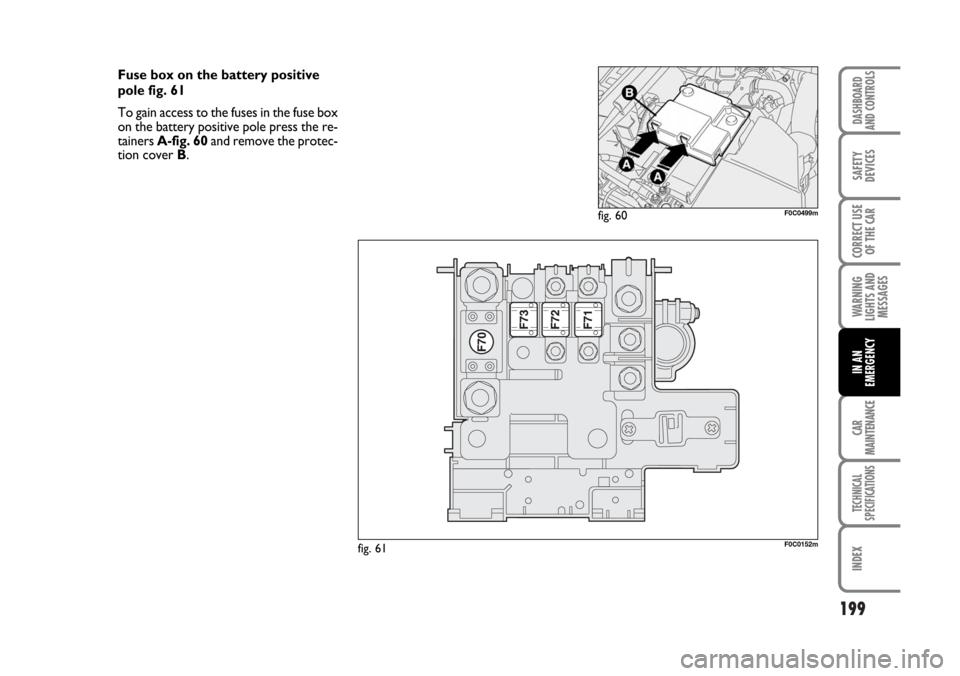
Fuse box on the battery positive
pole fig. 61
To gain access to the fuses in the fuse box
on the battery positive pole press the re-
tainers A-fig. 60and remove the protec-
tion cover B.
fig. 61F0C0152m
fig. 60F0C0499m
Page 206 of 274
205
WARNING
LIGHTS AND
MESSAGES
CAR
MAINTENANCE
TECHNICAL
SPECIFICATIONS
INDEX
DASHBOARD
AND CONTROLS
SAFETY
DEVICES
CORRECT USE
OF THE CAR
IN AN
EMERGENCY
IF THE BATTERY IS FLAT
IMPORTANT The battery charging pro-
cedure is described only for information
purposes. This operation should be car-
ried out by Fiat Dealership.
Charging should be slow at a low amp rat-
ing for 24 hours. Charging for a longer
time may damage the battery.Charge the battery as follows:❒disconnect battery negative terminal;
❒connect the charger cables to the bat-
tery terminals, observing the poles;
❒turn on the charger;
❒ when you have finished, turn the charg-
er off before disconnecting the battery;
❒ reconnect battery negative terminal.
IMPORTANT Where relevant, switch the
electronic car alarm off with remote con-
trol (see “Alarm” in section “Dashboard
and controls”).
The liquid contained in the
battery is poisonous and cor-
rosive. Avoid contact with the skin or
eyes. The battery should be charged
in a well ventilated place, away from
naked flames or possible sources of
sparks: danger of explosion and fire.
WARNING
Do not attempt to charge a
frozen battery: it must first-
ly be thawed, otherwise it may burst.
If freezing has occurred, the battery
should be checked by skilled person-
nel to make sure that the internal el-
ements are not damaged and that the
body is not cracked, with the risk of
leaking poisonous and corrosive acid.
WARNING
Page 210 of 274
209
WARNING
LIGHTS AND
MESSAGES
TECHNICAL
SPECIFICATIONS
INDEX
DASHBOARD
AND CONTROLS
SAFETY
DEVICES
CORRECT USE
OF THE CAR
IN AN
EMERGENCY
CAR
MAINTENANCE
SCHEDULED SERVICING .................................................. 210
SERVICE SCHEDULE ............................................................. 211
ANNUAL INSPECTION SCHEDULE ............................... 213
ADDITIONAL CHECKS....................................................... 213
CHECKING FLUID LEVELS ................................................. 216
AIR FILTER .............................................................................. 225
POLLEN FILTER ..................................................................... 225
DIESEL FUEL FILTER ............................................................ 225
BATTERY .................................................................................. 226
WHEELS AND TYRES .......................................................... 229
RUBBER HOSES ...................................................................... 230
WINDSCREEN/REAR WINDOW WIPERS.................... 231
BODYWORK .......................................................................... 233
INTERIORS ............................................................................. 235
C C C C
A A A A
R R R R
M M M M
A A A A
I I I I
N N N N
T T T T
E E E E
N N N N
A A A A
N N N N
C C C C
E E E E
Page 212 of 274
211
WARNING
LIGHTS AND
MESSAGES
TECHNICAL
SPECIFICATIONS
INDEX
DASHBOARD
AND CONTROLS
SAFETY
DEVICES
CORRECT USE
OF THE CAR
IN AN
EMERGENCY
CAR
MAINTENANCE
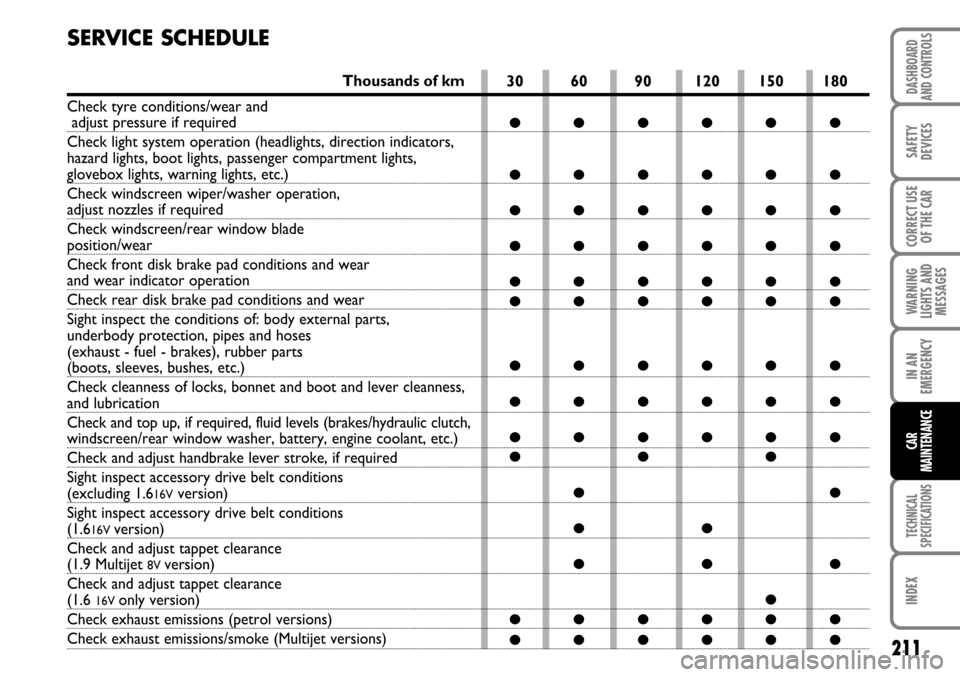
SERVICE SCHEDULE
30 60 90 120 150 180
●●●●●●
●●●●●●
●●●●●●
●●●●●●
●●●●●●
●●●●●●
●●●●●●
●●●●●●
●●●●●●
●●●
●●
●●
●●●
●
●●●●●●
●●●●●●
Thousands of km
Check tyre conditions/wear and
adjust pressure if required
Check light system operation (headlights, direction indicators,
hazard lights, boot lights, passenger compartment lights,
glovebox lights, warning lights, etc.)
Check windscreen wiper/washer operation,
adjust nozzles if required
Check windscreen/rear window blade
position/wear
Check front disk brake pad conditions and wear
and wear indicator operation
Check rear disk brake pad conditions and wear
Sight inspect the conditions of: body external parts,
underbody protection, pipes and hoses
(exhaust - fuel - brakes), rubber parts
(boots, sleeves, bushes, etc.)
Check cleanness of locks, bonnet and boot and lever cleanness,
and lubrication
Check and top up, if required, fluid levels (brakes/hydraulic clutch,
windscreen/rear window washer, battery, engine coolant, etc.)
Check and adjust handbrake lever stroke, if required
Sight inspect accessory drive belt conditions
(excluding 1.616Vversion)
Sight inspect accessory drive belt conditions
(1.616V version)
Check and adjust tappet clearance
(1.9 Multijet 8V version)
Check and adjust tappet clearance
(1.6 16V only version)
Check exhaust emissions (petrol versions)
Check exhaust emissions/smoke (Multijet versions)
Page 214 of 274
213
WARNING
LIGHTS AND
MESSAGES
TECHNICAL
SPECIFICATIONS
INDEX
DASHBOARD
AND CONTROLS
SAFETY
DEVICES
CORRECT USE
OF THE CAR
IN AN
EMERGENCY
CAR
MAINTENANCE
ANNUAL INSPECTION
SCHEDULE
For cars with an annual mileage of below
30.000 km (for example about 15.000 km)
the following yearly inspection programme
is advised:
❒check tyre conditions/wear and adjust
pressure if required (including the
space-saver spare wheel);
❒check light system operation (head-
lights, direction indicators, hazard lights,
boot lights, passenger compartment
lights, glovebox light, warning lights,
etc.);
❒check windscreen wiper/washer oper-
ation, adjust nozzles;
❒check windscreen/rear window blade
position/wear;
❒ check front disk brake pad conditions
and wear;
❒sight inspect the conditions of: engine,
gearbox, transmission, pipes and hoses
(exhaust - fuel - brakes), rubber parts
(boots, sleeves, bushes, etc.) fuel and
brake system hoses;
❒check cleanness of bonnet and boot
locks, and lever cleanness and lubrica-
tion
❒check battery charge (by optical depth
gauge);
❒visual check on various drive belt con-
ditions;
❒check and top up fluid levels (engine
coolant, brakes, windscreen washer,
battery, etc.);
❒change engine oil and oil filter, if re-
quired (Multijet versions);
❒replace pollen filter.
ADDITIONAL CHECKS
Every 1,000 km or before long journeys,
check and top up if required:
❒engine coolant fluid level;
❒ brake fluid level;
❒ windscreen washer fluid level;
❒tyre pressure and conditions.
Every 3,000 km check and top up if re-
quired: engine oil level.
You are recommended to use FL Sele-
niaproducts, designed and produced
specifically for Fiat cars (see table “Ca-
pacities” in section “Technical specifica-
tions”).
Page 216 of 274
215
WARNING
LIGHTS AND
MESSAGES
TECHNICAL
SPECIFICATIONS
INDEX
DASHBOARD
AND CONTROLS
SAFETY
DEVICES
CORRECT USE
OF THE CAR
IN AN
EMERGENCY
CAR
MAINTENANCE
IMPORTANT - Battery
The charge in the battery should be
checked at the start of winter to limit the
risk of electrolyte freezing.
This check should be carried out more
frequently if the car is used mainly for
short trips, or if it is fitted with accessories
that permanently absorb electricity even
with the ignition key removed, especially
in the case of after market accessories. If
the car is used in hot climates or particu-
larly harsh conditions it is wise to check
the level of the battery fluid (electrolyte)
more frequently than specified in the “Ser-
vice schedule”. IMPORTANT - Pollen filter
If the car is used frequently in dusty or
heavily polluted environments it is advis-
able to replace the filtering element more
frequently; in particular it should be re-
placed if a reduction of the amount of air
admitted to the passenger compartment
is noted.
IMPORTANT - Diesel filter
The possibility of topping up with diesel
fuel not complying with EN590 European
Norm might make it necessary to replace
the filter more frequently than indicated
in the “Service Schedule”.Car maintenance should be
entrusted to Fiat Dealership.
For routine and minor main-
tenance operations you wish
to carry out yourself, always make sure
you have the proper equipment, gen-
uine Fiat spare parts and the necessary
fluids; do not however carry out these
operations if you have no experience.
Page 217 of 274
216
WARNING
LIGHTS AND
MESSAGES
TECHNICAL
SPECIFICATIONS
INDEX
DASHBOARD
AND CONTROLS
SAFETY
DEVICES
CORRECT USE
OF THE CAR
IN AN
EMERGENCY
CAR
MAINTENANCE
CHECKING FLUID
LEVELS
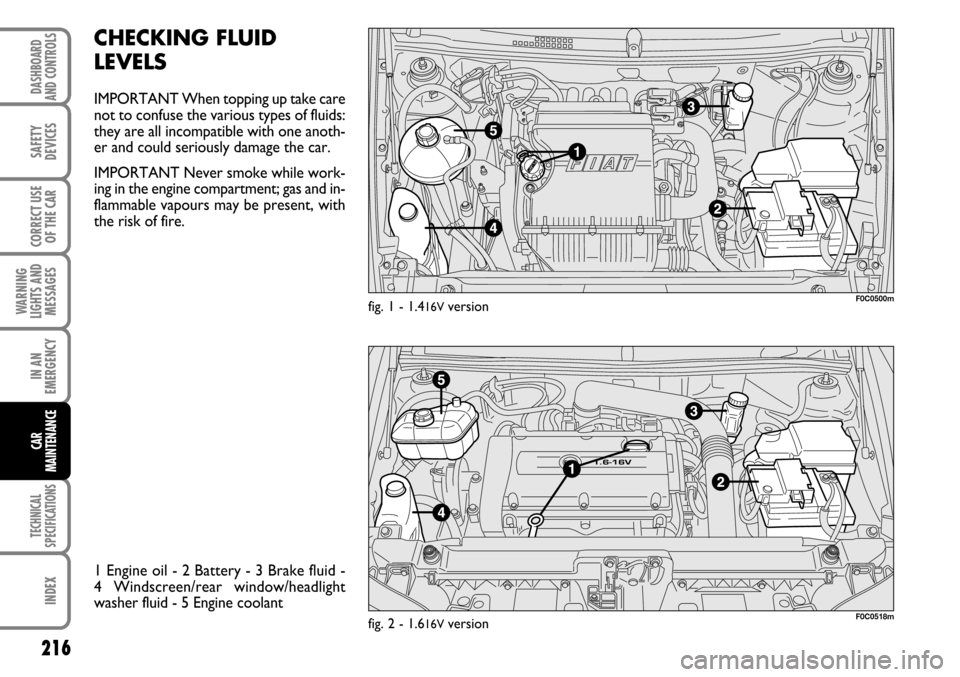
IMPORTANT When topping up take care
not to confuse the various types of fluids:
they are all incompatible with one anoth-
er and could seriously damage the car.
IMPORTANT Never smoke while work-
ing in the engine compartment; gas and in-
flammable vapours may be present, with
the risk of fire.
1 Engine oil - 2 Battery - 3 Brake fluid -
4 Windscreen/rear window/headlight
washer fluid - 5 Engine coolant
F0C0500mfig. 1 - 1.416V version
F0C0518mfig. 2 - 1.616V version
Page 218 of 274
217
WARNING
LIGHTS AND
MESSAGES
TECHNICAL
SPECIFICATIONS
INDEX
DASHBOARD
AND CONTROLS
SAFETY
DEVICES
CORRECT USE
OF THE CAR
IN AN
EMERGENCY
CAR
MAINTENANCE
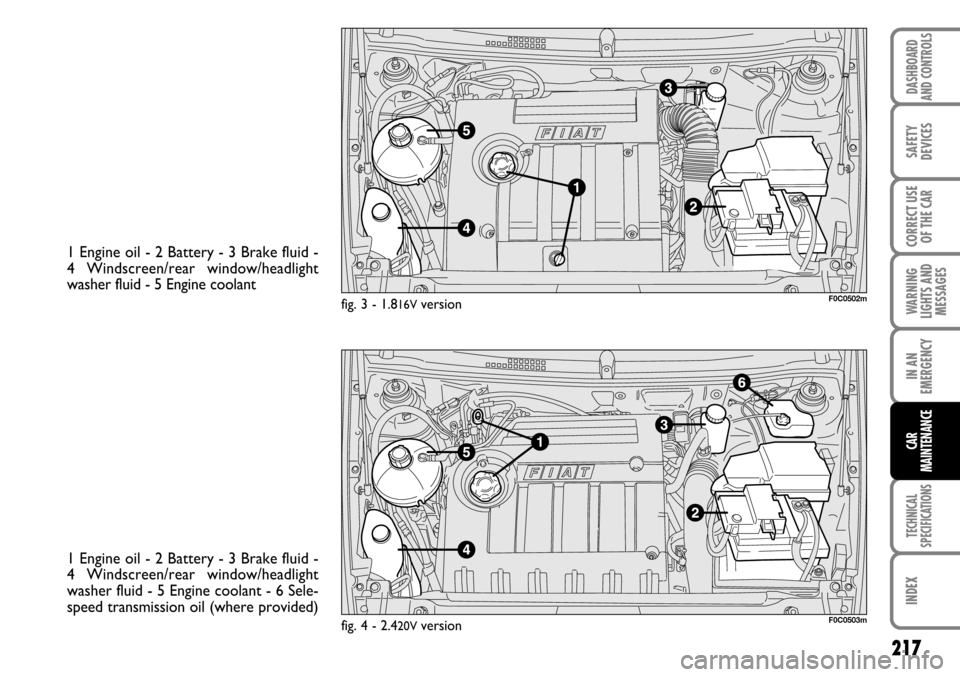
1 Engine oil - 2 Battery - 3 Brake fluid -
4 Windscreen/rear window/headlight
washer fluid - 5 Engine coolant - 6 Sele-
speed transmission oil (where provided)
fig. 3 - 1.816V version
fig. 4 - 2.4
20V version
1 Engine oil - 2 Battery - 3 Brake fluid -
4 Windscreen/rear window/headlight
washer fluid - 5 Engine coolant
F0C0502m
F0C0503m
Page 219 of 274
218
WARNING
LIGHTS AND
MESSAGES
TECHNICAL
SPECIFICATIONS
INDEX
DASHBOARD
AND CONTROLS
SAFETY
DEVICES
CORRECT USE
OF THE CAR
IN AN
EMERGENCY
CAR
MAINTENANCE
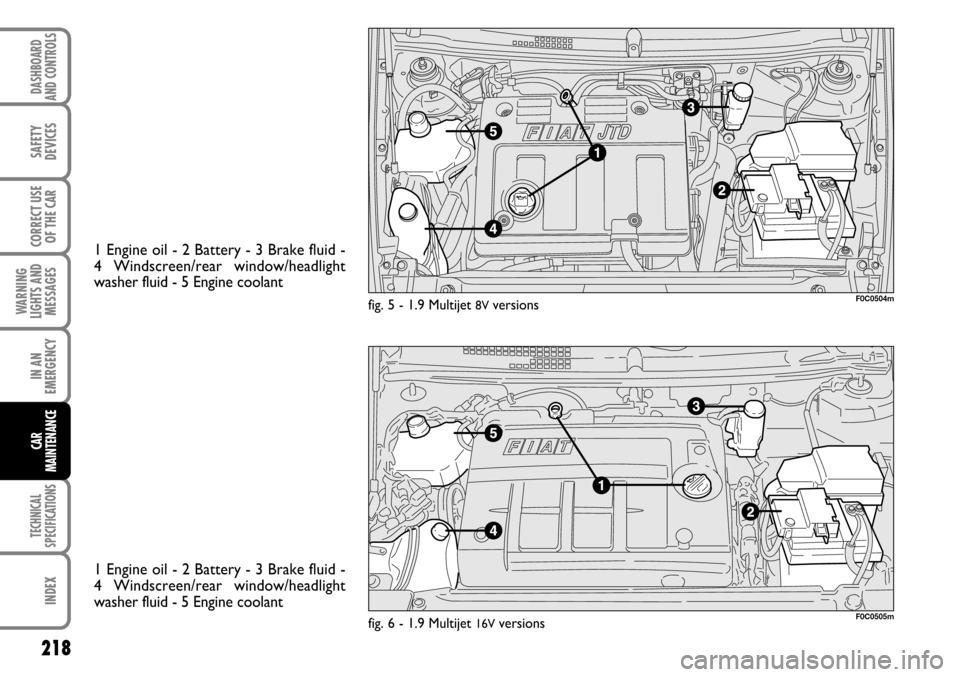
1 Engine oil - 2 Battery - 3 Brake fluid -
4 Windscreen/rear window/headlight
washer fluid - 5 Engine coolant
1 Engine oil - 2 Battery - 3 Brake fluid -
4 Windscreen/rear window/headlight
washer fluid - 5 Engine coolant
fig. 6 - 1.9 Multijet 16V versions
F0C0504mfig. 5 - 1.9 Multijet 8V versions
F0C0505m
Page 227 of 274
The liquid in the battery is
poisonous and corrosive.
Avoid contact with eyes and skin. Do
not bring naked flames or possible
sources of sparks near the battery:
risk of fire and explosion.
WARNING
Running the battery with
low fluid level can damage
the battery beyond repair and could
also cause its explosion.
WARNING
226
WARNING
LIGHTS AND
MESSAGES
TECHNICAL
SPECIFICATIONS
INDEX
DASHBOARD
AND CONTROLS
SAFETY
DEVICES
CORRECT USE
OF THE CAR
IN AN
EMERGENCY
CAR
MAINTENANCE
BATTERY
The battery is of the “Limited mainte-
nance” type: under normal conditions of
use the electrolyte does not need topping
up with distilled water.
Contact Fiat Dealership to have the bat-
tery checked/replaced.
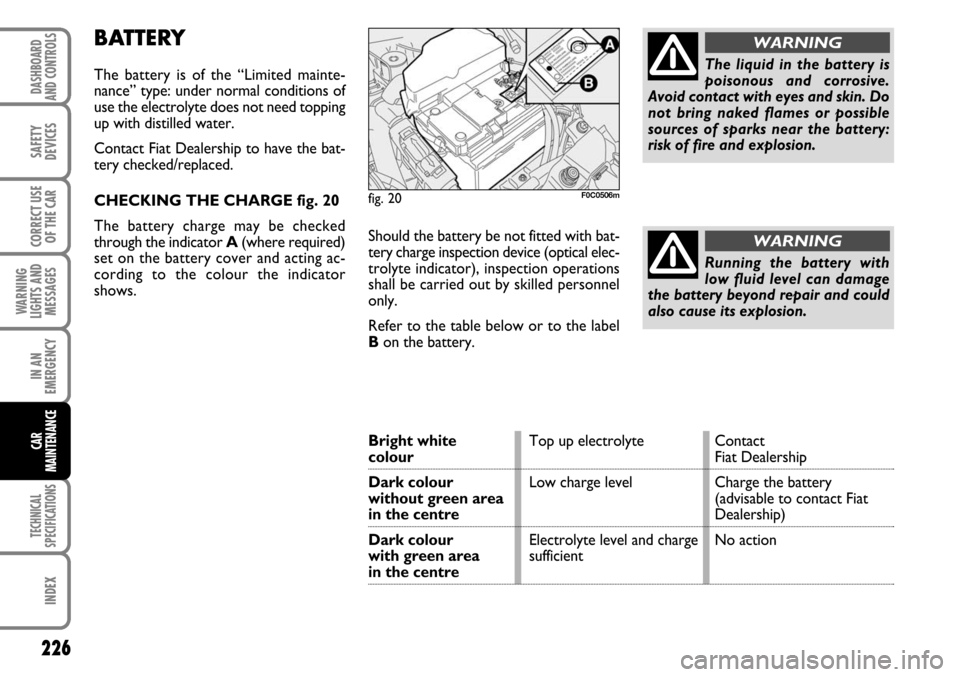
CHECKING THE CHARGE fig. 20
The battery charge may be checked
through the indicator A(where required)
set on the battery cover and acting ac-
cording to the colour the indicator
shows.Should the battery be not fitted with bat-
tery charge inspection device (optical elec-
trolyte indicator), inspection operations
shall be carried out by skilled personnel
only.
Refer to the table below or to the label
Bon the battery.
fig. 20F0C0506m
Bright white colour
Dark colour
without green area
in the centre
Dark colour
with green area
in the centreTop up electrolyte
Low charge level
Electrolyte level and charge
sufficientContact
Fiat Dealership
Charge the battery
(advisable to contact Fiat
Dealership)
No action