steering wheel FIAT STILO 2006 1.G Owner's Manual
[x] Cancel search | Manufacturer: FIAT, Model Year: 2006, Model line: STILO, Model: FIAT STILO 2006 1.GPages: 274, PDF Size: 4.76 MB
Page 171 of 274
170
WARNING
LIGHTS AND
MESSAGES
CAR
MAINTENANCE
TECHNICAL
SPECIFICATIONS
IINDEX
DASHBOARD
AND CONTROLS
SAFETY
DEVICES
CORRECT USE
OF THE CAR
IN AN
EMERGENCY
ENGINE STARTING
JUMP STARTING
If the battery is flat, it is possible to start
the engine using an auxiliary battery with
the same capacity or a little higher than
the flat one.
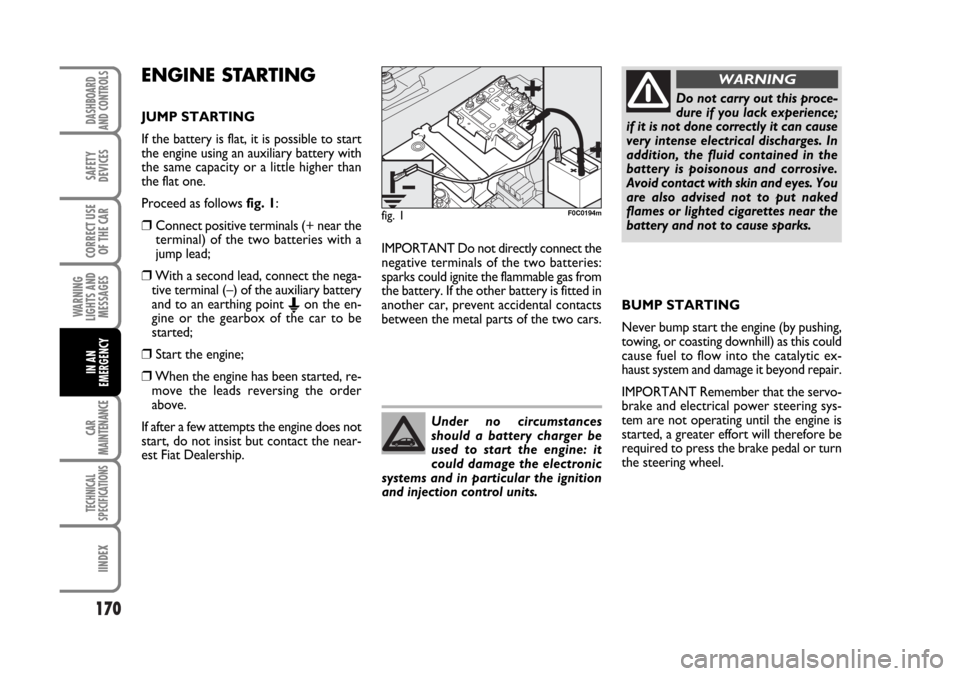
Proceed as follows fig. 1:
❒Connect positive terminals (+ near the
terminal) of the two batteries with a
jump lead;
❒With a second lead, connect the nega-
tive terminal (–) of the auxiliary battery
and to an earthing point
Eon the en-
gine or the gearbox of the car to be
started;
❒Start the engine;
❒When the engine has been started, re-
move the leads reversing the order
above.
If after a few attempts the engine does not
start, do not insist but contact the near-
est Fiat Dealership.IMPORTANT Do not directly connect the
negative terminals of the two batteries:
sparks could ignite the flammable gas from
the battery. If the other battery is fitted in
another car, prevent accidental contacts
between the metal parts of the two cars.BUMP STARTING
Never bump start the engine (by pushing,
towing, or coasting downhill) as this could
cause fuel to flow into the catalytic ex-
haust system and damage it beyond repair.
IMPORTANT Remember that the servo-
brake and electrical power steering sys-
tem are not operating until the engine is
started, a greater effort will therefore be
required to press the brake pedal or turn
the steering wheel.
fig. 1F0C0194m
Under no circumstances
should a battery charger be
used to start the engine: it
could damage the electronic
systems and in particular the ignition
and injection control units.
Do not carry out this proce-
dure if you lack experience;
if it is not done correctly it can cause
very intense electrical discharges. In
addition, the fluid contained in the
battery is poisonous and corrosive.
Avoid contact with skin and eyes. You
are also advised not to put naked
flames or lighted cigarettes near the
battery and not to cause sparks.
WARNING
Page 205 of 274
204
WARNING
LIGHTS AND
MESSAGES
CAR
MAINTENANCE
TECHNICAL
SPECIFICATIONS
IINDEX
DASHBOARD
AND CONTROLS
SAFETY
DEVICES
CORRECT USE
OF THE CAR
IN AN
EMERGENCY
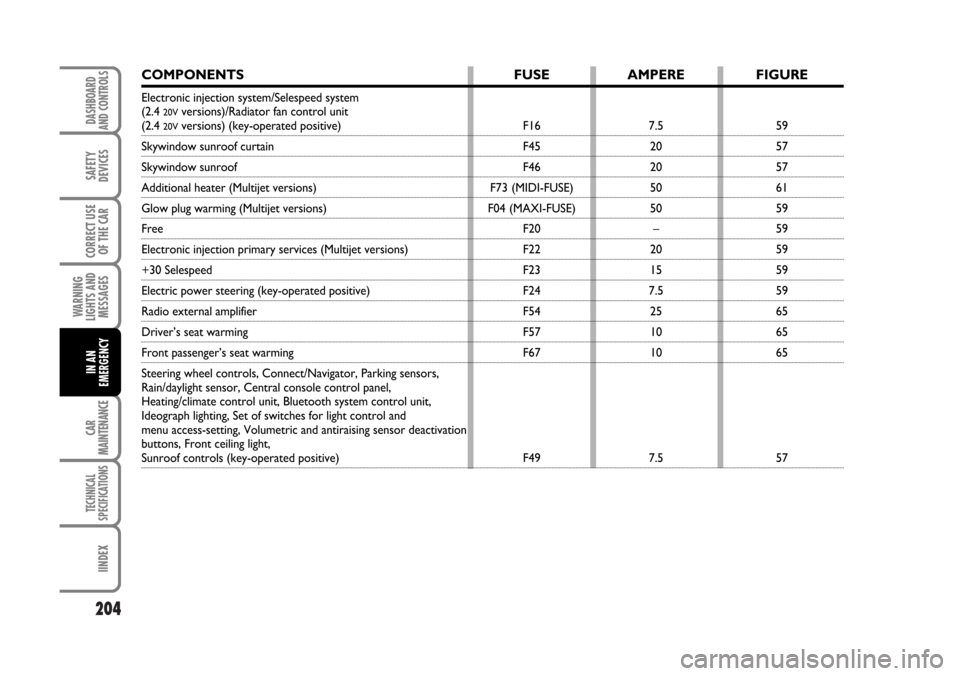
COMPONENTS
Electronic injection system/Selespeed system
(2.4 20Vversions)/Radiator fan control unit(2.4 20Vversions) (key-operated positive)
Skywindow sunroof curtain
Skywindow sunroof
Additional heater (Multijet versions)
Glow plug warming (Multijet versions)
Free
Electronic injection primary services (Multijet versions)
+30 Selespeed
Electric power steering (key-operated positive)
Radio external amplifier
Driver’s seat warming
Front passenger’s seat warming
Steering wheel controls, Connect/Navigator, Parking sensors,
Rain/daylight sensor, Central console control panel,
Heating/climate control unit, Bluetooth system control unit,
Ideograph lighting, Set of switches for light control and
menu access-setting, Volumetric and antiraising sensor deactivation
buttons, Front ceiling light,
Sunroof controls (key-operated positive)
FUSE
F16
F45
F46
F73 (MIDI-FUSE)
F04 (MAXI-FUSE)
F20
F22
F23
F24
F54
F57
F67
F49
AMPERE
7.5
20
20
50
50
–
20
15
7.5
25
10
10
7.5
FIGURE
59
57
57
61
59
59
59
59
59
65
65
65
57
Page 208 of 274
207
WARNING
LIGHTS AND
MESSAGES
CAR
MAINTENANCE
TECHNICAL
SPECIFICATIONS
INDEX
DASHBOARD
AND CONTROLS
SAFETY
DEVICES
CORRECT USE
OF THE CAR
IN AN
EMERGENCY
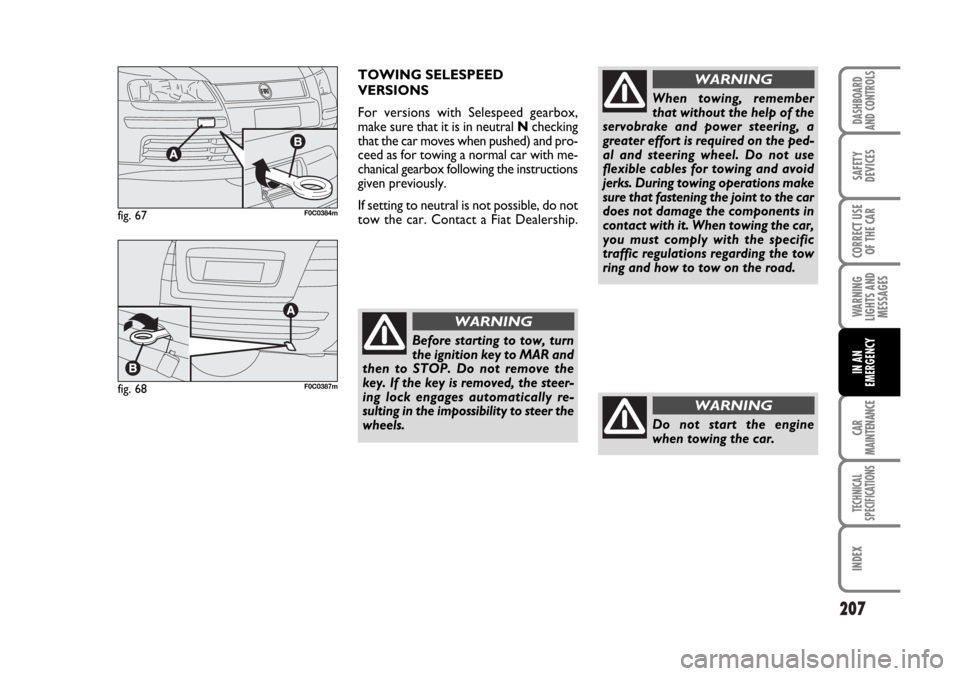
fig. 67F0C0384m
fig. 68F0C0387m
TOWING SELESPEED
VERSIONS
For versions with Selespeed gearbox,
make sure that it is in neutral Nchecking
that the car moves when pushed) and pro-
ceed as for towing a normal car with me-
chanical gearbox following the instructions
given previously.
If setting to neutral is not possible, do not
tow the car. Contact a Fiat Dealership.
Before starting to tow, turn
the ignition key to MAR and
then to STOP. Do not remove the
key. If the key is removed, the steer-
ing lock engages automatically re-
sulting in the impossibility to steer the
wheels.
WARNING
When towing, remember
that without the help of the
servobrake and power steering, a
greater effort is required on the ped-
al and steering wheel. Do not use
flexible cables for towing and avoid
jerks. During towing operations make
sure that fastening the joint to the car
does not damage the components in
contact with it. When towing the car,
you must comply with the specific
traffic regulations regarding the tow
ring and how to tow on the road.
WARNING
Do not start the engine
when towing the car.
WARNING
Page 230 of 274
229
WARNING
LIGHTS AND
MESSAGES
TECHNICAL
SPECIFICATIONS
INDEX
DASHBOARD
AND CONTROLS
SAFETY
DEVICES
CORRECT USE
OF THE CAR
IN AN
EMERGENCY
CAR
MAINTENANCE
WHEELS AND TYRES
Check the pressure of each tyre, includ-
ing the spare, every two weeks and before
long journeys. The pressure should be
checked with the tyre rested and cold.
For the correct tyre inflation pressure, see
“Wheels” in “Technical specifications”
section.
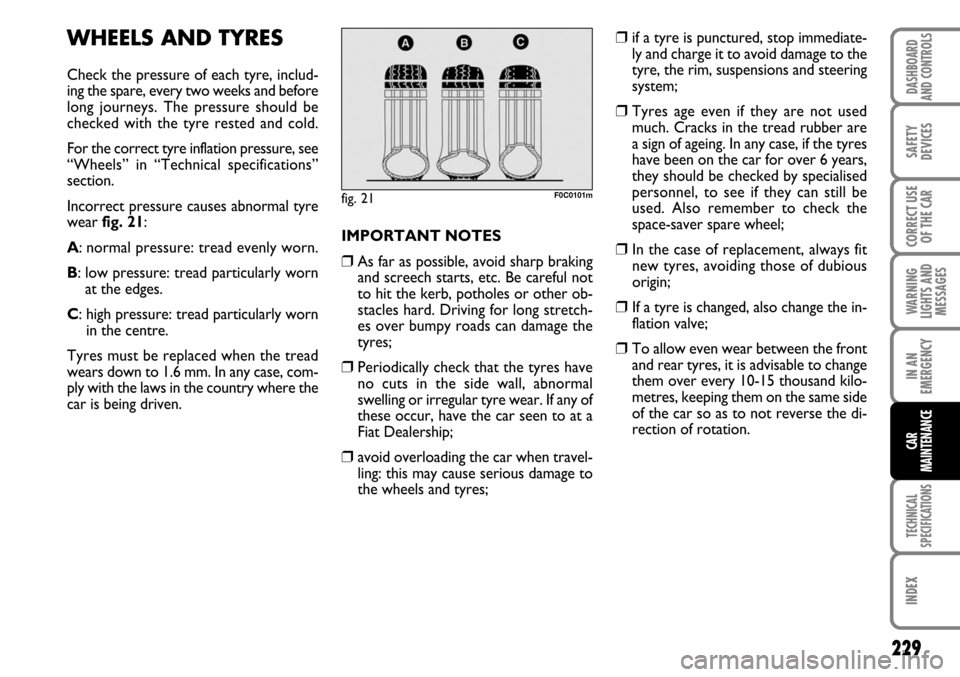
Incorrect pressure causes abnormal tyre
wearfig. 21:
A: normal pressure: tread evenly worn.
B: low pressure: tread particularly worn
at the edges.
C: high pressure: tread particularly worn
in the centre.
Tyres must be replaced when the tread
wears down to 1.6 mm. In any case, com-
ply with the laws in the country where the
car is being driven.IMPORTANT NOTES
❒As far as possible, avoid sharp braking
and screech starts, etc. Be careful not
to hit the kerb, potholes or other ob-
stacles hard. Driving for long stretch-
es over bumpy roads can damage the
tyres;
❒Periodically check that the tyres have
no cuts in the side wall, abnormal
swelling or irregular tyre wear. If any of
these occur, have the car seen to at a
Fiat Dealership;
❒avoid overloading the car when travel-
ling: this may cause serious damage to
the wheels and tyres;
fig. 21F0C0101m
❒if a tyre is punctured, stop immediate-
ly and charge it to avoid damage to the
tyre, the rim, suspensions and steering
system;
❒Tyres age even if they are not used
much. Cracks in the tread rubber are
a sign of ageing. In any case, if the tyres
have been on the car for over 6 years,
they should be checked by specialised
personnel, to see if they can still be
used. Also remember to check the
space-saver spare wheel;
❒ In the case of replacement, always fit
new tyres, avoiding those of dubious
origin;
❒ If a tyre is changed, also change the in-
flation valve;
❒To allow even wear between the front
and rear tyres, it is advisable to change
them over every 10-15 thousand kilo-
metres, keeping them on the same side
of the car so as to not reverse the di-
rection of rotation.
Page 237 of 274
236
WARNING
LIGHTS AND
MESSAGES
TECHNICAL
SPECIFICATIONS
INDEX
DASHBOARD
AND CONTROLS
SAFETY
DEVICES
CORRECT USE
OF THE CAR
IN AN
EMERGENCY
CAR
MAINTENANCE
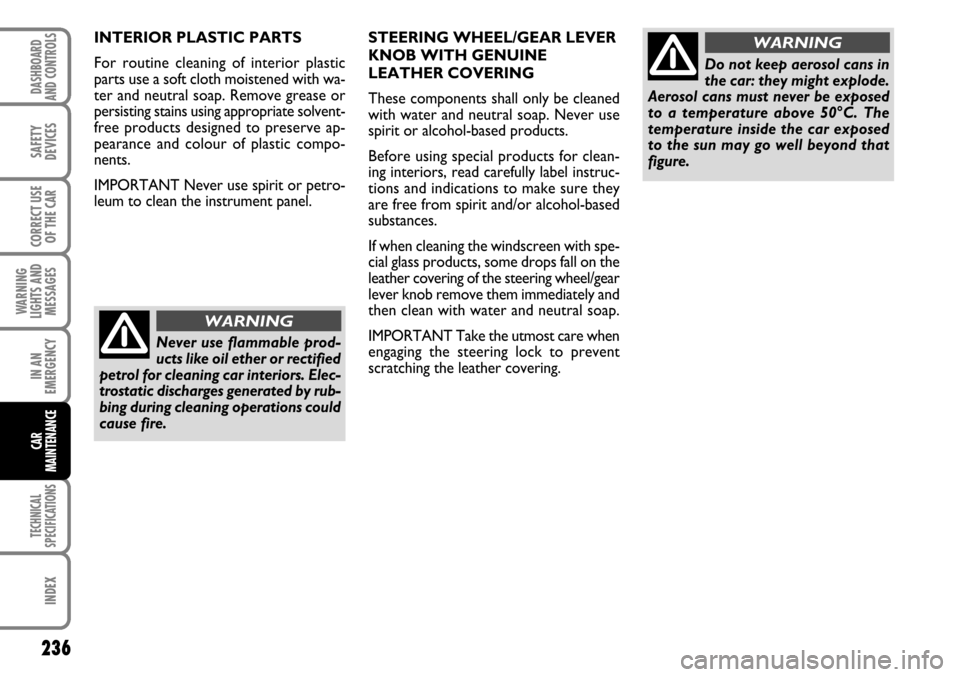
INTERIOR PLASTIC PARTS
For routine cleaning of interior plastic
parts use a soft cloth moistened with wa-
ter and neutral soap. Remove grease or
persisting stains using appropriate solvent-
free products designed to preserve ap-
pearance and colour of plastic compo-
nents.
IMPORTANT Never use spirit or petro-
leum to clean the instrument panel.STEERING WHEEL/GEAR LEVER
KNOB WITH GENUINE
LEATHER COVERING
These components shall only be cleaned
with water and neutral soap. Never use
spirit or alcohol-based products.
Before using special products for clean-
ing interiors, read carefully label instruc-
tions and indications to make sure they
are free from spirit and/or alcohol-based
substances.
If when cleaning the windscreen with spe-
cial glass products, some drops fall on the
leather covering of the steering wheel/gear
lever knob remove them immediately and
then clean with water and neutral soap.
IMPORTANT Take the utmost care when
engaging the steering lock to prevent
scratching the leather covering.
Do not keep aerosol cans in
the car: they might explode.
Aerosol cans must never be exposed
to a temperature above 50°C. The
temperature inside the car exposed
to the sun may go well beyond that
figure.
WARNING
Never use flammable prod-
ucts like oil ether or rectified
petrol for cleaning car interiors. Elec-
trostatic discharges generated by rub-
bing during cleaning operations could
cause fire.
WARNING
Page 238 of 274
237
WARNING
LIGHTS AND
MESSAGES
INDEX
DASHBOARD
AND CONTROLS
SAFETY
DEVICES
CORRECT USE
OF THE CAR
IN AN
EMERGENCY
CAR
MAINTENANCE
TECHNICAL
SPECIFICATIONS
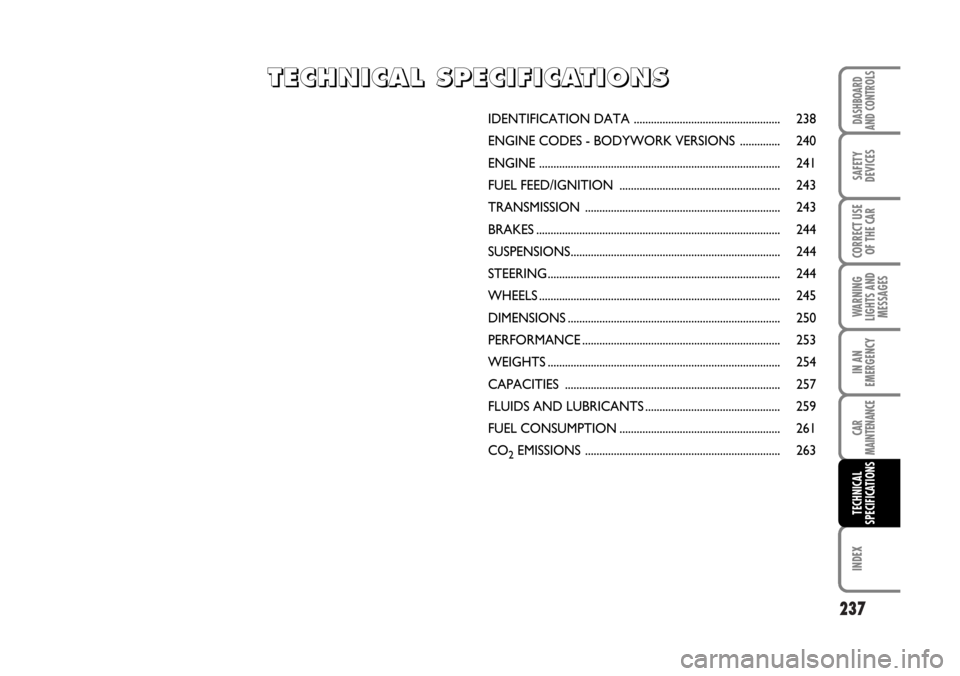
IDENTIFICATION DATA ................................................... 238
ENGINE CODES - BODYWORK VERSIONS .............. 240
ENGINE .................................................................................... 241
FUEL FEED/IGNITION ........................................................ 243
TRANSMISSION .................................................................... 243
BRAKES ..................................................................................... 244
SUSPENSIONS......................................................................... 244
STEERING ................................................................................. 244
WHEELS .................................................................................... 245
DIMENSIONS .......................................................................... 250
PERFORMANCE ..................................................................... 253
WEIGHTS ................................................................................. 254
CAPACITIES ........................................................................... 257
FLUIDS AND LUBRICANTS ............................................... 259
FUEL CONSUMPTION ........................................................ 261
CO
2EMISSIONS .................................................................... 263
T T
E E
C C
H H
N N
I I
C C
A A
L L
S S
P P
E E
C C
I I
F F
I I
C C
A A
T T
I I
O O
N N
S S
Page 245 of 274
244
WARNING
LIGHTS AND
MESSAGES
INDEX
DASHBOARD
AND CONTROLS
SAFETY
DEVICES
CORRECT USE
OF THE CAR
IN AN
EMERGENCY
CAR
MAINTENANCE
TECHNICAL
SPECIFICATIONS
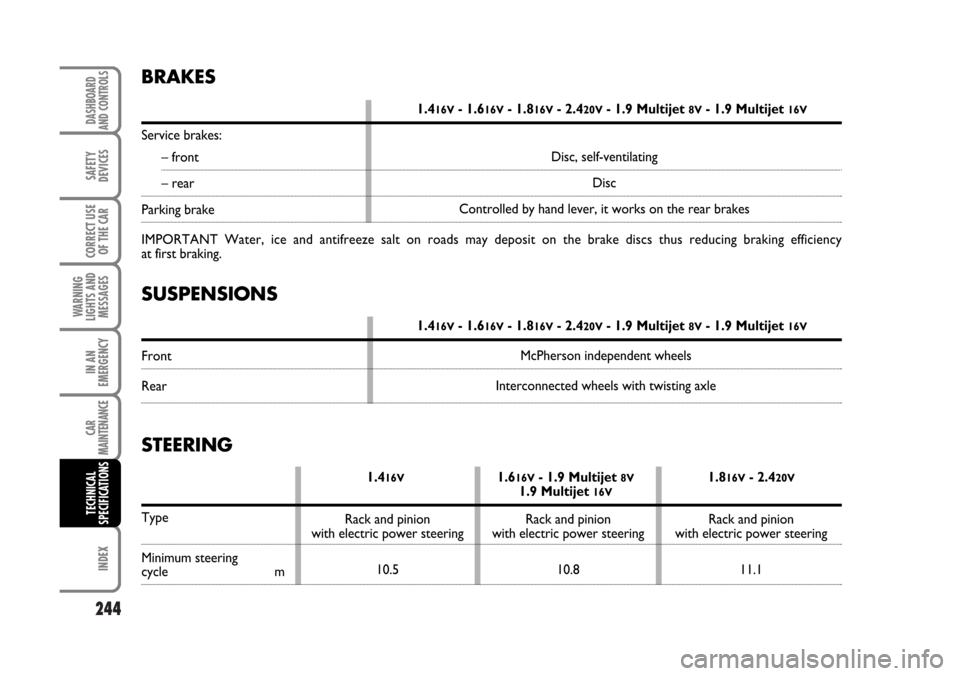
SUSPENSIONS
1.416V- 1.616V- 1.816V- 2.420V- 1.9 Multijet 8V- 1.9 Multijet 16V
Front
RearMcPherson independent wheels
Interconnected wheels with twisting axle
STEERING
1.416V1.616V- 1.9 Multijet 8V1.816V- 2.420V1.9 Multijet 16V
Type
Minimum steeringcycle m
BRAKES
1.416V- 1.616V- 1.816V- 2.420V- 1.9 Multijet 8V- 1.9 Multijet 16V
Service brakes:
– front
– rear
Parking brake
IMPORTANT Water, ice and antifreeze salt on roads may deposit on the brake discs thus reducing braking efficiency
at first braking.Disc, self-ventilating
Disc
Controlled by hand lever, it works on the rear brakes
Rack and pinion
with electric power steering
10.5Rack and pinion
with electric power steering
10.8Rack and pinion
with electric power steering
11.1
Page 267 of 274
266
WARNING
LIGHTS AND
MESSAGES
DASHBOARD
AND CONTROLS
SAFETY
DEVICES
CORRECT USE
OF THE CAR
IN AN
EMERGENCY
CAR
MAINTENANCE
TECHNICAL
SPECIFICATIONS
INDEX
Seats ........................................................ 37
– cleaning ............................................ 235
– easy entry ......................................... 38
– manually adjustable front seats .. 37
– rear sliding seats ............................ 39
– seat warming ................................. 38
Selespeed (gearbox) ........................... 141
Side/taillights .......................................... 59
Ski tunnel ................................................ 91
Skywindow (blade sunroof) .............. 74
Smart washing ...................................... 63
Snow chains .......................................... 155
Sound system (presetting).................. 100
Spark plugs ............................................. 241
Starting the engine ............................... 136
Steering .................................................. 244
Steering column lock .......................... 20
Steering wheel ....................................... 42
Sun visors .............................................. 73
Sunroof (Skywindow) ......................... 74
Suspensions ........................................... 244
Symbols .................................................. 8
Technical specifications............. 237
Third brake light
(bulb replacement) ............................ 191
Tilting shelf ............................................ 72Top speeds ............................................ 253
Towing the car ...................................... 206
Towing trailers ...................................... 151
Transmission ........................................ 241
Trip Computer...................................... 34
Tyre repair kit
(Fix&Go automatic)........................... 177
Tyres
– changing ............................................ 171
– pressure ............................................ 246
– snow tyres ....................................... 154
– standard tyres ................................. 247
– understanding tyre marking......... 246
Using the manual gearbox ............... 140
Using the Selespeed gearbox ........... 141
Warning lights and messages.. 157
Weights ................................................... 254
Wheel
– changing ............................................ 171
Wheel geometry................................... 245
Window (washing/cleaning) ........ 62-234
Windscreen washer/wiper ................. 62
Windscreen wiper
– blades ................................................ 231
– control .............................................. 62
– nozzles .............................................. 232 Presetting for mounting
the “Universal Isofix”
child restraint system ...................... 124
Pretensioners ....................................... 113
Protecting the environment ............. 108
Puddle light/door opening light
(bulb replacement) ............................ 195
Radio transmitters and
cellular telephones............................. 101
Rain sensor ........................................... 63
Rear fog lights ........................................ 69
Rear window washer/wiper............... 64
Rear window wiper
– blades ............................................... 231
– control ............................................. 64
– nozzles ............................................. 232
Rearview mirrors ................................. 43
Reversing lights
(bulb replacement) ..................... 188-189
Rims
– understanding rim marking .......... 246
Roof rack/ski rack ............................... 93
Rubber hoses ....................................... 230
Safety devices.................................. 109
S.B.R. system ........................................ 112
Seat belts ................................................ 110