emergency towing FIAT STILO 2006 1.G Owners Manual
[x] Cancel search | Manufacturer: FIAT, Model Year: 2006, Model line: STILO, Model: FIAT STILO 2006 1.GPages: 274, PDF Size: 4.76 MB
Page 20 of 274
19
SAFETY
DEVICES
CORRECT USE
OF THE CAR
WARNING
LIGHTS AND
MESSAGES
IN AN
EMERGENCY
CAR
MAINTENANCE
TECHNICAL
SPECIFICATIONS
INDEX
DASHBOARD
AND CONTROLS
ANTI-RAISING SENSOR
The anti-raising sensor detects any ab-
normal car raising/sloping, even partial
(e.g.: attempt to remove a wheel).
This sensor can detect the smallest car
sideslip angle changes, both longitudinally
and transversally.
Sideslip angle changes lower than 0.5°/min.
(e.g.: slow tyre flattening) are not consid-
ered.
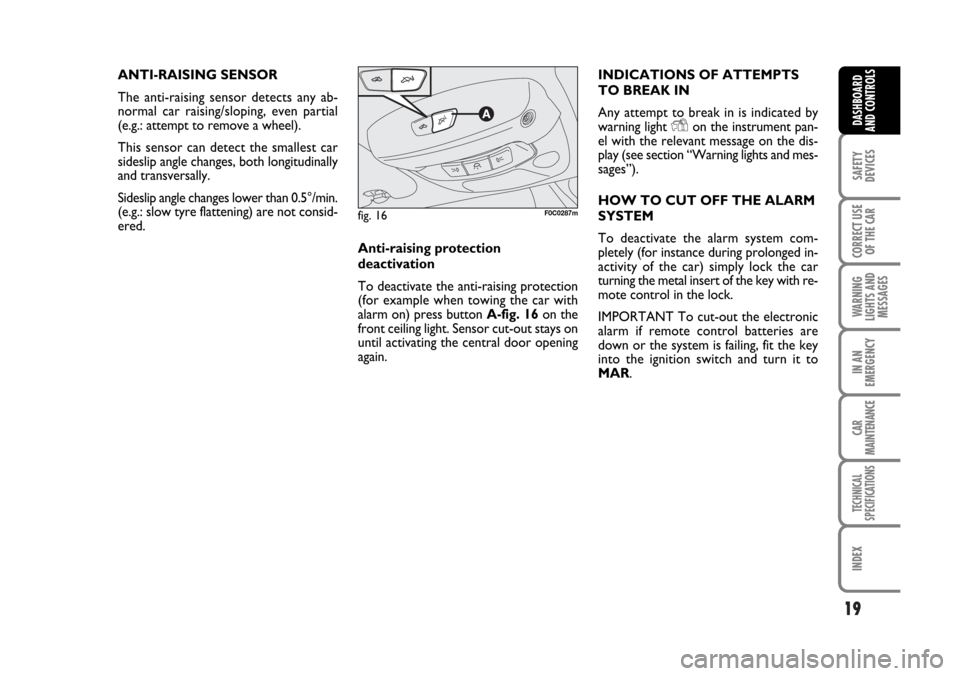
Anti-raising protection
deactivation
To deactivate the anti-raising protection
(for example when towing the car with
alarm on) press button A-fig. 16 on the
front ceiling light. Sensor cut-out stays on
until activating the central door opening
again.INDICATIONS OF ATTEMPTS
TO BREAK IN
Any attempt to break in is indicated by
warning light
Yon the instrument pan-
el with the relevant message on the dis-
play (see section “Warning lights and mes-
sages”).
HOW TO CUT OFF THE ALARM
SYSTEM
To deactivate the alarm system com-
pletely (for instance during prolonged in-
activity of the car) simply lock the car
turning the metal insert of the key with re-
mote control in the lock.
IMPORTANT To cut-out the electronic
alarm if remote control batteries are
down or the system is failing, fit the key
into the ignition switch and turn it to
MAR.
fig. 16F0C0287m
Page 136 of 274
135
WARNING
LIGHTS AND
MESSAGES
IN AN
EMERGENCY
CAR
MAINTENANCE
TECHNICAL
SPECIFICATIONS
INDEX
DASHBOARD
AND CONTROLS
SAFETY
DEVICES
CORRECT USE
OF THE CAR
ENGINE STARTING ............................................................ 136
PARKING .................................................................................. 139
USING THE MANUAL GEARBOX .................................. 140
USING THE “SELESPEED” GEARBOX .......................... 141
CONTAINING RUNNING COSTS ................................. 149
TOWING TRAILERS ............................................................. 151
SNOW TYRES ......................................................................... 154
SNOW CHAINS ..................................................................... 155
CAR INACTIVITY ................................................................. 156
C C
O O
R R
R R
E E
C C
T T
U U
S S
E E
O O
F F
T T
H H
E E
C C
A A
R R
Page 139 of 274
138
WARNING
LIGHTS AND
MESSAGES
IN AN
EMERGENCY
CAR
MAINTENANCE
TECHNICAL
SPECIFICATIONS
INDEX
DASHBOARD
AND CONTROLS
SAFETY
DEVICES
CORRECT USE
OF THE CAR
STOPPING THE ENGINE
Turn the ignition to STOPwhile the en-
gine is idling.
IMPORTANT After a taxing drive, you
should allow the engine to “catch its
breath” before turning it off by letting it
idle to allow the temperature in the en-
gine compartment to fall.
Never bump start the engine
by pushing, towing or coasting
downhill as this could cause
fuel to flow into the catalytic
exhaust system and damage it beyond
repair.
Remember that the servo-
brake and power steering
are not operational until the engine
has been started, therefore much ef-
fort than usual is required on the
brake pedal and steering wheel.
WARNING
A quick burst on the acceler-
ator before turning off the en-
gine serves absolutely no prac-
tical purpose, it wastes fuel
and is damaging especially to tur-
bocharged engines.
HOW TO WARM UP
THE ENGINE AFTER IT
HAS JUST STARTED
(petrol and diesel engines)
Proceed as follows:
❒Drive off slowly, letting the engine turn
at medium revs. Do not accelerate
abruptly;
❒Do not drive at full performance for the
initial kilometres. Wait until the coolant
temperature gauge starts moving.
EMERGENCY START-UP
If the instrument panel warning light
Ystays on with fixed light, contact Fiat Deal-
ership.
Page 149 of 274

148
WARNING
LIGHTS AND
MESSAGES
IN AN
EMERGENCY
CAR
MAINTENANCE
TECHNICAL
SPECIFICATIONS
INDEX
DASHBOARD
AND CONTROLS
SAFETY
DEVICES
CORRECT USE
OF THE CAR
STOPPING THE CAR
To stop the car, simply release the accel-
erator pedal and, if necessary press the
brake pedal.
Regardless of the gear engaged and the op-
erating mode activated (MANUAL or AU-
TO) the system automatically disengages
the clutch and shifts to a lower gear.
Stopping the car the system automatical-
ly engages the first gear (1).PARKING THE CAR
To park the car safely it is absolutely nec-
essary to engage first gear (1) or reverse
(R) and also the handbrake if the car is on
a slope.
When turning off the engine with the car
on an uphill slope and a gear engaged, it
is absolutely necessary to wait for the dis-
play showing the gear engaged to go off
before releasing the brake pedal.
If the gearbox is in neutral (N) and want-
ing to engage a parking gear, the system
should be activated and with the foot on
the brake pedal it is necessary to engage
first gear (1) or reverse (R).
TOWING THE CAR
See the instructions contained in para-
graph “Towing the car” in section “In an
emergency”. BUZZER WARNINGS
The buzzer is activated when:
❒reverse gear is engaged (R);
❒clutch overheating occurs when mov-
ing off (in this case it is necessary to
“force” start-up without hesitation or,
if the car is on a slope, release the ac-
celerator and use the brake pedal to
stop the car);
❒an attempt is made to start the engine
with a gear engaged and the brake ped-
al is not pressed completely;
Still for safety reasons, when the car is sta-
tionary, with engine started gear engaged,
the system activates the buzzer and au-
tomatically shifts to neutral (N) when:
❒no action is made on the accelerator
and/or brake pedal for at least 3 min-
utes;
❒the brake is pressed for over 10 min-
utes;
❒the driver’s door is opened and no ac-
tion is made on the accelerator and
brake by at least 2 seconds;
❒a gearbox failure has been detected.
Page 152 of 274
151
WARNING
LIGHTS AND
MESSAGES
IN AN
EMERGENCY
CAR
MAINTENANCE
TECHNICAL
SPECIFICATIONS
INDEX
DASHBOARD
AND CONTROLS
SAFETY
DEVICES
CORRECT USE
OF THE CAR
TOWING TRAILERS
IMPORTANT NOTES
For towing caravans or trailers the car
must be fitted with a certified tow hook
and an adequate electric system. Installa-
tion should be carried out by specialised
personnel who release a special document
for circulation on the road.
Install any specific and/or additional rear-
view mirrors as specified by law.
Remember that when towing a trailer,
steep hills are harder to climb, the brak-
ing spaces increase and overtaking takes
longer depending on the overall weight.
Engage a low gear when driving downhill,
rather than constantly using the brake.The weight the trailer exerts on the car
tow hook reduces by the same amount
the actual car loading capacity. To make
sure the maximum towable weight is not
exceeded (given in the log book) account
should be taken of the fully laden trailer,
including accessories and personal be-
longings.
Do not exceed the speed limits of the
country you are driving in. In any case do
not exceed 100 km/h.INSTALLING THE TOW HOOK
The towing device should be fastened to
the body by specialised personnel ac-
cording to any additional and/or integra-
tive information supplied by the Manufac-
turer of the device.
The ABS system with which
the car may be fitted does
not control the trailer braking system.
Drive with extreme care on slippery
roadbeds.
WARNING
Under no circumstances
should the car brake system
be altered to control the trailer brake.
The trailer braking system must be
fully independent of the car hydraulic
system.
WARNING
Page 153 of 274

152
WARNING
LIGHTS AND
MESSAGES
IN AN
EMERGENCY
CAR
MAINTENANCE
TECHNICAL
SPECIFICATIONS
INDEX
DASHBOARD
AND CONTROLS
SAFETY
DEVICES
CORRECT USE
OF THE CAR
The towing device must meet current reg-
ulations with reference to 94/20/EC Di-
rective and subsequent amendments.
For any version the towing device used
must match the towable weight of the car
on which it is to be installed.
IMPORTANT Supplementary electric
loads other than external lights (e.g. elec-
tric brake, electric winch, etc.) shall be
used with running engine.Assembly diagram fig. 13-14
The tow hook structure must be fastened
in the points shown by the symbol
Øus-
ing a total of 6 M10 screws.
Counterplates
➀shall have a 4 mm min
thickness.
Counterplates
➁shall have a 6 mm min
thickness.
The hook should be fastened to the body
avoiding any type of drilling and trimming
of the rear bumpers that remains visible
when the hook is removed.IMPORTANT It is compulsory to fasten a
label (plainly visible) of suitable size and
material with the following wording:
MAX LOAD ON BALL 60 kg
After fitting, screw holes shall be sealed to
prevent exhaust gas inlet.
Page 163 of 274
162
IN AN
EMERGENCY
CAR
MAINTENANCE
TECHNICAL
SPECIFICATIONS
INDEX
DASHBOARD
AND CONTROLS
SAFETY
DEVICES
CORRECT USE
OF THE CAR
WARNING
LIGHTS AND
MESSAGES
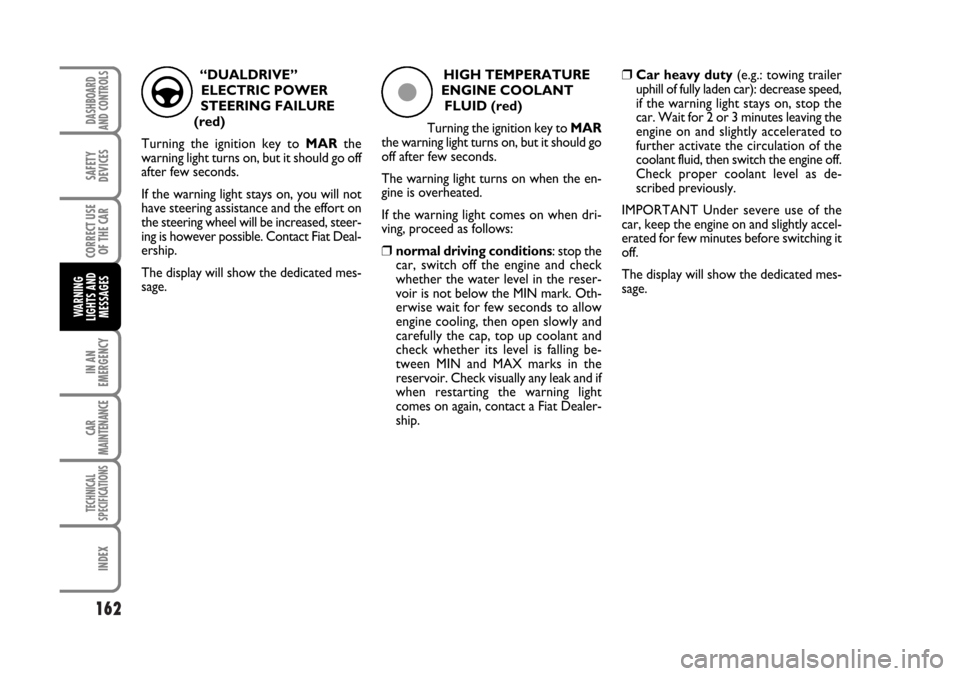
“DUALDRIVE”
ELECTRIC POWER
STEERING FAILURE
(red)
Turning the ignition key to MARthe
warning light turns on, but it should go off
after few seconds.
If the warning light stays on, you will not
have steering assistance and the effort on
the steering wheel will be increased, steer-
ing is however possible. Contact Fiat Deal-
ership.
The display will show the dedicated mes-
sage.HIGH TEMPERATURE
ENGINE COOLANT
FLUID (red)
Turning the ignition key to MAR
the warning light turns on, but it should go
off after few seconds.
The warning light turns on when the en-
gine is overheated.
If the warning light comes on when dri-
ving, proceed as follows:
❒normal driving conditions: stop the
car, switch off the engine and check
whether the water level in the reser-
voir is not below the MIN mark. Oth-
erwise wait for few seconds to allow
engine cooling, then open slowly and
carefully the cap, top up coolant and
check whether its level is falling be-
tween MIN and MAX marks in the
reservoir. Check visually any leak and if
when restarting the warning light
comes on again, contact a Fiat Dealer-
ship.
❒Car heavy duty(e.g.: towing trailer
uphill of fully laden car): decrease speed,
if the warning light stays on, stop the
car. Wait for 2 or 3 minutes leaving the
engine on and slightly accelerated to
further activate the circulation of the
coolant fluid, then switch the engine off.
Check proper coolant level as de-
scribed previously.
IMPORTANT Under severe use of the
car, keep the engine on and slightly accel-
erated for few minutes before switching it
off.
The display will show the dedicated mes-
sage.
gç
Page 170 of 274
169
WARNING
LIGHTS AND
MESSAGES
CAR
MAINTENANCE
TECHNICAL
SPECIFICATIONS
INDEX
DASHBOARD
AND CONTROLS
SAFETY
DEVICES
CORRECT USE
OF THE CAR
IN AN
EMERGENCY
ENGINE STARTING.............................................................. 170
IF A TYRE IS PUNCTURED ................................................ 171
QUICK TYRE REPAIR KIT FIX & GO automatic ......... 177
WHEN NEEDING TO CHANGE A BULB .................... 181
IF AN EXTERIOR LIGHT BURNS OUT .......................... 184
IF AN INTERIOR LIGHT BURNS OUT ........................... 192
IF A FUSE BLOWS ................................................................. 196
IF THE BATTERY IS FLAT ................................................... 205
JACKING THE CAR .............................................................. 206
TOWING THE CAR ............................................................ 206
FIRE EXTINGUISHER ........................................................... 208
I I
N N
A A
N N
E E
M M
E E
R R
G G
E E
N N
C C
Y Y
Page 171 of 274
170
WARNING
LIGHTS AND
MESSAGES
CAR
MAINTENANCE
TECHNICAL
SPECIFICATIONS
IINDEX
DASHBOARD
AND CONTROLS
SAFETY
DEVICES
CORRECT USE
OF THE CAR
IN AN
EMERGENCY
ENGINE STARTING
JUMP STARTING
If the battery is flat, it is possible to start
the engine using an auxiliary battery with
the same capacity or a little higher than
the flat one.
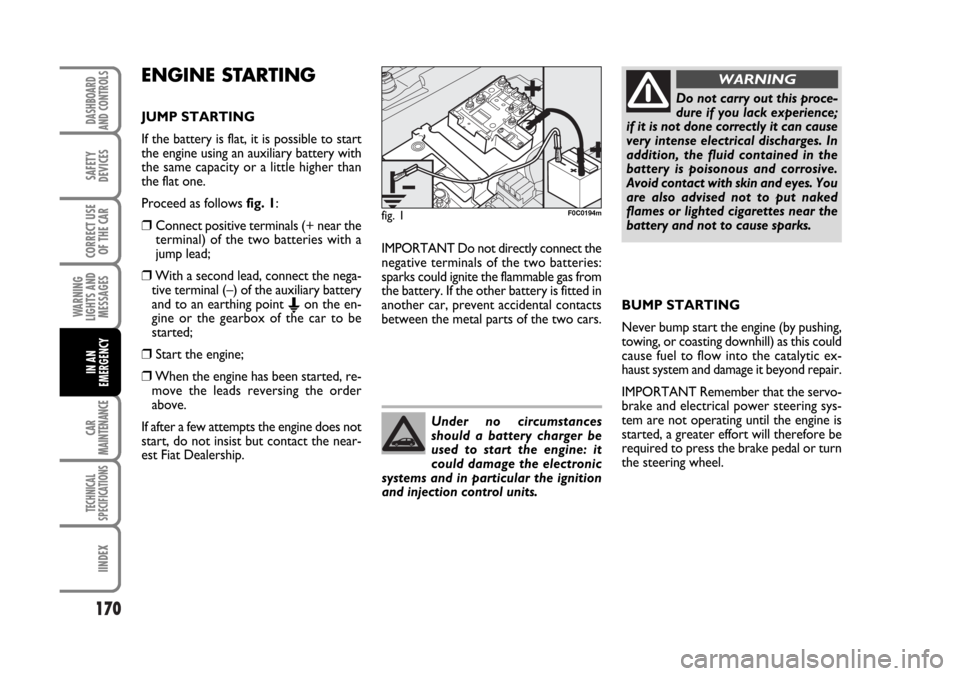
Proceed as follows fig. 1:
❒Connect positive terminals (+ near the
terminal) of the two batteries with a
jump lead;
❒With a second lead, connect the nega-
tive terminal (–) of the auxiliary battery
and to an earthing point
Eon the en-
gine or the gearbox of the car to be
started;
❒Start the engine;
❒When the engine has been started, re-
move the leads reversing the order
above.
If after a few attempts the engine does not
start, do not insist but contact the near-
est Fiat Dealership.IMPORTANT Do not directly connect the
negative terminals of the two batteries:
sparks could ignite the flammable gas from
the battery. If the other battery is fitted in
another car, prevent accidental contacts
between the metal parts of the two cars.BUMP STARTING
Never bump start the engine (by pushing,
towing, or coasting downhill) as this could
cause fuel to flow into the catalytic ex-
haust system and damage it beyond repair.
IMPORTANT Remember that the servo-
brake and electrical power steering sys-
tem are not operating until the engine is
started, a greater effort will therefore be
required to press the brake pedal or turn
the steering wheel.
fig. 1F0C0194m
Under no circumstances
should a battery charger be
used to start the engine: it
could damage the electronic
systems and in particular the ignition
and injection control units.
Do not carry out this proce-
dure if you lack experience;
if it is not done correctly it can cause
very intense electrical discharges. In
addition, the fluid contained in the
battery is poisonous and corrosive.
Avoid contact with skin and eyes. You
are also advised not to put naked
flames or lighted cigarettes near the
battery and not to cause sparks.
WARNING
Page 207 of 274
TOWING THE CAR
The tow ring provided with the car is
housed in the tool box under the boot
mat.
TOW RING HOOKING
Proceed as follows:
❒release the cap operating the tab A-
fig. 67-68;
❒take the tow hook Bfrom its support;
❒ tighten the ring on the rear or front
threaded pin.
fig. 66F0C0247m
206
WARNING
LIGHTS AND
MESSAGES
CAR
MAINTENANCE
TECHNICAL
SPECIFICATIONS
IINDEX
DASHBOARD
AND CONTROLS
SAFETY
DEVICES
CORRECT USE
OF THE CAR
IN AN
EMERGENCY
JACKING THE CAR
If the car is to be lifted, go to a Fiat Deal-
ership which is equipped with the arm
hoist or workshop lift.
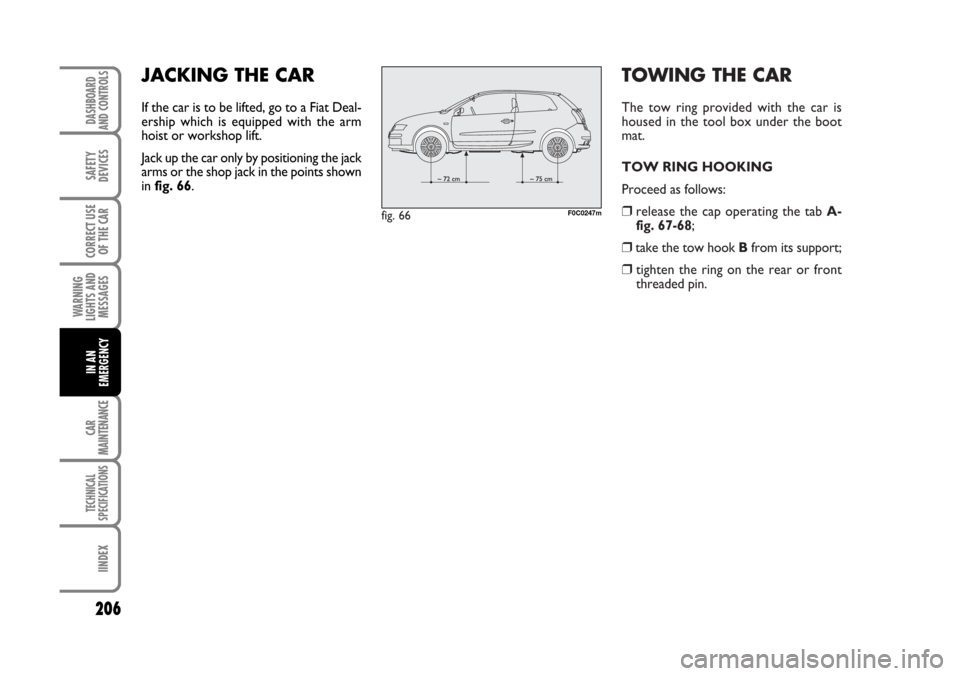
Jack up the car only by positioning the jack
arms or the shop jack in the points shown
in fig. 66.