Service light FIAT TALENTO 2016 2.G Owners Manual
[x] Cancel search | Manufacturer: FIAT, Model Year: 2016, Model line: TALENTO, Model: FIAT TALENTO 2016 2.GPages: 232, PDF Size: 5.01 MB
Page 77 of 232
PROTECTING THE
ENVIRONMENT
Temperature of the exhaust gases
The system controlling the exhaust lets
you identify the malfunctions of the
vehicle's anti-pollution device. These
faults can cause an excess in polluting
emissions and cause mechanical
damage.
This warning light on the instrument
panel indicates any system function
failure:
If it stays on, contact a Fiat
Dealership as soon as possible;
If it flashes, you need to reduce the
engine running until the flashing stops.
Contact a Fiat Dealership as soon as
possible.
Refer to the information in the "AdBblue
additive tank" paragraph in the
"Knowing your vehicle" chapter.
The vehicle was designed with
environmental friendliness in mind for its
entire life cycle: from manufacture to
use up to the end of its life cycle. This
commitment is demonstrated by the
writing eco
2.Manufacture
The vehicle's manufacture has been
carried out at an industrial factory that
applies advanced procedures aimed at
environmental impact reduction with
respect to the inhabitants and nature in
the surrounding areas (reduction of
water and power consumption,
atmospheric and water emissions,
disposal and evaluation of waste.
Emissions
While it is being used, the vehicle was
designed to emit a lower quantity of
greenhouse gasses (CO
2) and
therefore lower consumption (ex.:
170 g/km amounts to 6.4 l/100 km for
a Diesel vehicle).
Moreover, the vehicles are equipped
with anti-pollution systems such as the
catalytic exhaust, oxygen sensor, etc.
For some vehicles, this system is
rounded out with an anti-particulate
filter that allows a reduction in particle
emissions.
Used and replaced parts on sale during
regular servicing (battery, oil filter, air
filter, batteries, etc.) and oil tanks (both
empty and full of used oil) must be
delivered to specialised waste disposal
consortiums.To hand the vehicle over at the end of
its life without extra cost, contact one of
our dealerships if you are purchasing
another vehicle or an FCA-authorised
collection and scrapping centre. These
centres have been carefully chosen to
offer high quality service for the
collection, treatment and recycling of
vehicles at their end of life, respecting
the surrounding environment.
Recyclability
The vehicle is 85% recyclable and 95%
recoverable.
To achieve these aims, several of the
vehicle's parts have been designed so
they can be recycled. The structure and
materials have been especially studied
to facilitate dismantling of these
components and their re-treatment in
specific chains.
In order to preserve raw material
resources, the vehicle incorporates
several parts in recycled plastic or
renewable materials (plant or animal like
cotton or wool).
75
Page 90 of 232
CONTROL PANEL
AND ON-BOARD
INSTRUMENTS
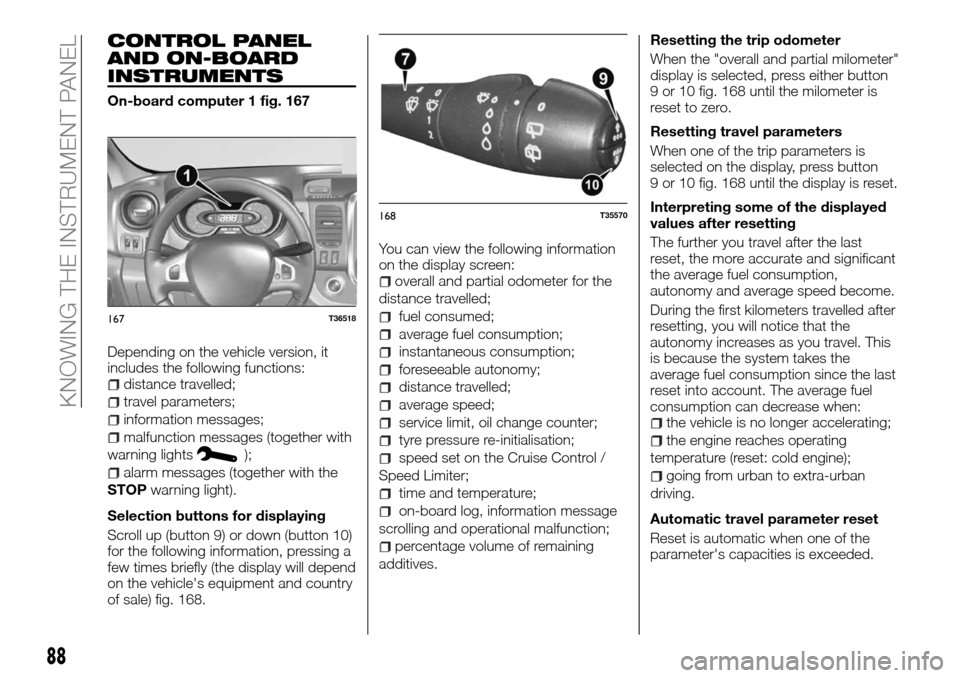
On-board computer 1 fig. 167
Depending on the vehicle version, it
includes the following functions:
distance travelled;
travel parameters;
information messages;
malfunction messages (together with
warning lights
);
alarm messages (together with the
STOPwarning light).
Selection buttons for displaying
Scroll up (button 9) or down (button 10)
for the following information, pressing a
few times briefly (the display will depend
on the vehicle's equipment and country
of sale) fig. 168.You can view the following information
on the display screen:
overall and partial odometer for the
distance travelled;
fuel consumed;
average fuel consumption;
instantaneous consumption;
foreseeable autonomy;
distance travelled;
average speed;
service limit, oil change counter;
tyre pressure re-initialisation;
speed set on the Cruise Control /
Speed Limiter;
time and temperature;
on-board log, information message
scrolling and operational malfunction;
percentage volume of remaining
additives.Resetting the trip odometer
When the "overall and partial milometer"
display is selected, press either button
9 or 10 fig. 168 until the milometer is
reset to zero.
Resetting travel parameters
When one of the trip parameters is
selected on the display, press button
9 or 10 fig. 168 until the display is reset.
Interpreting some of the displayed
values after resetting
The further you travel after the last
reset, the more accurate and significant
the average fuel consumption,
autonomy and average speed become.
During the first kilometers travelled after
resetting, you will notice that the
autonomy increases as you travel. This
is because the system takes the
average fuel consumption since the last
reset into account. The average fuel
consumption can decrease when:
the vehicle is no longer accelerating;
the engine reaches operating
temperature (reset: cold engine);
going from urban to extra-urban
driving.
Automatic travel parameter reset
Reset is automatic when one of the
parameter's capacities is exceeded.
167T36518
168T35570
88
KNOWING THE INSTRUMENT PANEL
Page 92 of 232
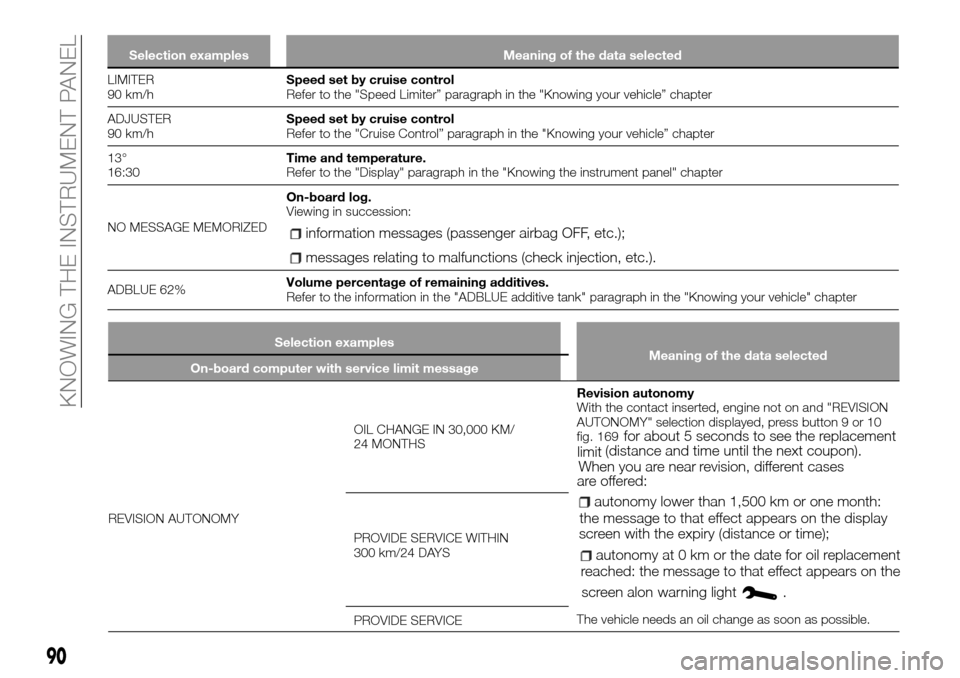
Selection examples Meaning of the data selected
LIMITER
90 km/hSpeed set by cruise control
Refer to the "Speed Limiter” paragraph in the "Knowing your vehicle” chapter
ADJUSTER
90 km/hSpeed set by cruise control
Refer to the "Cruise Control” paragraph in the "Knowing your vehicle” chapter
13°
16:30Time and temperature.
Refer to the "Display" paragraph in the "Knowing the instrument panel" chapter
NO MESSAGE MEMORIZEDOn-board log.
Viewing in succession:
information messages (passenger airbag OFF, etc.);
messages relating to malfunctions (check injection, etc.).
ADBLUE 62%Volume percentage of remaining additives.
Refer to the information in the "ADBLUE additive tank" paragraph in the "Knowing your vehicle" chapter
90
KNOWING THE INSTRUMENT PANEL
Selection examples
Meaning of the data selected
On-board computer with service limit message
REVISION AUTONOMYOIL CHANGE IN 30,000 KM/
24 MONTHSRevision autonomy
With the contact inserted, engine not on and "REVISION
AUTONOMY" selection displayed, press button 9 or 10
fig. 169
for about 5 seconds to see the replacement
limit(distance and time until the next coupon).
When you are nearrevision, different cases
are offered:
autonomy lower than 1,500 km or one month:
the message to that effect appears on the display
screen with theexpiry (distance or time);
autonomy at 0 km or the date for oil replacement
reached: the message to that effect appears on the
screen alonwarning light
.
The vehicle needs an oil change as soon as possible. PROVIDE SERVICE WITHIN
300 km/24 DAYS
PROVIDE SERVICE
Page 93 of 232
Selection examples
Meaning of the data selected
On-board computer with service limit message
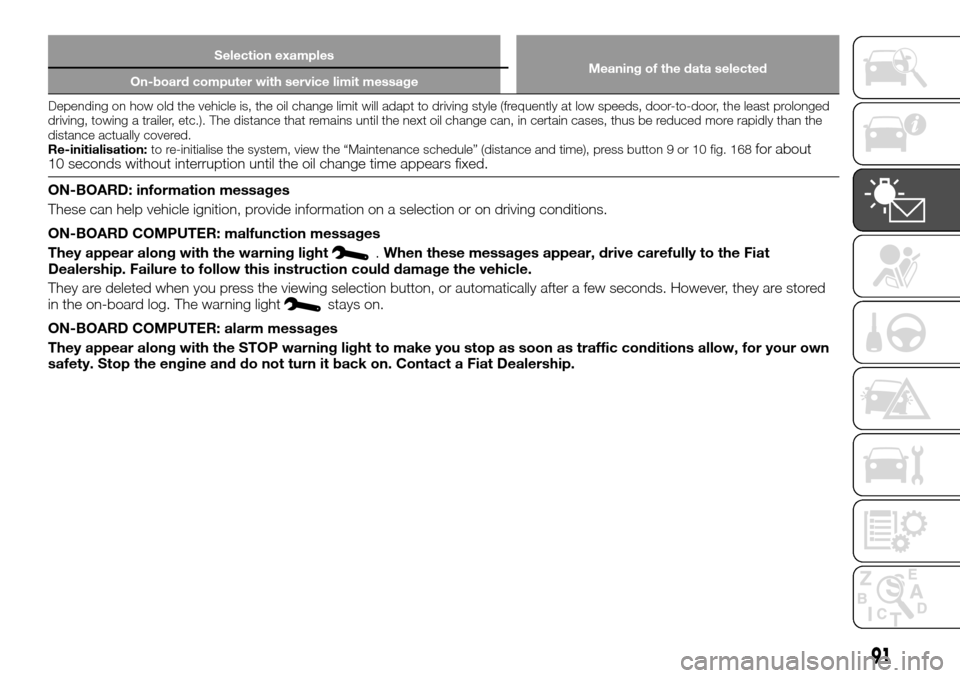
Depending on how old the vehicle is, the oil change limit will adapt to driving style (frequently at low speeds, door-to-door, the least prolonged
driving, towing a trailer, etc.). The distance that remains until the next oil change can, in certain cases, thus be reduced more rapidly than the
distance actually covered.
Re-initialisation:to re-initialise the system, view the “Maintenance schedule” (distance and time), press button 9 or 10 fig. 168
for about
10 seconds without interruption until the oil change time appears fixed.
ON-BOARD: information messages
These can help vehicle ignition, provide information on a selection or on driving conditions.
ON-BOARD COMPUTER: malfunction messages
They appear along with the warning light
.When these messages appear, drive carefully to the Fiat
Dealership. Failure to follow this instruction could damage the vehicle.
They are deleted when you press the viewing selection button, or automatically after a few seconds. However, they are stored
in the on-board log. The warning light
stays on.
ON-BOARD COMPUTER: alarm messages
They appear along with the STOP warning light to make you stop as soon as traffic conditions allow, for your own
safety. Stop the engine and do not turn it back on. Contact a Fiat Dealership.
91
Page 95 of 232
OCCUPANT
PROTECTION
SYSTEMS
84) 85)
19) 20)
3)
Depending on the trim, there could be:load limiters;
driver and front passenger airbags;
These systems are designed to function
separately or at the same time in case
of a frontal collision.
Depending on the violence of the
collision, the system activates:
seat belt locking.
seat belt pre-tensioner (which
activates the belt tension);
the airbags.
WARNING
84)Check the safety devices after every
accident.
85)Any intervention on the complete
system (pre-tensioners, airbags, electronic
modules, wiring) or re-use on another
vehicle, even if identical, is strictly
prohibited.
IMPORTANT
19)In order to prevent accidental
deployments that could cause damage,
only qualified Fiat Dealership personnel can
intervene in pre-tensioners and air bags.
20)Checking the electrical features of the
actuator can only be effected by specifically
prepared personnel using the proper tools.
IMPORTANT
3)When the vehicle is scrapped, see a Fiat
Dealership to remove the pre-tensioner gas
generator and air bags.
SEAT BELTS
86)
For obvious safety reasons, always
fasten the seat belts. In addition, always
comply with the laws of the country you
are in.
IMPORTANT For full effectiveness of the
rear seat belts, make sure that the
single rear seat is correctly locked in
place. Refer to the "Rear single seats”
paragraph in the "Knowing your vehicle”
chapter.
Before starting the engine, first adjust
the driving position and adjust the seat
belts to obtain the best possible
protection (for all the passengers).
The safety belts must always be kept
clean. Use products selected by Fiat
Dealership services or soap and warm
water, rubbing with a sponge and
drying with a dry cloth. Do not use
detergents or chemical products.
ADJUSTING THE DRIVER'S
POSITION
Sit with your back against the
backrest (after taking off clothing like
coat, jacket, etc.). This is an essential
factor for correctly positioning the back;
adjust the seat position according to
the pedals. The seat position must be
so as to allow pressing the clutch pedal
all the way. The backrest must be
inclined so arms are slightly bent;
93
Page 134 of 232
ENGINE RUN-IN
Until you have gone 1,500 km, do not
exceed 130 km/h on the highest ratio,
or 2,500 rpm. After that mileage, you
can push the engine harder, but the
vehicle will perform better only after
having travelled 6,000 kilometres.
During the running-in period, do not
accelerate abruptly while the engine is
cold, and avoid running it too fast.
Coupon frequency:refer to the
"Scheduled Service Plan".
STARTING THE
ENGINE
138) 139) 140) 141) 142)
Vehicles with a key and remote
control
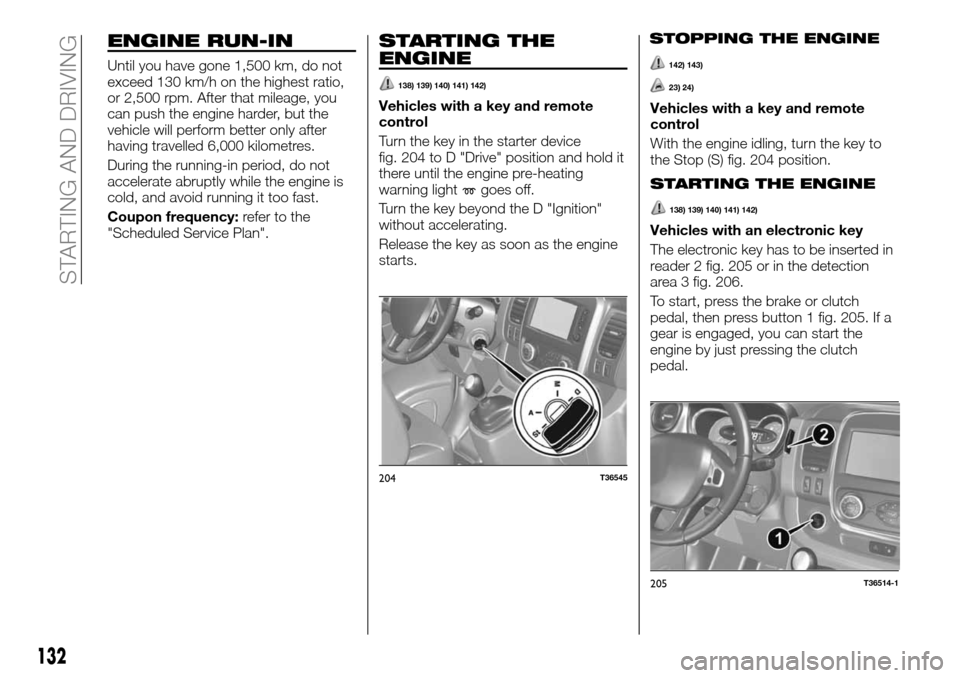
Turn the key in the starter device
fig. 204 to D "Drive" position and hold it
there until the engine pre-heating
warning light
goes off.
Turn the key beyond the D "Ignition"
without accelerating.
Release the key as soon as the engine
starts.
STOPPING THE ENGINE
142) 143)
23) 24)
Vehicles with a key and remote
control
With the engine idling, turn the key to
the Stop (S) fig. 204 position.
STARTING THE ENGINE
138) 139) 140) 141) 142)
Vehicles with an electronic key
The electronic key has to be inserted in
reader 2 fig. 205 or in the detection
area 3 fig. 206.
To start, press the brake or clutch
pedal, then press button 1 fig. 205. If a
gear is engaged, you can start the
engine by just pressing the clutch
pedal.
204T36545
205T36514-1
132
STARTING AND DRIVING
Page 154 of 232
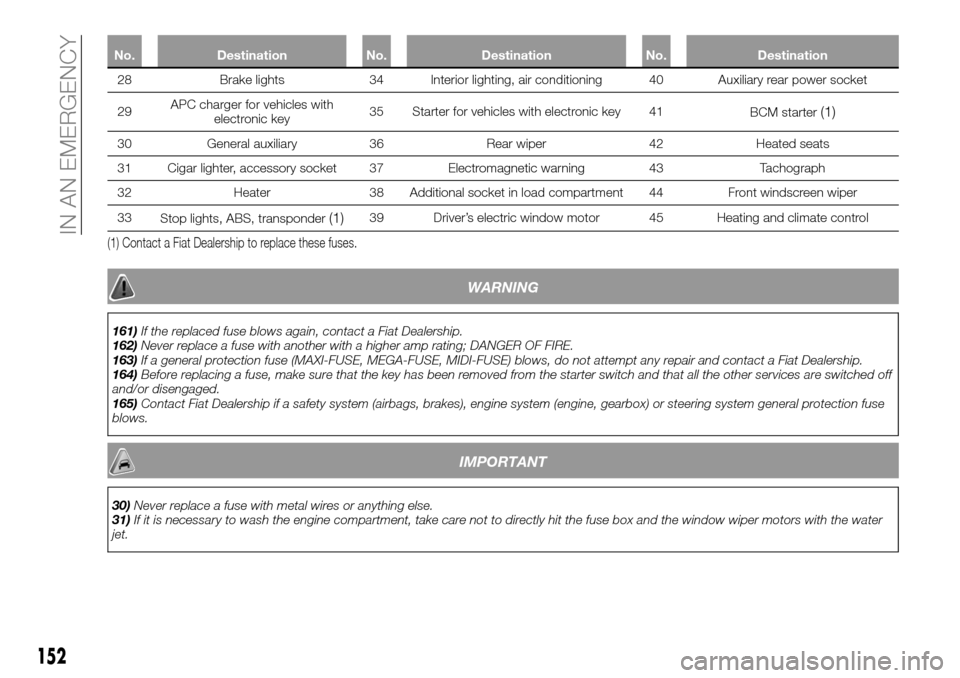
No. Destination No. Destination No. Destination
28 Brake lights 34 Interior lighting, air conditioning 40 Auxiliary rear power socket
29APC charger for vehicles with
electronic key35 Starter for vehicles with electronic key 41
BCM starter
(1)
30 General auxiliary 36 Rear wiper 42 Heated seats
31 Cigar lighter, accessory socket 37 Electromagnetic warning 43 Tachograph
32 Heater 38 Additional socket in load compartment 44 Front windscreen wiper
33
Stop lights, ABS, transponder
(1)39 Driver’s electric window motor 45 Heating and climate control
(1) Contact a Fiat Dealership to replace these fuses.
WARNING
161)If the replaced fuse blows again, contact a Fiat Dealership.
162)Never replace a fuse with another with a higher amp rating; DANGER OF FIRE.
163)If a general protection fuse (MAXI-FUSE, MEGA-FUSE, MIDI-FUSE) blows, do not attempt any repair and contact a Fiat Dealership.
164)Before replacing a fuse, make sure that the key has been removed from the starter switch and that all the other services are switched off
and/or disengaged.
165)Contact Fiat Dealership if a safety system (airbags, brakes), engine system (engine, gearbox) or steering system general protection fuse
blows.
IMPORTANT
30)Never replace a fuse with metal wires or anything else.
31)If it is necessary to wash the engine compartment, take care not to directly hit the fuse box and the window wiper motors with the water
jet.
152
IN AN EMERGENCY
Page 166 of 232
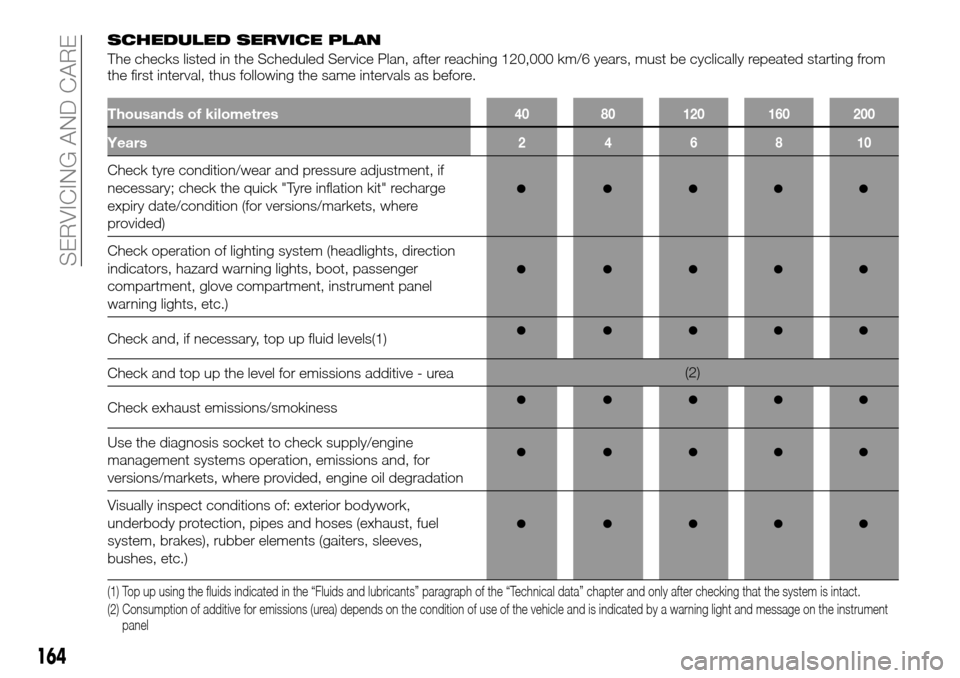
SCHEDULED SERVICE PLAN
The checks listed in the Scheduled Service Plan, after reaching 120,000 km/6 years, must be cyclically repeated starting from
the first interval, thus following the same intervals as before.
Thousands of kilometres40 80 120 160 200
Years246810
Check tyre condition/wear and pressure adjustment, if
necessary; check the quick "Tyre inflation kit" recharge
expiry date/condition (for versions/markets, where
provided)
Check operation of lighting system (headlights, direction
indicators, hazard warning lights, boot, passenger
compartment, glove compartment, instrument panel
warning lights, etc.)
Check and, if necessary, top up fluid levels(1)
Check and top up the level for emissions additive - urea(2)
Check exhaust emissions/smokiness
Use the diagnosis socket to check supply/engine
management systems operation, emissions and, for
versions/markets, where provided, engine oil degradation
Visually inspect conditions of: exterior bodywork,
underbody protection, pipes and hoses (exhaust, fuel
system, brakes), rubber elements (gaiters, sleeves,
bushes, etc.)
(1) Top up using the fluids indicated in the “Fluids and lubricants” paragraph of the “Technical data” chapter and only after checking that the system is intact.
(2) Consumption of additive for emissions (urea) depends on the condition of use of the vehicle and is indicated by a warning light and message on the instrument
panel
164
SERVICING AND CARE
Page 170 of 232
PERIODIC CHECKS
Every1,000km or before long trips
check and, if necessary, top up:
engine coolant level;
brake fluid level;
windscreen washer fluid level;
tyre inflation pressure and condition;
operation of lighting system
(headlights, direction indicators, hazard
warning lights, etc.);
operation of screen washer/wiper
system and positioning/wear of
windscreen/rear window wiper blades.
Every3,000km, check and top up the
engine oil level.
DEMANDING VEHICLE
USE
If the vehicle is mostly used in one of
the following conditions:
dusty roads;
short, repeated journeys (less than
7-8 km) at sub-zero outside
temperatures;
engine often idling or driving long
distances at low speeds or long periods
of inactivity;
the following checks must be carried
out more often than indicated in the
Scheduled Service Plan:
check front disc brake pad condition
and wear;
check cleanliness of bonnet and
boot locks, cleanliness and lubrication
of linkage;
visually inspect conditions of: engine,
gearbox, transmission, pipes and hoses
(exhaust/fuel system/brakes) and
rubber elements (gaiters/sleeves/
bushes, etc.);
check battery charge and battery
fluid level (electrolyte);
visually inspect conditions of the
accessory drive belts;
check and, if necessary, change
engine oil and replace oil filter;
check and, if necessary, replace
pollen filter;
check and, if necessary, replace air
cleaner.
SERVICING
PROCEDURES
The vehicle respects the recycling
criteria and scrapped vehicle
assessment that will become law in
2016.
Therefore, some of the vehicle’s
components are designed with their
ultimate recycling in mind.
These components can easily be
disassembled to be recovered and
reused in the recycling industry.
Moreover, thanks to its advanced
design, its original setup and its modest
fuel consumption, the vehicle complies
with the anti-pollution regulations in
force. We are actively committed to
reducing polluting gases and saving
energy. But the level of polluting gas
emissions and vehicle consumption
also depend on you. Take care to use
and service your vehicle correctly.
Keep in mind that lack of respect for
anti-pollution laws can expose the
vehicle's owner to administrative
sanctions. Moreover, replacing engine,
fuel system and exhaust parts with
other non-original ones voids the
vehicle's compliance with the
anti-pollution regulations.
168
SERVICING AND CARE
Page 182 of 232
INTERIOR
212) 213) 214)
62) 63)
If it undergoes correct service, the
vehicle can last longer. Therefore, we
advise you to regularly see to servicing
the interior of your vehicle.
Every spot must be seen to promptly.
Whatever caused the stain, use cold,
soapy water (possibly warm) based on
mild soap.
Detergents are prohibited (liquid
detergent for dishes, powdered
detergent, alcohol-based products).
Use a soft cloth.
Rinse and blot the excess water.
Fabric (seats, door coverings, etc.)
Dust the fabric regularly.
Liquid spots
Use soapy water.
Blot lightly (without rubbing) with a soft
cloth, then rinse and remove residual
liquid.
Solid or pasty spots
Immediately and delicately remove the
excess solid or pasty material with a
spatula (working from the edges to the
middle, keeping the spot from growing).
Clean as indicated for liquid spots.
Special procedure for candy,
chewing gum
Apply an ice cube to crystalise it, then
proceed as indicated for solid spots.IMPORTANT For any interior service
advice or in case of unsatisfactory
results, see a Fiat Dealership.
Dismounting/remounting
removable equipment original to
the vehicle
If you need to remove original
equipment from the passenger
compartment (for example, mats) in
order to clean it, be sure to replace
them carefully on the correct side (the
driver's mat goes on the driver's side)
and fasten them using the components
supplied with them (for example, the
driver's mat must be held in place with
the standard fastening elements).
In any case, when the vehicle is
stopped, make sure nothing can
interfere with driving (impedes use of
the pedals: a heel that catches on the
mat, etc.).
What not to do
Placing objects where the diffusers are,
such as deodorants, air fresheners,
etc., that could damage the dashboard
trim.
WARNING
212)Never use flammable products, such
as petrol ether or rectified petrol to clean
the inside of the vehicle. The electrostatic
charges which are generated by rubbing
during the cleaning operation may cause a
fire.213)Do not keep aerosol cans in the
vehicle: they might explode. Aerosol cans
must not be exposed to a temperature
exceeding 50°C. When the vehicle is
exposed to sunlight, the internal
temperature can greatly exceed this value.
214)There must be no obstacles on the
floor underneath the pedals; make sure
that mats are always flat and do not
interfere with the pedals.
IMPORTANT
62)We advise you not to use a high
powered or spray cleaner inside the
passenger compartment: without the
necessary precautions, you could damage
the electrical or electronic components in
the vehicle.
63)Never use alcohol, petrols and
derivatives to clean the dashboard and
instrument panel lens.
180
SERVICING AND CARE