child lock FIAT TALENTO 2016 2.G Owners Manual
[x] Cancel search | Manufacturer: FIAT, Model Year: 2016, Model line: TALENTO, Model: FIAT TALENTO 2016 2.GPages: 232, PDF Size: 5.01 MB
Page 23 of 232
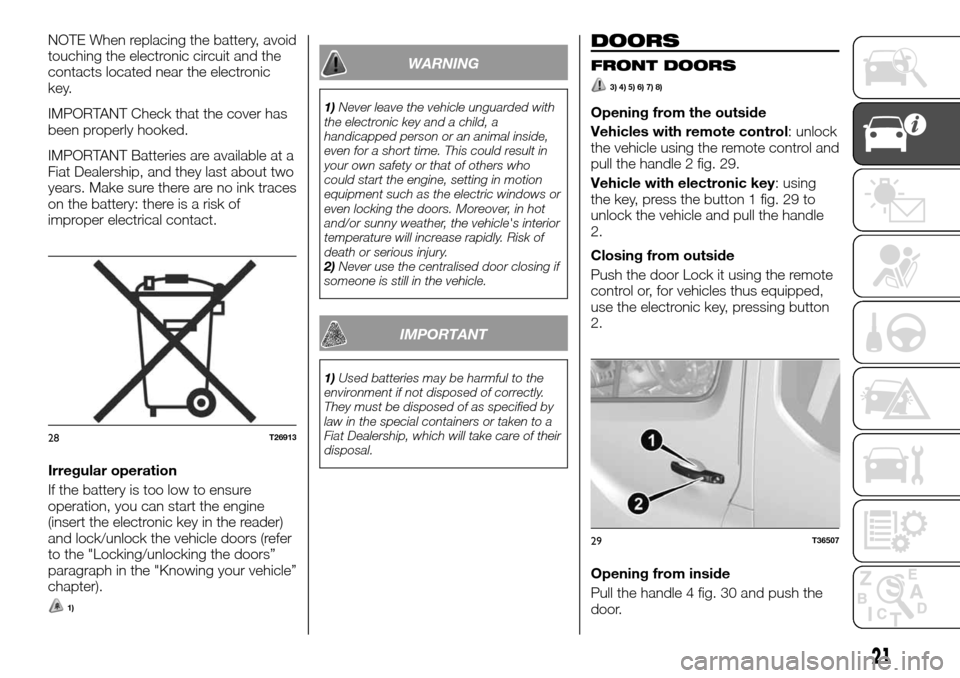
NOTE When replacing the battery, avoid
touching the electronic circuit and the
contacts located near the electronic
key.
IMPORTANT Check that the cover has
been properly hooked.
IMPORTANT Batteries are available at a
Fiat Dealership, and they last about two
years. Make sure there are no ink traces
on the battery: there is a risk of
improper electrical contact.
Irregular operation
If the battery is too low to ensure
operation, you can start the engine
(insert the electronic key in the reader)
and lock/unlock the vehicle doors (refer
to the "Locking/unlocking the doors”
paragraph in the "Knowing your vehicle”
chapter).
1)
WARNING
1)Never leave the vehicle unguarded with
the electronic key and a child, a
handicapped person or an animal inside,
even for a short time. This could result in
your own safety or that of others who
could start the engine, setting in motion
equipment such as the electric windows or
even locking the doors. Moreover, in hot
and/or sunny weather, the vehicle's interior
temperature will increase rapidly. Risk of
death or serious injury.
2)Never use the centralised door closing if
someone is still in the vehicle.
IMPORTANT
1)Used batteries may be harmful to the
environment if not disposed of correctly.
They must be disposed of as specified by
law in the special containers or taken to a
Fiat Dealership, which will take care of their
disposal.
DOORS
FRONT DOORS
3) 4) 5) 6) 7) 8)
Opening from the outside
Vehicles with remote control: unlock
the vehicle using the remote control and
pull the handle 2 fig. 29.
Vehicle with electronic key: using
the key, press the button 1 fig. 29 to
unlock the vehicle and pull the handle
2.
Closing from outside
Push the door Lock it using the remote
control or, for vehicles thus equipped,
use the electronic key, pressing button
2.
Opening from inside
Pull the handle 4 fig. 30 and push the
door.
28T26913
29T36507
21
Page 25 of 232
Child safety
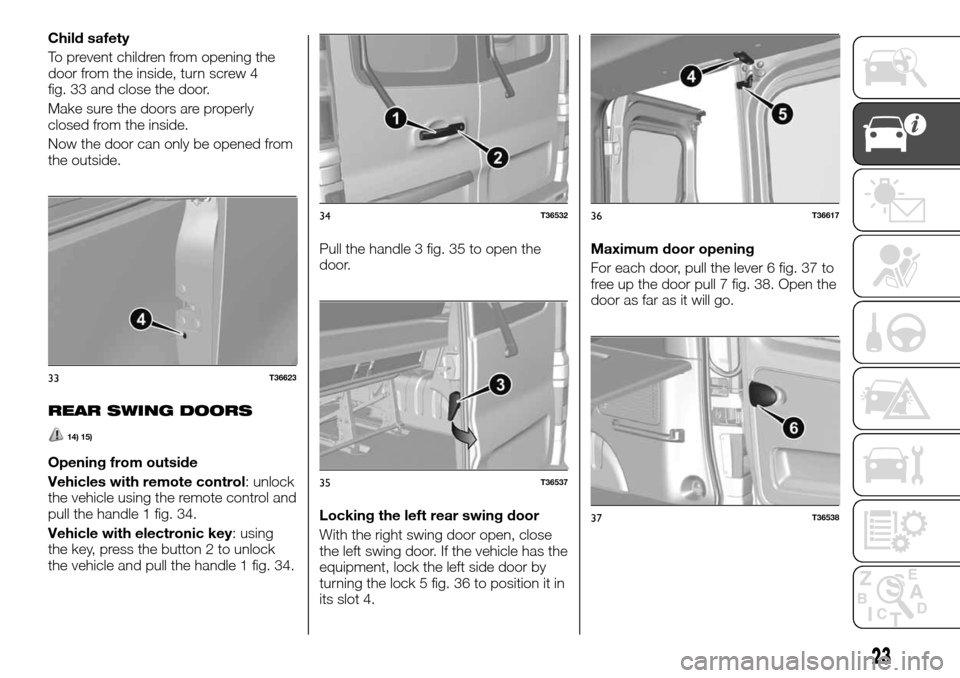
To prevent children from opening the
door from the inside, turn screw 4
fig. 33 and close the door.
Make sure the doors are properly
closed from the inside.
Now the door can only be opened from
the outside.
REAR SWING DOORS
14) 15)
Opening from outside
Vehicles with remote control: unlock
the vehicle using the remote control and
pull the handle 1 fig. 34.
Vehicle with electronic key: using
the key, press the button 2 to unlock
the vehicle and pull the handle 1 fig. 34.Pull the handle 3 fig. 35 to open the
door.
Locking the left rear swing door
With the right swing door open, close
the left swing door. If the vehicle has the
equipment, lock the left side door by
turning the lock 5 fig. 36 to position it in
its slot 4.Maximum door opening
For each door, pull the lever 6 fig. 37 to
free up the door pull 7 fig. 38. Open the
door as far as it will go.
33T36623
34T36532
35T36537
36T36617
37T36538
23
Page 29 of 232
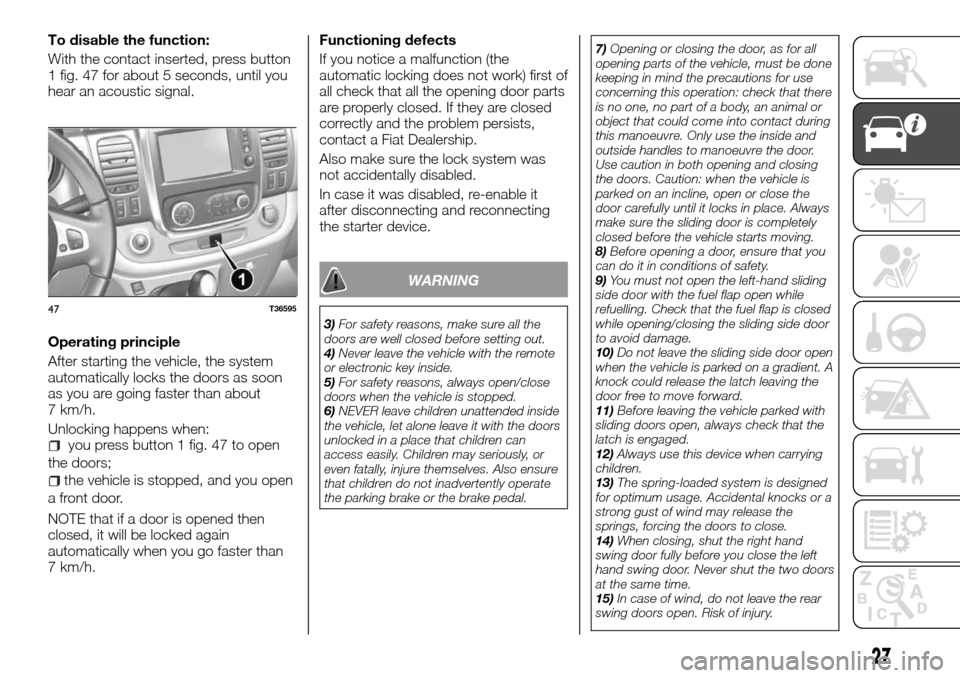
To disable the function:
With the contact inserted, press button
1 fig. 47 for about 5 seconds, until you
hear an acoustic signal.
Operating principle
After starting the vehicle, the system
automatically locks the doors as soon
as you are going faster than about
7 km/h.
Unlocking happens when:
you press button 1 fig. 47 to open
the doors;
the vehicle is stopped, and you open
a front door.
NOTE that if a door is opened then
closed, it will be locked again
automatically when you go faster than
7 km/h.Functioning defects
If you notice a malfunction (the
automatic locking does not work) first of
all check that all the opening door parts
are properly closed. If they are closed
correctly and the problem persists,
contact a Fiat Dealership.
Also make sure the lock system was
not accidentally disabled.
In case it was disabled, re-enable it
after disconnecting and reconnecting
the starter device.
WARNING
3)For safety reasons, make sure all the
doors are well closed before setting out.
4)Never leave the vehicle with the remote
or electronic key inside.
5)For safety reasons, always open/close
doors when the vehicle is stopped.
6)NEVER leave children unattended inside
the vehicle, let alone leave it with the doors
unlocked in a place that children can
access easily. Children may seriously, or
even fatally, injure themselves. Also ensure
that children do not inadvertently operate
the parking brake or the brake pedal.7)Opening or closing the door, as for all
opening parts of the vehicle, must be done
keeping in mind the precautions for use
concerning this operation: check that there
is no one, no part of a body, an animal or
object that could come into contact during
this manoeuvre. Only use the inside and
outside handles to manoeuvre the door.
Use caution in both opening and closing
the doors. Caution: when the vehicle is
parked on an incline, open or close the
door carefully until it locks in place. Always
make sure the sliding door is completely
closed before the vehicle starts moving.
8)Before opening a door, ensure that you
can do it in conditions of safety.
9)You must not open the left-hand sliding
side door with the fuel flap open while
refuelling. Check that the fuel flap is closed
while opening/closing the sliding side door
to avoid damage.
10)Do not leave the sliding side door open
when the vehicle is parked on a gradient. A
knock could release the latch leaving the
door free to move forward.
11)Before leaving the vehicle parked with
sliding doors open, always check that the
latch is engaged.
12)Always use this device when carrying
children.
13)The spring-loaded system is designed
for optimum usage. Accidental knocks or a
strong gust of wind may release the
springs, forcing the doors to close.
14)When closing, shut the right hand
swing door fully before you close the left
hand swing door. Never shut the two doors
at the same time.
15)In case of wind, do not leave the rear
swing doors open. Risk of injury.47T36595
27
Page 34 of 232
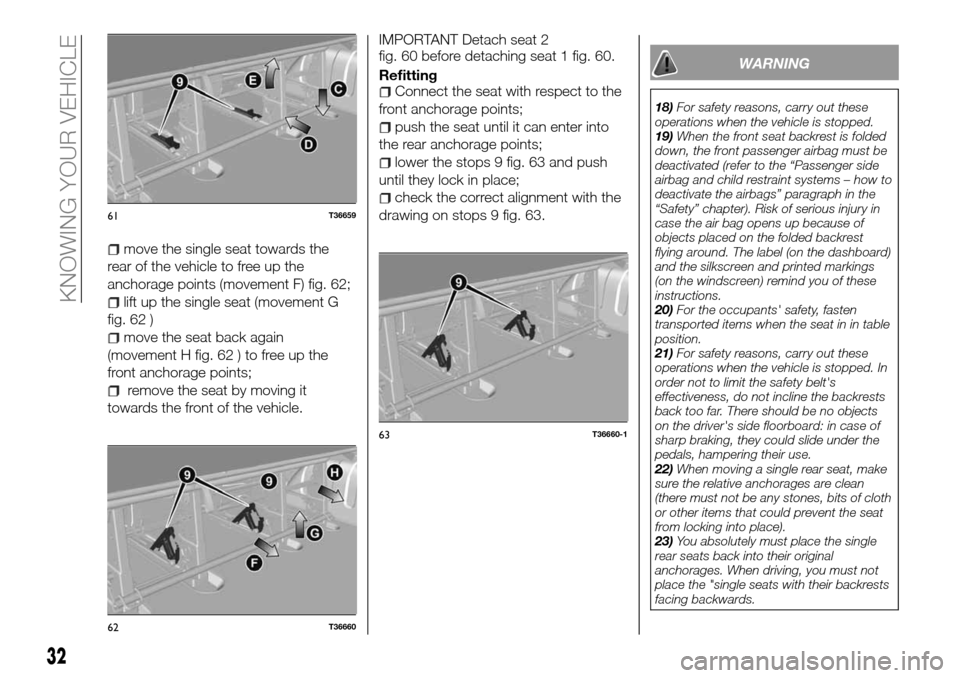
move the single seat towards the
rear of the vehicle to free up the
anchorage points (movement F) fig. 62;
lift up the single seat (movement G
fig. 62 )
move the seat back again
(movement H fig. 62 ) to free up the
front anchorage points;
remove the seat by moving it
towards the front of the vehicle.IMPORTANT Detach seat 2
fig. 60 before detaching seat 1 fig. 60.
Refitting
Connect the seat with respect to the
front anchorage points;
push the seat until it can enter into
the rear anchorage points;
lower the stops 9 fig. 63 and push
until they lock in place;
check the correct alignment with the
drawing on stops 9 fig. 63.
WARNING
18)For safety reasons, carry out these
operations when the vehicle is stopped.
19)When the front seat backrest is folded
down, the front passenger airbag must be
deactivated (refer to the “Passenger side
airbag and child restraint systems – how to
deactivate the airbags” paragraph in the
“Safety” chapter). Risk of serious injury in
case the air bag opens up because of
objects placed on the folded backrest
flying around. The label (on the dashboard)
and the silkscreen and printed markings
(on the windscreen) remind you of these
instructions.
20)For the occupants' safety, fasten
transported items when the seat in in table
position.
21)For safety reasons, carry out these
operations when the vehicle is stopped. In
order not to limit the safety belt's
effectiveness, do not incline the backrests
back too far. There should be no objects
on the driver's side floorboard: in case of
sharp braking, they could slide under the
pedals, hampering their use.
22)When moving a single rear seat, make
sure the relative anchorages are clean
(there must not be any stones, bits of cloth
or other items that could prevent the seat
from locking into place).
23)You absolutely must place the single
rear seats back into their original
anchorages. When driving, you must not
place the "single seats with their backrests
facing backwards.
61T36659
62T36660
63T36660-1
32
KNOWING YOUR VEHICLE
Page 48 of 232
IGNITION DEVICE
45) 46) 47) 48) 49)
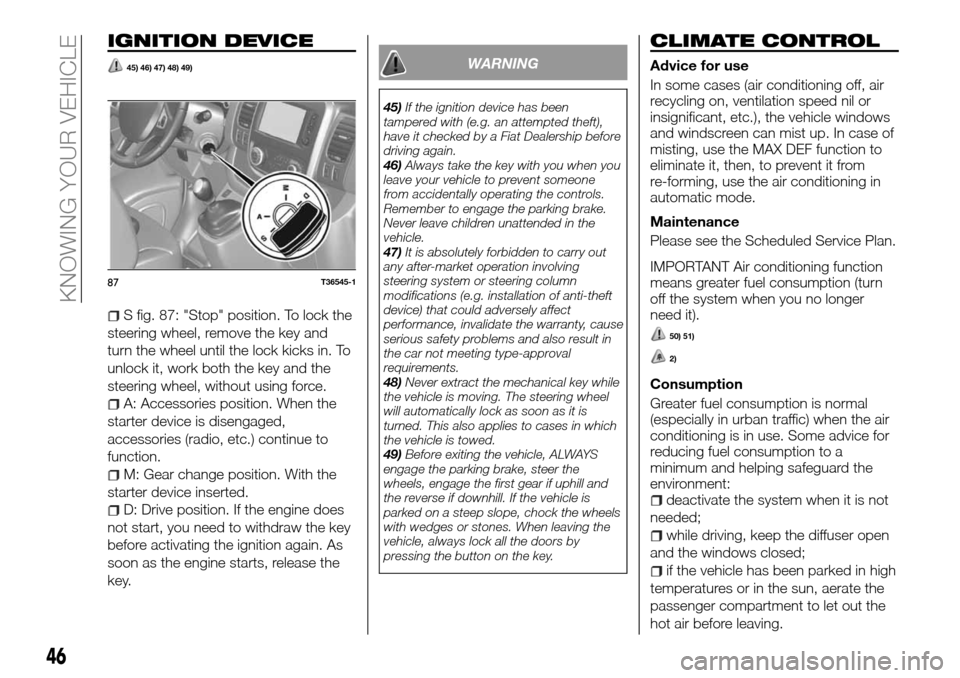
S fig. 87: "Stop" position. To lock the
steering wheel, remove the key and
turn the wheel until the lock kicks in. To
unlock it, work both the key and the
steering wheel, without using force.
A: Accessories position. When the
starter device is disengaged,
accessories (radio, etc.) continue to
function.
M: Gear change position. With the
starter device inserted.
D: Drive position. If the engine does
not start, you need to withdraw the key
before activating the ignition again. As
soon as the engine starts, release the
key.
WARNING
45)If the ignition device has been
tampered with (e.g. an attempted theft),
have it checked by a Fiat Dealership before
driving again.
46)Always take the key with you when you
leave your vehicle to prevent someone
from accidentally operating the controls.
Remember to engage the parking brake.
Never leave children unattended in the
vehicle.
47)It is absolutely forbidden to carry out
any after-market operation involving
steering system or steering column
modifications (e.g. installation of anti-theft
device) that could adversely affect
performance, invalidate the warranty, cause
serious safety problems and also result in
the car not meeting type-approval
requirements.
48)Never extract the mechanical key while
the vehicle is moving. The steering wheel
will automatically lock as soon as it is
turned. This also applies to cases in which
the vehicle is towed.
49)Before exiting the vehicle, ALWAYS
engage the parking brake, steer the
wheels, engage the first gear if uphill and
the reverse if downhill. If the vehicle is
parked on a steep slope, chock the wheels
with wedges or stones. When leaving the
vehicle, always lock all the doors by
pressing the button on the key.
CLIMATE CONTROL
Advice for use
In some cases (air conditioning off, air
recycling on, ventilation speed nil or
insignificant, etc.), the vehicle windows
and windscreen can mist up. In case of
misting, use the MAX DEF function to
eliminate it, then, to prevent it from
re-forming, use the air conditioning in
automatic mode.
Maintenance
Please see the Scheduled Service Plan.
IMPORTANT Air conditioning function
means greater fuel consumption (turn
off the system when you no longer
need it).
50) 51)
2)
Consumption
Greater fuel consumption is normal
(especially in urban traffic) when the air
conditioning is in use. Some advice for
reducing fuel consumption to a
minimum and helping safeguard the
environment:
deactivate the system when it is not
needed;
while driving, keep the diffuser open
and the windows closed;
if the vehicle has been parked in high
temperatures or in the sun, aerate the
passenger compartment to let out the
hot air before leaving.
87T36545-1
46
KNOWING YOUR VEHICLE
Page 97 of 232
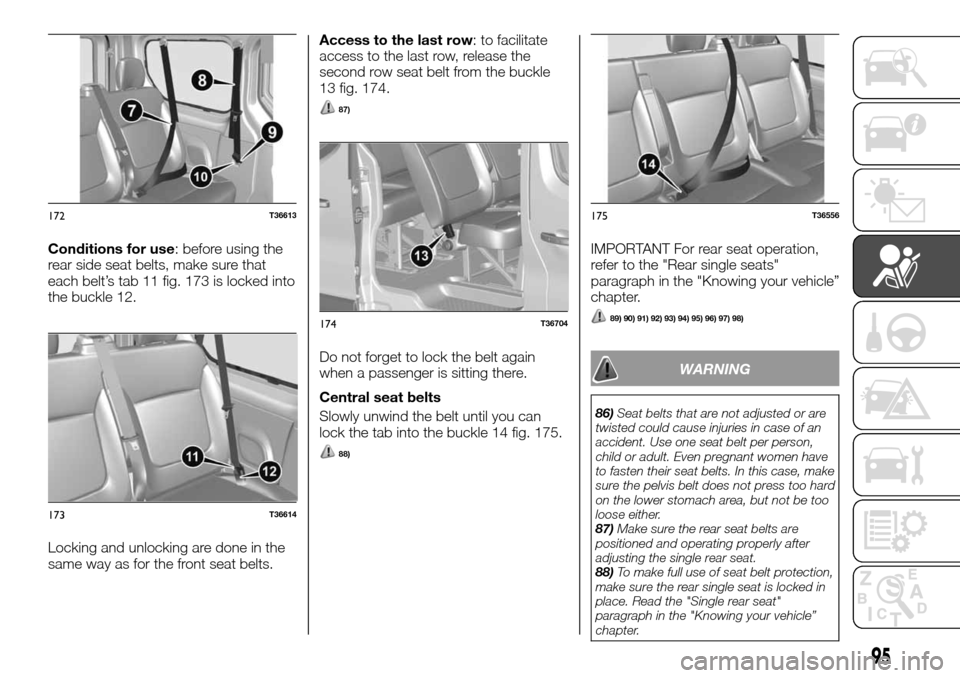
Conditions for use: before using the
rear side seat belts, make sure that
each belt’s tab 11 fig. 173 is locked into
the buckle 12.
Locking and unlocking are done in the
same way as for the front seat belts.Access to the last row: to facilitate
access to the last row, release the
second row seat belt from the buckle
13 fig. 174.
87)
Do not forget to lock the belt again
when a passenger is sitting there.
Central seat belts
Slowly unwind the belt until you can
lock the tab into the buckle 14 fig. 175.
88)
IMPORTANT For rear seat operation,
refer to the "Rear single seats"
paragraph in the "Knowing your vehicle”
chapter.
89) 90) 91) 92) 93) 94) 95) 96) 97) 98)
WARNING
86)Seat belts that are not adjusted or are
twisted could cause injuries in case of an
accident. Use one seat belt per person,
child or adult. Even pregnant women have
to fasten their seat belts. In this case, make
sure the pelvis belt does not press too hard
on the lower stomach area, but not be too
loose either.
87)Make sure the rear seat belts are
positioned and operating properly after
adjusting the single rear seat.
88)To make full use of seat belt protection,
make sure the rear single seat is locked in
place. Read the "Single rear seat"
paragraph in the "Knowing your vehicle”
chapter.
172T36613
173T36614
174T36704
175T36556
95
Page 98 of 232
89)Do not change the originally installed
restraining system components in any way:
belts, seats and related fasteners. In
special cases (e.g.: installing a child seat)
see a Fiat Dealership.
90)Do not use anything that could loosen
the buckles (diaper pins, clips, etc.)
because a loose seat belt can cause injury
in case of an accident.
91)Never pass the shoulder belt under
your arm or behind your back.
92)Never use the same belt for more than
one person, and never fasten your seat
belt across a newborn or child you are
holding in your lap.
93)The seat belt must not be twisted.
94)After an accident, check the seat belts
and if necessary replace them. In addition,
replace the seat belts if they start to show
any sign of wear or deterioration.
95)When refitting the single rear seat,
make sure the safety belts and their tabs
are positioned correctly so they can be
used normally.
96)Check that the seat belt locking device
is correctly inserted into the buckle.
97)Do not insert any object that could
block the belt and compromise its correct
operation.
98)Make sure you have positioned the
locking housing (it should not be covered,
crushed or flattened by people or objects).PRE-TENSIONERS
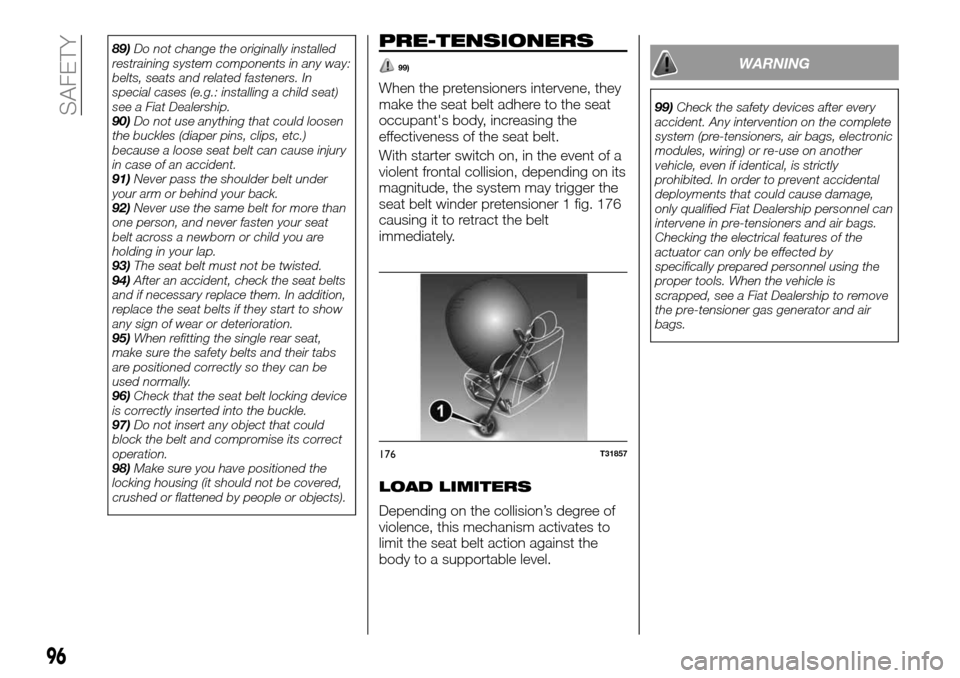
99)
When the pretensioners intervene, they
make the seat belt adhere to the seat
occupant's body, increasing the
effectiveness of the seat belt.
With starter switch on, in the event of a
violent frontal collision, depending on its
magnitude, the system may trigger the
seat belt winder pretensioner 1 fig. 176
causing it to retract the belt
immediately.
LOAD LIMITERS
Depending on the collision’s degree of
violence, this mechanism activates to
limit the seat belt action against the
body to a supportable level.
WARNING
99)Check the safety devices after every
accident. Any intervention on the complete
system (pre-tensioners, air bags, electronic
modules, wiring) or re-use on another
vehicle, even if identical, is strictly
prohibited. In order to prevent accidental
deployments that could cause damage,
only qualified Fiat Dealership personnel can
intervene in pre-tensioners and air bags.
Checking the electrical features of the
actuator can only be effected by
specifically prepared personnel using the
proper tools. When the vehicle is
scrapped, see a Fiat Dealership to remove
the pre-tensioner gas generator and air
bags.
176T31857
96
SAFETY
Page 105 of 232
FITTING A CHILD
RESTRAINT SYSTEM
WITH SEAT BELTS
128) 129)
The seat belt must be adjusted to
ensure it works in case of abrupt
braking or collision. Comply with the
belt direction indicated by the child
restraint system manufacturer.
Check that the seat belt is fastened
correctly.
Check that the child seat is correctly
locked in place by moving it left/right
and forwards/backwards: the seat
should remain firmly in place. Make sure
that the child restraint system is not
installed crosswise and is not resting
against a window.
103
Page 118 of 232
ISOFIX FASTENING
SYSTEM
Authorised child seats are approved
according to the ECE-R44 law in one of
the three following cases:
universal ISOFIX with 3 couplings
facing forward;
semi-universal ISOFIX with
2 couplings;
specific.
For the last two, check that your child
restraint system can be installed by
referring to the list of compatible
vehicles.
Fit the child restraint system with the
ISOFIX anchors, where provided. The
ISOFIX system ensures simple, fast and
safe installation.
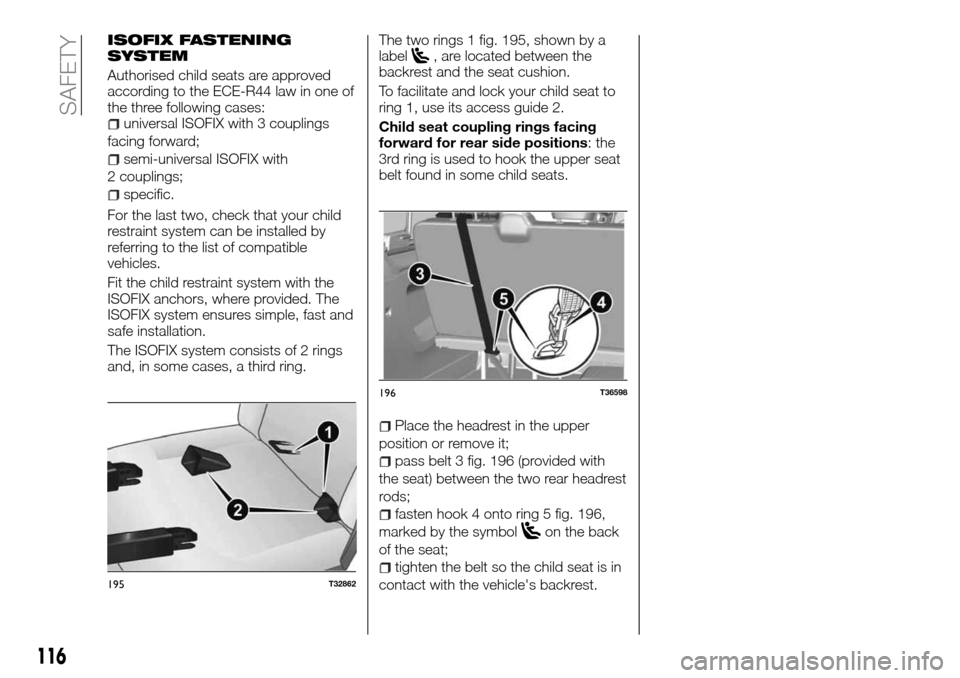
The ISOFIX system consists of 2 rings
and, in some cases, a third ring.The two rings 1 fig. 195, shown by a
label
, are located between the
backrest and the seat cushion.
To facilitate and lock your child seat to
ring 1, use its access guide 2.
Child seat coupling rings facing
forward for rear side positions: the
3rd ring is used to hook the upper seat
belt found in some child seats.
Place the headrest in the upper
position or remove it;
pass belt 3 fig. 196 (provided with
the seat) between the two rear headrest
rods;
fasten hook 4 onto ring 5 fig. 196,
marked by the symbol
on the back
of the seat;
tighten the belt so the child seat is in
contact with the vehicle's backrest.195T32862
196T36598
116
SAFETY
Page 127 of 232
(2)Move the front seat as far forward as possible to install the child seat backwards from driving direction, then move it back to
maximum so it does not come into contact with the child seat.
(3)Child seat facing forward: position the child seat backrest in contact with the seat backrest. In any case, remove the rear
seat headrest that the child seat is positioned against. This should be done before positioning the child restraint system (refer to
the "Rear headrest" paragraph in the "Knowing your vehicle” chapter). Do not move the seat in front of the child back more
than half the distance and do not incline it more than 25°.
WARNING
120)To prevent opening the door from the
inside, use the safety device (refer to the
"Child safety” paragraph in the “Knowing
your vehicle” chapter).
121)A collision at 50 Km/h is the
equivalent of falling 10 meters. Never hold
a child in your arms or on your knees, in
case of an accident you would never be
able to hold him even if you have your seat
bets fastened.
122)Never leave the vehicle unguarded
with the electronic key and a child, a
handicapped person or an animal inside,
even for a short time. This could result in
your own safety or that of others who
could start the engine, setting in motion
equipment such as the electric windows or
even locking the doors. Moreover, in hot
and/or sunny weather, the vehicle's interior
temperature will increase rapidly. Risk of
death or serious injury.123)Never leave a child alone in the
vehicle. Make sure the child always has
his/her seat belt fastened and correctly
adjusted. Avoid too heavy clothing that
causes the belts to be loose. Never allow
the child to put his/her head or arm out the
window. Make sure the child is seated
correctly throughout the trip. especially
when asleep.
124)Make sure the child seat or his/her
feet do not prevent the front seat from
locking into place correctly. Refer to the
"Front seat" paragraph in the "Knowing
your vehicle” chapter. Make sure that the
child seat installed in the vehicle is not at
risk of coming out of its housing. If you
have to remove the head rest, make sure it
is positioned so it is not thrown about in
case of abrupt braking or collision. Always
fasten the child seat even if you are not
using it so it is not thrown about in case of
abrupt braking or collision.
125)RISK OF DEATH OR SERIOUS
INJURY: before installing a rear-facing child
restraint system in the front passenger
seat, check that the air bag has been
correctly deactivated (refer to the
"Passenger side airbag and child restraint
systems" paragraph in this chapter).
126)Install the child seat preferably in one
of the rear seats.127)Never install a child seat on the rear
centre seat. RISK OF DEATH OR SERIOUS
INJURY.
128)Do not use child seats that could
unlock the belt holding it in place: the child
seat base must not rest on the seat belt
buckle and/or housing.
129)The seat belt must never be loose or
twisted. Never pass the shoulder belt
under your arm or behind your back.
Check that the belt has not been damaged
by sharp edges. If the seat belt is not
working normally, it will not protect the
child. Contact a Fiat Dealership. Do not
use this seat until the belt has been
repaired.
130)Using a child seat inappropriate for
this vehicle will not properly protect the
child. You risk causing him/her serious
injury or death.
125