distrib FIAT TALENTO 2016 2.G Owners Manual
[x] Cancel search | Manufacturer: FIAT, Model Year: 2016, Model line: TALENTO, Model: FIAT TALENTO 2016 2.GPages: 232, PDF Size: 5.01 MB
Page 52 of 232
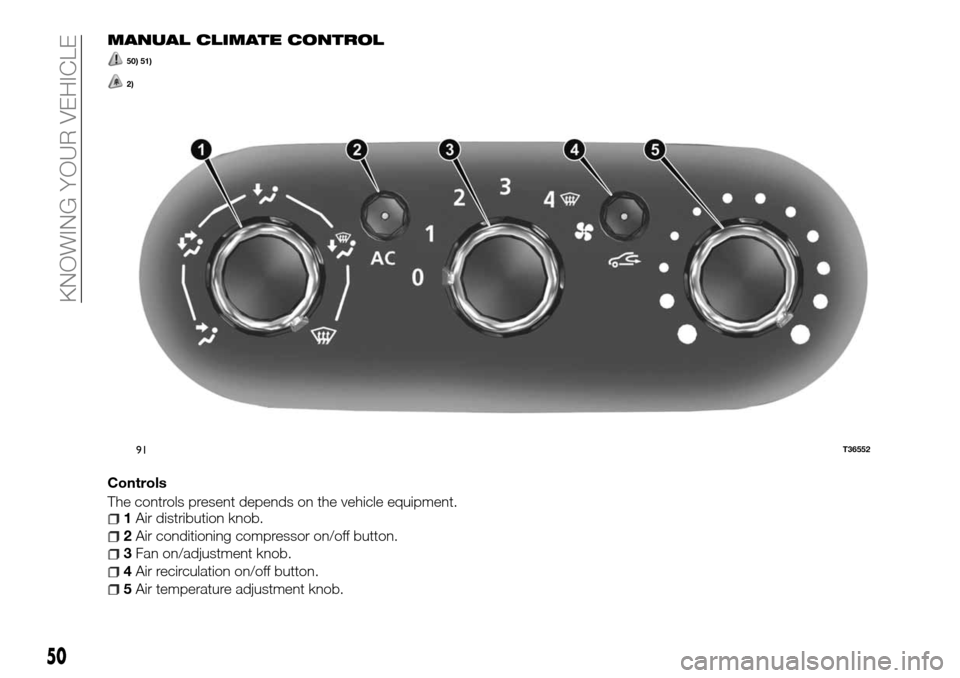
MANUAL CLIMATE CONTROL
50) 51)
2)
Controls
The controls present depends on the vehicle equipment.
1Air distribution knob.
2Air conditioning compressor on/off button.
3Fan on/adjustment knob.
4Air recirculation on/off button.
5Air temperature adjustment knob.
91T36552
50
KNOWING YOUR VEHICLE
Page 53 of 232
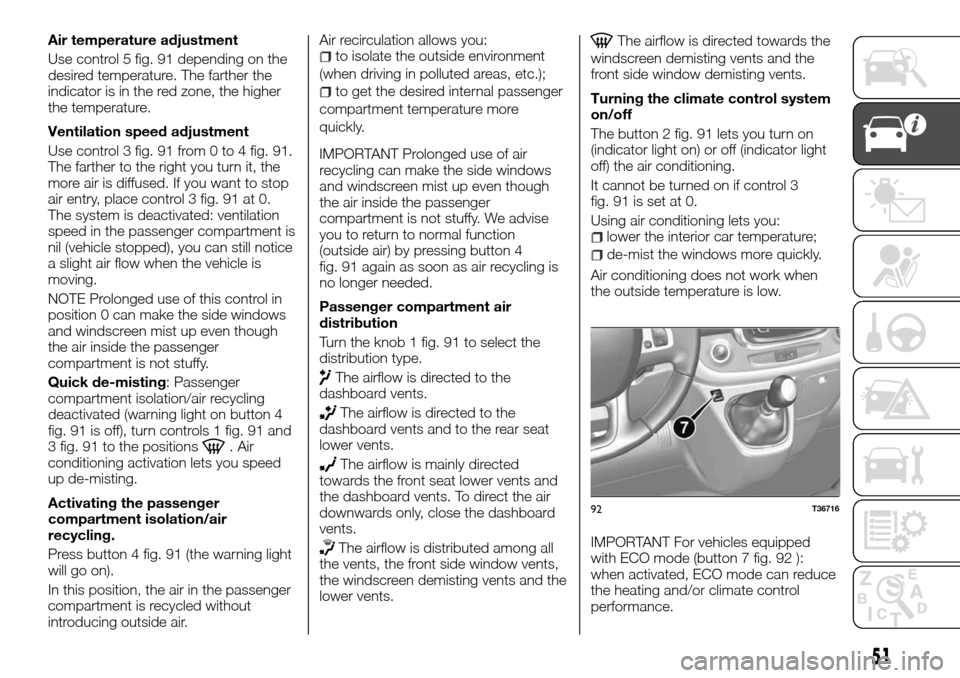
Air temperature adjustment
Use control 5 fig. 91 depending on the
desired temperature. The farther the
indicator is in the red zone, the higher
the temperature.
Ventilation speed adjustment
Use control 3 fig. 91 from 0 to 4 fig. 91.
The farther to the right you turn it, the
more air is diffused. If you want to stop
air entry, place control 3 fig. 91 at 0.
The system is deactivated: ventilation
speed in the passenger compartment is
nil (vehicle stopped), you can still notice
a slight air flow when the vehicle is
moving.
NOTE Prolonged use of this control in
position 0 can make the side windows
and windscreen mist up even though
the air inside the passenger
compartment is not stuffy.
Quick de-misting: Passenger
compartment isolation/air recycling
deactivated (warning light on button 4
fig. 91 is off), turn controls 1 fig. 91 and
3 fig. 91 to the positions
. Air
conditioning activation lets you speed
up de-misting.
Activating the passenger
compartment isolation/air
recycling.
Press button 4 fig. 91 (the warning light
will go on).
In this position, the air in the passenger
compartment is recycled without
introducing outside air.Air recirculation allows you:
to isolate the outside environment
(when driving in polluted areas, etc.);
to get the desired internal passenger
compartment temperature more
quickly.
IMPORTANT Prolonged use of air
recycling can make the side windows
and windscreen mist up even though
the air inside the passenger
compartment is not stuffy. We advise
you to return to normal function
(outside air) by pressing button 4
fig. 91 again as soon as air recycling is
no longer needed.
Passenger compartment air
distribution
Turn the knob 1 fig. 91 to select the
distribution type.
The airflow is directed to the
dashboard vents.
The airflow is directed to the
dashboard vents and to the rear seat
lower vents.
The airflow is mainly directed
towards the front seat lower vents and
the dashboard vents. To direct the air
downwards only, close the dashboard
vents.
The airflow is distributed among all
the vents, the front side window vents,
the windscreen demisting vents and the
lower vents.
The airflow is directed towards the
windscreen demisting vents and the
front side window demisting vents.
Turning the climate control system
on/off
The button 2 fig. 91 lets you turn on
(indicator light on) or off (indicator light
off) the air conditioning.
It cannot be turned on if control 3
fig. 91 is set at 0.
Using air conditioning lets you:
lower the interior car temperature;
de-mist the windows more quickly.
Air conditioning does not work when
the outside temperature is low.
IMPORTANT For vehicles equipped
with ECO mode (button 7 fig. 92 ):
when activated, ECO mode can reduce
the heating and/or climate control
performance.
92T36716
51
Page 55 of 232
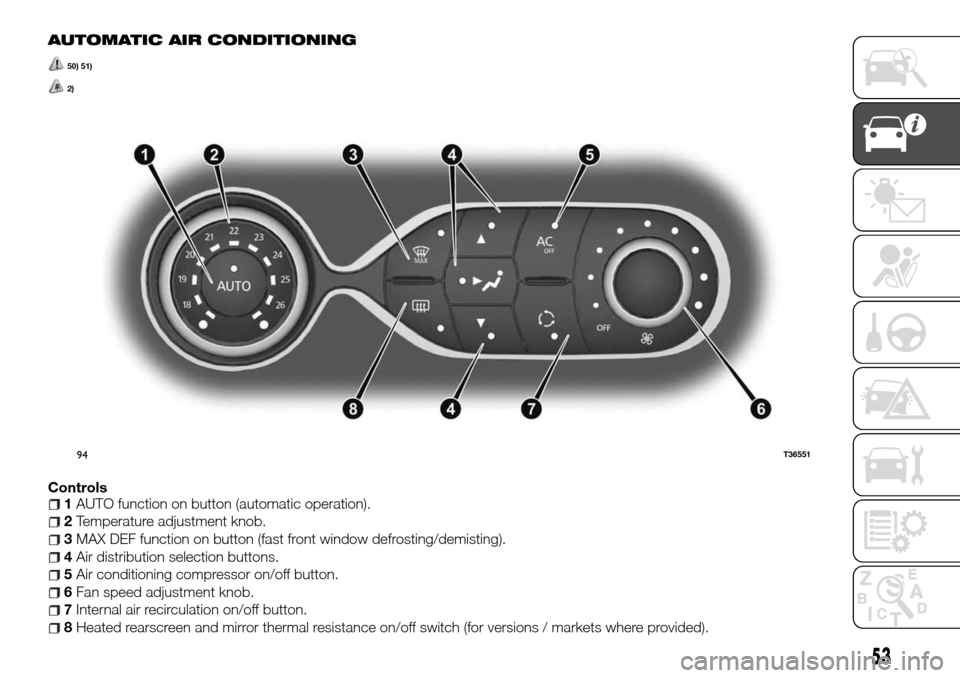
AUTOMATIC AIR CONDITIONING
50) 51)
2)
Controls1AUTO function on button (automatic operation).
2Temperature adjustment knob.
3MAX DEF function on button (fast front window defrosting/demisting).
4Air distribution selection buttons.
5Air conditioning compressor on/off button.
6Fan speed adjustment knob.
7Internal air recirculation on/off button.
8Heated rearscreen and mirror thermal resistance on/off switch (for versions / markets where provided).
94T36551
53
Page 56 of 232
AUTO function (automatic
operation)
Automatic air conditioning is a system
that guarantees (except when using it in
extreme conditions) interior comfort and
a good level of visibility, optimising
consumption. The system uses
ventilation speed, air distribution, air
recycling, activating or turning off the air
conditioner and air temperature.
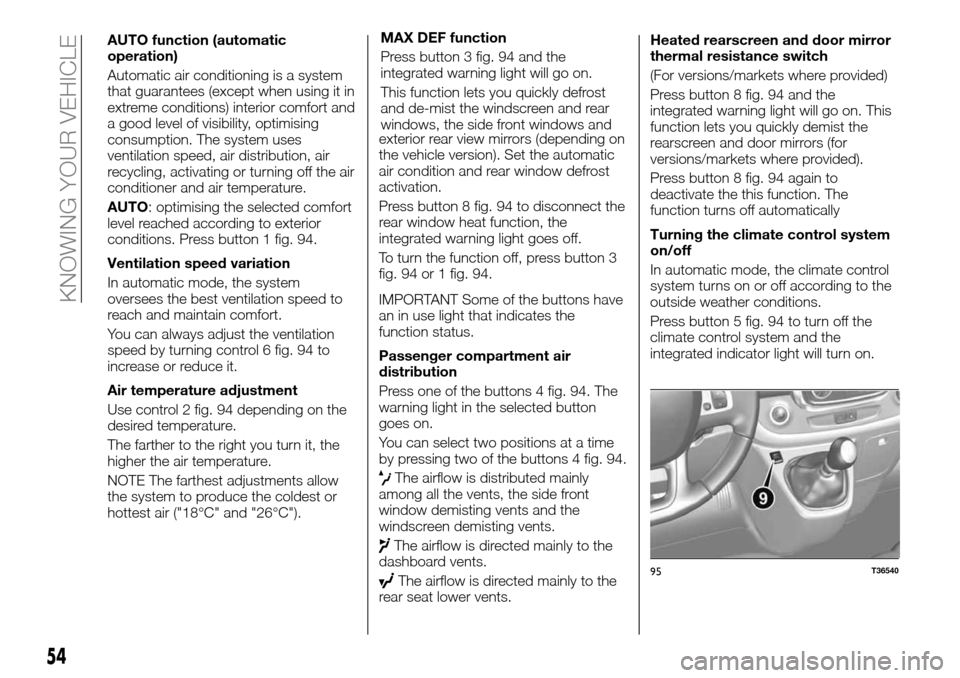
AUTO: optimising the selected comfort
level reached according to exterior
conditions. Press button 1 fig. 94.
Ventilation speed variation
In automatic mode, the system
oversees the best ventilation speed to
reach and maintain comfort.
You can always adjust the ventilation
speed by turning control 6 fig. 94 to
increase or reduce it.
Air temperature adjustment
Use control 2 fig. 94 depending on the
desired temperature.
The farther to the right you turn it, the
higher the air temperature.
NOTE The farthest adjustments allow
the system to produce the coldest or
hottest air ("18°C" and "26°C").MAX DEF function
Press button 3 fig. 94 and the
integrated warning light will go on.
This function lets you quickly defrost
and de-mist the windscreen and rear
windows, the side front windows and
exterior rear view mirrors (depending on
the vehicle version). Set the automatic
air condition and rear window defrost
activation.
Press button 8 fig. 94 to disconnect the
rear window heat function, the
integrated warning light goes off.
To turn the function off, press button 3
fig. 94 or 1 fig. 94.
IMPORTANT Some of the buttons have
an in use light that indicates the
function status.
Passenger compartment air
distribution
Press one of the buttons 4 fig. 94. The
warning light in the selected button
goes on.
You can select two positions at a time
by pressing two of the buttons 4 fig. 94.
The airflow is distributed mainly
among all the vents, the side front
window demisting vents and the
windscreen demisting vents.
The airflow is directed mainly to the
dashboard vents.
The airflow is directed mainly to the
rear seat lower vents.Heated rearscreen and door mirror
thermal resistance switch
(For versions/markets where provided)
Press button 8 fig. 94 and the
integrated warning light will go on. This
function lets you quickly demist the
rearscreen and door mirrors (for
versions/markets where provided).
Press button 8 fig. 94 again to
deactivate the this function. The
function turns off automatically
Turning the climate control system
on/off
In automatic mode, the climate control
system turns on or off according to the
outside weather conditions.
Press button 5 fig. 94 to turn off the
climate control system and the
integrated indicator light will turn on.95T36540
54
KNOWING YOUR VEHICLE
Page 159 of 232
speed between 20 and 60 km/h to
uniformly distribute the product on the
tyre and, after 3 kilometres, stop to
check the pressure;
if the pressure is greater than 1.3 bar
but less than prescribed, you need to
adjust it (see the label attached to the
driver's door pillar), otherwise see a Fiat
Dealership: you cannot repair it.
WARNING
172)There should be no objects at the
driver's feet: in case of sharp braking, they
could slide under the pedals, preventing
their correct use.
IMPORTANT
32)The kit can repair tyres whose treads A
fig. 257 are damaged by foreign objects
smaller than 4 millimetres. It cannot repair
all types of puncture, such as cuts larger
than 4 millimetres and those on side B
fig. 257 of the tyre. Also make sure the rims
are in good condition. Do not remove the
foreign object that caused the puncture if it
is implanted in the tyre.33)Do not use the inflation kit if the tyre is
damaged by driving with a puncture. Check
the tyre sides carefully before any
intervention. Travelling with partially or
completely deflated tyres (or punctured)
can cause safety problems and damage
the concerned tyre beyond repair. This
reparation is temporary. A tyre that has
been punctured must be examined (and
repaired if possible) by a specialist as soon
as possible. When replacing a tyre repaired
by the kit, always notify the tyre repairer.
When driving, you can feel vibrations
caused by the product being in the tyre.
34)The kit is approved only for inflating
tyres of vehicles that were originally
equipped with it. It should never be used to
inflate another vehicle's tyres or any other
object (life vests, inflatable mattresses,
etc.). Avoid splashing on skin when using
the repair canister. If the product comes in
contact with skin, rinse thoroughly. Keep
the kit out of the reach of children. Do not
leave empty canister in the environment.
Deliver it to a Fiat Dealership or to a
consortium specialised in its disposal. The
canister has an expiration date indicated on
the label. Check the expiration date. Go to
a Fiat Dealership to replace the inflation
hose and repair canister.
35)Before using the kit, park the vehicle so
it is sufficiently far from traffic, turn on the
emergency lights, pull up the handbrake
and get all the occupants out of the vehicle,
moving them far away from the traffic.
36)In case you are stopped by the
carriageway, warn other road users that
your vehicle is there by placing the warning
triangle or other device allowed by law in
the country you are driving in.37)Caution, a missing or badly screwed on
valve cap could impact the tyre's grip and
cause a loss of pressure. The valve caps
must all be identical to the original ones
and screwed tightly.
38)After repair using the kit, do not drive
farther than 200 km. In addition, lower your
speed, and in any case do not exceed
80 km/h. The label is to be attached in a
visible part of the dashboard. Depending
on the market country or local laws, a tyre
repaired with the inflation kit must be
replaced.
157
leave immediately and drive at a