fuel pressure FIAT TALENTO 2016 2.G Owners Manual
[x] Cancel search | Manufacturer: FIAT, Model Year: 2016, Model line: TALENTO, Model: FIAT TALENTO 2016 2.GPages: 232, PDF Size: 5.01 MB
Page 37 of 232
paragraph in the "Knowing your vehicle”
chapter);
the engine coolant liquid temperature
is not sufficient;
the anti-particulate filter automatic
regeneration is underway;
Or:
the instrument panel warning light
turns on to indicate that the engine
cannot be put in standby.
NOTES:To refuel, the engine must be
turned off (and not in stand-by): you
must stop the engine (refer to the
"Starting the engine” paragraph in the
“Starting and driving” chapter):
RESTARTING
CONDITIONS
In some cases, the engine can restart
without any intervention to guarantee
safety and ideal comfort. This can be
confirmed when:
the outside temperature is too low or
too high (lower than 0°C or over 30°C);
the MAX DEF function is activated
(refer to the "Air conditioning"
paragraph in the "Knowing your vehicle”
chapter);
the battery not sufficiently charged;
the vehicle speed is higher than
5 km/h (going downhill, etc.);
repeated pressure on the brake
pedal or need to use the braking
system;
Vehicles with remote control
Some of these conditions prevent
automatic engine restart when opening:
one of the doors (for vehicles with a
key);
the passenger door (for vehicles with
an electronic key).
IRREGULAR OPERATION
When the appropriate message
appears on the instrument panel, along
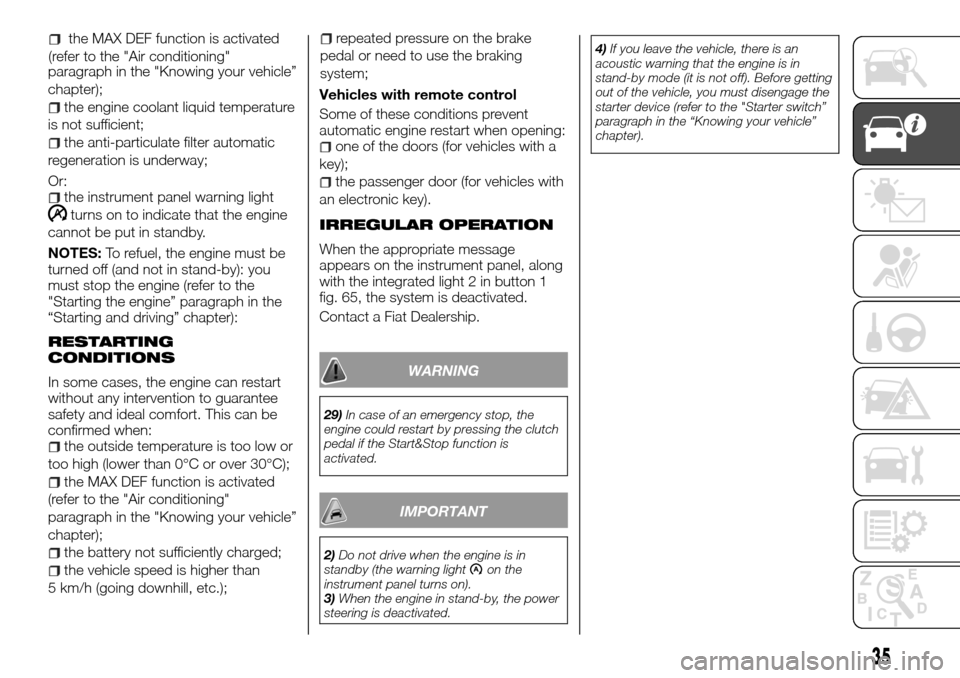
with the integrated light 2 in button 1
fig. 65, the system is deactivated.
Contact a Fiat Dealership.
WARNING
29)In case of an emergency stop, the
engine could restart by pressing the clutch
pedal if the Start&Stop function is
activated.
IMPORTANT
2)Do not drive when the engine is in
standby (the warning lighton the
instrument panel turns on).
3)When the engine in stand-by, the power
steering is deactivated.4)If you leave the vehicle, there is an
acoustic warning that the engine is in
stand-by mode (it is not off). Before getting
out of the vehicle, you must disengage the
starter device (refer to the "Starter switch”
paragraph in the “Knowing your vehicle”
chapter).
35
the MAX DEF function is activated
(refer to the "Air conditioning"
Page 46 of 232
Fuel filling
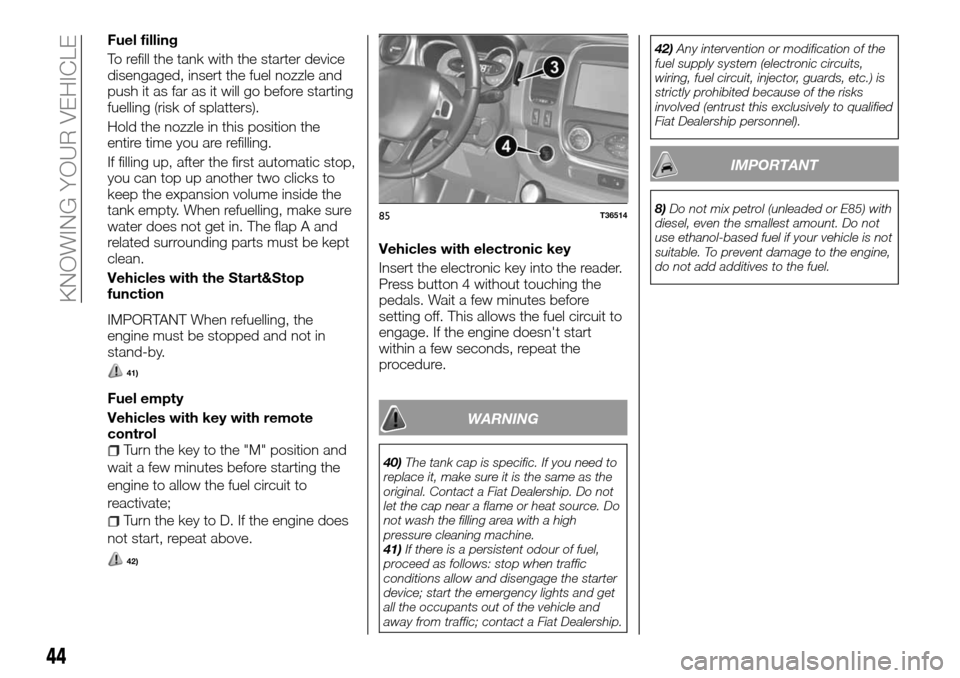
To refill the tank with the starter device
disengaged, insert the fuel nozzle and
push it as far as it will go before starting
fuelling (risk of splatters).
Hold the nozzle in this position the
entire time you are refilling.
If filling up, after the first automatic stop,
you can top up another two clicks to
keep the expansion volume inside the
tank empty. When refuelling, make sure
water does not get in. The flap A and
related surrounding parts must be kept
clean.
Vehicles with the Start&Stop
function
IMPORTANT When refuelling, the
engine must be stopped and not in
stand-by.
41)
Fuel empty
Vehicles with key with remote
control
Turn the key to the "M" position and
wait a few minutes before starting the
engine to allow the fuel circuit to
reactivate;
Turn the key to D. If the engine does
not start, repeat above.
42)
Vehicles with electronic key
Insert the electronic key into the reader.
Press button 4 without touching the
pedals. Wait a few minutes before
setting off. This allows the fuel circuit to
engage. If the engine doesn't start
within a few seconds, repeat the
procedure.
WARNING
40)The tank cap is specific. If you need to
replace it, make sure it is the same as the
original. Contact a Fiat Dealership. Do not
let the cap near a flame or heat source. Do
not wash the filling area with a high
pressure cleaning machine.
41)If there is a persistent odour of fuel,
proceed as follows: stop when traffic
conditions allow and disengage the starter
device; start the emergency lights and get
all the occupants out of the vehicle and
away from traffic; contact a Fiat Dealership.42)Any intervention or modification of the
fuel supply system (electronic circuits,
wiring, fuel circuit, injector, guards, etc.) is
strictly prohibited because of the risks
involved (entrust this exclusively to qualified
Fiat Dealership personnel).
IMPORTANT
8)Do not mix petrol (unleaded or E85) with
diesel, even the smallest amount. Do not
use ethanol-based fuel if your vehicle is not
suitable. To prevent damage to the engine,
do not add additives to the fuel.85T36514
44
KNOWING YOUR VEHICLE
Page 47 of 232
ADBLUE ADDITIVE
RESERVOIR
Make sure that you comply with the
laws of the country you're in.
You need to remember that if the owner
of the vehicle does not comply with the
laws in effect, there could be legal
consequences.
Operating principle
Using additives reduces exhaust
emissions, transforming polluting gases
into water vapour and nitrogen.
Filling
Usable tank capacity: Approx. 20 litres
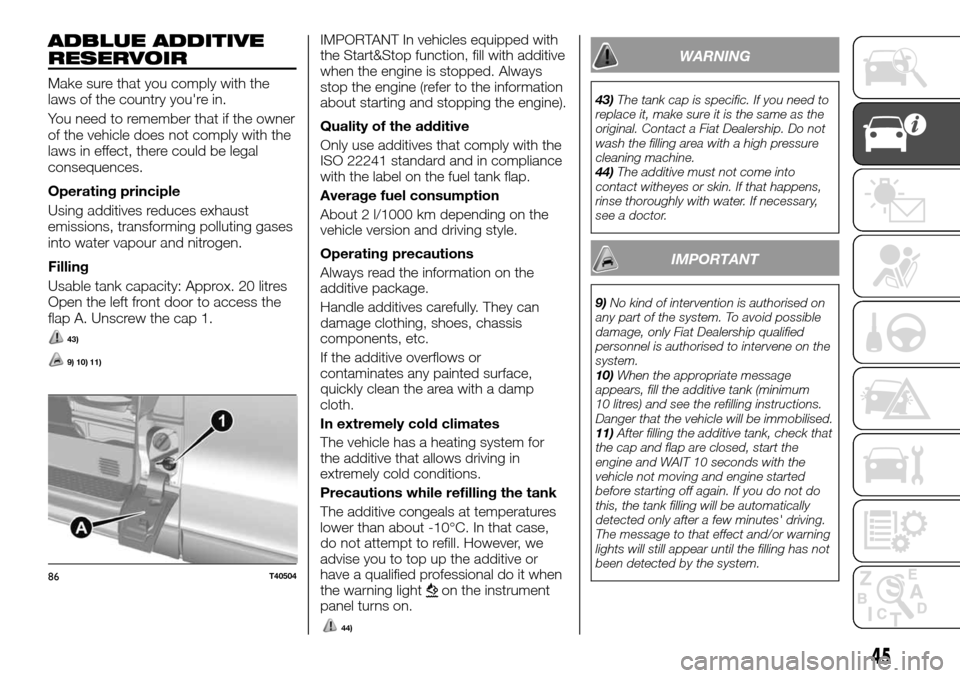
Open the left front door to access the
flap A. Unscrew the cap 1.
43)
9) 10) 11)
IMPORTANT In vehicles equipped with
the Start&Stop function, fill with additive
when the engine is stopped. Always
stop the engine (refer to the information
about starting and stopping the engine).
Quality of the additive
Only use additives that comply with the
ISO 22241 standard and in compliance
with the label on the fuel tank flap.
Average fuel consumption
About 2 l/1000 km depending on the
vehicle version and driving style.
Operating precautions
Always read the information on the
additive package.
Handle additives carefully. They can
damage clothing, shoes, chassis
components, etc.
If the additive overflows or
contaminates any painted surface,
quickly clean the area with a damp
cloth.
In extremely cold climates
The vehicle has a heating system for
the additive that allows driving in
extremely cold conditions.
Precautions while refilling the tank
The additive congeals at temperatures
lower than about -10°C. In that case,
do not attempt to refill. However, we
advise you to top up the additive or
have a qualified professional do it when
the warning light
on the instrument
panel turns on.
44)
WARNING
43)The tank cap is specific. If you need to
replace it, make sure it is the same as the
original. Contact a Fiat Dealership. Do not
wash the filling area with a high pressure
cleaning machine.
44)The additive must not come into
contact witheyes or skin. If that happens,
rinse thoroughly with water. If necessary,
see a doctor.
IMPORTANT
9)No kind of intervention is authorised on
any part of the system. To avoid possible
damage, only Fiat Dealership qualified
personnel is authorised to intervene on the
system.
10)When the appropriate message
appears, fill the additive tank (minimum
10 litres) and see the refilling instructions.
Danger that the vehicle will be immobilised.
11)After filling the additive tank, check that
the cap and flap are closed, start the
engine and WAIT 10 seconds with the
vehicle not moving and engine started
before starting off again. If you do not do
this, the tank filling will be automatically
detected only after a few minutes' driving.
The message to that effect and/or warning
lights will still appear until the filling has not
been detected by the system.
86T40504
45
Page 90 of 232
CONTROL PANEL
AND ON-BOARD
INSTRUMENTS
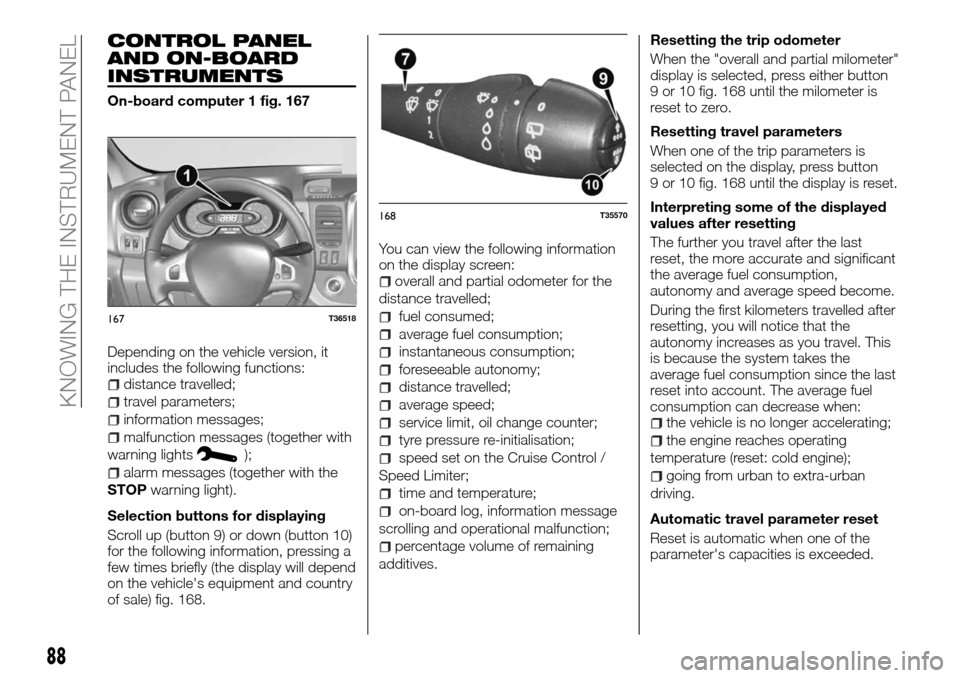
On-board computer 1 fig. 167
Depending on the vehicle version, it
includes the following functions:
distance travelled;
travel parameters;
information messages;
malfunction messages (together with
warning lights
);
alarm messages (together with the
STOPwarning light).
Selection buttons for displaying
Scroll up (button 9) or down (button 10)
for the following information, pressing a
few times briefly (the display will depend
on the vehicle's equipment and country
of sale) fig. 168.You can view the following information
on the display screen:
overall and partial odometer for the
distance travelled;
fuel consumed;
average fuel consumption;
instantaneous consumption;
foreseeable autonomy;
distance travelled;
average speed;
service limit, oil change counter;
tyre pressure re-initialisation;
speed set on the Cruise Control /
Speed Limiter;
time and temperature;
on-board log, information message
scrolling and operational malfunction;
percentage volume of remaining
additives.Resetting the trip odometer
When the "overall and partial milometer"
display is selected, press either button
9 or 10 fig. 168 until the milometer is
reset to zero.
Resetting travel parameters
When one of the trip parameters is
selected on the display, press button
9 or 10 fig. 168 until the display is reset.
Interpreting some of the displayed
values after resetting
The further you travel after the last
reset, the more accurate and significant
the average fuel consumption,
autonomy and average speed become.
During the first kilometers travelled after
resetting, you will notice that the
autonomy increases as you travel. This
is because the system takes the
average fuel consumption since the last
reset into account. The average fuel
consumption can decrease when:
the vehicle is no longer accelerating;
the engine reaches operating
temperature (reset: cold engine);
going from urban to extra-urban
driving.
Automatic travel parameter reset
Reset is automatic when one of the
parameter's capacities is exceeded.
167T36518
168T35570
88
KNOWING THE INSTRUMENT PANEL
Page 91 of 232
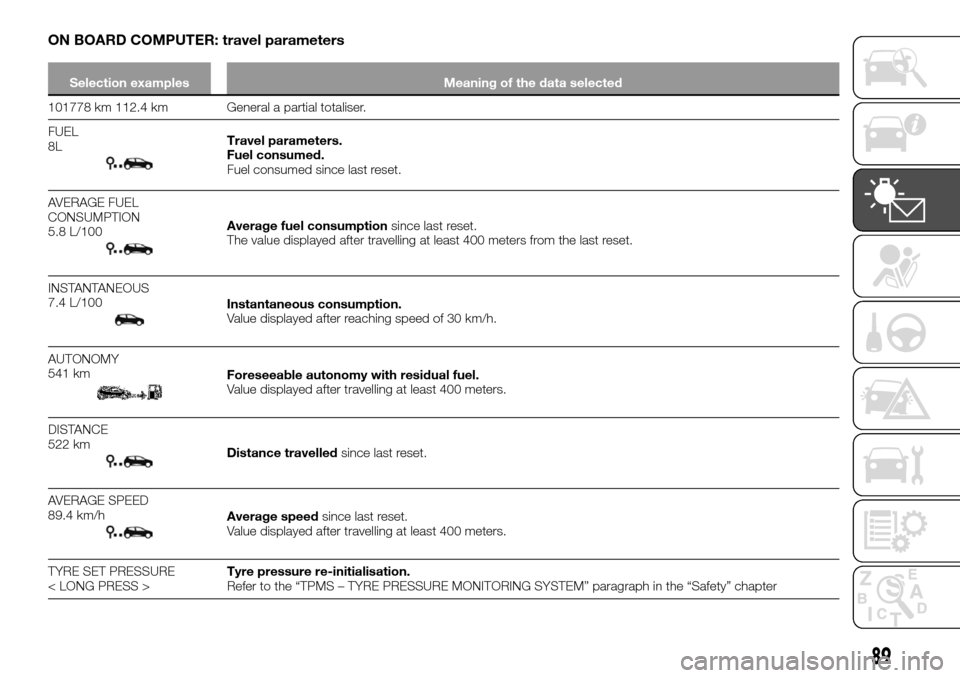
ON BOARD COMPUTER: travel parameters
Selection examples Meaning of the data selected
101778 km 112.4 km General a partial totaliser.
FUEL
8L
Travel parameters.
Fuel consumed.
Fuel consumed since last reset.
AVERAGE FUEL
CONSUMPTION
5.8 L/100
Average fuel consumptionsince last reset.
The value displayed after travelling at least 400 meters from the last reset.
INSTANTANEOUS
7.4 L/100
Instantaneous consumption.
Value displayed after reaching speed of 30 km/h.
AUTONOMY
541 km
Foreseeable autonomy with residual fuel.
Value displayed after travelling at least 400 meters.
DISTANCE
522 km
Distance travelledsince last reset.
AVERAGE SPEED
89.4 km/h
Average speedsince last reset.
Value displayed after travelling at least 400 meters.
TYRE SET PRESSURE
< LONG PRESS >Tyre pressure re-initialisation.
Refer to the “TPMS – TYRE PRESSURE MONITORING SYSTEM” paragraph in the “Safety” chapter
89
Page 142 of 232
A general grade from 0 to 100 appears
that allows you to assess your
ecological driving performance: high
values mean reduced fuel consumption.
Below is some ecological advice to
improve your performance. Store your
preferred routes lets you compare
performances. For further information,
refer to the RADIO/TOUCH – RADIO
NAV supplement.
ECOMODE
ECOMODE is a function that optimises
fuel consumption. It acts on a few of
the vehicle's uses (heating, air
conditioning, power steering, etc.) and
on a few driving operations
(acceleration, gear shift, speed
regulation, deceleration, etc.).
Activation of the function
Press button 4 fig. 219.
TheECOfig. 220 indicator light 5 on
the instrument panel turns on to
confirm that it has been activated.
While driving, you can temporarily leave
the ECOMODE function to reset all
engine performances.
To do this, press the accelerator pedal
firmly.
The ECOMODE function is reactivated
as soon as you release the accelerator.Deactivating the function
Press button 4 fig. 219.
TheECOfig. 220 warning light 5 on the
instrument panel turns off to confirm
that it has been deactivated.
Behaviour
Rather than heat the engine while
stopped, we advise you to drive
moderately until the engine reaches its
normal operating temperature.
Speed increases fuel consumption.
Do not strain the engine by
exceeding speed in intermediary gears.
Use the highest gear.
Avoid sudden acceleration.
Brake as little as possible. By
assessing the danger or curve in
advance, it will be sufficient to lift your
foot off the accelerator.
When going uphill, we advise you to
keep a steady speed, without having to
change it.
In modern vehicles, double clutching
before stopping the engine is not
necessary and could even cause
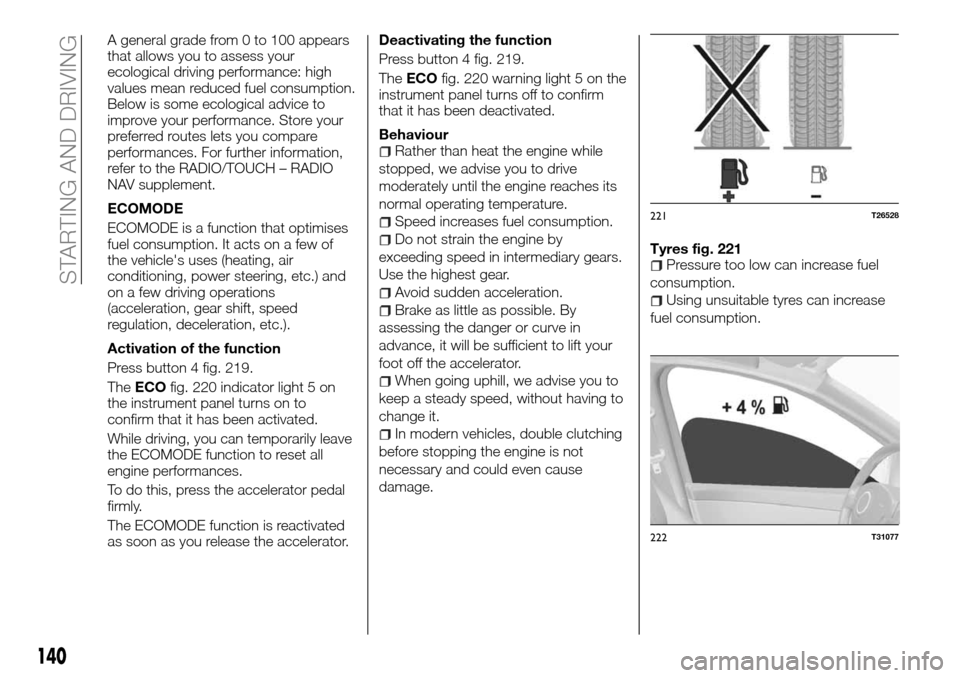
damage.Tyres fig. 221
Pressure too low can increase fuel
consumption.
Using unsuitable tyres can increase
fuel consumption.
221T26528
222T31077
140
STARTING AND DRIVING
Page 166 of 232
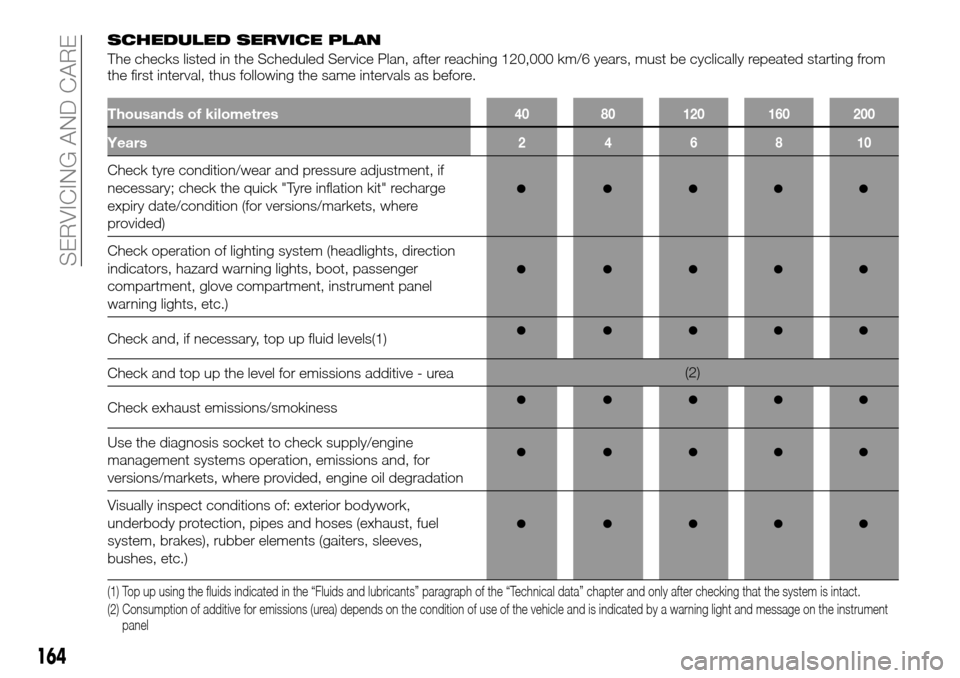
SCHEDULED SERVICE PLAN
The checks listed in the Scheduled Service Plan, after reaching 120,000 km/6 years, must be cyclically repeated starting from
the first interval, thus following the same intervals as before.
Thousands of kilometres40 80 120 160 200
Years246810
Check tyre condition/wear and pressure adjustment, if
necessary; check the quick "Tyre inflation kit" recharge
expiry date/condition (for versions/markets, where
provided)
Check operation of lighting system (headlights, direction
indicators, hazard warning lights, boot, passenger
compartment, glove compartment, instrument panel
warning lights, etc.)
Check and, if necessary, top up fluid levels(1)
Check and top up the level for emissions additive - urea(2)
Check exhaust emissions/smokiness
Use the diagnosis socket to check supply/engine
management systems operation, emissions and, for
versions/markets, where provided, engine oil degradation
Visually inspect conditions of: exterior bodywork,
underbody protection, pipes and hoses (exhaust, fuel
system, brakes), rubber elements (gaiters, sleeves,
bushes, etc.)
(1) Top up using the fluids indicated in the “Fluids and lubricants” paragraph of the “Technical data” chapter and only after checking that the system is intact.
(2) Consumption of additive for emissions (urea) depends on the condition of use of the vehicle and is indicated by a warning light and message on the instrument
panel
164
SERVICING AND CARE
Page 170 of 232
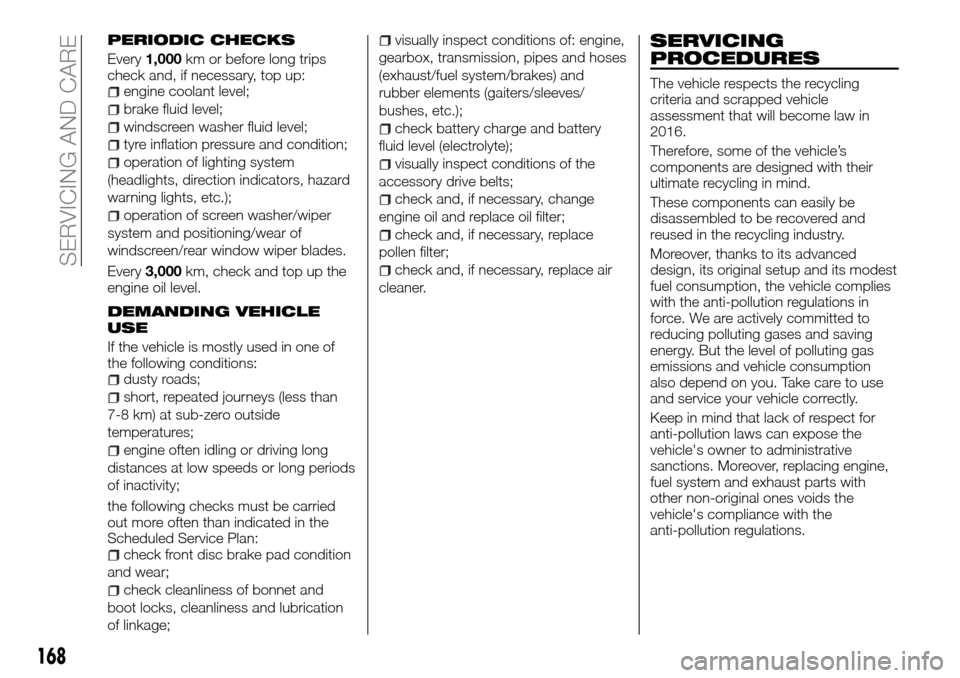
PERIODIC CHECKS
Every1,000km or before long trips
check and, if necessary, top up:
engine coolant level;
brake fluid level;
windscreen washer fluid level;
tyre inflation pressure and condition;
operation of lighting system
(headlights, direction indicators, hazard
warning lights, etc.);
operation of screen washer/wiper
system and positioning/wear of
windscreen/rear window wiper blades.
Every3,000km, check and top up the
engine oil level.
DEMANDING VEHICLE
USE
If the vehicle is mostly used in one of
the following conditions:
dusty roads;
short, repeated journeys (less than
7-8 km) at sub-zero outside
temperatures;
engine often idling or driving long
distances at low speeds or long periods
of inactivity;
the following checks must be carried
out more often than indicated in the
Scheduled Service Plan:
check front disc brake pad condition
and wear;
check cleanliness of bonnet and
boot locks, cleanliness and lubrication
of linkage;
visually inspect conditions of: engine,
gearbox, transmission, pipes and hoses
(exhaust/fuel system/brakes) and
rubber elements (gaiters/sleeves/
bushes, etc.);
check battery charge and battery
fluid level (electrolyte);
visually inspect conditions of the
accessory drive belts;
check and, if necessary, change
engine oil and replace oil filter;
check and, if necessary, replace
pollen filter;
check and, if necessary, replace air
cleaner.
SERVICING
PROCEDURES
The vehicle respects the recycling
criteria and scrapped vehicle
assessment that will become law in
2016.
Therefore, some of the vehicle’s
components are designed with their
ultimate recycling in mind.
These components can easily be
disassembled to be recovered and
reused in the recycling industry.
Moreover, thanks to its advanced
design, its original setup and its modest
fuel consumption, the vehicle complies
with the anti-pollution regulations in
force. We are actively committed to
reducing polluting gases and saving
energy. But the level of polluting gas
emissions and vehicle consumption
also depend on you. Take care to use
and service your vehicle correctly.
Keep in mind that lack of respect for
anti-pollution laws can expose the
vehicle's owner to administrative
sanctions. Moreover, replacing engine,
fuel system and exhaust parts with
other non-original ones voids the
vehicle's compliance with the
anti-pollution regulations.
168
SERVICING AND CARE
Page 230 of 232
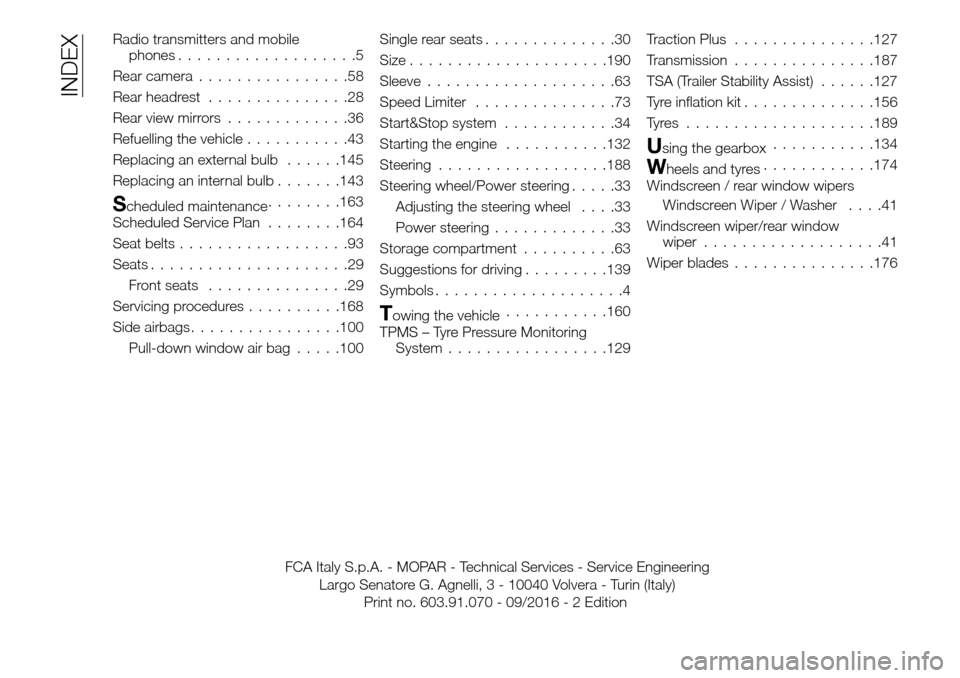
Radio transmitters and mobile
phones...................5
Rear camera................58
Rear headrest...............28
Rear view mirrors.............36
Refuelling the vehicle...........43
Replacing an external bulb......145
Replacing an internal bulb.......143
Scheduled maintenance........163
Scheduled Service Plan........164
Seat belts..................93
Seats.....................29
Front seats...............29
Servicing procedures..........168
Side airbags................100
Pull-down window air bag.....100Single rear seats..............30
Size.....................190
Sleeve....................63
Speed Limiter...............73
Start&Stop system............34
Starting the engine...........132
Steering..................188
Steering wheel/Power steering.....33
Adjusting the steering wheel....33
Power steering.............33
Storage compartment..........63
Suggestions for driving.........139
Symbols....................4
Towing the vehicle...........160
TPMS – Tyre Pressure Monitoring
System.................129Traction Plus...............127
Transmission...............187
TSA (Trailer Stability Assist)......127
Tyre inflation kit..............156
Tyres ....................189
Using the gearbox...........134
Wheels and tyres............174
Windscreen / rear window wipers
Windscreen Wiper / Washer....41
Windscreen wiper/rear window
wiper...................41
Wiper blades...............176
INDEX
FCA Italy S.p.A. - MOPAR - Technical Services - Service Engineering
Largo Senatore G. Agnelli, 3 - 10040 Volvera - Turin (Italy)
Print no. 603.91.070 - 09/2016 - 2 Edition