heating FIAT TALENTO 2016 2.G Owners Manual
[x] Cancel search | Manufacturer: FIAT, Model Year: 2016, Model line: TALENTO, Model: FIAT TALENTO 2016 2.GPages: 232, PDF Size: 5.01 MB
Page 13 of 232
INSTRUMENT PANEL
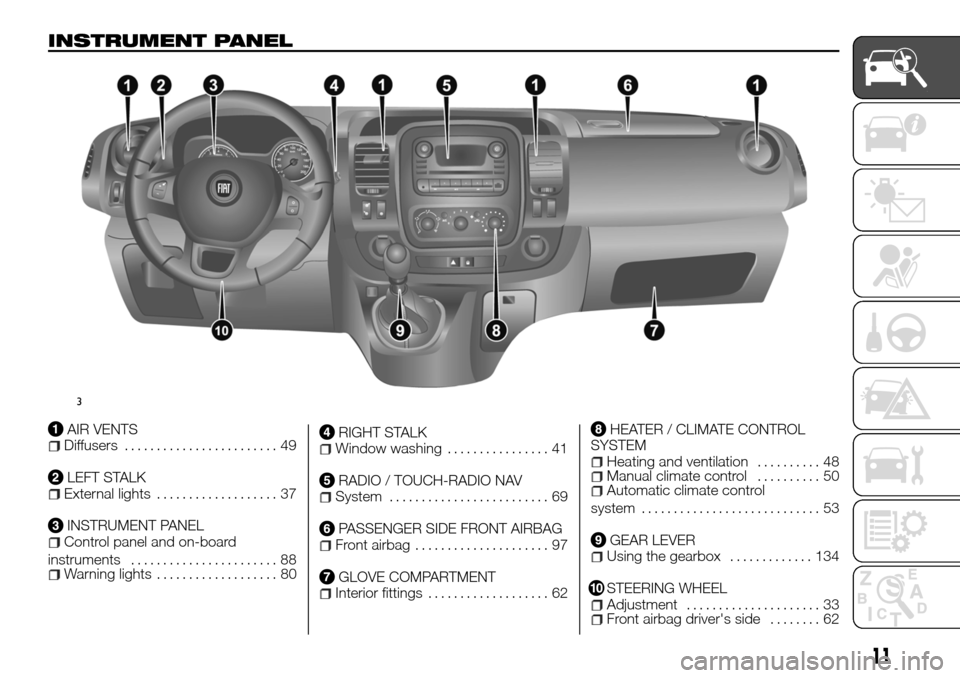
AIR VENTSDiffusers........................ 49
LEFT STALKExternal lights................... 37
INSTRUMENT PANELControl panel and on-board
instruments....................... 88
Warning lights................... 80
RIGHT STALKWindow washing................ 41
RADIO / TOUCH-RADIO NAVSystem......................... 69
PASSENGER SIDE FRONT AIRBAGFront airbag..................... 97
GLOVE COMPARTMENTInterior fittings................... 62
HEATER / CLIMATE CONTROL
SYSTEM
Heating and ventilation.......... 48Manual climate control.......... 50Automatic climate control
system............................ 53
GEAR LEVERUsing the gearbox............. 134
STEERING WHEELAdjustment..................... 33Front airbag driver's side........ 62
3
11
Page 31 of 232
Putting it back
Insert the headrest rods into the slots (if
necessary, recline the backrest). Lower
the headrest as far as it will go, then lift
it up until it clicks. Check that each rod
is locked in place into the seat
backrest.
WARNING
17)Head restraints must be adjusted so
that the head, rather than the neck, rests
on them. Only in this case they can protect
your head correctly. Any removed head
restraints must be repositioned correctly, in
order to protect the occupants in the event
of impact: follow the instructions above.
SEATS
FRONT SEATS
18) 19) 20)
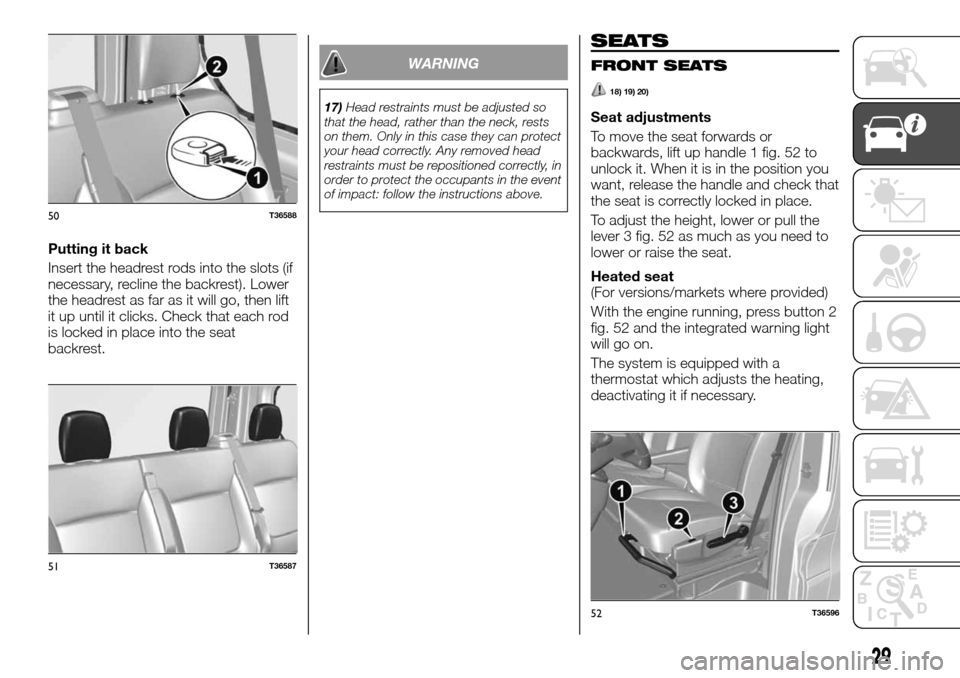
Seat adjustments
To move the seat forwards or
backwards, lift up handle 1 fig. 52 to
unlock it. When it is in the position you
want, release the handle and check that
the seat is correctly locked in place.
To adjust the height, lower or pull the
lever 3 fig. 52 as much as you need to
lower or raise the seat.
Heated seat
(For versions/markets where provided)
With the engine running, press button 2
fig. 52 and the integrated warning light
will go on.
The system is equipped with a
thermostat which adjusts the heating,
deactivating it if necessary.
50T36588
51T36587
52T36596
29
Page 44 of 232
best speed. You can change the
activation threshold and the time
between one wipe and the next by
turning the ring 2:
Efig. 81 Minimum sensitivity
Ffig. 81 Maximum sensitivity
C fig. 80Continuous slow operation
Dfig. 80 Continuous fast operation
NOTE If there is fog or snow, the
automatic windscreen wipers are not
systematic and the driver has to
operate them.
IMPORTANT The C fig. 80 operation
mode is only accessible when the
starter device is inserted. Functions B
and D fig. 80 can only be accessed
with the engine started.
NOTE There is a service position for
replacing the wiper blades. With the
starter switch on and engine off, lower
the wiper lever 1 fig. 81 completely
(position D). The wiper blades will stop
in a free position (refer to the "Screen
wiper" paragraph in the "Maintenance
and care” chapter).
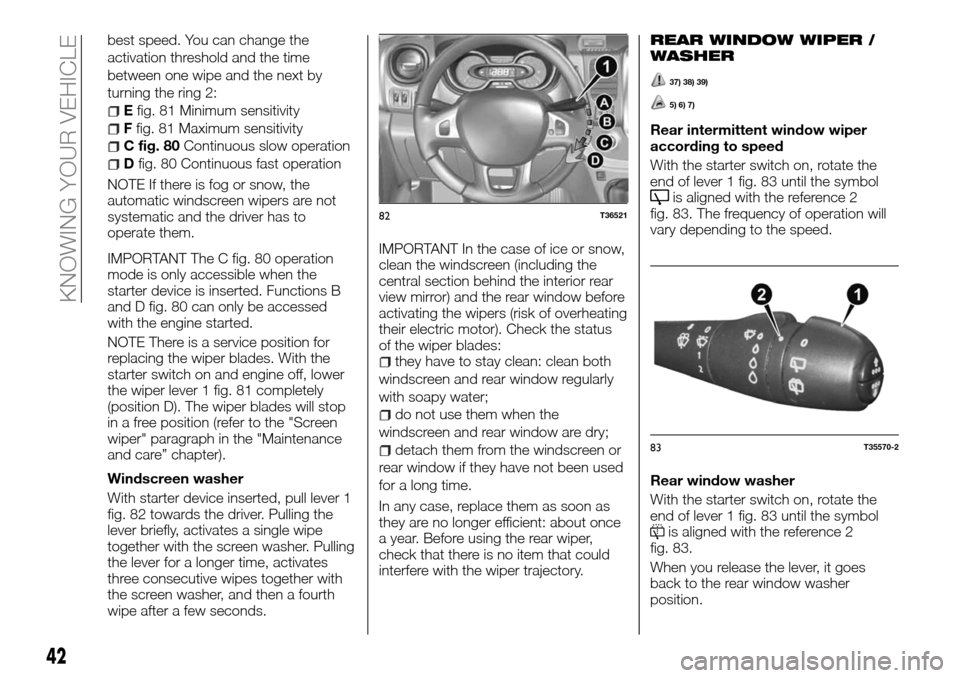
Windscreen washer
With starter device inserted, pull lever 1
fig. 82 towards the driver. Pulling the
lever briefly, activates a single wipe
together with the screen washer. Pulling
the lever for a longer time, activates
three consecutive wipes together with
the screen washer, and then a fourth
wipe after a few seconds.IMPORTANT In the case of ice or snow,
clean the windscreen (including the
central section behind the interior rear
view mirror) and the rear window before
activating the wipers (risk of overheating
their electric motor). Check the status
of the wiper blades:
they have to stay clean: clean both
windscreen and rear window regularly
with soapy water;
do not use them when the
windscreen and rear window are dry;
detach them from the windscreen or
rear window if they have not been used
for a long time.
In any case, replace them as soon as
they are no longer efficient: about once
a year. Before using the rear wiper,
check that there is no item that could
interfere with the wiper trajectory.
REAR WINDOW WIPER /
WASHER
37) 38) 39)
5) 6) 7)
Rear intermittent window wiper
according to speed
With the starter switch on, rotate the
end of lever 1 fig. 83 until the symbol
is aligned with the reference 2
fig. 83. The frequency of operation will
vary depending to the speed.
Rear window washer
With the starter switch on, rotate the
end of lever 1 fig. 83 until the symbol
is aligned with the reference 2
fig. 83.
When you release the lever, it goes
back to the rear window washer
position.
82T36521
83T35570-2
42
KNOWING YOUR VEHICLE
Page 45 of 232
NOTE If the wipers are operating or are
in automatic mode, when you put the
gear in reverse, the rear window starts
working intermittently.
IMPORTANT In the case of ice or snow,
clean the windscreen (including the
central section behind the interior rear
view mirror) and the rear window before
activating the wipers (risk of overheating
their electric motor). Check the status
of the wiper blades:
they have to be kept clean: clean the
blades, the windscreen and rearscreen
regularly with soapy water;
do not use them when the
windscreen and rear window are dry;
detach them from the windscreen or
rear window if they have not been used
for a long time.
IMPORTANT In any case, replace them
as soon as they are no longer efficient:
about once a year.
IMPORTANT Before using the rear
wiper, check that there is no item that
could interfere with the wiper trajectory.
IMPORTANT Do not use the wiper arm
to open or close the luggage
compartment door.
WARNING
37)When working in the engine
compartment, make sure that the
windscreen wiper is in position A
(stopped). Risk of injury.
38)If the window needs to be cleaned,
make sure the device is deactivated or the
key is on STOP.
39)When working in the engine
compartment, make sure that the rear
window wiper is in the stopped position.
Risk of injury.
IMPORTANT
5)Never use the windscreen wipers to
remove layers of snow or ice from the
windscreen. In such conditions, the
windscreen wiper may be subjected to
excessive stress and the motor cut-out
switch, which prevents operation for a few
seconds, may intervene. If operation is not
subsequently restored, even after restarting
the vehicle, contact a Fiat Dealership.
6)Do not operate the windscreen wiper
with the blades lifted from the windscreen.
7)Make sure the device is switched off if
there is ice on the windscreen.
REFUELLING THE
VEHICLE
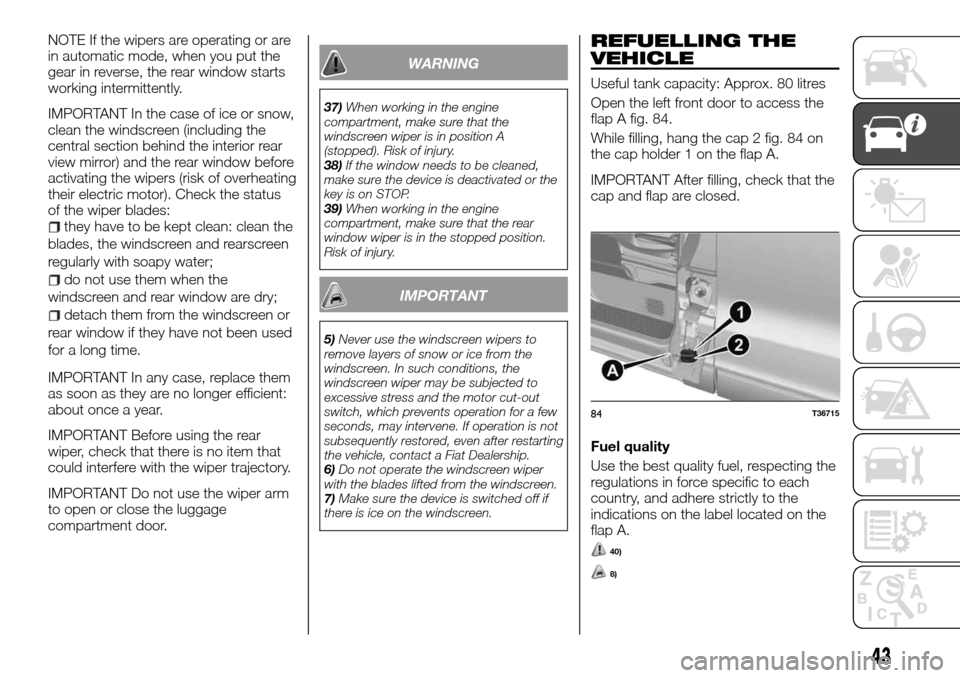
Useful tank capacity: Approx. 80 litres
Open the left front door to access the
flap A fig. 84.
While filling, hang the cap 2 fig. 84 on
the cap holder 1 on the flap A.
IMPORTANT After filling, check that the
cap and flap are closed.
Fuel quality
Use the best quality fuel, respecting the
regulations in force specific to each
country, and adhere strictly to the
indications on the label located on the
flap A.
40)
8)
84T36715
43
Page 47 of 232
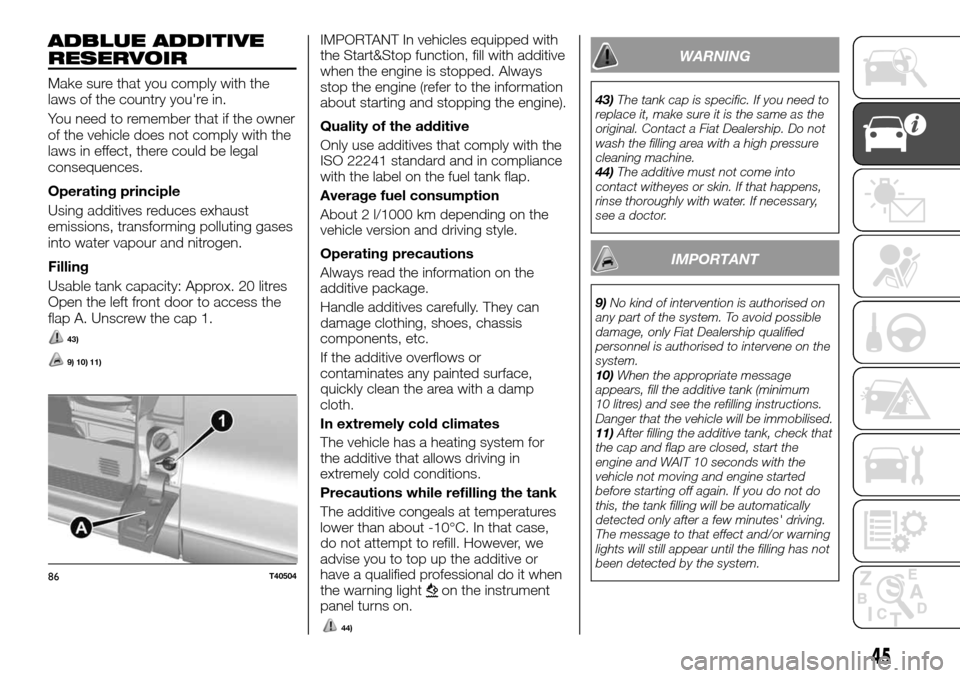
ADBLUE ADDITIVE
RESERVOIR
Make sure that you comply with the
laws of the country you're in.
You need to remember that if the owner
of the vehicle does not comply with the
laws in effect, there could be legal
consequences.
Operating principle
Using additives reduces exhaust
emissions, transforming polluting gases
into water vapour and nitrogen.
Filling
Usable tank capacity: Approx. 20 litres
Open the left front door to access the
flap A. Unscrew the cap 1.
43)
9) 10) 11)
IMPORTANT In vehicles equipped with
the Start&Stop function, fill with additive
when the engine is stopped. Always
stop the engine (refer to the information
about starting and stopping the engine).
Quality of the additive
Only use additives that comply with the
ISO 22241 standard and in compliance
with the label on the fuel tank flap.
Average fuel consumption
About 2 l/1000 km depending on the
vehicle version and driving style.
Operating precautions
Always read the information on the
additive package.
Handle additives carefully. They can
damage clothing, shoes, chassis
components, etc.
If the additive overflows or
contaminates any painted surface,
quickly clean the area with a damp
cloth.
In extremely cold climates
The vehicle has a heating system for
the additive that allows driving in
extremely cold conditions.
Precautions while refilling the tank
The additive congeals at temperatures
lower than about -10°C. In that case,
do not attempt to refill. However, we
advise you to top up the additive or
have a qualified professional do it when
the warning light
on the instrument
panel turns on.
44)
WARNING
43)The tank cap is specific. If you need to
replace it, make sure it is the same as the
original. Contact a Fiat Dealership. Do not
wash the filling area with a high pressure
cleaning machine.
44)The additive must not come into
contact witheyes or skin. If that happens,
rinse thoroughly with water. If necessary,
see a doctor.
IMPORTANT
9)No kind of intervention is authorised on
any part of the system. To avoid possible
damage, only Fiat Dealership qualified
personnel is authorised to intervene on the
system.
10)When the appropriate message
appears, fill the additive tank (minimum
10 litres) and see the refilling instructions.
Danger that the vehicle will be immobilised.
11)After filling the additive tank, check that
the cap and flap are closed, start the
engine and WAIT 10 seconds with the
vehicle not moving and engine started
before starting off again. If you do not do
this, the tank filling will be automatically
detected only after a few minutes' driving.
The message to that effect and/or warning
lights will still appear until the filling has not
been detected by the system.
86T40504
45
Page 50 of 232
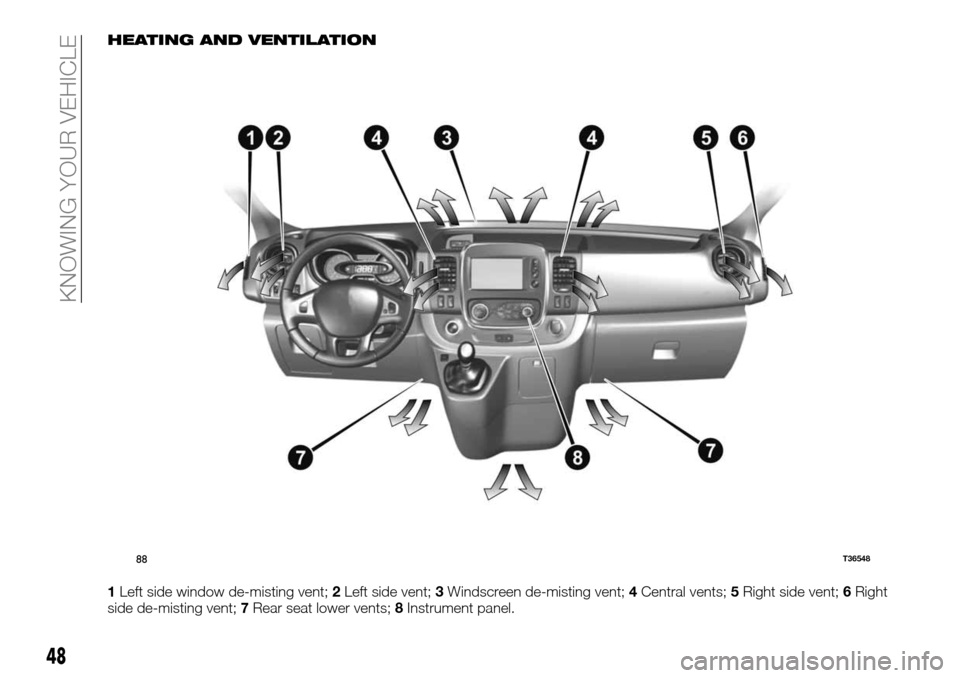
HEATING AND VENTILATION
1Left side window de-misting vent;2Left side vent;3Windscreen de-misting vent;4Central vents;5Right side vent;6Right
side de-misting vent;7Rear seat lower vents;8Instrument panel.
88T36548
48
KNOWING YOUR VEHICLE
Page 53 of 232
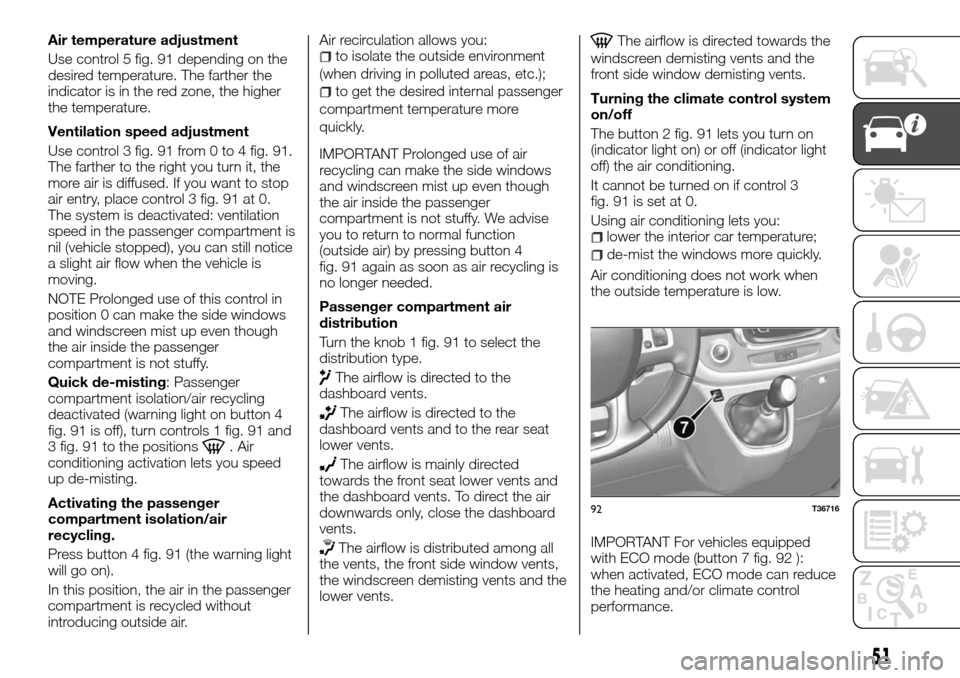
Air temperature adjustment
Use control 5 fig. 91 depending on the
desired temperature. The farther the
indicator is in the red zone, the higher
the temperature.
Ventilation speed adjustment
Use control 3 fig. 91 from 0 to 4 fig. 91.
The farther to the right you turn it, the
more air is diffused. If you want to stop
air entry, place control 3 fig. 91 at 0.
The system is deactivated: ventilation
speed in the passenger compartment is
nil (vehicle stopped), you can still notice
a slight air flow when the vehicle is
moving.
NOTE Prolonged use of this control in
position 0 can make the side windows
and windscreen mist up even though
the air inside the passenger
compartment is not stuffy.
Quick de-misting: Passenger
compartment isolation/air recycling
deactivated (warning light on button 4
fig. 91 is off), turn controls 1 fig. 91 and
3 fig. 91 to the positions
. Air
conditioning activation lets you speed
up de-misting.
Activating the passenger
compartment isolation/air
recycling.
Press button 4 fig. 91 (the warning light
will go on).
In this position, the air in the passenger
compartment is recycled without
introducing outside air.Air recirculation allows you:
to isolate the outside environment
(when driving in polluted areas, etc.);
to get the desired internal passenger
compartment temperature more
quickly.
IMPORTANT Prolonged use of air
recycling can make the side windows
and windscreen mist up even though
the air inside the passenger
compartment is not stuffy. We advise
you to return to normal function
(outside air) by pressing button 4
fig. 91 again as soon as air recycling is
no longer needed.
Passenger compartment air
distribution
Turn the knob 1 fig. 91 to select the
distribution type.
The airflow is directed to the
dashboard vents.
The airflow is directed to the
dashboard vents and to the rear seat
lower vents.
The airflow is mainly directed
towards the front seat lower vents and
the dashboard vents. To direct the air
downwards only, close the dashboard
vents.
The airflow is distributed among all
the vents, the front side window vents,
the windscreen demisting vents and the
lower vents.
The airflow is directed towards the
windscreen demisting vents and the
front side window demisting vents.
Turning the climate control system
on/off
The button 2 fig. 91 lets you turn on
(indicator light on) or off (indicator light
off) the air conditioning.
It cannot be turned on if control 3
fig. 91 is set at 0.
Using air conditioning lets you:
lower the interior car temperature;
de-mist the windows more quickly.
Air conditioning does not work when
the outside temperature is low.
IMPORTANT For vehicles equipped
with ECO mode (button 7 fig. 92 ):
when activated, ECO mode can reduce
the heating and/or climate control
performance.
92T36716
51
Page 86 of 232
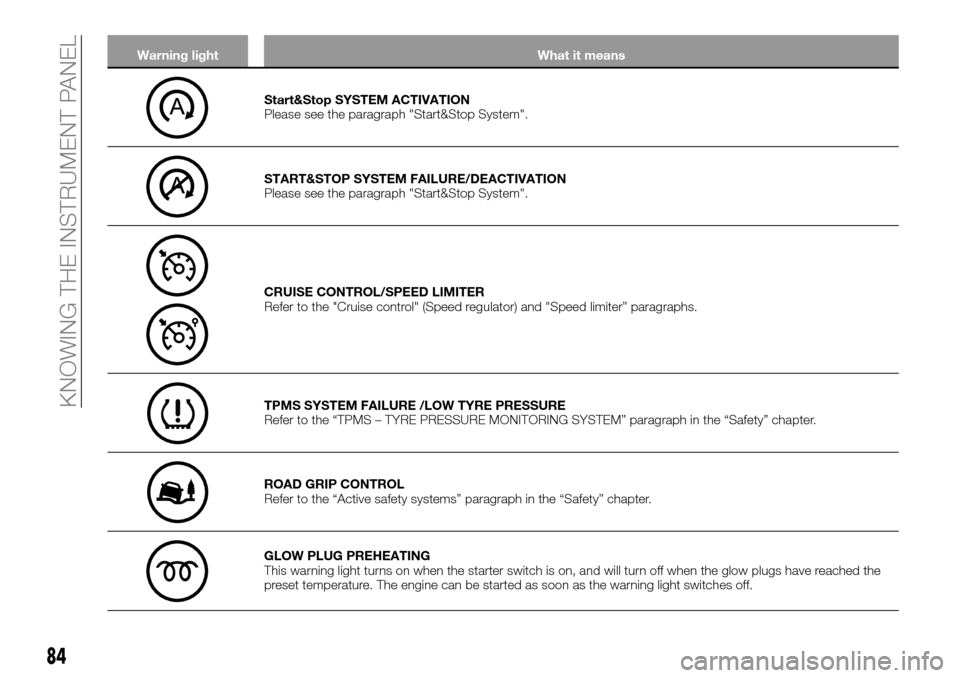
Warning light What it means
Start&Stop SYSTEM ACTIVATION
Please see the paragraph "Start&Stop System".
START&STOP SYSTEM FAILURE/DEACTIVATION
Please see the paragraph "Start&Stop System".
CRUISE CONTROL/SPEED LIMITER
Refer to the "Cruise control" (Speed regulator) and "Speed limiter” paragraphs.
TPMS SYSTEM FAILURE /LOW TYRE PRESSURE
Refer to the “TPMS – TYRE PRESSURE MONITORING SYSTEM” paragraph in the “Safety” chapter.
ROAD GRIP CONTROL
Refer to the “Active safety systems” paragraph in the “Safety” chapter.
GLOW PLUG PREHEATING
This warning light turns on when the starter switch is on, and will turn off when the glow plugs have reached the
preset temperature. The engine can be started as soon as the warning light switches off.
84
KNOWING THE INSTRUMENT PANEL
Page 134 of 232
ENGINE RUN-IN
Until you have gone 1,500 km, do not
exceed 130 km/h on the highest ratio,
or 2,500 rpm. After that mileage, you
can push the engine harder, but the
vehicle will perform better only after
having travelled 6,000 kilometres.
During the running-in period, do not
accelerate abruptly while the engine is
cold, and avoid running it too fast.
Coupon frequency:refer to the
"Scheduled Service Plan".
STARTING THE
ENGINE
138) 139) 140) 141) 142)
Vehicles with a key and remote
control
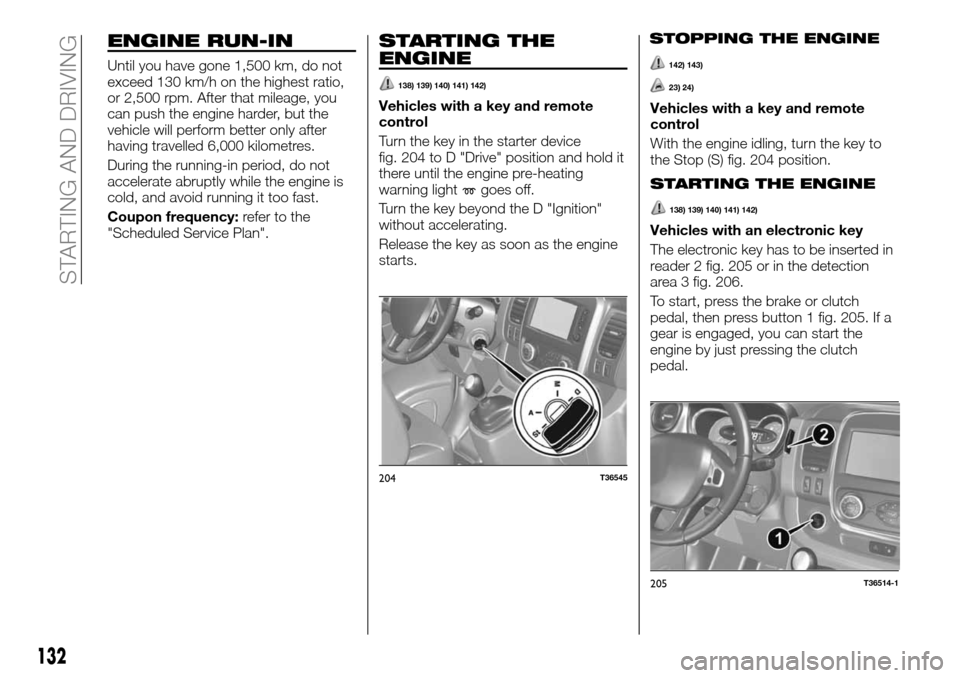
Turn the key in the starter device
fig. 204 to D "Drive" position and hold it
there until the engine pre-heating
warning light
goes off.
Turn the key beyond the D "Ignition"
without accelerating.
Release the key as soon as the engine
starts.
STOPPING THE ENGINE
142) 143)
23) 24)
Vehicles with a key and remote
control
With the engine idling, turn the key to
the Stop (S) fig. 204 position.
STARTING THE ENGINE
138) 139) 140) 141) 142)
Vehicles with an electronic key
The electronic key has to be inserted in
reader 2 fig. 205 or in the detection
area 3 fig. 206.
To start, press the brake or clutch
pedal, then press button 1 fig. 205. If a
gear is engaged, you can start the
engine by just pressing the clutch
pedal.
204T36545
205T36514-1
132
STARTING AND DRIVING
Page 142 of 232
A general grade from 0 to 100 appears
that allows you to assess your
ecological driving performance: high
values mean reduced fuel consumption.
Below is some ecological advice to
improve your performance. Store your
preferred routes lets you compare
performances. For further information,
refer to the RADIO/TOUCH – RADIO
NAV supplement.
ECOMODE
ECOMODE is a function that optimises
fuel consumption. It acts on a few of
the vehicle's uses (heating, air
conditioning, power steering, etc.) and
on a few driving operations
(acceleration, gear shift, speed
regulation, deceleration, etc.).
Activation of the function
Press button 4 fig. 219.
TheECOfig. 220 indicator light 5 on
the instrument panel turns on to
confirm that it has been activated.
While driving, you can temporarily leave
the ECOMODE function to reset all
engine performances.
To do this, press the accelerator pedal
firmly.
The ECOMODE function is reactivated
as soon as you release the accelerator.Deactivating the function
Press button 4 fig. 219.
TheECOfig. 220 warning light 5 on the
instrument panel turns off to confirm
that it has been deactivated.
Behaviour
Rather than heat the engine while
stopped, we advise you to drive
moderately until the engine reaches its
normal operating temperature.
Speed increases fuel consumption.
Do not strain the engine by
exceeding speed in intermediary gears.
Use the highest gear.
Avoid sudden acceleration.
Brake as little as possible. By
assessing the danger or curve in
advance, it will be sufficient to lift your
foot off the accelerator.
When going uphill, we advise you to
keep a steady speed, without having to
change it.
In modern vehicles, double clutching
before stopping the engine is not
necessary and could even cause
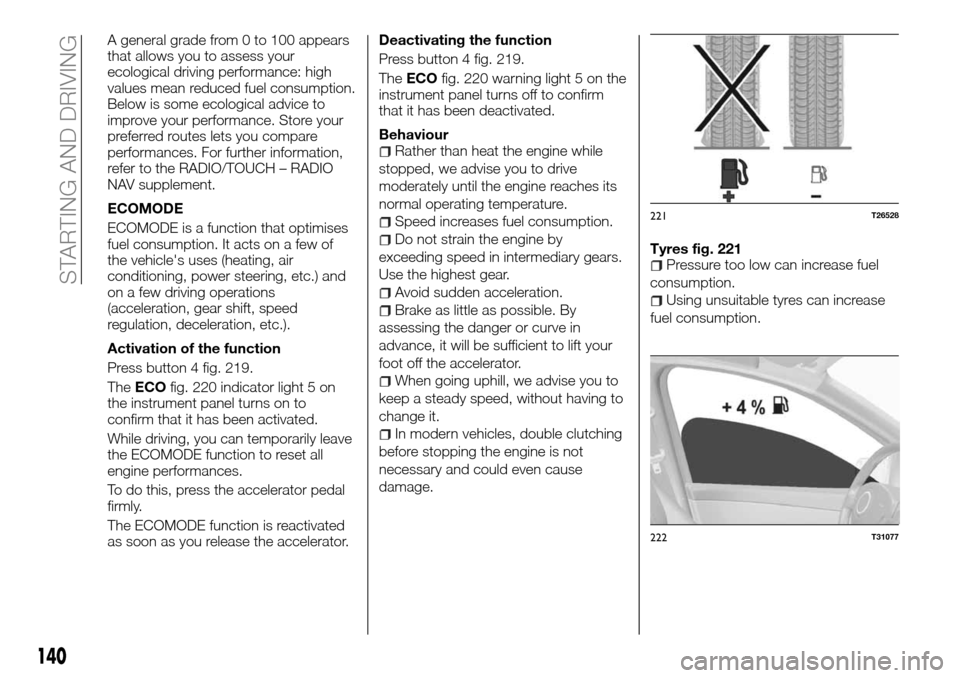
damage.Tyres fig. 221
Pressure too low can increase fuel
consumption.
Using unsuitable tyres can increase
fuel consumption.
221T26528
222T31077
140
STARTING AND DRIVING