air filter FIAT TEMPRA 1988 Service And User Guide
[x] Cancel search | Manufacturer: FIAT, Model Year: 1988, Model line: TEMPRA, Model: FIAT TEMPRA 1988Pages: 171, PDF Size: 18.05 MB
Page 48 of 171
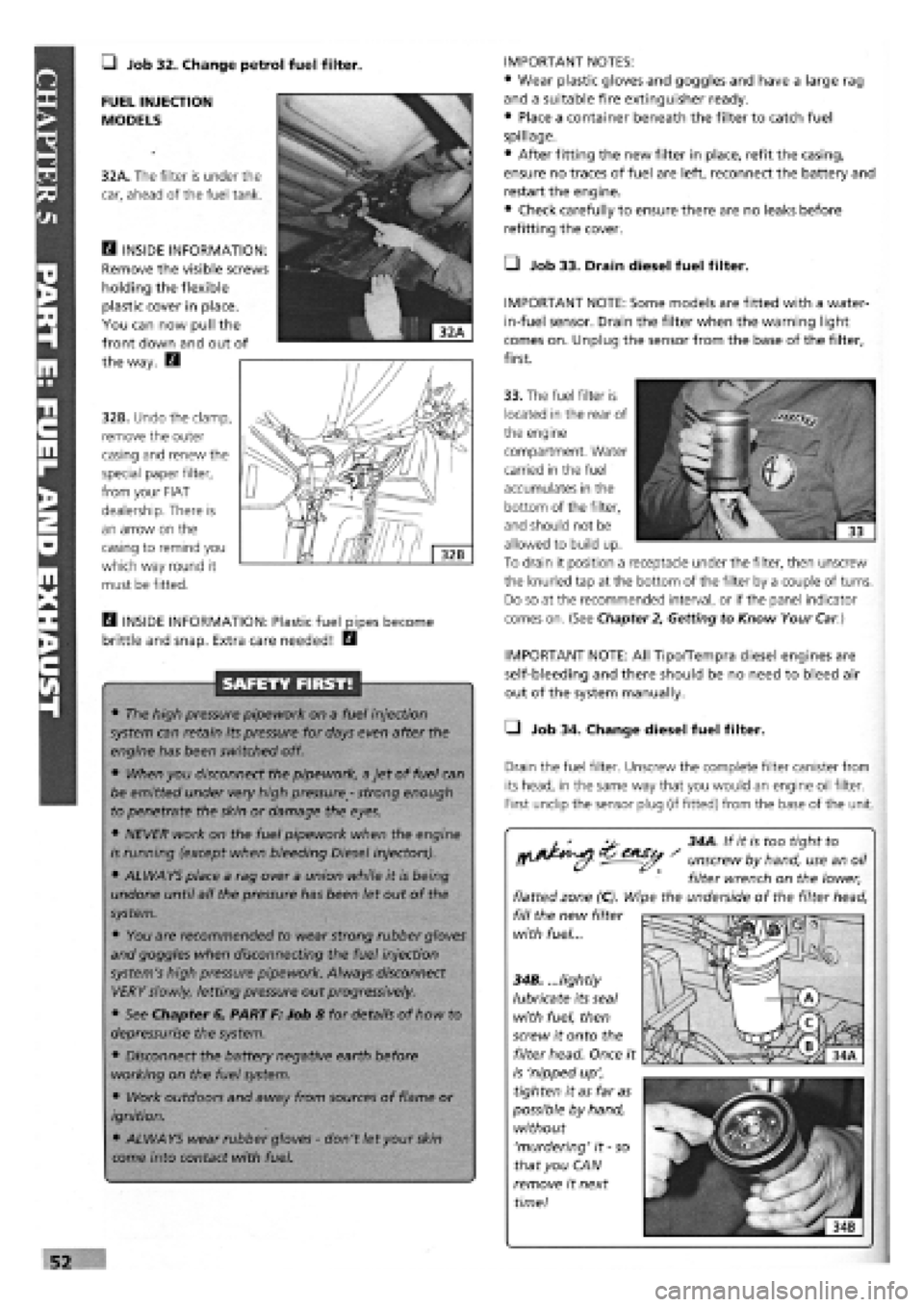
• Job 32. Change petrol fuel filter. IMPORTANT NOTES:
• Wear plastic gloves and goggles and have a large rag
and a suitable fire extinguisher ready.
• Place a container beneath the filter to catch fuel
spillage.
• After fitting the new filter in place, refit the casing,
ensure no traces of fuel are left, reconnect the battery and
restart the engine.
• Check carefully to ensure there are no leaks before
refitting the cover.
• Job 33. Drain diesel fuel filter.
IMPORTANT NOTE: Some models are fitted with a water-
in-fuel sensor. Drain the filter when the warning light
comes on. Unplug the sensor from the base of the filter,
first.
FUEL INJECTION
MODELS
32A. The filter is under the
car, ahead of the fuel tank.
E3 INSIDE INFORMATION:
Remove the visible screws
holding the flexible
plastic cover in place.
You can now pull the
front down and out of
the way. E3
32B. Undo the clamp,
remove the outer
casing and renew the
special paper filter,
from your FIAT
dealership. There is
an arrow on the
casing to remind you
which way round it
must be fitted.
33. The fuel filter is
located in the rear of
the engine
compartment. Water
carried in the fuel
accumulates in the
bottom of the filter,
and should not be
allowed to build up.
To drain it position a receptacle under the filter, then unscrew
the knurled tap at the bottom of the filter by a couple of turns.
Do so at the recommended interval, or if the panel indicator
comes on. (See Chapter
2,
Getting to Know Your
Car.)
H INSIDE INFORMATION: Plastic fuel pipes become
brittle and snap. Extra care needed! E3
SAFETY FIRST!
• The high pressure pipework on a fuel injection
system can retain its pressure for days even after the
engine has been switched off.
• When you disconnect the pipework, a jet of fuel can
be emitted under very high pressure
-
strong enough
to penetrate the skin or damage the eyes.
• NEVER work on the fuel pipework when the engine
is running (except when bleeding Diesel injectors).
• ALWAYS place a rag over a union while it is being
undone until all the pressure has been let out of the
system.
• You are recommended to wear strong rubber gloves
and goggles when disconnecting the fuel injection
system's high pressure pipework. Always disconnect
VERY slowly, letting pressure out progressively.
• See Chapter 6, PART F: Job 8 for details of how to
depressurise the system.
• Disconnect the battery negative earth before
working on the fuel system.
• Work outdoors and away from sources of flame or
ignition.
• ALWAYS wear rubber gloves
-
don't let your
skin
come into contact with fuel.
IMPORTANT NOTE: All Tipo/Tempra diesel engines are
self-bleeding and there should be no need to bleed air
out of the system manually.
• Job 34. Change diesel fuel filter.
Drain the fuel filter. Unscrew the complete filter canister from
its head, in the same way that you would an engine oil filter.
First undip the sensor plug (if fitted) from the base of the unit.
^ 34A. If it is too tight to
^^ - unscrew by hand, use an oil
filter wrench on the lower,
flatted zone (C). Wipe the underside of the filter head,
fill the new filter
with fuel...
34B. ...lightly
lubricate its seal
with fuel, then
screw it onto the
filter head. Once it
is 'nipped up',
tighten it as far as
possible by hand,
without
'murdering' it
-
so
that you CAN
remove it next
time!
Page 49 of 171
IMPORTANT NOTE: • All Tipo/Tempra diesel engines are
self-bleeding and there should be no need to bleed air
out of the system manually.
• If the engine does not eventually re-start, check all the
unions for the fuel inlet pipe and the other unions,
replacing the sealing washers if necessary, to eliminate
any air leaks.
Q Job 35. Check/adjust petrol engine idle and
emissions.
Setting the idle speed and mixture is not just a matter of
making
the car run smoothly and economically; it's also a
question of allowing it to run within the legal hydrocarbon
(HC), Nitrous Oxide (NO) and carbon monoxide (CO) emission
limits. If it
is
outside limits, the car will fail the annual test.
(However, a worn engine will fail even if the carburettor or
injection system is correctly set up.)
FACT FILE: ESSENTIAL
PREPARATIONS
• When tuning the engine you should
adjust the carburettor (when fitted) last
of all, as its settings will be affected by
the state of tune of the rest of the engine.
• Ignition dwell angle and timing must be correct, the
air
filter
should be clean, there should be no air leaks
on
the induction system, and all electrical components
and
the air conditioning (if fitted) should be switched
off.
• Get the engine to full operating temperature before
checking and adjusting.
• If
you
warm the engine on tick-over (instead of on a
journey), it won't be hot enough until you have heard
the electric cooling fan cut in twice.
Q INSIDE INFORMATION: These jobs require the use of a
tachometer (rev-counter) and an exhaust gas analyser to
achieve any degree of accuracy. If you don't own them -
and relatively inexpensive tools are now available
-
you
may
wish
to have the work carried out by your local FIAT
dealer. D
ROUGH
GUIDE: Within each section is a description of how
you
can
get the car running tolerably well without any
specialist
equipment, so that you can take it to your FIAT
dealership
for accurate (and MoT-able!) tuning.
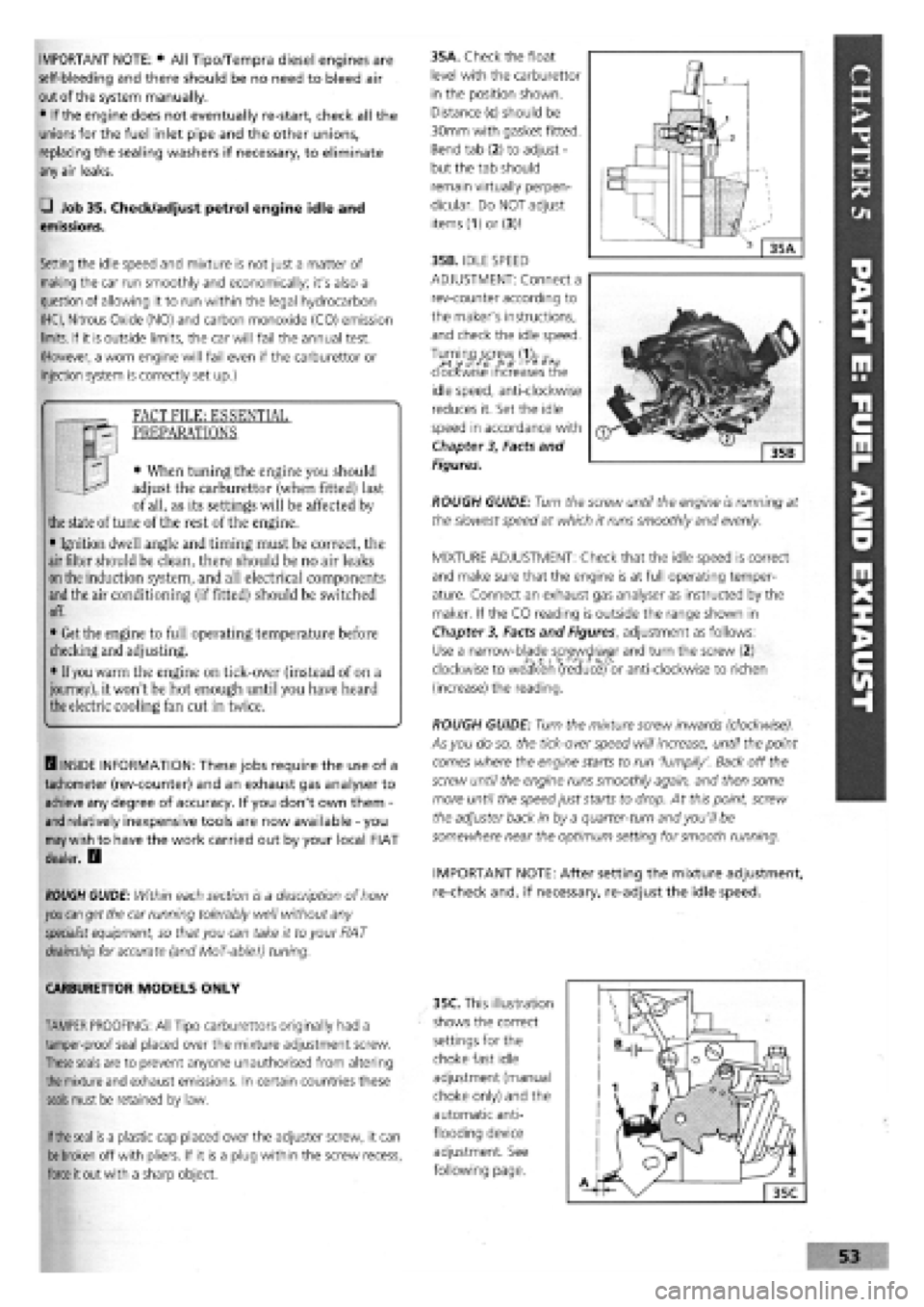
35A. Check the float
level with the carburettor
in the position shown.
Distance (c) should be
30mm with gasket fitted.
Bend tab (2) to adjust
-
but the tab should
remain virtually perpen-
dicular. Do NOT adjust
items (1)or (3)1
35B. IDLE SPEED
ADJUSTMENT: Connect a
rev-counter according to
the maker's instructions,
and check the idle speed.
clockwise increases the
idle speed, anti-clockwise
reduces it. Set the idle
speed in accordance with
Chapter
3,
Facts and
Figures.
ROUGH GUIDE: Turn the screw until the engine is running at
the slowest speed at which it runs smoothly and evenly.
MIXTURE ADJUSTMENT: Check that the idle speed is correct
and make sure that the engine is at full operating temper-
ature. Connect an exhaust gas analyser as instructed by the
maker. If the CO reading is outside the range shown in
Chapter
3,
Facts and Figures, adjustment as follows:
Use a narrow-blade screwdriver and turn the screw (2)
clockwise to weaken (reduce) or anti-clockwise to richen
(increase) the reading.
ROUGH GUIDE: Turn the mixture screw inwards (clockwise).
As you do so, the tick-over speed will increase, until the point
comes where the engine starts to run 'lumpily'. Back off the
screw until the engine runs smoothly again, and then some
more until the speed just starts to drop. At this point, screw
the adjuster back in by a quarter-turn and you'll be
somewhere near the optimum setting for smooth running.
IMPORTANT NOTE: After setting the mixture adjustment,
re-check and, if necessary, re-adjust the idle speed.
CARBURETTOR MODELS ONLY
TAMPER PROOFING: All Tipo carburettors originally had a
tamper-proof seal placed over the mixture adjustment screw.
These
seals are to prevent anyone unauthorised from altering
the
mixture and exhaust emissions. In certain countries these
seals
must be retained by law.
If the
seal
is
a plastic cap placed over the adjuster screw, it can
be
broken
off with pliers. If it is a plug within the screw recess,
force
it out with a sharp object.
35C. This illustration
shows the correct
settings for the
choke fast idle
adjustment (manual
choke only) and the
automatic anti-
flooding device
adjustment. See
following page.
Page 59 of 171
—1 Job 59. Check spare tyre.
This
job should ideally be carried out every month or two
-
you
never know when you're going to need that spare! But if you
haven't remembered, do it at the time shown on the Service
Interval Chart at the latest.
Q INSIDE INFORMATION: Put in the maximum recom-
mended pressure for heavy-duty use
-
it's always easier
to let some air out if necessary, than to put some in. Lift
the spare out check the 'hidden' lower side wall
for cracking. See Job 6. E9
PART I: ROAD TEST
Q Job 62. Road test and specialist check
-
after
every service.
Before you can claim to have 'finished' working on your car,
you must check it, test it, and, if necessary, have a qualified
mechanic check it over for you.
If you
are not a qualified mechanic, we strongly recommend
having someone who is a properly qualified mechanic
-
your
FIAT dealership perhaps
-
inspect all of the car's safety-related
items
after they have been worked on at home and before
using
the car on the road.
You'll have to remove the toolkit and the wheel to get at the
valve
-
under the boot floor on most models but to one side of
the rear compartment on Estate versions.
• Job 60. Change pollen filter.
When fitted to the fresh air intake, replace it at the scheduled
mileage interval.
• Job 61. Replace airbag gas generator.
Have your FIAT dealer replace the airbag gas generator 10
years after the car was built
-
see the label inside the car's
glove compartment door.
• Before setting out, check that the lights, indicators and in-
car controls, as well as seat belts and seat adjustments, all
work correctly.
• Run the car for several minutes before setting out then turn
off, check fluid levels and check underneath for leaks.
• Check that the steering moves freely in both directions and
that the car does not 'pull' one way or the other when driving
in a straight line
-
but do bear in mind the effect of the
camber on the road.
• Make sure that the brakes work effectively, smoothly and
without the need for 'pumping'. There should be no juddering
or squealing.
• Check that the car does not 'pull' from one side to the
other when you brake firmly from around 40 mph. (Don't
cause a skid and don't try this if there is any following traffic.)
"V,
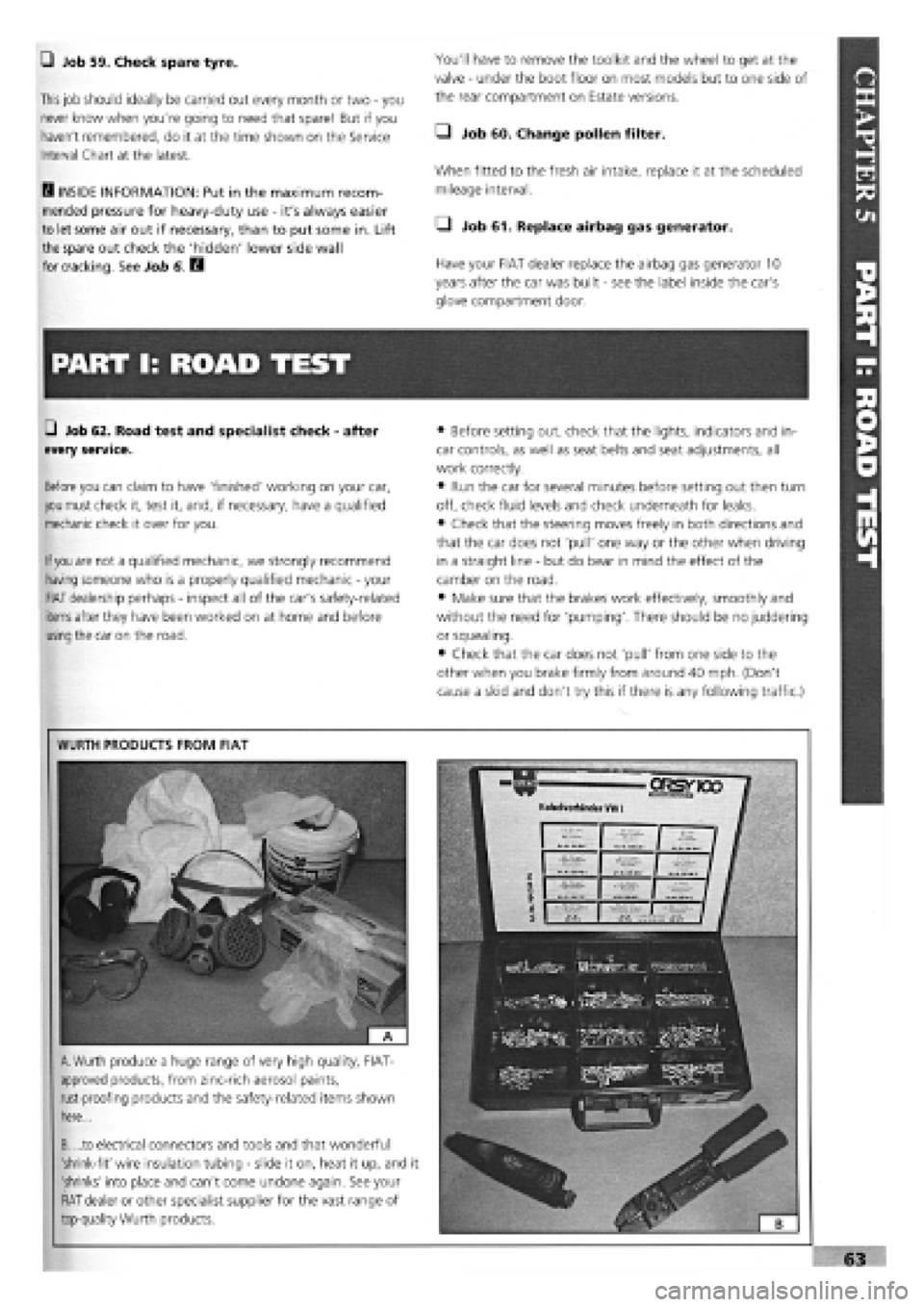
WURTH PRODUCTS FROM FIAT
A.
Wurth produce a huge range of very high quality, FIAT-
approved products, from zinc-rich aerosol paints,
rust-proofing products and the safety-related items shown
here...
B. ...to electrical connectors and tools and that wonderful
'shrink-fit' wire insulation tubing
-
slide it on, heat it up, and it
'shrinks' into place and can't come undone again. See your
FIAT dealer or other specialist supplier for the vast range of
top-quality Wurth products.
Page 69 of 171
G Step 17: Now repeat this operation on the remaining
valves.
G Step 18: Wash the whole cylinder head again using
paraffin and an old brush, making sure that all traces of
grinding paste are removed, then dry off. Use compressed air
if
available.
SAFETY FIRST!
•
Treat
compressed air with respect. Always wear
goggles
to protect your eyes.
•
Never
allow the airline nozzle near any of the body Sep apertures.
H INSIDE INFORMATION! Check the height of the valve
springs against new ones if possible, but if not, compare
them with each other. If any are shorter than the others,
play safe and replace the complete set. They are bound
to have suffered fatigue which could cause premature
valve failure. H
G Step 19: To install the valves, start from one end.
Lubricate a valve stem with fresh engine oil and slide it in to its
guide.
G Step 20: Locate a new valve stem seal over the stem of
the valve
(if applicable) and push down into contact with the
guide. Position the seal on its seat using a suitable metal tube.
G Step 21: Refit the flat washer and spring seat.
G Step 22: Position the inner and outer springs and the
spring
cap.
G Step 23: Re-apply the valve spring compressor and
compress
the springs enough to allow you to engage the split
collets
in
the stem grooves.
D INSIDE INFORMATION! Grease the grooves so that the
collets will 'stick' in place. The collets are easily fitted by
'sticking' the backs of them onto the end of a screw-
driver with some grease and feeding them into
position. B
G Step 24: Carefully release the spring compressor and
check
that the collets are correctly located. Tap the end of the
stem with
a hammer, to bed them in.
G Step 25: Fit the remaining valves.
Job 5. Petrol engine -
dismantling.
G Step 1: Familiarise yourself with the layout of the engine.
Refer to
illustration Job
2-1
for an exploded view of the
engine
components.
G Step 2: Drain the engine oil. Remove the cylinder head.
See
Job 2.
G Step 3: Remove the distributor. See PART D: IGNITION
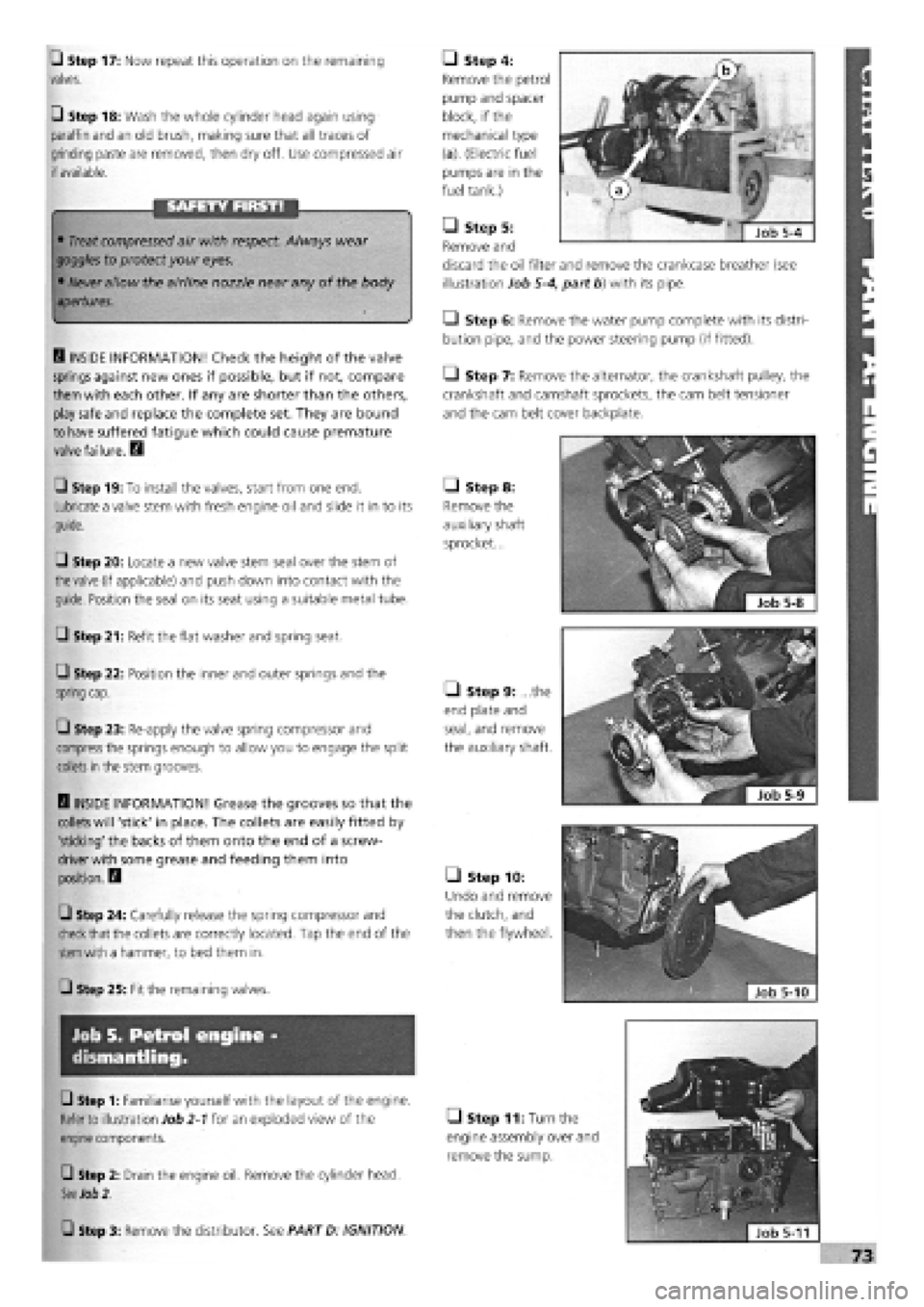
• Step 4:
Remove the petrol
pump and spacer
block, if the
mechanical type
(a). (Electric fuel
pumps are in the
fuel tank.)
• Step 5:
Remove and
discard the oil filter
illustration Job
5-4,
• Step 6: Remove the water pump complete with its distri-
bution pipe, and the power steering pump (if fitted).
Q Step 7: Remove the alternator, the crankshaft pulley, the
crankshaft and camshaft sprockets, the cam belt tensioner
and the cam belt cover backplate.
• Step 8:
Remove the
auxiliary shaft
sprocket...
• Step 9: ...the
end plate and
seal, and remove
the auxiliary shaft.
• Step 10:
Undo and remove
the clutch, and
then the flywheel.
• Step 11: Turr
engine assembly c
remove the sump
and remove the crankcase breather (see
part b) with its pipe.
Page 76 of 171
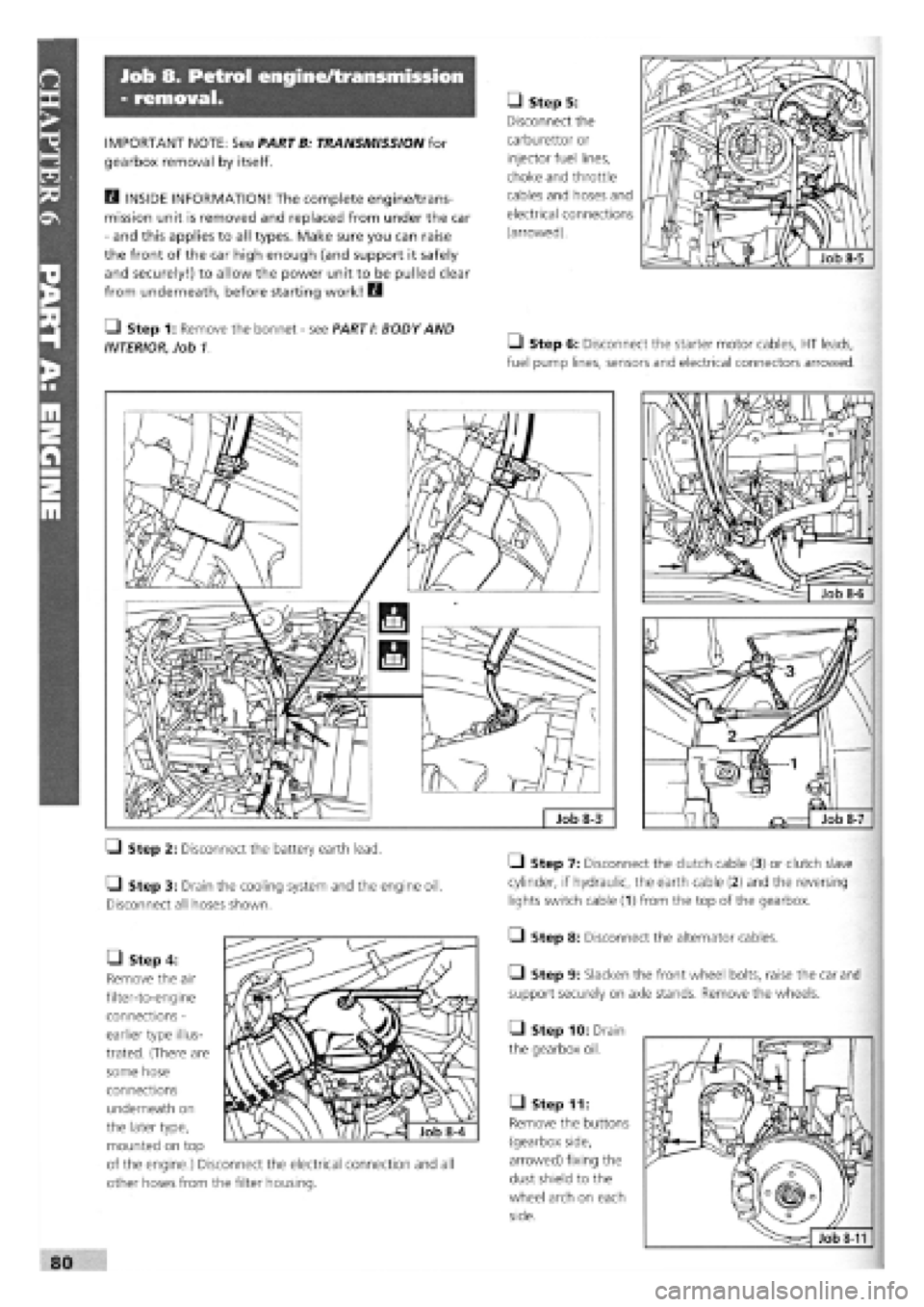
Job 8. Petrol engine/transmission
- removal.
IMPORTANT NOTE: See PARTB: TRANSMISSION for
gearbox removal by itself.
H INSIDE INFORMATION! The complete engine/trans-
mission unit is removed and replaced from under the car
- and this applies to all types. Make sure you can raise
the front of the car high enough (and support it safely
and securely!) to allow the power unit to be pulled clear
from underneath, before starting work! 13
• Step 1: Remove the bonnet
-
see PARTI: BODY AND
INTERIOR, Job 1.
• Step 5:
Disconnect the
carburettor or
injector fuel lines,
choke and throttle
cables and hoses and
electrical connections
(arrowed).
Q Step 6: Disconnect the starter motor cables, HT leads,
fuel pump lines, sensors and electrical connectors arrowed.
Job
8-7
• Step 2: Disconnect the battery earth lead.
• Step 3: Drain the cooling system and the engine oil.
Disconnect all hoses shown.
• Step 7: Disconnect the clutch cable (3) or clutch slave
cylinder, if hydraulic, the earth cable (2) and the reversing
lights switch cable
(1)
from the top of the gearbox.
• Step 8: Disconnect the alternator cables.
Q Step 9: Slacken the front wheel bolts, raise the car and
support securely on axle stands. Remove the wheels.
• Step 10: Drain
the gearbox oil.
• Step 4:
Remove the air
filter-to-engine
connections
-
earlier type illus-
trated. (There are
some hose
connections
underneath on
the later type,
mounted on top
of the engine.) Disconnect the electrical connection and all
other hoses from the filter housing.
• Step 11:
Remove the buttons
(gearbox side,
arrowed) fixing the
dust shield to the
wheel arch on each
side.
Page 112 of 171
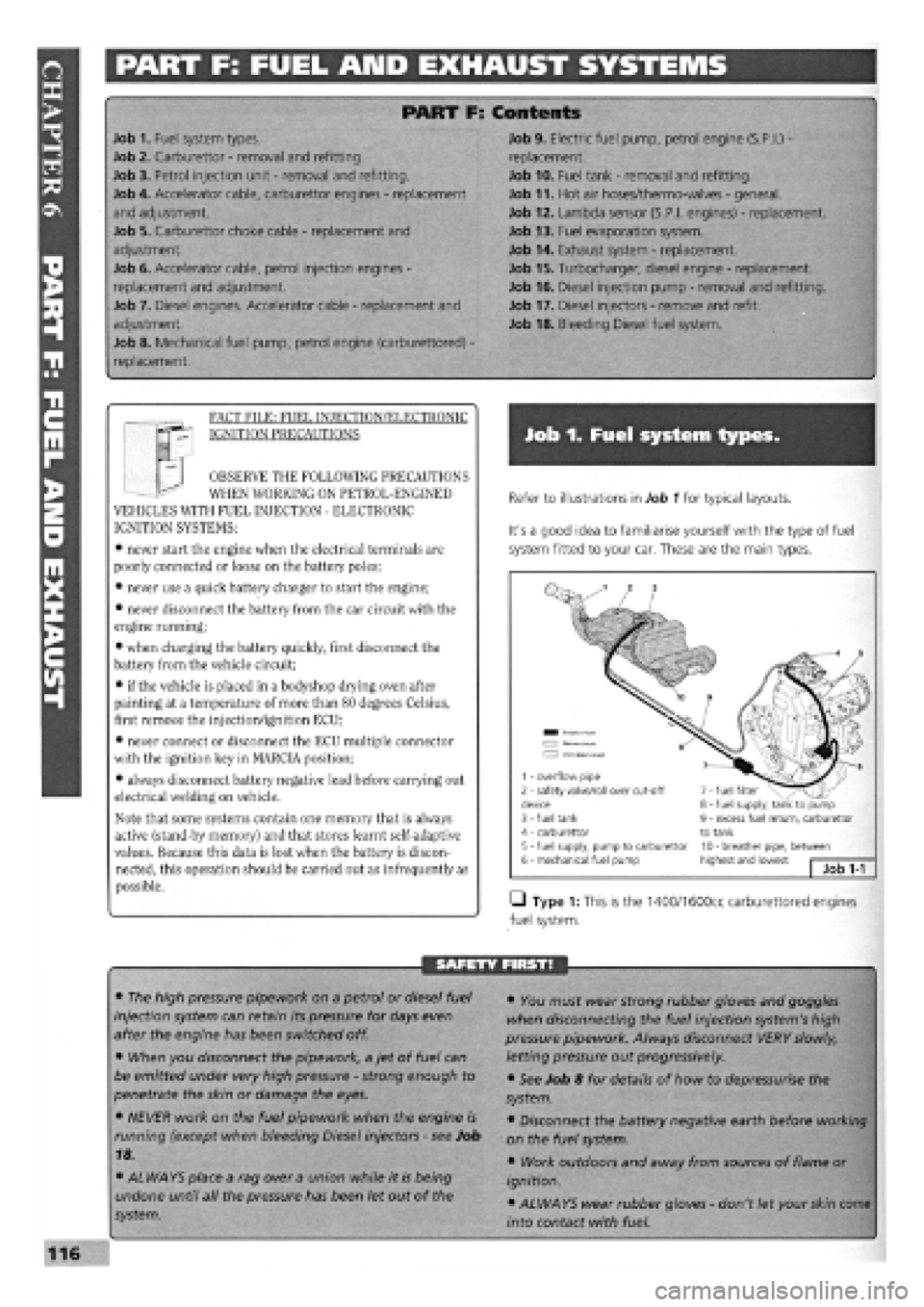
PART F: FUEL AMD EXHAUST SYSTEMS
PART F: Contents
Job 1. Fuel system types. Job 9. Electric fuel pump, petrol engine (S.P.I.)
-
Job 2. Carburettor
-
removal and refitting. replacement.
Job 3. Petrol injection unit
-
removal and refitting. Job 10. Fuel tank
-
removal and refitting.
Job 4. Accelerator cable, carburettor engines
-
replacement Job 11. Hot air hoses/thermo-valves
-
general.
and adjustment. Job 12. Lambda sensor (S.P.I, engines)
-
replacement.
Job 5. Carburettor choke cable
-
replacement and Job 13. Fuel evaporation system.
adjustment. Job 14. Exhaust system
-
replacement.
Job 6. Accelerator cable, petrol injection engines -Job 15. Turbocharger, diesel engine
-
replacement.
replacement and adjustment. Job 16. Diesel injection pump
-
removal and refitting.
Job 7. Diesel engines. Accelerator cable
-
replacement and Job 17. Diesel injectors
-
remove and refit.
adjustment. Job 18. Bleeding Diesel fuel system.
Job 8. Mechanical fuel pump, petrol engine (carburettored) -
replacement.
Job 1. Fuel system types.
FACT FILE: FUEL INJECTION/ELECTRONIC
IGNITION PRECAUTIONS
OBSERVE THE FOLLOWING PRECAUTIONS
WHEN WORKING ON PETROL-ENGINED
VEHICLES WITH FUEL INJECTION - ELECTRONIC
IGNITION SYSTEMS:
• never start the engine when the electrical terminals are
poorly connected or loose on the battery poles;
• never use a quick battery charger to start the engine;
• never disconnect the battery from the car circuit with the
engine running;
• when charging the battery quickly, first disconnect the
battery from the vehicle circuit;
• if the vehicle is placed in a bodyshop drying oven after
painting at a temperature of more than 80 degrees Celsius,
first remove the injection/ignition ECU;
• never connect or disconnect the ECU multiple connector
with the ignition key in MARCIA position;
• always disconnect battery negative lead before carrying out
electrical welding on vehicle.
Note that some systems contain one memory that is always
active (stand-by memory) and that stores learnt self-adaptive
values. Because this data is lost when the battery is discon-
nected, this operation should be carried out as infrequently as
possible.
Refer to illustrations in Job 1 for typical layouts.
It's a good idea to familiarise yourself with the type of fuel
system fitted to your car. These are the main types.
• Type 1: This is the 1400/1600cc carburettored engines
fuel system.
SAFETY FIRST!
• The high pressure pipework on a petrol or diesel fuel
injection system can retain its pressure for days even
after the engine has been switched off.
• When you disconnect the pipework, a jet of fuel can
be emitted under very high pressure
-
strong enough to
penetrate the skin or damage the eyes.
• NEVER work on the fuel pipework when the engine is
running (except when bleeding Diesel injectors
-
see Job
18.
• ALWAYS place a rag over a union while it is being
undone until all the pressure has been let out of the
system.
• You must wear strong rubber gloves and goggles
when disconnecting the fuel injection system's high
pressure pipework. Always disconnect VERY slowly,
letting pressure out progressively.
• See Job 8 for details of how to depressurise the
system.
• Disconnect the battery negative earth before working
on the fuel system.
• Work outdoors and away from sources of flame or
ignition.
• ALWAYS wear rubber gloves
-
don't let your skin come
into contact with fuel.
1 - overflow pipe 2 - safety valve/roll over cut-off device 3 - fuel tank 4 - carburettor 5 - fuel supply, pump to carburettor 6 - mechanical fuel pump
7 - fuel filter 8 - fuel supply, tank to pump 9 - excess fuel return, carburettor to tank 10 - breather pipe, between highest and lowest Job
1-1
Page 113 of 171
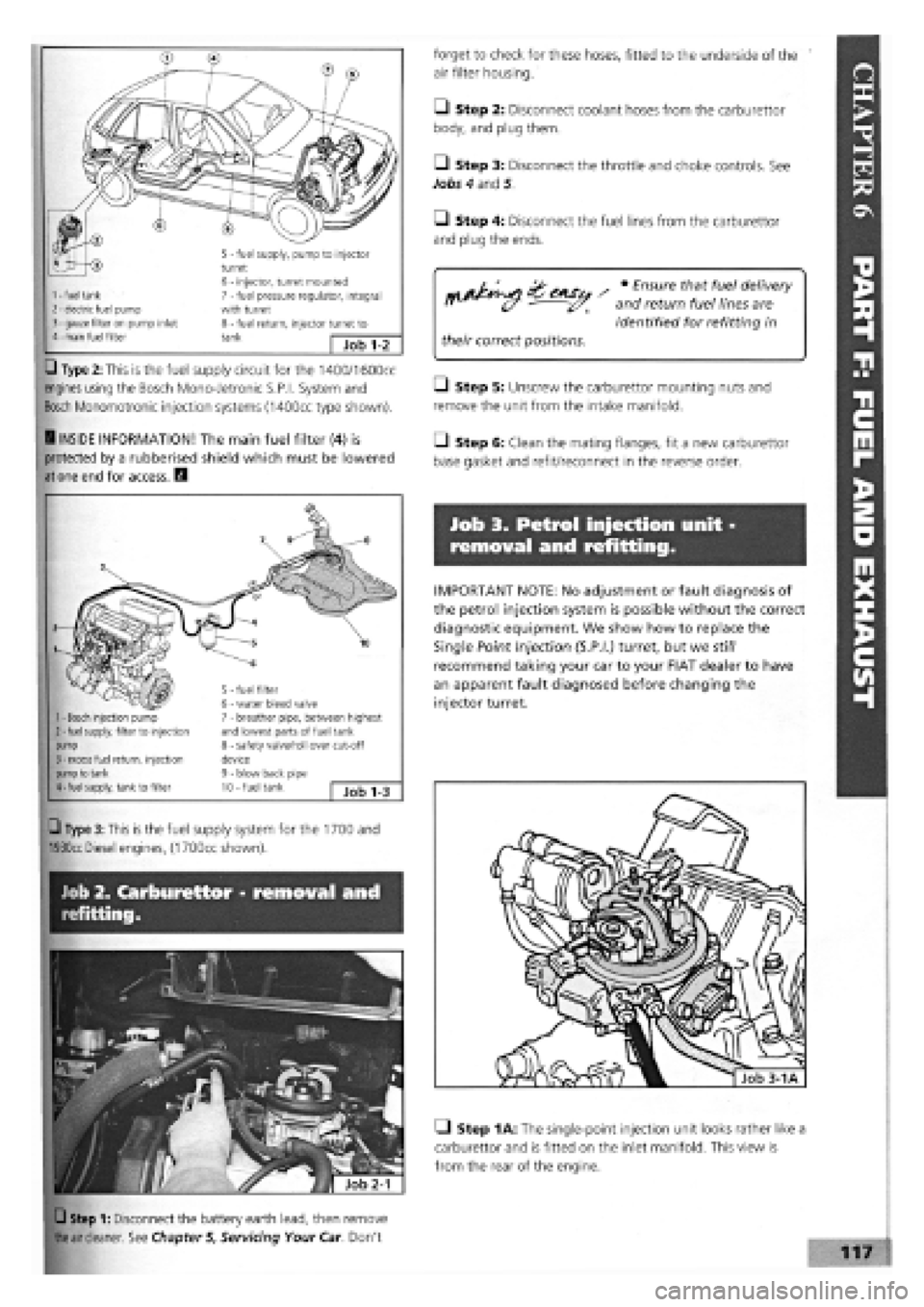
• Type 2: This is the fuel supply circuit for the 1400/1600cc
engines using the Bosch Mono-Jetronic S.P.I. System and
Bosch Monomotronic injection systems (1400cc type shown).
5 - fuel supply, pump to injector turret 6 - injector, turret mounted 7 - fuel pressure regulator, integral with turret 8 - fuel return, injector turret to tank — Job 1-2
1
-
fuel tank 2
-
electric fuel pump 3
-
gauze filter on pump inlet 4
-
main fuel filter
H INSIDE INFORMATION! The main fuel filter (4) is
protected by a rubberised shield which must be lowered
at one end for access. H
5 - fuel filter 6 - water bleed valve 7 - breather pipe, between highest and lowest parts of fuel tank 8 - safety valve/roll over cut-off device 9 - blow back pipe 10 - fuel tank Job 1-3
1
-
Bosch injection pump 2
-
fuel supply, filter to injection pump 3
-
excess fuel return, injection pump to tank 4
-
fuel supply, tank to filter
forget to check for these hoses, fitted to the underside of the
air filter housing.
• Step 2: Disconnect coolant hoses from the carburettor
body, and plug them.
Q Step 3: Disconnect the throttle and choke controls. See
Jobs 4 and 5.
Q Step 4: Disconnect the fuel lines from the carburettor
and plug the ends.
/ • E"sure thf ™ delivery
" (/ and return fuel lines are
identified for refitting in
their correct positions.
• Step 5: Unscrew the carburettor mounting nuts and
remove the unit from the intake manifold.
LI Step 6: Clean the mating flanges, fit a new carburettor
base gasket and refit/reconnect in the reverse order.
Job 3. Petrol injection unit -
removal and refitting.
IMPORTANT NOTE: No adjustment or fault diagnosis of
the petrol injection system is possible without the correct
diagnostic equipment. We show how to replace the
Single Point Injection (S.P.I.) turret, but we still
recommend taking your car to your FIAT dealer to have
an apparent fault diagnosed before changing the
injector turret.
Job 2. Carburettor - removal and
refitting.
Q Type 3: This is the fuel supply system for the 1700 and
1930cc
Diesel engines, (1700cc shown).
Q Step 1: Disconnect the battery earth lead, then remove
the air cleaner.
See Chapter 5, Servicing Your Car. Don't
Q Step 1A: The single-point injection unit looks rather like a
carburettor and is fitted on the inlet manifold. This view is
from the rear of the engine.
Page 114 of 171
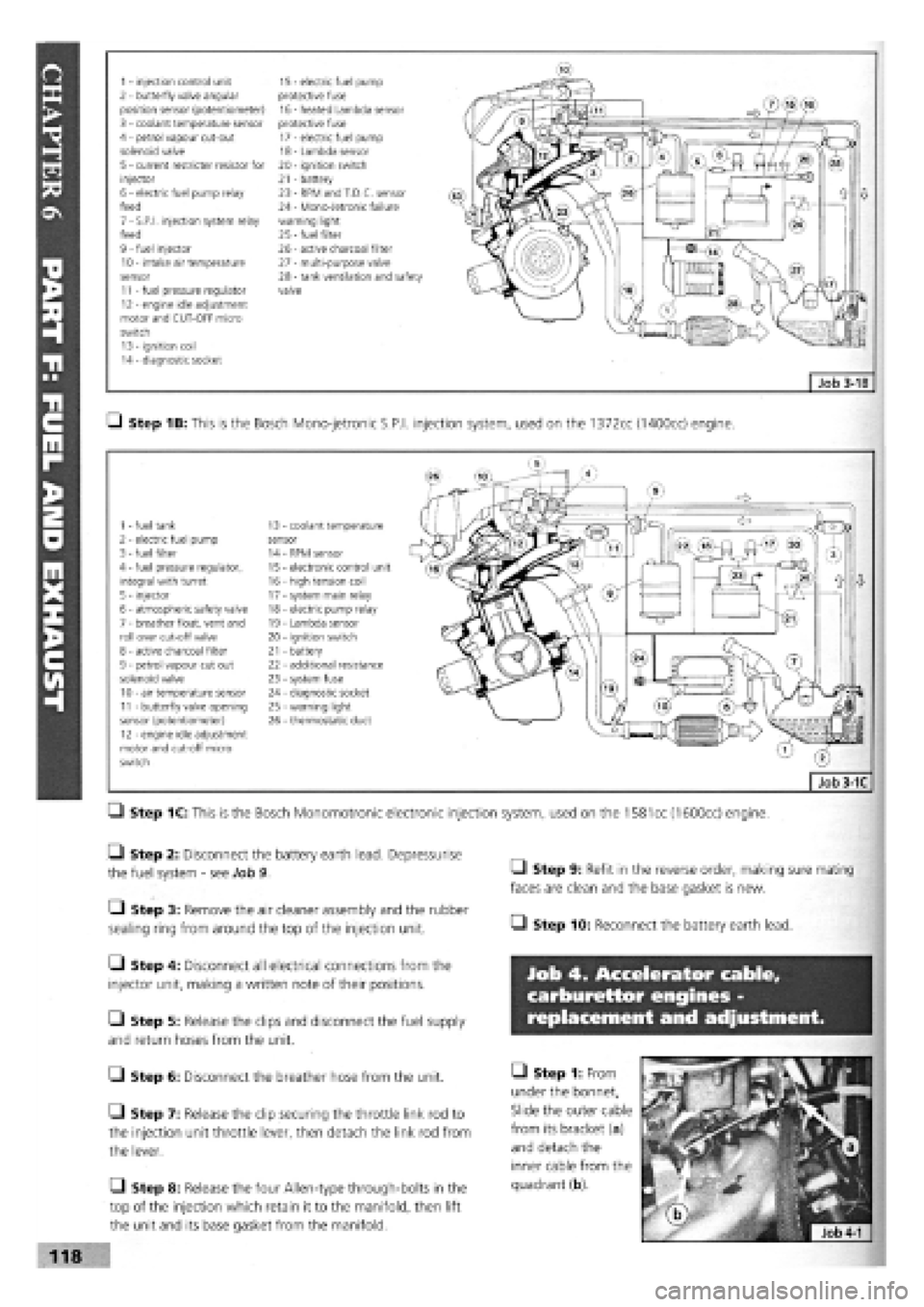
1 - injection control unit 15 - electric fuel pump 2 - butterfly valve angular protective fuse position sensor (potentiometer) 16 - heated Lambda sensor 3 - coolant temperature sensor protective fuse 4 - petrol vapour cut-out 17 - electric fuel pump solenoid valve 18 - Lambda sensor 5 - current restricter resistor for 20 - ignition switch injector 21 - battery 6 - electric fuel pump relay 23 - RPM and T.D.C. sensor feed 24 - Mono-Jetronic failure 7 - S.P.I, injection system relay warning light feed 25
-
fuel filter 9 - fuel injector 26 - active charcoal filter 10 - intake air temperature 27 - multi-purpose valve sensor 28 - tank ventilation and safety 11 - fuel pressure regulator valve 12 - engine idle adjustment motor and CUT-OFF micro switch 13 - ignition coil 14 - diagnostic socket
Q Step 1B: This is the Bosch Mono-jetronic S.P.I, injection system, used on the 1372cc (1400cc) engine.
1 - fuel tank 13 coolant temperature 2 - electric fuel pump sensor 3 - fuel filter 14 RPM sensor 4 - fuel pressure regulator, 15 electronic control unit integral with turret 16 - high tension coil 5 - injector 17 - system main relay 6 - atmospheric safety valve 18 - electric pump relay 7 - breather float, vent and 19 - Lambda sensor roll over cut-off valve 20 - ignition switch 8 - active charcoal filter 21 - battery 9 - petrol vapour cut out 22 - additional resistance solenoid valve 23 - system fuse 10 - air temperature sensor 24 - diagnostic socket 11 - butterfly valve opening 25 - warning light sensor (potentiometer) 26 - thermostatic duct 12 - engine idle adjustment motor and cut-off micro switch
Q Step 1C: This is the Bosch Monomotronic electronic injection system, used on the
1581
cc (1600cc) engine.
• Step 2: Disconnect the battery earth lead. Depressurise
the fuel system
-
see Job 9.
• Step 3: Remove the air cleaner assembly and the rubber
sealing ring from around the top of the injection unit.
Q Step 4: Disconnect all electrical connections from the
injector unit, making a written note of their positions.
Q Step 5: Release the clips and disconnect the fuel supply
and return hoses from the unit.
G Step 6: Disconnect the breather hose from the unit.
• Step 7: Release the clip securing the throttle link rod to
the injection unit throttle lever, then detach the link rod from
the lever.
Q Step 8: Release the four Allen-type through-bolts in the
top of the injection which retain it to the manifold, then lift
the unit and its base gasket from the manifold.
• Step 9: Refit in the reverse order, making sure mating
faces are clean and the base gasket is new.
• Step 10: Reconnect the battery earth lead.
Job 4. Accelerator cable,
carburettor engines -
replacement and adjustment.
• Step 1: From
under the bonnet,
Slide the outer cable
from its bracket (a)
and detach the
inner cable from the
quadrant (b).
118
Page 117 of 171
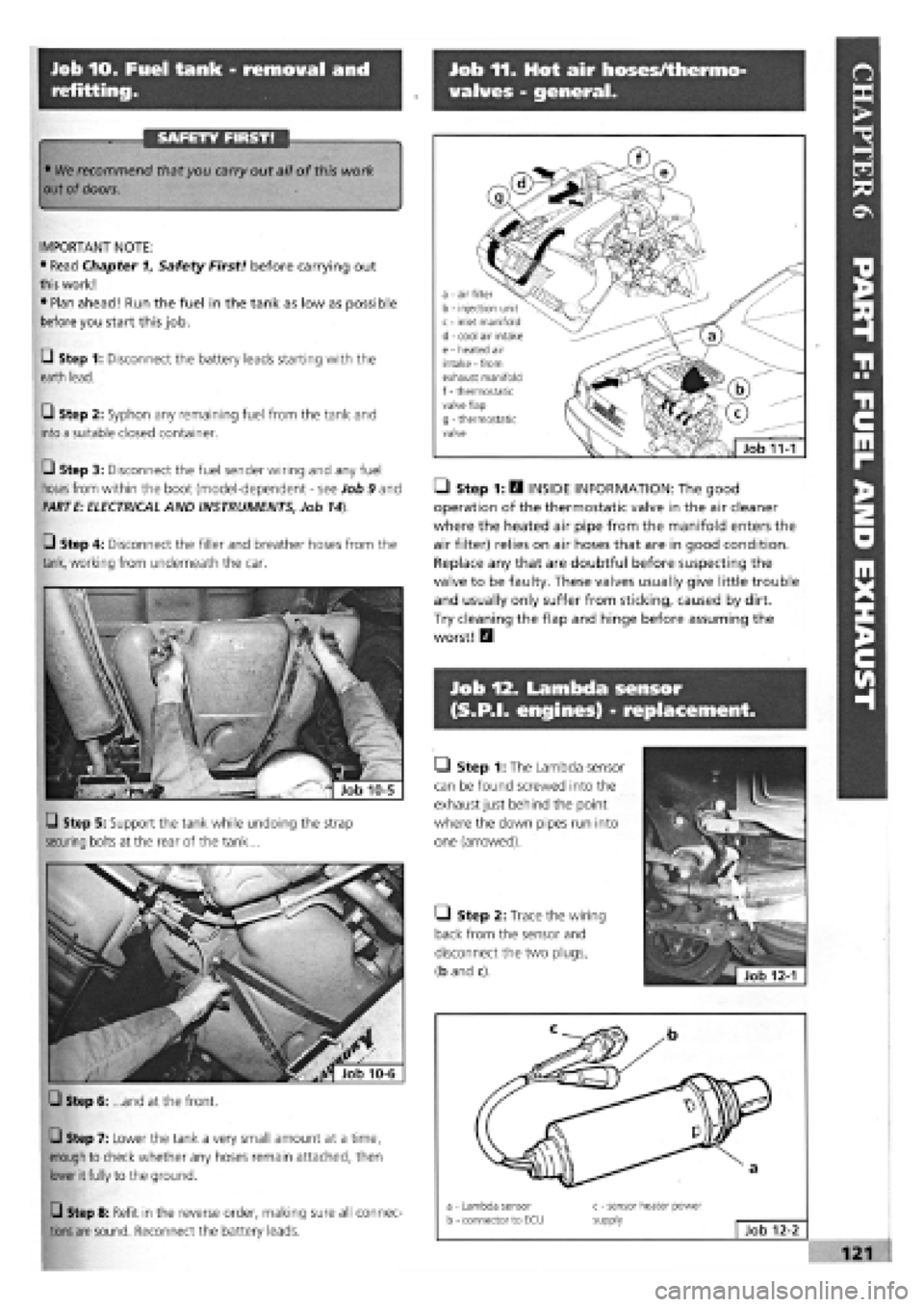
Job 10. Fuel tank - removal and
refitting.
Job 11. Hot air hoses/thermo-
valves - general.
SAFETY FIRST!
Job 12. Lambda sensor
(S.P.I, engines) - replacement.
• We recommend that you carry out all of this work
out of
doors.
I
IMPORTANT NOTE:
• Read Chapter 1, Safety First! before carrying out
this
work!
• Plan ahead! Run the fuel in the tank as low as possible
before you start this job.
Q Step 1: Disconnect the battery leads starting with the
earth lead.
• Step 2: Syphon any remaining fuel from the tank and
into a suitable closed container.
Q Step 3: Disconnect the fuel sender wiring and any fuel
hoses
from within the boot (model-dependent
-
see Job 9 and
PARTE: ELECTRICAL AND INSTRUMENTS, Job 14).
• Step 4: Disconnect the filler and breather hoses from the
tank,
working from underneath the car.
a - Lambda sensor b - connector to ECU c - sensor heater power supply Job 12-2
Q Step 5: Support the tank while undoing the strap
securing bolts at the rear of the tank...
Q Step 6: ...and at the front.
Q Step 7: Lower the tank a very small amount at a time,
enough to check whether any hoses remain attached, then
lower it fully to the ground.
Q Step 8: Refit in the reverse order, making sure all connec-
tions are
sound. Reconnect the battery leads.
• Step 1: H INSIDE INFORMATION: The good
operation of the thermostatic valve in the air cleaner
where the heated air pipe from the manifold enters the
air filter) relies on air hoses that are in good condition.
Replace any that are doubtful before suspecting the
valve to be faulty. These valves usually give little trouble
and usually only suffer from sticking, caused by dirt.
Try cleaning the flap and hinge before assuming the
worst! Q
• Step 1: The Lambda sensor
can be found screwed into the
exhaust just behind the point
where the down pipes run into
one (arrowed).
Q Step 2: Trace the wiring
back from the sensor and
disconnect the two plugs,
(b and c).
a - air filter b - injection unit c - inlet manifold d - cool air intake e - heated air intake - from exhaust manifold f
-
thermostatic valve flap g - thermostatic valve
Job 11-1
Page 118 of 171
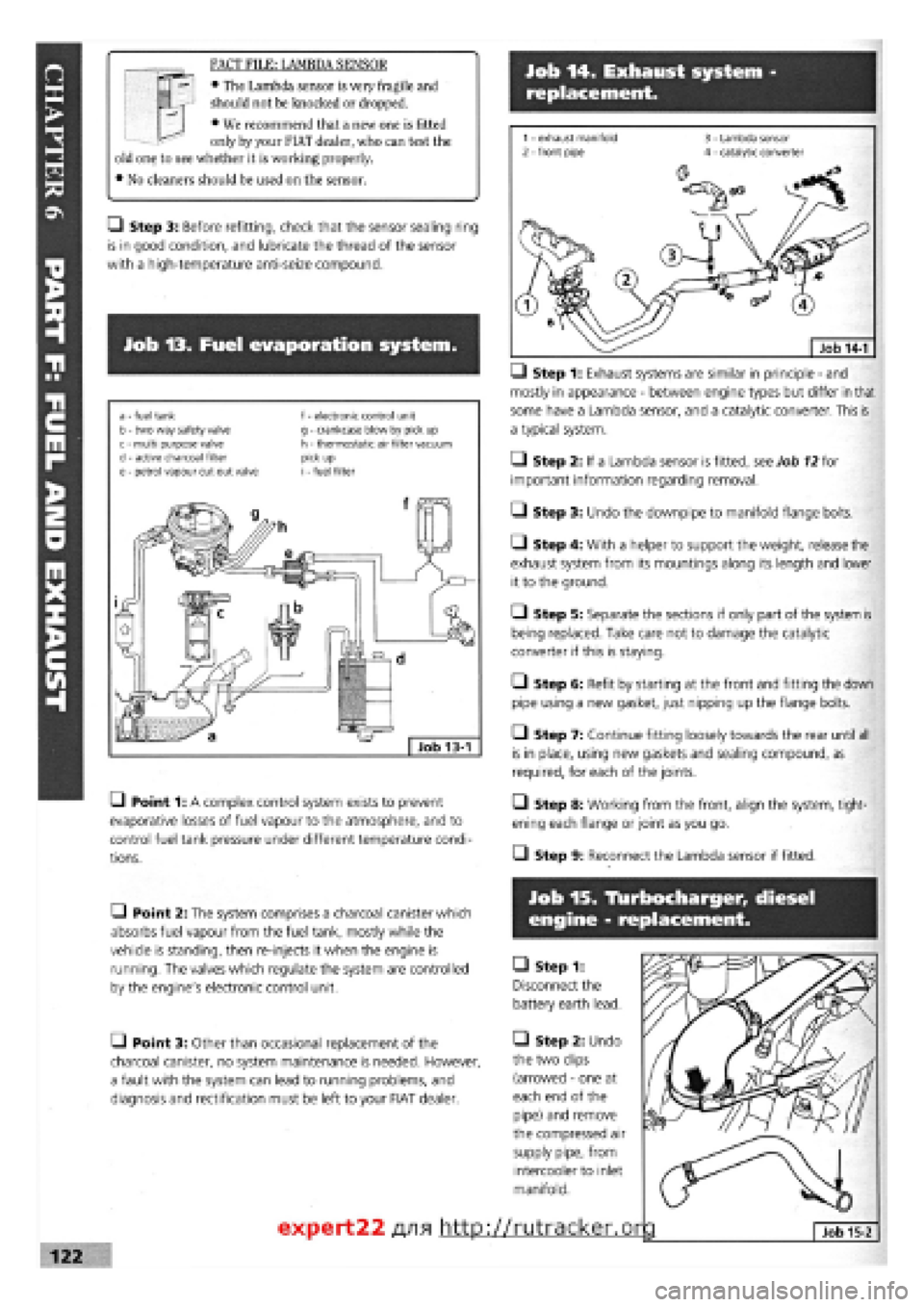
Job 14. Exhaust system -
replacement.
FACT FILE: LAMBDA SENSOR
• The Lambda sensor is very fragile and
should not be knocked or dropped.
• We recommend that a new one is fitted
only by your FIAT dealer, who can test the
old one to see whether it is working properly.
• No cleaners should be used on the sensor.
Q Step 3: Before refitting, check that the sensor sealing ring
is in good condition, and lubricate the thread of the sensor
with a high-temperature anti-seize compound.
Job 13. Fuel evaporation system.
a - fuel tank b - two way safety valve c - multi purpose valve d
-
active charcoal filter e - petrol vapour cut out valve
f - electronic control unit g - crankcase blow by pick up h - thermostatic air filter vacuum pick up i - fuel filter
• Point 1: A complex control system exists to prevent
evaporative losses of fuel vapour to the atmosphere, and to
control fuel tank pressure under different temperature condi-
tions.
—) Step 1: Exhaust systems are similar in principle
-
and
mostly in appearance
-
between engine types but differ in that
some have a Lambda sensor, and a catalytic converter. This is
a typical system.
• Step 2: If a Lambda sensor is fitted, see Job
12
for
important information regarding removal.
• Step 3: Undo the downpipe to manifold flange bolts.
• Step 4: With a helper to support the weight, release the
exhaust system from its mountings along its length and lower
it to the ground.
O Step 5: Separate the sections if only part of the system is
being replaced. Take care not to damage the catalytic
converter if this is staying.
• Step 6: Refit by starting at the front and fitting the down
pipe using a new gasket, just nipping up the flange bolts.
• Step 7: Continue fitting loosely towards the rear until all
is in place, using new gaskets and sealing compound, as
required, for each of the joints.
• Step 8: Working from the front, align the system, tight-
ening each flange or joint as you go.
• Step 9: Reconnect the Lambda sensor if fitted.
• Point 2: The system comprises a charcoal canister which
absorbs fuel vapour from the fuel tank, mostly while the
vehicle is standing, then re-injects it when the engine is
running. The valves which regulate the system are controlled
by the engine's electronic control unit.
• Point 3: Other than occasional replacement of the
charcoal canister, no system maintenance is needed. However,
a fault with the system can lead to running problems, and
diagnosis and rectification must be left to your FIAT dealer.
Job 15. Tlurbocharger, diesel
engine - replacement.
• Step 1:
Disconnect the
battery earth lead.
• Step 2: Undo
the two clips
(arrowed
-
one at
each end of the
pipe) and remove
the compressed air
supply pipe, from
intercooler to inlet
manifold.
expert22 fl/i* http://rutracker.or