dashboard FIAT TEMPRA 1988 Service And Repair Manual
[x] Cancel search | Manufacturer: FIAT, Model Year: 1988, Model line: TEMPRA, Model: FIAT TEMPRA 1988Pages: 171, PDF Size: 18.05 MB
Page 7 of 171
Fluid levels (if included) are monitored by LEDs f, o and
p, indicating the levels of the fluid reservoirs.
A red LED illuminates at the position on the check panel
corresponding to a side door or a hatchback/tailgate
that is not properly closed.
SIDE AND TAIL LIGHTS
When the side and tail lights are turned on, the check
panel monitors the light bulbs, fuses and circuits.
• LED g monitors the front side lights.
• LED i monitors the tail lights.
If one of the two fuses protecting the following bulbs
blows, LEDs g, i, and m illuminate.
NUMBER PLATE LIGHTS
• LED m indicates when one or both of the number
plate light bulbs have burnt out.
REAR FOG LIGHTS
• When the fog-guard lights are turned on, LED h
monitors the light bulbs.
• When the fuse blows or a circuit malfunction occurs,
LED h illuminates, but not the panel indicator.
STOP LIGHTS
If one or both stop lights burn out, the fuse blows or a
circuit malfunction occurs, LED I or n illuminates when
braking.
• LED n monitors the left stop light.
• LED I monitors the right stop light.
If both bulbs burn out at the same time or brake pedal
switch malfunction occurs, both LEDs I and n
illuminate.
ENGINE OIL LEVEL
• LED f illuminates when the engine oil level is low (key
at MAR,engine not running).
The oil level monitoring system does not operate when
the engine is running. If the oil level warning LED
illuminates when driving, a circuit sensor malfunction
has occurred.
When starting the car on a hill or within 10 minutes of
switching off the engine the warning light may
illuminate (event will be stored in system memory). Start
the engine again on level ground to ensure the oil level
is sufficient.
COOLANT
A low coolant level is indicated by LED o (key at MAR).
The LED also illuminates when a sensor or circuit
malfunction occurs.
WINDSCREEN AND REAR SCREEN WASH LEVELS
• LED p illuminates (key at MAR) when the level in the
windscreen or rear screen wash reservoirs are low.
• The LED also indicates when a circuit or sensor
malfunction occurs.
• 5. HE ATI IMG AMD VENTILATION
CONTROLS
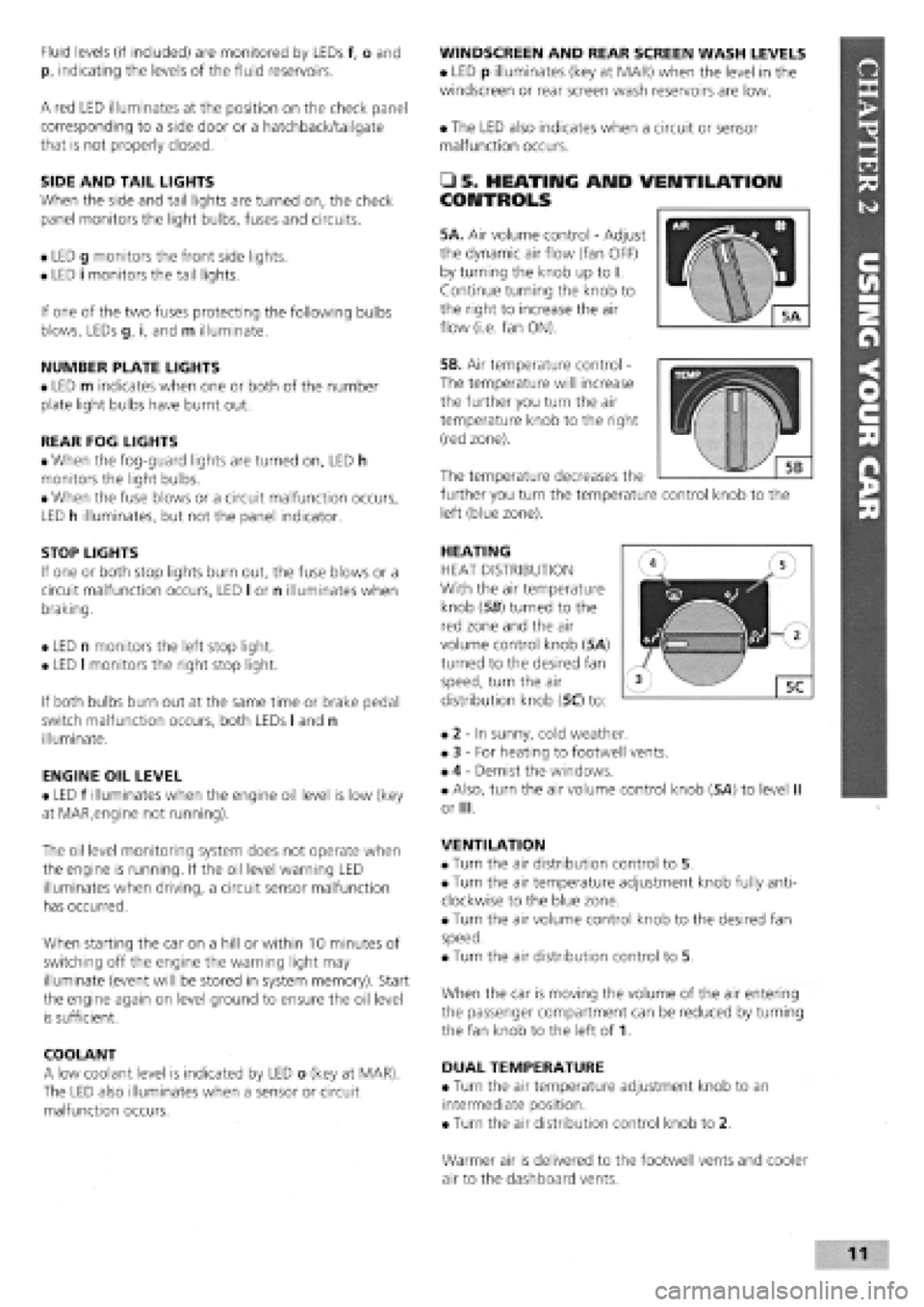
5A. Air volume control
-
Adjust
the dynamic air flow (fan OFF)
by turning the knob up to I.
Continue turning the knob to
the right to increase the air
flow (i.e. fan ON).
5B. Air temperature control -
The temperature will increase
the further you turn the air
temperature knob to the right
(red zone).
HEATING
HEAT DISTRIBUTION
With the air temperature
knob (56) turned to the
red zone and the air
volume control knob (5A)
turned to the desired fan
speed, turn the air
distribution knob (5C) to:
• 2
-
In sunny, cold weather.
• 3
-
For heating to footwell vents.
• 4
-
Demist the windows.
• Also, turn the air volume control knob (5A) to level II
or III.
VENTILATION
• Turn the air distribution control to 5.
• Turn the air temperature adjustment knob fully anti-
clockwise to the blue zone.
• Turn the air volume control knob to the desired fan
speed.
• Turn the air distribution control to 5.
When the car is moving the volume of the air entering
the passenger compartment can be reduced by turning
the fan knob to the left of 1.
DUAL TEMPERATURE
• Turn the air temperature adjustment knob to an
intermediate position.
• Turn the air distribution control knob to 2.
The temperature decreases the
further you turn the temperature control knob to the
left (blue zone).
Warmer air is delivered to the footwell vents and cooler
air to the dashboard vents.
Page 22 of 171
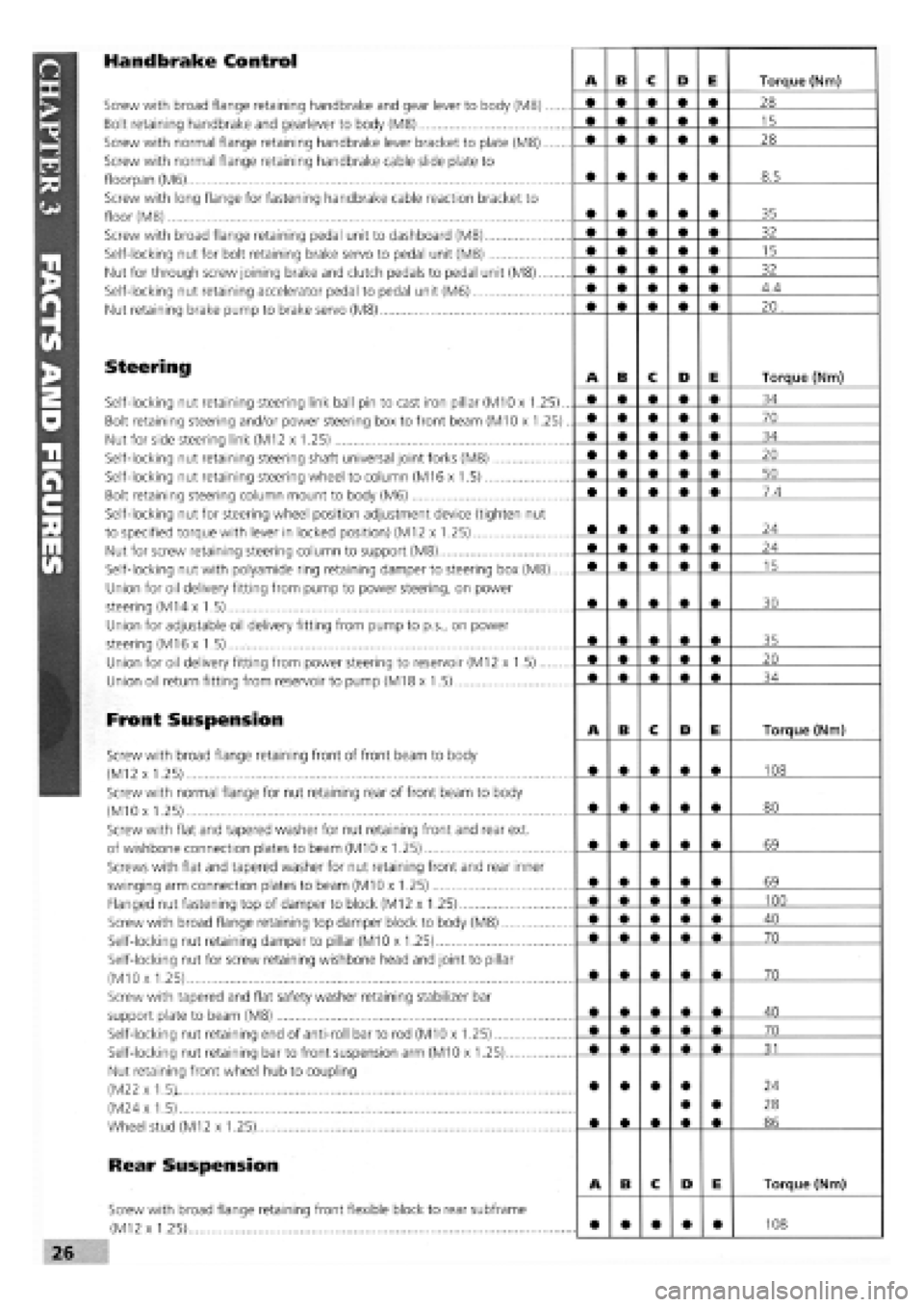
Handbrake Control
Screw with broad flange retaining handbrake and gear lever to body (M8)
Bolt retaining handbrake and gearlever to body (M8)
Screw with normal flange retaining handbrake lever bracket to plate (M8)
Screw with normal flange retaining handbrake cable slide plate to
floorpan (M6)
Screw with long flange for fastening handbrake cable reaction bracket to
floor (M8)
Screw with broad flange retaining pedal unit to dashboard (M8)
Self-locking nut for bolt retaining brake servo to pedal unit (M8)
Nut for through screw joining brake and clutch pedals to pedal unit (M8).
Self-locking nut retaining accelerator pedal to pedal unit (M6)
Nut retaining brake pump to brake servo (M8)
Steering
Self-locking nut retaining steering link ball pin to cast iron pillar (M10 x 1.25)..
Bolt retaining steering and/or power steering box to front beam (M10 x 1.25).
Nut for side steering link (M12 x 1.25)
Self-locking nut retaining steering shaft universal joint forks (M8)
Self-locking nut retaining steering wheel to column (M16 x 1.5)
Bolt retaining steering column mount to body (M6)
Self-locking nut for steering wheel position adjustment device (tighten nut
to specified torque with lever in locked position) (M12 x 1.25)
Nut for screw retaining steering column to support (M8)
Self-locking nut with polyamide ring retaining damper to steering box (M8)
Union for oil delivery fitting from pump to power steering, on power
steering (M14 x 1.5)
Union for adjustable oil delivery fitting from pump to p.s., on power
steering (M16 x 1.5)
Union for oil delivery fitting from power steering to reservoir (M12 x 1.5)
Union oil return fitting from reservoir to pump (M18 x 1.5)
Front Suspension
Screw with broad flange retaining front of front beam to body
(M12 x 1.25)
Screw with normal flange for nut retaining rear of front beam to body
(M10
x
1.25)
Screw with flat and tapered washer for nut retaining front and rear ext.
of wishbone connection plates to beam (M10 x 1.25)
Screws with flat and tapered washer for nut retaining front and rear inner
swinging arm connection plates to beam (M10 x 1.25)
Flanged nut fastening top of damper to block (M12 x 1.25)
Screw with broad flange retaining top damper block to body (M8)
Self-locking nut retaining damper to pillar (M10 x 1.25)
Self-locking nut for screw retaining wishbone head and joint to pillar
(M10
x
1.25)
Screw with tapered and flat safety washer retaining stabilizer bar
support plate to beam (M8)
Self-locking nut retaining end of anti-roll bar to rod (M10 x 1.25)
Self-locking nut retaining bar to front suspension arm (M10 x 1.25)
Nut retaining front wheel hub to coupling
(M22 x 1.5)i
(M24
x
1.5)
Wheel stud (M12 x 1.25).....
Rear Suspension
Screw with broad flange retaining front flexible block to rear subframe
(M12 x 1.25)
A B C D E Torque (Nm)
• • • • • 28
• • • • • 15
• • • • • 28
8.5
35
32
15
32
4.4
20 .
A B C D E Torque (Nm)
• • • • • 34
70
34
• • • • • 20
50
7.4
24
24
15
30
35
20
34
A B c D E Torque (Nm)
108
80
69
69
100
40
70
70
40
70
31
• • • • • •
24
28
86
A B c D E Torque (Nm)
108
Page 36 of 171
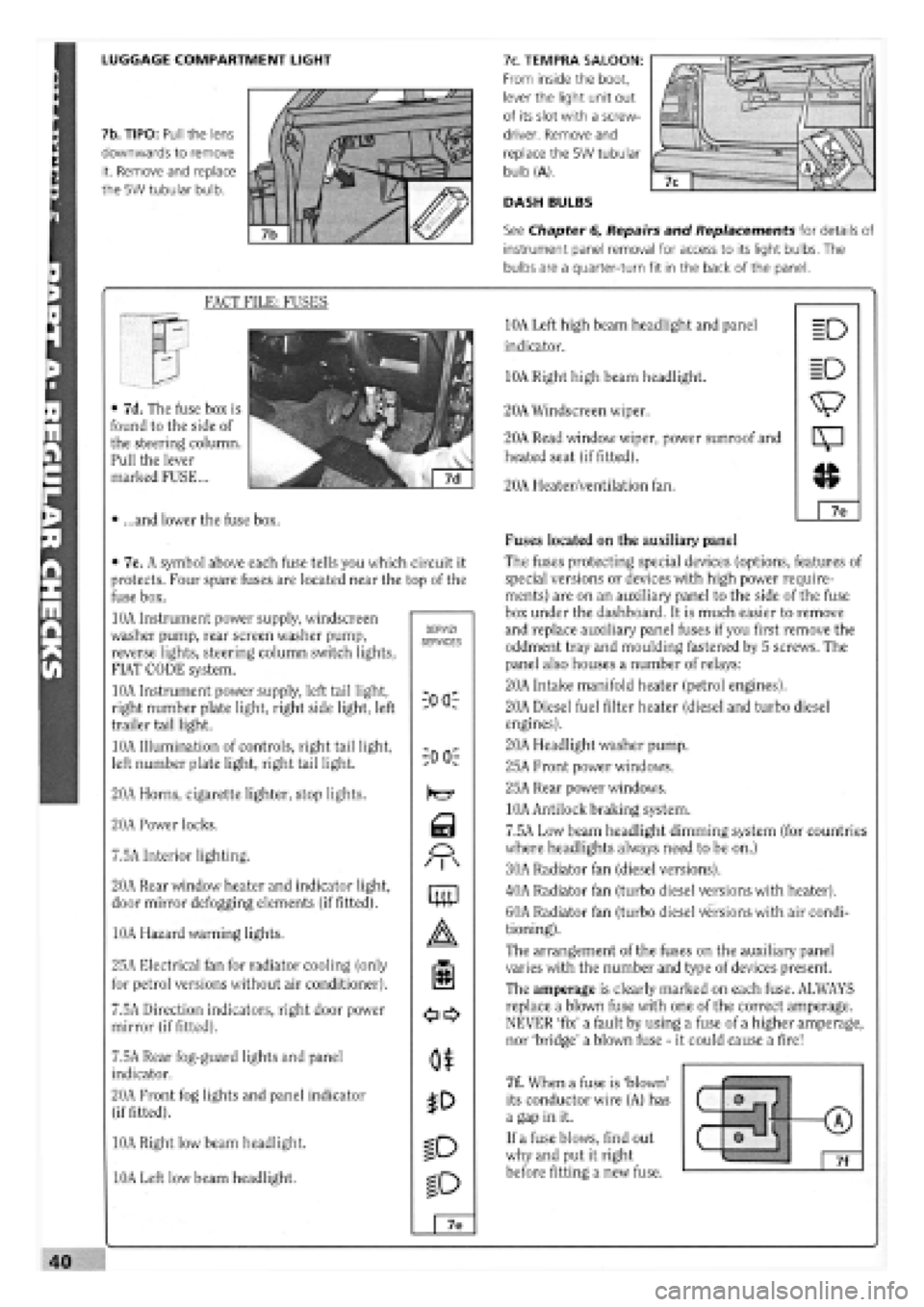
LUGGAGE COMPARTMENT LIGHT
7b. TIPO: Pull the lens
downwards to remove
it. Remove and replace
the 5W tubular bulb.
7c. TEMPRA SALOON:
From inside the boot,
lever the light unit out
of its slot with a screw-
driver. Remove and
replace the 5W tubular
bulb (A).
DASH BULBS
See Chapter 6, Repairs and Replacements for details of
instrument panel removal for access to its light bulbs. The
bulbs are a quarter-turn fit in the back of the panel.
FACT FILE: FUSES
• 7d. The fuse box is
found to the side of
the steering column.
Pull the lever
marked FUSE...
• ...and lower the fuse box.
• 7e. A symbol above each fuse tells you which circuit it
protects. Four spare fuses are located near the top of the
fuse box.
10A Instrument power supply, windscreen
washer pump, rear screen washer pump,
reverse lights, steering column switch lights,
FIAT CODE system.
10A Instrument power supply, left tail light,
right number plate light, right side light, left
trailer tail light.
10A Illumination of controls, right tail light,
left number plate light, right tail light.
20A Horns, cigarette lighter, stop lights.
20A Power locks.
7.5A Interior lighting.
20A Rear window heater and indicator light,
door mirror defogging elements (if fitted).
10A Hazard warning lights.
25A Electrical fan for radiator cooling (only
for petrol versions without air conditioner).
7.5A Direction indicators, right door power
mirror (if fitted).
7.5A Rear fog-guard lights and panel
indicator.
20A Front fog lights and panel indicator
(if fitted).
10A Right low beam headlight.
10A Left low beam headlight.
SERVIZI SERVICES
iOO:
-00 r
Q
M
mp
o$
ID
ID
7e
10A Left high beam headlight and panel
indicator.
10A Right high beam headlight.
20A Windscreen wiper.
20A Read window wiper, power sunroof and
heated seat (if fitted).
20A Heater/ventilation fan.
Fuses located on the auxiliary panel
The fuses protecting special devices (options, features of
special versions or devices with high power require-
ments) are on an auxiliary panel to the side of the fuse
box under the dashboard. It is much easier to remove
and replace auxiliary panel fuses if you first remove the
oddment tray and moulding fastened by 5 screws. The
panel also houses a number of relays:
20A Intake manifold heater (petrol engines).
20A Diesel fuel filter heater (diesel and turbo diesel
engines).
20A Headlight washer pump.
25A Front power windows.
25A Rear power windows.
10A Antilock braking system.
7.5A Low beam headlight dimming system (for countries
where headlights always need to be on.)
30A Radiator fan (diesel versions).
40A Radiator fan (turbo diesel versions with heater).
60A Radiator fan (turbo diesel versions with air condi-
tioning).
The arrangement of the fuses on the auxiliary panel
varies with the number and type of devices present.
The amperage is clearly marked on each fuse. ALWAYS
replace a blown fuse with one of the correct amperage.
NEVER 'fix' a fault by using a fuse of a higher amperage,
nor 'bridge' a blown fuse
-
it could cause a fire!
7f. When a fuse is 'blown'
its conductor wire (A) has
a gap in it.
If a fuse blows, find out
why and put it right
before fitting a new fuse.
(7)
o m f (7) (7)
0 tJ 7f
Page 52 of 171
• Job 39. Check/adjust diesel injection timing.
Although a check of the injection timing is scheduled as a
service item, there is no reason why the timing should have
altered if the pump mounting bolts are tight and the pump
has not been disturbed. Injection timing is best checked
dynamically by a FIAT dealer or diesel specialist using
specialised equipment. If you want to check the timing stati-
cally, and you have access to a dial gauge and the necessary
adaptor to fit it to the pump, proceed as follows:
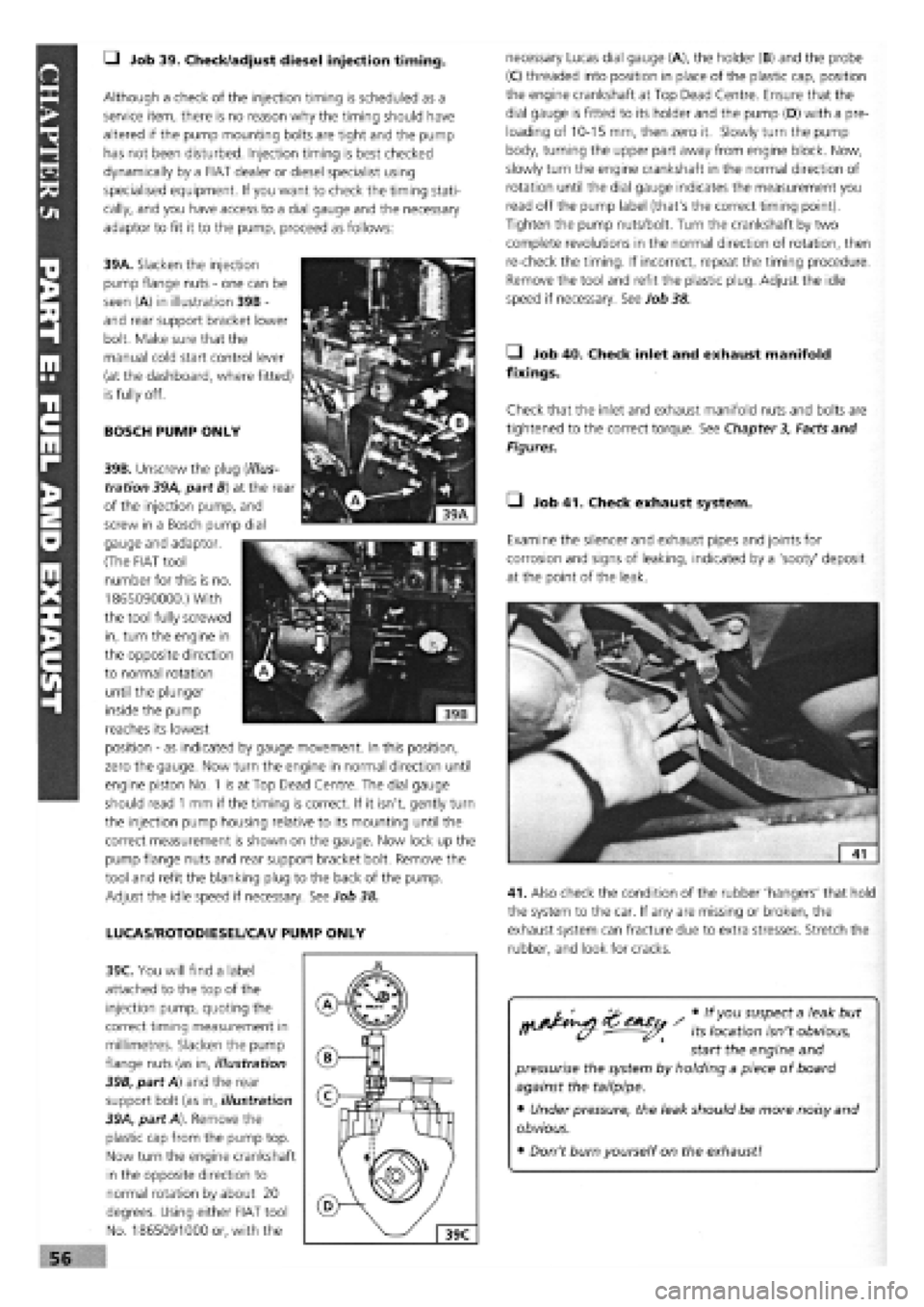
39A. Slacken the injection
pump flange nuts
-
one can be
seen (A) in illustration 39B -
and rear support bracket lower
bolt. Make sure that the
manual cold start control lever
(at the dashboard, where fitted)
is fully off.
BOSCH PUMP ONLY
necessary Lucas dial gauge (A), the holder (B) and the probe
(C) threaded into position in place of the plastic cap, position
the engine crankshaft at Top Dead Centre. Ensure that the
dial gauge is fitted to its holder and the pump (D) with a pre-
loading of 10-15 mm, then zero it. Slowly turn the pump
body, turning the upper part away from engine block. Now,
slowly turn the engine crankshaft in the normal direction of
rotation until the dial gauge indicates the measurement you
read off the pump label (that's the correct timing point).
Tighten the pump nuts/bolt. Turn the crankshaft by two
complete revolutions in the normal direction of rotation, then
re-check the timing. If incorrect, repeat the timing procedure.
Remove the tool and refit the plastic plug. Adjust the idle
speed if necessary. See Job 38.
• Job 40. Check inlet and exhaust manifold
fixings.
Check that the inlet and exhaust manifold nuts and bolts are
tightened to the correct torque. See Chapter
3,
Facts and
Figures.
• Job 41. Check exhaust system.
Examine the silencer and exhaust pipes and joints for
corrosion and signs of leaking, indicated by a 'sooty' deposit
at the point of the leak.
41. Also check the condition of the rubber 'hangers' that hold
the system to the car. If any are missing or broken, the
exhaust system can fracture due to extra stresses. Stretch the
rubber, and look for cracks.
39B. Unscrew the plug (illus-
tration 39A, part B) at the rear
of the injection pump, and
screw in a Bosch pump dial
gauge and adaptor.
(The FIAT tool
number for this is no.
1865090000.) With
the tool fully screwed
in, turn the engine in
the opposite direction
to normal rotation
until the plunger
inside the pump
reaches its lowest
position
-
as indicated by gauge movement. In this position,
zero the gauge. Now turn the engine in normal direction until
engine piston No. 1 is at Top Dead Centre. The dial gauge
should read
1
mm if the timing is correct. If it isn't, gently turn
the injection pump housing relative to its mounting until the
correct measurement is shown on the gauge. Now lock up the
pump flange nuts and rear support bracket bolt. Remove the
tool and refit the blanking plug to the back of the pump.
Adjust the idle speed if necessary. See Job 38.
LUCAS/ROTODIESEL/CAV PUMP ONLY
39C. You will find a label
attached to the top of the
injection pump, quoting the
correct timing measurement in
millimetres. Slacken the pump
flange nuts (as in, illustration
39B, part A) and the rear
support bolt (as in, illustration
39A, part A). Remove the
plastic cap from the pump top.
Now turn the engine crankshaft
in the opposite direction to
normal rotation by about 20
degrees. Using either FIAT tool
No. 1865091000 or, with the
cos / * susPect a but
fl^^^Cf- ^^ its location isn't obvious,
start the engine and
pressurise the system by holding a piece of board
against the tailpipe.
• Under pressure, the leak should be more noisy and
obvious.
• Don't burn yourself on the exhaust!
Page 146 of 171
B INSIDE INFORMATION! As an alternative to steps A1
and A2 you can disconnect all the electrical plugs under
the dashboard, which have wires which go through to
the door. B
LI Step A3: Support the door using a trolley jack with a
wad of rag on its pad for protection.
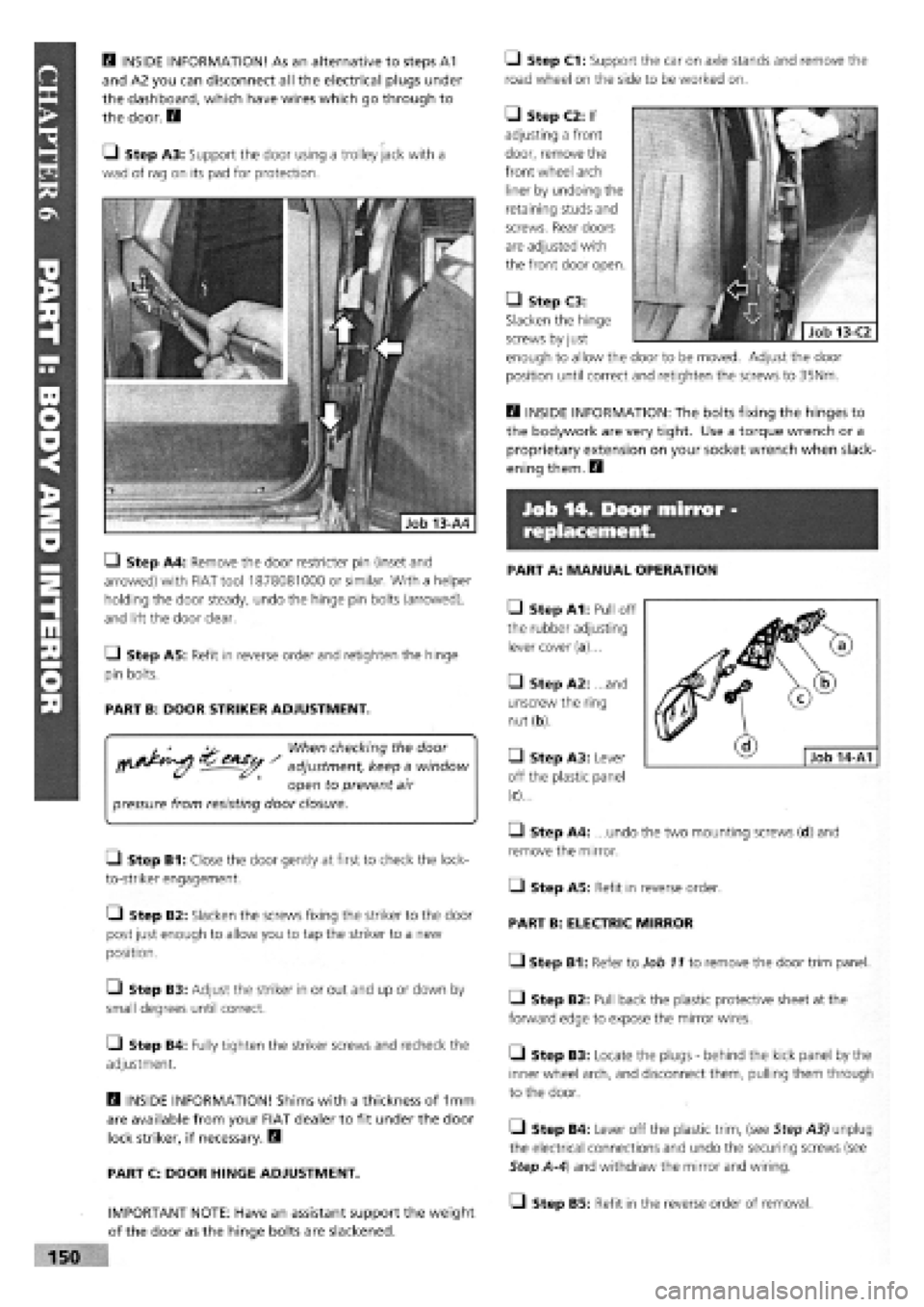
LI Step A4: Remove the door restricter pin (inset and
arrowed) with FIAT tool 1878081000 or similar. With a helper
holding the door steady, undo the hinge pin bolts (arrowed),
and lift the door clear.
• Step A5: Refit in reverse order and retighten the hinge
pin bolts.
PART B: DOOR STRIKER ADJUSTMENT.
, ' -u. When checking the door
jpj^ adjustment, keep a window
open to prevent air
pressure from resisting door closure.
• Step B1: Close the door gently at first to check the lock-
to-striker engagement.
• Step B2: Slacken the screws fixing the striker to the door
post just enough to allow you to tap the striker to a new
position.
L) Step B3: Adjust the striker in or out and up or down by
small degrees until correct.
Q Step B4: Fully tighten the striker screws and recheck the
adjustment.
B INSIDE INFORMATION! Shims with a thickness of 1mm
are available from your FIAT dealer to fit under the door
lock striker, if necessary. B
PART C: DOOR HINGE ADJUSTMENT.
IMPORTANT NOTE: Have an assistant support the weight
of the door as the hinge bolts are slackened.
• Step C1: Support the car on axle stands and remove the
road wheel on the side to be worked on.
• Step C2: If
adjusting a front
door, remove the
front wheel arch
liner by undoing the
retaining studs and
screws. Rear doors
are adjusted with
the front door open.
B INSIDE INFORMATION: The bolts fixing the hinges to
the bodywork are very tight. Use a torque wrench or a
proprietary extension on your socket wrench when slack-
ening them. B
Job 14. Door mirror -
replacement.
PART A: MANUAL OPERATION
• Step A1: Pull off
the rubber adjusting
lever cover (a)...
• Step A2: and
unscrew the ring
nut (b).
• Step A3: Lever
off the plastic panel
(c)...
• Step A4: ...undo the two mounting screws (d) and
remove the mirror.
D Step A5: Refit in reverse order.
PART B: ELECTRIC MIRROR
• Step B1: Refer to Job 11 to remove the door trim panel.
• Step B2: Pull back the plastic protective sheet at the
forward edge to expose the mirror wires.
• Step B3: Locate the plugs
-
behind the kick panel by the
inner wheel arch, and disconnect them, pulling them through
to the door.
• Step B4: Lever off the plastic trim, (see Step A3) unplug
the electrical connections and undo the securing screws (see
Step A-4) and withdraw the mirror and wiring.
LI Step B5: Refit in the reverse order of removal.
• Step C3:
Slacken the hinge
screws by just
enough to allow the door to be moved. Adjust the door
position until correct and retighten the screws to 35Nm.