weight FIAT TIPO 5DOORS STATION WAGON 2017 1.G User Guide
[x] Cancel search | Manufacturer: FIAT, Model Year: 2017, Model line: TIPO 5DOORS STATION WAGON, Model: FIAT TIPO 5DOORS STATION WAGON 2017 1.GPages: 264, PDF Size: 4.53 MB
Page 100 of 264
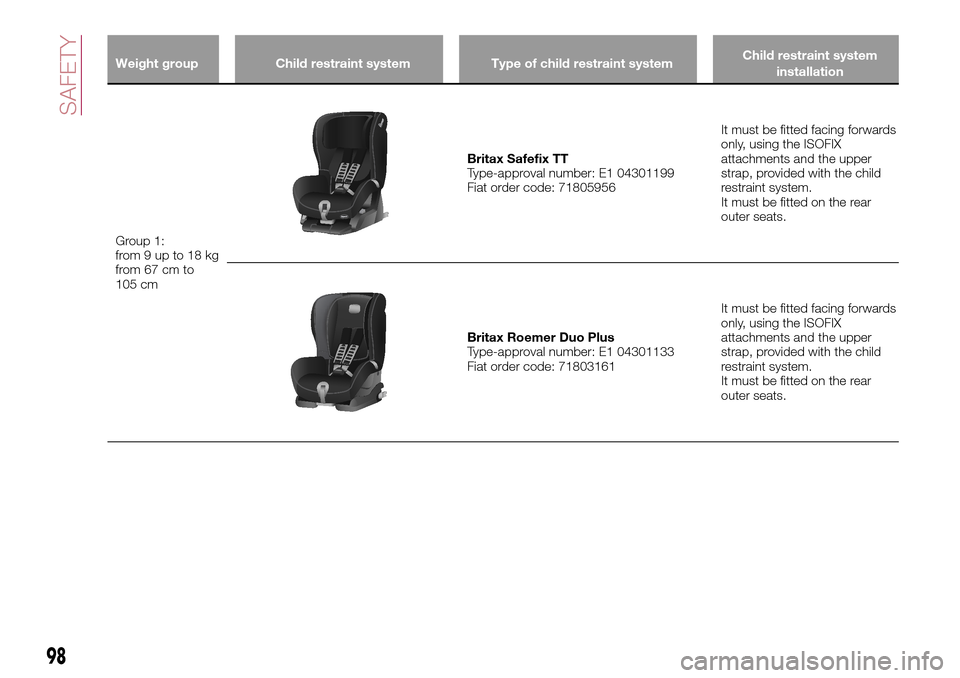
Weight group Child restraint system Type of child restraint systemChild restraint system
installation
Group 1:
from9upto18kg
from 67 cm to
105 cm
Britax Safefix TT
Type-approval number: E1 04301199
Fiat order code: 71805956It must be fitted facing forwards
only, using the ISOFIX
attachments and the upper
strap, provided with the child
restraint system.
It must be fitted on the rear
outer seats.
Britax Roemer Duo Plus
Type-approval number: E1 04301133
Fiat order code: 71803161It must be fitted facing forwards
only, using the ISOFIX
attachments and the upper
strap, provided with the child
restraint system.
It must be fitted on the rear
outer seats.
98
SAFETY
Page 101 of 264
Weight group Child restraint system Type of child restraint systemChild restraint system
installation
Group 2:
from 15 to 25 kg
from 95 cm to
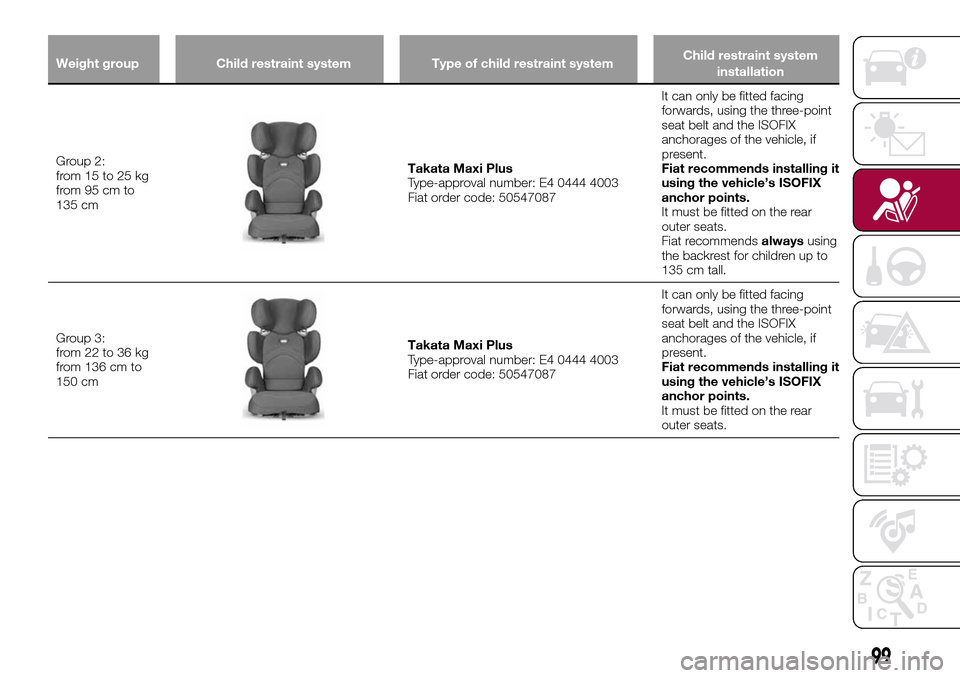
135 cmTakata Maxi Plus
Type-approval number: E4 0444 4003
Fiat order code: 50547087It can only be fitted facing
forwards, using the three-point
seat belt and the ISOFIX
anchorages of the vehicle, if
present.
Fiat recommends installing it
using the vehicle’s ISOFIX
anchor points.
It must be fitted on the rear
outer seats.
Fiat recommendsalwaysusing
the backrest for children up to
135 cm tall.
Group 3:
from 22 to 36 kg
from 136 cm to
150 cm
Takata Maxi Plus
Type-approval number: E4 0444 4003
Fiat order code: 50547087It can only be fitted facing
forwards, using the three-point
seat belt and the ISOFIX
anchorages of the vehicle, if
present.
Fiat recommends installing it
using the vehicle’s ISOFIX
anchor points.
It must be fitted on the rear
outer seats.
99
Page 102 of 264
Main recommendations to carry
children safely
Install the child restraint systems on
the rear seat, which is the most
protected position in the event of an
impact.
Keep children in rearward facing child
restraint systems for as long as
possible, until 3–4 years old if possible.
If the passenger's front airbag is
deactivated always check the
dedicated warning light on the trim
located on the dashboard to make sure
that it has actually been deactivated.
Carefully follow the instructions
supplied with the child restraint system.
Keep the instructions in the vehicle
along with the other documents and
this handbook. Do not use
second-hand child restraint systems
without instructions.
Only one child is to be strapped into
each restraint system; never carry two
children using one child restraint
system.
Always check that the seat belts do
not rest on the child’s neck.
Always check that the seat belt is
well fastened by pulling on it.
While travelling, do not let the child
sit incorrectly or unfasten the belts.
Never allow a child to put the belt's
diagonal section under an arm or
behind their back.
Never carry children on your lap,
even newborns. No one can hold a
child in the case of an accident.
If the car has been involved in a road
accident, replace the child restraint
system with a new one. In addition, and
depending on the type of child restraint
system installed, replace the isofix
anchorages or the seat belt with which
the child restraint system was
connected.
Any child restraint systems fitted
facing forward on an outside rear seat,
independently of its weight group, must
be fitted after removing the headrest
relative to the seat where it is to be
fitted. This does not apply to child
restraint systems that only consist of a
cushion (without backrest): these child
restraint systems must be installed
when the relative headrest is fitted.
WARNING
79)SEVERE DANGER When a front
passenger airbag is fitted, do not install
rearward facing child restraint systems on
the front passenger seat. Deployment of
the airbag in an accident could cause fatal
injuries to the child regardless of the
severity of the collision. It is advisable to
always carry children in a child restraint
system on the rear seat, which is the most
protected position in the event of a
collision.80)On the sun visor there is a label with
suitable symbols reminding the user that it
is compulsory to deactivate the airbag if a
rearward facing child restraint system is
fitted. Always comply with the instructions
on the passenger side sun visor (see the
"Supplementary Restraint System (SRS) -
Airbag" paragraph).
81)Should it be necessary to carry a child
on the passenger side front seat in a rear
facing child restraint system, the passenger
side front airbag and side bag must be
deactivated through the Connect system
main menu (see the "Supplementary
Restraint System (SRS) - Airbag"
paragraph), verifying deactivation by
checking whether the
LED has
illuminated on the dashboard. Move the
passenger's seat as far back as possible to
avoid contact between the child seat and
the dashboard.
82)Do not move the front or rear seat if a
child is seated on it or on the dedicated
child restraint system
83)Incorrect fitting of the child restraint
system may result in an inefficient
protection system. In the event of an
accident the child restraint system may
become loose and the child may be
injured, even fatally. When fitting a restraint
system for newborns or children, strictly
comply with the instructions provided by
the Manufacturer.
84)When the child restraint system is not
used, secure it with the seat belt or with
the ISOFIX anchorages, or remove it from
the vehicle. Do not leave it unsecured
inside the passenger compartment. In this
way, in the case of sudden braking or an
accident, it will not cause injuries to the
occupants.
100
SAFETY
Page 129 of 264
IMPORTANT NOTES
IMPORTANT In some circumstances,
such as with ice, snow or mud on the
surface of the camera, the camera
sensitivity may be reduced.
IMPORTANT When parking, take the
utmost care over obstacles that may be
above or under the camera range.
WARNING
124)Parking and other potentially
dangerous manoeuvres are, however,
always the driver’s responsibility. While
carrying out these manoeuvres, always
make sure that no people (especially
children) or animals are in the area
concerned. The camera is an aid for the
driver, but the driver must never allow
his/her attention to lapse during potentially
dangerous manoeuvres, even those
executed at low speeds. Always keep a
slow speed, so as to promptly brake in the
case of obstacles.
IMPORTANT
53)It is vital, for correct operation, that the
camera is always kept clean and free from
any mud, dirt, snow or ice. Be careful not
to scratch or damage the camera while
cleaning it. Avoid using dry, rough or hard
cloths. The camera must be washed using
clean water, with the addition of car
shampoo if necessary. In washing stations
which use steam or high-pressure jets,
clean the camera quickly, keeping the
nozzle more than 10 cm away from the
sensors. Also, do not apply stickers to the
camera.
TOWING TRAILERS
IMPORTANT NOTES
125) 126)
For towing caravans or trailers the
vehicle must be fitted with an approved
tow hook and an adequate electrical
system. Should aftermarket installation
be requested, this must be carried out
by specialists.
Install any specific and/or additional
door mirrors as specified by the
Highway Code.
Remember that, when towing a trailer,
steep hills are harder to climb, braking
distances increase and overtaking takes
longer depending on the overall weight
of the trailer.
Engage a low gear when driving
downhill, rather than constantly using
the brake.
The weight the trailer exerts on the
vehicle tow hook reduces the vehicle's
loading capacity by the same amount.
To make sure that the maximum
towable weight is not exceeded (given
in the vehicle registration document)
account should be taken of the fully
laden trailer, including accessories and
luggage.
127
Page 150 of 264
CHANGING A WHEEL
JACK
Please note that:
the jack weight is 2.15 kg;
the jack cannot be repaired and in
the event of a fault it must be replaced
by another genuine one;
No tool other than its cranking device
may be fitted on the jack.
Servicing
Prevent any dirt from depositing on
the "worm screw";
Keep the "worm screw" lubricated;
Never modify the jack.
Conditions for non-use
Temperatures below −40°C;
On sandy or muddy ground;
On uneven ground;
On steep roads;
In extreme weather conditions:
thunderstorms, typhoons, hurricanes,
blizzards, storms, etc.
In direct contact with the engine or
for repairs under the vehicle;
On boats.
CHANGING PROCEDURE
138) 139) 140) 141) 142)
58) 59)
Proceed as follows:
stop the car in a position that is not
dangerous for oncoming traffic where
you can change the wheel safely. The
ground must be flat and sufficiently
compact;
stop the engine, engage the hazard
warning lights and the parking brake;
engage first gear or reverse;
wear the reflective safety jacket
before getting out of the car (anyway
comply with the laws in force in the
country you are driving in);
open the luggage compartment and
if there is a cargo box (for TIPO 5DOOR
version only), remove it as described in
the “Cargo box” paragraph in the
“Getting to know the car” chapter (for
petrol and diesel versions only);
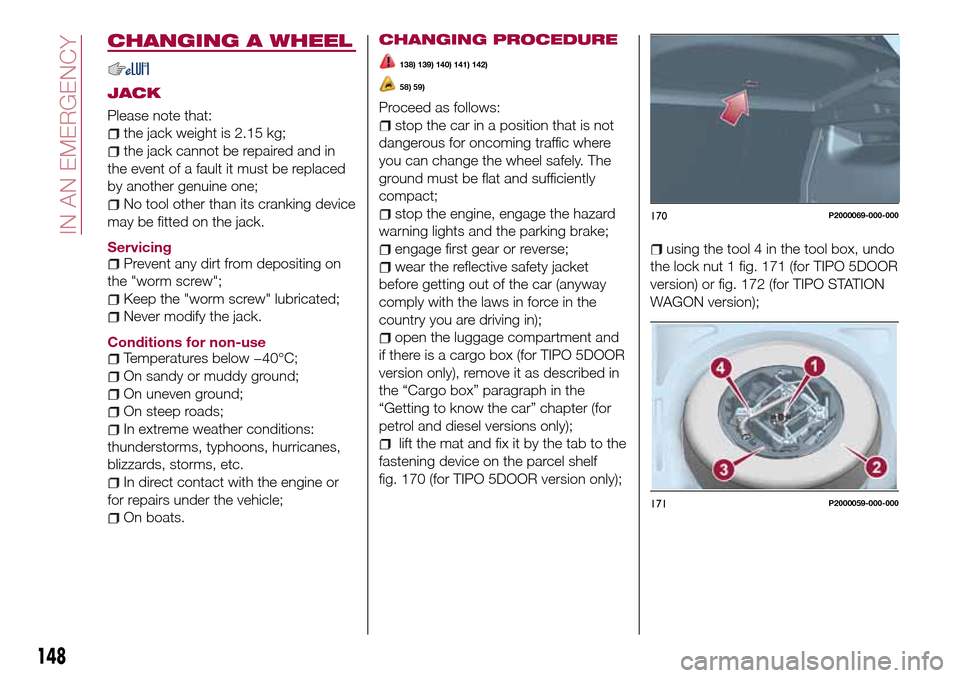
lift the mat and fix it by the tab to the
fastening device on the parcel shelf
fig. 170 (for TIPO 5DOOR version only);
using the tool 4 in the tool box, undo
the lock nut 1 fig. 171 (for TIPO 5DOOR
version) or fig. 172 (for TIPO STATION
WAGON version);
170P2000069-000-000
171P2000059-000-000
148
IN AN EMERGENCY
Page 188 of 264
TECHNICAL DATA
Everything you may find useful for
understanding how your vehicle is
made and works is contained in this
chapter and illustrated with data, tables
and graphics. For the enthusiasts and
the technician, but also just for those
who want to know every detail of their
vehicle.
IDENTIFICATION DATA.........187
ENGINE..................188
WHEELS.................190
DIMENSIONS..............195
WEIGHTS.................197
REFUELLING...............199
FLUIDS AND LUBRICANTS......202
PERFORMANCE............205
FUEL CONSUMPTION.........206
CO2 EMISSIONS............208
PRESCRIPTIONS FOR HANDLING
THE VEHICLE AT THE END OF ITS
LIFE....................209
186
TECHNICAL DATA
Page 189 of 264
IDENTIFICATION
DATA
VEHICLE IDENTIFICATION
NUMBER (VIN) PLATE
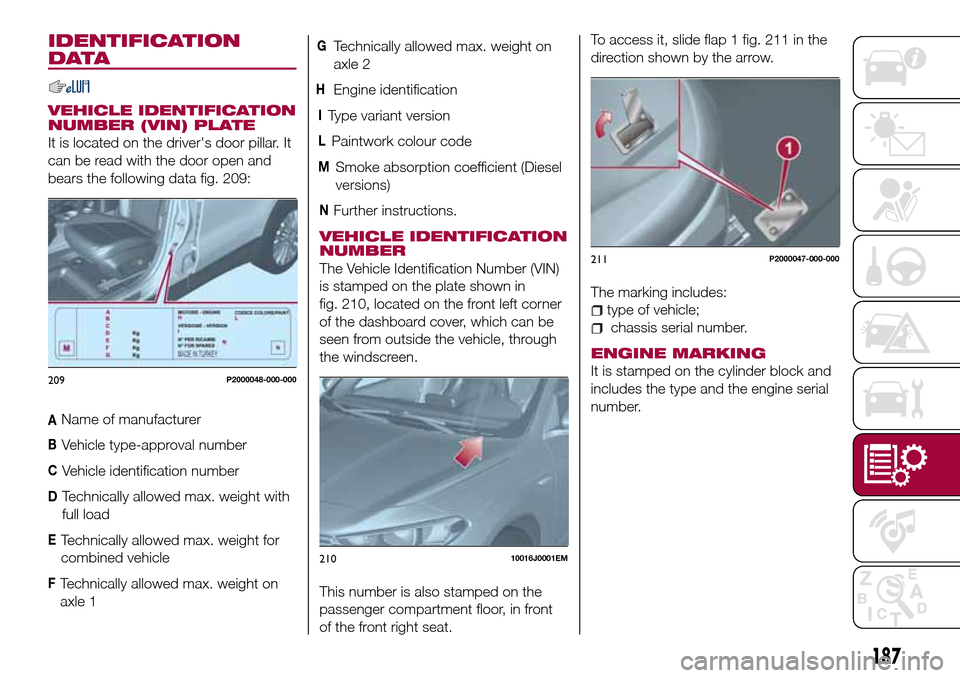
It is located on the driver's door pillar. It
can be read with the door open and
bears the following data fig. 209:
AName of manufacturer
BVehicle type-approval number
CVehicle identification number
DTechnically allowed max. weight with
full load
ETechnically allowed max. weight for
combined vehicle
FTechnically allowed max. weight on
axle 1
GTechnically allowed max. weight on
axle 2
HEngine identification
IType variant version
LPaintwork colour code
MSmoke absorption coefficient (Diesel
versions)
NFurther instructions.
VEHICLE IDENTIFICATION
NUMBER
The Vehicle Identification Number (VIN)
is stamped on the plate shown in
fig. 210, located on the front left corner
of the dashboard cover, which can be
seen from outside the vehicle, through
the windscreen.
This number is also stamped on the
passenger compartment floor, in front
of the front right seat.To access it, slide flap 1 fig. 211 in the
direction shown by the arrow.
The marking includes:
type of vehicle;
chassis serial number.
ENGINE MARKING
It is stamped on the cylinder block and
includes the type and the engine serial
number.209P2000048-000-000
21010016J0001EM
211P2000047-000-000
187
Page 199 of 264
WEIGHTS
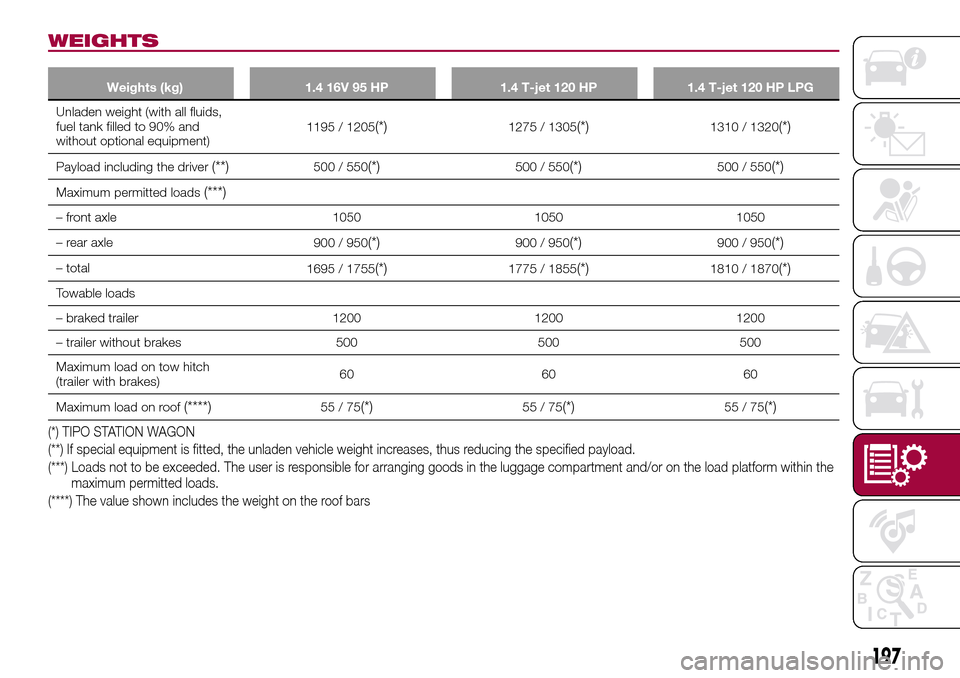
Weights (kg) 1.4 16V 95 HP 1.4 T-jet 120 HP 1.4 T-jet 120 HP LPG
Unladen weight (with all fluids,
fuel tank filled to 90% and
without optional equipment)1195 / 1205(*)1275 / 1305(*)1310 / 1320(*)
Payload including the driver(**)500 / 550(*)500 / 550(*)500 / 550(*)
Maximum permitted loads(***)
– front axle 1050 1050 1050
– rear axle
900 / 950
(*)900 / 950(*)900 / 950(*)
– total
1695 / 1755(*)1775 / 1855(*)1810 / 1870(*)
Towable loads
– braked trailer 1200 1200 1200
– trailer without brakes 500 500 500
Maximum load on tow hitch
(trailer with brakes)60 60 60
Maximum load on roof
(****)55/75(*)55/75(*)55/75(*)
(*) TIPO STATION WAGON
(**) If special equipment is fitted, the unladen vehicle weight increases, thus reducing the specified payload.
(***) Loads not to be exceeded. The user is responsible for arranging goods in the luggage compartment and/or on the load platform within the
maximum permitted loads.
(****) The value shown includes the weight on the roof bars
197
Page 200 of 264
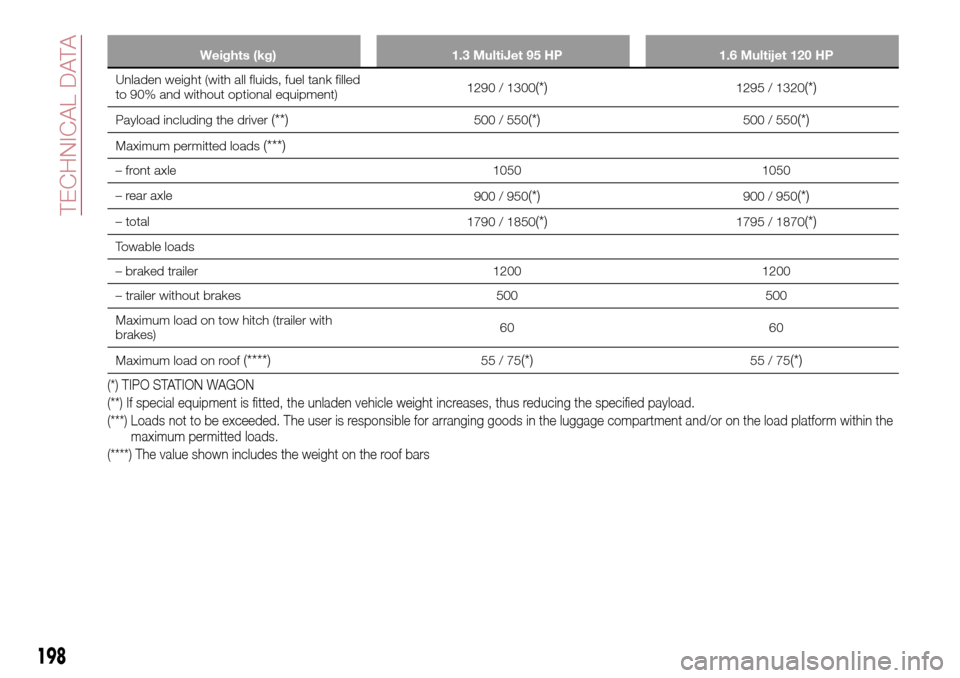
Weights (kg) 1.3 MultiJet 95 HP 1.6 Multijet 120 HP
Unladen weight (with all fluids, fuel tank filled
to 90% and without optional equipment)1290 / 1300(*)1295 / 1320(*)
Payload including the driver(**)500 / 550(*)500 / 550(*)
Maximum permitted loads(***)
– front axle 1050 1050
– rear axle
900 / 950
(*)900 / 950(*)
– total
1790 / 1850(*)1795 / 1870(*)
Towable loads
– braked trailer 1200 1200
– trailer without brakes 500 500
Maximum load on tow hitch (trailer with
brakes)60 60
Maximum load on roof
(****)55/75(*)55/75(*)
(*) TIPO STATION WAGON
(**) If special equipment is fitted, the unladen vehicle weight increases, thus reducing the specified payload.
(***) Loads not to be exceeded. The user is responsible for arranging goods in the luggage compartment and/or on the load platform within the
maximum permitted loads.
(****) The value shown includes the weight on the roof bars
198
TECHNICAL DATA
Page 208 of 264
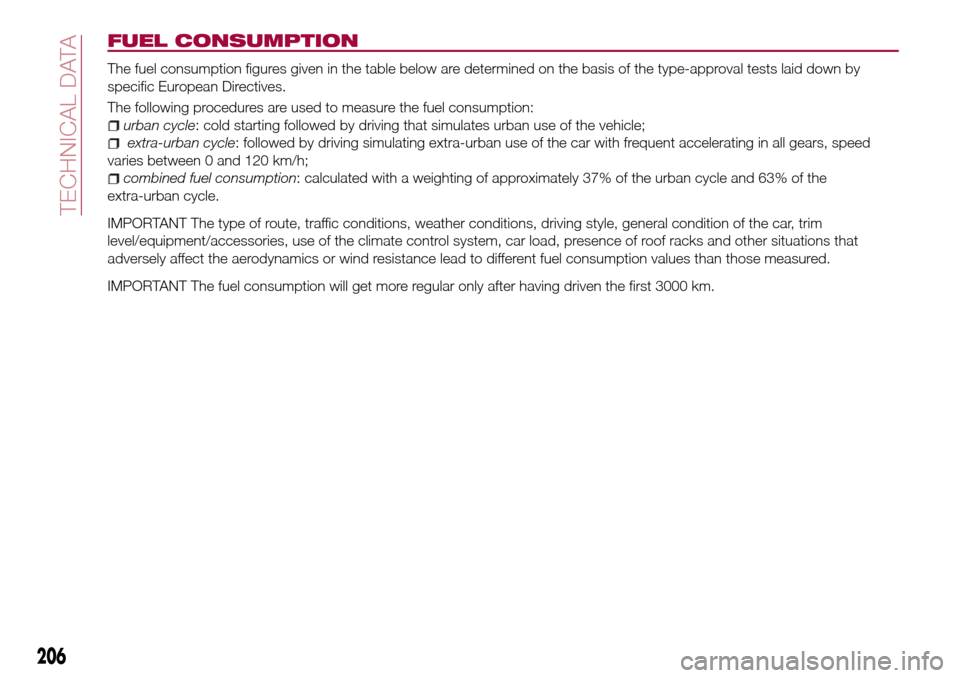
FUEL CONSUMPTION
The fuel consumption figures given in the table below are determined on the basis of the type-approval tests laid down by
specific European Directives.
The following procedures are used to measure the fuel consumption:
urban cycle: cold starting followed by driving that simulates urban use of the vehicle;
extra-urban cycle: followed by driving simulating extra-urban use of the car with frequent accelerating in all gears, speed
varies between 0 and 120 km/h;
combined fuel consumption: calculated with a weighting of approximately 37% of the urban cycle and 63% of the
extra-urban cycle.
IMPORTANT The type of route, traffic conditions, weather conditions, driving style, general condition of the car, trim
level/equipment/accessories, use of the climate control system, car load, presence of roof racks and other situations that
adversely affect the aerodynamics or wind resistance lead to different fuel consumption values than those measured.
IMPORTANT The fuel consumption will get more regular only after having driven the first 3000 km.
206
TECHNICAL DATA