transmission FIAT TIPO 5DOORS STATION WAGON 2017 1.G Owners Manual
[x] Cancel search | Manufacturer: FIAT, Model Year: 2017, Model line: TIPO 5DOORS STATION WAGON, Model: FIAT TIPO 5DOORS STATION WAGON 2017 1.GPages: 264, PDF Size: 4.53 MB
Page 76 of 264
43) 44) 45) 46) 47)
TC (Traction Control)
SYSTEM
The system automatically operates in
the event of slipping, loss of grip on wet
roads (aquaplaning) and acceleration on
slippery, snowy or icy roads, etc. on
one or more drive wheels. Depending
on the slipping conditions, two different
control systems are activated:
if the slipping involves both drive
wheels, the system intervenes, reducing
the power transmitted by the engine;
if the slipping only involves one of the
drive wheels, the BLD (Brake Limited
Differential) function is activated,
automatically braking the wheel which
is slipping (the behaviour of a
self-locking differential is simulated).
This will increase the engine torque
transferred to the wheel which isn't
slipping. This function remains active
even if the "Systems partially disabled"
and "Systems disabled" modes are
selected (see description in the
following pages).
System intervention
The intervention of the system is
indicated by the flashing of the
warning light on the instrument
panel, to inform the driver that the
vehicle is in critical stability and grip
conditions.
48) 49) 50) 51) 52)
PBA (Panic Brake
Assist) SYSTEM
The PBA system is designed to improve
the vehicle’s braking capacity during
emergency braking.
The system detects emergency braking
by monitoring the speed and force with
which the brake pedal is pressed, and
consequently applies the optimal brake
pressure. This can reduce the braking
distance: the PBA system therefore
completes the ABS.
Maximum assistance from the PBA
system is obtained by pressing the
brake pedal very quickly. In addition, the
brake pedal should be pressed
continuously during braking, avoiding
intermittent presses, to get the most
out of the system. Do not reduce
pressure on the brake pedal until
braking is no longer necessary.
The PBA system is deactivated when
the brake pedal is released.
54) 54) 55)
HHC (Hill Hold Control)
SYSTEM
This is an integral part of the ESC
system and facilitates starting on
slopes, activating automatically in the
following cases:
uphill: vehicle stationary on a roadwith a gradient higher than 5%, engine
running, brake pressed and
transmission in neutral or gear other
than reverse engaged;
downhill: vehicle stationary on a road
with a gradient higher than 5%, engine
running, brake pressed and reverse
gear engaged.
When setting off, the ESC system
control unit maintains the braking
pressure on the wheels until the engine
torque necessary for starting is
reached, or in any case for a maximum
of 2 seconds, allowing your right foot to
be moved easily from the brake pedal
to the accelerator.
When two seconds have elapsed,
without starting, the system is
automatically deactivated, gradually
releasing the braking pressure. During
this release stage it is possible to hear a
typical mechanical brake release noise,
indicating the imminent movement of
the car.
56) 57)
ERM (Electronic Rollover
Mitigation) SYSTEM
The system monitors the tendency of
the wheels to rise from the ground if the
driver performs extreme manoeuvres
like quick steering to avoid an obstacle,
especially in poor road conditions.
74
SAFETY
Page 110 of 264
STARTING AND DRIVING
Let’s get to the core of the vehicle:
seeing how you can exploit all of its
potential to the full.
We’ll look at how to drive it safely in any
situation, so that it can be a welcome
companion, with our comfort and our
wallets in mind.STARTING THE ENGINE.......109
PARKING THE VEHICLE........110
PARKING BRAKE............110
USING THE TRANSMISSION. . . .111
STOP/START SYSTEM........111
SPEED LIMITER.............113
ELECTRONIC CRUISE CONTROL .114
ADAPTIVE CRUISE CONTROL
(ACC)....................116
PARKING SENSORS..........123
REAR VIEW CAMERA.........125
TOWING TRAILERS..........127
REFUELLING THE VEHICLE.....128
108
STARTING AND DRIVING
Page 113 of 264
USING THE
TRANSMISSION
112)
41)
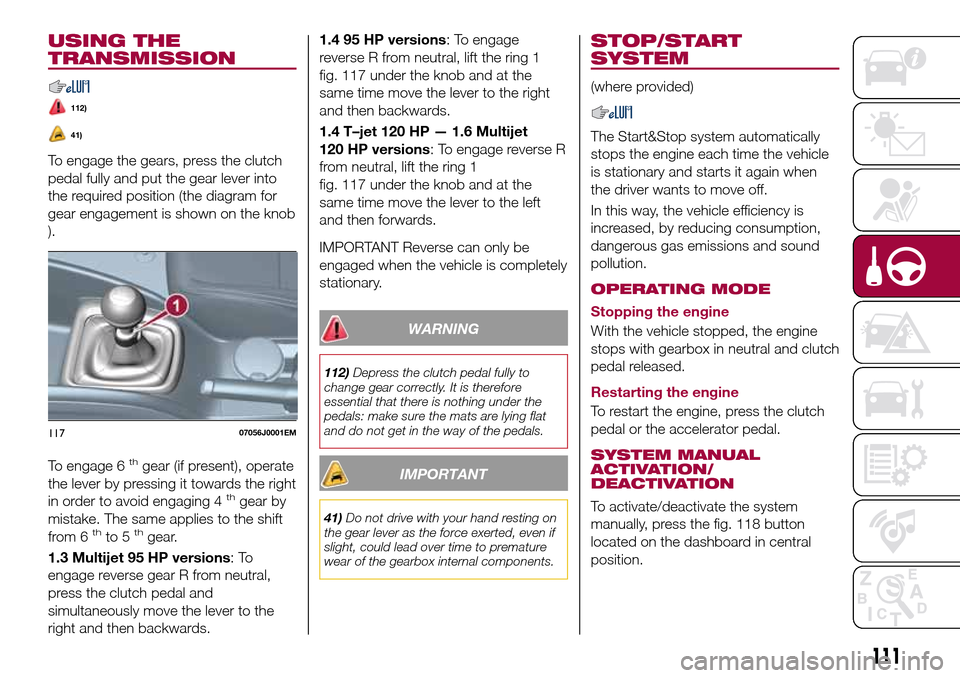
To engage the gears, press the clutch
pedal fully and put the gear lever into
the required position (the diagram for
gear engagement is shown on the knob
).
To engage 6
thgear (if present), operate
the lever by pressing it towards the right
in order to avoid engaging 4
thgear by
mistake. The same applies to the shift
from 6
thto 5thgear.
1.3 Multijet 95 HP versions:To
engage reverse gear R from neutral,
press the clutch pedal and
simultaneously move the lever to the
right and then backwards.1.4 95 HP versions: To engage
reverse R from neutral, lift the ring 1
fig. 117 under the knob and at the
same time move the lever to the right
and then backwards.
1.4 T–jet 120 HP — 1.6 Multijet
120 HP versions: To engage reverse R
from neutral, lift the ring 1
fig. 117 under the knob and at the
same time move the lever to the left
and then forwards.
IMPORTANT Reverse can only be
engaged when the vehicle is completely
stationary.
WARNING
112)Depress the clutch pedal fully to
change gear correctly. It is therefore
essential that there is nothing under the
pedals: make sure the mats are lying flat
and do not get in the way of the pedals.
IMPORTANT
41)Do not drive with your hand resting on
the gear lever as the force exerted, even if
slight, could lead over time to premature
wear of the gearbox internal components.
STOP/START
SYSTEM
(where provided)
The Start&Stop system automatically
stops the engine each time the vehicle
is stationary and starts it again when
the driver wants to move off.
In this way, the vehicle efficiency is
increased, by reducing consumption,
dangerous gas emissions and sound
pollution.
OPERATING MODE
Stopping the engine
With the vehicle stopped, the engine
stops with gearbox in neutral and clutch
pedal released.
Restarting the engine
To restart the engine, press the clutch
pedal or the accelerator pedal.
SYSTEM MANUAL
ACTIVATION/
DEACTIVATION
To activate/deactivate the system
manually, press the fig. 118 button
located on the dashboard in central
position.
11707056J0001EM
111
Page 158 of 264
63)
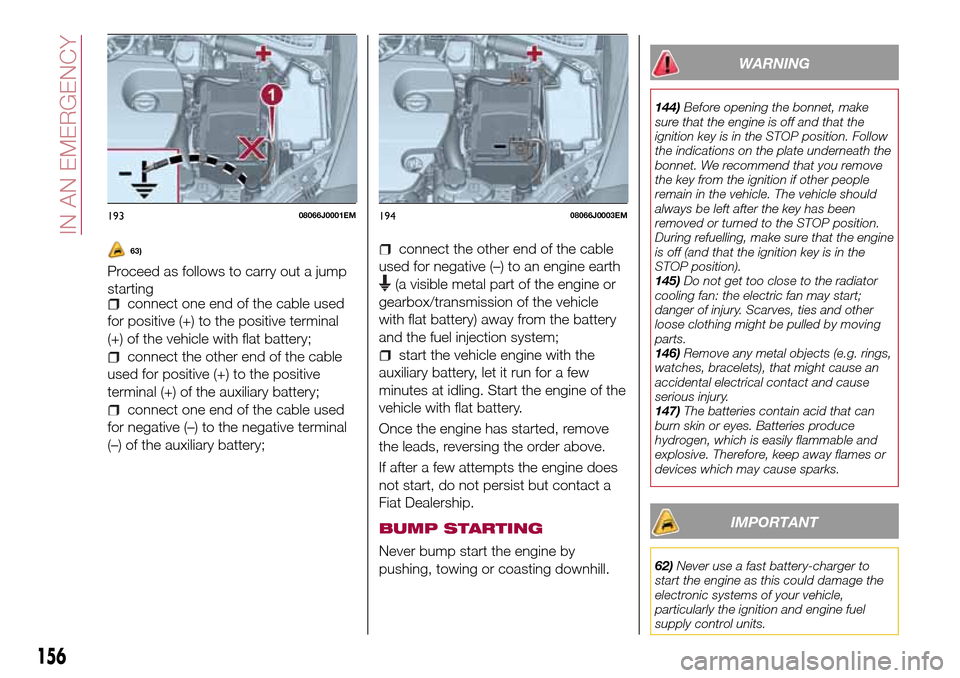
Proceed as follows to carry out a jump
starting
connect one end of the cable used
for positive (+) to the positive terminal
(+) of the vehicle with flat battery;
connect the other end of the cable
used for positive (+) to the positive
terminal (+) of the auxiliary battery;
connect one end of the cable used
for negative (–) to the negative terminal
(–) of the auxiliary battery;
connect the other end of the cable
used for negative (–) to an engine earth
(a visible metal part of the engine or
gearbox/transmission of the vehicle
with flat battery) away from the battery
and the fuel injection system;
start the vehicle engine with the
auxiliary battery, let it run for a few
minutes at idling. Start the engine of the
vehicle with flat battery.
Once the engine has started, remove
the leads, reversing the order above.
If after a few attempts the engine does
not start, do not persist but contact a
Fiat Dealership.
BUMP STARTING
Never bump start the engine by
pushing, towing or coasting downhill.
WARNING
144)Before opening the bonnet, make
sure that the engine is off and that the
ignition key is in the STOP position. Follow
the indications on the plate underneath the
bonnet. We recommend that you remove
the key from the ignition if other people
remain in the vehicle. The vehicle should
always be left after the key has been
removed or turned to the STOP position.
During refuelling, make sure that the engine
is off (and that the ignition key is in the
STOP position).
145)Do not get too close to the radiator
cooling fan: the electric fan may start;
danger of injury. Scarves, ties and other
loose clothing might be pulled by moving
parts.
146)Remove any metal objects (e.g. rings,
watches, bracelets), that might cause an
accidental electrical contact and cause
serious injury.
147)The batteries contain acid that can
burn skin or eyes. Batteries produce
hydrogen, which is easily flammable and
explosive. Therefore, keep away flames or
devices which may cause sparks.
IMPORTANT
62)Never use a fast battery-charger to
start the engine as this could damage the
electronic systems of your vehicle,
particularly the ignition and engine fuel
supply control units.
19308066J0001EM19408066J0003EM
156
IN AN EMERGENCY
Page 161 of 264
TOWING THE
VEHICLE
ATTACHING THE TOW
RING
149) 150) 151)
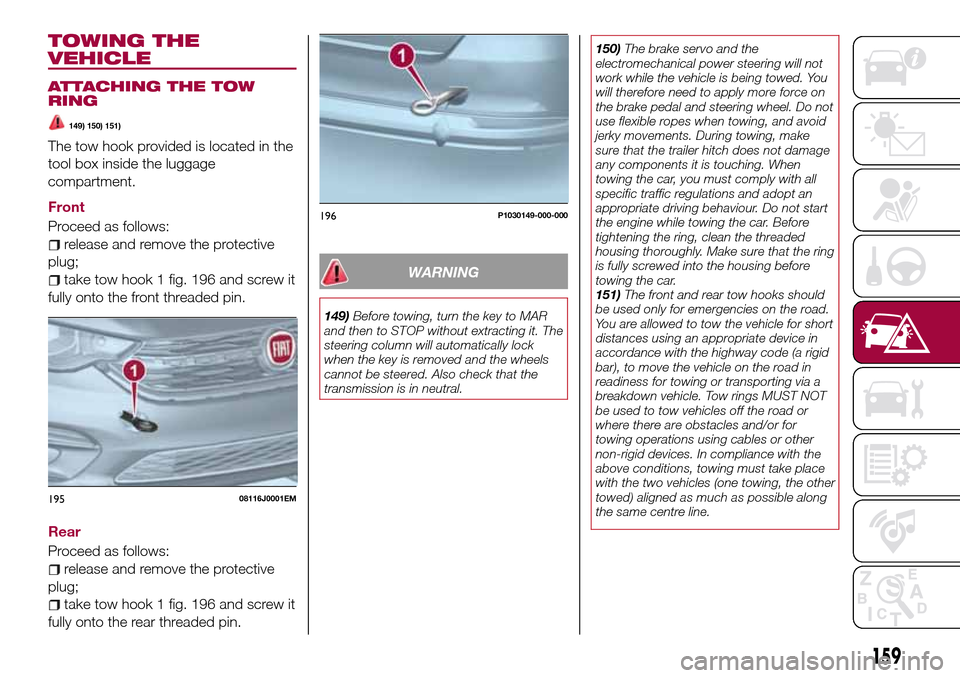
The tow hook provided is located in the
tool box inside the luggage
compartment.
Front
Proceed as follows:
release and remove the protective
plug;
take tow hook 1 fig. 196 and screw it
fully onto the front threaded pin.
Rear
Proceed as follows:
release and remove the protective
plug;
take tow hook 1 fig. 196 and screw it
fully onto the rear threaded pin.
WARNING
149)Before towing, turn the key to MAR
and then to STOP without extracting it. The
steering column will automatically lock
when the key is removed and the wheels
cannot be steered. Also check that the
transmission is in neutral.150)The brake servo and the
electromechanical power steering will not
work while the vehicle is being towed. You
will therefore need to apply more force on
the brake pedal and steering wheel. Do not
use flexible ropes when towing, and avoid
jerky movements. During towing, make
sure that the trailer hitch does not damage
any components it is touching. When
towing the car, you must comply with all
specific traffic regulations and adopt an
appropriate driving behaviour. Do not start
the engine while towing the car. Before
tightening the ring, clean the threaded
housing thoroughly. Make sure that the ring
is fully screwed into the housing before
towing the car.
151)The front and rear tow hooks should
be used only for emergencies on the road.
You are allowed to tow the vehicle for short
distances using an appropriate device in
accordance with the highway code (a rigid
bar), to move the vehicle on the road in
readiness for towing or transporting via a
breakdown vehicle. Tow rings MUST NOT
be used to tow vehicles off the road or
where there are obstacles and/or for
towing operations using cables or other
non-rigid devices. In compliance with the
above conditions, towing must take place
with the two vehicles (one towing, the other
towed) aligned as much as possible along
the same centre line.
19508116J0001EM
196P1030149-000-000
159
Page 171 of 264
PERIODIC CHECKS
Every1,000km or before long trips
check and, if necessary, top up:
engine coolant level;
brake fluid level;
windscreen washer fluid level;
tyre inflation pressure and condition;
operation of lighting system
(headlights, direction indicators, hazard
warning lights, etc.);
operation of screen washing/wiping
system and positioning/wear of wiper
blades.
Every3,000km, check and top up if
required: engine oil level.
DEMANDING USE OF THE
CAR
If the vehicle is used mainly under one
of the following conditions:
dusty roads;
short, repeated journeys (less than
7-8 km) at sub-zero outside
temperatures;
engine often idling or driving long
distances at low speeds or long periods
of inactivity;
the following checks must be carried
out more often than indicated in the
Scheduled Servicing Plan:
check front disc brake pad condition
and wear;
check cleanliness of bonnet and
luggage compartment locks,cleanliness and lubrication of linkage;
visually inspect conditions of: engine,
gearbox, transmission, pipes and hoses
(exhaust/fuel system/brakes) and
rubber elements (gaiters/sleeves/
bushes, etc.);
check battery charge and battery
fluid level (electrolyte);
visually inspect conditions of the
accessory drive belts;
check and, if necessary, change
engine oil and replace oil filter;
check and, if necessary, replace
pollen filter;
check and, if necessary, replace air
cleaner.
169
Page 201 of 264
REFUELLING
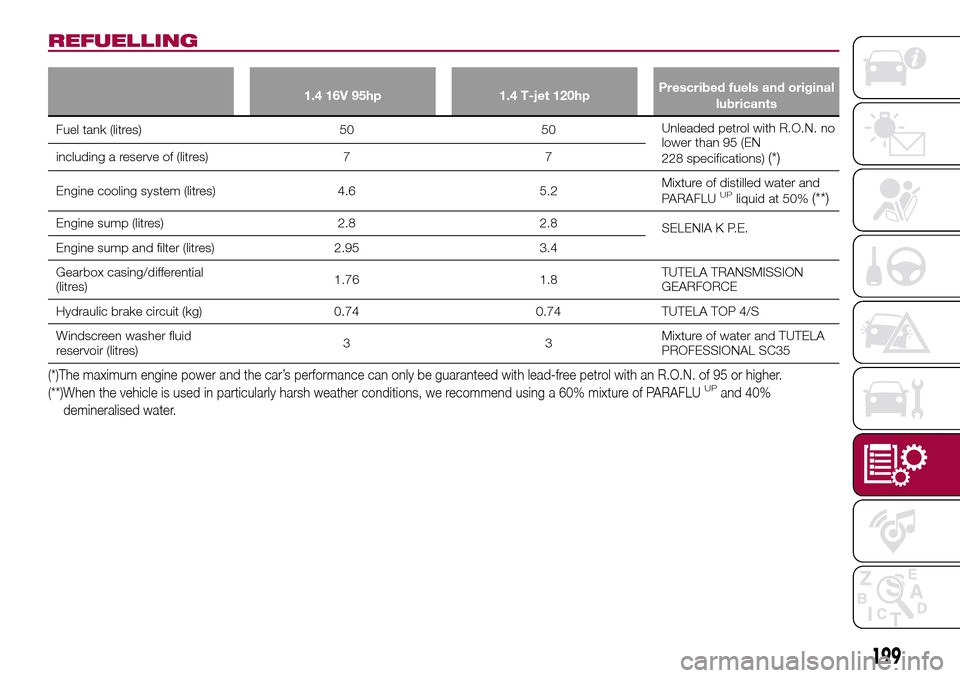
1.4 16V 95hp 1.4 T-jet 120hpPrescribed fuels and original
lubricants
Fuel tank (litres) 50 50Unleaded petrol with R.O.N. no
lower than 95 (EN
228 specifications)
(*)including a reserve of (litres) 7 7
Engine cooling system (litres) 4.6 5.2Mixture of distilled water and
PARAFLU
UPliquid at 50%(**)
Engine sump (litres) 2.8 2.8
SELENIA K P.E.
Engine sump and filter (litres) 2.95 3.4
Gearbox casing/differential
(litres)1.76 1.8TUTELA TRANSMISSION
GEARFORCE
Hydraulic brake circuit (kg) 0.74 0.74 TUTELA TOP 4/S
Windscreen washer fluid
reservoir (litres)33Mixture of water and TUTELA
PROFESSIONAL SC35
(*)The maximum engine power and the car’s performance can only be guaranteed with lead-free petrol with an R.O.N. of 95 or higher.
(**)When the vehicle is used in particularly harsh weather conditions, we recommend using a 60% mixture of PARAFLUUPand 40%
demineralised water.
199
Page 202 of 264
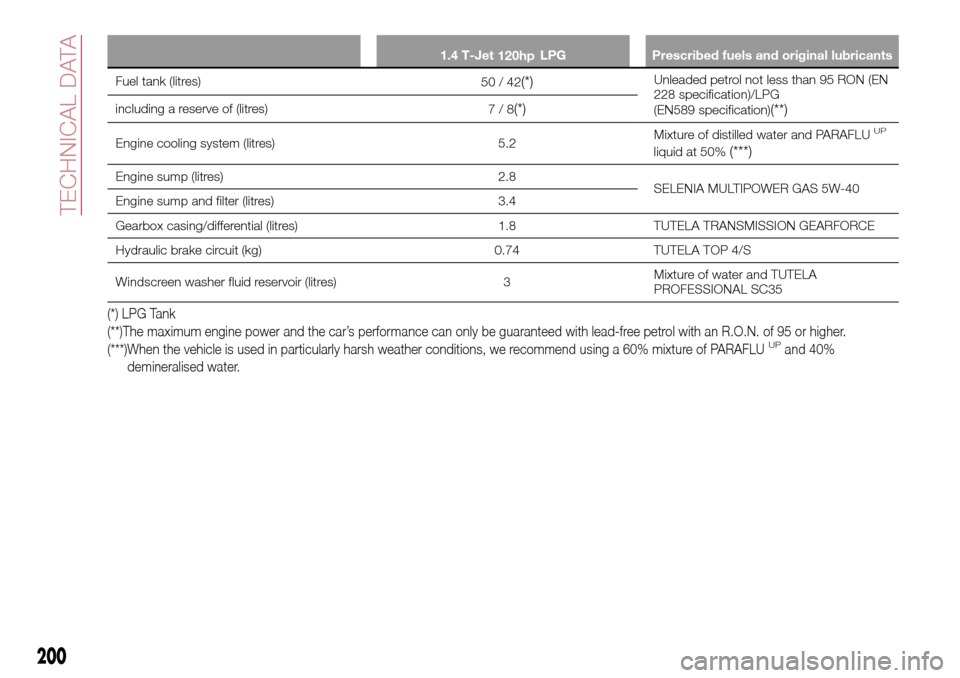
1.4 T-Jet LPG Prescribed fuels and original lubricants
Fuel tank (litres)
50/42(*)Unleaded petrol not less than 95 RON (EN
228 specification)/LPG
(EN589 specification)
(**)including a reserve of (litres)
7/8(*)
Engine cooling system (litres) 5.2Mixture of distilled water and PARAFLUUP
liquid at 50%(***)
Engine sump (litres) 2.8
SELENIA MULTIPOWER GAS 5W-40
Engine sump and filter (litres) 3.4
Gearbox casing/differential (litres) 1.8 TUTELA TRANSMISSION GEARFORCE
Hydraulic brake circuit (kg) 0.74 TUTELA TOP 4/S
Windscreen washer fluid reservoir (litres) 3Mixture of water and TUTELA
PROFESSIONAL SC35
(*) LPG Tank
(**)The maximum engine power and the car’s performance can only be guaranteed with lead-free petrol with an R.O.N. of 95 or higher.
(***)When the vehicle is used in particularly harsh weather conditions, we recommend using a 60% mixture of PARAFLU
UPand 40%
demineralised water.
200
TECHNICAL DATA
120hp
Page 203 of 264
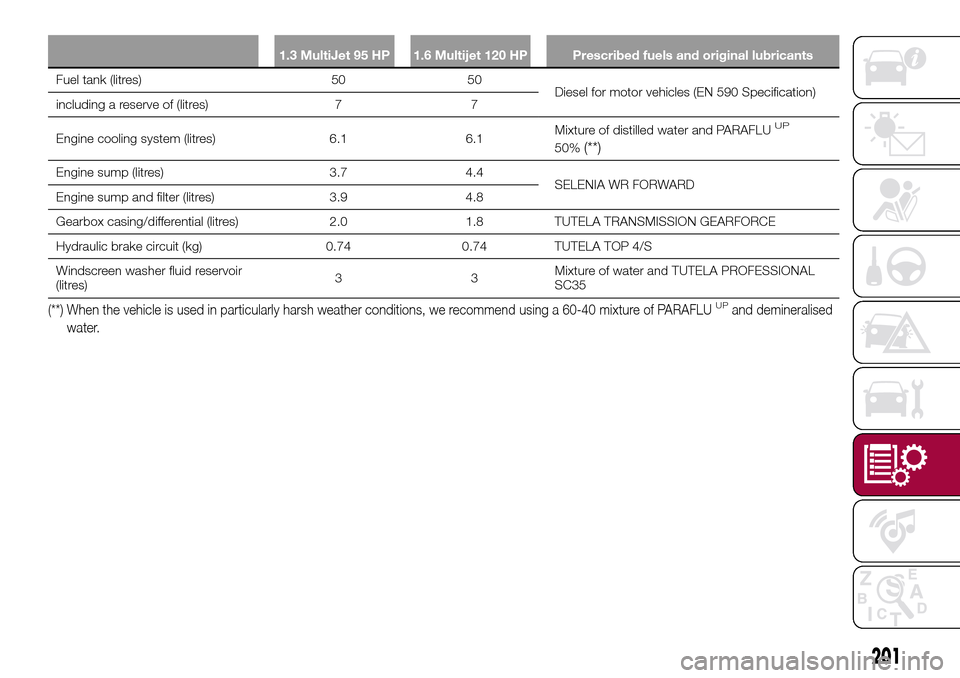
1.3 MultiJet 95 HP 1.6 Multijet 120 HP Prescribed fuels and original lubricants
Fuel tank (litres) 50 50
Diesel for motor vehicles (EN 590 Specification)
including a reserve of (litres) 7 7
Engine cooling system (litres) 6.1 6.1Mixture of distilled water and PARAFLU
UP
50%(**)
Engine sump (litres) 3.7 4.4
SELENIA WR FORWARD
Engine sump and filter (litres) 3.9 4.8
Gearbox casing/differential (litres) 2.0 1.8 TUTELA TRANSMISSION GEARFORCE
Hydraulic brake circuit (kg) 0.74 0.74 TUTELA TOP 4/S
Windscreen washer fluid reservoir
(litres)33Mixture of water and TUTELA PROFESSIONAL
SC35
(**) When the vehicle is used in particularly harsh weather conditions, we recommend using a 60-40 mixture of PARAFLUUPand demineralised
water.
201
Page 205 of 264
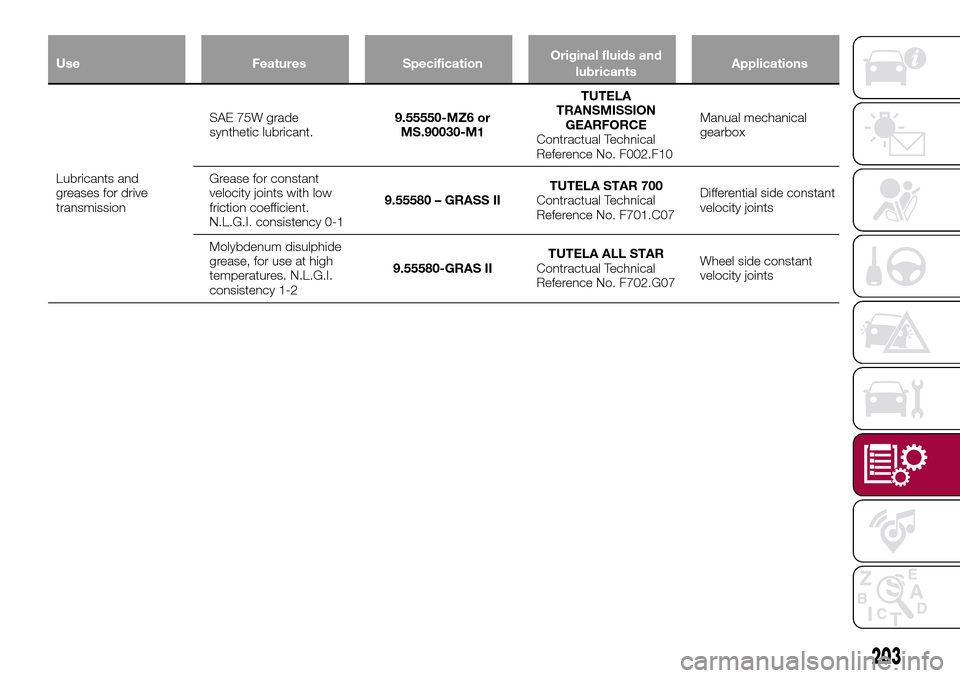
Use Features SpecificationOriginal fluids and
lubricantsApplications
Lubricants and
greases for drive
transmissionSAE 75W grade
synthetic lubricant.9.55550-MZ6 or
MS.90030-M1TUTELA
TRANSMISSION
GEARFORCE
Contractual Technical
Reference No. F002.F10Manual mechanical
gearbox
Grease for constant
velocity joints with low
friction coefficient.
N.L.G.I. consistency 0-19.55580 – GRASS IITUTELA STAR 700
Contractual Technical
Reference No. F701.C07Differential side constant
velocity joints
Molybdenum disulphide
grease, for use at high
temperatures. N.L.G.I.
consistency 1-29.55580-GRAS IITUTELA ALL STAR
Contractual Technical
Reference No. F702.G07Wheel side constant
velocity joints
203