climate control FIAT ULYSSE 2009 2.G User Guide
[x] Cancel search | Manufacturer: FIAT, Model Year: 2009, Model line: ULYSSE, Model: FIAT ULYSSE 2009 2.GPages: 254, PDF Size: 3.56 MB
Page 71 of 254
GETTING TO KNOW YOUR CAR
70
In addition, still with the climate con-
trol system working in automatic
mode, when the external temperature
is lower than 18°C, supplementary
fans can be used to direct some warm
air to the second and third row.
If cold air is required, treated air di-
rected to the feet is distributed to all
three rows.
MAX-DEF function
Air is completely directed to the
windscreen and front side windows.
This function is used for the wind-
screen/side window rapid defrost-
ing/demisting and rear heated window
activation with only one operation.
Such function is activated manually
and enables the following functions:
– ventilation with maximum air ca-
pacity;
– air mixing completely hot;– air recirculation off (outside air);
– compressor on;
– air distribution to the windscreen;
– rear heated window on.
When the MAX-DEF function is on
it is possible to alter the air capacity
(the minimum corresponds to 1 fan
notch) and to deactivate the rear heat-
ed window.
The rear heated window works for
a limited time and turns off automati-
cally.
MIXING
Temperature can be adjusted rang-
ing from a minimum of 14°C to a max-
imum of 28°C, i.e. “completely cold”
and “completely hot”. AIR QUALITY
The system is fitted with a pollen fil-
ter which prevents dust particles and
pollen coming from the outside from
getting into the system.
Have the pollen filter checked at a
Fiat Dealership at least once a year,
possibly at the beginning of spring/
summer.
If the car is often used in dusty or
highly polluted areas, you should check
or change the pollen filter more fre-
quently.
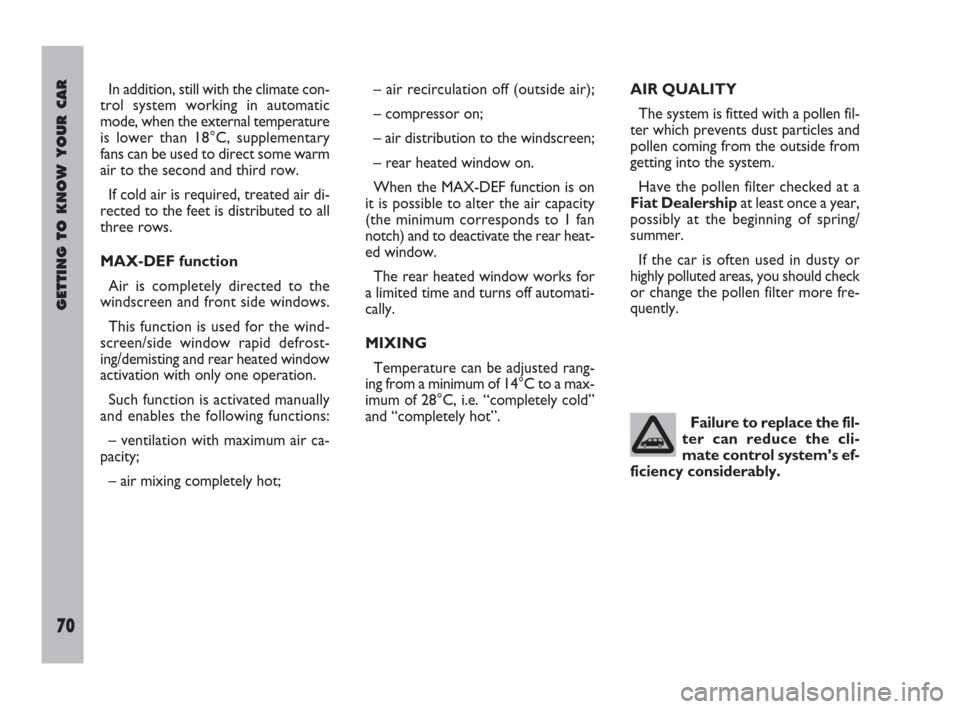
Failure to replace the fil-
ter can reduce the cli-
mate control system’s ef-
ficiency considerably.
001-077 ULYSSE ING:001-077 ULYSSE ING 5-11-2009 12:11 Pagina 70
Page 73 of 254
GETTING TO KNOW YOUR CAR
72
Legend fig. 88
AInternal temperature adjustment
button on driver’s side
B“AUTO” mode button
CDisplay
DMONO button for driver’s and
passenger’s side temperature align-
ment
EInternal temperature adjustment
button on passenger’s side
FRear heated window on/offGMaximum defrosting/demisting
on/off for windscreen and front side
windows, rear heated window and
door mirrors (MAX-DEF function)
HAir flow adjustment button for
central vents
IAir flow adjustment button for low-
er vents
LRotating slider for air capacity ad-
justment (main fan)MAir flow adjustment button for up-
per vents
NClimate control system compres-
sor on/off
OInside air recirculation on/off.
001-077 ULYSSE ING:001-077 ULYSSE ING 5-11-2009 12:11 Pagina 72
Page 75 of 254
GETTING TO KNOW YOUR CAR
74
NClimate control system compres-
sor on/off
OInside air recirculation on/off.
SYSTEM OPERATION
fig. 88-89
The system can be activated in sev-
eral ways:
– turning the main fan slider clock-
wise (L);
– or pressing button A(+/–) or E
(+/–);
– or pressing one of buttons (H, I,
M);
In these three cases the system re-
stores all the operation functions
stored before turning it off.
– or pressing one of buttons B, D,
N; in this case the automatic mode is
selected;– or pressing button G; in this case
the MAX-DEF function is selected.
The system automatically stores the
settings prior to the system switching
off, but it also takes into consideration
the vehicle stop and other external pa-
rameters, i.e.:
– if the engine is turned off for 20
minutes with the same internal tem-
perature, the system is restored keep-
ing the same settings. If in that period
temperature changes considerably, the
system restores the temperature pri-
or to switching off;
– if the engine is turned off for more
than 20 minutes, the system is
switched on in automatic mode, even
it was off before the vehicle stop, with-
out changing the temperature value.SETTINGS fig. 88-89
The user can choose the following
options:
• wished temperature setting:
this is possible pressing button A(+/–)
or E(+/–) and checking the temper-
ature value on the display (C). It is al-
so possible to split temperature and
set different values for the driver and
the passenger; the maximum differ-
ence is 5°C.
Temperature can be increased or de-
creased by setting different steps
which can be viewed on the display:
1°C between 14°C and 18°C and be-
tween 24°C and 28°C, 0.5°C between
18°C and 24°C.
001-077 ULYSSE ING:001-077 ULYSSE ING 5-11-2009 12:11 Pagina 74
Page 76 of 254
GETTING TO KNOW YOUR CAR
75
• “completely cold” setting: this
option can be selected automatically
by pressing and keeping button A(–)
or E(–) pressed until 14°C are
reached; in this case the system per-
formance is at the highest. With this
option the system works in mono
conditions and the following settings
are active:
– slider turned to “completely cold”;
– air distribution during ventilation;
– maximum air capacity value;
– compressor on;
– automatic recirculation off, even if
it is possible to activate it manually
without leaving the wished setting.• “completely hot” setting: this
option can be selected automatically
by pressing and keeping button A(+)
or E(+) pressed until 28°C are
reached; in this case the system per-
formance is at the highest. The fol-
lowing settings are active as well:
– slider turned to “completely hot”;
– air directed to windscreen/feet or
feet, according to the outside tem-
perature;
– maximum air capacity value;
– compressor controlled by the sys-
tem;
– automatic recirculation closed even
if it possible to activate manually the
open recirculation without leaving the
required setting.• fan speed setting: this is possi-
ble by turning slider L; the wished
speed value is displayed through the
front fan stake blackening C.
IMPORTANTWhen the engine is
started with the climate control sys-
tem in automatic mode (AUTO) and
the external temperature is very low,
the fan may not be activated. Do not
consider it a malfunction; the system
will restore the normal operation as
soon as the temperature threshold set
by the system is reached.
• air distribution selection: this is
possible by pressing altogether H, I,
Mon the central rotating slider L.
Air can be distributed in five
ways: ventilation (front), bilevel
(front/feet), feet, windscreen/feet,
windscreen (MAX-DEF).
001-077 ULYSSE ING:001-077 ULYSSE ING 5-11-2009 12:11 Pagina 75
Page 138 of 254
DRIVING YOUR CAR
137
5)Wait for the warning light mto
go out. The hotter the engine is, the
quicker this will happen.
6)Turn the ignition key to Dimme-
diately after the mwarning light
goes out. If you wait too long, you will
lose the benefit of the work done by
the glow plugs. PROCEDURE FOR STARTING
1)Make sure the handbrake is up.
2)Put the gear lever in neutral.
3) Press down the clutch pedal.
4)Turn the ignition key to Mand in-
strument panel warning light mwill
come on.High current absorption electric de-
vices (climate control system, rear
heated window, etc.) are automatical-
ly deactivated during start-up.
If the engine does not start at the
first attempt, return the ignition key
to Sand then again to M. If it is still
impossible to start the engine, try with
the other key provided with the car.
If you are still unable to start the en-
gine, contact a Fiat Dealership.
136-152 ULYSSE ING 10-03-2009 11:40 Pagina 137
Page 146 of 254
DRIVING YOUR CAR
145
CONTAINING RUNNING COSTS
AND POLLUTION
Tyres
Tyre pressure should be checked at
least once every four weeks: if the
pressure is too low fuel consumption
increases as the resistance to the
rolling movement of the tyre is
greater. In this state, tyre wear is in-
creased and vehicle handling suffers,
which will effect safety.
Unnecessary loads
Do not travel with too much luggage
stowed in the boot. The weight of the
vehicle (especially when driving in the
city) and its trim greatly effects con-
sumption and stability.
Roof rack/ski rack
Remove the roof/ski rack from the
roof when no longer necessary. These
accessories reduce the vehicle’s aero-
dynamic penetration, which affects
consumption. Use a trailer, if particu-
larly heavy objects are to be trans-
ported. Some suggestions which may help
you to keep the running costs of the
car down and lower the amount of
toxic emissions released into the at-
mosphere are given below.
GENERAL CONSIDERATIONS
Car maintenance
The overall state of the vehicle is an
important factor that has a marked in-
fluence over fuel consumption, driving
comfort and on the life span of your
vehicle. For this reason, care should
be taken to maintain your vehicle by
carrying out the necessary checks and
observing regulations in accordance
with the specifications given in the
Scheduled Maintenance Programme
(see section, idling, air cleaners, tim-
ing).Electrical devices
Use electric devices for the neces-
sary time only. The heated rear win-
dow, supplementary lights, windscreen
wipers, heating system blower require
large amounts of electricity; this means
an increase in the request for power
and consequently an increase in fuel
consumption (up to +25% when dri-
ving in built-up areas).
Climate control system
The climate control unit is an addi-
tional load that greatly affects the en-
gine leading to higher consumption (on
average +20%). When the tempera-
ture outside allows it, use the air
vents.
Spoilers
The use of optional extras which are
not certified for specific use on the car
may reduce the aerodynamic pene-
tration of the car and increase con-
sumption.
136-152 ULYSSE ING 10-03-2009 11:40 Pagina 145
Page 175 of 254
IN AN EMERGENCY
174
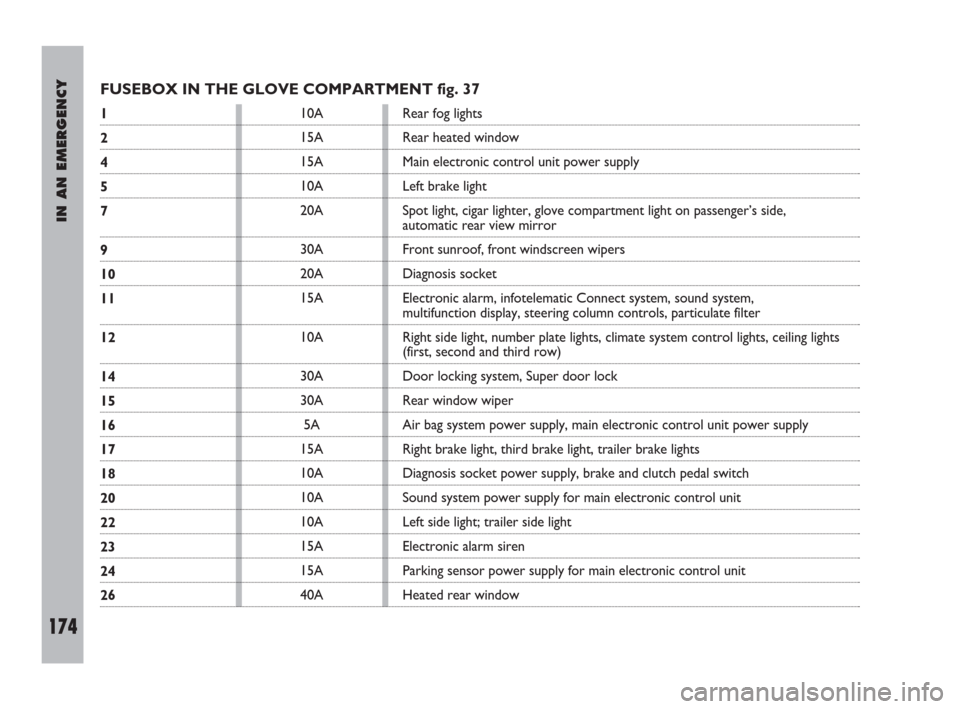
FUSEBOX IN THE GLOVE COMPARTMENT fig. 37
1
2
4
5
7
9
10
11
12
14
15
16
17
18
20
22
23
24
2610A
15A
15A
10A
20A
30A
20A
15A
10A
30A
30A
5A
15A
10A
10A
10A
15A
15A
40ARear fog lights
Rear heated window
Main electronic control unit power supply
Left brake light
Spot light, cigar lighter, glove compartment light on passenger’s side,
automatic rear view mirror
Front sunroof, front windscreen wipers
Diagnosis socket
Electronic alarm, infotelematic Connect system, sound system,
multifunction display, steering column controls, particulate filter
Right side light, number plate lights, climate system control lights, ceiling lights
(first, second and third row)
Door locking system, Super door lock
Rear window wiper
Air bag system power supply, main electronic control unit power supply
Right brake light, third brake light, trailer brake lights
Diagnosis socket power supply, brake and clutch pedal switch
Sound system power supply for main electronic control unit
Left side light; trailer side light
Electronic alarm siren
Parking sensor power supply for main electronic control unit
Heated rear window
153-183 ULYSSE ING:153-183 ULYSSE ING 13-11-2009 10:07 Pagina 174
Page 178 of 254
IN AN EMERGENCY
177
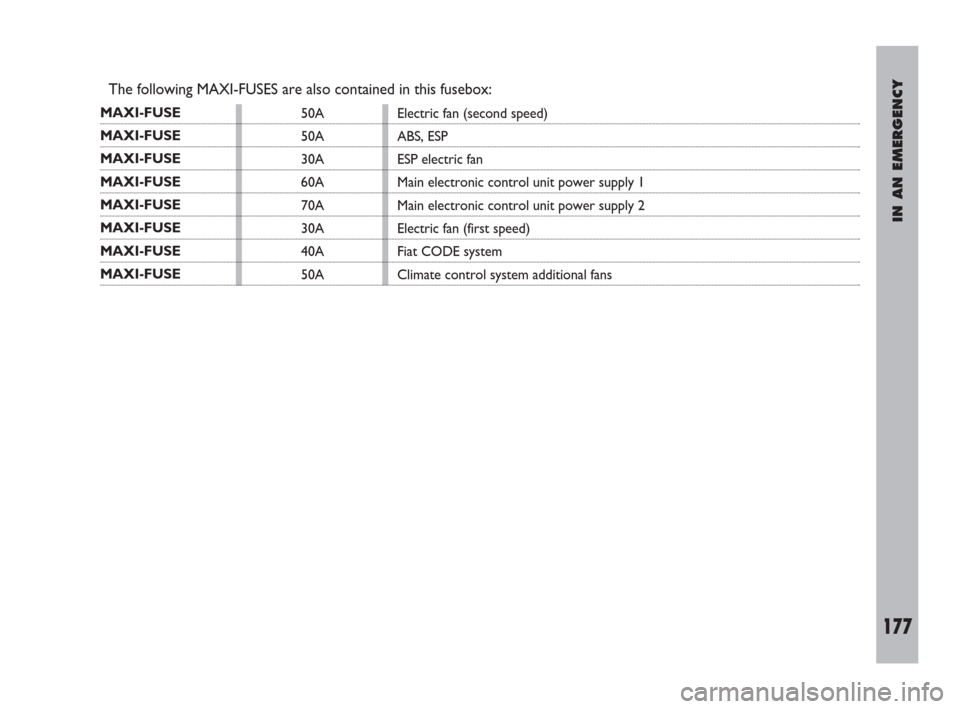
The following MAXI-FUSES are also contained in this fusebox:
MAXI-FUSE
MAXI-FUSE
MAXI-FUSE
MAXI-FUSE
MAXI-FUSE
MAXI-FUSE
MAXI-FUSE
MAXI-FUSE 50A
50A
30A
60A
70A
30A
40A
50AElectric fan (second speed)
ABS, ESP
ESP electric fan
Main electronic control unit power supply 1
Main electronic control unit power supply 2
Electric fan (first speed)
Fiat CODE system
Climate control system additional fans
153-183 ULYSSE ING:153-183 ULYSSE ING 13-11-2009 10:07 Pagina 177
Page 200 of 254
CAR MAINTENANCE
199
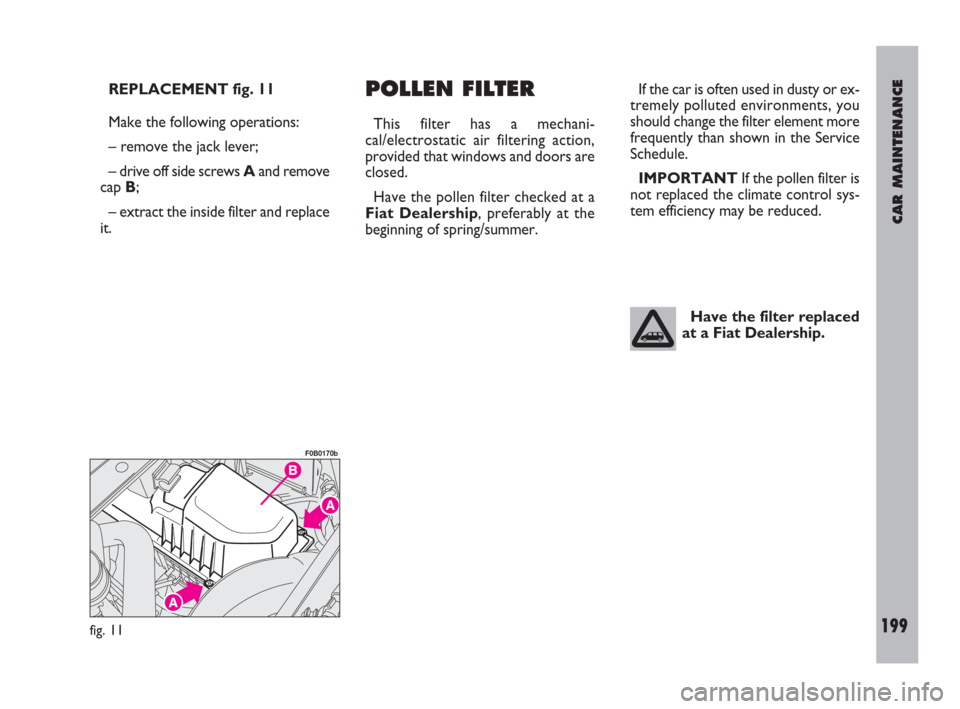
REPLACEMENT fig. 11
Make the following operations:
– remove the jack lever;
– drive off side screws Aand remove
cap B;
– extract the inside filter and replace
it.POLLEN FILTER
This filter has a mechani-
cal/electrostatic air filtering action,
provided that windows and doors are
closed.
Have the pollen filter checked at a
Fiat Dealership, preferably at the
beginning of spring/summer.If the car is often used in dusty or ex-
tremely polluted environments, you
should change the filter element more
frequently than shown in the Service
Schedule.
IMPORTANTIf the pollen filter is
not replaced the climate control sys-
tem efficiency may be reduced.
fig. 11
F0B0170b
Have the filter replaced
at a Fiat Dealership.
184-213 ULYSSE ING:184-213 ULYSSE ING 13-11-2009 10:13 Pagina 199
Page 233 of 254
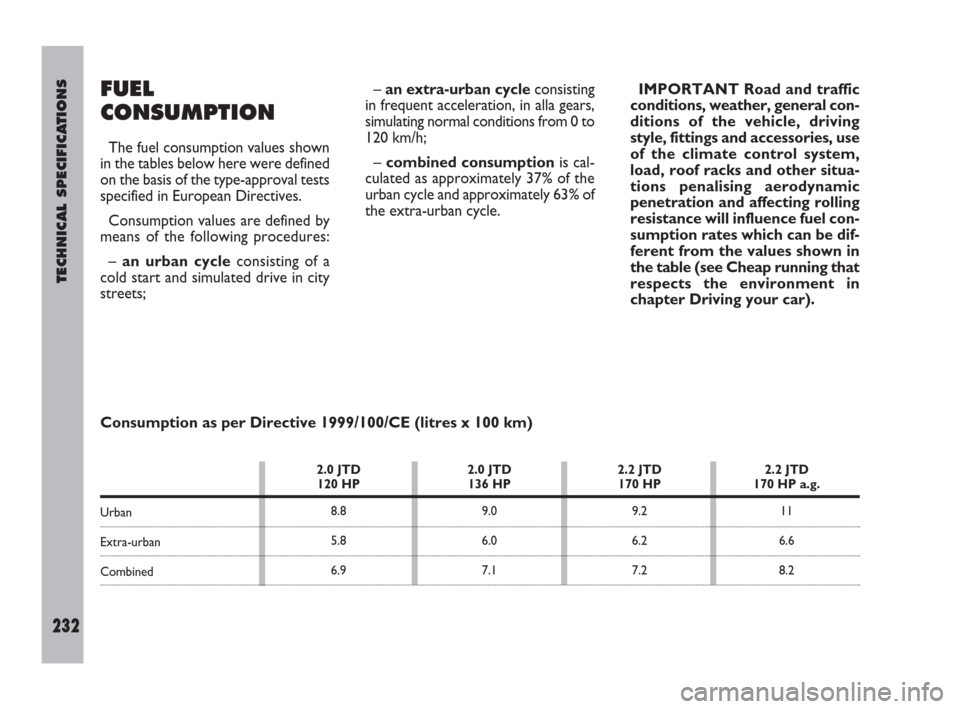
Consumption as per Directive 1999/100/CE (litres x 100 km)
TECHNICAL SPECIFICATIONS
232
FUEL
CONSUMPTION
The fuel consumption values shown
in the tables below here were defined
on the basis of the type-approval tests
specified in European Directives.
Consumption values are defined by
means of the following procedures:
– an urban cycleconsisting of a
cold start and simulated drive in city
streets;– an extra-urban cycleconsisting
in frequent acceleration, in alla gears,
simulating normal conditions from 0 to
120 km/h;
– combined consumptionis cal-
culated as approximately 37% of the
urban cycle and approximately 63% of
the extra-urban cycle.IMPORTANT Road and traffic
conditions, weather, general con-
ditions of the vehicle, driving
style, fittings and accessories, use
of the climate control system,
load, roof racks and other situa-
tions penalising aerodynamic
penetration and affecting rolling
resistance will influence fuel con-
sumption rates which can be dif-
ferent from the values shown in
the table (see Cheap running that
respects the environment in
chapter Driving your car).
2.0 JTD
120 HP
8.8
5.8
6.92.0 JTD
136 HP
9.0
6.0
7.12.2 JTD
170 HP
9.2
6.2
7.22.2 JTD
170 HP a.g.
11
6.6
8.2
Urban
Extra-urban
Combined
214-233 ULYSSE ING:214-233 ULYSSE ING 13-11-2009 10:21 Pagina 232