oil FIAT ULYSSE 2009 2.G User Guide
[x] Cancel search | Manufacturer: FIAT, Model Year: 2009, Model line: ULYSSE, Model: FIAT ULYSSE 2009 2.GPages: 254, PDF Size: 3.56 MB
Page 133 of 254
GETTING TO KNOW YOUR CAR
132
GENERAL NOTES
While parking, pay attention to ob-
stacles above or below the sensors. In
fact certain objects very close to the
vehicle rear part are not detected by
the system and so the car or the sen-
sors might get damaged.
Warnings coming from the damaged
sensors may be altered and no longer
reliable, also when they are covered
with dirt, mud, snow or ice, or con-
founded by nearby ultrasound systems
(e.g. air brakes of trucks or rivetting
hammers).SOUND SYSTEM
For the sound system, see the
“Sound system” handbook enclosed
to this “Owner handbook”.
ACCESSORIES
PURCHASED
B Y THE OWNER
If, after purchasing your car, you wish
to add electric accessories (alarm,
satellite antitheft device, etc.) that re-
quire permanent power supply or high
feed accessories, visit a Fiat Dealer-
ship. The staff of experts, beside sug-
gesting the most suitable accessories
in the Lineaccessori Fiat range, will al-
so check whether the car electrical
system can support the the required
load or if a larger size battery needs to
be installed.Take care when fitting
additional spoilers, alloy
rims and non-standard
wheel caps: they might reduce
ventilation of the brakes, thus
their efficiency, during abrupt
and repeated braking, or long
downhill slopes. Make sure that
nothing (mats, etc.) gets in the
way of the pedals when they are
pushed down.
078-135 ULYSSE ING 10-03-2009 11:39 Pagina 132
Page 141 of 254
DRIVING YOUR CAR
140
BEFORE GETTING BEHIND
THE WHEEL
The main suggestions are the fol-
lowing:
– make sure all lights including the
headlights are working properly;
– adjust the position of the seat,
steering wheel, driving and door mir-
rors properly for the best driving po-
sition;
– adjust the head restraints careful-
ly so that they support the head and
not the neck;
– make sure that nothing (mats, etc.)
gets in the way of the pedals when
they are pushed down;
– make sure that any child restraint
systems (child seats, carriers, etc.) are
properly fixed, preferably on the back
seat as this is the safest place in the
event of an accident;– make sure that objects being trans-
ported are carefully arranged so they
will not fly forward if you have to
brake sharply;
– do not eat a heavy meal before
travelling. Light eating will help keep
your reflexes prompt. Above all, do
not have anything alcoholic to drink.
Using certain prescription drugs can
reduce your ability to drive: read in-
structions for use carefully.
Periodically, remember to check:
– tyre pressure and conditions;
– engine oil level;
– coolant level and conditions of the
system;
– brake fluid level;
– power steering fluid level;
– windscreen washer liquid level.WHEN TRAVELLING
The main suggestions are the fol-
lowing:
– the first rule of safe driving is pru-
dence. Prudence also means putting
yourself into a position where you can
predict wrong or imprudent behaviour
from other drivers;
– stick closely to the rules of the
road in the particular country where
the vehicle is being driven and, above
all, do not exceed speed limits;
– ensure that, besides yourself, all the
other passengers in the vehicle have
their seat belts fastened, that children
are sitting in the appropriate child
seats and any animals in the car are
placed in suitable compartments;
– you should be physically fit and
mentally alert before setting out on
long journeys;
136-152 ULYSSE ING 10-03-2009 11:40 Pagina 140
Page 142 of 254
DRIVING YOUR CAR
141
Be careful when fitting
additional spoilers, light
alloy rims and optional
wheel caps: these devices could
reduce brake ventilation and ef-
ficiency in the event of repeated
and sudden braking or long
downhill drives.Never drive with objects
on the floor in front of the
driver’s seat. The objects
could get jammed under the ped-
als making braking or accelerat-
ing impossible.
Driving while drunk or
under the influence of
drugs or certain medi-
cines is dangerous for both you
and other road users.Pay attention to mats: if
you note even a small
problem in braking, the
pedal stroke may need to be ad-
justed.
Always fasten both front
and back seat belts, in-
cluding child restraint sys-
tems. Travelling with the seat
belts unfastened increases the
risk of injury or death if you are
in a collision.
Water, ice and road salt
may deposit on brake
discs making it difficult to
brake the first time this is neces-
sary.– do not drive too many hours at a
time but stop at intervals to stretch
your legs and recoup your energies;
– make sure the air in the vehicle is
being changed continuously;
– never coast downhill (i.e. with the
engine off): if you do, you lose the aid
of the engine brake, power brakes and
power steering, so that braking and
steering require greater effort.
136-152 ULYSSE ING 10-03-2009 11:40 Pagina 141
Page 146 of 254
DRIVING YOUR CAR
145
CONTAINING RUNNING COSTS
AND POLLUTION
Tyres
Tyre pressure should be checked at
least once every four weeks: if the
pressure is too low fuel consumption
increases as the resistance to the
rolling movement of the tyre is
greater. In this state, tyre wear is in-
creased and vehicle handling suffers,
which will effect safety.
Unnecessary loads
Do not travel with too much luggage
stowed in the boot. The weight of the
vehicle (especially when driving in the
city) and its trim greatly effects con-
sumption and stability.
Roof rack/ski rack
Remove the roof/ski rack from the
roof when no longer necessary. These
accessories reduce the vehicle’s aero-
dynamic penetration, which affects
consumption. Use a trailer, if particu-
larly heavy objects are to be trans-
ported. Some suggestions which may help
you to keep the running costs of the
car down and lower the amount of
toxic emissions released into the at-
mosphere are given below.
GENERAL CONSIDERATIONS
Car maintenance
The overall state of the vehicle is an
important factor that has a marked in-
fluence over fuel consumption, driving
comfort and on the life span of your
vehicle. For this reason, care should
be taken to maintain your vehicle by
carrying out the necessary checks and
observing regulations in accordance
with the specifications given in the
Scheduled Maintenance Programme
(see section, idling, air cleaners, tim-
ing).Electrical devices
Use electric devices for the neces-
sary time only. The heated rear win-
dow, supplementary lights, windscreen
wipers, heating system blower require
large amounts of electricity; this means
an increase in the request for power
and consequently an increase in fuel
consumption (up to +25% when dri-
ving in built-up areas).
Climate control system
The climate control unit is an addi-
tional load that greatly affects the en-
gine leading to higher consumption (on
average +20%). When the tempera-
ture outside allows it, use the air
vents.
Spoilers
The use of optional extras which are
not certified for specific use on the car
may reduce the aerodynamic pene-
tration of the car and increase con-
sumption.
136-152 ULYSSE ING 10-03-2009 11:40 Pagina 145
Page 152 of 254
DRIVING YOUR CAR
151
STORING THE CAR
The following precautions should be
taken if the car will not be used for
several months:
– park the vehicle in covered, dry and
if possible well-ventilated premises;
– engage a gear (Pfor versions with
automatic electronic gear);
– make sure the handbrake is not en-
gaged;
– clean and protect the painted parts
using protective wax;
– sprinkle talcum powder on the rub-
ber windscreen and rear window
wiper blades and lift them off the glass;
– slightly open the windows;
– inflate the tyres to 0.5 bar above
the normal specified pressure and
check it at intervals;– switch off the electronic car alarm;
– disconnect the terminals (–) from
the battery poles (negative pole first)
and check the battery charge. When
the vehicle is in storage, this check
should be carried out once a month.
If no-load voltage is less than 12.5V,
recharge the battery;
– do not drain the engine cooling sys-
tem;
– cover the vehicle with a cloth or
perforated plastic sheet. Do not use
sheets of non-perforated plastic as
they do not allow moisture on the car
body to evaporate.RESTARTING THE CAR
AFTER STORAGE
Before restarting the vehicle after a
long storage, make the following op-
erations:
– do not take dust off the bodywork
without water;
– check if there are fluid leakages (oil,
brake and clutch fluid, engine coolant,
etc.);
– have the engine oil and the filter re-
placed;
– check the level of: brake and clutch
fluid, engine coolant;
136-152 ULYSSE ING 10-03-2009 11:40 Pagina 151
Page 187 of 254
30 60 90 120 150 180
●●●●●●
●
●
●●●
●●●●●●
●●●
●●●●●●
●●●
●●●●●●
CAR MAINTENANCE
186
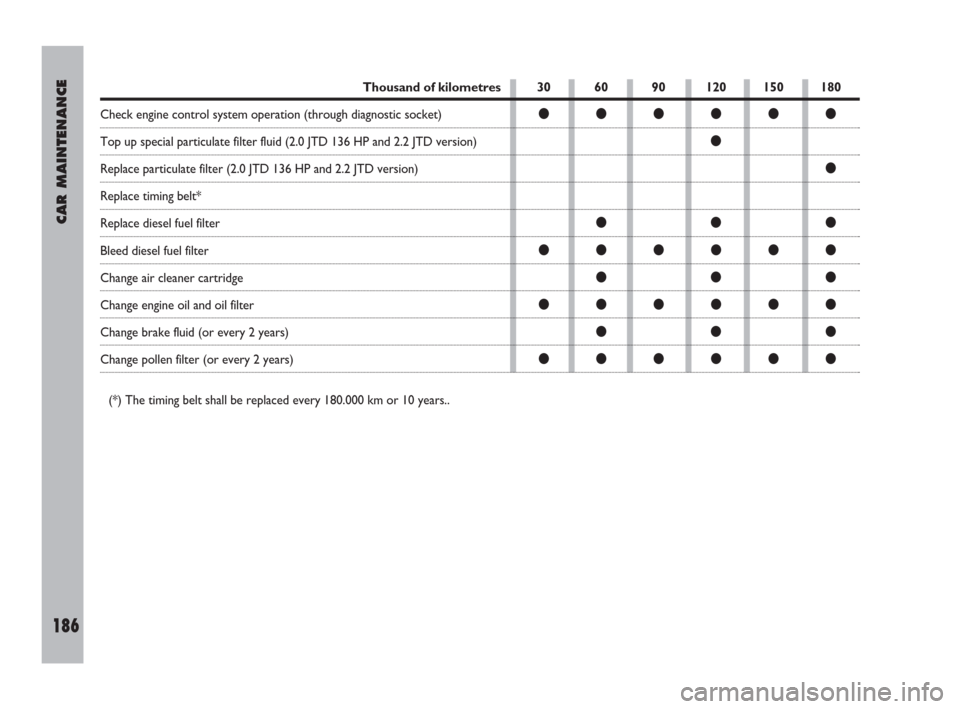
Thousand of kilometres
Check engine control system operation (through diagnostic socket)
Top up special particulate filter fluid (2.0 JTD 136 HP and 2.2 JTD version)
Replace particulate filter (2.0 JTD 136 HP and 2.2 JTD version)
Replace timing belt*
Replace diesel fuel filter
Bleed diesel fuel filter
Change air cleaner cartridge
Change engine oil and oil filter
Change brake fluid (or every 2 years)
Change pollen filter (or every 2 years)
(*) The timing belt shall be replaced every 180.000 km or 10 years..
184-213 ULYSSE ING:184-213 ULYSSE ING 13-11-2009 10:13 Pagina 186
Page 188 of 254
CAR MAINTENANCE
187
Every 1,000 km or before long jour-
neys, check and top up if required:
– engine coolant fluid level;
– brake fluid level;
– windscreen washer fluid level;
– yre pressure and conditions;– light system operation (headlights,
direction indicators, hazard lights,
etc.);
– windscreen wiper/washer opera-
tion and windscreen/rear window
blade position/wear;Every 3,000 km check and top up if
required: engine oil level.
You are recommended to use
PETRONAS LUBRICANTS, products,
designed and produced specifically for
Fiat vehicles (see table “Capacities” in
section “Technical specifications”).
ROUTINE MAINTENANCE
184-213 ULYSSE ING:184-213 ULYSSE ING 13-11-2009 10:13 Pagina 187
Page 191 of 254
CAR MAINTENANCE
190
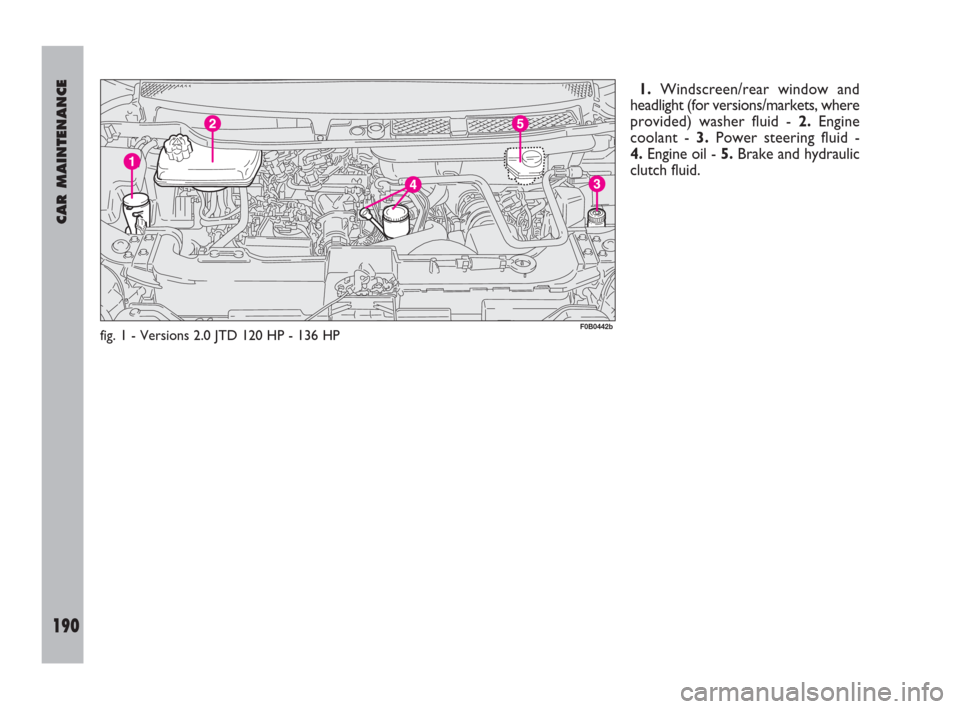
1.Windscreen/rear window and
headlight (for versions/markets, where
provided) washer fluid -2.Engine
coolant - 3.Power steering fluid -
4.Engine oil - 5.Brake and hydraulic
clutch fluid.
fig. 1 - Versions 2.0 JTD 120 HP - 136 HPF0B0442b
184-213 ULYSSE ING:184-213 ULYSSE ING 13-11-2009 10:13 Pagina 190
Page 192 of 254
CAR MAINTENANCE
191
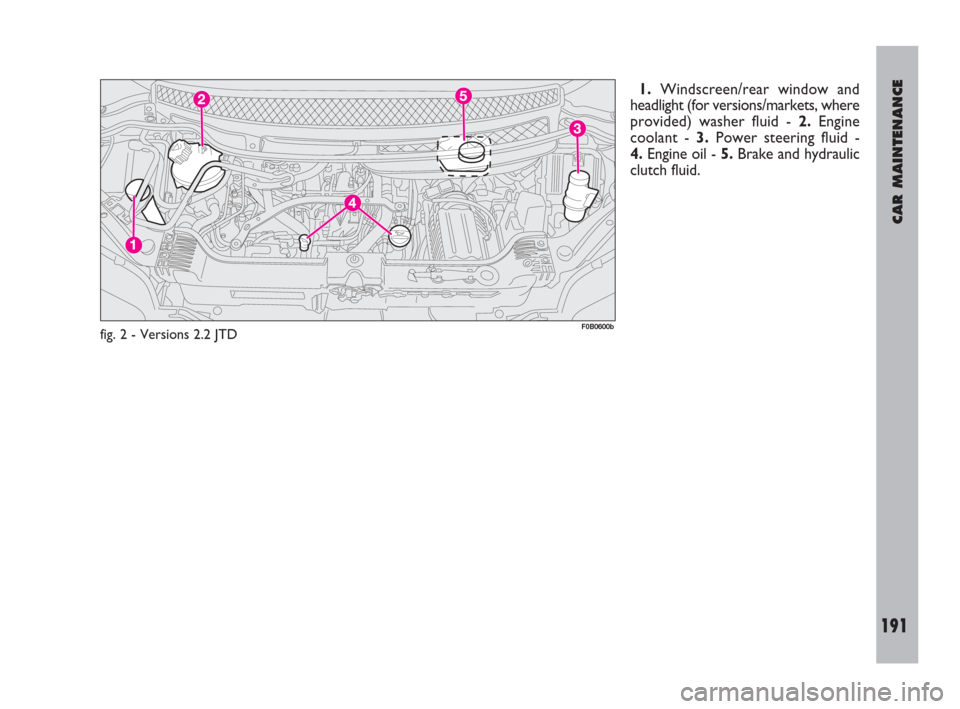
1.Windscreen/rear window and
headlight (for versions/markets, where
provided) washer fluid -2.Engine
coolant - 3.Power steering fluid -
4.Engine oil - 5.Brake and hydraulic
clutch fluid.
fig. 2 - Versions 2.2 JTDF0B0600b
184-213 ULYSSE ING:184-213 ULYSSE ING 13-11-2009 10:13 Pagina 191
Page 193 of 254
CAR MAINTENANCE
192
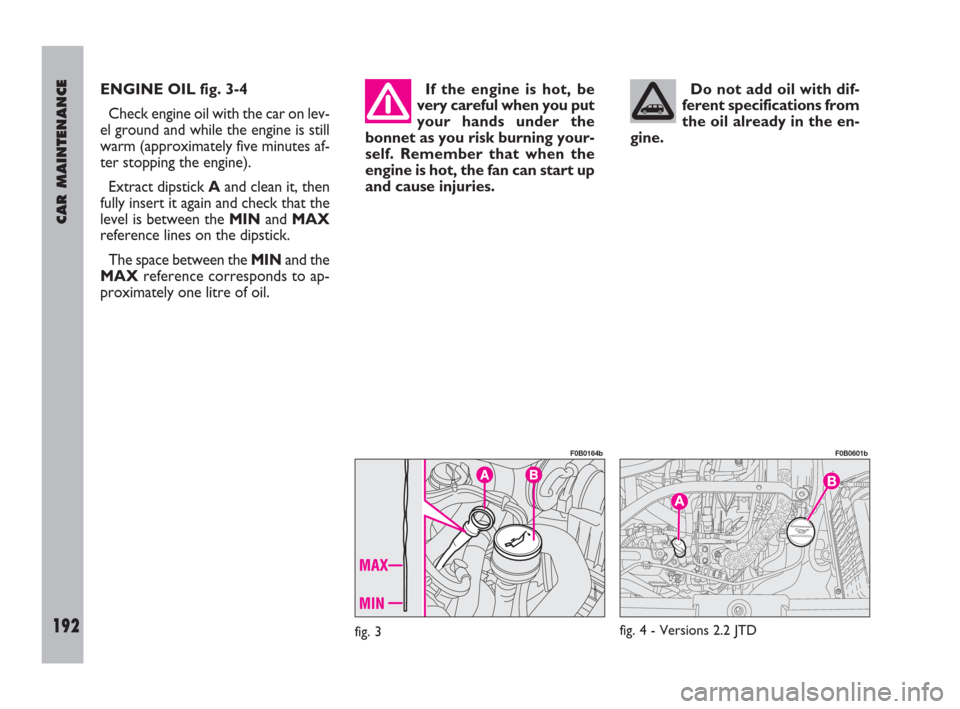
ENGINE OIL fig. 3-4
Check engine oil with the car on lev-
el ground and while the engine is still
warm (approximately five minutes af-
ter stopping the engine).
Extract dipstick Aand clean it, then
fully insert it again and check that the
level is between the MINand MAX
reference lines on the dipstick.
The space between the MINand the
MAXreference corresponds to ap-
proximately one litre of oil.Do not add oil with dif-
ferent specifications from
the oil already in the en-
gine.If the engine is hot, be
very careful when you put
your hands under the
bonnet as you risk burning your-
self. Remember that when the
engine is hot, the fan can start up
and cause injuries.
fig. 3
F0B0164b
fig. 4 - Versions 2.2 JTD
F0B0601b
184-213 ULYSSE ING:184-213 ULYSSE ING 13-11-2009 10:13 Pagina 192