lights FIAT ULYSSE 2009 2.G Owner's Manual
[x] Cancel search | Manufacturer: FIAT, Model Year: 2009, Model line: ULYSSE, Model: FIAT ULYSSE 2009 2.GPages: 254, PDF Size: 3.56 MB
Page 115 of 254
GETTING TO KNOW YOUR CAR
114
HEADLAMPS
XENON LAMPS
(for versions/markets, where provided)
Xenon lamps work with a voltaic arc
in a pressure Xenon saturated envi-
ronment, in place of the traditional fil-
ament.
The produced light is far greater than
that of traditional lamps, both for its
quality (lighter) and its lighting range.
The advantages in using such lamps
are the following: less eyes fatigue, im-
proved driver’s orientation and driving
safety, especially with the bad weath-
er, with fog and/or inadequate road
signs, illumination of side bands usu-
ally in the shadow.Illumination of side bands consider-
ably improves driving safety because
the driver is able to identify other road
users on the road margins (pedestri-
ans, bikers and motor-bikers).
When the lights come on, the volta-
ic arc tension is very high, but then it
falls.
The maximum light is obtained after
0.5 seconds after turning the head-
lamps on.
The great light produced by this type
of headlamps requires an automatic
system for maintaining the headlight
beam constant and preventing dazzling
other vehicles in the event of sudden
braking, acceleration or while carrying
heavy loads. Never load the rack with
more than the weight al-
lowed (see the “Technical
specifications” section).
Be careful not to knock
the tailgate into objects
on the roof rack.
After travelling a few
miles, check that the an-
chorage bolts of the at-
tachments are still fully tight.
078-135 ULYSSE ING 10-03-2009 11:39 Pagina 114
Page 119 of 254
GETTING TO KNOW YOUR CAR
118
MBA AND HBA
SYSTEM
(for versions/markets, where provided)
The MBA (Mechanic Brake Assis-
tance) and HBA (Hydraulic Brake As-
sistance) systems increase braking
pressure in emergency braking. When
the driver is forced by the critical dri-
ving conditions to press violently the
brake pedal, the system increases the
braking pressure to assure the quick-
est vehicle stop.
These two systems behave in the
same way, the only difference is that
one increases braking pressure
through the ESP control unit and the
other with a mechanic action. By following these indications you
will be able to brake in the best con-
ditions in all events.
IMPORTANTVehicles fitted with
ABS may only be fitted with wheel
rims, tyres and brake pads of the make
and model approved by the vehicle
manufacturer.
The system is completed with an
Electronic Brake Distributor EBD
which increases the brake system per-
formance and employs the ABS con-
trol unit and sensors.
If the xbrake fluid low
warning light comes on,
stop the vehicle immedi-
ately and contact the nearest Fi-
at Dealership. Fluid leaks from
the hydraulic system, in fact, can
compromise brake system oper-
ation, both traditional systems
and systems with ABS. The car is fitted with an
electronic braking device
(EBD). The xand >
warning lights will come on at the
same time when the engine is
running to indicate that there is
an EBD system failure. In this
case violent braking may be ac-
companied by early rear wheel
locking with the possibility of
skidding. Drive the car extreme-
ly carefully to the nearest Fiat
Dealership to have the system
checked.Warning light >alone,
with the engine running,
normally indicates a fault
in the ABS system. In this case,
the braking system is still effi-
cient, though without the an-
tilocking device. Under these
conditions, performance of the
EBD system may be reduced. Al-
so in this case, you are advised to
go immediately to the nearest Fi-
at Dealership, driving in such a
way to avoid sharp braking to
have the system checked.
078-135 ULYSSE ING 10-03-2009 11:39 Pagina 118
Page 141 of 254
DRIVING YOUR CAR
140
BEFORE GETTING BEHIND
THE WHEEL
The main suggestions are the fol-
lowing:
– make sure all lights including the
headlights are working properly;
– adjust the position of the seat,
steering wheel, driving and door mir-
rors properly for the best driving po-
sition;
– adjust the head restraints careful-
ly so that they support the head and
not the neck;
– make sure that nothing (mats, etc.)
gets in the way of the pedals when
they are pushed down;
– make sure that any child restraint
systems (child seats, carriers, etc.) are
properly fixed, preferably on the back
seat as this is the safest place in the
event of an accident;– make sure that objects being trans-
ported are carefully arranged so they
will not fly forward if you have to
brake sharply;
– do not eat a heavy meal before
travelling. Light eating will help keep
your reflexes prompt. Above all, do
not have anything alcoholic to drink.
Using certain prescription drugs can
reduce your ability to drive: read in-
structions for use carefully.
Periodically, remember to check:
– tyre pressure and conditions;
– engine oil level;
– coolant level and conditions of the
system;
– brake fluid level;
– power steering fluid level;
– windscreen washer liquid level.WHEN TRAVELLING
The main suggestions are the fol-
lowing:
– the first rule of safe driving is pru-
dence. Prudence also means putting
yourself into a position where you can
predict wrong or imprudent behaviour
from other drivers;
– stick closely to the rules of the
road in the particular country where
the vehicle is being driven and, above
all, do not exceed speed limits;
– ensure that, besides yourself, all the
other passengers in the vehicle have
their seat belts fastened, that children
are sitting in the appropriate child
seats and any animals in the car are
placed in suitable compartments;
– you should be physically fit and
mentally alert before setting out on
long journeys;
136-152 ULYSSE ING 10-03-2009 11:40 Pagina 140
Page 143 of 254
DRIVING YOUR CAR
142
– only use full-beam headlights when
you are driving outside the city and
when you are sure they do not annoy
other drivers;
– if the headlights are on full, dip
them when you meet cars going in the
other direction and pass them with the
headlights dipped;
– keep all lights clean;
– be careful of animals crossing the
road when driving in the country.
DRIVING IN THE RAIN
Rain and wet road surfaces spell dan-
ger.
All manoeuvres are more difficult on
a wet road because the friction of the
wheels on the tarmac is greatly re-
duced. This is why braking distances
are much longer and roadholding on
bends is lower.
The main suggestions are the fol-
lowing:
– reduce speed and keep a greater
safety distance from the cars in front;– if it is raining particularly heavily,
visibility is also reduced. In these cas-
es, switch on the dipped headlights
even if it is still daylight, to make your-
self easier to be seen;
– do not drive through puddles at
speed and hold on tightly to the wheel:
the loss of grip caused by taking a pud-
dle at speed can make you lose con-
trol of the vehicle (“aquaplaning”);
– move the ventilation controls to
the position for demisting the win-
dows (see the section “Getting to
know your car”), to avoid visibility
problems;
– periodically check the condition of
the windscreen wiper blades. DRIVING AT NIGHT
The main suggestions are the fol-
lowing:
– drive especially carefully: it is hard-
er to drive at night;
– slow down especially if the road is
not lit;
– at the first signs of sleepiness, stop:
continuing would be a risk to yourself
and everybody else. Only start driving
again when you have had enough rest;
– keep a greater safety distance from
the cars in front of you than during
daylight hours: it is hard to judge how
fast other cars are going when all you
can see are their lights;
– make sure the headlight beams are
properly positioned: if they are too
low, they reduce visibility and are hard
on the eyes. If they are too high they
can dazzle other drivers;
136-152 ULYSSE ING 10-03-2009 11:40 Pagina 142
Page 144 of 254
DRIVING YOUR CAR
143
Remember that fog also means the
tarmac is wet and therefore manoeu-
vres of all kinds are more difficult and
stopping distances are longer:
– keep a good distance from the cars
in front of you;
– when possible, avoid spurts of
speed or sudden deceleration;
– do not overtake other vehicles if
you can help it;
– if you are forced to stop your ve-
hicle (breakdown, limited visibility,
etc.), first try to stop off the road.
Then turn on the hazard lights and, if
possible, the dipped headlights;
– rhythmically sound the horn if you
realise another vehicle is approaching.DRIVING IN
THE MOUNTAINS
The main suggestions are the fol-
lowing:
– when driving downhill use the en-
gine brake by engaging a low gear so
as not to overheat the brakes;
– under no circumstances should you
drive downhill with the engine off or
with the vehicle in neutral, let alone
with the ignition key out;
– drive at moderate speed without
“cutting” corners;
– remember that overtaking while
going uphill is slower and therefore re-
quires more clear road. If you are be-
ing overtaken while driving uphill,
make it easier for the other vehicle
to pass. DRIVING IN FOG
If the fog is thick, do not start out on
a journey unless you absolutely have to.
If driving in mist, blanket fog or when
there is the danger of fog patches:
– keep your speed down;
– turn on the dipped headlights, rear
fog lights and front fog lights, if fitted,
even during the day. Do not drive with
your headlights at full-beam.
IMPORTANTOn stretches of
road with good visibility, switch off
your rear foglights; the brightness of
these lights could annoy the people
travelling in the cars behind.
136-152 ULYSSE ING 10-03-2009 11:40 Pagina 143
Page 146 of 254
DRIVING YOUR CAR
145
CONTAINING RUNNING COSTS
AND POLLUTION
Tyres
Tyre pressure should be checked at
least once every four weeks: if the
pressure is too low fuel consumption
increases as the resistance to the
rolling movement of the tyre is
greater. In this state, tyre wear is in-
creased and vehicle handling suffers,
which will effect safety.
Unnecessary loads
Do not travel with too much luggage
stowed in the boot. The weight of the
vehicle (especially when driving in the
city) and its trim greatly effects con-
sumption and stability.
Roof rack/ski rack
Remove the roof/ski rack from the
roof when no longer necessary. These
accessories reduce the vehicle’s aero-
dynamic penetration, which affects
consumption. Use a trailer, if particu-
larly heavy objects are to be trans-
ported. Some suggestions which may help
you to keep the running costs of the
car down and lower the amount of
toxic emissions released into the at-
mosphere are given below.
GENERAL CONSIDERATIONS
Car maintenance
The overall state of the vehicle is an
important factor that has a marked in-
fluence over fuel consumption, driving
comfort and on the life span of your
vehicle. For this reason, care should
be taken to maintain your vehicle by
carrying out the necessary checks and
observing regulations in accordance
with the specifications given in the
Scheduled Maintenance Programme
(see section, idling, air cleaners, tim-
ing).Electrical devices
Use electric devices for the neces-
sary time only. The heated rear win-
dow, supplementary lights, windscreen
wipers, heating system blower require
large amounts of electricity; this means
an increase in the request for power
and consequently an increase in fuel
consumption (up to +25% when dri-
ving in built-up areas).
Climate control system
The climate control unit is an addi-
tional load that greatly affects the en-
gine leading to higher consumption (on
average +20%). When the tempera-
ture outside allows it, use the air
vents.
Spoilers
The use of optional extras which are
not certified for specific use on the car
may reduce the aerodynamic pene-
tration of the car and increase con-
sumption.
136-152 ULYSSE ING 10-03-2009 11:40 Pagina 145
Page 147 of 254
DRIVING YOUR CAR
146
DRIVING STYLE
Starting
Do not warm the engine when the
vehicle is stationary or at high or low
revs: in this way the engine will warm
up gradually increasing consumption
and emissions. You should drive off
slowly straight away avoiding high revs
so that the engine will warm up more
quickly.
Unnecessary actions
Avoid revving the engine when
stopped at traffic lights or before
switching off the engine and avoid dou-
ble-clutching as these actions have no
purpose on modern vehicles and serve
only to increase consumption and pol-
lution.
Gear selections
As soon as the traffic and road con-
ditions allow it, shift to a higher gear.
Using a lower gear to liven up accel-
eration greatly increases consumption.
In the same way, improper use of the
higher gears will increase consump-
tion, emissions and wear and tear on
the engine.Top speeds
Fuel consumption increases consid-
erably as speed increases. For exam-
ple, when accelerating from 90 to
120 Kph, fuel consumption increases
by about +30%. Your speed should be
kept as even as possible and superflu-
ous braking and acceleration avoided
as this increases both consumption
and emissions. A “soft” way of driving
should be adopted by attempting to
anticipate manoeuvres to avoid immi-
nent danger and to keep a safe dis-
tance from the vehicle in front to
avoid braking sharply.
Acceleration
Accelerating violently increasing the
revs will greatly effect consumption
and emission: acceleration should be
gradual and not exceed the maximum
torque.CONDITIONS OF USE
Cold starting
Short trips and frequent cold start-
ing will not enable the engine to reach
optimal running temperature (from
+15 to +30% in built up areas) as will
the production of toxic emissions.
Traffic and road conditions
Heavy traffic and higher consumption
are synonymous: for example, when
driving slowly with frequent use of
lower gears or in large towns where
there are numerous traffic lights.
Winding roads, mountain roads and
bumpy roads also have a negative ef-
fect on consumption.
Enforced halts
During prolonged stops (traffic lights,
level crossings, etc.) the engine should
be switched off.
136-152 ULYSSE ING 10-03-2009 11:40 Pagina 146
Page 156 of 254
IN AN EMERGENCY
155
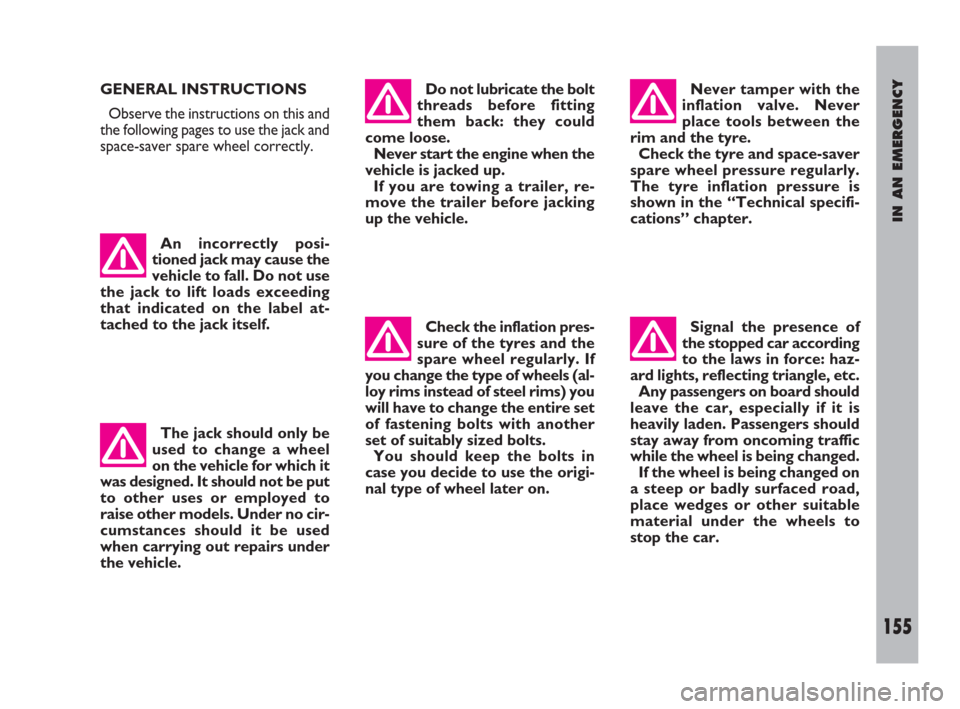
An incorrectly posi-
tioned jack may cause the
vehicle to fall. Do not use
the jack to lift loads exceeding
that indicated on the label at-
tached to the jack itself.Do not lubricate the bolt
threads before fitting
them back: they could
come loose.
Never start the engine when the
vehicle is jacked up.
If you are towing a trailer, re-
move the trailer before jacking
up the vehicle.Never tamper with the
inflation valve. Never
place tools between the
rim and the tyre.
Check the tyre and space-saver
spare wheel pressure regularly.
The tyre inflation pressure is
shown in the “Technical specifi-
cations” chapter.
The jack should only be
used to change a wheel
on the vehicle for which it
was designed. It should not be put
to other uses or employed to
raise other models. Under no cir-
cumstances should it be used
when carrying out repairs under
the vehicle.
Check the inflation pres-
sure of the tyres and the
spare wheel regularly. If
you change the type of wheels (al-
loy rims instead of steel rims) you
will have to change the entire set
of fastening bolts with another
set of suitably sized bolts.
You should keep the bolts in
case you decide to use the origi-
nal type of wheel later on.Signal the presence of
the stopped car according
to the laws in force: haz-
ard lights, reflecting triangle, etc.
Any passengers on board should
leave the car, especially if it is
heavily laden. Passengers should
stay away from oncoming traffic
while the wheel is being changed.
If the wheel is being changed on
a steep or badly surfaced road,
place wedges or other suitable
material under the wheels to
stop the car.
GENERAL INSTRUCTIONS
Observe the instructions on this and
the following pages to use the jack and
space-saver spare wheel correctly.
153-183 ULYSSE ING:153-183 ULYSSE ING 13-11-2009 10:07 Pagina 155
Page 162 of 254
IN AN EMERGENCY
161
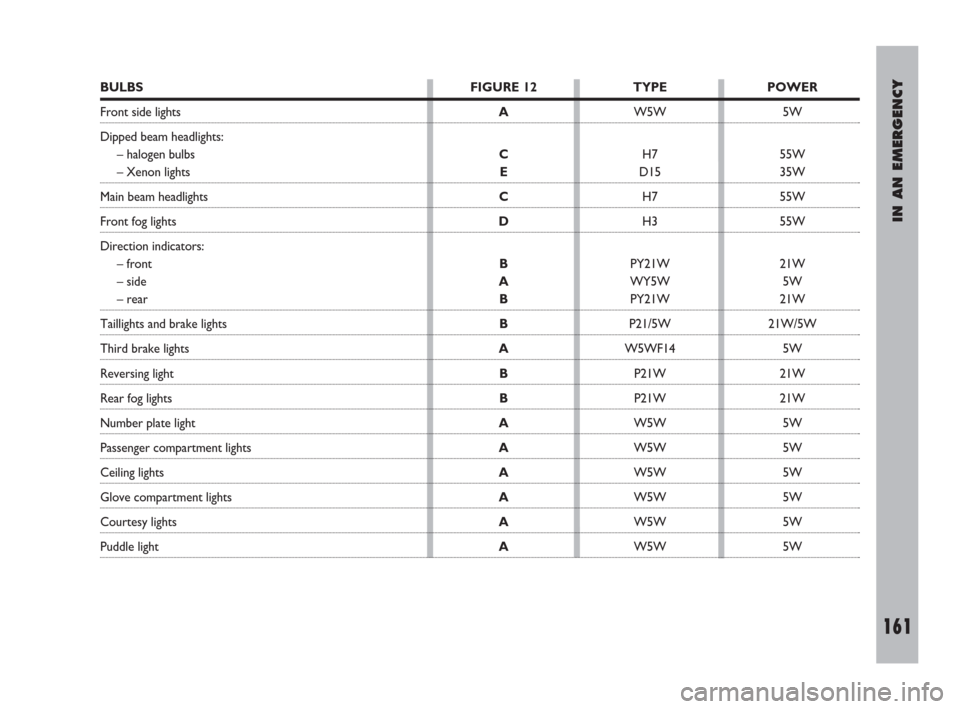
BULBS
Front side lights
Dipped beam headlights:
– halogen bulbs
– Xenon lights
Main beam headlights
Front fog lights
Direction indicators:
– front
– side
– rear
Taillights and brake lights
Third brake lights
Reversing light
Rear fog lights
Number plate light
Passenger compartment lights
Ceiling lights
Glove compartment lights
Courtesy lights
Puddle lightFIGURE 12
A
C
E
C
D
B
A
B
B
A
B
B
A
A
A
A
A
ATYPE
W5W
H7
D15
H7
H3
PY21W
WY5W
PY21W
P21/5W
W5WF14
P21W
P21W
W5W
W5W
W5W
W5W
W5W
W5WPOWER
5W
55W
35W
55W
55W
21W
5W
21W
21W/5W
5W
21W
21W
5W
5W
5W
5W
5W
5W
153-183 ULYSSE ING:153-183 ULYSSE ING 13-11-2009 10:07 Pagina 161
Page 163 of 254
IN AN EMERGENCY
162
IF AN EXTERIOR
LIGHT BURNS OUT
Modifications or repairs
to the electrical system
carried out incorrectly
and without bearing the features
of the system in mind can cause
malfunctions with the risk of fire.
IMPORTANTSee “If a bulb burns
out” for information on bulb types and
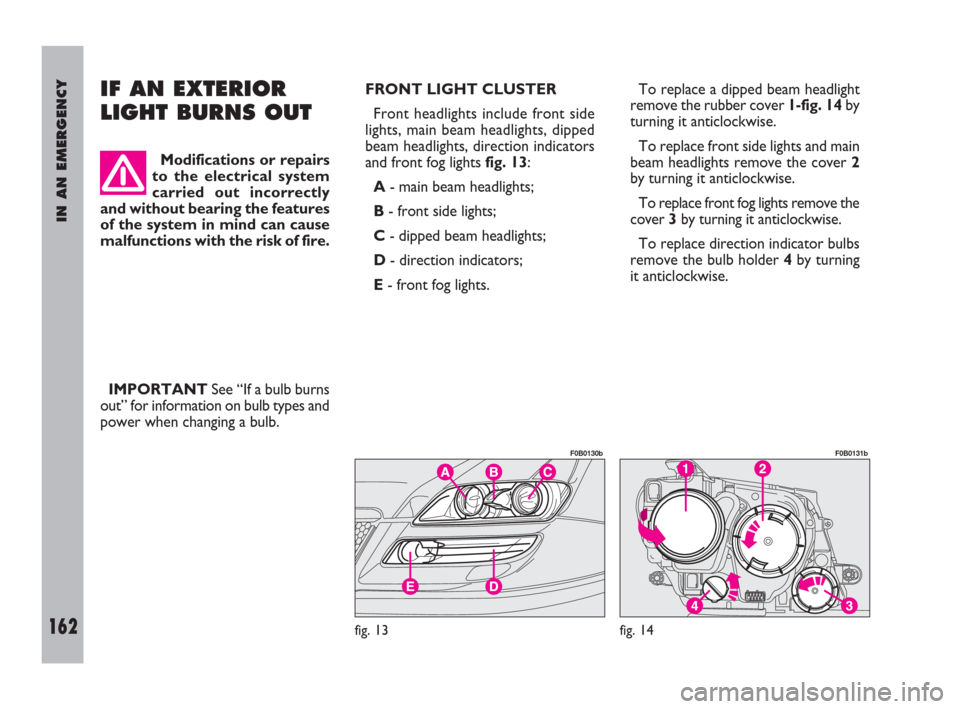
power when changing a bulb.FRONT LIGHT CLUSTER
Front headlights include front side
lights, main beam headlights, dipped
beam headlights, direction indicators
and front fog lights fig. 13:
A- main beam headlights;
B- front side lights;
C- dipped beam headlights;
D- direction indicators;
E- front fog lights.To replace a dipped beam headlight
remove the rubber cover 1-fig. 14by
turning it anticlockwise.
To replace front side lights and main
beam headlights remove the cover 2
by turning it anticlockwise.
To replace front fog lights remove the
cover 3by turning it anticlockwise.
To replace direction indicator bulbs
remove the bulb holder 4by turning
it anticlockwise.
fig. 13
F0B0130b
fig. 14
F0B0131b
153-183 ULYSSE ING:153-183 ULYSSE ING 13-11-2009 10:07 Pagina 162