open bonnet FIAT UNO 1983 Service User Guide
[x] Cancel search | Manufacturer: FIAT, Model Year: 1983, Model line: UNO, Model: FIAT UNO 1983Pages: 303, PDF Size: 10.36 MB
Page 234 of 303
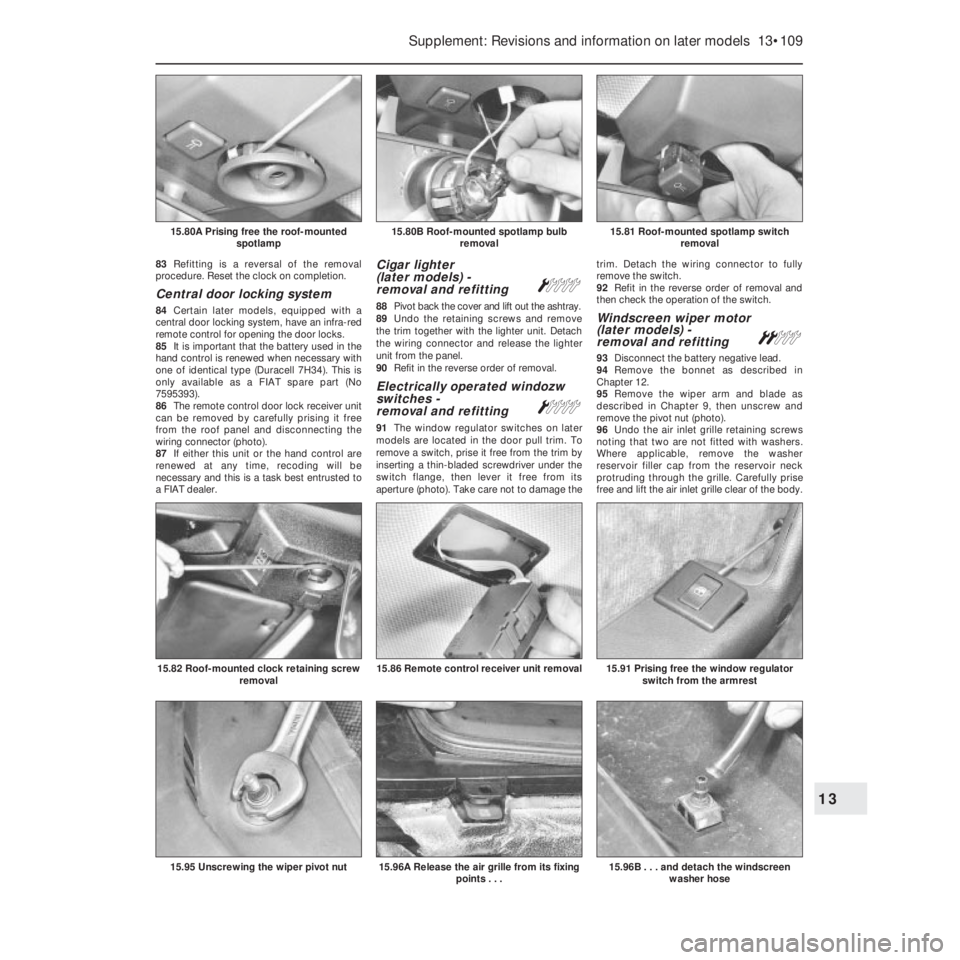
83Refitting is a reversal of the removal
procedure. Reset the clock on completion.
Central door locking system
84Certain later models, equipped with a
central door locking system, have an infra-red
remote control for opening the door locks.
85It is important that the battery used in the
hand control is renewed when necessary with
one of identical type (Duracell 7H34). This is
only available as a FIAT spare part (No
7595393).
86The remote control door lock receiver unit
can be removed by carefully prising it free
from the roof panel and disconnecting the
wiring connector (photo).
87If either this unit or the hand control are
renewed at any time, recoding will be
necessary and this is a task best entrusted to
a FIAT dealer.
Cigar lighter
(later models) -
removal and refitting
Á
88Pivot back the cover and lift out the ashtray.
89Undo the retaining screws and remove
the trim together with the lighter unit. Detach
the wiring connector and release the lighter
unit from the panel.
90Refit in the reverse order of removal.
Electrically operated windozw
switches -
removal and refitting
Á
91The window regulator switches on later
models are located in the door pull trim. To
remove a switch, prise it free from the trim by
inserting a thin-bladed screwdriver under the
switch flange, then lever it free from its
aperture (photo). Take care not to damage thetrim. Detach the wiring connector to fully
remove the switch.
92Refit in the reverse order of removal and
then check the operation of the switch.
Windscreen wiper motor
(later models) -
removal and refitting
ª
93Disconnect the battery negative lead.
94Remove the bonnet as described in
Chapter 12.
95Remove the wiper arm and blade as
described in Chapter 9, then unscrew and
remove the pivot nut (photo).
96Undo the air inlet grille retaining screws
noting that two are not fitted with washers.
Where applicable, remove the washer
reservoir filler cap from the reservoir neck
protruding through the grille. Carefully prise
free and lift the air inlet grille clear of the body.
Supplement: Revisions and information on later models 13•109
15.81 Roof-mounted spotlamp switch
removal15.80B Roof-mounted spotlamp bulb
removal15.80A Prising free the roof-mounted
spotlamp
15.96B . . . and detach the windscreen
washer hose15.96A Release the air grille from its fixing
points . . .15.95 Unscrewing the wiper pivot nut
15.91 Prising free the window regulator
switch from the armrest15.86 Remote control receiver unit removal15.82 Roof-mounted clock retaining screw
removal
13
Page 235 of 303
As it is lifted, invert it and detach the washer
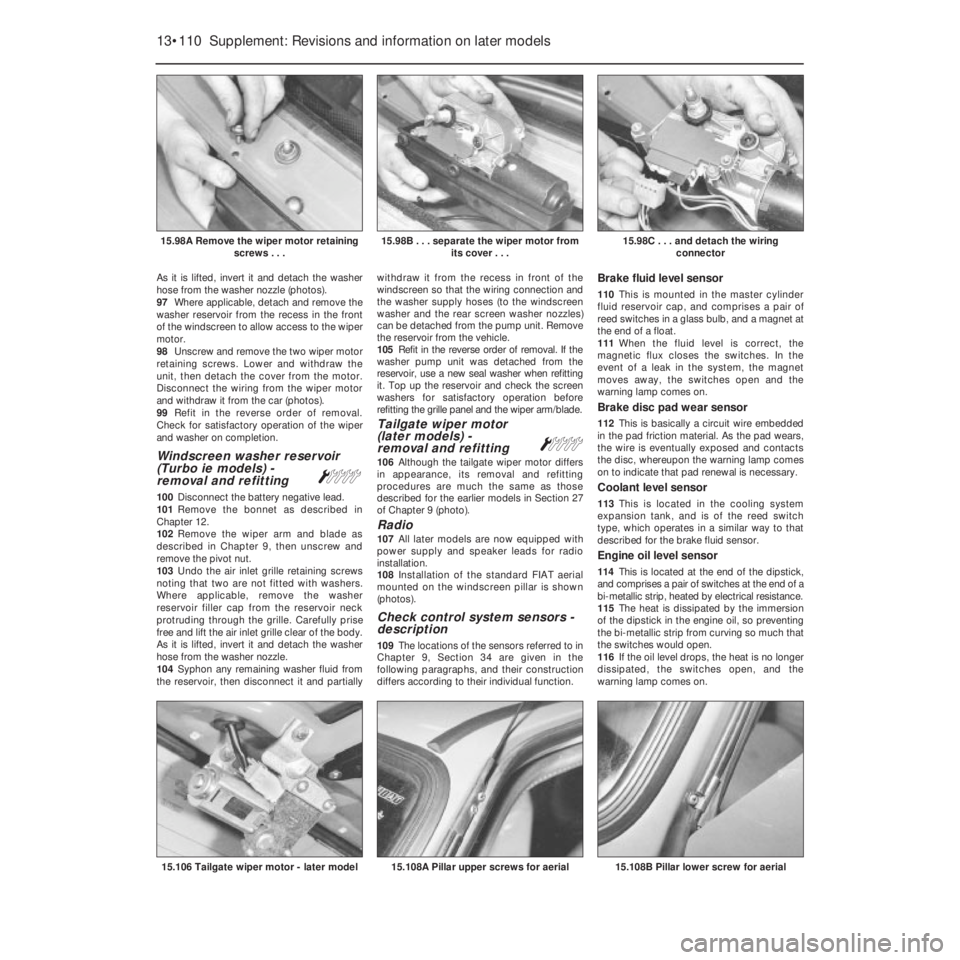
hose from the washer nozzle (photos).
97Where applicable, detach and remove the
washer reservoir from the recess in the front
of the windscreen to allow access to the wiper
motor.
98Unscrew and remove the two wiper motor
retaining screws. Lower and withdraw the
unit, then detach the cover from the motor.
Disconnect the wiring from the wiper motor
and withdraw it from the car (photos).
99Refit in the reverse order of removal.
Check for satisfactory operation of the wiper
and washer on completion.
Windscreen washer reservoir
(Turbo ie models) -
removal and refitting
Á
100Disconnect the battery negative lead.
101Remove the bonnet as described in
Chapter 12.
102Remove the wiper arm and blade as
described in Chapter 9, then unscrew and
remove the pivot nut.
103Undo the air inlet grille retaining screws
noting that two are not fitted with washers.
Where applicable, remove the washer
reservoir filler cap from the reservoir neck
protruding through the grille. Carefully prise
free and lift the air inlet grille clear of the body.
As it is lifted, invert it and detach the washer
hose from the washer nozzle.
104Syphon any remaining washer fluid from
the reservoir, then disconnect it and partiallywithdraw it from the recess in front of the
windscreen so that the wiring connection and
the washer supply hoses (to the windscreen
washer and the rear screen washer nozzles)
can be detached from the pump unit. Remove
the reservoir from the vehicle.
105Refit in the reverse order of removal. If the
washer pump unit was detached from the
reservoir, use a new seal washer when refitting
it. Top up the reservoir and check the screen
washers for satisfactory operation before
refitting the grille panel and the wiper arm/blade.
Tailgate wiper motor
(later models) -
removal and refitting
Á
106Although the tailgate wiper motor differs
in appearance, its removal and refitting
procedures are much the same as those
described for the earlier models in Section 27
of Chapter 9 (photo).
Radio
107All later models are now equipped with
power supply and speaker leads for radio
installation.
108Installation of the standard FIAT aerial
mounted on the windscreen pillar is shown
(photos).
Check control system sensors -
description
109The locations of the sensors referred to in
Chapter 9, Section 34 are given in the
following paragraphs, and their construction
differs according to their individual function.
Brake fluid level sensor
110This is mounted in the master cylinder
fluid reservoir cap, and comprises a pair of
reed switches in a glass bulb, and a magnet at
the end of a float.
111When the fluid level is correct, the
magnetic flux closes the switches. In the
event of a leak in the system, the magnet
moves away, the switches open and the
warning lamp comes on.
Brake disc pad wear sensor
112This is basically a circuit wire embedded
in the pad friction material. As the pad wears,
the wire is eventually exposed and contacts
the disc, whereupon the warning lamp comes
on to indicate that pad renewal is necessary.
Coolant level sensor
113This is located in the cooling system
expansion tank, and is of the reed switch
type, which operates in a similar way to that
described for the brake fluid sensor.
Engine oil level sensor
114This is located at the end of the dipstick,
and comprises a pair of switches at the end of a
bi-metallic strip, heated by electrical resistance.
115The heat is dissipated by the immersion
of the dipstick in the engine oil, so preventing
the bi-metallic strip from curving so much that
the switches would open.
116If the oil level drops, the heat is no longer
dissipated, the switches open, and the
warning lamp comes on.
13•110 Supplement: Revisions and information on later models
15.108B Pillar lower screw for aerial15.108A Pillar upper screws for aerial15.106 Tailgate wiper motor - later model
15.98C . . . and detach the wiring
connector15.98B . . . separate the wiper motor from
its cover . . .15.98A Remove the wiper motor retaining
screws . . .
Page 238 of 303
18Refitting of all components is a reversal of
removal.
Radiator grille (1301 cc
Turbo ie model) -
removal and refitting
Á
19The grille is secured by a central screw
and two upper clips. Use a screwdriver to
prise the tabs on the upper clips downwards
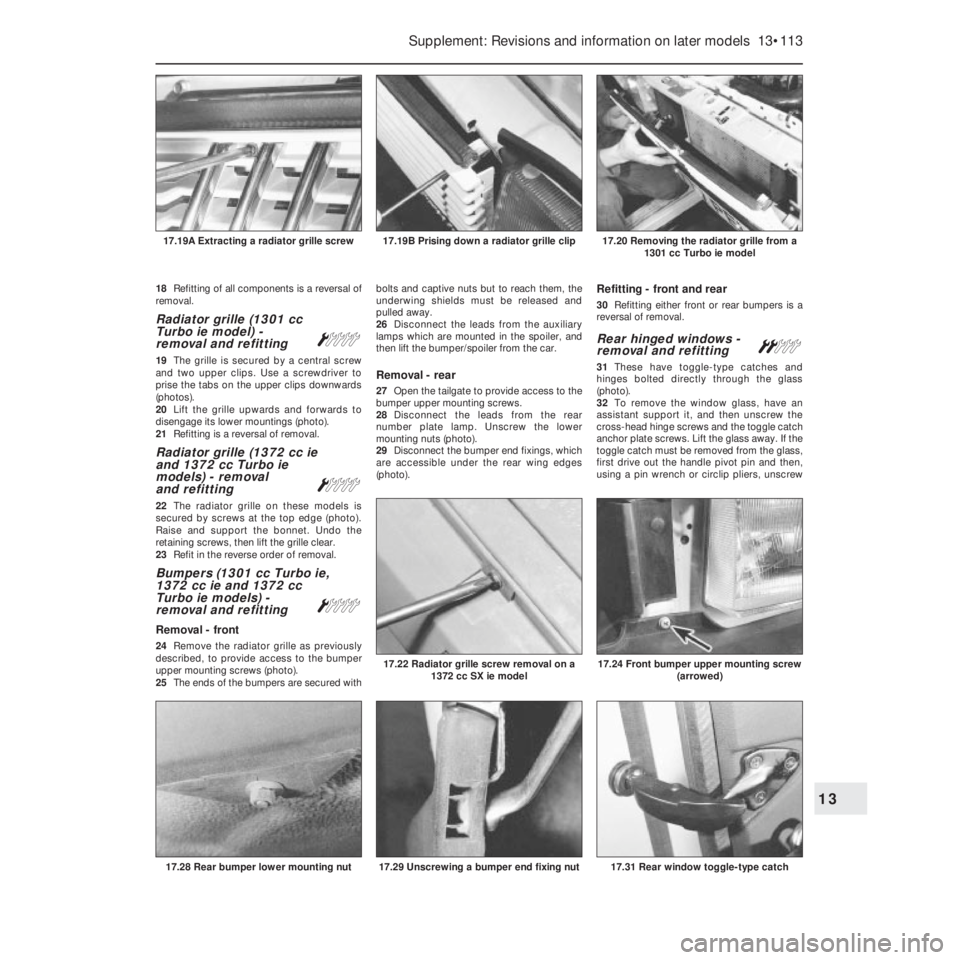
(photos).
20Lift the grille upwards and forwards to
disengage its lower mountings (photo).
21Refitting is a reversal of removal.
Radiator grille (1372 cc ie
and 1372 cc Turbo ie
models) - removal
and refitting
Á
22The radiator grille on these models is
secured by screws at the top edge (photo).
Raise and support the bonnet. Undo the
retaining screws, then lift the grille clear.
23Refit in the reverse order of removal.
Bumpers (1301 cc Turbo ie,
1372 cc ie and 1372 cc
Turbo ie models) -
removal and refitting
Á
Removal - front
24Remove the radiator grille as previously
described, to provide access to the bumper
upper mounting screws (photo).
25The ends of the bumpers are secured withbolts and captive nuts but to reach them, the
underwing shields must be released and
pulled away.
26Disconnect the leads from the auxiliary
lamps which are mounted in the spoiler, and
then lift the bumper/spoiler from the car.
Removal - rear
27Open the tailgate to provide access to the
bumper upper mounting screws.
28Disconnect the leads from the rear
number plate lamp. Unscrew the lower
mounting nuts (photo).
29Disconnect the bumper end fixings, which
are accessible under the rear wing edges
(photo).
Refitting - front and rear
30Refitting either front or rear bumpers is a
reversal of removal.
Rear hinged windows -
removal and refittingª
31These have toggle-type catches and
hinges bolted directly through the glass
(photo).
32To remove the window glass, have an
assistant support it, and then unscrew the
cross-head hinge screws and the toggle catch
anchor plate screws. Lift the glass away. If the
toggle catch must be removed from the glass,
first drive out the handle pivot pin and then,
using a pin wrench or circlip pliers, unscrew
Supplement: Revisions and information on later models 13•113
17.20 Removing the radiator grille from a
1301 cc Turbo ie model17.19B Prising down a radiator grille clip17.19A Extracting a radiator grille screw
17.31 Rear window toggle-type catch17.29 Unscrewing a bumper end fixing nut
17.24 Front bumper upper mounting screw
(arrowed)17.22 Radiator grille screw removal on a
1372 cc SX ie model
17.28 Rear bumper lower mounting nut
13
Page 295 of 303
Buying spare parts
Spare parts are available from many
sources, for example, FIAT garages, other
garages and accessory shops, and motor
factors. Our advice regarding spare parts is as
follows:
Officially appointed FIAT garages -This is
the best source of parts which are peculiar to
your car and otherwise not generally available
(eg complete cylinder heads, internal gearbox
components, badges, interior trim etc). It is
also the only place at which you should buy
parts if your vehicle is still under warranty;
non-FlAT components may invalidate the
warranty. To be sure of obtaining the correct
parts it will always be necessary to give the
partsman your car’s engine number, chassis
number and number for spares, and if
possible, to take the old part along for positive
identification. Many parts are available under
a factory exchange scheme - any parts
returned should always be clean. It obviously
makes good sense to go straight to the
specialists on your car for this type of part for
they are best equipped to supply you. They
will also be able to provide their own FIATservice manual for your car should you require
one.
Other garages and accessory shops - These
are often very good places to buy material
and components needed for the maintenance
of your car (eg oil filters, spark plugs, bulbs,
drivebelts, oils and grease, touch-up paint,
filler paste etc). They also sell accessories,
usually have convenient opening hours,
charge lower prices and can often be found
not far from home.
Motor factors - Good factors stock all of the
more important components which wear out
relatively quickly (eg clutch components,
pistons, valves, exhaust systems, brake
pipes/seals/shoes and pads etc). Motor
factors will often provide new or reconditioned
components on a part exchange basis - this
can save a considerable amount of money.
Vehicle identification
numbers
Modifications are a continuing and
unpublicised process in vehicle manufacture
quite apart from major model changes. Spareparts manuals and lists are compiled upon a
numerical basis, the individual vehicle
numbers being essential to correct identifi-
cation of the component required.
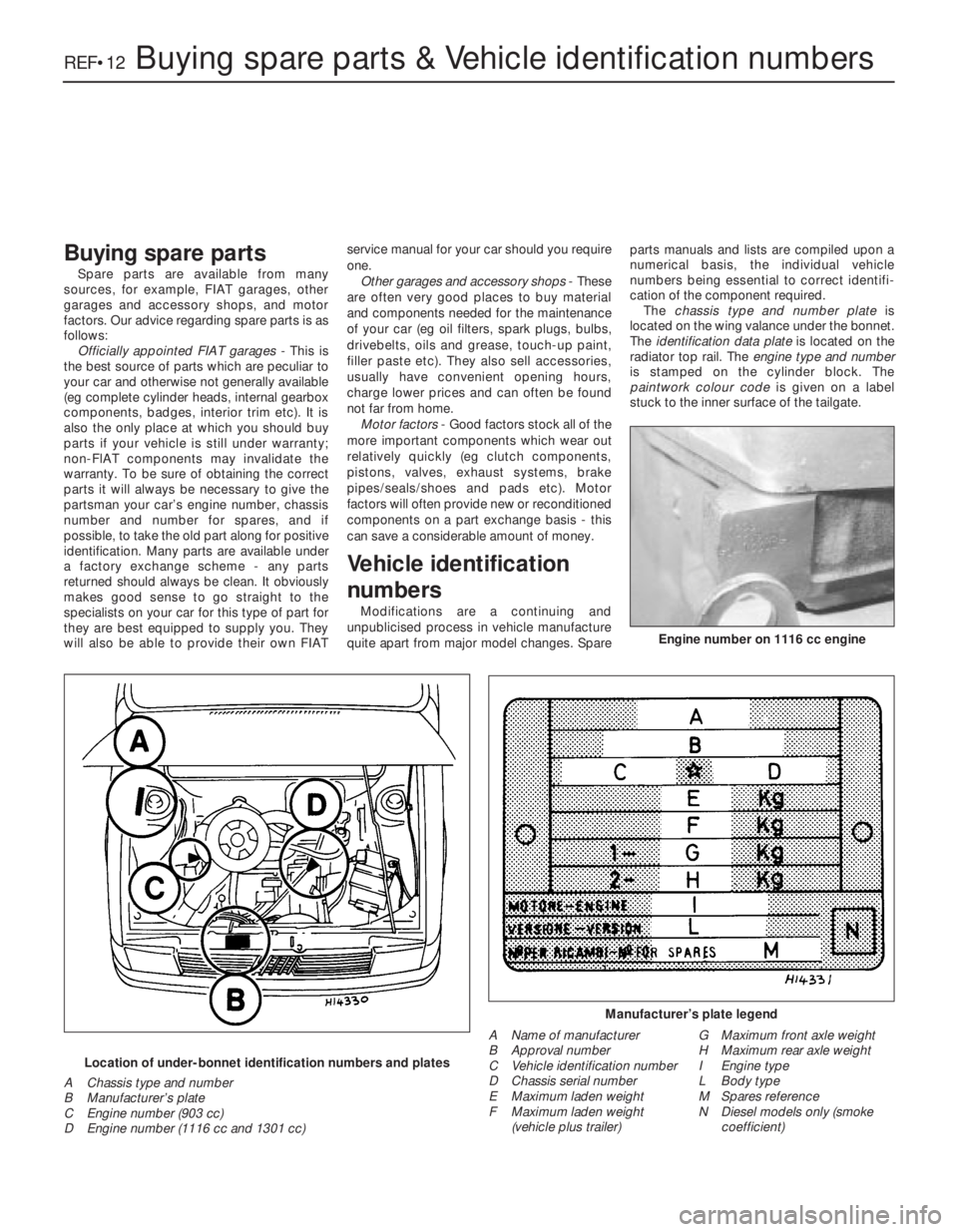
The chassis type and number plate is
located on the wing valance under the bonnet.
The identification data plate is located on the
radiator top rail. The engine type and number
is stamped on the cylinder block. The
paintwork colour code is given on a label
stuck to the inner surface of the tailgate.
REF•12Buying spare parts & Vehicle identification numbers
Manufacturer’s plate legend
Location of under-bonnet identification numbers and plates
A Chassis type and number
B Manufacturer’s plate
C Engine number (903 cc)
D Engine number (1116 cc and 1301 cc)
Engine number on 1116 cc engine
A Name of manufacturer
B Approval number
C Vehicle identification number
D Chassis serial number
E Maximum laden weight
F Maximum laden weight
(vehicle plus trailer)G Maximum front axle weight
H Maximum rear axle weight
I Engine type
L Body type
M Spares reference
N Diesel models only (smoke
coefficient)