lock FIAT UNO 1983 Service Workshop Manual
[x] Cancel search | Manufacturer: FIAT, Model Year: 1983, Model line: UNO, Model: FIAT UNO 1983Pages: 303, PDF Size: 10.36 MB
Page 91 of 303
1 General description
The electrical system is of 12 volt negative
earth type and employs a belt-driven
alternator and a pre-engaged type starter
motor.
The models in the range are all adequately
equipped with electrical accessories, while SX
versions also have power windows and
centralised door locking plus a check control
system (Section 34).
2 Battery- inspection, charging,
removal and refitting
2
1The battery is of maintenance-free type and
under normal circumstances, no topping up
will be required, but regularly check that the
electrolyte level is between the minimum and
maximum lines on the translucent battery
casing.
2If the electrolyte level does drop below theminimum line, suspect a leak in the battery
casing or that the alternator is overcharging. If
the latter is the case, rectify the alternator fault
and then prise out the two rectangular plugs
from the top of the battery and top up with
distilled or purified water.
3Always keep the battery terminals clean
and smear them with petroleum jelly to
prevent corrosion.
4The battery will normally be kept fully
charged by the alternator, but it is possible for
the battery to become discharged if the daily
mileage is very low with much use being
made of the starter and electrical accessories.
5When the battery begins to deteriorate with
age it may also require a boost from a mains
charger.
6Disconnect both battery leads before
connecting the mains charger. 7To remove the battery from the car, first
disconnect the leads from the battery
terminals (earth first) and then unscrew the
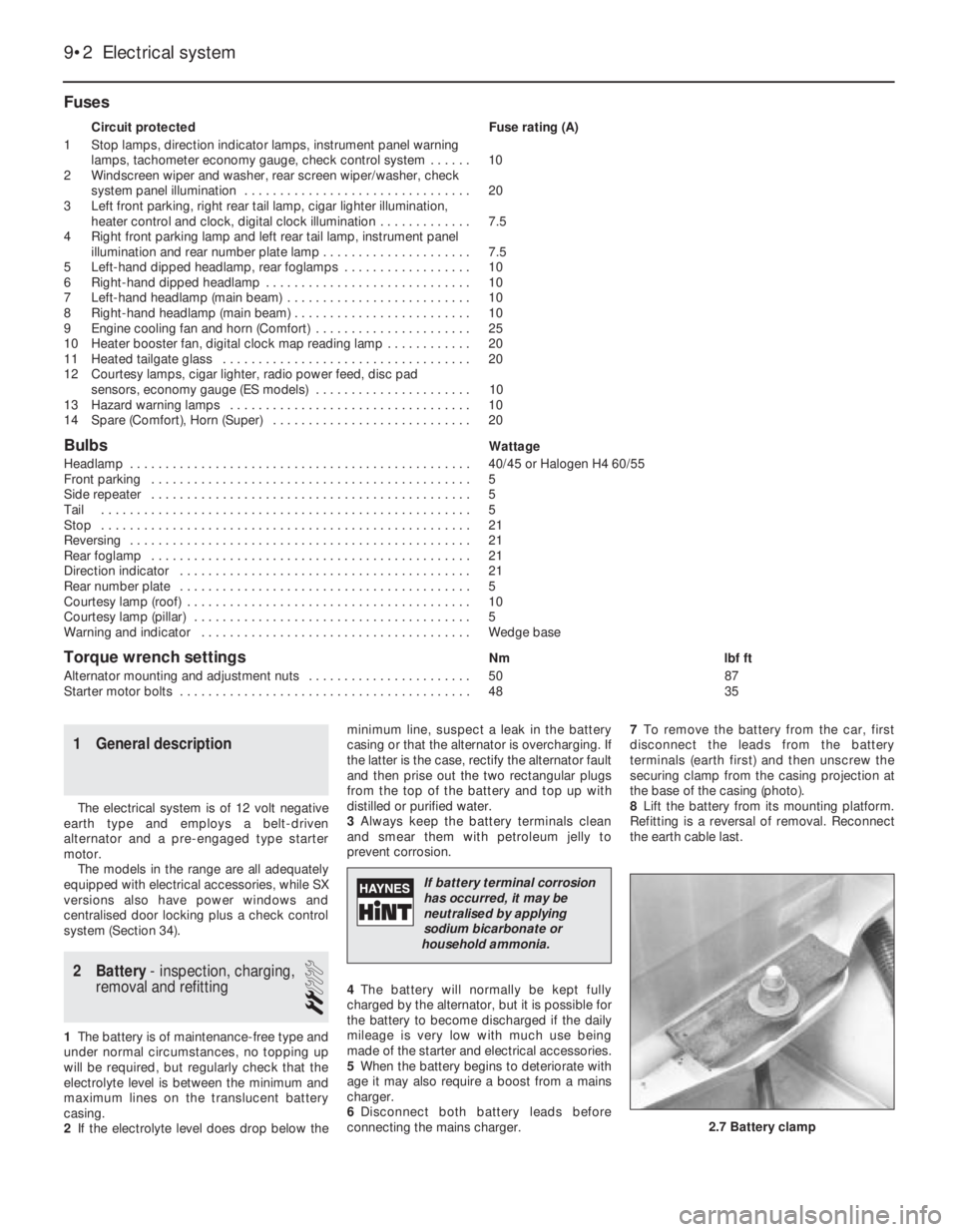
securing clamp from the casing projection at
the base of the casing (photo).
8Lift the battery from its mounting platform.
Refitting is a reversal of removal. Reconnect
the earth cable last.
Fuses
Circuit protected Fuse rating (A)
1 Stop lamps, direction indicator lamps, instrument panel warning
lamps, tachometer economy gauge, check control system . . . . . . 10
2 Windscreen wiper and washer, rear screen wiper/washer, check
system panel illumination . . . . . . . . . . . . . . . . . . . . . . . . . . . . . . . . 20
3 Left front parking, right rear tail lamp, cigar lighter illumination,
heater control and clock, digital clock illumination . . . . . . . . . . . . . 7.5
4 Right front parking lamp and left rear tail lamp, instrument panel
illumination and rear number plate lamp . . . . . . . . . . . . . . . . . . . . . 7.5
5 Left-hand dipped headlamp, rear foglamps . . . . . . . . . . . . . . . . . . 10
6 Right-hand dipped headlamp . . . . . . . . . . . . . . . . . . . . . . . . . . . . . 10
7 Left-hand headlamp (main beam) . . . . . . . . . . . . . . . . . . . . . . . . . . 10
8 Right-hand headlamp (main beam) . . . . . . . . . . . . . . . . . . . . . . . . . 10
9 Engine cooling fan and horn (Comfort) . . . . . . . . . . . . . . . . . . . . . . 25
10 Heater booster fan, digital clock map reading lamp . . . . . . . . . . . . 20
11 Heated tailgate glass . . . . . . . . . . . . . . . . . . . . . . . . . . . . . . . . . . . 20
12 Courtesy lamps, cigar lighter, radio power feed, disc pad
sensors, economy gauge (ES models) . . . . . . . . . . . . . . . . . . . . . . 10
13 Hazard warning lamps . . . . . . . . . . . . . . . . . . . . . . . . . . . . . . . . . . 10
14 Spare (Comfort), Horn (Super) . . . . . . . . . . . . . . . . . . . . . . . . . . . . 20
BulbsWattage
Headlamp . . . . . . . . . . . . . . . . . . . . . . . . . . . . . . . . . . . . . . . . . . . . . . . . 40/45 or Halogen H4 60/55
Front parking . . . . . . . . . . . . . . . . . . . . . . . . . . . . . . . . . . . . . . . . . . . . . 5
Side repeater . . . . . . . . . . . . . . . . . . . . . . . . . . . . . . . . . . . . . . . . . . . . . 5
Tail . . . . . . . . . . . . . . . . . . . . . . . . . . . . . . . . . . . . . . . . . . . . . . . . . . . . 5
Stop . . . . . . . . . . . . . . . . . . . . . . . . . . . . . . . . . . . . . . . . . . . . . . . . . . . . 21
Reversing . . . . . . . . . . . . . . . . . . . . . . . . . . . . . . . . . . . . . . . . . . . . . . . . 21
Rear foglamp . . . . . . . . . . . . . . . . . . . . . . . . . . . . . . . . . . . . . . . . . . . . . 21
Direction indicator . . . . . . . . . . . . . . . . . . . . . . . . . . . . . . . . . . . . . . . . . 21
Rear number plate . . . . . . . . . . . . . . . . . . . . . . . . . . . . . . . . . . . . . . . . . 5
Courtesy lamp (roof) . . . . . . . . . . . . . . . . . . . . . . . . . . . . . . . . . . . . . . . . 10
Courtesy lamp (pillar) . . . . . . . . . . . . . . . . . . . . . . . . . . . . . . . . . . . . . . . 5
Warning and indicator . . . . . . . . . . . . . . . . . . . . . . . . . . . . . . . . . . . . . . Wedge base
Torque wrench settingsNm lbf ft
Alternator mounting and adjustment nuts . . . . . . . . . . . . . . . . . . . . . . . 50 87
Starter motor bolts . . . . . . . . . . . . . . . . . . . . . . . . . . . . . . . . . . . . . . . . . 48 35
9•2 Electrical system
2.7 Battery clamp
If battery terminal corrosion
has occurred, it may be
neutralised by applying
sodium bicarbonate or
household ammonia.
Page 94 of 303
8Withdraw the solenoid and yoke off the
armature and from the drive end bracket.
Note the steel and fibre washers and the
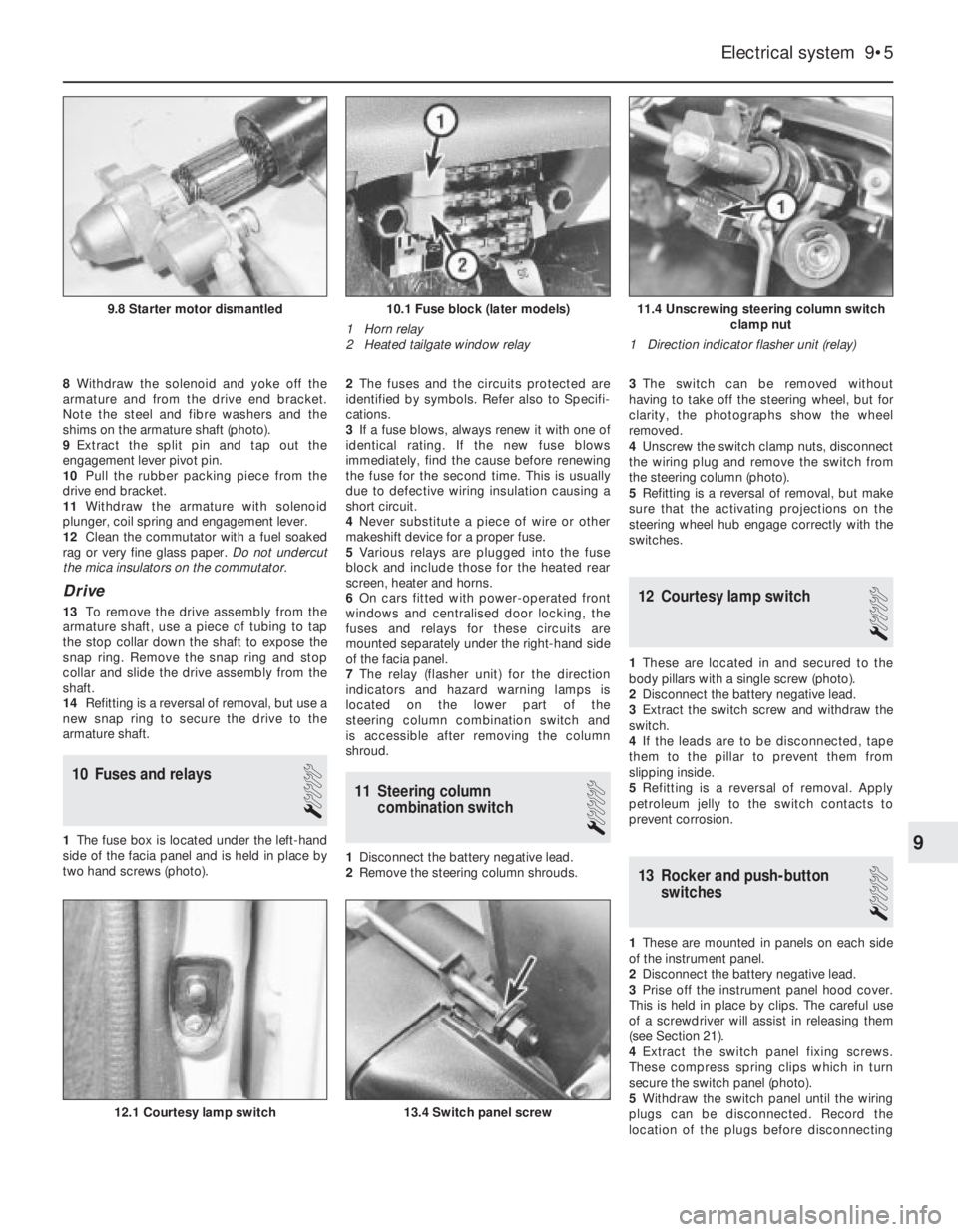
shims on the armature shaft (photo).
9Extract the split pin and tap out the
engagement lever pivot pin.
10Pull the rubber packing piece from the
drive end bracket.
11Withdraw the armature with solenoid
plunger, coil spring and engagement lever.
12Clean the commutator with a fuel soaked
rag or very fine glass paper. Do not undercut
the mica insulators on the commutator.
Drive
13To remove the drive assembly from the
armature shaft, use a piece of tubing to tap
the stop collar down the shaft to expose the
snap ring. Remove the snap ring and stop
collar and slide the drive assembly from the
shaft.
14Refitting is a reversal of removal, but use a
new snap ring to secure the drive to the
armature shaft.
10 Fuses and relays
1
1The fuse box is located under the left-hand
side of the facia panel and is held in place by
two hand screws (photo).2The fuses and the circuits protected are
identified by symbols. Refer also to Specifi-
cations.
3If a fuse blows, always renew it with one of
identical rating. If the new fuse blows
immediately, find the cause before renewing
the fuse for the second time. This is usually
due to defective wiring insulation causing a
short circuit.
4Never substitute a piece of wire or other
makeshift device for a proper fuse.
5Various relays are plugged into the fuse
block and include those for the heated rear
screen, heater and horns.
6On cars fitted with power-operated front
windows and centralised door locking, the
fuses and relays for these circuits are
mounted separately under the right-hand side
of the facia panel.
7The relay (flasher unit) for the direction
indicators and hazard warning lamps is
located on the lower part of the
steering column combination switch and
is accessible after removing the column
shroud.
11 Steering column
combination switch
1
1Disconnect the battery negative lead.
2Remove the steering column shrouds. 3The switch can be removed without
having to take off the steering wheel, but for
clarity, the photographs show the wheel
removed.
4Unscrew the switch clamp nuts, disconnect
the wiring plug and remove the switch from
the steering column (photo).
5Refitting is a reversal of removal, but make
sure that the activating projections on the
steering wheel hub engage correctly with the
switches.
12 Courtesy lamp switch
1
1These are located in and secured to the
body pillars with a single screw (photo).
2Disconnect the battery negative lead.
3Extract the switch screw and withdraw the
switch.
4If the leads are to be disconnected, tape
them to the pillar to prevent them from
slipping inside.
5Refitting is a reversal of removal. Apply
petroleum jelly to the switch contacts to
prevent corrosion.
13 Rocker and push-button
switches
1
1These are mounted in panels on each side
of the instrument panel.
2Disconnect the battery negative lead.
3Prise off the instrument panel hood cover.
This is held in place by clips. The careful use
of a screwdriver will assist in releasing them
(see Section 21).
4Extract the switch panel fixing screws.
These compress spring clips which in turn
secure the switch panel (photo).
5Withdraw the switch panel until the wiring
plugs can be disconnected. Record the
location of the plugs before disconnecting
Electrical system 9•5
11.4 Unscrewing steering column switch
clamp nut
1 Direction indicator flasher unit (relay)10.1 Fuse block (later models)
1 Horn relay
2 Heated tailgate window relay9.8 Starter motor dismantled
13.4 Switch panel screw12.1 Courtesy lamp switch
9
Page 95 of 303
them. Carefully release the fibre optic
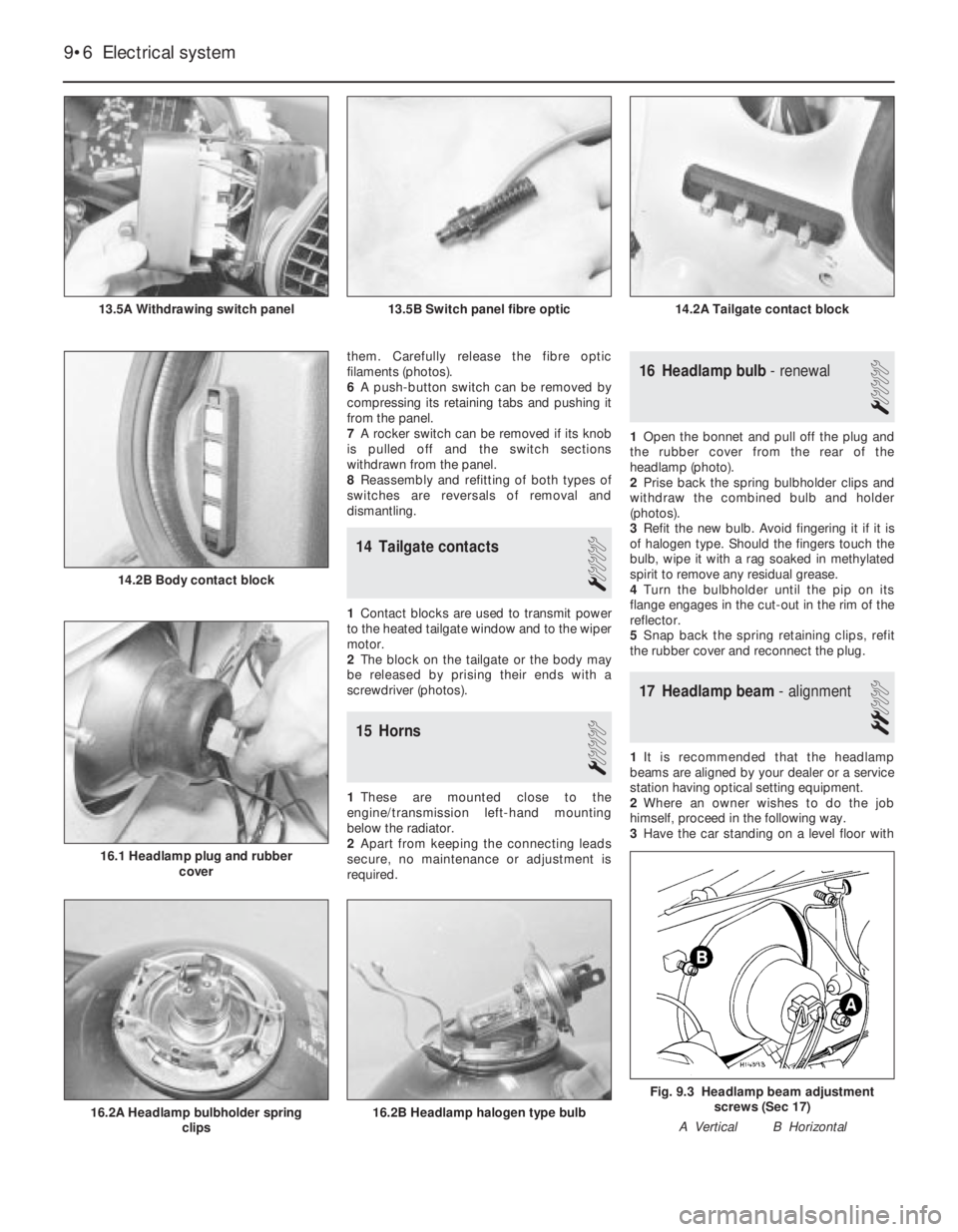
filaments (photos).
6A push-button switch can be removed by
compressing its retaining tabs and pushing it
from the panel.
7A rocker switch can be removed if its knob
is pulled off and the switch sections
withdrawn from the panel.
8Reassembly and refitting of both types of
switches are reversals of removal and
dismantling.
14 Tailgate contacts
1
1Contact blocks are used to transmit power
to the heated tailgate window and to the wiper
motor.
2The block on the tailgate or the body may
be released by prising their ends with a
screwdriver (photos).
15 Horns
1
1These are mounted close to the
engine/transmission left-hand mounting
below the radiator.
2Apart from keeping the connecting leads
secure, no maintenance or adjustment is
required.
16 Headlamp bulb- renewal
1
1Open the bonnet and pull off the plug and
the rubber cover from the rear of the
headlamp (photo).
2Prise back the spring bulbholder clips and
withdraw the combined bulb and holder
(photos).
3Refit the new bulb. Avoid fingering it if it is
of halogen type. Should the fingers touch the
bulb, wipe it with a rag soaked in methylated
spirit to remove any residual grease.
4Turn the bulbholder until the pip on its
flange engages in the cut-out in the rim of the
reflector.
5Snap back the spring retaining clips, refit
the rubber cover and reconnect the plug.
17 Headlamp beam- alignment
2
1It is recommended that the headlamp
beams are aligned by your dealer or a service
station having optical setting equipment.
2Where an owner wishes to do the job
himself, proceed in the following way.
3Have the car standing on a level floor with
9•6 Electrical system
Fig. 9.3 Headlamp beam adjustment
screws (Sec 17)
A Vertical B Horizontal
16.2B Headlamp halogen type bulb16.2A Headlamp bulbholder spring
clips
14.2B Body contact block
16.1 Headlamp plug and rubber
cover
14.2A Tailgate contact block13.5B Switch panel fibre optic13.5A Withdrawing switch panel
Page 98 of 303
3Working at the transmission, disconnect
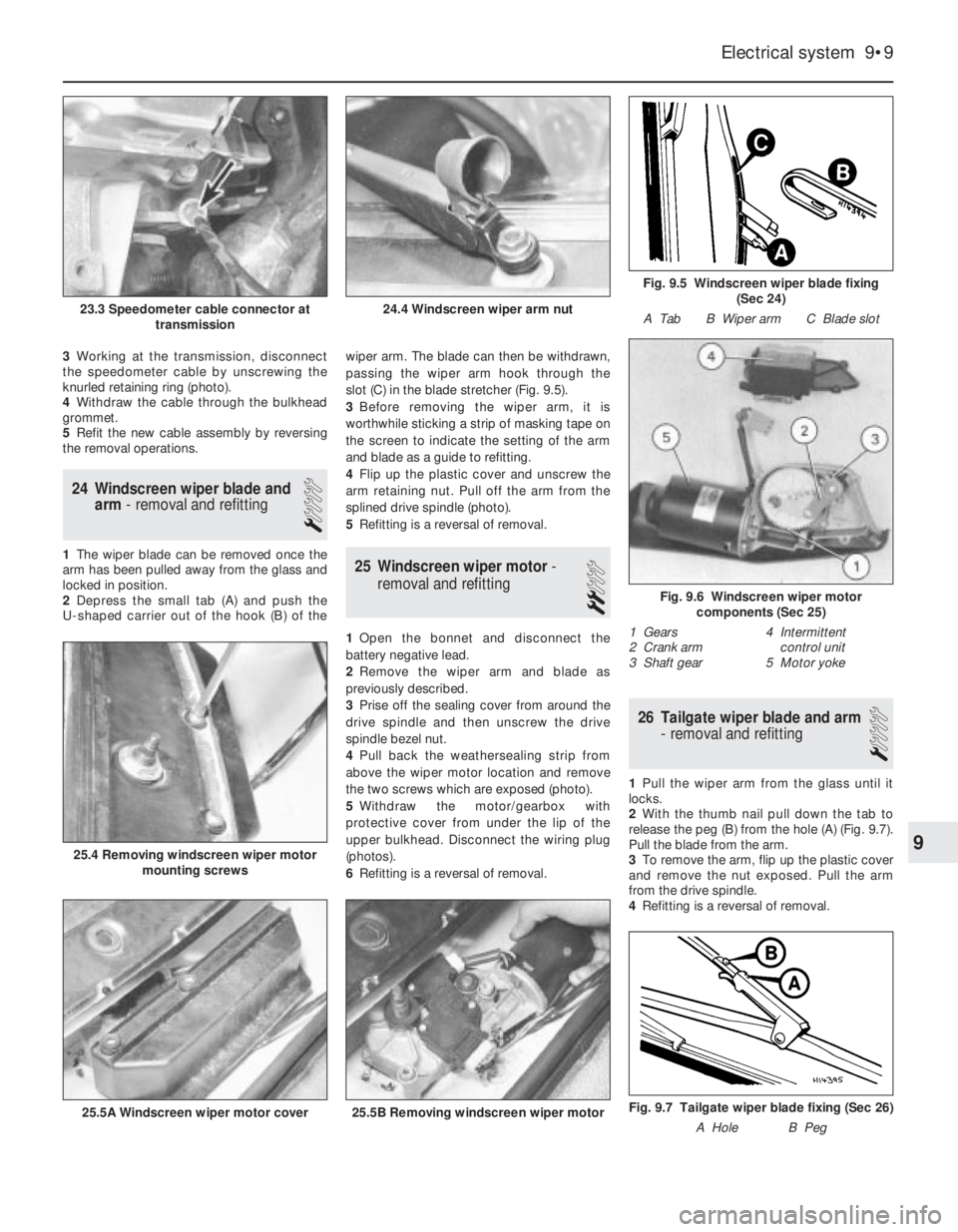
the speedometer cable by unscrewing the
knurled retaining ring (photo).
4Withdraw the cable through the bulkhead
grommet.
5Refit the new cable assembly by reversing
the removal operations.
24 Windscreen wiper blade and
arm- removal and refitting
1
1The wiper blade can be removed once the
arm has been pulled away from the glass and
locked in position.
2Depress the small tab (A) and push the
U-shaped carrier out of the hook (B) of thewiper arm. The blade can then be withdrawn,
passing the wiper arm hook through the
slot (C) in the blade stretcher (Fig. 9.5).
3Before removing the wiper arm, it is
worthwhile sticking a strip of masking tape on
the screen to indicate the setting of the arm
and blade as a guide to refitting.
4Flip up the plastic cover and unscrew the
arm retaining nut. Pull off the arm from the
splined drive spindle (photo).
5Refitting is a reversal of removal.25 Windscreen wiper motor-
removal and refitting
2
1Open the bonnet and disconnect the
battery negative lead.
2Remove the wiper arm and blade as
previously described.
3Prise off the sealing cover from around the
drive spindle and then unscrew the drive
spindle bezel nut.
4Pull back the weathersealing strip from
above the wiper motor location and remove
the two screws which are exposed (photo).
5Withdraw the motor/gearbox with
protective cover from under the lip of the
upper bulkhead. Disconnect the wiring plug
(photos).
6Refitting is a reversal of removal.
26 Tailgate wiper blade and arm
- removal and refitting
1
1Pull the wiper arm from the glass until it
locks.
2With the thumb nail pull down the tab to
release the peg (B) from the hole (A) (Fig. 9.7).
Pull the blade from the arm.
3To remove the arm, flip up the plastic cover
and remove the nut exposed. Pull the arm
from the drive spindle.
4Refitting is a reversal of removal.
Electrical system 9•9
Fig. 9.5 Windscreen wiper blade fixing
(Sec 24)
A Tab B Wiper arm C Blade slot
24.4 Windscreen wiper arm nut23.3 Speedometer cable connector at
transmission
Fig. 9.7 Tailgate wiper blade fixing (Sec 26)
A Hole B Peg25.5B Removing windscreen wiper motor25.5A Windscreen wiper motor cover
25.4 Removing windscreen wiper motor
mounting screws
Fig. 9.6 Windscreen wiper motor
components (Sec 25)
1 Gears 4 Intermittent
2 Crank arm control unit
3 Shaft gear 5 Motor yoke
9
Page 99 of 303
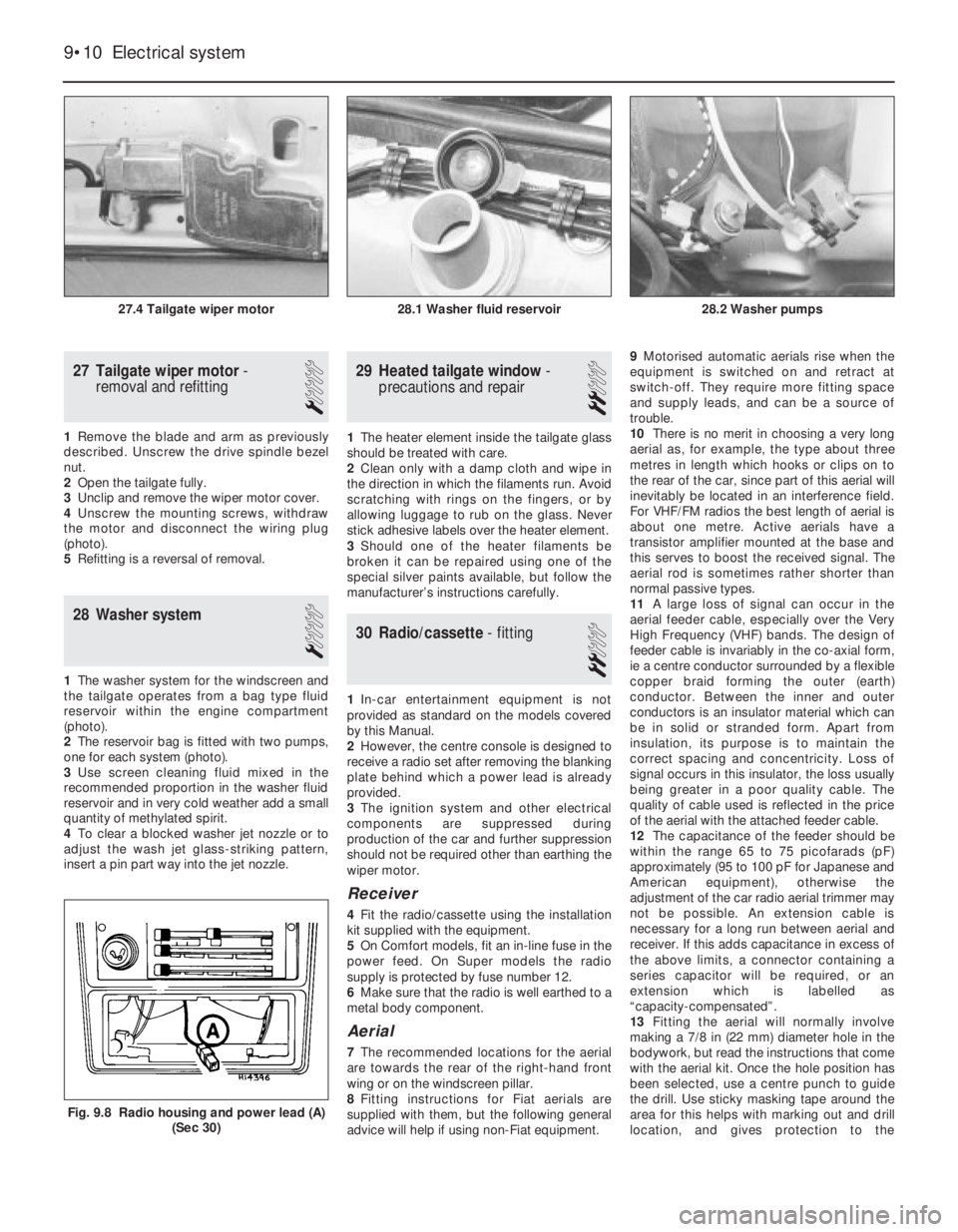
27 Tailgate wiper motor-
removal and refitting
1
1Remove the blade and arm as previously
described. Unscrew the drive spindle bezel
nut.
2Open the tailgate fully.
3Unclip and remove the wiper motor cover.
4Unscrew the mounting screws, withdraw
the motor and disconnect the wiring plug
(photo).
5Refitting is a reversal of removal.
28 Washer system
1
1The washer system for the windscreen and
the tailgate operates from a bag type fluid
reservoir within the engine compartment
(photo).
2The reservoir bag is fitted with two pumps,
one for each system (photo).
3Use screen cleaning fluid mixed in the
recommended proportion in the washer fluid
reservoir and in very cold weather add a small
quantity of methylated spirit.
4To clear a blocked washer jet nozzle or to
adjust the wash jet glass-striking pattern,
insert a pin part way into the jet nozzle.
29 Heated tailgate window-
precautions and repair
2
1The heater element inside the tailgate glass
should be treated with care.
2Clean only with a damp cloth and wipe in
the direction in which the filaments run. Avoid
scratching with rings on the fingers, or by
allowing luggage to rub on the glass. Never
stick adhesive labels over the heater element.
3Should one of the heater filaments be
broken it can be repaired using one of the
special silver paints available, but follow the
manufacturer’s instructions carefully.
30 Radio/cassette- fitting
2
1In-car entertainment equipment is not
provided as standard on the models covered
by this Manual.
2However, the centre console is designed to
receive a radio set after removing the blanking
plate behind which a power lead is already
provided.
3The ignition system and other electrical
components are suppressed during
production of the car and further suppression
should not be required other than earthing the
wiper motor.
Receiver
4Fit the radio/cassette using the installation
kit supplied with the equipment.
5On Comfort models, fit an in-line fuse in the
power feed. On Super models the radio
supply is protected by fuse number 12.
6Make sure that the radio is well earthed to a
metal body component.
Aerial
7The recommended locations for the aerial
are towards the rear of the right-hand front
wing or on the windscreen pillar.
8Fitting instructions for Fiat aerials are
supplied with them, but the following general
advice will help if using non-Fiat equipment.9Motorised automatic aerials rise when the
equipment is switched on and retract at
switch-off. They require more fitting space
and supply leads, and can be a source of
trouble.
10There is no merit in choosing a very long
aerial as, for example, the type about three
metres in length which hooks or clips on to
the rear of the car, since part of this aerial will
inevitably be located in an interference field.
For VHF/FM radios the best length of aerial is
about one metre. Active aerials have a
transistor amplifier mounted at the base and
this serves to boost the received signal. The
aerial rod is sometimes rather shorter than
normal passive types.
11A large loss of signal can occur in the
aerial feeder cable, especially over the Very
High Frequency (VHF) bands. The design of
feeder cable is invariably in the co-axial form,
ie a centre conductor surrounded by a flexible
copper braid forming the outer (earth)
conductor. Between the inner and outer
conductors is an insulator material which can
be in solid or stranded form. Apart from
insulation, its purpose is to maintain the
correct spacing and concentricity. Loss of
signal occurs in this insulator, the loss usually
being greater in a poor quality cable. The
quality of cable used is reflected in the price
of the aerial with the attached feeder cable.
12The capacitance of the feeder should be
within the range 65 to 75 picofarads (pF)
approximately (95 to 100 pF for Japanese and
American equipment), otherwise the
adjustment of the car radio aerial trimmer may
not be possible. An extension cable is
necessary for a long run between aerial and
receiver. If this adds capacitance in excess of
the above limits, a connector containing a
series capacitor will be required, or an
extension which is labelled as
“capacity-compensated”.
13Fitting the aerial will normally involve
making a 7/8 in (22 mm) diameter hole in the
bodywork, but read the instructions that come
with the aerial kit. Once the hole position has
been selected, use a centre punch to guide
the drill. Use sticky masking tape around the
area for this helps with marking out and drill
location, and gives protection to the
9•10 Electrical system
Fig. 9.8 Radio housing and power lead (A)
(Sec 30)
28.2 Washer pumps28.1 Washer fluid reservoir27.4 Tailgate wiper motor
Page 100 of 303
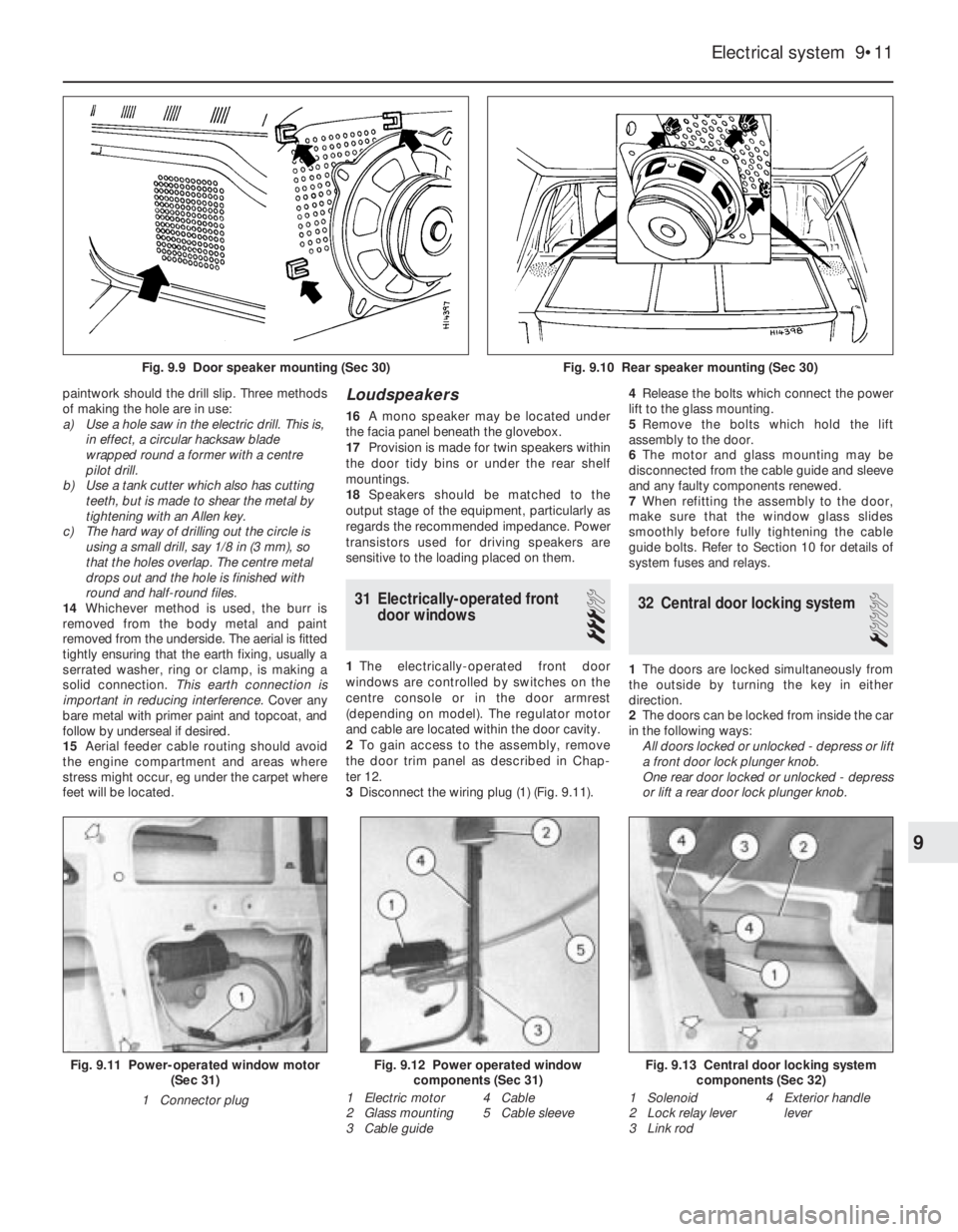
paintwork should the drill slip. Three methods
of making the hole are in use:
a) Use a hole saw in the electric drill. This is,
in effect, a circular hacksaw blade
wrapped round a former with a centre
pilot drill.
b) Use a tank cutter which also has cutting
teeth, but is made to shear the metal by
tightening with an Allen key.
c) The hard way of drilling out the circle is
using a small drill, say 1/8 in (3 mm), so
that the holes overlap. The centre metal
drops out and the hole is finished with
round and half-round files.
14Whichever method is used, the burr is
removed from the body metal and paint
removed from the underside. The aerial is fitted
tightly ensuring that the earth fixing, usually a
serrated washer, ring or clamp, is making a
solid connection. This earth connection is
important in reducing interference. Cover any
bare metal with primer paint and topcoat, and
follow by underseal if desired.
15Aerial feeder cable routing should avoid
the engine compartment and areas where
stress might occur, eg under the carpet where
feet will be located.Loudspeakers
16A mono speaker may be located under
the facia panel beneath the glovebox.
17Provision is made for twin speakers within
the door tidy bins or under the rear shelf
mountings.
18Speakers should be matched to the
output stage of the equipment, particularly as
regards the recommended impedance. Power
transistors used for driving speakers are
sensitive to the loading placed on them.
31 Electrically-operated front
door windows
3
1The electrically-operated front door
windows are controlled by switches on the
centre console or in the door armrest
(depending on model). The regulator motor
and cable are located within the door cavity.
2To gain access to the assembly, remove
the door trim panel as described in Chap-
ter 12.
3Disconnect the wiring plug (1) (Fig. 9.11).4Release the bolts which connect the power
lift to the glass mounting.
5Remove the bolts which hold the lift
assembly to the door.
6The motor and glass mounting may be
disconnected from the cable guide and sleeve
and any faulty components renewed.
7When refitting the assembly to the door,
make sure that the window glass slides
smoothly before fully tightening the cable
guide bolts. Refer to Section 10 for details of
system fuses and relays.
32 Central door locking system
1
1The doors are locked simultaneously from
the outside by turning the key in either
direction.
2The doors can be locked from inside the car
in the following ways:
All doors locked or unlocked - depress or lift
a front door lock plunger knob.
One rear door locked or unlocked - depress
or lift a rear door lock plunger knob.
Electrical system 9•11
Fig. 9.9 Door speaker mounting (Sec 30)Fig. 9.10 Rear speaker mounting (Sec 30)
Fig. 9.13 Central door locking system
components (Sec 32)Fig. 9.12 Power operated window
components (Sec 31)Fig. 9.11 Power-operated window motor
(Sec 31)
1 Connector plug
1 Electric motor
2 Glass mounting
3 Cable guide4 Cable
5 Cable sleeve1 Solenoid
2 Lock relay lever
3 Link rod4 Exterior handle
lever
9
Page 101 of 303
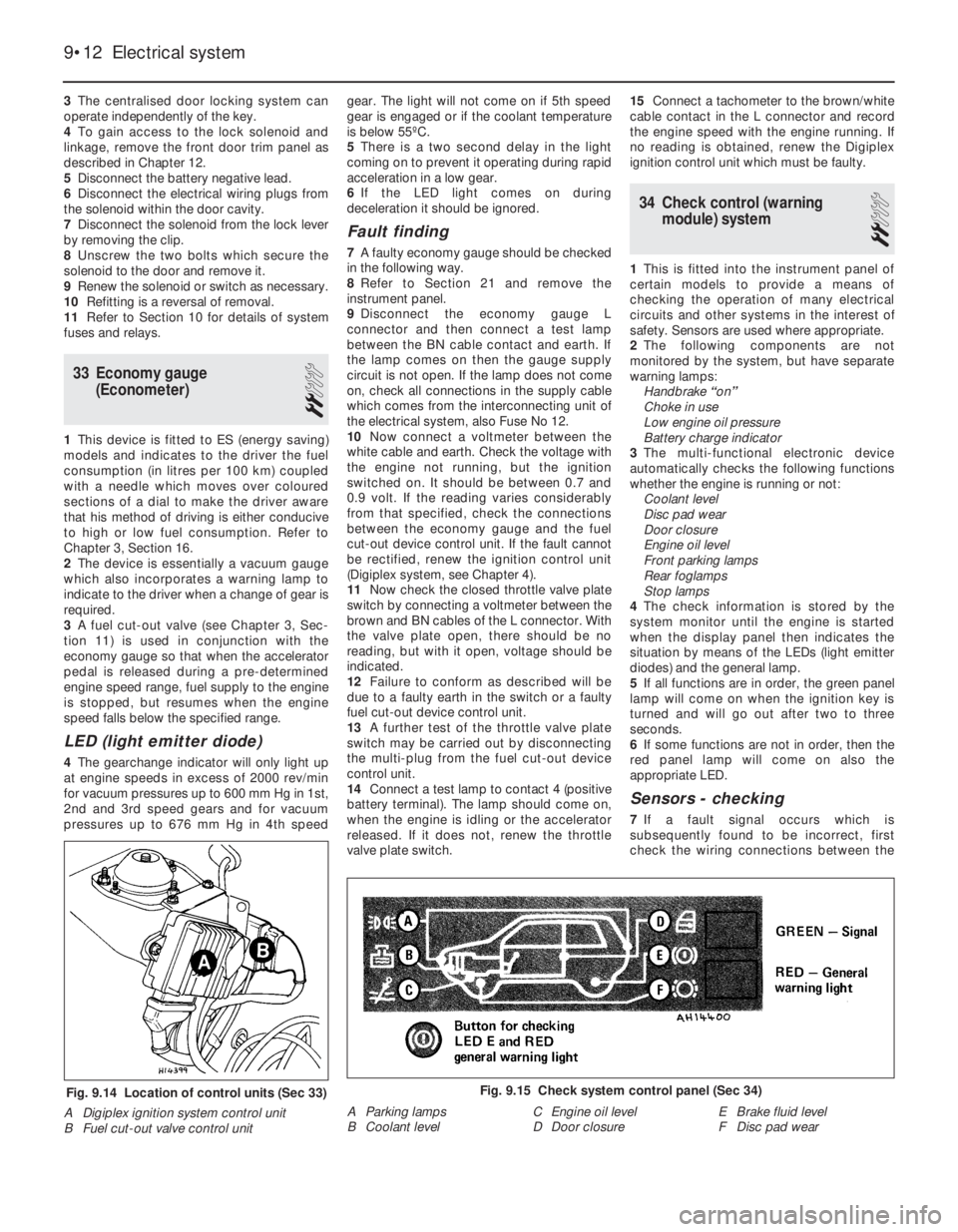
3The centralised door locking system can
operate independently of the key.
4To gain access to the lock solenoid and
linkage, remove the front door trim panel as
described in Chapter 12.
5Disconnect the battery negative lead.
6Disconnect the electrical wiring plugs from
the solenoid within the door cavity.
7Disconnect the solenoid from the lock lever
by removing the clip.
8Unscrew the two bolts which secure the
solenoid to the door and remove it.
9Renew the solenoid or switch as necessary.
10Refitting is a reversal of removal.
11Refer to Section 10 for details of system
fuses and relays.
33 Economy gauge
(Econometer)
2
1This device is fitted to ES (energy saving)
models and indicates to the driver the fuel
consumption (in litres per 100 km) coupled
with a needle which moves over coloured
sections of a dial to make the driver aware
that his method of driving is either conducive
to high or low fuel consumption. Refer to
Chapter 3, Section 16.
2The device is essentially a vacuum gauge
which also incorporates a warning lamp to
indicate to the driver when a change of gear is
required.
3A fuel cut-out valve (see Chapter 3, Sec-
tion 11) is used in conjunction with the
economy gauge so that when the accelerator
pedal is released during a pre-determined
engine speed range, fuel supply to the engine
is stopped, but resumes when the engine
speed falls below the specified range.
LED (light emitter diode)
4The gearchange indicator will only light up
at engine speeds in excess of 2000 rev/min
for vacuum pressures up to 600 mm Hg in 1st,
2nd and 3rd speed gears and for vacuum
pressures up to 676 mm Hg in 4th speedgear. The light will not come on if 5th speed
gear is engaged or if the coolant temperature
is below 55ºC.
5There is a two second delay in the light
coming on to prevent it operating during rapid
acceleration in a low gear.
6If the LED light comes on during
deceleration it should be ignored.
Fault finding
7A faulty economy gauge should be checked
in the following way.
8Refer to Section 21 and remove the
instrument panel.
9Disconnect the economy gauge L
connector and then connect a test lamp
between the BN cable contact and earth. If
the lamp comes on then the gauge supply
circuit is not open. If the lamp does not come
on, check all connections in the supply cable
which comes from the interconnecting unit of
the electrical system, also Fuse No 12.
10Now connect a voltmeter between the
white cable and earth. Check the voltage with
the engine not running, but the ignition
switched on. It should be between 0.7 and
0.9 volt. If the reading varies considerably
from that specified, check the connections
between the economy gauge and the fuel
cut-out device control unit. If the fault cannot
be rectified, renew the ignition control unit
(Digiplex system, see Chapter 4).
11Now check the closed throttle valve plate
switch by connecting a voltmeter between the
brown and BN cables of the L connector. With
the valve plate open, there should be no
reading, but with it open, voltage should be
indicated.
12Failure to conform as described will be
due to a faulty earth in the switch or a faulty
fuel cut-out device control unit.
13A further test of the throttle valve plate
switch may be carried out by disconnecting
the multi-plug from the fuel cut-out device
control unit.
14Connect a test lamp to contact 4 (positive
battery terminal). The lamp should come on,
when the engine is idling or the accelerator
released. If it does not, renew the throttle
valve plate switch.15Connect a tachometer to the brown/white
cable contact in the L connector and record
the engine speed with the engine running. If
no reading is obtained, renew the Digiplex
ignition control unit which must be faulty.
34 Check control (warning
module) system
2
1This is fitted into the instrument panel of
certain models to provide a means of
checking the operation of many electrical
circuits and other systems in the interest of
safety. Sensors are used where appropriate.
2The following components are not
monitored by the system, but have separate
warning lamps:
Handbrake “on”
Choke in use
Low engine oil pressure
Battery charge indicator
3The multi-functional electronic device
automatically checks the following functions
whether the engine is running or not:
Coolant level
Disc pad wear
Door closure
Engine oil level
Front parking lamps
Rear foglamps
Stop lamps
4The check information is stored by the
system monitor until the engine is started
when the display panel then indicates the
situation by means of the LEDs (light emitter
diodes) and the general lamp.
5If all functions are in order, the green panel
lamp will come on when the ignition key is
turned and will go out after two to three
seconds.
6If some functions are not in order, then the
red panel lamp will come on also the
appropriate LED.
Sensors - checking
7If a fault signal occurs which is
subsequently found to be incorrect, first
check the wiring connections between the
9•12 Electrical system
Fig. 9.15 Check system control panel (Sec 34)
A Parking lamps
B Coolant levelC Engine oil level
D Door closureE Brake fluid level
F Disc pad wearFig. 9.14 Location of control units (Sec 33)
A Digiplex ignition system control unit
B Fuel cut-out valve control unit
Page 102 of 303
sensors, lamp circuits and the control unit.
Corrosion at the terminals may also be a
contributory cause.
8Never short circuit a sensor supply wire or
the electronic module will be damaged.
Check control unit and monitor -
removal and refitting
9Remove the instrument panel as described
in Section 21.
10Unbolt the control unit housing from the
instrument panel.
11Access to the monitor can only be
obtained after removing the tachometer andthe red and green general warning lamps.
Unscrew the two monitor fixing bolts.
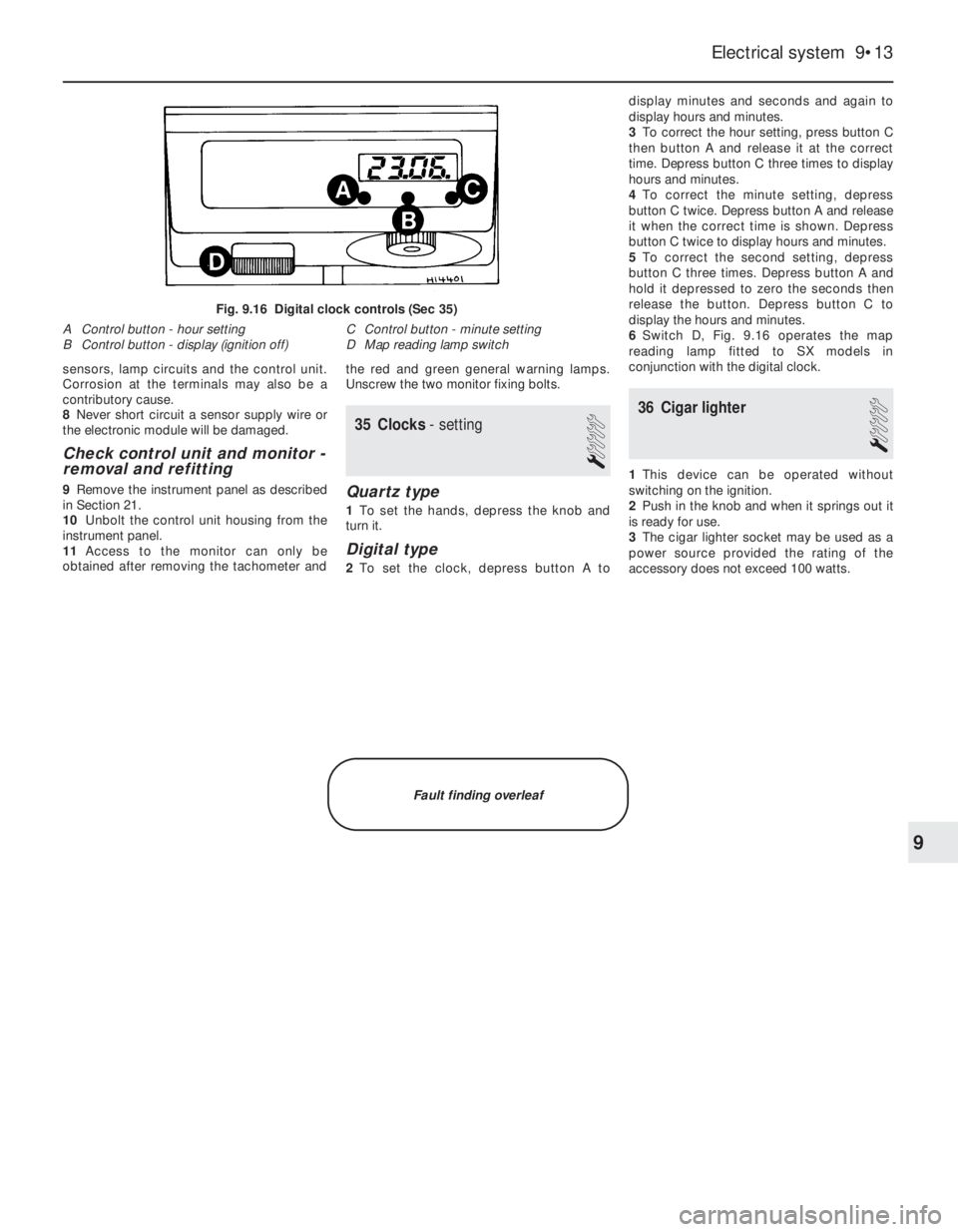
35 Clocks- setting
1
Quartz type
1To set the hands, depress the knob and
turn it.
Digital type
2To set the clock, depress button A todisplay minutes and seconds and again to
display hours and minutes.
3To correct the hour setting, press button C
then button A and release it at the correct
time. Depress button C three times to display
hours and minutes.
4To correct the minute setting, depress
button C twice. Depress button A and release
it when the correct time is shown. Depress
button C twice to display hours and minutes.
5To correct the second setting, depress
button C three times. Depress button A and
hold it depressed to zero the seconds then
release the button. Depress button C to
display the hours and minutes.
6Switch D, Fig. 9.16 operates the map
reading lamp fitted to SX models in
conjunction with the digital clock.
36 Cigar lighter
1
1This device can be operated without
switching on the ignition.
2Push in the knob and when it springs out it
is ready for use.
3The cigar lighter socket may be used as a
power source provided the rating of the
accessory does not exceed 100 watts.
Electrical system 9•13
Fig. 9.16 Digital clock controls (Sec 35)
A Control button - hour setting C Control button - minute setting
B Control button - display (ignition off) D Map reading lamp switch
9
Fault finding overleaf
Page 104 of 303
10
Type . . . . . . . . . . . . . . . . . . . . . . . . . . . . . . . . . . . . . . . . . . . . . . . . . . . Rack and pinion with safety column
Steering wheel diameter . . . . . . . . . . . . . . . . . . . . . . . . . . . . . . 381.0 mm (15.0 in)
Number of turns, lock-to-lock . . . . . . . . . . . . . . . . . . . . . . . . 4
Turning circle . . . . . . . . . . . . . . . . . . . . . . . . . . . . . . . . . . . . . . . . . 9.4 m (3084 ft)
Steering angles of roadwheels
Inner wheel . . . . . . . . . . . . . . . . . . . . . . . . . . . . . . . . . . . . . . . . . . . . . . . 32º 58’
Outer wheel . . . . . . . . . . . . . . . . . . . . . . . . . . . . . . . . . . . . . . . . . . . . . . 39º 8’
Front suspension steering angles
Camber . . . . . . . . . . . . . . . . . . . . . . . . . . . . . . . . . . . . . . . . . . . . . . . . . . 0º 5’ negative to 0º 55’ positive
Castor . . . . . . . . . . . . . . . . . . . . . . . . . . . . . . . . . . . . . . . . . . . . . . . . . . . 1º 40’ to 2º 20’ positive
Toe-in . . . . . . . . . . . . . . . . . . . . . . . . . . . . . . . . . . . . . . . . . . . . . . . . . . . 0 to 2.0 mm (0 to 0 08 in)
Rear suspension
Camber . . . . . . . . . . . . . . . . . . . . . . . . . . . . . . . . . . . . . . . . . . . . . . . . . . 0º (non-adjustable)
Rack lubricant
Type . . . . . . . . . . . . . . . . . . . . . . . . . . . . . . . . . . . . . . . . . . . . . . . . . . . . Lithium based molybdenum disulphide grease
Capacity . . . . . . . . . . . . . . . . . . . . . . . . . . . . . . . . . . . . . . . . . . . . . . . . . 140 cc
Torque wrench settingsNm lbf ft
Steering wheel nut . . . . . . . . . . . . . . . . . . . . . . . . . . . . . . . . . . . . . . . . . 50 37
Steering shaft coupling pinch-bolt . . . . . . . . . . . . . . . . . . . . . . . . . . . . . 27 20
Steering gear mounting bolts . . . . . . . . . . . . . . . . . . . . . . . . . . . . . . . . . 24 18
Tie rod balljoint locknut . . . . . . . . . . . . . . . . . . . . . . . . . . . . . . . . . . . . . 35 26
Tie-rod balljoint taper pin nut . . . . . . . . . . . . . . . . . . . . . . . . . . . . . . . . . 35 26
Steering column upper mounting bolts . . . . . . . . . . . . . . . . . . . . . . . . . 5 3
Chapter 10 Steering
Description and maintenance . . . . . . . . . . . . . . . . . . . . . . . . . . . . . . 1
Fault finding - steering . . . . . . . . . . . . . . . . . . . . . See end of Chapter
Steering angles and front wheel alignment . . . . . . . . . . . . . . . . . . . . 8
Steering column - removal, overhaul and refitting . . . . . . . . . . . . . . 5
Steering column lock - removal and refitting . . . . . . . . . . . . . . . . . . 9Steering gear - overhaul . . . . . . . . . . . . . . . . . . . . . . . . . . . . . . . . . . 7
Steering rack - removal and refitting . . . . . . . . . . . . . . . . . . . . . . . . . 6
Steering rack gaiter - renewal . . . . . . . . . . . . . . . . . . . . . . . . . . . . . . 3
Steering wheel - removal and refitting . . . . . . . . . . . . . . . . . . . . . . . 4
Tie-rod end balljoint - renewal . . . . . . . . . . . . . . . . . . . . . . . . . . . . . 2
10•1
Specifications Contents
Easy,suitable for
novice with little
experienceFairly easy,suitable
for beginner with
some experienceFairly difficult,
suitable for competent
DIY mechanic
Difficult,suitable for
experienced DIY
mechanicVery difficult,
suitable for expert DIY
or professional
Degrees of difficulty
54321
1 Description and
maintenance
1
1The steering gear is of rack and pinion type
with a universally-jointed column which
incorporates a steering lock and ignition
switch.
2The steering wheel is of two spoke type on
all models except the SX which has four
spokes.
3The system is maintenance-free except to
check occasionally the pinch-bolts.4At the intervals specified in“Routine
Maintenance”carefully inspect the rack gaiters
for splits, particularly at the bottom of the
vees, as a split here can often go unnoticed.
5Check the tie-rod balljoints for wear. To dothis, have an assistant turn the steering wheel
repeatedly in both directions through an arc of
about 10 or 15 degrees. Observe the balljoints
for lost motion or slackness. If evident, renew
the balljoint as described in Section 2
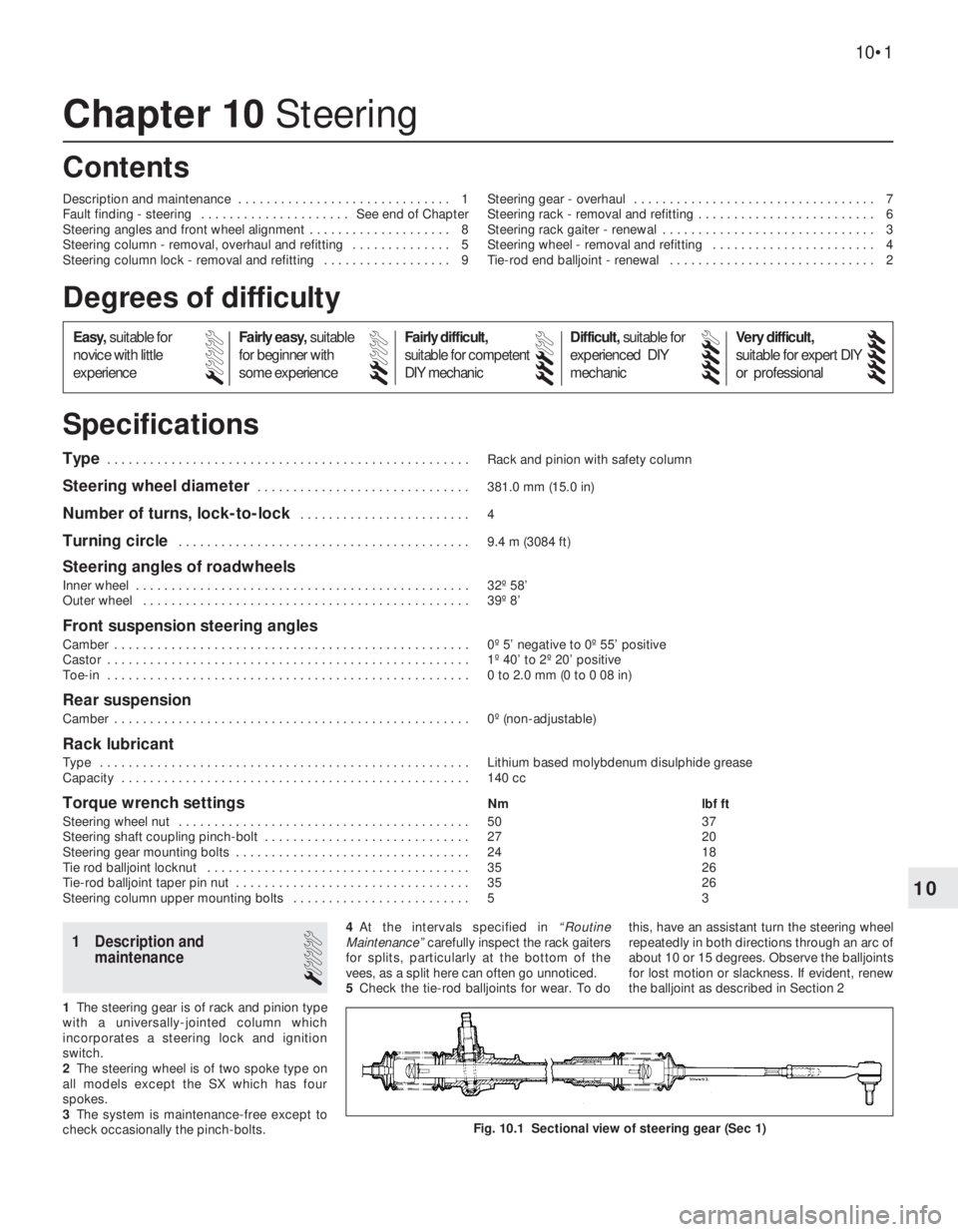
Fig. 10.1 Sectional view of steering gear (Sec 1)
Page 105 of 303
2 Tie-rod end balljoint-
renewal
4
1Jack up the front of the car and remove the
roadwheel from the side on which the balljoint
is to be renewed.
2Unscrew the tie-rod balljoint taper pin nut
and, using a suitable extractor, separate the
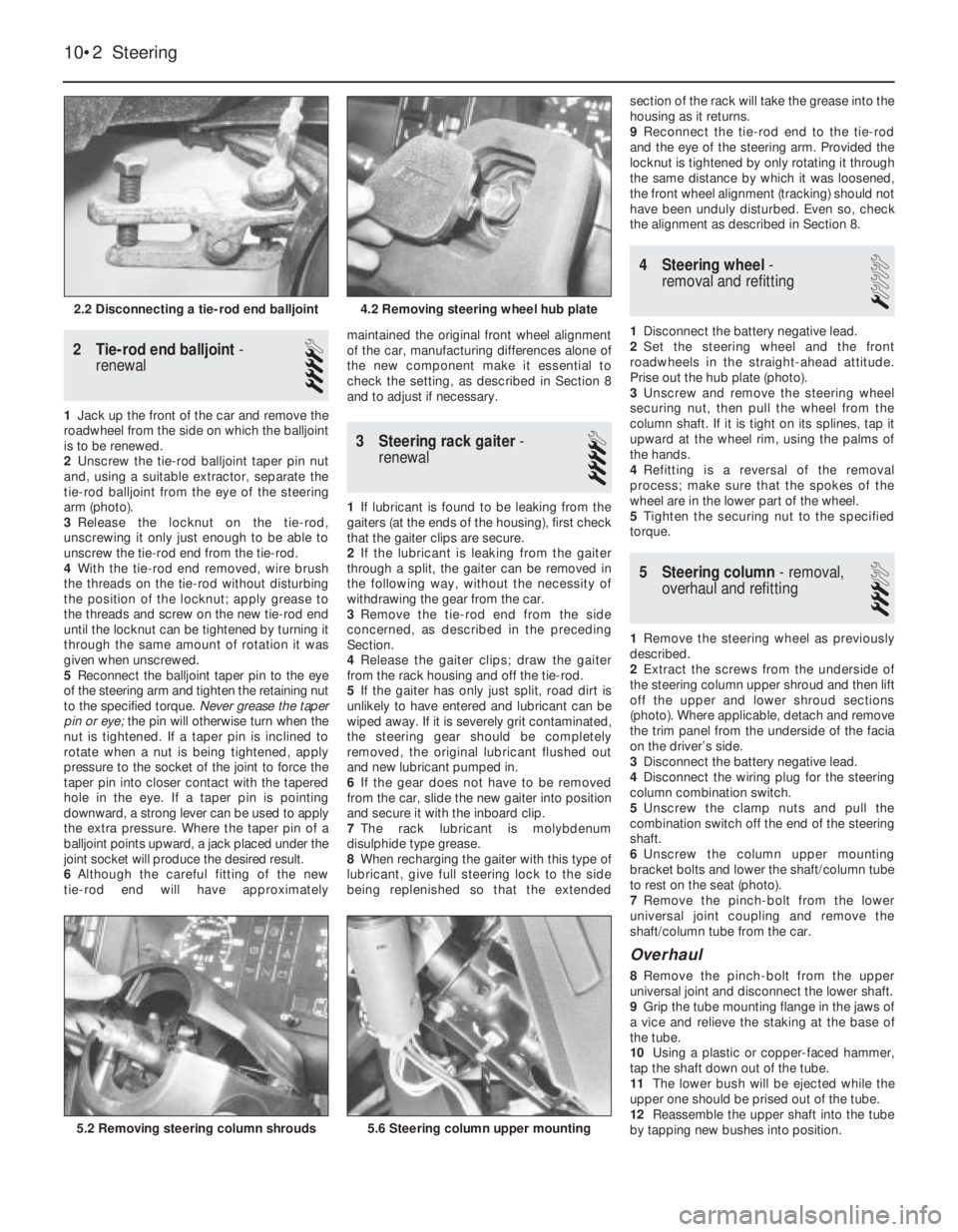
tie-rod balljoint from the eye of the steering
arm (photo).
3Release the locknut on the tie-rod,
unscrewing it only just enough to be able to
unscrew the tie-rod end from the tie-rod.
4With the tie-rod end removed, wire brush
the threads on the tie-rod without disturbing
the position of the locknut; apply grease to
the threads and screw on the new tie-rod end
until the locknut can be tightened by turning it
through the same amount of rotation it was
given when unscrewed.
5Reconnect the balljoint taper pin to the eye
of the steering arm and tighten the retaining nut
to the specified torque. Never grease the taper
pin or eye; the pin will otherwise turn when the
nut is tightened. If a taper pin is inclined to
rotate when a nut is being tightened, apply
pressure to the socket of the joint to force the
taper pin into closer contact with the tapered
hole in the eye. If a taper pin is pointing
downward, a strong lever can be used to apply
the extra pressure. Where the taper pin of a
balljoint points upward, a jack placed under the
joint socket will produce the desired result.
6Although the careful fitting of the new
tie-rod end will have approximatelymaintained the original front wheel alignment
of the car, manufacturing differences alone of
the new component make it essential to
check the setting, as described in Section 8
and to adjust if necessary.
3 Steering rack gaiter-
renewal
4
1If lubricant is found to be leaking from the
gaiters (at the ends of the housing), first check
that the gaiter clips are secure.
2If the lubricant is leaking from the gaiter
through a split, the gaiter can be removed in
the following way, without the necessity of
withdrawing the gear from the car.
3Remove the tie-rod end from the side
concerned, as described in the preceding
Section.
4Release the gaiter clips; draw the gaiter
from the rack housing and off the tie-rod.
5If the gaiter has only just split, road dirt is
unlikely to have entered and lubricant can be
wiped away. If it is severely grit contaminated,
the steering gear should be completely
removed, the original lubricant flushed out
and new lubricant pumped in.
6If the gear does not have to be removed
from the car, slide the new gaiter into position
and secure it with the inboard clip.
7The rack lubricant is molybdenum
disulphide type grease.
8When recharging the gaiter with this type of
lubricant, give full steering lock to the side
being replenished so that the extendedsection of the rack will take the grease into the
housing as it returns.
9Reconnect the tie-rod end to the tie-rod
and the eye of the steering arm. Provided the
locknut is tightened by only rotating it through
the same distance by which it was loosened,
the front wheel alignment (tracking) should not
have been unduly disturbed. Even so, check
the alignment as described in Section 8.
4 Steering wheel-
removal and refitting
1
1Disconnect the battery negative lead.
2Set the steering wheel and the front
roadwheels in the straight-ahead attitude.
Prise out the hub plate (photo).
3Unscrew and remove the steering wheel
securing nut, then pull the wheel from the
column shaft. If it is tight on its splines, tap it
upward at the wheel rim, using the palms of
the hands.
4Refitting is a reversal of the removal
process; make sure that the spokes of the
wheel are in the lower part of the wheel.
5Tighten the securing nut to the specified
torque.
5 Steering column- removal,
overhaul and refitting
3
1Remove the steering wheel as previously
described.
2Extract the screws from the underside of
the steering column upper shroud and then lift
off the upper and lower shroud sections
(photo). Where applicable, detach and remove
the trim panel from the underside of the facia
on the driver’s side.
3Disconnect the battery negative lead.
4Disconnect the wiring plug for the steering
column combination switch.
5Unscrew the clamp nuts and pull the
combination switch off the end of the steering
shaft.
6Unscrew the column upper mounting
bracket bolts and lower the shaft/column tube
to rest on the seat (photo).
7Remove the pinch-bolt from the lower
universal joint coupling and remove the
shaft/column tube from the car.
Overhaul
8Remove the pinch-bolt from the upper
universal joint and disconnect the lower shaft.
9Grip the tube mounting flange in the jaws of
a vice and relieve the staking at the base of
the tube.
10Using a plastic or copper-faced hammer,
tap the shaft down out of the tube.
11The lower bush will be ejected while the
upper one should be prised out of the tube.
12Reassemble the upper shaft into the tube
by tapping new bushes into position.
10•2 Steering
5.6 Steering column upper mounting5.2 Removing steering column shrouds
4.2 Removing steering wheel hub plate2.2 Disconnecting a tie-rod end balljoint