brake FIAT UNO 1983 Service Manual PDF
[x] Cancel search | Manufacturer: FIAT, Model Year: 1983, Model line: UNO, Model: FIAT UNO 1983Pages: 303, PDF Size: 10.36 MB
Page 243 of 303
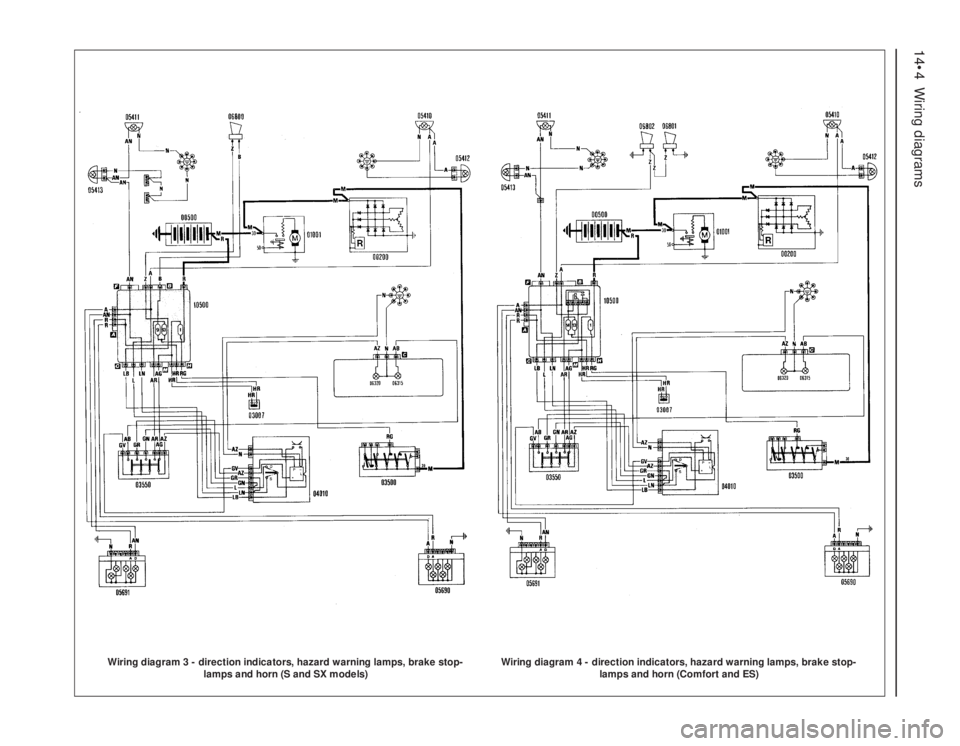
14•4 Wiring diagrams
Wiring diagram 3 - direction indicators, hazard warning lamps, brake stop-
lamps and horn (S and SX models)
Wiring diagram 4 - direction indicators, hazard warning lamps, brake stop-
lamps and horn (Comfort and ES)
Page 254 of 303
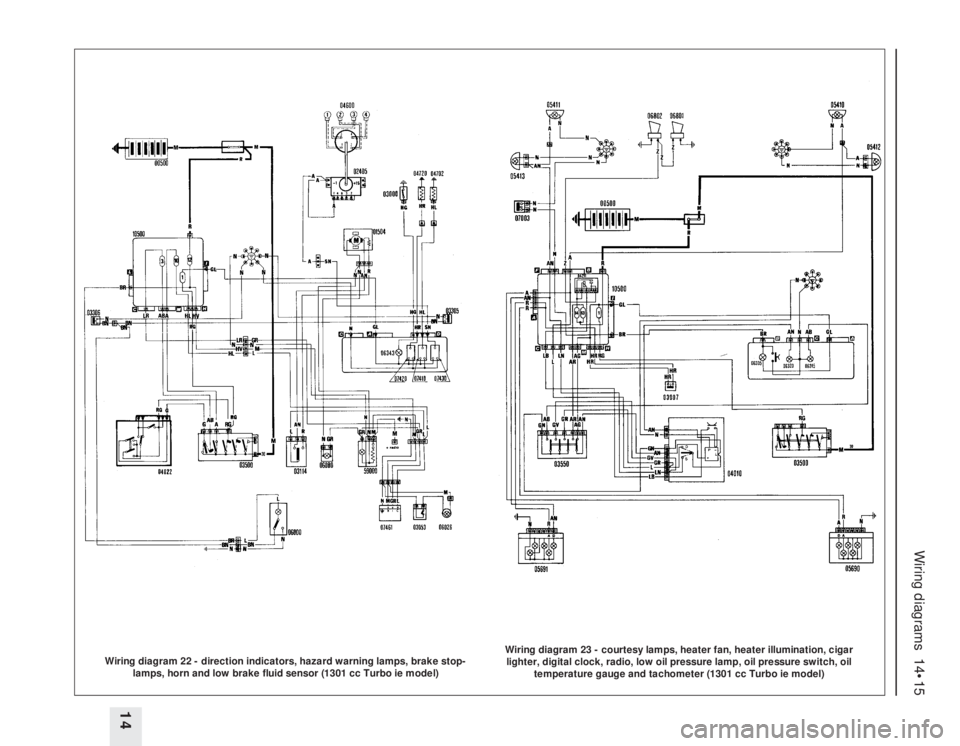
Wiring diagrams 14•15
14
Wiring diagram 22 - direction indicators, hazard warning lamps, brake stop-
lamps, horn and low brake fluid sensor (1301 cc Turbo ie model)
Wiring diagram 23 - courtesy lamps, heater fan, heater illumination, cigar
lighter, digital clock, radio, low oil pressure lamp, oil pressure switch, oil
temperature gauge and tachometer (1301 cc Turbo ie model)
Page 259 of 303
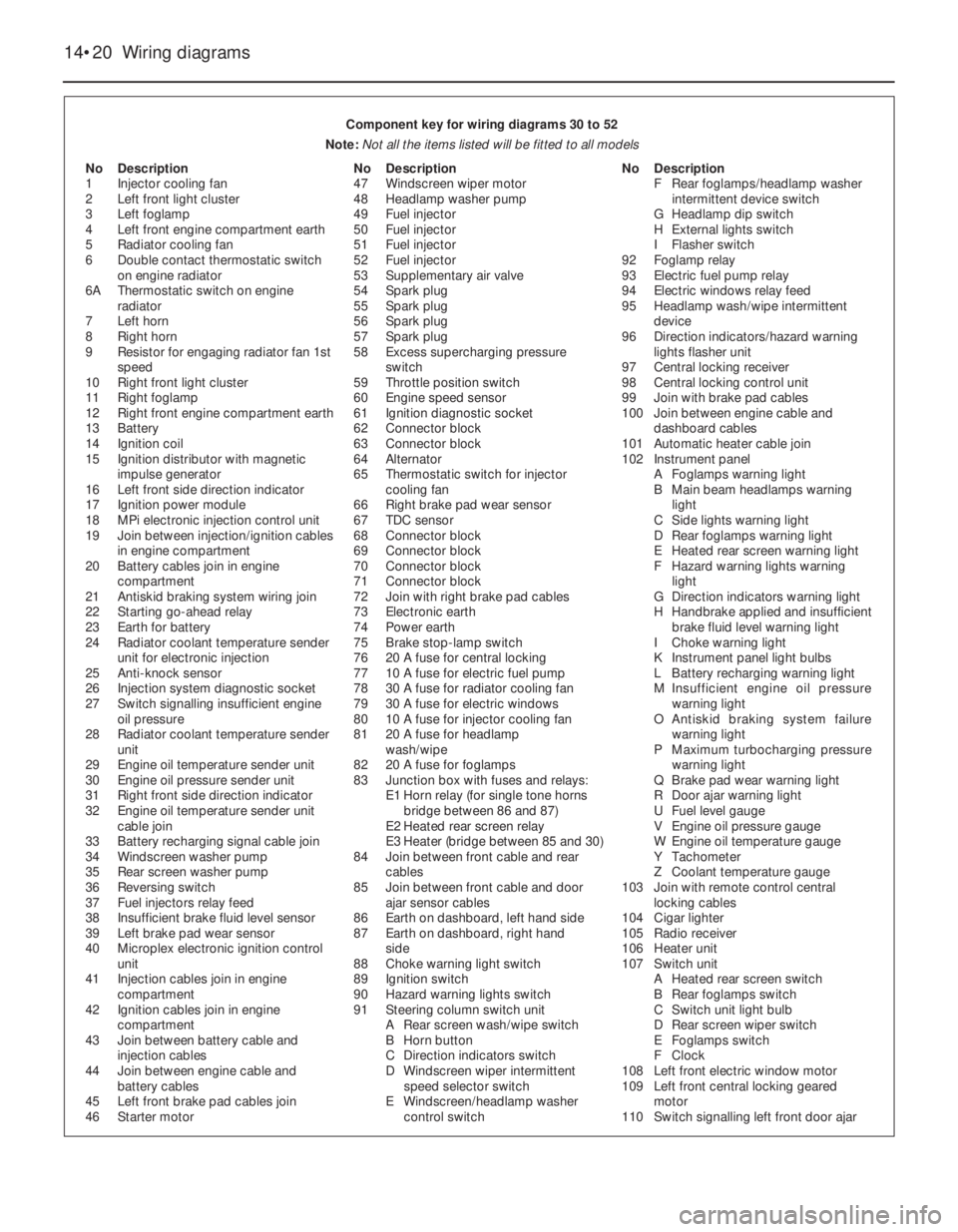
14•20 Wiring diagrams
Component key for wiring diagrams 30 to 52
Note: Not all the items listed will be fitted to all models
No Description
1 Injector cooling fan
2 Left front light cluster
3 Left foglamp
4 Left front engine compartment earth
5 Radiator cooling fan
6 Double contact thermostatic switch
on engine radiator
6A Thermostatic switch on engine
radiator
7 Left horn
8 Right horn
9 Resistor for engaging radiator fan 1st
speed
10 Right front light cluster
11 Right foglamp
12 Right front engine compartment earth
13 Battery
14 Ignition coil
15 Ignition distributor with magnetic
impulse generator
16 Left front side direction indicator
17 Ignition power module
18 MPi electronic injection control unit
19 Join between injection/ignition cables
in engine compartment
20 Battery cables join in engine
compartment
21 Antiskid braking system wiring join
22 Starting go-ahead relay
23 Earth for battery
24 Radiator coolant temperature sender
unit for electronic injection
25 Anti-knock sensor
26 Injection system diagnostic socket
27 Switch signalling insufficient engine
oil pressure
28 Radiator coolant temperature sender
unit
29 Engine oil temperature sender unit
30 Engine oil pressure sender unit
31 Right front side direction indicator
32 Engine oil temperature sender unit
cable join
33 Battery recharging signal cable join
34 Windscreen washer pump
35 Rear screen washer pump
36 Reversing switch
37 Fuel injectors relay feed
38 Insufficient brake fluid level sensor
39 Left brake pad wear sensor
40 Microplex electronic ignition control
unit
41 Injection cables join in engine
compartment
42 Ignition cables join in engine
compartment
43 Join between battery cable and
injection cables
44 Join between engine cable and
battery cables
45 Left front brake pad cables join
46 Starter motorNo Description
47 Windscreen wiper motor
48 Headlamp washer pump
49 Fuel injector
50 Fuel injector
51 Fuel injector
52 Fuel injector
53 Supplementary air valve
54 Spark plug
55 Spark plug
56 Spark plug
57 Spark plug
58 Excess supercharging pressure
switch
59 Throttle position switch
60 Engine speed sensor
61 Ignition diagnostic socket
62 Connector block
63 Connector block
64 Alternator
65 Thermostatic switch for injector
cooling fan
66 Right brake pad wear sensor
67 TDC sensor
68 Connector block
69 Connector block
70 Connector block
71 Connector block
72 Join with right brake pad cables
73 Electronic earth
74 Power earth
75 Brake stop-lamp switch
76 20 A fuse for central locking
77 10 A fuse for electric fuel pump
78 30 A fuse for radiator cooling fan
79 30 A fuse for electric windows
80 10 A fuse for injector cooling fan
81 20 A fuse for headlamp
wash/wipe
82 20 A fuse for foglamps
83 Junction box with fuses and relays:
E1 Horn relay (for single tone horns
bridge between 86 and 87)
E2 Heated rear screen relay
E3 Heater (bridge between 85 and 30)
84 Join between front cable and rear
cables
85 Join between front cable and door
ajar sensor cables
86 Earth on dashboard, left hand side
87 Earth on dashboard, right hand
side
88 Choke warning light switch
89 Ignition switch
90 Hazard warning lights switch
91 Steering column switch unit
A Rear screen wash/wipe switch
B Horn button
C Direction indicators switch
D Windscreen wiper intermittent
speed selector switch
E Windscreen/headlamp washer
control switchNo Description
F Rear foglamps/headlamp washer
intermittent device switch
G Headlamp dip switch
H External lights switch
I Flasher switch
92 Foglamp relay
93 Electric fuel pump relay
94 Electric windows relay feed
95 Headlamp wash/wipe intermittent
device
96 Direction indicators/hazard warning
lights flasher unit
97 Central locking receiver
98 Central locking control unit
99 Join with brake pad cables
100 Join between engine cable and
dashboard cables
101 Automatic heater cable join
102 Instrument panel
A Foglamps warning light
B Main beam headlamps warning
light
C Side lights warning light
D Rear foglamps warning light
E Heated rear screen warning light
F Hazard warning lights warning
light
G Direction indicators warning light
H Handbrake applied and insufficient
brake fluid level warning light
I Choke warning light
K Instrument panel light bulbs
L Battery recharging warning light
M Insufficient engine oil pressure
warning light
O Antiskid braking system failure
warning light
P Maximum turbocharging pressure
warning light
Q Brake pad wear warning light
R Door ajar warning light
U Fuel level gauge
V Engine oil pressure gauge
W Engine oil temperature gauge
Y Tachometer
Z Coolant temperature gauge
103 Join with remote control central
locking cables
104 Cigar lighter
105 Radio receiver
106 Heater unit
107 Switch unit
A Heated rear screen switch
B Rear foglamps switch
C Switch unit light bulb
D Rear screen wiper switch
E Foglamps switch
F Clock
108 Left front electric window motor
109 Left front central locking geared
motor
110 Switch signalling left front door ajar
Page 260 of 303
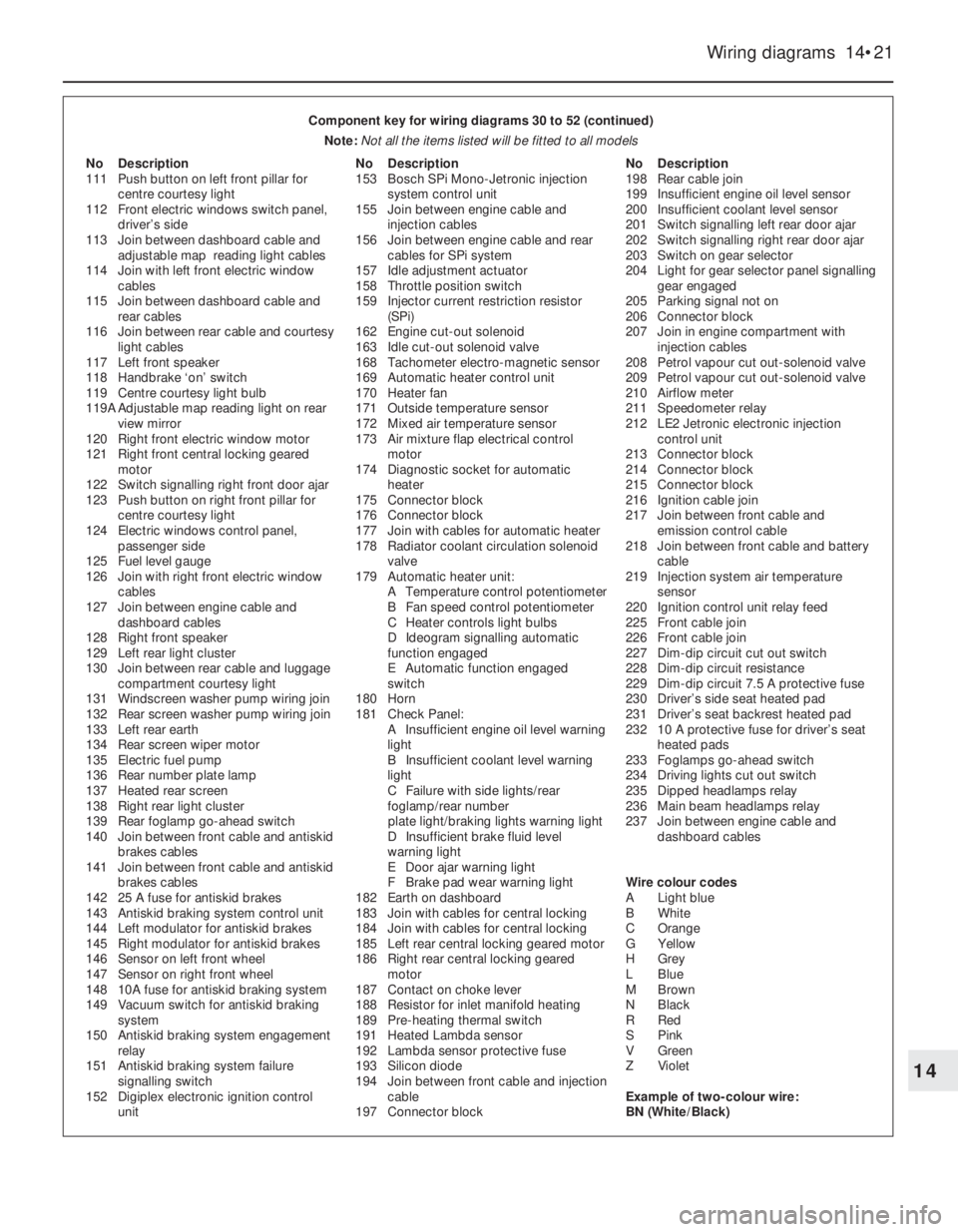
Wiring diagrams 14•21
14
Component key for wiring diagrams 30 to 52 (continued)
Note: Not all the items listed will be fitted to all models
No Description
111 Push button on left front pillar for
centre courtesy light
112 Front electric windows switch panel,
driver’s side
113 Join between dashboard cable and
adjustable map reading light cables
114 Join with left front electric window
cables
115 Join between dashboard cable and
rear cables
116 Join between rear cable and courtesy
light cables
117 Left front speaker
118 Handbrake ‘on’ switch
119 Centre courtesy light bulb
119A Adjustable map reading light on rear
view mirror
120 Right front electric window motor
121 Right front central locking geared
motor
122 Switch signalling right front door ajar
123 Push button on right front pillar for
centre courtesy light
124 Electric windows control panel,
passenger side
125 Fuel level gauge
126 Join with right front electric window
cables
127 Join between engine cable and
dashboard cables
128 Right front speaker
129 Left rear light cluster
130 Join between rear cable and luggage
compartment courtesy light
131 Windscreen washer pump wiring join
132 Rear screen washer pump wiring join
133 Left rear earth
134 Rear screen wiper motor
135 Electric fuel pump
136 Rear number plate lamp
137 Heated rear screen
138 Right rear light cluster
139 Rear foglamp go-ahead switch
140 Join between front cable and antiskid
brakes cables
141 Join between front cable and antiskid
brakes cables
142 25 A fuse for antiskid brakes
143 Antiskid braking system control unit
144 Left modulator for antiskid brakes
145 Right modulator for antiskid brakes
146 Sensor on left front wheel
147 Sensor on right front wheel
148 10A fuse for antiskid braking system
149 Vacuum switch for antiskid braking
system
150 Antiskid braking system engagement
relay
151 Antiskid braking system failure
signalling switch
152 Digiplex electronic ignition control
unitNo Description
153 Bosch SPi Mono-Jetronic injection
system control unit
155 Join between engine cable and
injection cables
156 Join between engine cable and rear
cables for SPi system
157 Idle adjustment actuator
158 Throttle position switch
159 Injector current restriction resistor
(SPi)
162 Engine cut-out solenoid
163 Idle cut-out solenoid valve
168 Tachometer electro-magnetic sensor
169 Automatic heater control unit
170 Heater fan
171 Outside temperature sensor
172 Mixed air temperature sensor
173 Air mixture flap electrical control
motor
174 Diagnostic socket for automatic
heater
175 Connector block
176 Connector block
177 Join with cables for automatic heater
178 Radiator coolant circulation solenoid
valve
179 Automatic heater unit:
A Temperature control potentiometer
B Fan speed control potentiometer
C Heater controls light bulbs
D Ideogram signalling automatic
function engaged
E Automatic function engaged
switch
180 Horn
181 Check Panel:
A Insufficient engine oil level warning
light
B Insufficient coolant level warning
light
C Failure with side lights/rear
foglamp/rear number
plate light/braking lights warning light
D Insufficient brake fluid level
warning light
E Door ajar warning light
F Brake pad wear warning light
182 Earth on dashboard
183 Join with cables for central locking
184 Join with cables for central locking
185 Left rear central locking geared motor
186 Right rear central locking geared
motor
187 Contact on choke lever
188 Resistor for inlet manifold heating
189 Pre-heating thermal switch
191 Heated Lambda sensor
192 Lambda sensor protective fuse
193 Silicon diode
194 Join between front cable and injection
cable
197 Connector blockNo Description
198 Rear cable join
199 Insufficient engine oil level sensor
200 Insufficient coolant level sensor
201 Switch signalling left rear door ajar
202 Switch signalling right rear door ajar
203 Switch on gear selector
204 Light for gear selector panel signalling
gear engaged
205 Parking signal not on
206 Connector block
207 Join in engine compartment with
injection cables
208 Petrol vapour cut out-solenoid valve
209 Petrol vapour cut out-solenoid valve
210 Airflow meter
211 Speedometer relay
212 LE2 Jetronic electronic injection
control unit
213 Connector block
214 Connector block
215 Connector block
216 Ignition cable join
217 Join between front cable and
emission control cable
218 Join between front cable and battery
cable
219 Injection system air temperature
sensor
220 Ignition control unit relay feed
225 Front cable join
226 Front cable join
227 Dim-dip circuit cut out switch
228 Dim-dip circuit resistance
229 Dim-dip circuit 7.5 A protective fuse
230 Driver’s side seat heated pad
231 Driver’s seat backrest heated pad
232 10 A protective fuse for driver’s seat
heated pads
233 Foglamps go-ahead switch
234 Driving lights cut out switch
235 Dipped headlamps relay
236 Main beam headlamps relay
237 Join between engine cable and
dashboard cables
Wire colour codes
A Light blue
B White
C Orange
G Yellow
H Grey
L Blue
M Brown
N Black
R Red
S Pink
V Green
Z Violet
Example of two-colour wire:
BN (White/Black)
Page 266 of 303
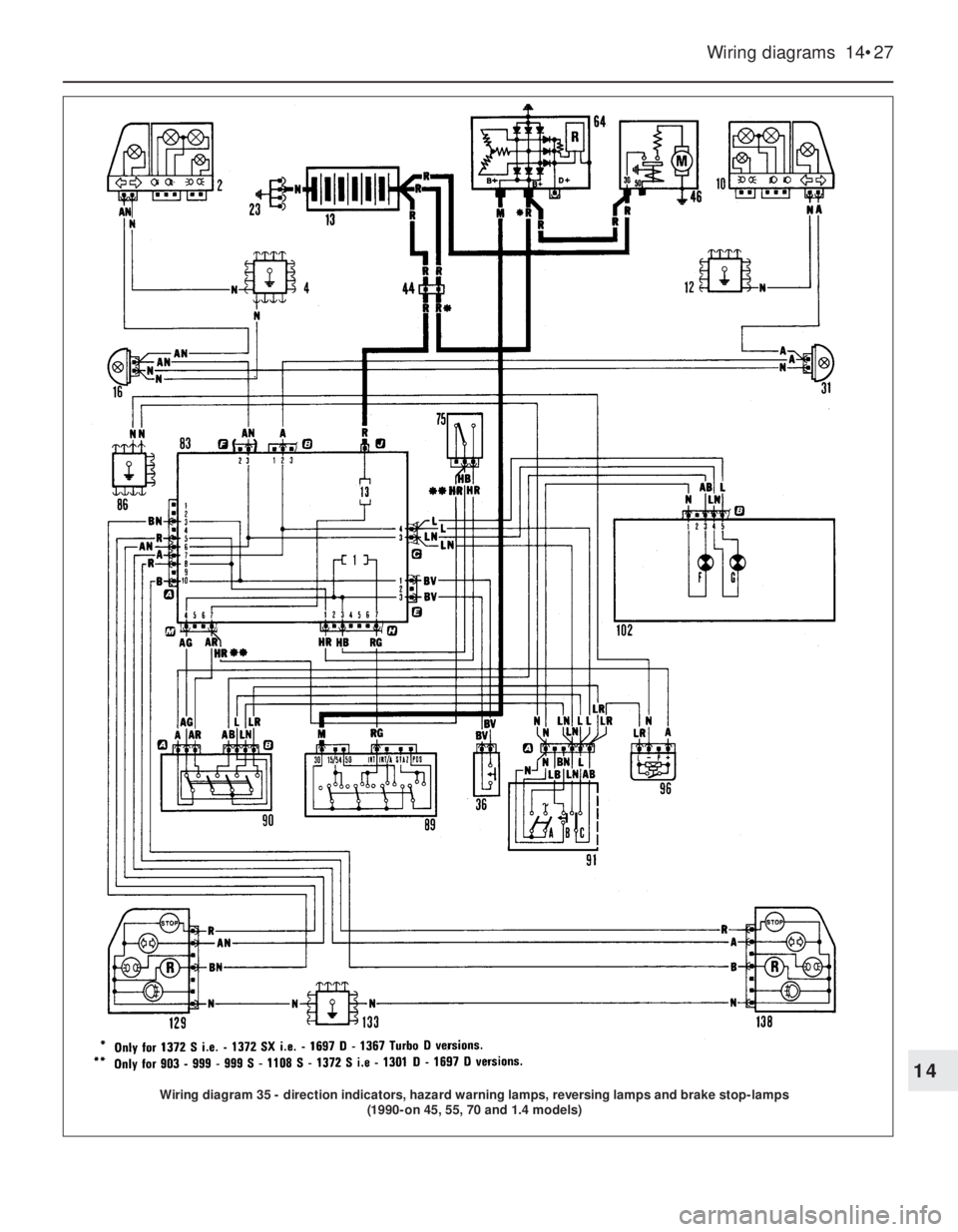
Wiring diagrams 14•27
14
Wiring diagram 35 - direction indicators, hazard warning lamps, reversing lamps and brake stop-lamps
(1990-on 45, 55, 70 and 1.4 models)
Page 267 of 303
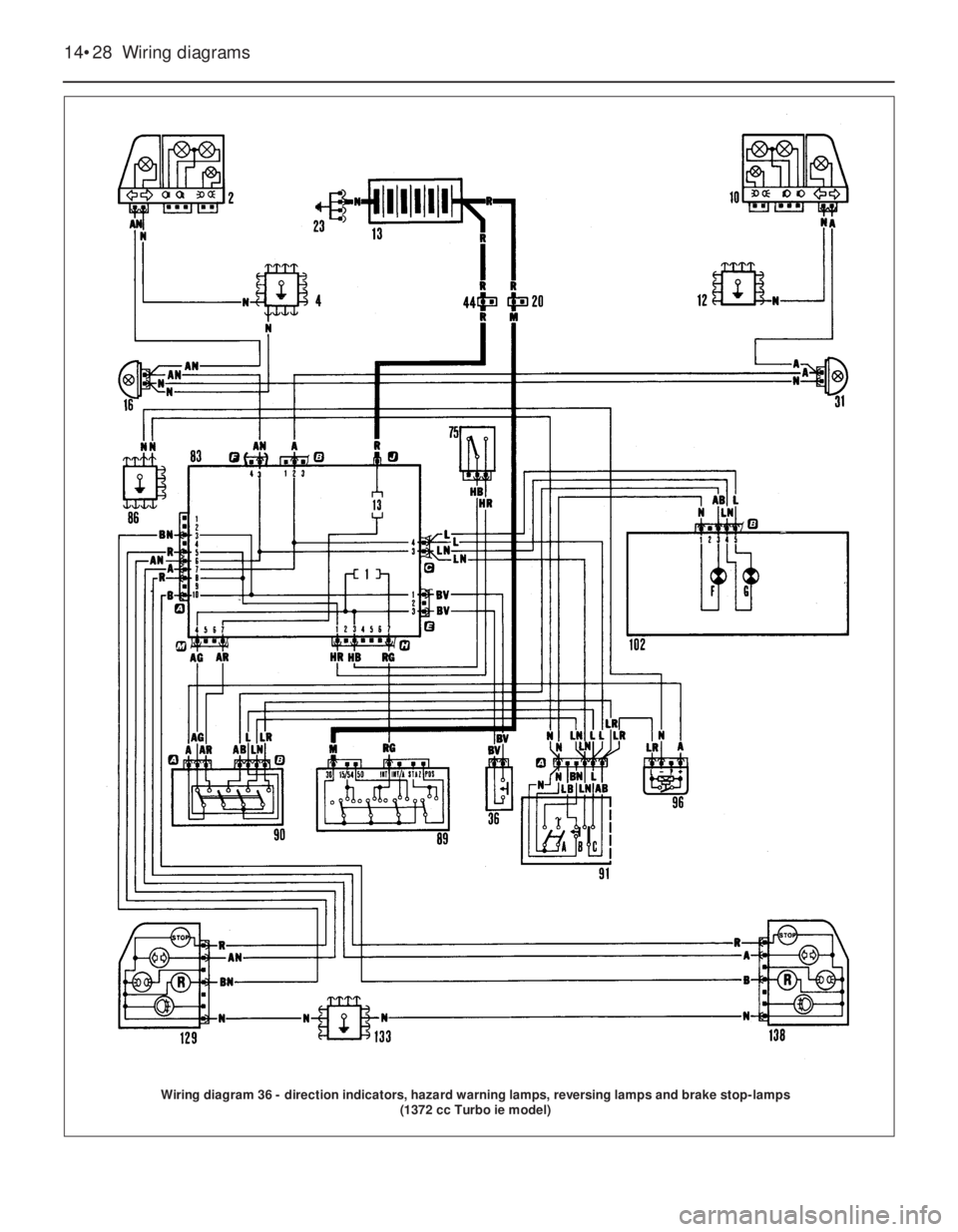
14•28 Wiring diagrams
Wiring diagram 36 - direction indicators, hazard warning lamps, reversing lamps and brake stop-lamps
(1372 cc Turbo ie model)
Page 278 of 303
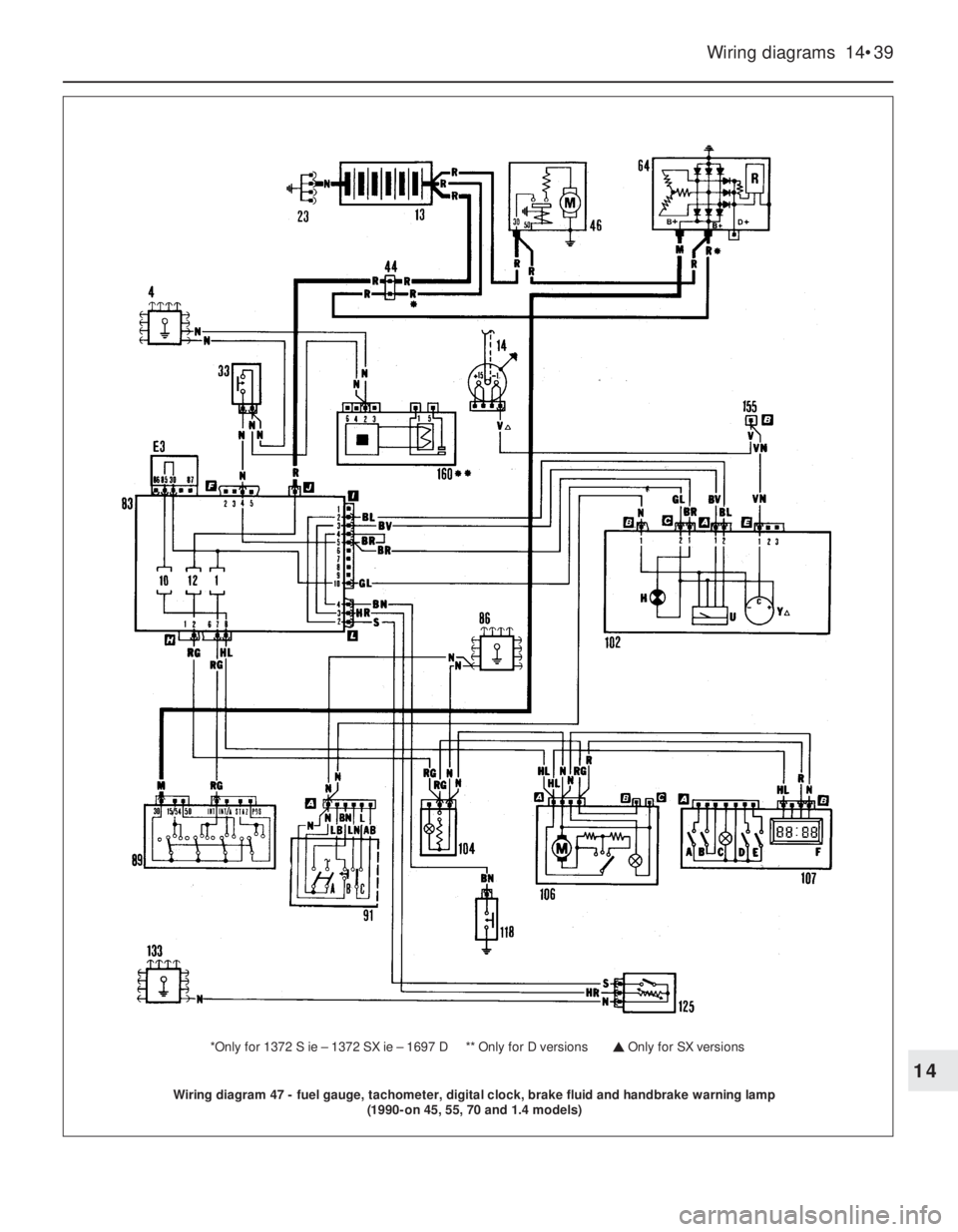
Wiring diagrams 14•39
14
Wiring diagram 47 - fuel gauge, tachometer, digital clock, brake fluid and handbrake warning lamp
(1990-on 45, 55, 70 and 1.4 models)
*Only for 1372 S ie – 1372 SX ie – 1697 D ** Only for D versions sOnly for SX versions
Page 279 of 303
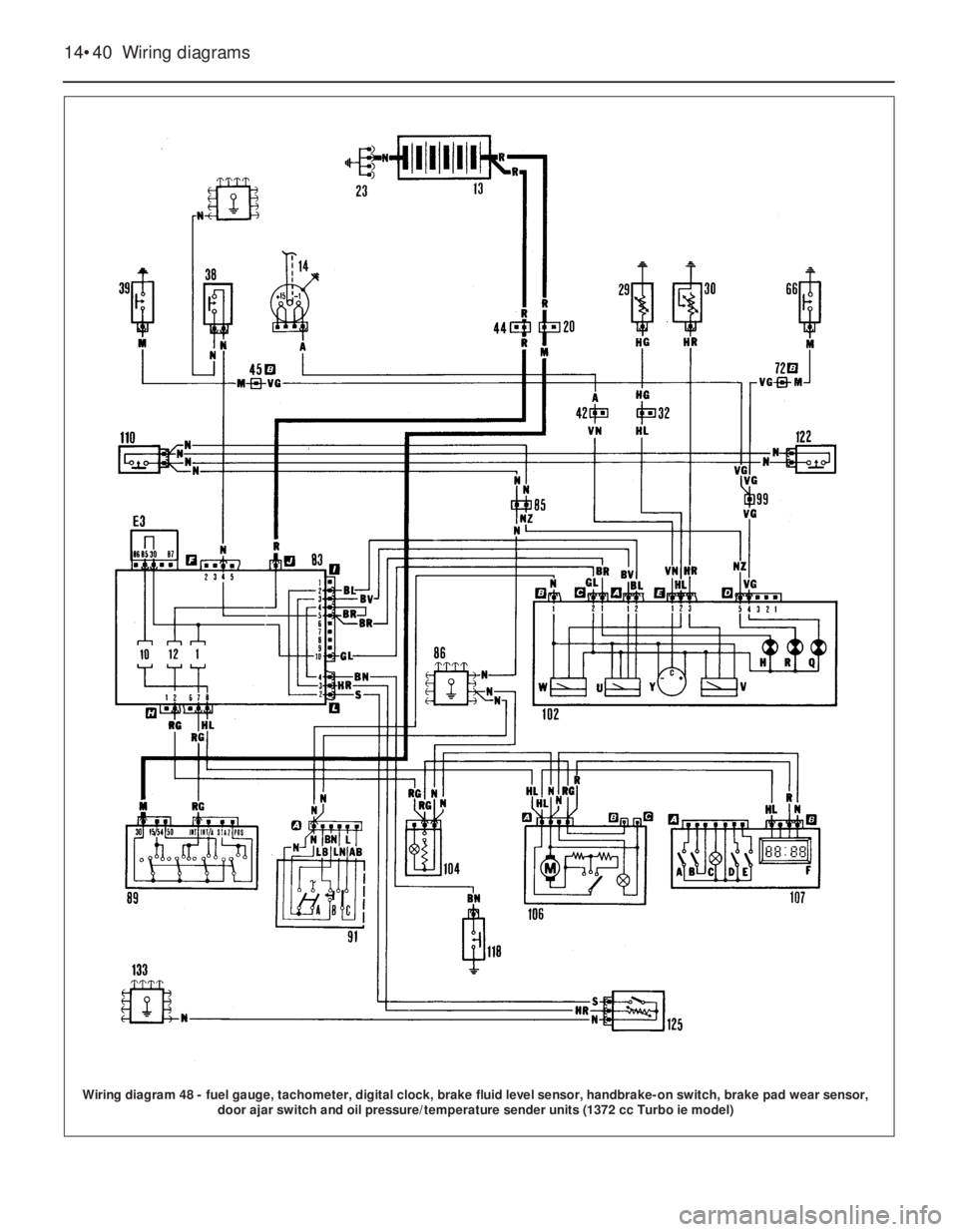
14•40 Wiring diagrams
Wiring diagram 48 - fuel gauge, tachometer, digital clock, brake fluid level sensor, handbrake-on switch, brake pad wear sensor,
door ajar switch and oil pressure/temperature sender units (1372 cc Turbo ie model)
Page 284 of 303
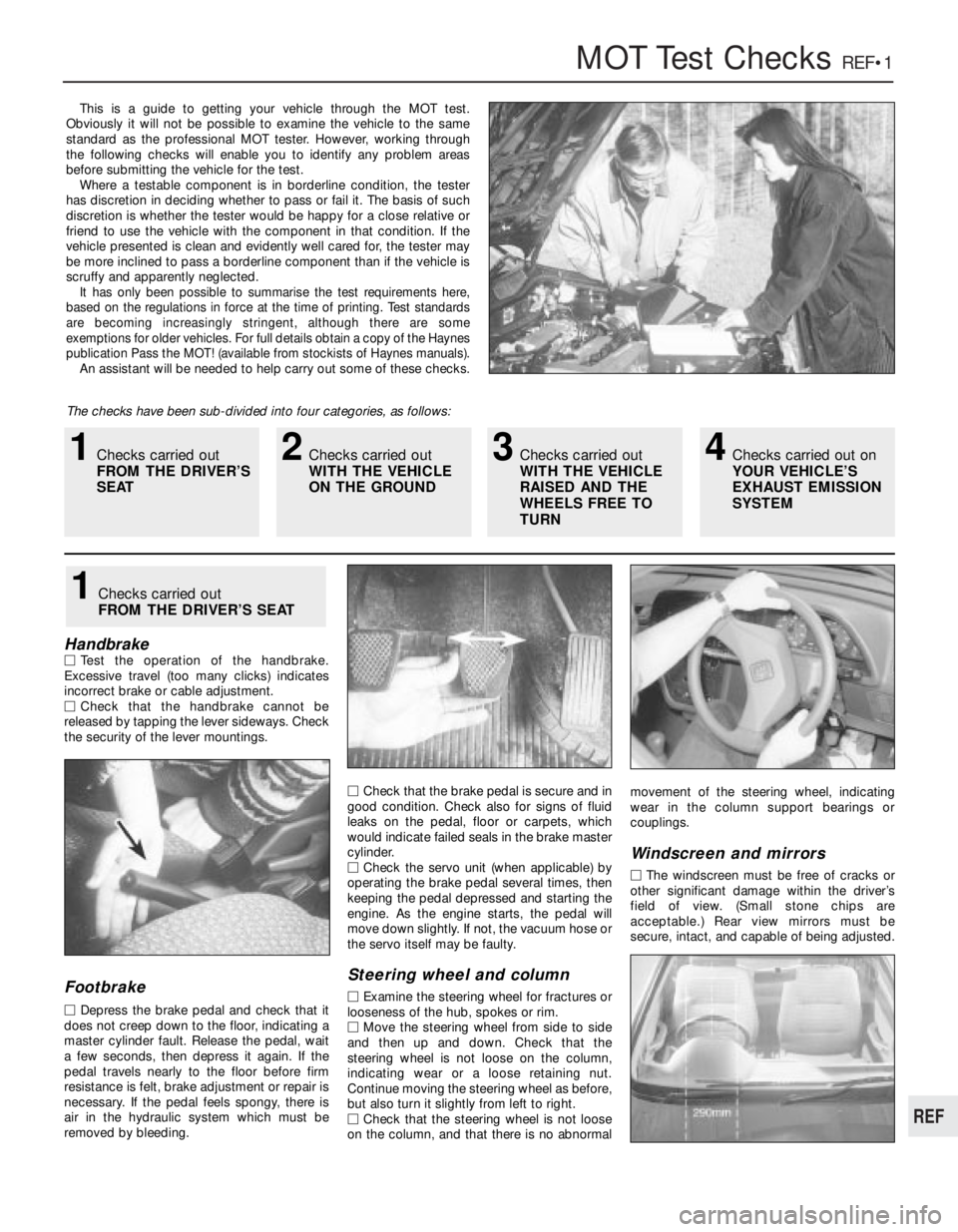
MOT Test ChecksREF•1
This is a guide to getting your vehicle through the MOT test.
Obviously it will not be possible to examine the vehicle to the same
standard as the professional MOT tester. However, working through
the following checks will enable you to identify any problem areas
before submitting the vehicle for the test.
Where a testable component is in borderline condition, the tester
has discretion in deciding whether to pass or fail it. The basis of such
discretion is whether the tester would be happy for a close relative or
friend to use the vehicle with the component in that condition. If the
vehicle presented is clean and evidently well cared for, the tester may
be more inclined to pass a borderline component than if the vehicle is
scruffy and apparently neglected.
It has only been possible to summarise the test requirements here,
based on the regulations in force at the time of printing. Test standards
are becoming increasingly stringent, although there are some
exemptions for older vehicles. For full details obtain a copy of the Haynes
publication Pass the MOT! (available from stockists of Haynes manuals).
An assistant will be needed to help carry out some of these checks.
The checks have been sub-divided into four categories, as follows:
HandbrakeMTest the operation of the handbrake.
Excessive travel (too many clicks) indicates
incorrect brake or cable adjustment.
MCheck that the handbrake cannot be
released by tapping the lever sideways. Check
the security of the lever mountings.
Footbrake
MDepress the brake pedal and check that it
does not creep down to the floor, indicating a
master cylinder fault. Release the pedal, wait
a few seconds, then depress it again. If the
pedal travels nearly to the floor before firm
resistance is felt, brake adjustment or repair is
necessary. If the pedal feels spongy, there is
air in the hydraulic system which must be
removed by bleeding.MCheck that the brake pedal is secure and in
good condition. Check also for signs of fluid
leaks on the pedal, floor or carpets, which
would indicate failed seals in the brake master
cylinder.
MCheck the servo unit (when applicable) by
operating the brake pedal several times, then
keeping the pedal depressed and starting the
engine. As the engine starts, the pedal will
move down slightly. If not, the vacuum hose or
the servo itself may be faulty.
Steering wheel and column
MExamine the steering wheel for fractures or
looseness of the hub, spokes or rim.
MMove the steering wheel from side to side
and then up and down. Check that the
steering wheel is not loose on the column,
indicating wear or a loose retaining nut.
Continue moving the steering wheel as before,
but also turn it slightly from left to right.
MCheck that the steering wheel is not loose
on the column, and that there is no abnormalmovement of the steering wheel, indicating
wear in the column support bearings or
couplings.
Windscreen and mirrors
MThe windscreen must be free of cracks or
other significant damage within the driver’s
field of view. (Small stone chips are
acceptable.) Rear view mirrors must be
secure, intact, and capable of being adjusted.
1Checks carried out
FROM THE DRIVER’S SEAT
1Checks carried out
FROM THE DRIVER’S
SEAT2Checks carried out
WITH THE VEHICLE
ON THE GROUND3Checks carried out
WITH THE VEHICLE
RAISED AND THE
WHEELS FREE TO
TURN4Checks carried out on
YOUR VEHICLE’S
EXHAUST EMISSION
SYSTEM
REF
Page 285 of 303
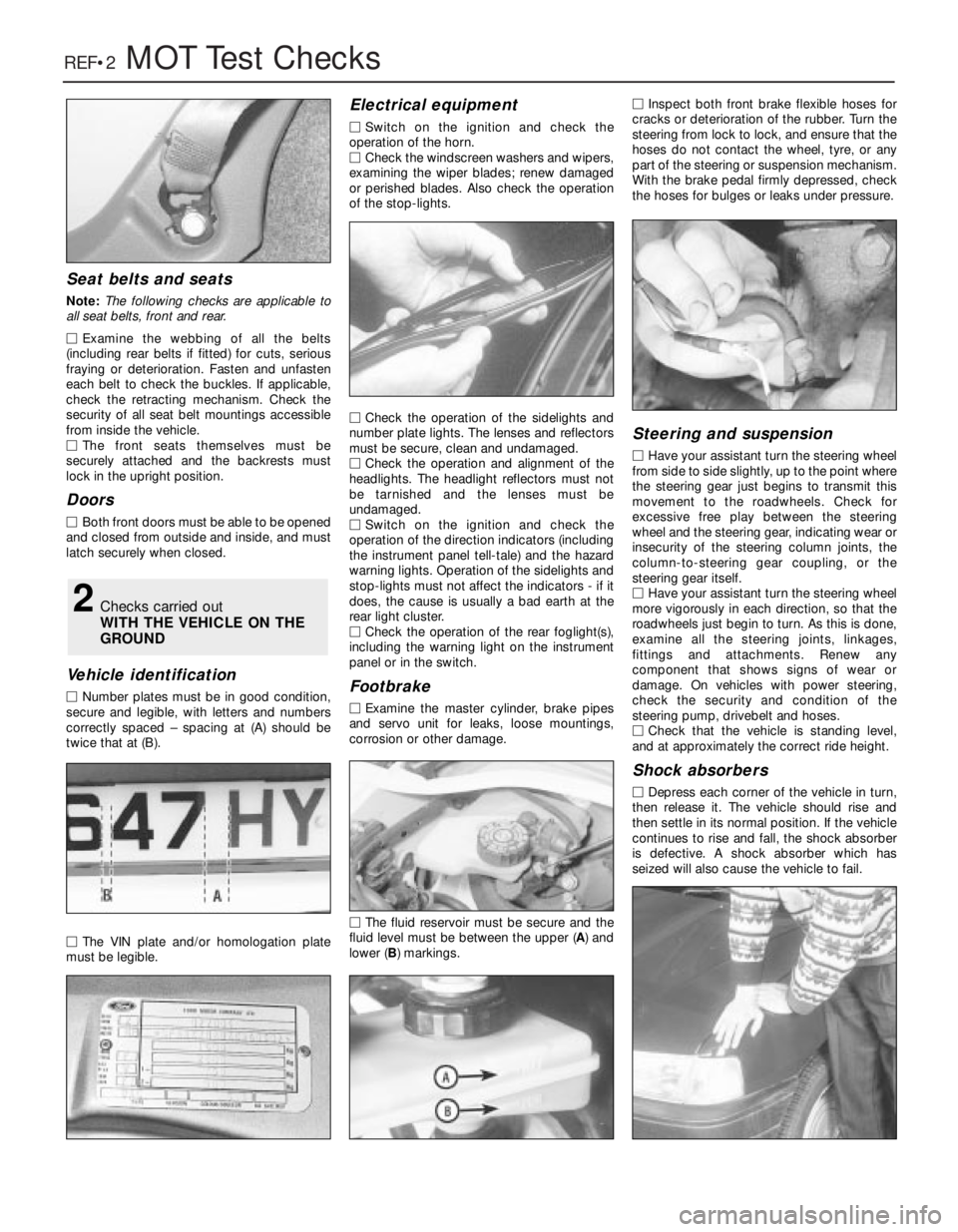
REF•2MOT Test Checks
Seat belts and seats
Note: The following checks are applicable to
all seat belts, front and rear.
MExamine the webbing of all the belts
(including rear belts if fitted) for cuts, serious
fraying or deterioration. Fasten and unfasten
each belt to check the buckles. If applicable,
check the retracting mechanism. Check the
security of all seat belt mountings accessible
from inside the vehicle.
MThe front seats themselves must be
securely attached and the backrests must
lock in the upright position.
Doors
MBoth front doors must be able to be opened
and closed from outside and inside, and must
latch securely when closed.
Vehicle identification
MNumber plates must be in good condition,
secure and legible, with letters and numbers
correctly spaced – spacing at (A) should be
twice that at (B).
MThe VIN plate and/or homologation plate
must be legible.
Electrical equipment
MSwitch on the ignition and check the
operation of the horn.
MCheck the windscreen washers and wipers,
examining the wiper blades; renew damaged
or perished blades. Also check the operation
of the stop-lights.
MCheck the operation of the sidelights and
number plate lights. The lenses and reflectors
must be secure, clean and undamaged.
MCheck the operation and alignment of the
headlights. The headlight reflectors must not
be tarnished and the lenses must be
undamaged.
MSwitch on the ignition and check the
operation of the direction indicators (including
the instrument panel tell-tale) and the hazard
warning lights. Operation of the sidelights and
stop-lights must not affect the indicators - if it
does, the cause is usually a bad earth at the
rear light cluster.
MCheck the operation of the rear foglight(s),
including the warning light on the instrument
panel or in the switch.
Footbrake
MExamine the master cylinder, brake pipes
and servo unit for leaks, loose mountings,
corrosion or other damage.
MThe fluid reservoir must be secure and the
fluid level must be between the upper (A) and
lower (B) markings.MInspect both front brake flexible hoses for
cracks or deterioration of the rubber. Turn the
steering from lock to lock, and ensure that the
hoses do not contact the wheel, tyre, or any
part of the steering or suspension mechanism.
With the brake pedal firmly depressed, check
the hoses for bulges or leaks under pressure.
Steering and suspension
MHave your assistant turn the steering wheel
from side to side slightly, up to the point where
the steering gear just begins to transmit this
movement to the roadwheels. Check for
excessive free play between the steering
wheel and the steering gear, indicating wear or
insecurity of the steering column joints, the
column-to-steering gear coupling, or the
steering gear itself.
MHave your assistant turn the steering wheel
more vigorously in each direction, so that the
roadwheels just begin to turn. As this is done,
examine all the steering joints, linkages,
fittings and attachments. Renew any
component that shows signs of wear or
damage. On vehicles with power steering,
check the security and condition of the
steering pump, drivebelt and hoses.
MCheck that the vehicle is standing level,
and at approximately the correct ride height.
Shock absorbers
MDepress each corner of the vehicle in turn,
then release it. The vehicle should rise and
then settle in its normal position. If the vehicle
continues to rise and fall, the shock absorber
is defective. A shock absorber which has
seized will also cause the vehicle to fail.
2Checks carried out
WITH THE VEHICLE ON THE
GROUND