wheel FORD B MAX 2012 1.G Owner's Manual
[x] Cancel search | Manufacturer: FORD, Model Year: 2012, Model line: B MAX, Model: FORD B MAX 2012 1.GPages: 256, PDF Size: 19.67 MB
Page 105 of 256
Downloaded from www.Manualslib.com manuals search engine PRINCIPLE OF OPERATION
Electronic Stability Program
WARNING
The system does not relieve you ofyour responsibility to drive with duecare and attention.
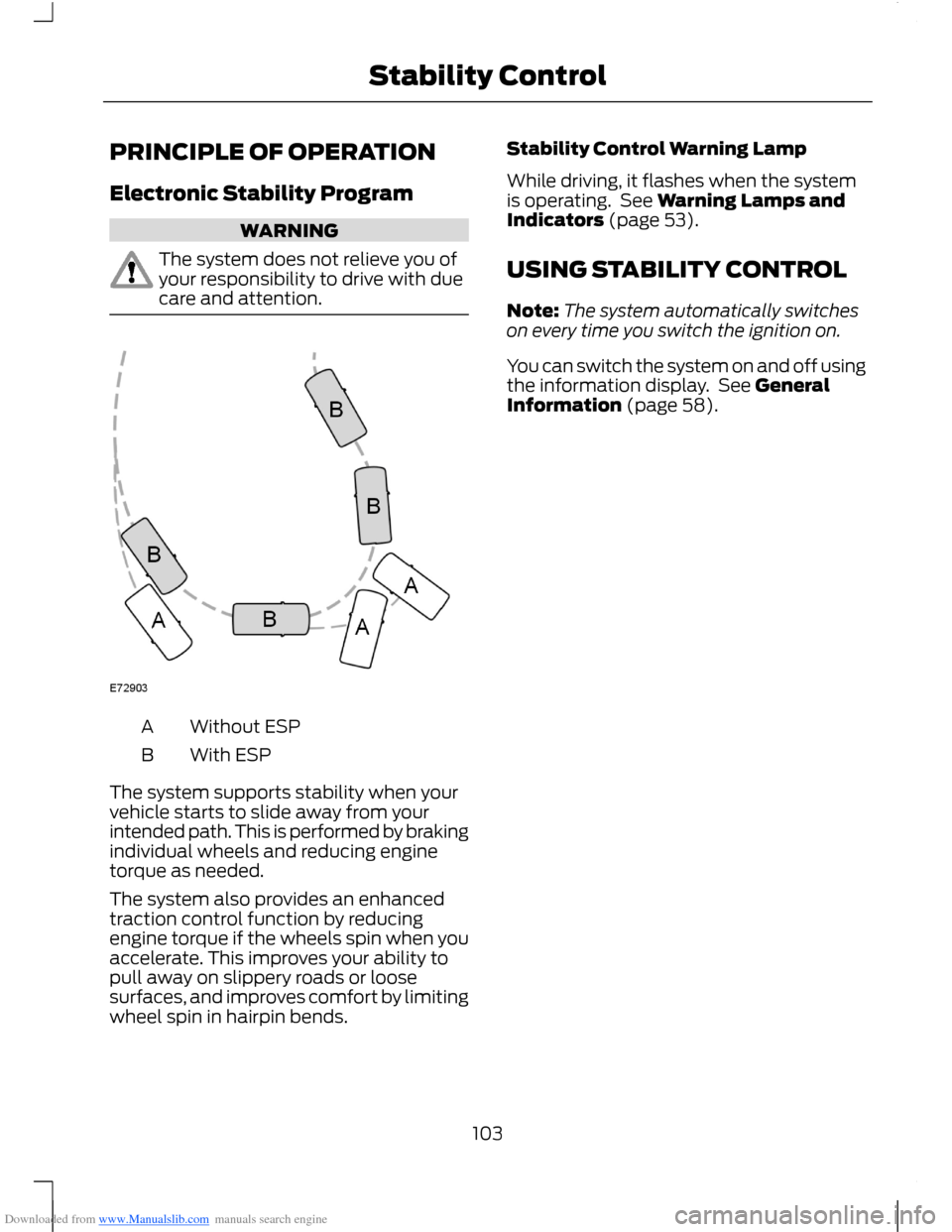
Without ESPA
With ESPB
The system supports stability when yourvehicle starts to slide away from yourintended path. This is performed by brakingindividual wheels and reducing enginetorque as needed.
The system also provides an enhancedtraction control function by reducingengine torque if the wheels spin when youaccelerate. This improves your ability topull away on slippery roads or loosesurfaces, and improves comfort by limitingwheel spin in hairpin bends.
Stability Control Warning Lamp
While driving, it flashes when the systemis operating. See Warning Lamps andIndicators (page 53).
USING STABILITY CONTROL
Note:The system automatically switcheson every time you switch the ignition on.
You can switch the system on and off usingthe information display. See GeneralInformation (page 58).
103Stability Control
Page 111 of 256
Downloaded from www.Manualslib.com manuals search engine PRINCIPLE OF OPERATION
WARNING
The system does not relieve you ofyour responsibility to drive with duecare and attention.
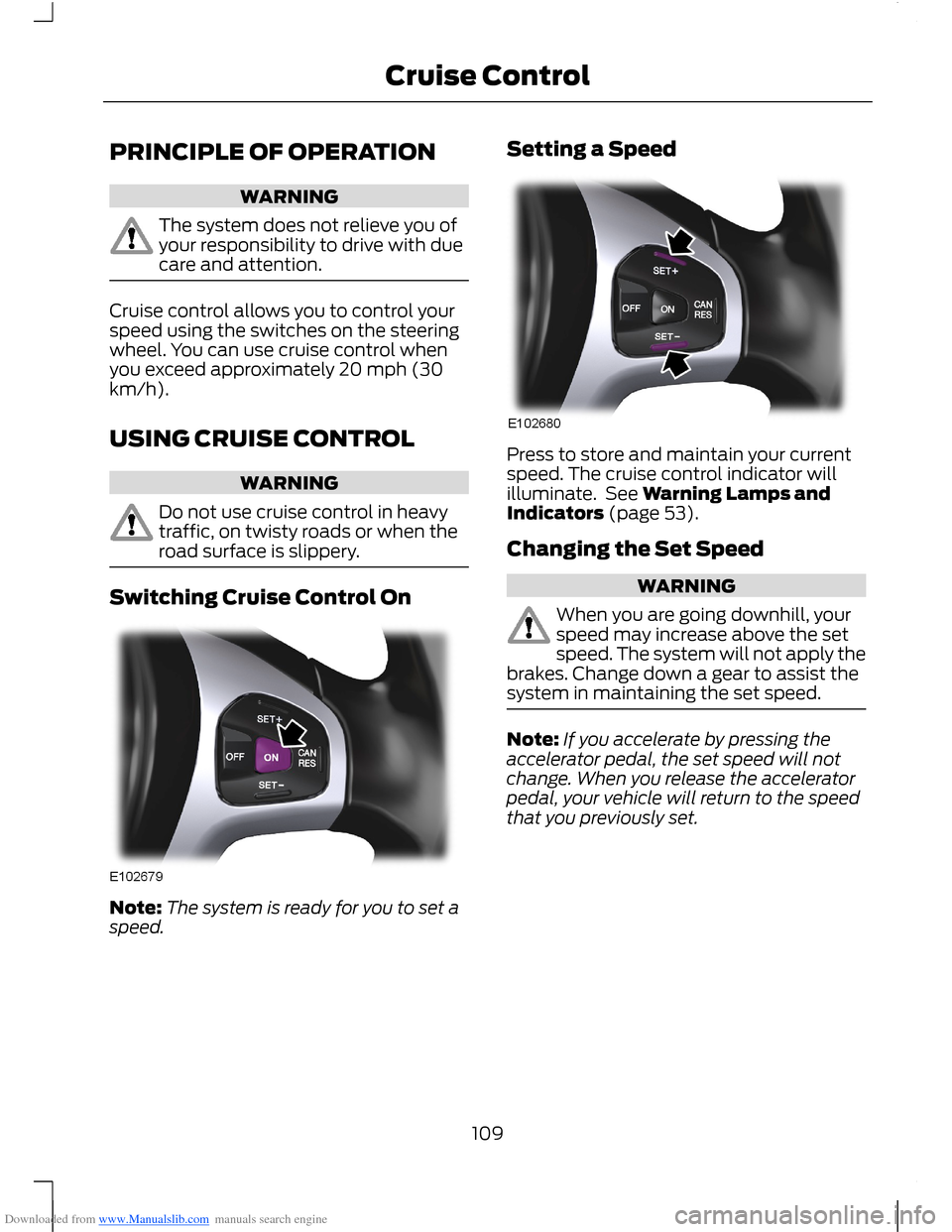
Cruise control allows you to control yourspeed using the switches on the steeringwheel. You can use cruise control whenyou exceed approximately 20 mph (30km/h).
USING CRUISE CONTROL
WARNING
Do not use cruise control in heavytraffic, on twisty roads or when theroad surface is slippery.
Switching Cruise Control On
Note:The system is ready for you to set aspeed.
Setting a Speed
Press to store and maintain your currentspeed. The cruise control indicator willilluminate. See Warning Lamps andIndicators (page 53).
Changing the Set Speed
WARNING
When you are going downhill, yourspeed may increase above the setspeed. The system will not apply thebrakes. Change down a gear to assist thesystem in maintaining the set speed.
Note:If you accelerate by pressing theaccelerator pedal, the set speed will notchange. When you release the acceleratorpedal, your vehicle will return to the speedthat you previously set.
109Cruise Control
Page 116 of 256
Downloaded from www.Manualslib.com manuals search engine CARGO NETS
Installing and Removing the Net
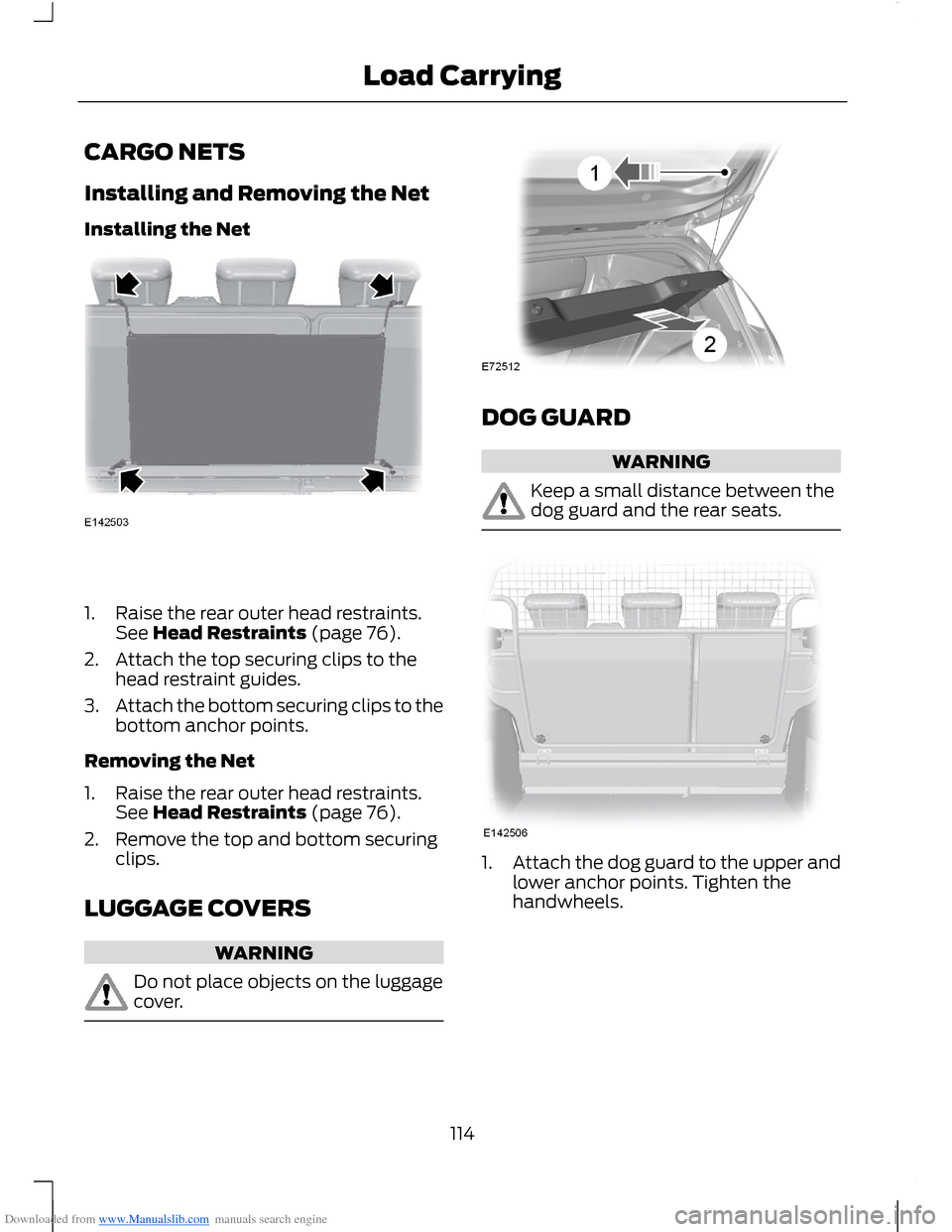
Installing the Net
1.Raise the rear outer head restraints.See Head Restraints (page 76).
2.Attach the top securing clips to thehead restraint guides.
3.Attach the bottom securing clips to thebottom anchor points.
Removing the Net
1.Raise the rear outer head restraints.See Head Restraints (page 76).
2.Remove the top and bottom securingclips.
LUGGAGE COVERS
WARNING
Do not place objects on the luggagecover.
DOG GUARD
WARNING
Keep a small distance between thedog guard and the rear seats.
1.Attach the dog guard to the upper andlower anchor points. Tighten thehandwheels.
114Load Carrying
Page 119 of 256
Downloaded from www.Manualslib.com manuals search engine Unlocking the Tow Ball ArmMechanism
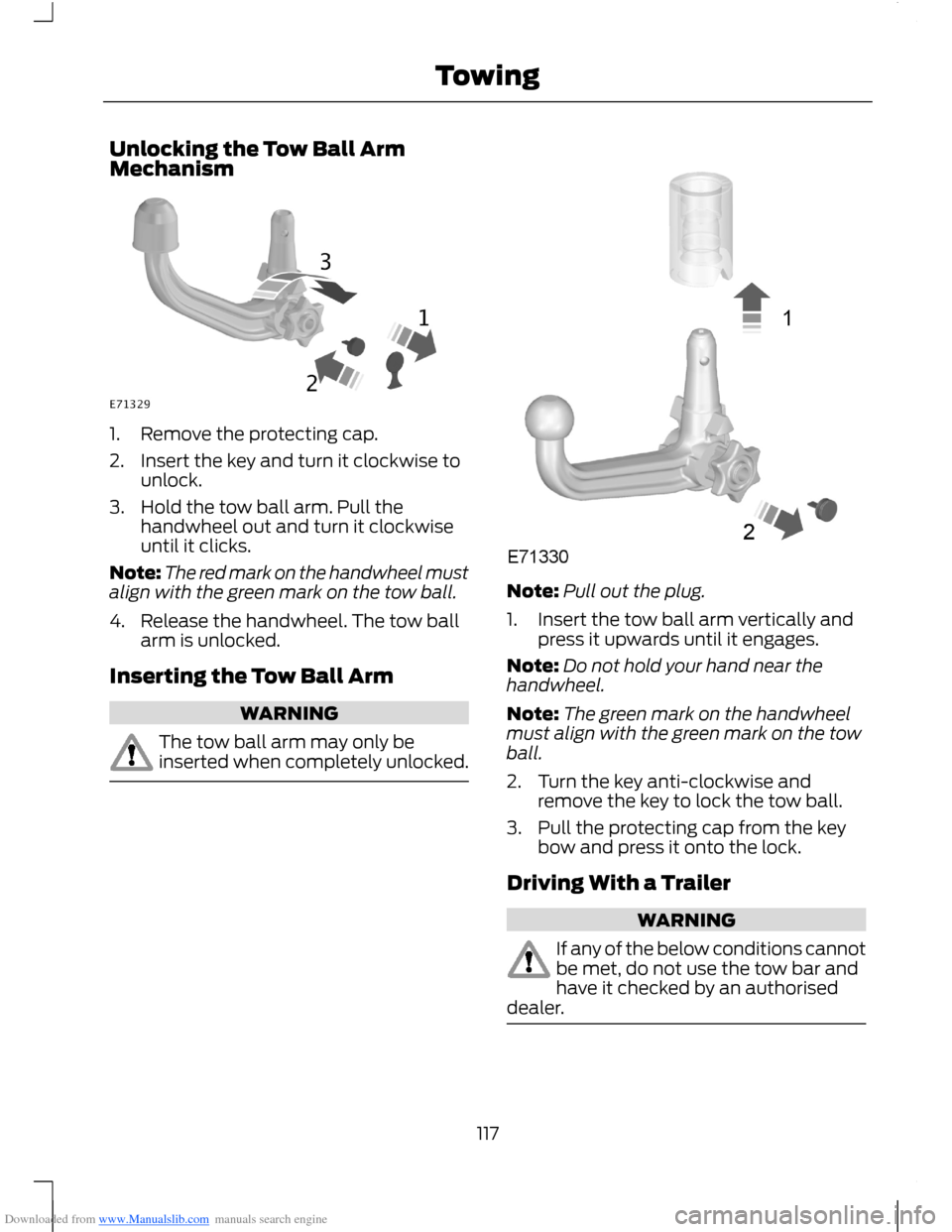
1.Remove the protecting cap.
2.Insert the key and turn it clockwise tounlock.
3.Hold the tow ball arm. Pull thehandwheel out and turn it clockwiseuntil it clicks.
Note:The red mark on the handwheel mustalign with the green mark on the tow ball.
4.Release the handwheel. The tow ballarm is unlocked.
Inserting the Tow Ball Arm
WARNING
The tow ball arm may only beinserted when completely unlocked.
Note:Pull out the plug.
1.Insert the tow ball arm vertically andpress it upwards until it engages.
Note:Do not hold your hand near thehandwheel.
Note:The green mark on the handwheelmust align with the green mark on the towball.
2.Turn the key anti-clockwise andremove the key to lock the tow ball.
3.Pull the protecting cap from the keybow and press it onto the lock.
Driving With a Trailer
WARNING
If any of the below conditions cannotbe met, do not use the tow bar andhave it checked by an authoriseddealer.
117Towing
Page 120 of 256
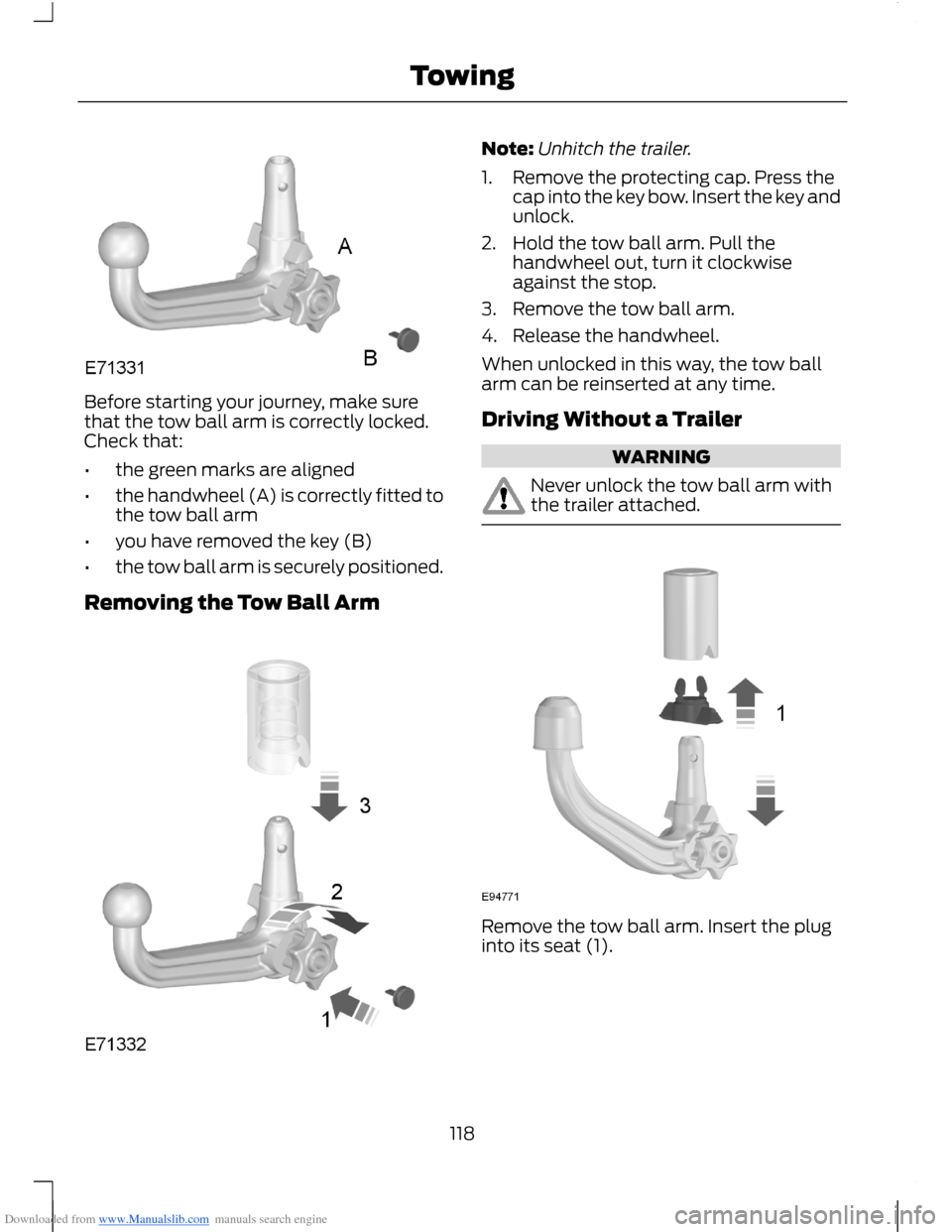
Downloaded from www.Manualslib.com manuals search engine Before starting your journey, make surethat the tow ball arm is correctly locked.Check that:
•the green marks are aligned
•the handwheel (A) is correctly fitted tothe tow ball arm
•you have removed the key (B)
•the tow ball arm is securely positioned.
Removing the Tow Ball Arm
Note:Unhitch the trailer.
1.Remove the protecting cap. Press thecap into the key bow. Insert the key andunlock.
2.Hold the tow ball arm. Pull thehandwheel out, turn it clockwiseagainst the stop.
3.Remove the tow ball arm.
4.Release the handwheel.
When unlocked in this way, the tow ballarm can be reinserted at any time.
Driving Without a Trailer
WARNING
Never unlock the tow ball arm withthe trailer attached.
Remove the tow ball arm. Insert the pluginto its seat (1).
118Towing
Page 121 of 256
Downloaded from www.Manualslib.com manuals search engine Maintenance
WARNING
Remove the tow ball arm andprotect the seat with the plug beforesteam cleaning your vehicle.
Keep the system clean. Periodicallylubricate bearings, sliding surfaces, andlocking balls with resin-free grease or oiland the lock with graphite.
In case of loss, replacement keys areavailable from the manufacturer by statingthe number on the lock cylinder.
TOWING POINTS
WARNING
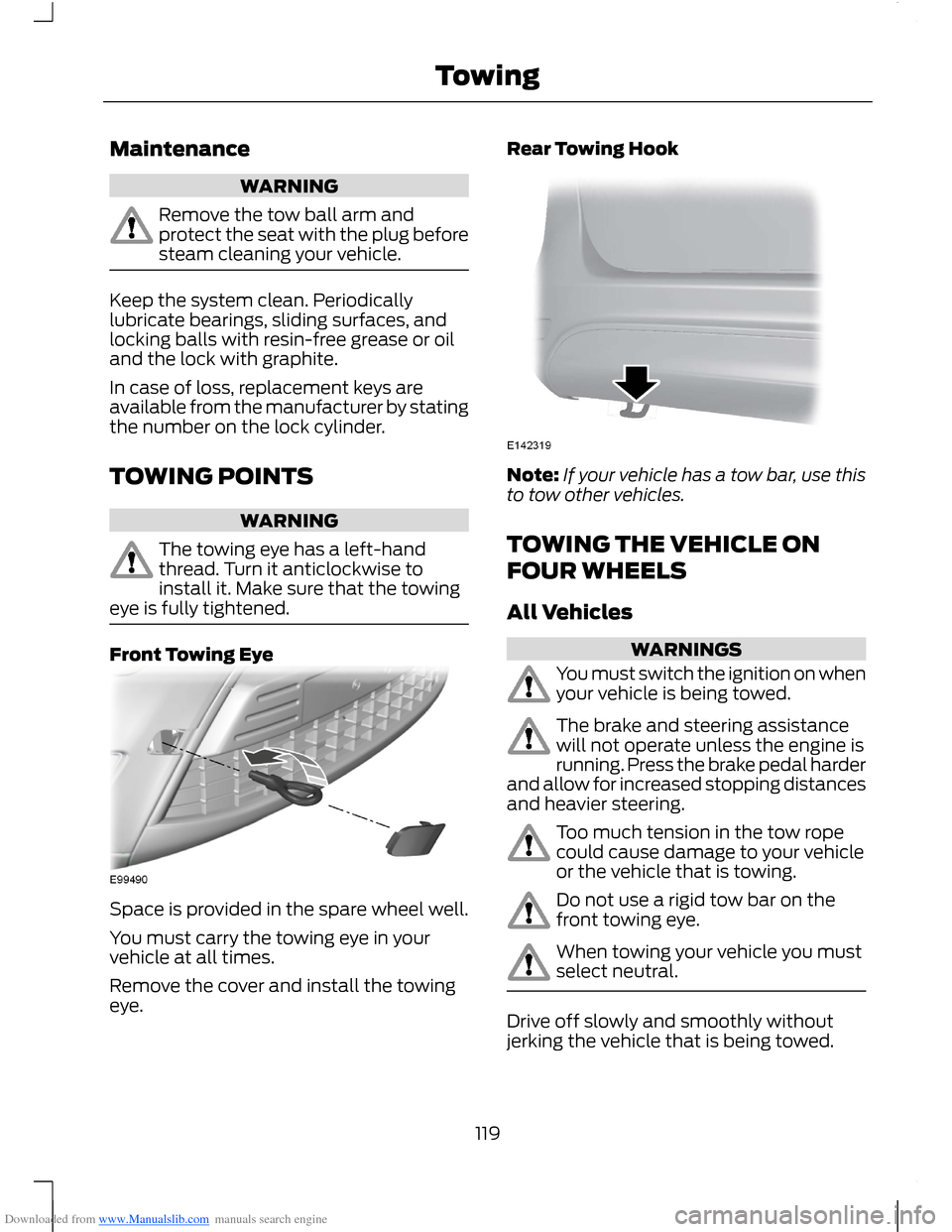
The towing eye has a left-handthread. Turn it anticlockwise toinstall it. Make sure that the towingeye is fully tightened.
Front Towing Eye
Space is provided in the spare wheel well.
You must carry the towing eye in yourvehicle at all times.
Remove the cover and install the towingeye.
Rear Towing Hook
Note:If your vehicle has a tow bar, use thisto tow other vehicles.
TOWING THE VEHICLE ON
FOUR WHEELS
All Vehicles
WARNINGS
You must switch the ignition on whenyour vehicle is being towed.
The brake and steering assistancewill not operate unless the engine isrunning. Press the brake pedal harderand allow for increased stopping distancesand heavier steering.
Too much tension in the tow ropecould cause damage to your vehicleor the vehicle that is towing.
Do not use a rigid tow bar on thefront towing eye.
When towing your vehicle you mustselect neutral.
Drive off slowly and smoothly withoutjerking the vehicle that is being towed.
119Towing
Page 122 of 256
Downloaded from www.Manualslib.com manuals search engine Vehicles With AutomaticTransmission
WARNINGS
If a speed of 12 mph (20 km/h) anda distance of 12 miles (20 kilometres)is to be exceeded the drive wheelsmust be lifted clear of the ground.
It is recommended not to tow withthe drive wheels on the ground.However, if it is required to move yourvehicle from a dangerous location, do nottow your vehicle faster than 12 mph (20km/h) or further than 12 miles (20kilometres).
Do not tow your vehicle backward.
In the event of a mechanical failureof the transmission the drive wheelsmust be lifted clear of the ground.
Do not tow your vehicle if theambient temperature is below 32°F(0°C).
120Towing
Page 136 of 256
Downloaded from www.Manualslib.com manuals search engine GENERAL INFORMATION
Have your vehicle serviced regularly to helpmaintain its roadworthiness and resalevalue. There is a large network of Fordauthorised repairers that are there to helpyou with their professional servicingexpertise. Authorised repairers are bestqualified to service your vehicle properlyand expertly, with a wide range of highlyspecialised tools.
In addition to regular servicing, werecommend that you carry out thefollowing checks.
WARNINGS
Switch the ignition off beforetouching or attempting adjustmentof any kind.
Do not touch the electronic ignitionsystem parts after you have switchedthe ignition on or when the engine isrunning. The system operates at highvoltage.
Keep your hands and clothing clearof the engine cooling fan. Undercertain conditions, the fan maycontinue to run for several minutes afteryou have switched the engine off.
Make sure that you fit filler capssecurely after carrying outmaintenance checks.
Daily Checks
•Exterior lamps.
•Interior lamps.
•Warning lamps and indicators.
Check When Refuelling
•Engine oil level. See Engine Oil Check(page 139).
•Brake fluid level. See Brake andClutch Fluid Check (page 141).
•Washer fluid level. See Washer FluidCheck (page 141).
•Tyre pressures (when cold). SeeTechnical Specifications (page 164).
•Tyre condition. See Wheels and Tyres(page 155).
Monthly Checks
•Engine coolant level (engine cold). SeeEngine Coolant Check (page 140).
•Pipes, hoses and reservoirs for leaks.
•Air conditioning operation.
•Parking brake operation.
•Horn operation.
•Tightness of wheel nuts. SeeTechnical Specifications (page 164).
OPENING AND CLOSING THE
BONNET
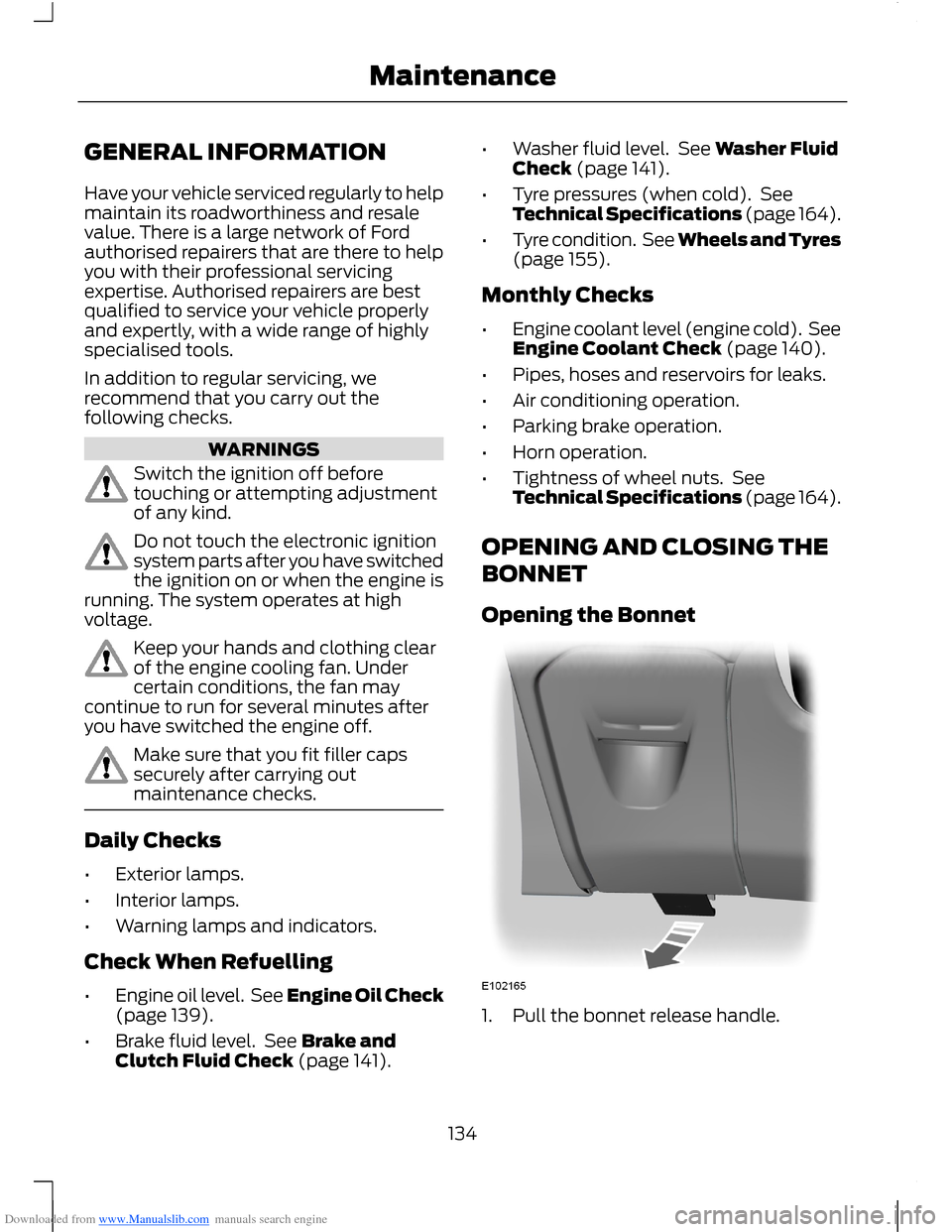
Opening the Bonnet
1.Pull the bonnet release handle.
134Maintenance
Page 156 of 256
Downloaded from www.Manualslib.com manuals search engine Clean the seat belts with interior cleaneror water applied with a soft sponge. Letthe seat belts dry naturally, away fromartificial heat.
Instrument Cluster Screens, LCDScreens and Radio Screens
WARNING
Do not use abrasives, alcoholicsolvents or chemical solvents toclean them.
Rear Windows
WARNING
Do not use any abrasive materials toclean the interior of the rearwindows.
Note:Do not install stickers or labels to theinterior of the rear windows.
REPAIRING MINOR PAINT
DAMAGE
You should repair paintwork damagecaused by stones from the road or minorscratches as soon as possible. A choice ofproducts are available from an authoriseddealer.
Remove particles such as bird droppings,tree sap, insect deposits, tar spots, roadsalt and industrial fallout before repairingpaint chips.
Always read and follow the manufacturer’sinstructions before using the products.
CLEANING THE ALLOY
WHEELS
Note:Do not apply a cleaning chemical towarm or hot wheel rims and covers.
Note:Industrial-strength (heavy-duty)cleaners, or cleaning chemicals, incombination with brush agitation to removebrake dust and dirt, could wear away theclear coat finish over a period time.
Note:Do not use hydrofluoric acid-basedor high caustic-based wheel cleaners, steelwool, fuels or strong household detergent.
Note:If you intend parking your vehicle foran extended period after cleaning thewheels with a wheel cleaner, drive yourvehicle for a few minutes before doing so.This will reduce the risk of increasedcorrosion of the brake discs, brake pads andlinings.
Note:Some automatic car washes maycause damage to the finish on your wheelrims and covers.
Alloy wheels and wheel covers are coatedwith a clear coat paint finish. To maintaintheir condition we recommend that you:
•Clean them weekly with therecommended wheel and tyre cleaner.
•Use a sponge to remove heavydeposits of dirt and brake dustaccumulation.
•Rinse them thoroughly with apressurised stream of water when youhave completed the cleaning process.
We recommend that you use Ford servicewheel cleaner. Make sure that you readand follow the manufacturer’s instructions.
Using other non-recommended cleaningproducts can result in severe andpermanent cosmetic damage.
154Vehicle Care
Page 157 of 256
Downloaded from www.Manualslib.com manuals search engine GENERAL INFORMATION
A decal with tyre pressure data is locatedin the driver’s door opening.
Check and set the tyre pressure at theambient temperature in which you areintending to drive your vehicle and whenthe tyres are cold.
Note:Check your tyre pressures regularlyto optimise fuel economy.
Note:Use only approved wheel and tyresizes. Using other sizes could damage yourvehicle and will make the National TypeApproval invalid.
Note:If you change the diameter of thetyres from that fitted at the factory, thespeedometer may not display the correctspeed. Take your vehicle to an authoriseddealer to have the engine managementsystem reprogrammed.
Note:If you intend to change the size of thewheels from that fitted at the factory, checkthe suitability with an authorised dealer.
TEMPORARY MOBILITY KIT
Your vehicle may not have a spare tyre.Therefore you will have an emergency kitwhich will only repair one flat tyre.
The kit is located in the spare wheel well.
General Information
WARNINGS
Depending on the type and extent oftyre damage, some tyres can only bepartially sealed or not sealed at all.Loss of tyre pressure can affect vehiclehandling, leading to loss of vehicle control.
Do not use the kit on a previouslydamaged tyre, for example when ithas been driven under inflated.
WARNINGS
Do not use the kit on run flat tyre.
Do not try to seal damage other thanthat located within the visible treadof the tyre.
Do not try to seal damage to thetyre’s sidewall.
The kit seals most tyre punctures [with adiameter of up to 1/4 inch (sixmillimetres)] to temporarily restoremobility.
Observe the following rules when using thekit:
•Drive with caution and avoid makingsudden steering or driving manoeuvres,especially if your vehicle is heavilyloaded or you are towing a trailer.
•The kit will provide you with anemergency temporary repair, enablingyou to continue your journey to the nextvehicle or tyre dealer, or to drive amaximum distance of 125 miles(200 kilometres).
•Do not exceed a maximum speed of50 mph (80 km/h).
•Keep the kit out of the reach ofchildren.
•Only use the kit when the ambienttemperature is between -22°F (–30°C)and +158°F (+70°C).
Using the Kit
WARNINGS
Compressed air can act as anexplosive or propellant.
Never leave the kit unattended whilein use.
Do not keep the compressoroperating for more than 10 minutes.
155Wheels and Tyres