child restraint FORD BRONCO 2021 Warranty Guide
[x] Cancel search | Manufacturer: FORD, Model Year: 2021, Model line: BRONCO, Model: FORD BRONCO 2021Pages: 106, PDF Size: 2.6 MB
Page 20 of 106
•
Generally children who are less than
57 in (1.45 m) tall.
• Are greater than age four (4) and less
than age twelve (12).
• Are between
40 lb (18 kg) and 80 lb
(36 kg) and upward to 100 lb (45 kg).
Many state and provincial laws require that
children use approved booster seats until
they reach age eight, a height of
57 in
(1.45 m) tall, or 80 lb (36 kg).
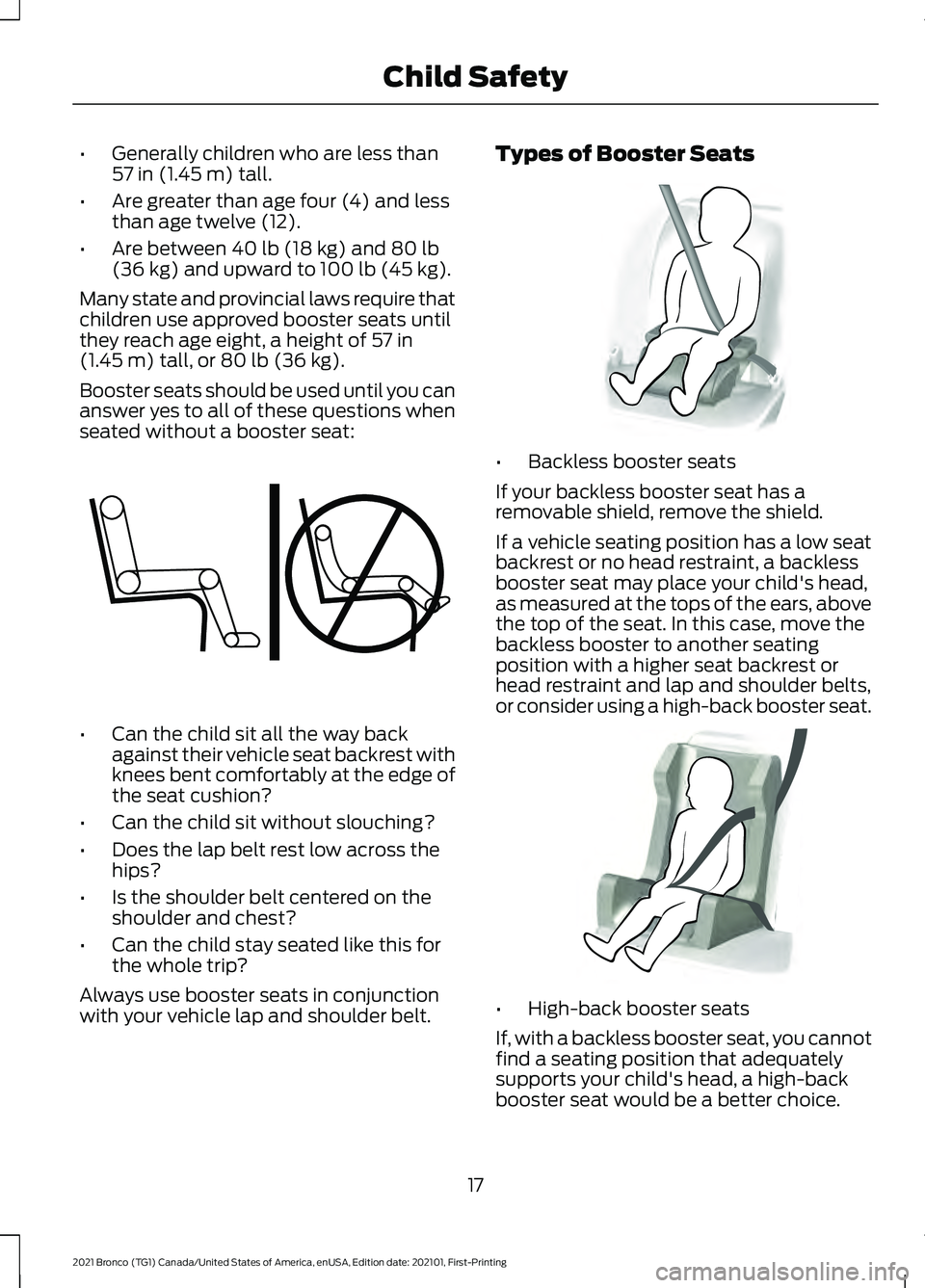
Booster seats should be used until you can
answer yes to all of these questions when
seated without a booster seat: •
Can the child sit all the way back
against their vehicle seat backrest with
knees bent comfortably at the edge of
the seat cushion?
• Can the child sit without slouching?
• Does the lap belt rest low across the
hips?
• Is the shoulder belt centered on the
shoulder and chest?
• Can the child stay seated like this for
the whole trip?
Always use booster seats in conjunction
with your vehicle lap and shoulder belt. Types of Booster Seats
•
Backless booster seats
If your backless booster seat has a
removable shield, remove the shield.
If a vehicle seating position has a low seat
backrest or no head restraint, a backless
booster seat may place your child's head,
as measured at the tops of the ears, above
the top of the seat. In this case, move the
backless booster to another seating
position with a higher seat backrest or
head restraint and lap and shoulder belts,
or consider using a high-back booster seat. •
High-back booster seats
If, with a backless booster seat, you cannot
find a seating position that adequately
supports your child's head, a high-back
booster seat would be a better choice.
17
2021 Bronco (TG1) Canada/United States of America, enUSA, Edition date: 202101, First-Printing Child SafetyE142595 E68924 E70710
Page 22 of 106
SEATBELT PRECAUTIONS
WARNING: Always drive and ride
with your seatback upright and the lap
belt snug and low across the hips. WARNING:
Children must always
be properly restrained. WARNING:
Do not allow a
passenger to hold a child on their lap
when your vehicle is moving. Failure to
follow this instruction could result in
personal injury or death in the event of a
sudden stop or crash. WARNING:
All occupants of your
vehicle, including the driver, should
always properly wear their seatbelts,
even when an airbag supplemental
restraint system is provided. Failure to
properly wear your seatbelt could
seriously increase the risk of injury or
death. WARNING:
It is extremely
dangerous to ride in a cargo area, inside
or outside of a vehicle. In a crash, people
riding in these areas are more likely to be
seriously injured or killed. Do not allow
people to ride in any area of your vehicle
that is not equipped with seats and
seatbelts. Make sure everyone in your
vehicle is in a seat and properly using a
seatbelt. Failure to follow this warning
could result in serious personal injury or
death. WARNING:
In a rollover crash, an
unbelted person is significantly more
likely to die than a person wearing a
seatbelt. WARNING:
Each seating position
in your vehicle has a specific seatbelt
assembly made up of one buckle and
one tongue designed to be used as a pair.
Use the shoulder belt on the outside
shoulder only. Never wear the shoulder
belt under the arm. Never use a single
seatbelt for more than one person. WARNING:
Even with advanced
restraints systems, properly restrain
children 12 and under in a rear seating
position. Failure to follow this could
seriously increase the risk of injury or
death. WARNING:
Seatbelts and seats
may be hot in a vehicle that is in the
sunshine. The hot seatbelts or seats may
burn a small child. Check seat covers and
buckles before you place a child
anywhere near them. WARNING:
If your vehicle is
involved in a crash, have the seatbelts
and associated components inspected
as soon as possible. Failure to follow this
instruction could result in personal injury
or death.
All seating positions in this vehicle have
lap and shoulder seatbelts. All occupants
of the vehicle should properly wear their
seatbelts, even when an airbag
supplemental restraint system is provided.
The seatbelt system consists of:
• Lap and shoulder seatbelts.
• A shoulder seatbelt with automatic
locking mode, except driver seatbelt.
• Seatbelt pretensioners at the front
outermost and rear outermost seating
positions. ·A seatbelt warning light and
chime.
19
2021 Bronco (TG1) Canada/United States of America, enUSA, Edition date: 202101, First-Printing SeatbeltsE71880
Page 27 of 106
SEATBELT EXTENSIONS
WARNING: Persons who fit into
the vehicle's seatbelt should not use an
extension. Unnecessary use could result
in serious personal injury in the event of
a crash. WARNING:
Only use extensions
provided free of charge by our dealers.
The dealer will provide an extension
designed specifically for this vehicle,
model year and seating position. The use
of an extension intended for another
vehicle, model year or seating position
may not offer you the full protection of
your vehicle's seatbelt restraint system. WARNING:
Never use seatbelt
extensions to install child restraints. WARNING:
Do not use extensions
to change the way the seatbelt fits
across the torso, over the lap or to make
the seatbelt buckle easier to reach.
If, because of body size or driving position,
it is not possible to properly fasten the
seatbelt over your lap and shoulder, an
extension that is compatible with the
seatbelts is available free of charge from
our dealers. Only use our seatbelt
extensions made by the original equipment
seatbelt manufacturer with our seatbelts.
Ask your authorized dealer if your extension
is compatible with your vehicle restraint
system.
24
2021 Bronco (TG1) Canada/United States of America, enUSA, Edition date: 202101, First-Printing Seatbelts
Page 31 of 106
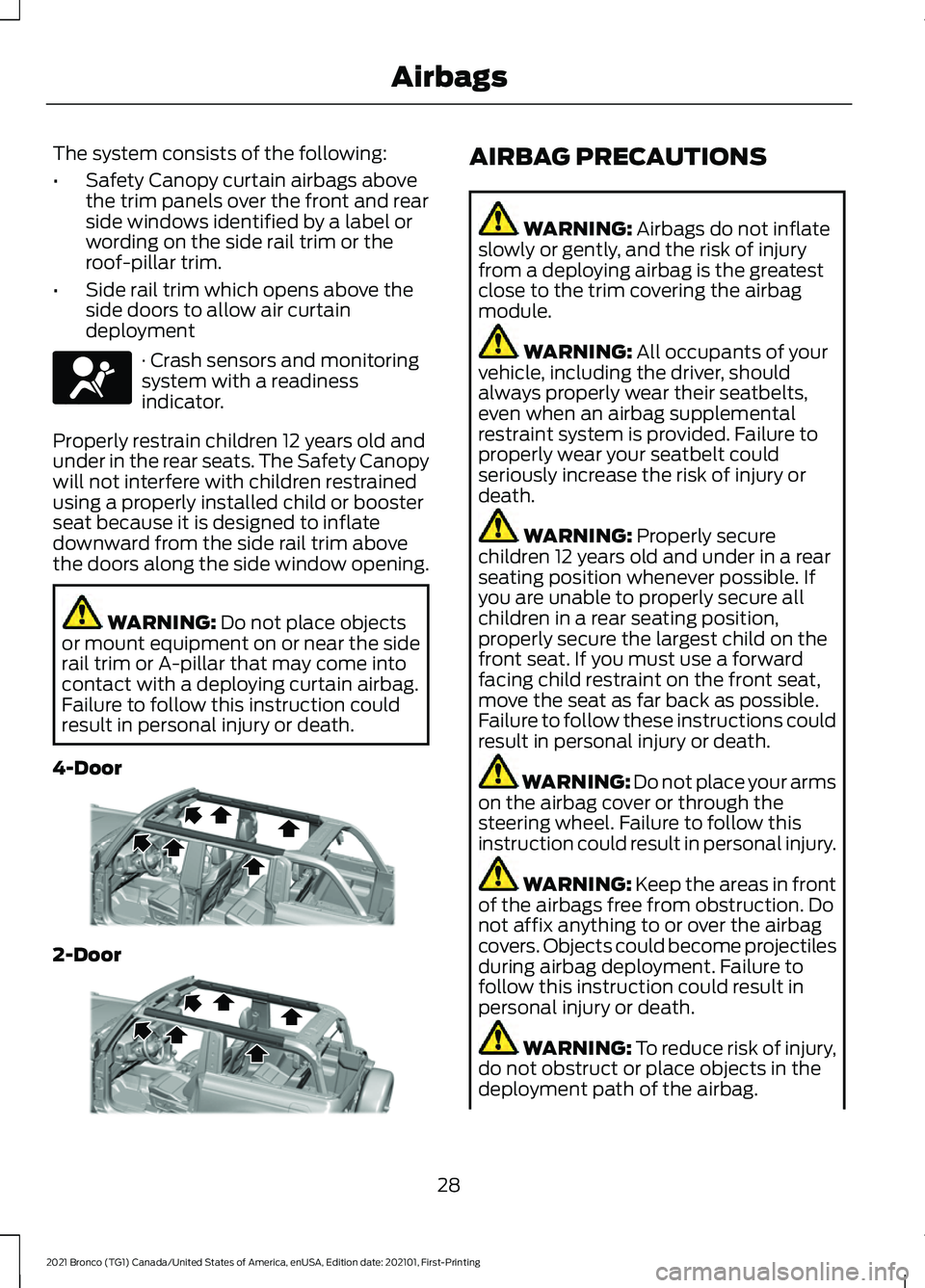
The system consists of the following:
•
Safety Canopy curtain airbags above
the trim panels over the front and rear
side windows identified by a label or
wording on the side rail trim or the
roof-pillar trim.
• Side rail trim which opens above the
side doors to allow air curtain
deployment · Crash sensors and monitoring
system with a readiness
indicator.
Properly restrain children 12 years old and
under in the rear seats. The Safety Canopy
will not interfere with children restrained
using a properly installed child or booster
seat because it is designed to inflate
downward from the side rail trim above
the doors along the side window opening. WARNING: Do not place objects
or mount equipment on or near the side
rail trim or A-pillar that may come into
contact with a deploying curtain airbag.
Failure to follow this instruction could
result in personal injury or death.
4-Door 2-Door AIRBAG PRECAUTIONS
WARNING:
Airbags do not inflate
slowly or gently, and the risk of injury
from a deploying airbag is the greatest
close to the trim covering the airbag
module. WARNING:
All occupants of your
vehicle, including the driver, should
always properly wear their seatbelts,
even when an airbag supplemental
restraint system is provided. Failure to
properly wear your seatbelt could
seriously increase the risk of injury or
death. WARNING:
Properly secure
children 12 years old and under in a rear
seating position whenever possible. If
you are unable to properly secure all
children in a rear seating position,
properly secure the largest child on the
front seat. If you must use a forward
facing child restraint on the front seat,
move the seat as far back as possible.
Failure to follow these instructions could
result in personal injury or death. WARNING:
Do not place your arms
on the airbag cover or through the
steering wheel. Failure to follow this
instruction could result in personal injury. WARNING:
Keep the areas in front
of the airbags free from obstruction. Do
not affix anything to or over the airbag
covers. Objects could become projectiles
during airbag deployment. Failure to
follow this instruction could result in
personal injury or death. WARNING:
To reduce risk of injury,
do not obstruct or place objects in the
deployment path of the airbag.
28
2021 Bronco (TG1) Canada/United States of America, enUSA, Edition date: 202101, First-Printing AirbagsE67017 E339113 E339112
Page 32 of 106
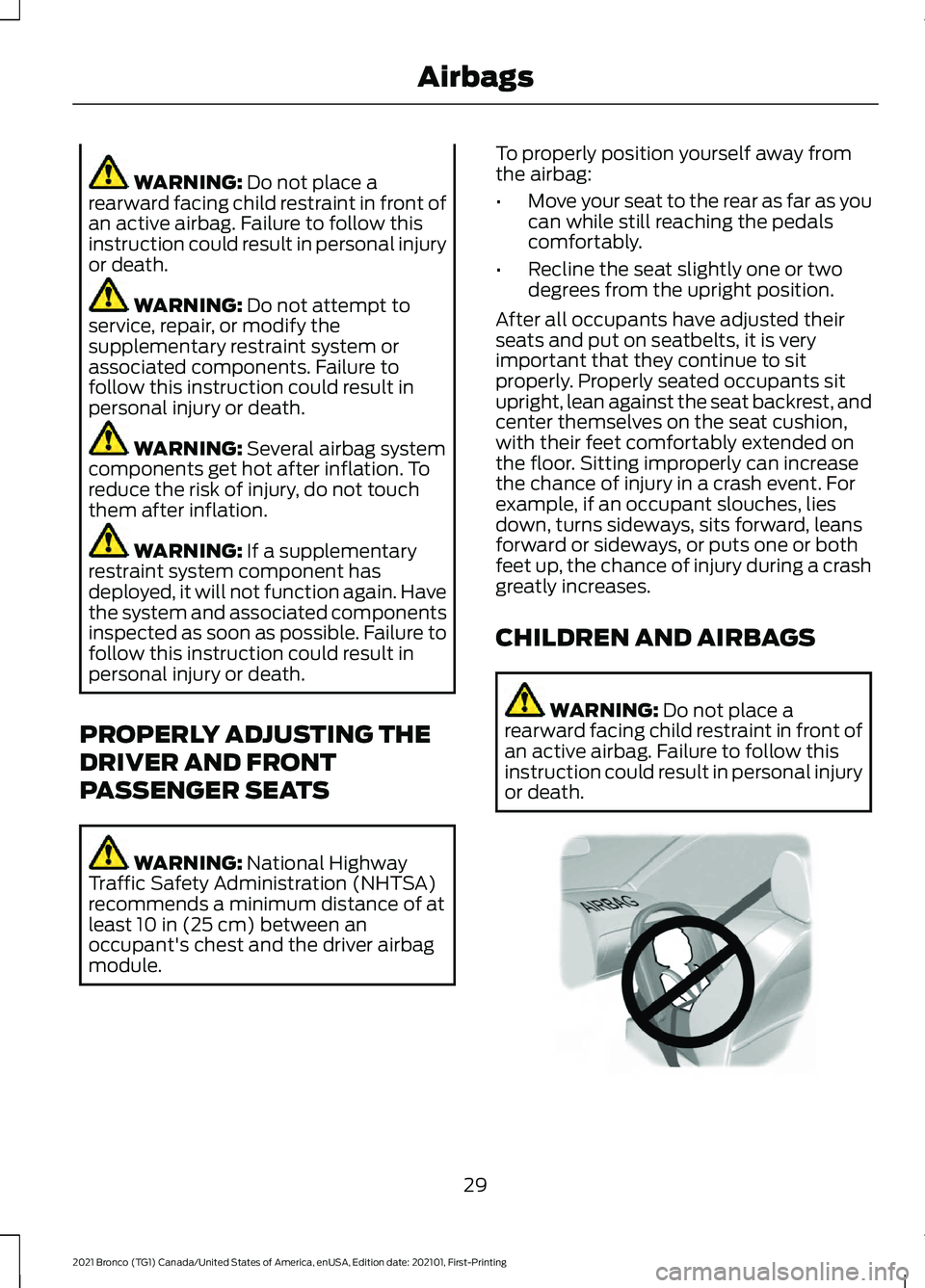
WARNING: Do not place a
rearward facing child restraint in front of
an active airbag. Failure to follow this
instruction could result in personal injury
or death. WARNING:
Do not attempt to
service, repair, or modify the
supplementary restraint system or
associated components. Failure to
follow this instruction could result in
personal injury or death. WARNING:
Several airbag system
components get hot after inflation. To
reduce the risk of injury, do not touch
them after inflation. WARNING:
If a supplementary
restraint system component has
deployed, it will not function again. Have
the system and associated components
inspected as soon as possible. Failure to
follow this instruction could result in
personal injury or death.
PROPERLY ADJUSTING THE
DRIVER AND FRONT
PASSENGER SEATS WARNING:
National Highway
Traffic Safety Administration (NHTSA)
recommends a minimum distance of at
least
10 in (25 cm) between an
occupant's chest and the driver airbag
module. To properly position yourself away from
the airbag:
•
Move your seat to the rear as far as you
can while still reaching the pedals
comfortably.
• Recline the seat slightly one or two
degrees from the upright position.
After all occupants have adjusted their
seats and put on seatbelts, it is very
important that they continue to sit
properly. Properly seated occupants sit
upright, lean against the seat backrest, and
center themselves on the seat cushion,
with their feet comfortably extended on
the floor. Sitting improperly can increase
the chance of injury in a crash event. For
example, if an occupant slouches, lies
down, turns sideways, sits forward, leans
forward or sideways, or puts one or both
feet up, the chance of injury during a crash
greatly increases.
CHILDREN AND AIRBAGS WARNING:
Do not place a
rearward facing child restraint in front of
an active airbag. Failure to follow this
instruction could result in personal injury
or death. 29
2021 Bronco (TG1) Canada/United States of America, enUSA, Edition date: 202101, First-Printing AirbagsE142846
Page 33 of 106
Children must always be properly
restrained. Accident statistics suggest that
children are safer when properly restrained
in the rear seating positions than in the
front seating position. Failure to follow
these instructions may increase the risk of
injury in a crash.
FRONT PASSENGER SENSING
SYSTEM
WHAT IS THE FRONT PASSENGER
SENSING SYSTEM
This system detects a properly seated
occupant and determines if the front
passenger airbag should be enabled.
HOW DOES THE FRONT
PASSENGER SENSING SYSTEM
WORK
The system uses a passenger airbag status
indicator which illuminates indicating that
the front passenger frontal airbag is either
enabled or disabled.
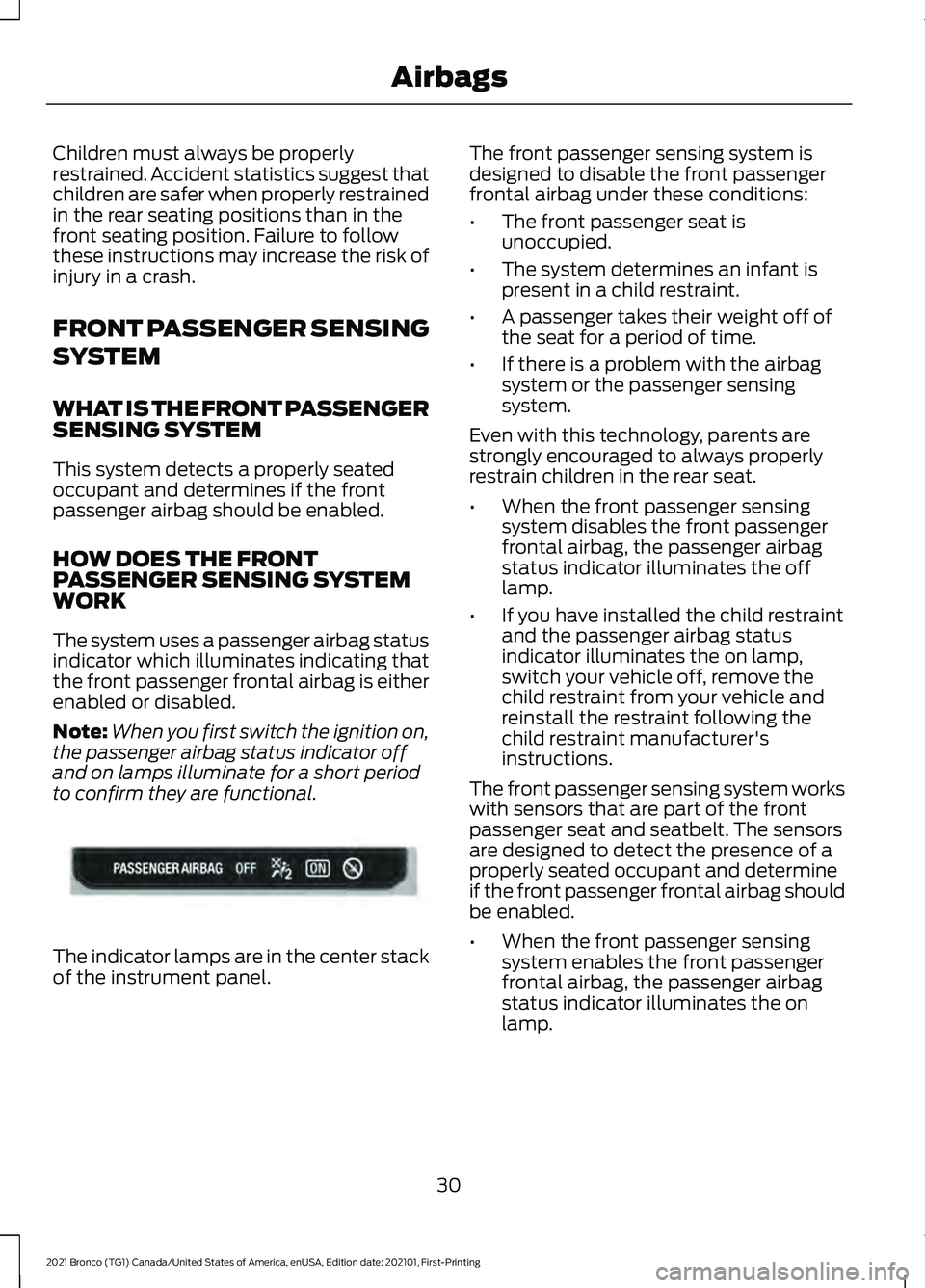
Note:
When you first switch the ignition on,
the passenger airbag status indicator off
and on lamps illuminate for a short period
to confirm they are functional. The indicator lamps are in the center stack
of the instrument panel. The front passenger sensing system is
designed to disable the front passenger
frontal airbag under these conditions:
•
The front passenger seat is
unoccupied.
• The system determines an infant is
present in a child restraint.
• A passenger takes their weight off of
the seat for a period of time.
• If there is a problem with the airbag
system or the passenger sensing
system.
Even with this technology, parents are
strongly encouraged to always properly
restrain children in the rear seat.
• When the front passenger sensing
system disables the front passenger
frontal airbag, the passenger airbag
status indicator illuminates the off
lamp.
• If you have installed the child restraint
and the passenger airbag status
indicator illuminates the on lamp,
switch your vehicle off, remove the
child restraint from your vehicle and
reinstall the restraint following the
child restraint manufacturer's
instructions.
The front passenger sensing system works
with sensors that are part of the front
passenger seat and seatbelt. The sensors
are designed to detect the presence of a
properly seated occupant and determine
if the front passenger frontal airbag should
be enabled.
• When the front passenger sensing
system enables the front passenger
frontal airbag, the passenger airbag
status indicator illuminates the on
lamp.
30
2021 Bronco (TG1) Canada/United States of America, enUSA, Edition date: 202101, First-Printing AirbagsE181984
Page 35 of 106
FRONT PASSENGER SENSING
SYSTEM PRECAUTIONS
WARNING: Sitting improperly, out
of position or with the seatback reclined
too far can take weight off the seat
cushion and affect the decision of the
passenger sensing system, resulting in
serious injury or death in the event of a crash. Always sit upright against your
seat back, with your feet on the floor.
WARNING: Any alteration or
modification to the front passenger seat
may affect the performance of the front
passenger sensing system. This could
seriously increase the risk of injury or
death.
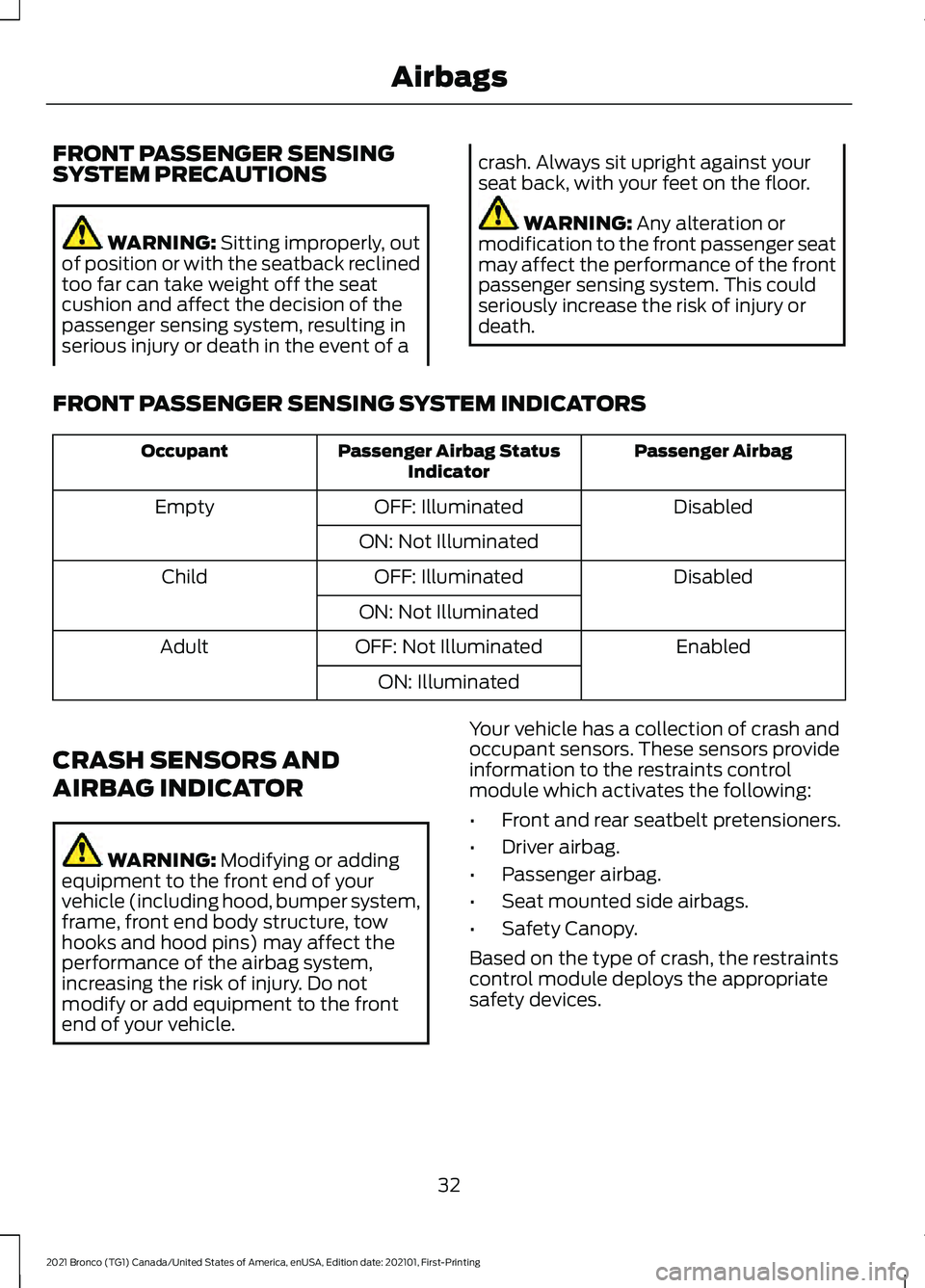
FRONT PASSENGER SENSING SYSTEM INDICATORS Passenger Airbag
Passenger Airbag Status
Indicator
Occupant
Disabled
OFF: Illuminated
Empty
ON: Not Illuminated Disabled
OFF: Illuminated
Child
ON: Not Illuminated Enabled
OFF: Not Illuminated
Adult
ON: Illuminated
CRASH SENSORS AND
AIRBAG INDICATOR WARNING:
Modifying or adding
equipment to the front end of your
vehicle (including hood, bumper system,
frame, front end body structure, tow
hooks and hood pins) may affect the
performance of the airbag system,
increasing the risk of injury. Do not
modify or add equipment to the front
end of your vehicle. Your vehicle has a collection of crash and
occupant sensors. These sensors provide
information to the restraints control
module which activates the following:
•
Front and rear seatbelt pretensioners.
• Driver airbag.
• Passenger airbag.
• Seat mounted side airbags.
• Safety Canopy.
Based on the type of crash, the restraints
control module deploys the appropriate
safety devices.
32
2021 Bronco (TG1) Canada/United States of America, enUSA, Edition date: 202101, First-Printing Airbags
Page 102 of 106
A
A/C
See: Climate Control - Vehicles With:
Automatic Temperature Control...............43
See: Climate Control - Vehicles With: Manual Temperature Control..................................... 46
About This Publication...................................5 Features and Options............................................ 5
Illustrations................................................................5
Location of Components..................................... 5
ABS See: Brakes............................................................. 58
Adjusting the Seatbelts During Pregnancy.......................................................21
Airbag Precautions........................................28
Airbags...............................................................26 Front Passenger Sensing System.................. 30
Air Conditioning See: Climate Control - Vehicles With:
Automatic Temperature Control...............43
See: Climate Control - Vehicles With: Manual Temperature Control..................................... 46
Automatic Locking Mode.............................21 Disengaging Automatic Locking Mode.........21
Engaging Automatic Locking Mode...............21
What Is Automatic Locking Mode................... 21
Automatic Transmission..............................57 Automatic Transmission Positions................57
Automatic Transmission Positions
..........57
Drive (D)................................................................... 57
Neutral (N).............................................................. 57
Park (P).................................................................... 57
Reverse (R)............................................................. 57
B
Booster Seats
...................................................16
Types of Booster Seats....................................... 17
Brakes.................................................................58 Brakes – Troubleshooting................................. 58
Brakes – Troubleshooting...........................58 Brakes – Warning Lamps.................................. 58
C
Calculating Payload
......................................63 Calculating the Load Limit.........................63
Helpful examples for calculating the
available amount of cargo and luggage
load capacity.................................................... 64
California Proposition 65 - United States of America
......................................................97
Changing a Flat Tire......................................90 Tire Change Procedure...................................... 90
Changing a Road Wheel.............................90
Checking the Tire Pressures......................85
Checking the Wiper Blades........................36
Children and Airbags....................................29
Child Restraint Anchor Points......................9 Locating the Child Restraint Lower Anchor
Points..................................................................... 9
Locating the Child Restraint Top Tether Anchor Points.................................................... 10
What Are the Child Restraint Anchor Points..................................................................... 9
Child Restraints
...............................................10
Child Restraint Position Information.............10
Child Restraints Recommendation................12
Child Safety
........................................................8
Child Restraint Anchor Points............................ 9
Child Restraints..................................................... 10
Installing Child Restraints.................................. 12
Child Safety Precautions
...............................8
Cleaning the Exterior.....................................73 Cleaning Windows and Wiper Blades..........73
Climate Control
...............................................43
Climate Control Hints...................................44 Defogging the Side Windows in Cold
Weather.............................................................. 45
General Hints......................................................... 44
Quickly Cooling the Interior.............................. 45
Quickly Heating the Interior.............................. 45
Recommended Settings for Cooling............45
Recommended Settings for Heating............45
Crash and Breakdown Information.........69 Jump Starting the Vehicle................................ 69
Crash Sensors and Airbag Indicator........32
Customer Information
.................................96
D
Data Privacy
........................................................7
99
2021 Bronco (TG1) Canada/United States of America, enUSA, Edition date: 202101, First-Printing Index
Page 103 of 106
Department of Transportation Uniform
Tire Quality Grades.....................................74
Temperature A B C............................................... 75
Traction AA A B C.................................................. 75
Treadwear................................................................ 74
Directing the Flow of Air..............................44 Directing Air to the Footwell Air Vents.........44
Directing Air to the Instrument Panel Air
Vents.................................................................... 44
Directing Air to the Windshield Air Vents.................................................................... 44
Disposing of Airbags.....................................33
E
Event Data
...........................................................7
F
Fastening and Unfastening the Seatbelts
........................................................20
Unfastening the Seatbelts............................... 20
Flat Tire See: Changing a Flat Tire.................................. 90
Front Passenger Sensing System............30 Front Passenger Sensing System
Indicators............................................................ 32
Front Passenger Sensing System Precautions........................................................ 32
How Does the Front Passenger Sensing System Work..................................................... 30
What Is the Front Passenger Sensing System................................................................ 30
Front Seats
.......................................................49
Heated Seats......................................................... 52
Manual Seats......................................................... 49
Power Seats............................................................ 51
G
Glossary of Tire Terminology....................80
H
Heated Seats
...................................................52
Heated Seat Precautions.................................. 52
Switching the Heated Seats On and Off........................................................................\
. 52Heating
See: Climate Control - Vehicles With:
Automatic Temperature Control...............43
See: Climate Control - Vehicles With: Manual Temperature Control..................................... 46
How Does the Personal Safety System Work.................................................................25
How Does the Safety Canopy ™
Work..................................................................27
How Do the Front Airbags Work...............26
How Do the Side Airbags Work.................26
I
Identifying the Climate Control Unit
.......43
Inflating the Tires...........................................85
Information on the Tire Sidewall..............75 Information on P Type Tires............................. 76
Inspecting the Tire for Damage
................86
Safety Practices................................................... 86
Inspecting the Tire for Wear
......................86
Inspecting the Wheel Valve Stems.........87
Installing Child Restraints............................12 Combining the Seatbelt and Lower Anchors
for Attaching Child Restraints..................... 15
Installing a Child Restraint in a Center Seat....................................................................... 15
Using Lower Anchors and Tethers for Children................................................................ 14
Using Seatbelts...................................................... 12
Using Tether Straps.............................................. 16
Instrument Cluster Indicators...................40 Adaptive Cruise Control.................................... 40
Automatic Headlamp High Beam.................40
Auto-Start-Stop................................................... 40
Blind Spot Monitor.............................................. 40
Cruise Control....................................................... 40
Differential Lock................................................... 40
Drive Modes............................................................. 41
Four-Wheel Drive.................................................. 41
Front Airbag............................................................. 41
Front Fog Lamp..................................................... 41
Headlamp High Beam......................................... 41
Hill Descent............................................................. 41
Lane Keeping System.......................................... 41
One Pedal Drive..................................................... 41
Parking Lamps....................................................... 41
Pre-Collision Assist.............................................. 41
100
2021 Bronco (TG1) Canada/United States of America, enUSA, Edition date: 202101, First-Printing Index