warning FORD C MAX 2008 1.G Owners Manual
[x] Cancel search | Manufacturer: FORD, Model Year: 2008, Model line: C MAX, Model: FORD C MAX 2008 1.GPages: 278, PDF Size: 17.5 MB
Page 190 of 278
Downloaded from www.Manualslib.com manuals search engine GENERAL INFORMATION
Have your vehicle serviced regularlyto help maintain its roadworthinessand resale value. There is a largenetwork of Ford Authorised Repairersthat are there to help you with theirprofessional servicing expertise. Webelieve that their specially trainedtechnicians are best qualified toservice your vehicle properly andexpertly. They are supported by awide range of highly specialised toolsdeveloped specifically for servicingyour vehicle.
In addition to regular servicing, werecommend that you carry out thefollowing additional checks.
WARNINGS
Switch the ignition off beforetouching or attemptingadjustment of any kind.
Do not touch the electronicignition system parts after youhave switched the ignition on orwhen the engine is running. Thesystem operates at high voltage.
Keep your hands and clothingclear of the engine cooling fan.Under certain conditions, the fan maycontinue to run for several minutesafter you have switched the engineoff.
Daily checks
•Exterior lamps.
•Interior lamps.
•Warning lamps and indicators.
Check when refuelling
•Engine oil level. See Engine oilcheck (page 200).
•Brake fluid level. See Brake andclutch fluid check (page 202).
•Washer fluid level. See Washerfluid check (page 203).
•Tyre pressures (when cold). SeeWheels and tyres (page 211).
•Tyre condition. See Wheels andtyres (page 211).
Monthly checks
•Engine coolant level (engine cold).See Engine coolant check(page 201).
•Pipes, hoses and reservoirs forleaks.
•Power steering fluid level. SeePower steering fluid check(page 202).
•Air conditioning operation.
•Parking brake operation.
•Horn operation.
•Tightness of wheel nuts. SeeWheels and tyres (page 211).
188
Maintenance
Page 191 of 278
Downloaded from www.Manualslib.com manuals search engine OPENING AND CLOSING
THE BONNET
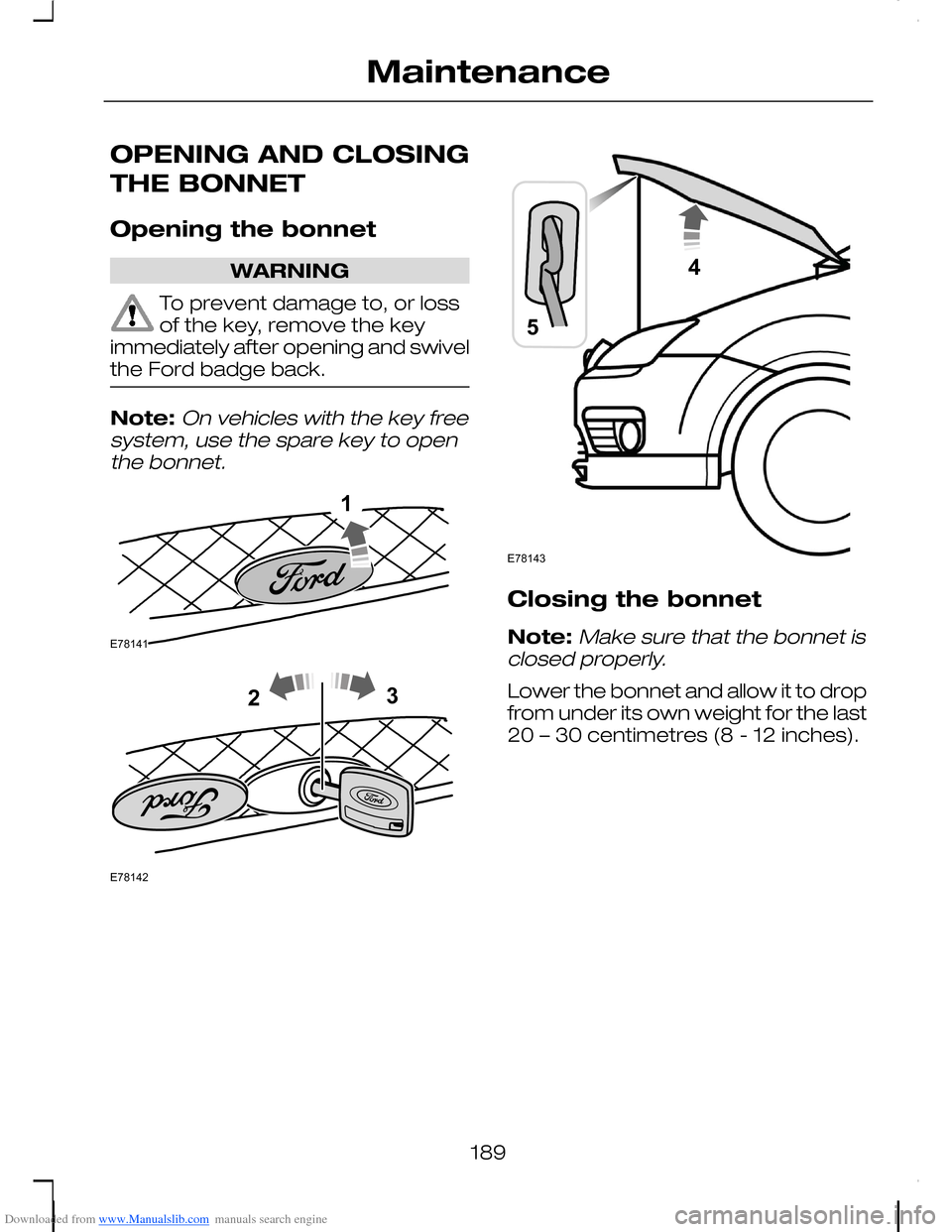
Opening the bonnet
WARNING
To prevent damage to, or lossof the key, remove the keyimmediately after opening and swivelthe Ford badge back.
Note:On vehicles with the key freesystem, use the spare key to openthe bonnet.
Closing the bonnet
Note:Make sure that the bonnet isclosed properly.
Lower the bonnet and allow it to dropfrom under its own weight for the last20 – 30 centimetres (8 - 12 inches).
189
MaintenanceE781411 E7814223 E7814354
Page 203 of 278
Downloaded from www.Manualslib.com manuals search engine Note:Make sure that your vehicleis on level ground.
Note:Oil expands when it is hot. Thelevel may therefore extend a fewmillimetres beyond the MAX mark.
Remove the dipstick and wipe it witha clean, lint free cloth. Replace thedipstick and remove it again to checkthe oil level.
If the level is at the MIN mark, top upimmediately.
Topping up
WARNINGS
Only top up when the engine iscold. If the engine is hot, wait 10minutes for the engine to cool down.
Do not remove the filler capwhen the engine is running.
Remove the filler cap.
CAUTION
Do not top up further than theMAX mark.
Top up with fluid that meets the Fordspecification. See Technicalspecifications (page 204).
ENGINE COOLANT
CHECK
CAUTION
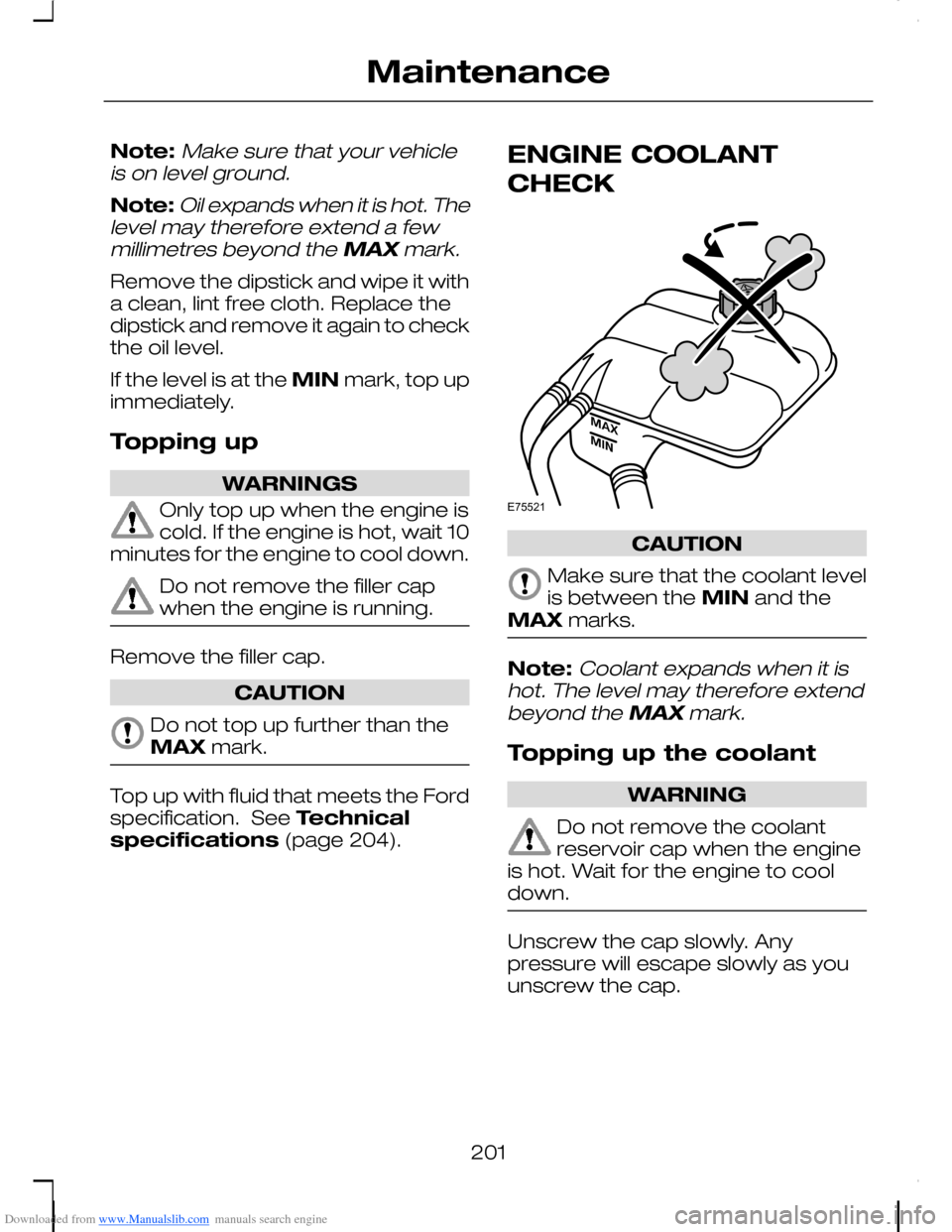
Make sure that the coolant levelis between the MIN and theMAX marks.
Note:Coolant expands when it ishot. The level may therefore extendbeyond the MAX mark.
Topping up the coolant
WARNING
Do not remove the coolantreservoir cap when the engineis hot. Wait for the engine to cooldown.
Unscrew the cap slowly. Anypressure will escape slowly as youunscrew the cap.
201
MaintenanceE75521
Page 204 of 278
Downloaded from www.Manualslib.com manuals search engine WARNINGS
Only add coolant when theengine is cold. If the engine ishot, wait 10 minutes for the engine tocool down.
Do not allow coolant to touchyour skin or eyes. If thishappens, rinse the affected areasimmediately with plenty of water andcontact your doctor.
CAUTION
Do not spill coolant on any partof the engine.
Only add coolant that meets the Fordspecification. See Technicalspecifications (page 204).
BRAKE AND CLUTCH
FLUID CHECK
WARNING
Do not allow brake fluid to touchyour skin or eyes. If thishappens, rinse the affected areasimmediately with plenty of water andcontact your doctor.
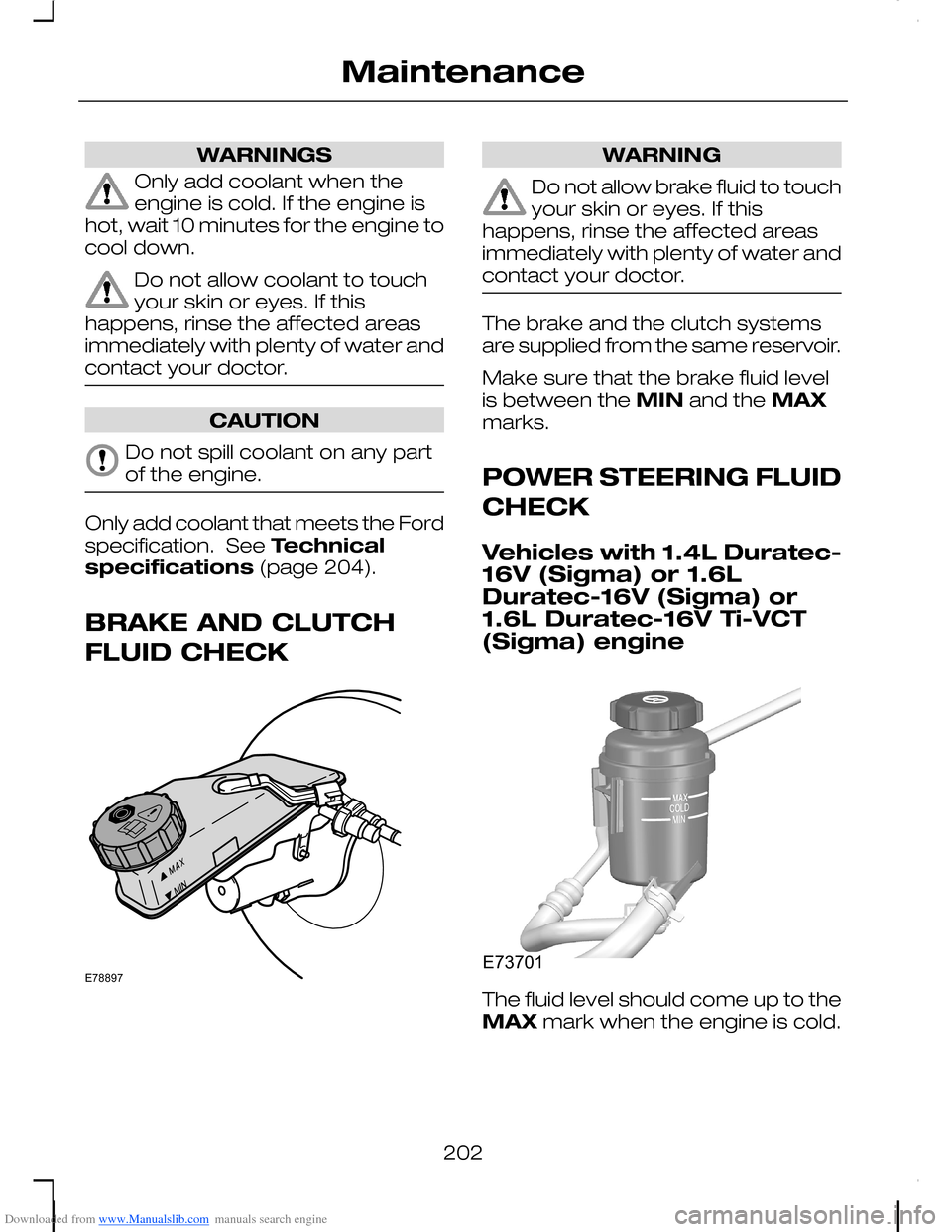
The brake and the clutch systemsare supplied from the same reservoir.
Make sure that the brake fluid levelis between the MIN and the MAXmarks.
POWER STEERING FLUID
CHECK
Vehicles with 1.4L Duratec-16V (Sigma) or 1.6LDuratec-16V (Sigma) or1.6L Duratec-16V Ti-VCT(Sigma) engine
The fluid level should come up to theMAX mark when the engine is cold.
202
MaintenanceE78897 E73701
Page 209 of 278
Downloaded from www.Manualslib.com manuals search engine CLEANING THE
EXTERIOR
WARNING
If you use a car wash with awaxing cycle, make sure thatyou remove the wax from thewindscreen.
CAUTIONS
Some car wash installations usewater at high pressure. Thiscould damage certain parts of yourvehicle.
Remove the aerial before usingan automatic car wash.
Switch the heater blower off toprevent contamination of thefresh air filter.
We recommend that you wash yourvehicle with a sponge and lukewarmwater containing a car shampoo.
Cleaning the headlamps
CAUTIONS
Do not scrape the headlamplenses or use abrasives orchemical solvents to clean them.
Do not wipe the headlampswhen they are dry.
Cleaning the rear window
CAUTION
Do not scrape the inside of therear window or use abrasives orchemical solvents to clean it.
Use a clean, lint free cloth or a dampchamois leather to clean the insideof the rear window.
Cleaning the chrome trim
CAUTION
Do not use abrasives or chemicalsolvents. Use soapy water.
Body paintworkpreservation
CAUTIONS
Do not polish your vehicle instrong sunshine.
Do not allow polish to touchplastic surfaces. It could bedifficult to remove.
Do not apply polish to thewindscreen or rear window. Thiscould cause the wipers to becomenoisy and they may not clear thewindow properly.
We recommend that you wax thepaintwork once or twice a year.
207
Vehicle care
Page 210 of 278
Downloaded from www.Manualslib.com manuals search engine CLEANING THE INTERIOR
Seat belts
WARNINGS
Do not use abrasives, orchemical solvents to cleanthem.
Do not allow moisture topenetrate the seat belt retractormechanism.
Clean the seat belts with interiorcleaner or water applied with a softsponge. Let the seat belts drynaturally, away from artificial heat.
Instrument cluster screens,LCD screens, radioscreens
WARNING
Do not use abrasives, orchemical solvents to cleanthem.
REPAIRING MINOR PAINT
DAMAGE
CAUTION
Remove apparently harmlesslooking substances from thepaintwork immediately (e.g. birddroppings, tree resins, insectremains, tar spots, road salt andindustrial fall out).
You should repair paintwork damagecaused by stones from the road orminor scratches as soon as possible.A choice of products is available fromyour Ford Dealer. Read and followthe manufacturer’s instructions.
208
Vehicle care
Page 213 of 278
Downloaded from www.Manualslib.com manuals search engine GENERAL INFORMATION
CAUTIONS
Use only approved wheel andtyre sizes. Using other sizescould damage the vehicle and willmake the National Type Approvalinvalid.
If you change the diameter of thetyres from that fitted at thefactory, the speedometer may notdisplay the correct speed. Take thevehicle to your dealer to have theengine management systemreprogrammed.
A decal with tyre pressure data islocated in the driver’s door openingat the B-pillar.
Check and set the tyre pressure atthe ambient temperature in whichyou are intending to drive the vehicleand when the tyres are cold.
CHANGING A ROAD
WHEEL
Spare wheel
Your vehicle is equipped with eithera spare wheel or a tyre repair kit(ContiMobilityKit). See Tyre repairkit (page 217).
All vehicles
WARNINGS
Use only approved wheel andtyre sizes. Using other sizescould damage the vehicle and willmake the National Type Approvalinvalid.
If you change the diameter ofthe tyres from that fitted at thefactory, the speedometer may notdisplay the correct speed. Take thevehicle to your dealer to have theengine management systemreprogrammed.
Vehicles with a temporaryspare wheel
WARNINGS
If the spare wheel differs fromthe other fitted wheels, theserules must be followed:
Do not exceed 80 km/h (50mph).
Drive the shortest possibledistances.
Do not fit more than one sparewheel on your vehicle at anyone time.
Do not use snow chains on thistype of wheel.
Do not drive through anautomatic car wash.
211
Wheels and tyres
Page 214 of 278
Downloaded from www.Manualslib.com manuals search engine Vehicles with stability control
Vehicles with ESP may exhibit someunusual driving characteristics. Switchthe ESP off. See Using stabilitycontrol (page 161).
All vehicles
Note:The spare wheel is locatedunder the floor cover in the luggagecompartment.
•Raise the rear of the floor cover inthe luggage compartment.
1.Completely unscrew the boltanticlockwise.
2.Lift out the spare wheel.
3.Remove the jack which is locatedbeneath the spare wheel.
4.Install the defective wheel in thereverse order.
Vehicle jack
WARNINGS
The vehicle jack supplied withyour vehicle should only be usedwhen changing a wheel inemergency situations.
Before using the vehicle jack,check that it is not damaged ordeformed and that the thread islubricated and free from foreignmatter.
Never place anything betweenthe jack and the ground, or thejack and the vehicle.
Note:The vehicle jack is located inthe underfloor storage compartmentunder the spare wheel.
Note:Vehicles with a tyre repair kitor run flat tyres are not equipped witha vehicle jack or a wheel brace.
It is recommended to use aworkshop type hydraulic jack forchanging between summer andwinter tyres.
Note:Use a jack with a minimumlifting capacity of 1.5 tonnes and alifting plate with a minimum diameterof 80 millimetres (3.1 inches).
212
Wheels and tyresE72563 E72564
Page 217 of 278
Downloaded from www.Manualslib.com manuals search engine Removing a wheel
All vehicles
WARNINGS
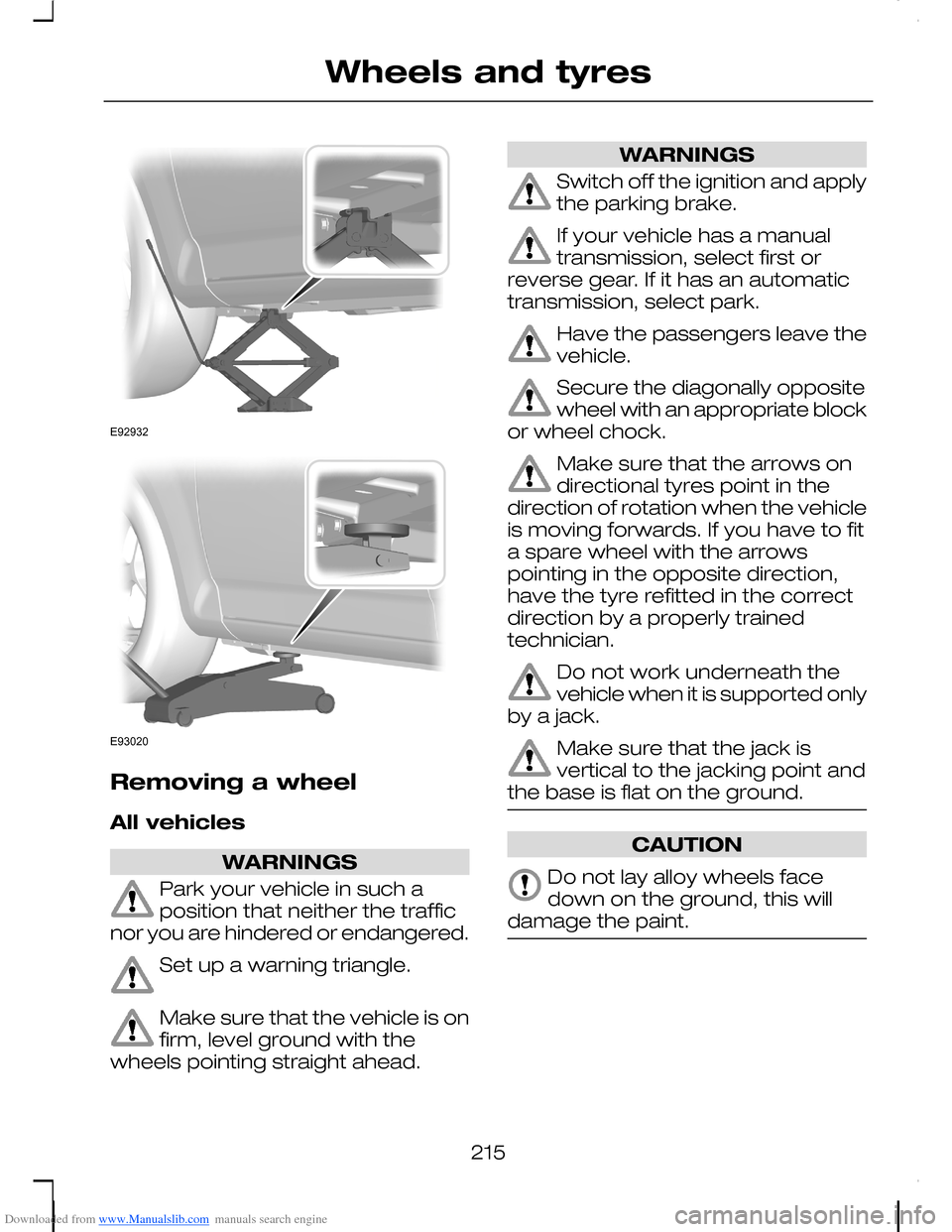
Park your vehicle in such aposition that neither the trafficnor you are hindered or endangered.
Set up a warning triangle.
Make sure that the vehicle is onfirm, level ground with thewheels pointing straight ahead.
WARNINGS
Switch off the ignition and applythe parking brake.
If your vehicle has a manualtransmission, select first orreverse gear. If it has an automatictransmission, select park.
Have the passengers leave thevehicle.
Secure the diagonally oppositewheel with an appropriate blockor wheel chock.
Make sure that the arrows ondirectional tyres point in thedirection of rotation when the vehicleis moving forwards. If you have to fita spare wheel with the arrowspointing in the opposite direction,have the tyre refitted in the correctdirection by a properly trainedtechnician.
Do not work underneath thevehicle when it is supported onlyby a jack.
Make sure that the jack isvertical to the jacking point andthe base is flat on the ground.
CAUTION
Do not lay alloy wheels facedown on the ground, this willdamage the paint.
215
Wheels and tyresE92932 E93020
Page 219 of 278
Downloaded from www.Manualslib.com manuals search engine All vehicles
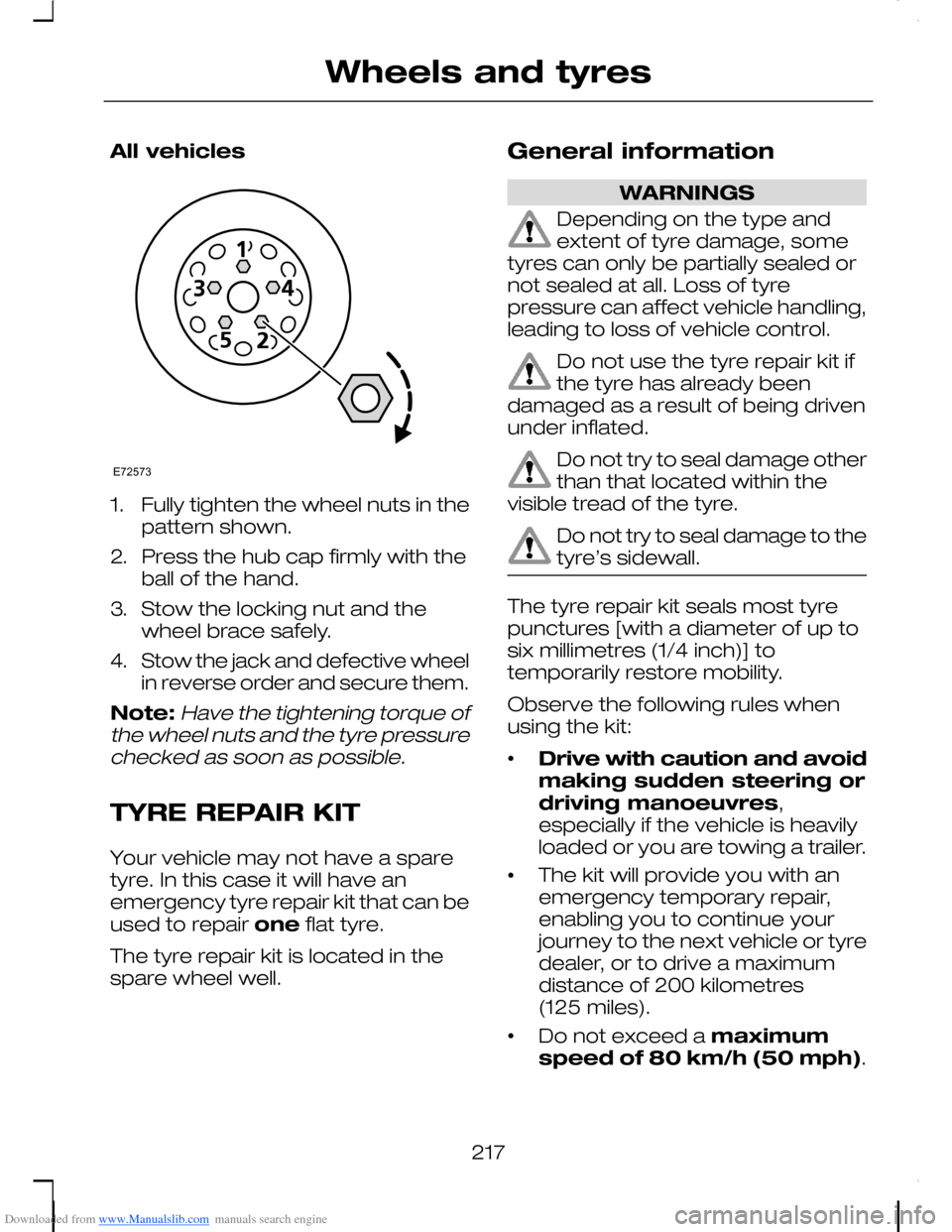
1.Fully tighten the wheel nuts in thepattern shown.
2.Press the hub cap firmly with theball of the hand.
3.Stow the locking nut and thewheel brace safely.
4.Stow the jack and defective wheelin reverse order and secure them.
Note:Have the tightening torque ofthe wheel nuts and the tyre pressurechecked as soon as possible.
TYRE REPAIR KIT
Your vehicle may not have a sparetyre. In this case it will have anemergency tyre repair kit that can beused to repair one flat tyre.
The tyre repair kit is located in thespare wheel well.
General information
WARNINGS
Depending on the type andextent of tyre damage, sometyres can only be partially sealed ornot sealed at all. Loss of tyrepressure can affect vehicle handling,leading to loss of vehicle control.
Do not use the tyre repair kit ifthe tyre has already beendamaged as a result of being drivenunder inflated.
Do not try to seal damage otherthan that located within thevisible tread of the tyre.
Do not try to seal damage to thetyre’s sidewall.
The tyre repair kit seals most tyrepunctures [with a diameter of up tosix millimetres (1/4 inch)] totemporarily restore mobility.
Observe the following rules whenusing the kit:
•Drive with caution and avoidmaking sudden steering ordriving manoeuvres,especially if the vehicle is heavilyloaded or you are towing a trailer.
•The kit will provide you with anemergency temporary repair,enabling you to continue yourjourney to the next vehicle or tyredealer, or to drive a maximumdistance of 200 kilometres(125 miles).
•Do not exceed a maximumspeed of 80 km/h (50 mph).
217
Wheels and tyresE72573