fuel FORD C MAX 2008 1.G User Guide
[x] Cancel search | Manufacturer: FORD, Model Year: 2008, Model line: C MAX, Model: FORD C MAX 2008 1.GPages: 278, PDF Size: 17.5 MB
Page 102 of 278
Downloaded from www.Manualslib.com manuals search engine ATM personalisation
Note:Kickdown functions in thesame way in all three modes.
Economy: The transmission keepsthe engine at lower engine speedsin order to optimize fuel economy.
Adaptive: The standard setupsuitable for all driving styles.
Sport: Initially, the transmission letsthe engine run at higher enginespeeds to provide faster accelerationand greater engine braking efficiency.Thereafter, it will adapt to yourindividual driving style.
ESP
Select this option to activate ESP.
Language setting
A choice of eleven languages areavailable.
Scroll to this display using the rotarycontrol and press the SET/RESETbutton to select the desiredlanguage. Turn the rotary control tosave the setting and exit the menu.
Clock setting
Note:This display is only present onvehicles equipped with aprogrammable auxiliary heater butno Ford audio or navigation system.If the vehicle is equipped with a Fordaudio or navigation system, the timeis set on the audio or navigationsystem. See separate audio ornavigation handbook.
Scroll to this display using the rotarycontrol and press SET/RESET. Thehours start to flash and can be setusing the rotary control.
Press the SET/RESET button toconfirm the setting and move to theminutes.
Proceed in the same way to set theminutes and the date.
After setting the year and pressingSET/RESET, the time and date arestored.
Units of measure
To toggle between metric andimperial units, scroll to this display andpress the SET/RESET button.
Toggling the units of measure usingthis display will affect the followingdisplays:
•Distance to empty
•Average fuel consumption
•Instantaneous fuel consumption
•Average speed
•Outside air temperature
•The temperature display in theautomatic climate control.
The units of measure for outside airtemperature and the automaticclimate control can be toggledindependent of the other displays.See General information (page96).
Auxiliary heaterprogramming
See Auxiliary heater (page 114).
100
Information displays
Page 103 of 278
Downloaded from www.Manualslib.com manuals search engine To programme the auxiliary heater,scroll to this display using the rotarycontrol and press the SET/RESETbutton.
Instant control
To switch on the programmableauxiliary heater or fuel operatedheater, scroll to this display and pressSET/RESET. The cursor will changeto a tick. The tick in this displayconfirms that the heater is nowactivated and will perform oneheating cycle.
AUX. HEATER ON will appear inthe display.
To switch off the programmableauxiliary heater or fuel operatedheater during a heating cycle, scrollto this display and pressSET/RESET. The cursor will changeto a tick. The tick in this displayconfirms that the heater is nowdeactivated.
AUX. HEATER OFF will appear inthe display.
Programme times
Note:The programmed time is thetime at which you wish the vehicle tobe warm and ready to drive, not thetime at which the heater switches on.
Note:Times must be programmedat least 70 minutes in advance of thetime you wish to set.
Note:The time and date must becorrectly set on the audio/ navigationsystem or on the information display.See Clock setting.
Four functions are available forsetting the times at which the vehicleshould be warmed up:
Seven days in the week
One or two times can beprogrammed for every day of theweek.
Five days in the week
One or two times can beprogrammed for the days Mondayto Friday.
Single day within week
One or two times can beprogrammed for one particular dayof the week.
Any time and date
One time can be programmed forone particular day in the next 12months from the date ofprogramming.
Programming procedure forSeven days in the week, Fivedays in the week, Single daywithin week:
In the Auxiliary heaterprogramming menu, scroll to therelevant display using the rotarycontrol and press the SET/RESETbutton.
When programming the functionSingle day within week, choosethe day using the rotary control andpress SET/RESET.
The first programme time will flash.
Press SET/RESET and the hourswill flash.
101
Information displays
Page 104 of 278
Downloaded from www.Manualslib.com manuals search engine Set the hours with the rotary control.
Press SET/RESET and the minuteswill flash.
Set the minutes with the rotarycontrol.
Press SET/RESET and the secondprogramme time will flash. Repeat toset the second programme time.
Note:If only one programme timeis desired, select dashes whenscrolling through the hours andminutes. These appear between 23and 00 hours and between 59 and00 minutes.
After setting the minutes of thesecond programme time, pressSET/RESET and the cursor will flash.
Press SET/RESET again and thecursor will change to a tick. The tickconfirms that the time schedules arenow stored and that the heater willhave the vehicle warmed up at thetimes set.
Note:It is not possible to select theSeven days in the week, Fivedays in the week and Singleday within week functionssimultaneously as only one set oftimes can be programmed for eachday.
If programme times for one of thesefunctions are stored and active,confirmed by a tick, a lock symbol willappear in the programming displayof the other two, showing that thesefunctions cannot be activated. Toactivate one of the other twofunctions, first deactivate the functioncurrently active by deleting the tick.
To deactivate the function, scroll tothe relevant display and pressSET/RESET repeatedly until the tickflashes. Press SET/RESET again todelete the tick and deactivate thefunction.
Programming procedure forAny time and date
In the Auxiliary heaterprogramming menu, scroll to thisdisplay using the rotary control andpress the SET/RESET button.
The hours will flash.
Set the hours with the rotary control.
Press SET/RESET and the minuteswill flash.
Proceed in the same way to set theminutes, the month and the day.
After setting the day, pressSET/RESET and the cursor will flash.
Press SET/RESET to confirm thesettings. The cursor will change to atick. The tick confirms that the timeschedule is now stored and theheater will have the vehicle warmedup at the time set.
To deactivate the function, scroll tothis display and press SET/RESETrepeatedly until the tick flashes. PressSET/RESET again to delete the tickand deactivate the function.
Chime deactivation
The following chimes can bedeactivated:
•Low fuel warning.
•General warning messages.
102
Information displays
Page 109 of 278
Downloaded from www.Manualslib.com manuals search engine PRINCIPLE OF
OPERATION
Outside air
Keep the air intakes forward of thewindscreen free from obstruction(snow, leaves etc.) to allow theclimate control system to functioneffectively.
Recirculated air
CAUTION
Prolonged use of recirculated airmay cause the windows to mistup. If the windows mist up, follow thesettings for defrosting and demistingthe windscreen.
The air currently in the passengercompartment will be recirculated.Outside air will not enter the vehicle.
Heating
Heating performance depends onthe temperature of the enginecoolant.
Air conditioning
Note:The air conditioning operatesonly when the temperature is above4ºC (39ºF).
Note:If you use the air conditioning,the fuel consumption of your vehiclewill be higher.
Air is directed through the evaporatorwhere it is cooled. Humidity isextracted from the air to help keepthe windows free of mist. Theresulting condensation is directed tothe outside of the vehicle and it istherefore normal if you see a smallpool of water under your vehicle.
General information oncontrolling the interiorclimate
Fully close all the windows.
Warming the interior
Direct the air towards your feet. Incold or humid weather conditions,direct some of the air towards thewindscreen and the door windows.
Cooling the interior
Direct the air towards your face.
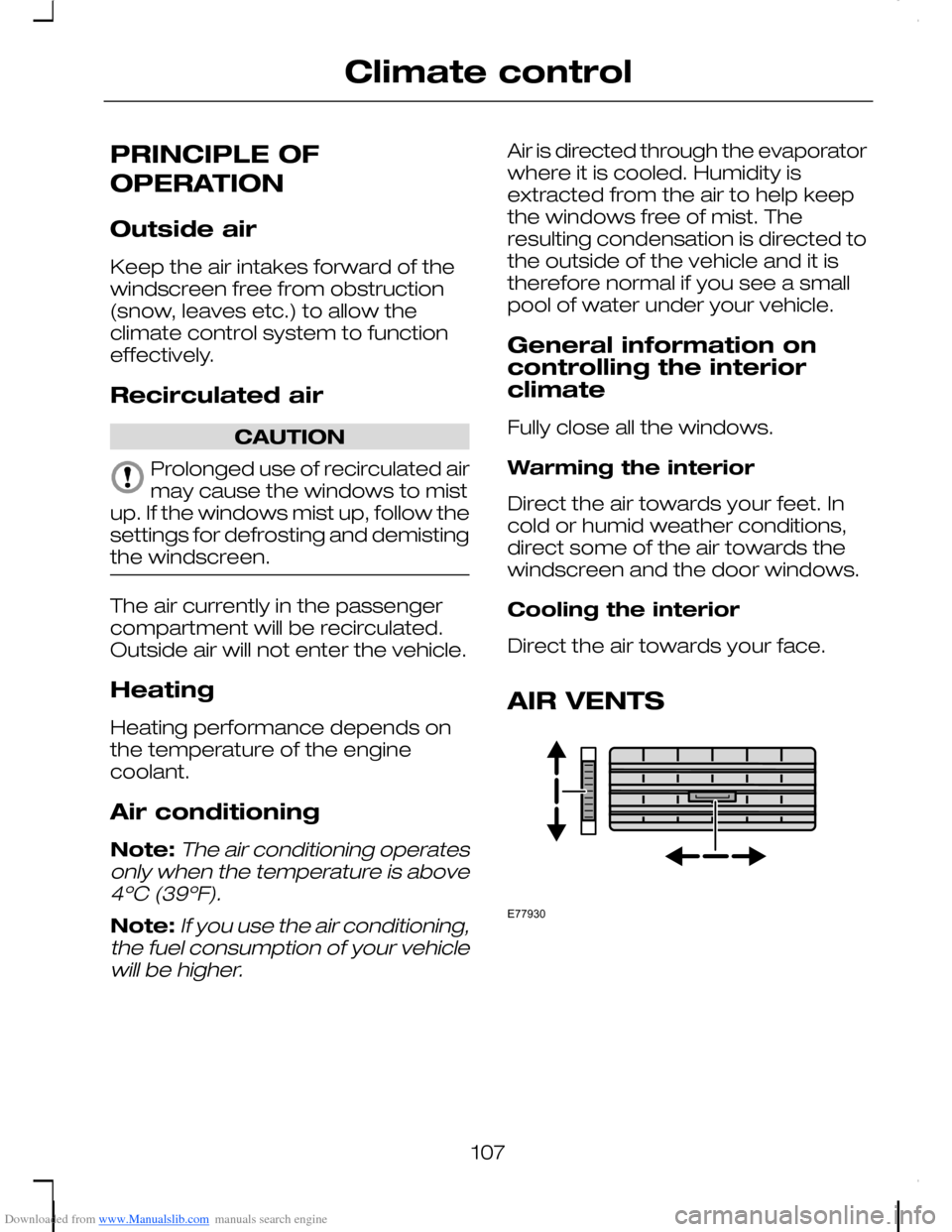
AIR VENTS
107
Climate controlE77930
Page 117 of 278
Downloaded from www.Manualslib.com manuals search engine WARNINGS
The programmable auxiliaryheater should be switched onfor approximately 10 minutes at leastonce a month all year round. Thisprevents the water pump and heatermotor from seizing.
To avoid corrosion, the coolantin your vehicle should contain atleast 10 % antifreeze all year round.
Note:The programmable auxiliaryheater will only operate if there is atleast 7.5 litres of fuel in the fuel tank.
Note:The heating depends on theoutside air temperature.
Note:It is possible that when theprogrammable auxiliary heater isactivated, exhaust fumes may comefrom under the sides of the vehicle.This is normal.
Note:On vehicles with manualclimate control the heating of thevehicle interior is dependent on thetemperature, air distribution andblower control settings.
The programmable auxiliary heateroperates independently of the vehicleheater by heating the engine’scoolant circuit. It is fed from thevehicle fuel tank.
Used properly, the programmableauxiliary heater provides the followingbenefits:
•It preheats the interior of thevehicle.
•It keeps the windows clear of icein the event of frost and preventscondensation.
•It avoids cold starts and allows theengine to reach operatingtemperature sooner.
The programmable auxiliary heatermay also be used while the vehicle isin motion to help the vehicle heaterand warm up the interior morequickly.
To prevent the battery fromdischarging:
•Once the programmable auxiliaryheater has performed one heatingcycle, the next programmedheater time will only be carried outif the vehicle’s engine has beenstarted in between.
•After a heating cycle, the vehicleshould be driven for at least theperiod of the heating cycle.
Programming the auxiliaryheater
The auxiliary heater is programmedusing the information display. SeeInformation displays (page 96).
115
Climate control
Page 118 of 278
Downloaded from www.Manualslib.com manuals search engine Auxiliary heater
The diesel auxiliary heater (PTCelectrical heater) aids in warming theengine and the interior compartmenton vehicles with diesel engines. It isautomatically switched on or offdepending on the outsidetemperature, the coolanttemperature and the alternator load.
Fuel operated heater
The fuel operated heater aids inwarming the engine and the interiorcompartment on vehicles with apetrol or diesel engine. It isautomatically switched on or offdepending on the outsidetemperature and the coolanttemperature, unless it has beendeactivated by the driver.
When the fuel operated heater isoperating, a message appears in theinformation display.
The fuel operated heater can bedeactivated using the informationdisplay. See Information displays(page 96).
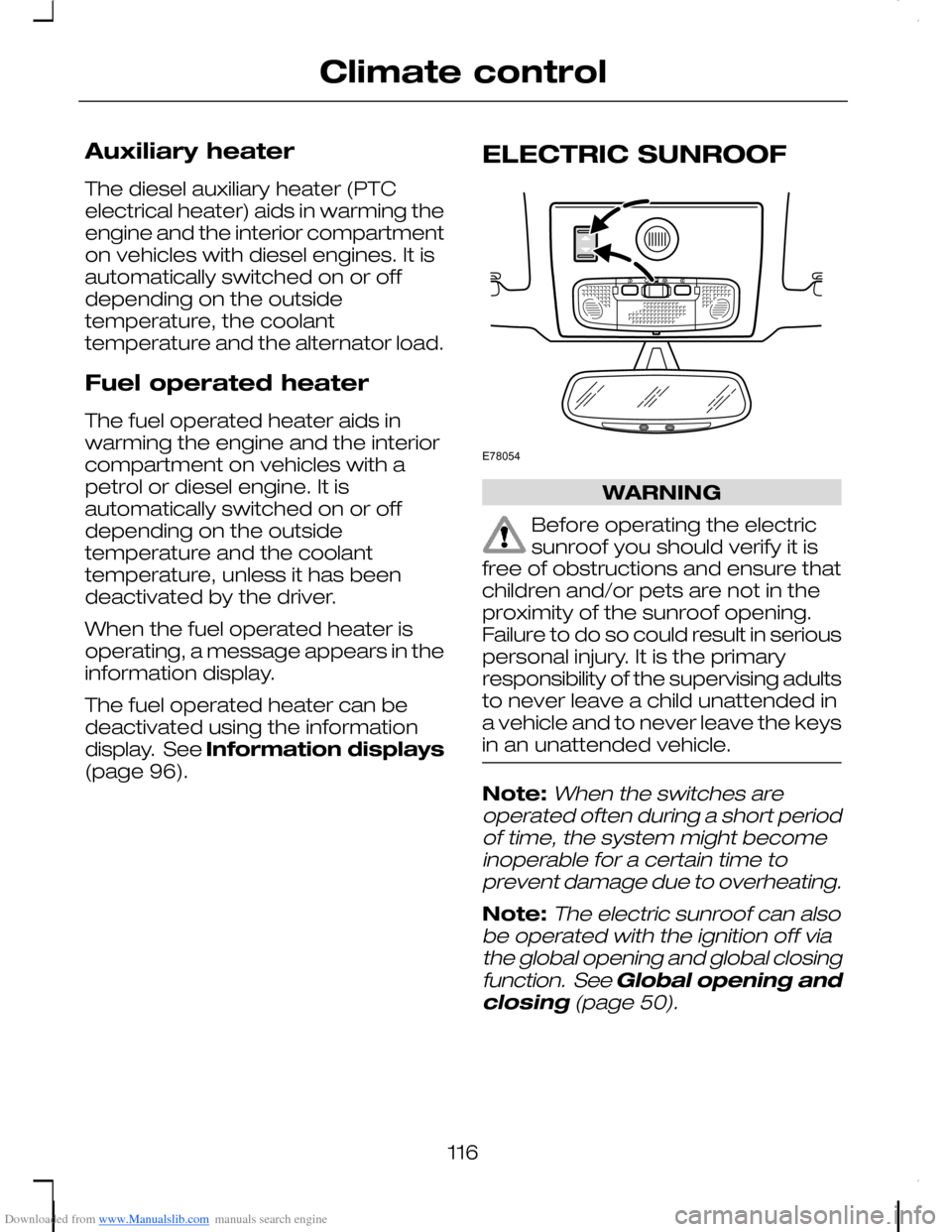
ELECTRIC SUNROOF
WARNING
Before operating the electricsunroof you should verify it isfree of obstructions and ensure thatchildren and/or pets are not in theproximity of the sunroof opening.Failure to do so could result in seriouspersonal injury. It is the primaryresponsibility of the supervising adultsto never leave a child unattended ina vehicle and to never leave the keysin an unattended vehicle.
Note:When the switches areoperated often during a short periodof time, the system might becomeinoperable for a certain time toprevent damage due to overheating.
Note:The electric sunroof can alsobe operated with the ignition off viathe global opening and global closingfunction. See Global opening andclosing (page 50).
116
Climate controlE78054
Page 144 of 278
Downloaded from www.Manualslib.com manuals search engine Position I
Steering unlocked. Ignition and allmain electrical circuits are disabled.The ignition key should not be left inthis position for too long to avoiddischarging the battery.
Positon II
Ignition switched on, all electricalcircuits operational. Warning andindicator lamps illuminate. This is thekey position when driving, and mustalso be selected when being towed.
Postion III
Starter motor activated. Release thekey as soon as the engine starts.
STEERING WHEEL LOCK
WARNING
Always check that the steeringis unlocked before attemptingto move your vehicle.
Vehicles without keylessstarting
To activate the steering wheel lock;
1.Remove the key from the ignitionswitch.
2.Turn the steering wheel.
Vehicles with keylessstarting
Your vehicle has an electronicallycontrolled steering wheel lock. Thisoperates automatically.
The steering wheel lock is activatedif the ignition is off, the engine notrunning and your vehicle is stationary.
The steering wheel lock isdeactivated when the ignition isswitched on.
STARTING A PETROL
ENGINE
All vehicles
WARNING
If the engine does not start,refer to the instructionsregarding the fuel cut-off switch. SeeFuel cut-off switch (page 175).
Engine idle speed afterstarting
The speed at which the engine idlesimmediately after starting will varydepending on the enginetemperature.
If the engine is cold then the idlespeed will automatically be increasedin order to heat the catalyticconverter as quickly as possible. Thisensures that vehicle emissions arekept to an absolute minimum.
The idle speed will slowly decreaseto the normal level as the catalyticconverter warms up.
142
Starting the engine
Page 145 of 278
Downloaded from www.Manualslib.com manuals search engine Except vehicles with aFlexfuel engine
Cold/hot engine
WARNING
At temperatures below -20 ºC,turn the ignition key to positionII for at least one second. Thisensures that maximum fuel pressureis established.
Depress the clutch pedal fully andstart the engine without touching theaccelerator.
If the engine does not start within 15seconds, wait for a short period andrepeat the procedure.
If the engine does not start afterthree attempts wait 10 seconds andfollow the Flooded engineprocedure.
If starting difficulty is experienced attemperatures below -25ºC, depressthe accelerator pedal ¼ to ½ of itstravel to assist starting.
Flooded engine
Depress the clutch pedal fully.
Slowly depress the accelerator fully,hold it in this position and start theengine.
If the engine does not start repeatthe Cold/hot engine procedure.
Vehicles with a Flexfuelengine
Starting at low ambienttemperatures
When the temperature is expectedto be lower than -15°C and thevehicle is filled with bio ethanol E 85,an engine block heater should beused to facilitate starting.
If the temperature is expected toremain below -15°C, it isrecommended that you increase theproportion of petrol in the tank bytopping up with 95 octane unleadedpetrol if the tank is not already full.About 10 litres of petrol will reducethe proportion of bio ethanol E 85 ina ¾ full tank from 85% to 70%.
If, at very low temperatures, the tankis filled with only bio ethanol E 85 andthere is no way to use an engineblock heater, you may experiencedifficulties starting the engine.
If the engine fails to start, proceed asfollows:
1.Depress the accelerator pedal 1/3to ½ of its travel.
2.Turn the ignition key to positionIII.
3.Release the ignition key as soonas the engine has started andrelease the accelerator pedalgradually as the engine speedincreases.
4.If the engine fails to start, depressthe accelerator pedal fully andrepeat steps 2 and 3.
143
Starting the engine
Page 146 of 278
Downloaded from www.Manualslib.com manuals search engine During starting, the fuel injectors areturned off as long as the acceleratorpedal is depressed. This can be usedto drain excessive fuel from theintake manifold after severalunsuccessful starting attempts.
If the battery has been disconnectedor after the fuel type has beenchanged, the idle speed may beirregular. This will improve after 10 to30 seconds.
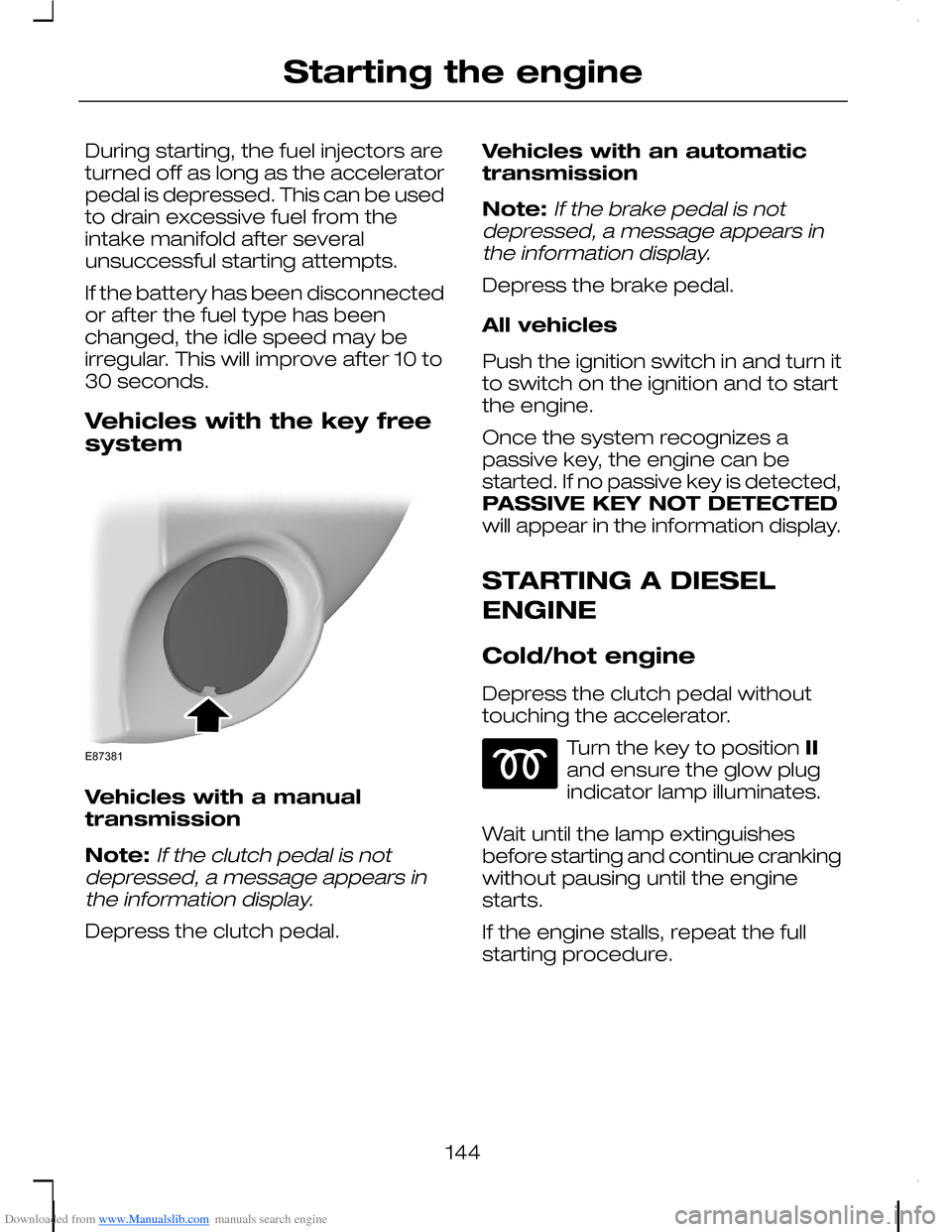
Vehicles with the key freesystem
Vehicles with a manualtransmission
Note:If the clutch pedal is notdepressed, a message appears inthe information display.
Depress the clutch pedal.
Vehicles with an automatictransmission
Note:If the brake pedal is notdepressed, a message appears inthe information display.
Depress the brake pedal.
All vehicles
Push the ignition switch in and turn itto switch on the ignition and to startthe engine.
Once the system recognizes apassive key, the engine can bestarted. If no passive key is detected,PASSIVE KEY NOT DETECTEDwill appear in the information display.
STARTING A DIESEL
ENGINE
Cold/hot engine
Depress the clutch pedal withouttouching the accelerator.
Turn the key to position IIand ensure the glow plugindicator lamp illuminates.
Wait until the lamp extinguishesbefore starting and continue crankingwithout pausing until the enginestarts.
If the engine stalls, repeat the fullstarting procedure.
144
Starting the engineE87381
Page 151 of 278
Downloaded from www.Manualslib.com manuals search engine SAFETY PRECAUTIONS
WARNINGS
Stop refuelling after the fuelnozzle stops the second time.Additional fuel will fill the expansionspace in the fuel tank which couldlead to fuel overflowing. Fuel spillagecould be hazardous to other roadusers.
Do not use any kind of flamesor heat near the fuel system.The fuel system is under pressure.There is a risk of injury if the fuelsystem is leaking.
FUEL QUALITY - PETROL
Note:We recommend that you useonly high quality fuel without additivesor other engine treatments.
CAUTION
Do not use leaded petrol orpetrol with additives containingother metallic compounds (e.g.manganese-based). They coulddamage the emission system.
Use minimum 95 octaneunleaded petrol that meets thespecification defined by EN 228, orequivalent.
FUEL QUALITY -
FLEXIBLE FUEL
WARNINGS
Do not modify the fuel systemconfiguration or thecomponents in the system.
Do not replace the fuel systemor the components with partsnot specially designed to be usedwith bio ethanol.
CAUTIONS
Do not use leaded petrol orpetrol with additives containingother metallic compounds (e.g.manganese-based). They coulddamage the emission system.
Do not use methanol instead ofbio ethanol E 85
Note:We recommend that you useonly high quality fuel without additivesor other engine treatments.
Note:When using bio ethanol E 85,you may experience a higher fuelconsumption.
Note:The correct fuel type for yourvehicle is shown on a decal on theinside of the fuel filler flap.
Note:Your vehicle will operate wellon commercial quality 95 octaneunleaded petrol, but only high qualitybio ethanol E 85 offers the sameprotection and performance.
149
Fuel and refuelling