automatic transmission FORD C MAX 2011 2.G User Guide
[x] Cancel search | Manufacturer: FORD, Model Year: 2011, Model line: C MAX, Model: FORD C MAX 2011 2.GPages: 296, PDF Size: 7.87 MB
Page 143 of 296
Downloaded from www.Manualslib.com manuals search engine MANUAL TRANSMISSION
CAUTION
Do not engage reverse gear when the
vehicle is moving. This can cause
damage to the transmission.
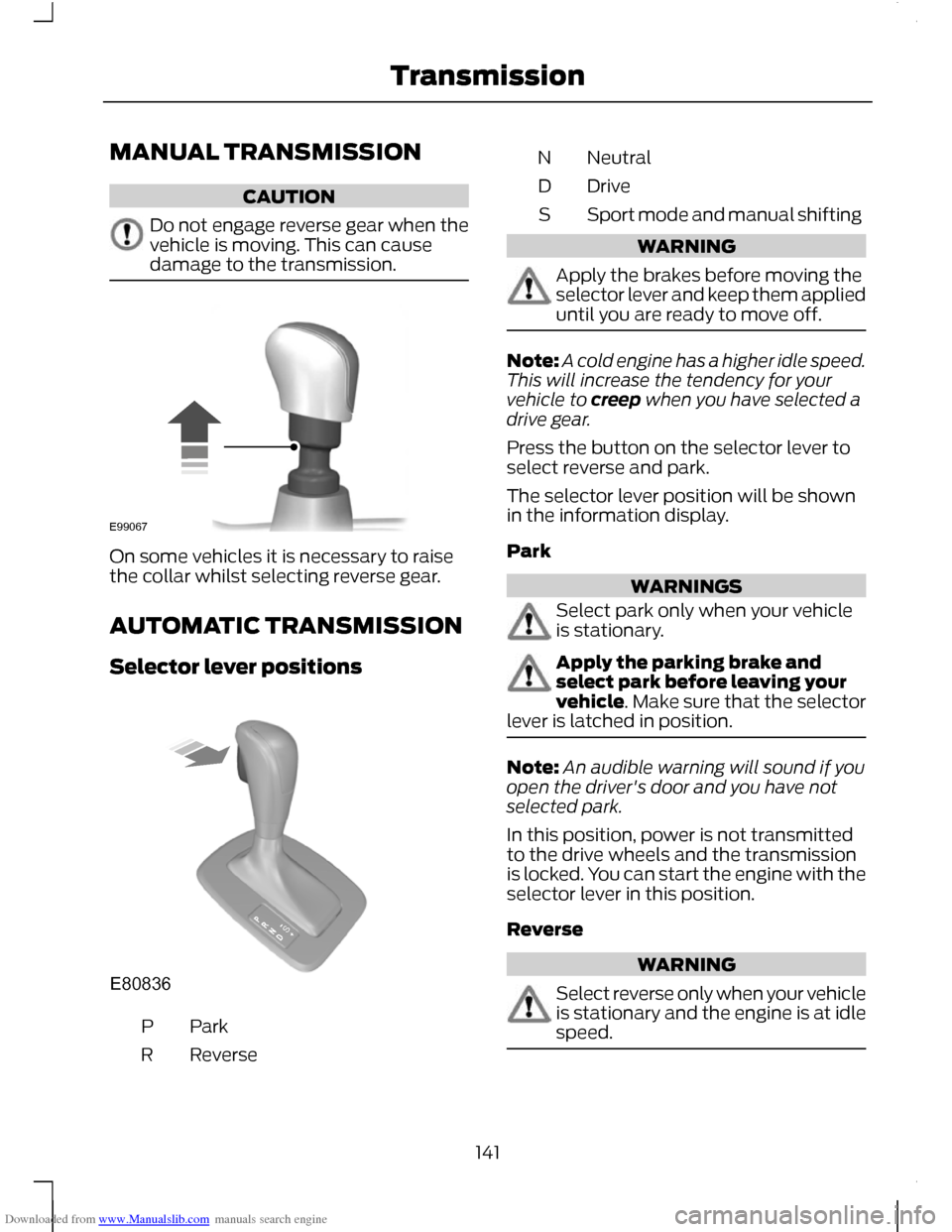
On some vehicles it is necessary to raise
the collar whilst selecting reverse gear.
AUTOMATIC TRANSMISSION
Selector lever positions
ParkP
Reverse
R Neutral
N
Drive
D
Sport mode and manual shifting
S WARNING
Apply the brakes before moving the
selector lever and keep them applied
until you are ready to move off.
Note:
A cold engine has a higher idle speed.
This will increase the tendency for your
vehicle to creep when you have selected a
drive gear.
Press the button on the selector lever to
select reverse and park.
The selector lever position will be shown
in the information display.
Park WARNINGS
Select park only when your vehicle
is stationary.
Apply the parking brake and
select park before leaving your
vehicle. Make sure that the selector
lever is latched in position. Note:
An audible warning will sound if you
open the driver's door and you have not
selected park.
In this position, power is not transmitted
to the drive wheels and the transmission
is locked. You can start the engine with the
selector lever in this position.
Reverse WARNING
Select reverse only when your vehicle
is stationary and the engine is at idle
speed.
141
TransmissionE99067 E80836S
Page 144 of 296
Downloaded from www.Manualslib.com manuals search engine Neutral
In this position, power is not transmitted
to the drive wheels but the transmission is
not locked. You can start the engine with
the selector lever in this position.
Drive
Select drive to shift automatically through
the forward gears.
The transmission will select the
appropriate gear for optimum performance
based on ambient temperature, road
gradient, vehicle load and driver input.
Manual shifting - Vehicles with a
5 speed transmission
WARNING
Do not hold the selector lever
permanently in – or +.
CAUTION
The transmission will automatically
downshift when the engine speed is
too low and upshift when too high.
Note:
A shift will occur only when the
vehicle speed and the engine speed are
appropriate.
Note: In Select mode the current gear (1,
2, 3, 4 or 5) will be displayed on the
instrument panel.
Move the selector lever to position S.
Push the selector lever forwards to shift
down and pull it backwards to shift up.
Gears may be skipped by moving the
selector lever repeatedly at short intervals.
Manual mode also provides a kickdown
function. See Kickdown. Sport mode and manual shifting -
Vehicles with a 6 speed
transmission
Note:
A shift will occur only when the
vehicle speed and the engine speed are
appropriate.
Sport Mode
Note: In Sport mode the transmission
operates as normal but gears are selected
more quickly and at higher engine speeds.
Note: In Sport mode S will be displayed on
the instrument panel.
Activate Sport mode by moving the
selector lever to position S. Sport mode
will remain active until either you shift
manually up or down the gears or return
the selector lever to position D.
Manual shifting WARNING
Do not hold the selector lever
permanently in – or +.
CAUTION
The transmission will automatically
downshift when the engine speed is
too low.
Push the selector lever forwards to shift
down and pull it backwards to shift up.
Gears may be skipped by moving the
selector lever repeatedly at short intervals.
Manual mode also provides a kickdown
function. See Kickdown.
142
Transmission
Page 145 of 296
Downloaded from www.Manualslib.com manuals search engine Hints on driving with an automatic
transmission
CAUTION
Do not idle the engine for long periods
of time in drive with the brakes
applied.
Moving off
1. Release the parking brake.
2.
Release the brake pedal and press the
accelerator pedal.
Stopping
1. Release the accelerator pedal and press the brake pedal.
2. Apply the parking brake.
3. Select neutral or park.
Kickdown
Press the accelerator pedal fully with the
selector lever in the drive position to select
the next lowest gear for optimum
performance. Release the accelerator
pedal when you no longer require
kickdown.
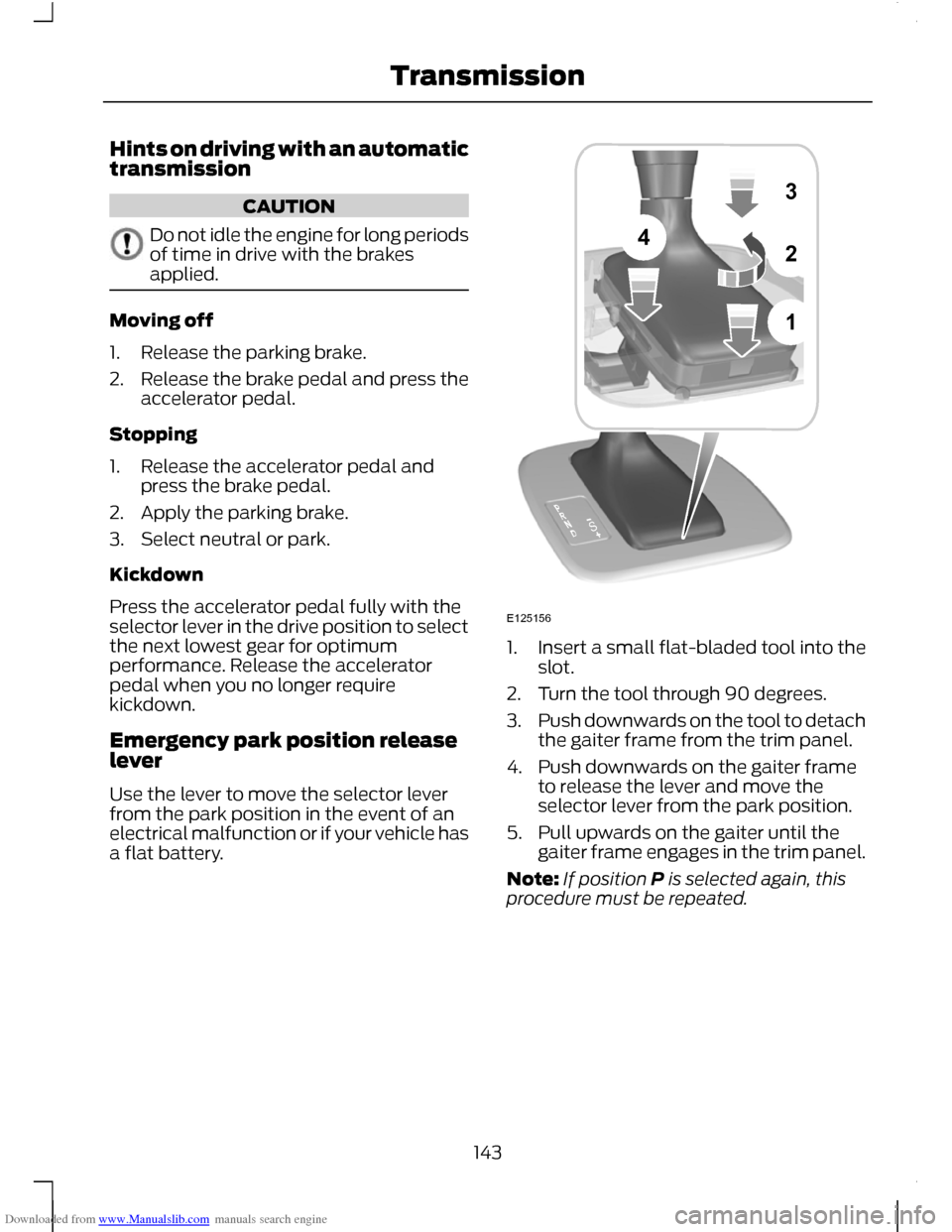
Emergency park position release
lever
Use the lever to move the selector lever
from the park position in the event of an
electrical malfunction or if your vehicle has
a flat battery. 1.
Insert a small flat-bladed tool into the
slot.
2. Turn the tool through 90 degrees.
3. Push downwards on the tool to detach
the gaiter frame from the trim panel.
4. Push downwards on the gaiter frame to release the lever and move the
selector lever from the park position.
5. Pull upwards on the gaiter until the gaiter frame engages in the trim panel.
Note: If position P is selected again, this
procedure must be repeated.
143
Transmission1324SE125156
Page 146 of 296
Downloaded from www.Manualslib.com manuals search engine PRINCIPLE OF OPERATION
Note:
Depending on applicable laws and
regulations in the country for which your
vehicle was originally built, the brake lamps
may flash if you brake heavily.
Note: Occasional brake noise is normal and
often does not indicate a concern. In normal
operation, the system may emit occasional
or intermittent squeal or groan noises when
the brakes are applied. Such noises are
usually caused by environmental conditions
such as cold, heat, moisture, road dust, salt
or mud.
Disc brakes
Wet brake discs result in reduced braking
efficiency. Dab the brake pedal when
driving from a car wash to remove the film
of water.
ABS WARNING
The ABS does not relieve you of your
responsibility to drive with due care
and attention.
The ABS helps you to maintain full steering
and directional stability when you brake
heavily in an emergency, by preventing the
road wheels from locking.
HINTS ON DRIVING WITH
ANTI-LOCK BRAKES
When the ABS is operating, the brake pedal
will pulse. This is normal. Maintain pressure
on the brake pedal.
The ABS will not eliminate the dangers
inherent when:
•
you drive too close to the vehicle in
front of you.
• the vehicle is aquaplaning. •
you take corners too fast.
• the road surface is poor.
PARKING BRAKE WARNING
Vehicles with an automatic
transmission should always be left
with the selector lever in position P
(Park). •
Press the foot brake pedal firmly.
• Pull the parking brake lever up smartly
to its fullest extent.
• Do not press the release button while
pulling the lever up.
• If your vehicle is parked on a hill and
facing uphill, select first gear or P
(Park) and turn the steering wheel
away from the kerb.
• If your vehicle is parked on a hill and
facing downhill, select reverse gear or
P (Park) and turn the steering wheel
towards the kerb.
To release the parking brake, press the
brake pedal firmly, pull the lever up slightly,
depress the release button and push the
lever down.
144
Brakes
Page 148 of 296
Downloaded from www.Manualslib.com manuals search engine PRINCIPLE OF OPERATION
The system makes it easier to pull away
when the vehicle is on a slope without the
need to use the parking brake.
When the system is active, the vehicle will
remain stationary on the slope for a short
time after you release the brake pedal.
During this time, you have time to move
your foot from the brake to the accelerator
pedal and pull away. The brakes are
released automatically once the engine
has developed sufficient drive to prevent
the vehicle from rolling down the slope.
This is an advantage when pulling away
on a slope, for example from a car park
ramp, traffic lights or when reversing uphill
into a parking space.
WARNING
The system does not replace the
parking brake. When you leave the
vehicle, always apply the parking
brake and select first or reverse gear. USING HILL START ASSIST
The system is activated automatically
when you stop your vehicle on a slope
greater than 3%. The system operates with
the vehicle facing downhill if reverse gear
is selected and with the vehicle facing
uphill if any forward gear is selected.
Vehicles with manual
transmission only
The system can be switched on and off
using the information display. See General
Information (page 83).
Activating the system
WARNINGS
You must remain in the vehicle once
you have activated the system. WARNINGS
At all times you are responsible for
controlling the vehicle, supervising
the system and intervening, if
required. If a malfunction is detected when the
system is active, the system will be
deactivated and a message will be
shown in the display. See Information
Messages (page 90). You can activate the system only if the
following conditions have been met:
•
The engine is running.
• The system is switched on.
• On vehicles with manual transmission,
the clutch pedal is pressed.
• No failure mode is present.
To activate the system:
1. Press the brake pedal to bring the vehicle to a complete standstill. Keep
the brake pedal depressed.
2. If the sensors detect that the vehicle is
on a slope the system will be activated
automatically.
3. When you remove your foot from the brake pedal, the vehicle will remain on
the slope without rolling away for a
short time. This hold time will
automatically be extended if you are
in the process of driving off.
4. Drive off in the normal manner. The brakes will be released automatically.
Deactivating the system
To deactivate the system, perform one of
the following:
146
Hill Start Assist
Page 186 of 296
Downloaded from www.Manualslib.com manuals search engine CAUTIONS
Too much tension in the tow rope
could cause damage to your vehicle
or the vehicle that is towing.
Select neutral when your vehicle is
being towed.
In the event of a breakdown or
mechanical failure do not use
individual axle carriers. Your vehicle
must be recovered with either ALL wheels
on the ground or transported with ALL
wheels lifted clear of the ground on a level
platform. Drive off slowly and smoothly without
jerking the vehicle that is towing.
Vehicles with automatic
transmission
CAUTIONS
If a speed of 20 km/h (12 mph) and a
distance of 20 kilometres (12 miles)
is to be exceeded ALL wheels must
be lifted clear of the ground. It is recommended not to tow with the
drive wheels on the ground. However,
if it is required to move the vehicle
from a dangerous location, do not tow your
vehicle faster than 20 km/h (12 mph) or
further than 20 kilometres (12 miles). Do not tow your vehicle backwards.
In the event of a mechanical failure of
the transmission do not use individual
axle carriers.
ALL wheels must be
lifted clear of the ground on a level
platform. Do not tow your vehicle if the ambient
temperature is below 0°C (32°F).
184
Vehicle recovery
Page 204 of 296
Downloaded from www.Manualslib.com manuals search engine Removing the wheel trim
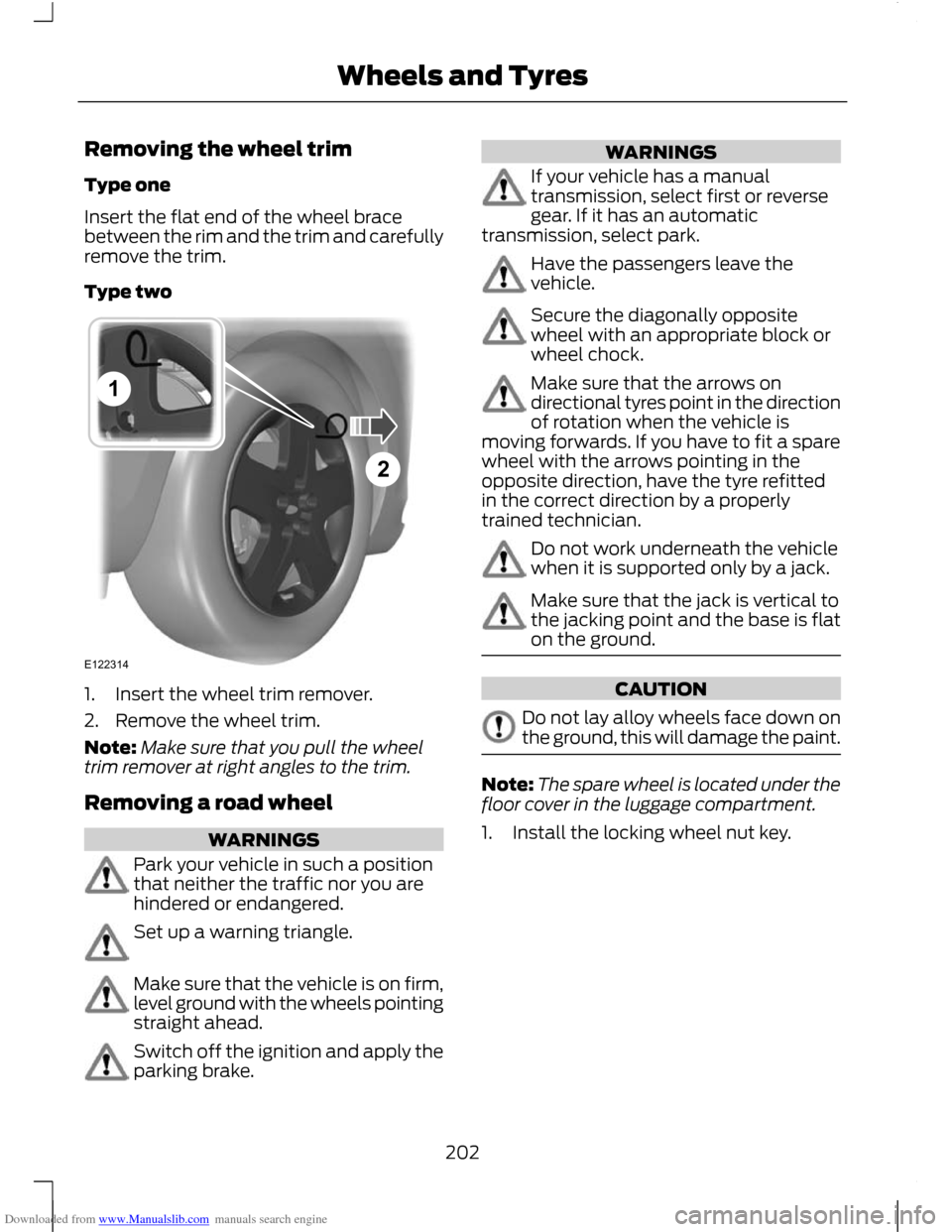
Type one
Insert the flat end of the wheel brace
between the rim and the trim and carefully
remove the trim.
Type two
1. Insert the wheel trim remover.
2. Remove the wheel trim.
Note:
Make sure that you pull the wheel
trim remover at right angles to the trim.
Removing a road wheel WARNINGS
Park your vehicle in such a position
that neither the traffic nor you are
hindered or endangered.
Set up a warning triangle.
Make sure that the vehicle is on firm,
level ground with the wheels pointing
straight ahead.
Switch off the ignition and apply the
parking brake. WARNINGS
If your vehicle has a manual
transmission, select first or reverse
gear. If it has an automatic
transmission, select park. Have the passengers leave the
vehicle.
Secure the diagonally opposite
wheel with an appropriate block or
wheel chock.
Make sure that the arrows on
directional tyres point in the direction
of rotation when the vehicle is
moving forwards. If you have to fit a spare
wheel with the arrows pointing in the
opposite direction, have the tyre refitted
in the correct direction by a properly
trained technician. Do not work underneath the vehicle
when it is supported only by a jack.
Make sure that the jack is vertical to
the jacking point and the base is flat
on the ground.
CAUTION
Do not lay alloy wheels face down on
the ground, this will damage the paint.
Note:
The spare wheel is located under the
floor cover in the luggage compartment.
1. Install the locking wheel nut key.
202
Wheels and TyresE12231421
Page 232 of 296
Downloaded from www.Manualslib.com manuals search engine AUTOMATIC VOLUME
CONTROL
When available, automatic volume control
(AVC) adjusts the volume level to
compensate for engine noise and road
speed noise.
1. Press the MENU button and select
AUDIO.
2. Select AVC LEVEL or ADAPTIVE VOL.
3. Use the left or right arrow button to adjust the setting.
4. Press the OK button to confirm your selection.
5. Press the MENU button to return.
DIGITAL SIGNAL PROCESSING
(DSP)
DSP occupancy
This feature takes into account the
differences in distance from the various
speakers in the vehicle to each seat. Select
the sitting position for which the audio is
to be correctly enhanced.
DSP equaliser
Select the music category that most suits
your listening preference. The audio output
will change to enhance the particular style
of music chosen.
Changing the DSP settings
1. Press the MENU button.
2. Select AUDIO or AUDIO SETTINGS.
3. Scroll to the required DSP function.
4. Use the up and down arrow buttons to
select the required setting.
5. Press the OK button to confirm your selection.
6. Press the MENU button to return. NEWS BROADCASTS
Some audio units interrupt normal
reception to broadcast news bulletins from
stations on the FM waveband or radio data
system (RDS) and enhanced other
network (EON) linked stations, in the same
way as traffic information is provided.
During news broadcasts, the display will
indicate there is an incoming
announcement. News interrupts are
broadcast at the same preset volume level
as traffic announcements.
1. Press the MENU button.
2. Select AUDIO or AUDIO SETTINGS.
3.
Scroll to NEWS and turn on or off with
the OK button.
4. Press the MENU button to return.
ALTERNATIVE FREQUENCIES
Many programmes that broadcast on the
FM waveband have a programme
identification (PI) code, which can be
recognised by audio units.
If your radio has alternative frequencies
(AF) tuning switched on and you move
from one transmission area to another, this
facility will search for and switch to a
stronger station signal, if one can be found.
Under certain conditions, however, AF
tuning may temporarily disrupt normal
reception.
When selected, the unit continually
evaluates signal strength and, if a better
signal becomes available, the unit will
switch to that alternative. It mutes while
it checks a list of alternative frequencies
and, if necessary, it will search once across
the selected waveband for a genuine
alternative frequency.
230
Audio unit menus
Page 285 of 296
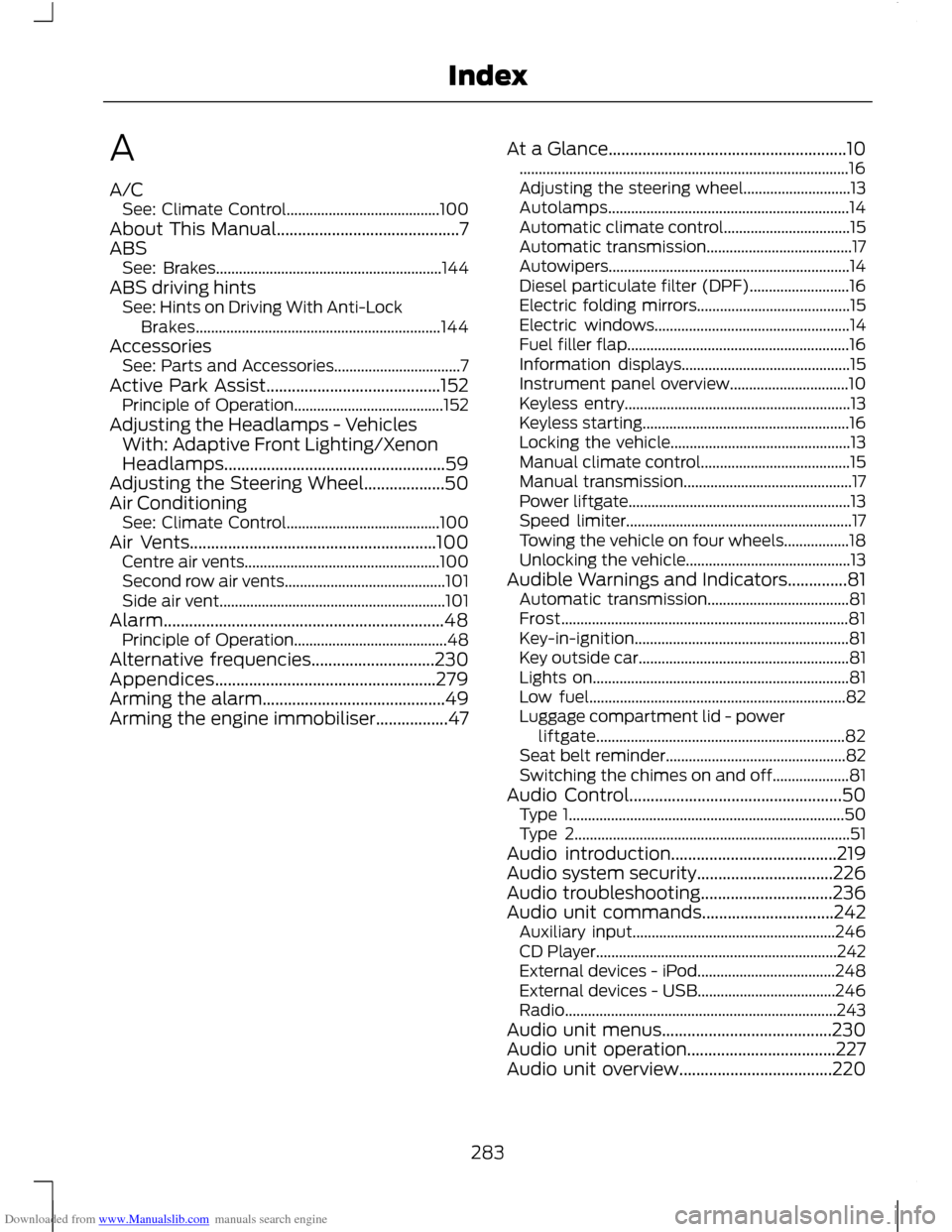
Downloaded from www.Manualslib.com manuals search engine A
A/C
See: Climate Control........................................ 100
About This Manual...........................................7
ABS See: Brakes........................................................... 144
ABS driving hints See: Hints on Driving With Anti-Lock
Brakes................................................................ 144
Accessories See: Parts and Accessories................................. 7
Active Park Assist.........................................152 Principle of Operation....................................... 152
Adjusting the Headlamps - Vehicles With: Adaptive Front Lighting/Xenon
Headlamps....................................................59
Adjusting the Steering Wheel...................50
Air Conditioning See: Climate Control........................................ 100
Air Vents..........................................................100 Centre air vents................................................... 100
Second row air vents.......................................... 101
Side air vent........................................................... 101
Alarm..................................................................48 Principle of Operation........................................ 48
Alternative frequencies.............................230
Appendices....................................................279
Arming the alarm...........................................49
Arming the engine immobiliser.................47 At a Glance........................................................10
........................................................................\
.............. 16
Adjusting the steering wheel............................ 13
Autolamps............................................................... 14
Automatic climate control................................. 15
Automatic transmission...................................... 17
Autowipers............................................................... 14
Diesel particulate filter (DPF).......................... 16
Electric folding mirrors........................................ 15
Electric windows................................................... 14
Fuel filler flap.......................................................... 16
Information displays............................................ 15
Instrument panel overview............................... 10
Keyless entry........................................................... 13
Keyless starting...................................................... 16
Locking the vehicle............................................... 13
Manual climate control....................................... 15
Manual transmission............................................ 17
Power liftgate.......................................................... 13
Speed limiter........................................................... 17
Towing the vehicle on four wheels.................18
Unlocking the vehicle........................................... 13
Audible Warnings and Indicators..............81 Automatic transmission..................................... 81
Frost........................................................................\
... 81
Key-in-ignition........................................................ 81
Key outside car....................................................... 81
Lights on................................................................... 81
Low fuel................................................................... 82
Luggage compartment lid - power liftgate................................................................. 82
Seat belt reminder............................................... 82
Switching the chimes on and off.................... 81
Audio Control..................................................50 Type 1........................................................................\
50
Type 2........................................................................\
51
Audio introduction.......................................219
Audio system security................................226
Audio troubleshooting...............................236
Audio unit commands...............................242 Auxiliary input..................................................... 246
CD Player............................................................... 242
External devices - iPod.................................... 248
External devices - USB.................................... 246
Radio ....................................................................... 243
Audio unit menus........................................230
Audio unit operation...................................227
Audio unit overview....................................220
283
Index
Page 286 of 296
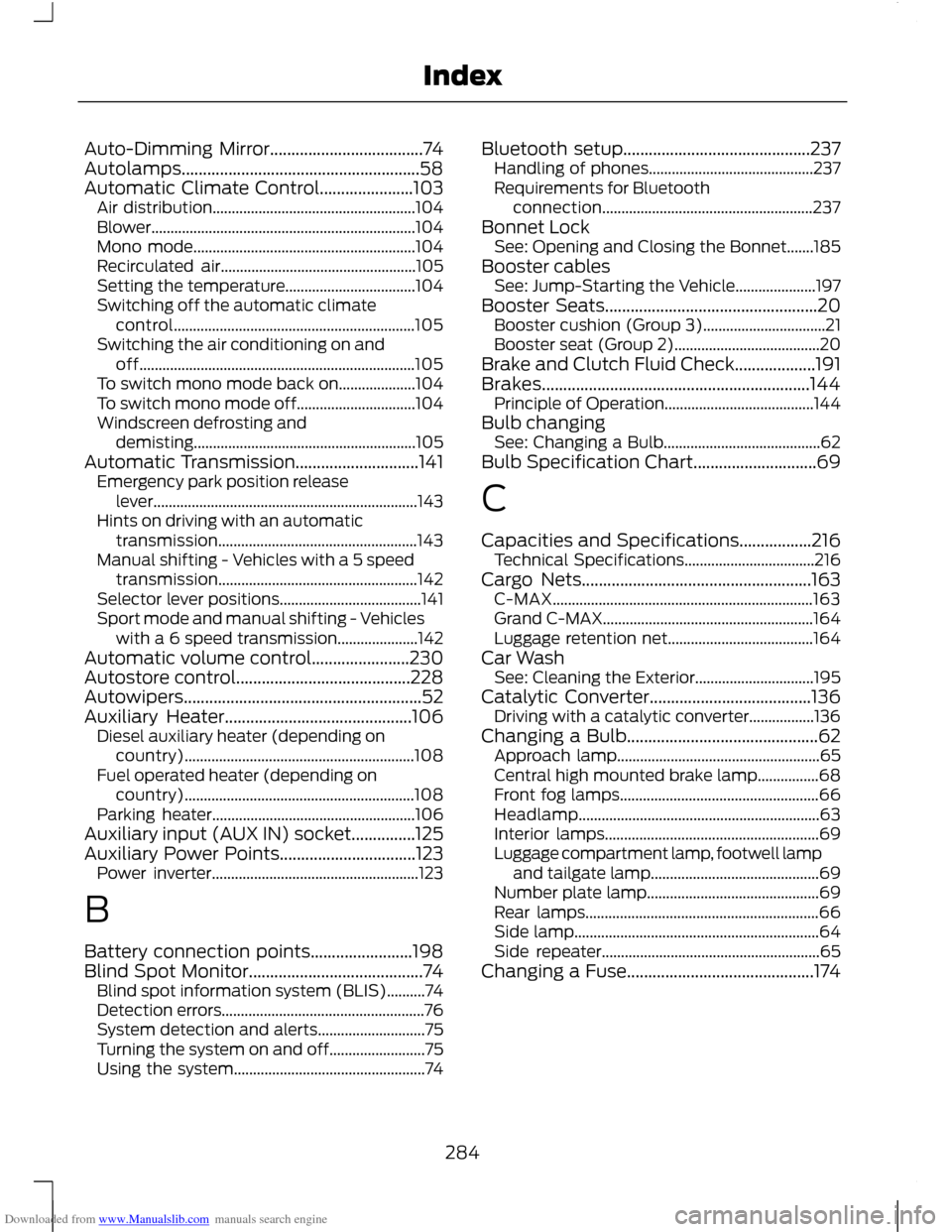
Downloaded from www.Manualslib.com manuals search engine Auto-Dimming Mirror....................................74
Autolamps........................................................58
Automatic Climate Control......................103
Air distribution..................................................... 104
Blower..................................................................... 104
Mono mode.......................................................... 104
Recirculated air................................................... 105
Setting the temperature.................................. 104
Switching off the automatic climate control............................................................... 105
Switching the air conditioning on and off........................................................................\
105
To switch mono mode back on.................... 104
To switch mono mode off............................... 104
Windscreen defrosting and demisting.......................................................... 105
Automatic Transmission.............................141 Emergency park position release
lever..................................................................... 143
Hints on driving with an automatic transmission.................................................... 143
Manual shifting - Vehicles with a 5 speed transmission.................................................... 142
Selector lever positions..................................... 141
Sport mode and manual shifting - Vehicles with a 6 speed transmission..................... 142
Automatic volume control.......................230
Autostore control.........................................228
Autowipers........................................................52
Auxiliary Heater............................................106 Diesel auxiliary heater (depending on
country)............................................................ 108
Fuel operated heater (depending on country)............................................................ 108
Parking heater..................................................... 106
Auxiliary input (AUX IN) socket...............125
Auxiliary Power Points................................123 Power inverter...................................................... 123
B
Battery connection points........................198
Blind Spot Monitor.........................................74 Blind spot information system (BLIS)..........74
Detection errors..................................................... 76
System detection and alerts............................ 75
Turning the system on and off......................... 75
Using the system.................................................. 74Bluetooth setup............................................237
Handling of phones........................................... 237
Requirements for Bluetooth connection....................................................... 237
Bonnet Lock See: Opening and Closing the Bonnet.......185
Booster cables See: Jump-Starting the Vehicle..................... 197
Booster Seats..................................................20 Booster cushion (Group 3)................................ 21
Booster seat (Group 2)...................................... 20
Brake and Clutch Fluid Check...................191
Brakes...............................................................144 Principle of Operation....................................... 144
Bulb changing See: Changing a Bulb......................................... 62
Bulb Specification Chart.............................69
C
Capacities and Specifications.................216 Technical Specifications.................................. 216
Cargo Nets......................................................163 C-MAX.................................................................... 163
Grand C-MAX....................................................... 164
Luggage retention net...................................... 164
Car Wash See: Cleaning the Exterior............................... 195
Catalytic Converter......................................136 Driving with a catalytic converter.................136
Changing a Bulb.............................................62 Approach lamp..................................................... 65
Central high mounted brake lamp................68
Front fog lamps.................................................... 66
Headlamp............................................................... 63
Interior lamps........................................................ 69
Luggage compartment lamp, footwell lamp and tailgate lamp............................................ 69
Number plate lamp............................................. 69
Rear lamps............................................................. 66
Side lamp................................................................ 64
Side repeater......................................................... 65
Changing a Fuse............................................174
284
Index