parking brake FORD C MAX 2013 Owner's Manual
[x] Cancel search | Manufacturer: FORD, Model Year: 2013, Model line: C MAX, Model: FORD C MAX 2013Pages: 552, PDF Size: 8.55 MB
Page 250 of 552
The front wheels must be on a tow dolly when towing your vehicle
from the rear using wheel lift equipment. This prevents damage to the
transmission.
TOWING THE VEHICLE ON FOUR WHEELS
Emergency Towing
If your vehicle becomes inoperable (without access to wheel dollies,
car-hauling trailer, or flatbed transport vehicle), it can be flat-towed
(all wheels on the ground, regardless of the powertrain and transmission
configuration) under the following conditions:
•Your vehicle is facing forward for towing in a forward direction.
•
Place the transmission in positionN.SeeAutomatic transmissionin
theTransmissionchapter if you cannot move the transmission intoN.
•Maximum speed is 35 mph (56 km/h).
•Maximum distance is 50 miles (80 kilometers).
Recreational Towing
Note:Put your climate control system in recirculated air mode to
prevent exhaust fumes from entering your vehicle. See theClimate
Controlchapter.
Follow these guidelines if you have a need for recreational towing,
such as towing your vehicle behind a motorhome. We designed these
guidelines to prevent damage to your transmission.
You can tow your vehicle with all four wheels on the ground or with
the front wheels off the ground by using a tow dolly. If you are using a
tow dolly, follow the instructions specified by the equipment provider.
If you are towing with all four wheels on the ground, see the following
instructions.
If you tow your vehicle with all four wheels on the ground:
•Tow only in the forward direction.
•Release the parking brake.
•Place the transmission in positionN.
•Place the ignition in the accessory mode. See theStarting and
Stopping the Enginechapter.
•Do not exceed 70 mph (113 km/h).
•Place the transmission in positionP,start the engine and allow it to
run for one minute at the beginning of each day (you may need to
press the accelerator pedal in order to start the engine). After
allowing the engine to run, place the transmission back into position
Nand the ignition in the accessory position.
Towing249
2013 C-Max Full Hybrid(34h)
Owners Guide gf, 3rd Printing, January 2013
USA(fus)
Page 255 of 552
In the event of damage or fire involving an electric vehicle (EV) or
hybrid-electric vehicle (HEV):
•Always assume the high-voltage battery and associated components
are energized and fully charged.
•Exposed electrical components, wires, and high-voltage batteries
present potential high-voltage shock hazards.
•Venting/off-gassing high-voltage battery vapors are potentially toxic
and flammable.
•Physical damage to the vehicle or high-voltage battery may result in
immediate or delayed release of toxic and/or flammable gases and fire.
Vehicle information and general safety practices:
•Know the make and model of your vehicle.
•Review the Owner’s Manual and become familiar with your vehicle’s
safety information and recommended safety practices.
•Do not attempt to repair damaged electric and hybrid-electric vehicles
yourself. Contact an authorized Ford Dealer or vehicle manufacturer
representative for service.
Crashes
A crash or impact significant enough to require an emergency response
for conventional vehicles would also require the same response for an
electric or hybrid-electric vehicle.
If possible
•Move your car to a safe, nearby location and remain on the scene.
•Roll down windows before shutting vehicle off.
•Place vehicle in Park, set parking brake, turn off the vehicle, activate
hazard lights, and move key(s) at least 16 feet (5 meters) away from
the vehicle.
254Roadside Emergencies
2013 C-Max Full Hybrid(34h)
Owners Guide gf, 3rd Printing, January 2013
USA(fus)
Page 260 of 552
To reactivate the vehicle after either event perform the following steps:
1. Press the START/STOP button to power the vehicle on.
2. Press the START/STOP button to power the vehicle off.
3. Press the START/STOP button to power the vehicle on again.
Note:After completing this process the vehicle will detect if the
electrical system is safe and reactivate. Once your vehicle determines the
electrical system safe you can start your vehicle as you would normally
by pressing the brake in combination with the START/STOP button.
JUMP STARTING THE VEHICLE
WARNING:Batteries contain sulfuric acid which can burn skin,
eyes and clothing, if contacted.
Note:Use only a 12 volt supply to start your vehicle.
Note:The high-voltage battery cannot be jumped with a standard
12 volt battery.
Note:Do not disconnect the battery of the disabled vehicle as this could
damage the vehicle’s electrical system. The 12 volt battery controls the
switches and contacts that engage the high-voltage battery.
Preparing your vehicle
1. Park the booster vehicle close to the hood of the disabled vehicle
making sure the two vehicles do not touch. Set the parking brake on
both vehicles. Stay clear of any moving parts on both vehicles that can
cause harm.
2. Check all battery terminals and remove any excessive corrosion before
you attach the battery cables. Ensure that vent caps are tight and level.
3. Turn the heater fan on in both vehicles to protect from any electrical
surges. Turn all other accessories off.
Roadside Emergencies259
2013 C-Max Full Hybrid(34h)
Owners Guide gf, 3rd Printing, January 2013
USA(fus)
Page 282 of 552
GENERAL INFORMATION
Have your vehicle serviced regularly to help maintain its roadworthiness
and resale value. There is a large network of Ford authorized dealers
who are there to help you with their professional servicing expertise.
We believe that their specially trained technicians are best qualified to
service your vehicle properly and expertly. They are supported by a wide
range of highly specialized tools developed specifically for servicing your
vehicle.
To help you service your vehicle, we provideScheduled Maintenance
Informationwhich makes tracking routine service easy.
If your vehicle requires professional service, your authorized dealer
can provide the necessary parts and service. Check your warranty
information to find out which parts and services are covered.
Use only recommended fuels, lubricants, fluids and service parts
conforming to specifications. Motorcraft® parts are designed and built to
provide the best performance in your vehicle.
Precautions
•Do not work on a hot engine.
•Make sure that nothing gets caught in moving parts.
•Do not work on a vehicle with the engine running in an enclosed
space, unless you are sure you have enough ventilation.
•Keep all open flames and other burning material (such as cigarettes)
away from the battery and all fuel related parts.
Working with the Engine Off
1. Set the parking brake and shift toP(Park).
2. Turn off the engine and remove the key (if equipped).
3. Block the wheels.
Working with the Engine On
WARNING:To reduce the risk of vehicle damage or personal
burn injuries, do not start your engine with the air cleaner
removed and do not remove it while the engine is running.
1. Set the parking brake and shift to positionP.
2. Block the wheels.
Maintenance281
2013 C-Max Full Hybrid(34h)
Owners Guide gf, 3rd Printing, January 2013
USA(fus)
Page 294 of 552
CHANGING THE LOW VOLTAGE BATTERY
Your vehicle is equipped with a Motorcraft® maintenance-free low
voltage battery which normally does not require additional water during
its life of service.
Note:See an authorized dealer for low voltage battery access, testing, or
replacement.
When a low voltage battery replacement is necessary, see an authorized
dealer to replace the low voltage battery with a Ford recommended
replacement low voltage battery that matches the electrical requirements
of the vehicle.
To ensure proper operation of the battery management system (BMS), do
not allow a technician to connect any electrical device ground connection
directly to the low voltage battery negative post. A connection at the low
voltage battery negative post can cause inaccurate measurements of the
battery condition and potential incorrect system operation.
Note:If a person adds electrical or electronic accessories or components
to the vehicle, the accessories or components may adversely affect the
low voltage battery performance and durability and may also affect the
performance of other electrical systems in the vehicle.
Note:Always dispose of automotive batteries in a responsible manner.
Follow your local authorized standards for disposal. Call your local
authorized recycling center to find out more about recycling automotive
batteries.
Because your vehicle’s engine is electronically-controlled by a computer,
some engine control settings are maintained by power from the low
voltage battery. Some engine computer settings, like the idle trim and
fuel trim strategy, optimize the driveability and performance of the
engine. Some other computer settings, like the clock and radio station
presets, are also maintained in memory by power from the low voltage
battery. When a technician disconnects and connects the low voltage
battery, these settings are erased. Complete the following procedure in
order to restore the settings:
1. With the vehicle at a complete stop, set the parking brake.
2. Shift the transmission to P (Park).
3. Turn off all accessories.
4. Step on the brake pedal and start the vehicle.
5. Step on the accelerator to start the engine.
Maintenance293
2013 C-Max Full Hybrid(34h)
Owners Guide gf, 3rd Printing, January 2013
USA(fus)
Page 319 of 552
Low voltage battery (except C-MAX Energi)
Complete the following steps:
1. Open the liftgate.
2. Remove the carpet from the cargo area.
3. Remove the bolts and the cargo area floor storage interior trim panel.
4. Check and recharge the low voltage battery as necessary. Keep
connections clean.
5. If you are storing your vehicle for more than 30 days without
recharging the battery, disconnect the negative battery cable from
the low voltage battery.
6. If you disconnected the negative battery cable, apply painter’s tape to
the liftgate latch in order to prevent the liftgate from closing fully.
Note:If you disconnected the negative battery cable, it will be necessary
to reset memory features. SeeChanging the Low Voltage Battery.
Low voltage battery (C-MAX Energi)
Complete the following steps:
1. Open the liftgate.
2. Pull and remove the access panel from the rear of the cargo area in
order to access the low voltage battery.
3. Check and recharge the low voltage battery as necessary. Keep
connections clean.
4. If you are storing your vehicle for more than 30 days without
recharging the battery, disconnect the negative battery cable from
the low voltage battery.
5. If you disconnected the negative battery cable, apply painter’s tape to
the liftgate latch in order to prevent the liftgate from closing fully.
Note:If you disconnected the negative battery cable, it will be necessary
to reset memory features. SeeChanging the Low Voltage Battery.
Brakes
•Make sure brakes and parking brake are fully released.
Tires
•Maintain recommended air pressure.
Miscellaneous
•Make sure all linkages, cables, levers and pins under vehicle are
covered with grease to prevent rust.
•Move vehicles at least 25 feet (8 m) every 15 days to lubricate
working parts and prevent corrosion.
318Vehicle Care
2013 C-Max Full Hybrid(34h)
Owners Guide gf, 3rd Printing, January 2013
USA(fus)
Page 343 of 552
Tips for Use of the Temporary Mobility Kit
Read the following list of tips to make sure safe operation of the
temporary mobility kit:
•Before operating the temporary mobility kit, make sure your vehicle is
safely off the road and away from moving traffic. Turn on the hazard
lights.
•Always set the parking brake to make sure the vehicle does not move
unexpectedly.
•
Do not remove any foreign objects, such as nails or screws, from the
tire.
•When using the temporary mobility kit, leave the engine running
(only if the vehicle is outdoors or in a well-ventilated area) so the
compressor does not drain the vehicle’s battery.
•Do not allow the compressor to operate continuously for more than
15 minutes; this will help prevent the compressor from overheating.
•Never leave the temporary mobility kit unattended when it is
operating.
•Sealant compound contains latex. Make sure that you use the
non-latex gloves provided to avoid an allergic reaction.
•Keep the temporary mobility kit away from children.
•Only use the temporary mobility kit when the ambient temperature is
between -22°F (–30°C) and 158°F (70°C).
•Only use the sealing compound before the use by date. The use by
date is on the lower right hand corner of the label located on the
sealant canister (bottle).Note:Check the use by date regularly and
replace the canister after four years.
•Do not store the temporary mobility kit unsecured inside the
passenger compartment of the vehicle as it may cause injury during a
sudden stop or collision. Always store the kit in its original location.
•
After sealant use, the tire pressure monitoring system sensor and valve
stem on the wheel must be replaced by an authorized Ford dealer.
•When inflating a tire or other objects, use the black air hose only. Do not
use the transparent hose which is designed for sealant application only.
•Operating the temporary mobility kit could cause an electrical
disturbance in radio, CD, and DVD player operation (if equipped).
342Wheels and Tires
2013 C-Max Full Hybrid(34h)
Owners Guide gf, 3rd Printing, January 2013
USA(fus)
Page 344 of 552
What to Do When a Tire Is Punctured
A tire puncture within the tire’s tread area can be repaired in two stages
with the temporary mobility kit:
•In the first stage, the tire will be reinflated with a sealing compound
and air. After the tire has been reinflated, you will need to drive the
vehicle a short distance (about 4 miles [6 kilometers]) to distribute
the sealant in the tire.
•In the second stage, check the tire pressure and adjust, if necessary,
to the vehicle’s tire inflation pressure.
First Stage: Reinflating the Tire with Sealing Compound and Air
WARNING:Do not stand directly over the temporary mobility
kit while inflating the tire. If you notice any unusual bulges or
deformations in the tire’s sidewall during inflation, stop and call
roadside assistance.
WARNING:If the tire does not inflate to the recommended tire
pressure within 15 minutes, stop and call roadside assistance.
Preparation
Park the vehicle in a safe, level and secure area, away from moving
traffic. Turn the hazard lights on. Apply the parking brake and turn the
engine off. Inspect the flat tire for visible damage.
Sealant compound contains latex. To avoid any allergic reactions, use the
non-latex gloves located in the accessory box on the underside of the
temporary mobility kit housing.
Do not remove any foreign object that has pierced the tire. If a puncture
is located in the tire sidewall, stop and call roadside assistance.
1. Remove the valve cap from the tire valve.
2. Unwrap the clear tube from the compressor housing.
3. Remove the tube cap and fasten the metal connector of the tube to
the tire valve, turning clockwise. Make sure the connection is tightly
fastened.
Wheels and Tires343
2013 C-Max Full Hybrid(34h)
Owners Guide gf, 3rd Printing, January 2013
USA(fus)
Page 366 of 552
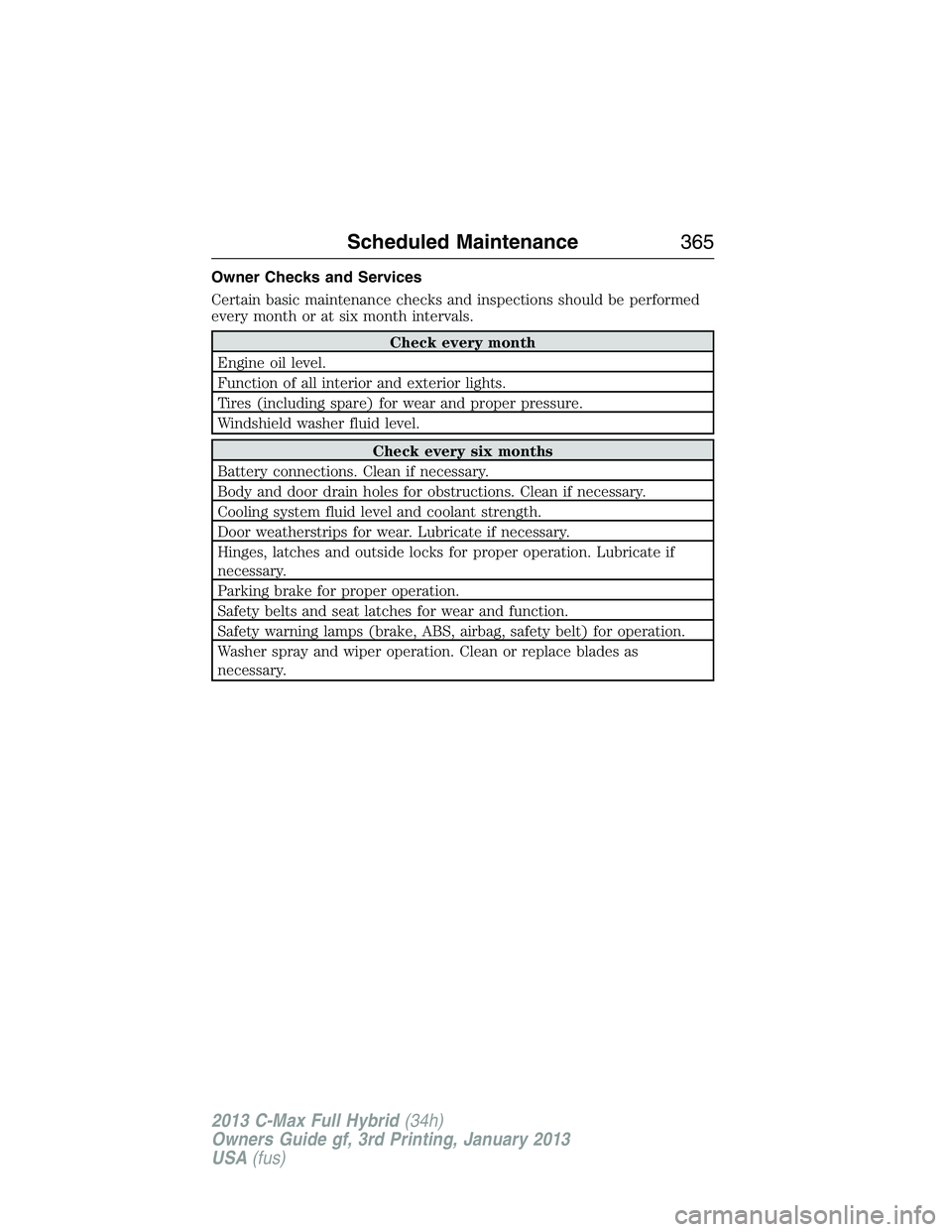
Owner Checks and Services
Certain basic maintenance checks and inspections should be performed
every month or at six month intervals.
Check every month
Engine oil level.
Function of all interior and exterior lights.
Tires (including spare) for wear and proper pressure.
Windshield washer fluid level.
Check every six months
Battery connections. Clean if necessary.
Body and door drain holes for obstructions. Clean if necessary.
Cooling system fluid level and coolant strength.
Door weatherstrips for wear. Lubricate if necessary.
Hinges, latches and outside locks for proper operation. Lubricate if
necessary.
Parking brake for proper operation.
Safety belts and seat latches for wear and function.
Safety warning lamps (brake, ABS, airbag, safety belt) for operation.
Washer spray and wiper operation. Clean or replace blades as
necessary.
Scheduled Maintenance365
2013 C-Max Full Hybrid(34h)
Owners Guide gf, 3rd Printing, January 2013
USA(fus)
Page 369 of 552
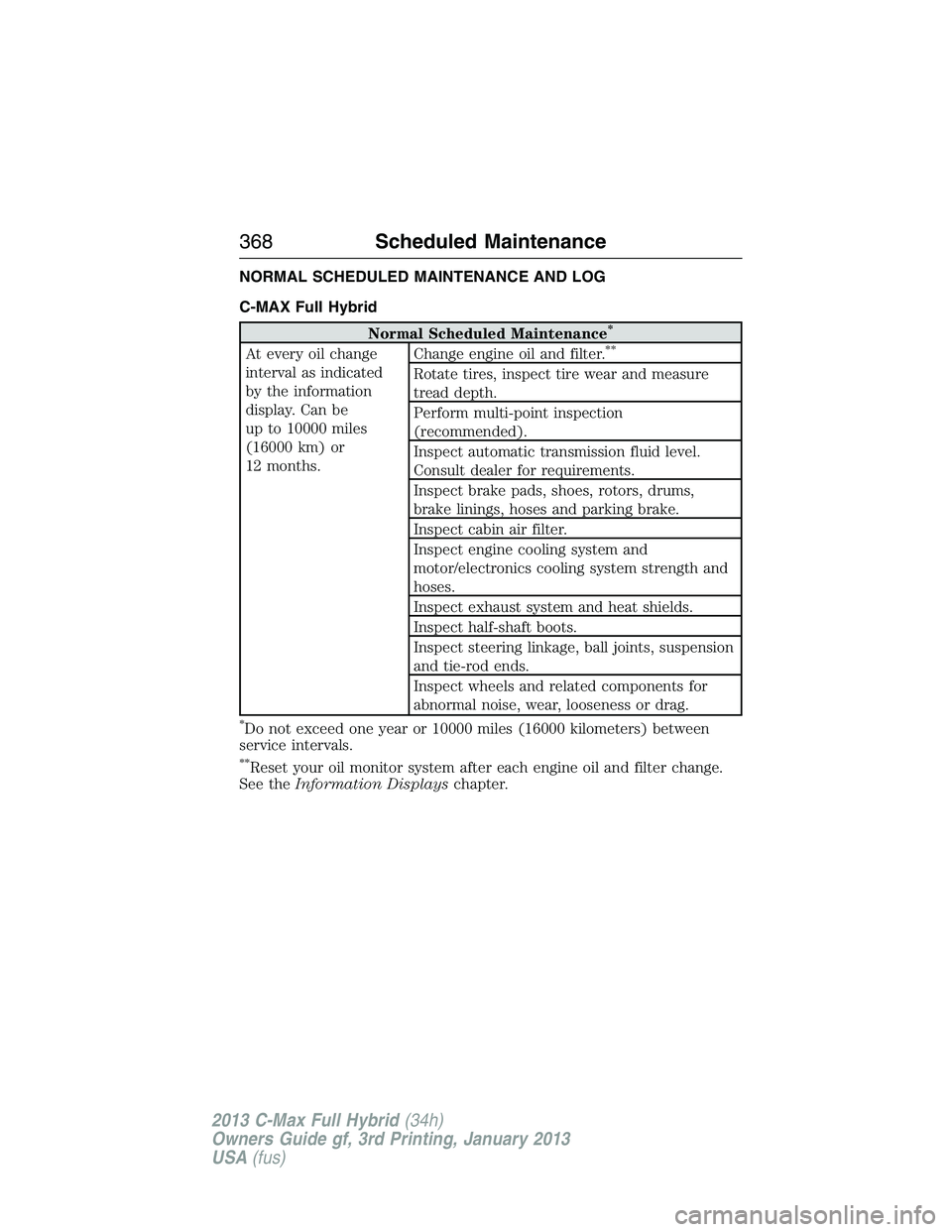
NORMAL SCHEDULED MAINTENANCE AND LOG
C-MAX Full Hybrid
Normal Scheduled Maintenance*
At every oil change
interval as indicated
by the information
display. Can be
up to 10000 miles
(16000 km) or
12 months.Change engine oil and filter.**
Rotate tires, inspect tire wear and measure
tread depth.
Perform multi-point inspection
(recommended).
Inspect automatic transmission fluid level.
Consult dealer for requirements.
Inspect brake pads, shoes, rotors, drums,
brake linings, hoses and parking brake.
Inspect cabin air filter.
Inspect engine cooling system and
motor/electronics cooling system strength and
hoses.
Inspect exhaust system and heat shields.
Inspect half-shaft boots.
Inspect steering linkage, ball joints, suspension
and tie-rod ends.
Inspect wheels and related components for
abnormal noise, wear, looseness or drag.
*Do not exceed one year or 10000 miles (16000 kilometers) between
service intervals.
**Reset your oil monitor system after each engine oil and filter change.
See theInformation Displayschapter.
368Scheduled Maintenance
2013 C-Max Full Hybrid(34h)
Owners Guide gf, 3rd Printing, January 2013
USA(fus)