belt FORD CONTOUR 2000 2.G User Guide
[x] Cancel search | Manufacturer: FORD, Model Year: 2000, Model line: CONTOUR, Model: FORD CONTOUR 2000 2.GPages: 248, PDF Size: 2.23 MB
Page 83 of 248
Seating and safety restraints
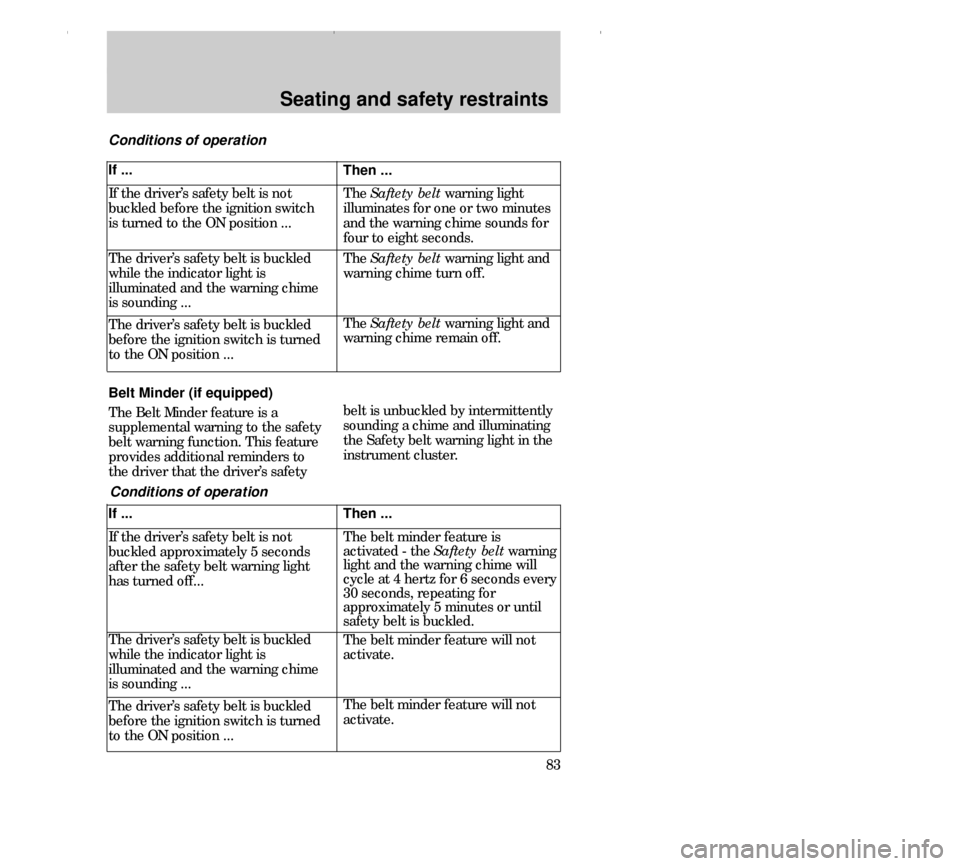
83 Conditions of operation
If the driver’s safety belt is not
buckled before the ignition switch
is turned to the ON position ... The Saftety belt warning light
illuminates for one or two minutes
and the warning chime sounds for
four to eight seconds.
The driver’s safety belt is buckled
while the indicator light is
illuminated and the warning chime
is sounding ...The Saftety belt warning light and
warning chime turn off.
The driver’s safety belt is buckled
before the ignition switch is turned
to the ON position ...The Saftety belt warning light and
warning chime remain off.
If ...Then ...
Belt Minder (if equipped)
The Belt Minder feature is a
supplemental warning to the safety
belt warning function. This feature
provides additional reminders to
the driver that the driver’s safety
Conditions of operation
If the driver’s safety belt is not
buckled approximately 5 seconds
after the safety belt warning light
has turned off...
The belt minder feature is
activated - the Saftety belt warning
light and the warning chime will
cycle at 4 hertz for 6 seconds every
30 seconds, repeating for
approximately 5 minutes or until
safety belt is buckled.
The driver’s safety belt is buckled
while the indicator light is
illuminated and the warning chime
is sounding ...
The belt minder feature will not
activate.
The driver’s safety belt is buckled
before the ignition switch is turned
to the ON position ...
The belt minder feature will not
activate.
If ...Then ...
belt is unbuckled by intermittently
sounding a chime and illuminating
the Safety belt warning light in the
instrument cluster.
14CSSen 17.6.99 11:00 Uhr Seite 83
Page 84 of 248
Seating and safety restraints
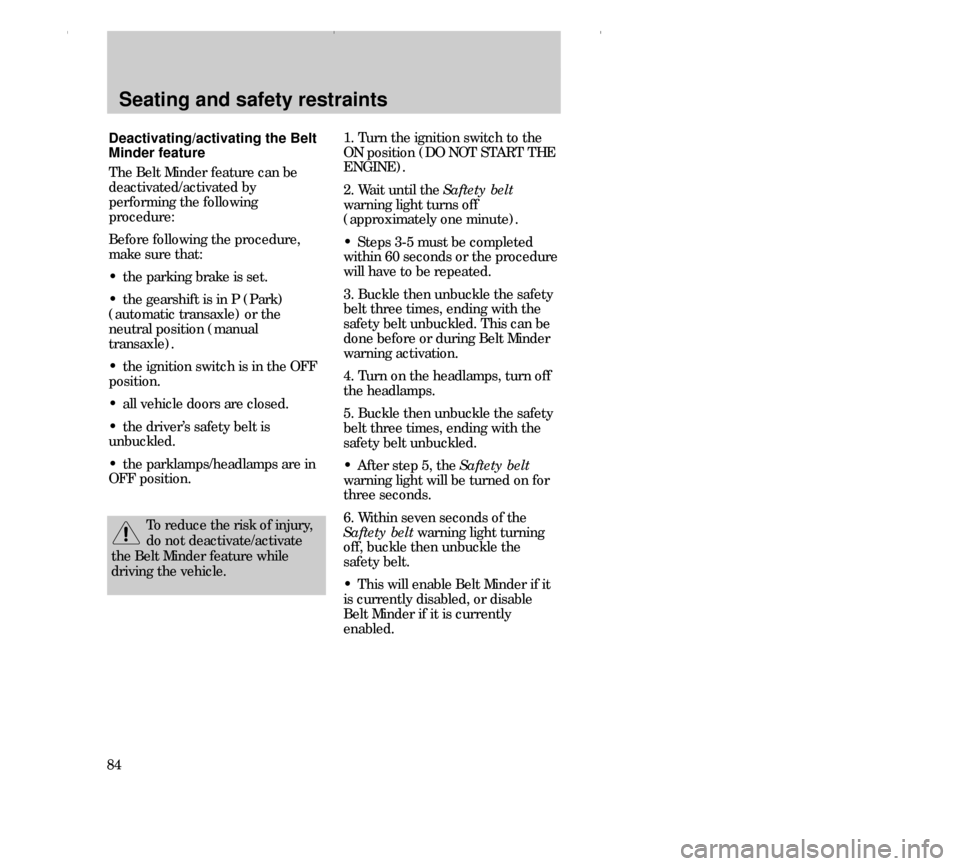
841. Turn the ignition switch to the
ON position (DO NOT START THE
ENGINE).
2. Wait until the Saftety belt
warning light turns off
(approximately one minute).
• Steps 3-5 must be completed
within 60 seconds or the procedure
will have to be repeated.
3. Buckle then unbuckle the safety
belt three times, ending with the
safety belt unbuckled. This can be
done before or during Belt Minder
warning activation.
4. Turn on the headlamps, turn off
the headlamps.
5. Buckle then unbuckle the safety
belt three times, ending with the
safety belt unbuckled.
• After step 5, the Saftety belt
warning light will be turned on for
three seconds.
6. Within seven seconds of the
Saftety beltwarning light turning
off, buckle then unbuckle the
safety belt.
• This will enable Belt Minder if it
is currently disabled, or disable
Belt Minder if it is currently
enabled.
To reduce the risk of injury,
do not deactivate/activate
the Belt Minder feature while
driving the vehicle.
Deactivating/activating the Belt
Minder feature
The Belt Minder feature can be
deactivated/activated by
performing the following
procedure:
Before following the procedure,
make sure that:
• the parking brake is set.
• the gearshift is in P (Park)
(automatic transaxle) or the
neutral position (manual
transaxle).
• the ignition switch is in the OFF
position.
• all vehicle doors are closed.
• the driver’s safety belt is
unbuckled.
• the parklamps/headlamps are in
OFF position.
14CSSen 17.6.99 11:00 Uhr Seite 84
Page 85 of 248
Seating and safety restraints
85
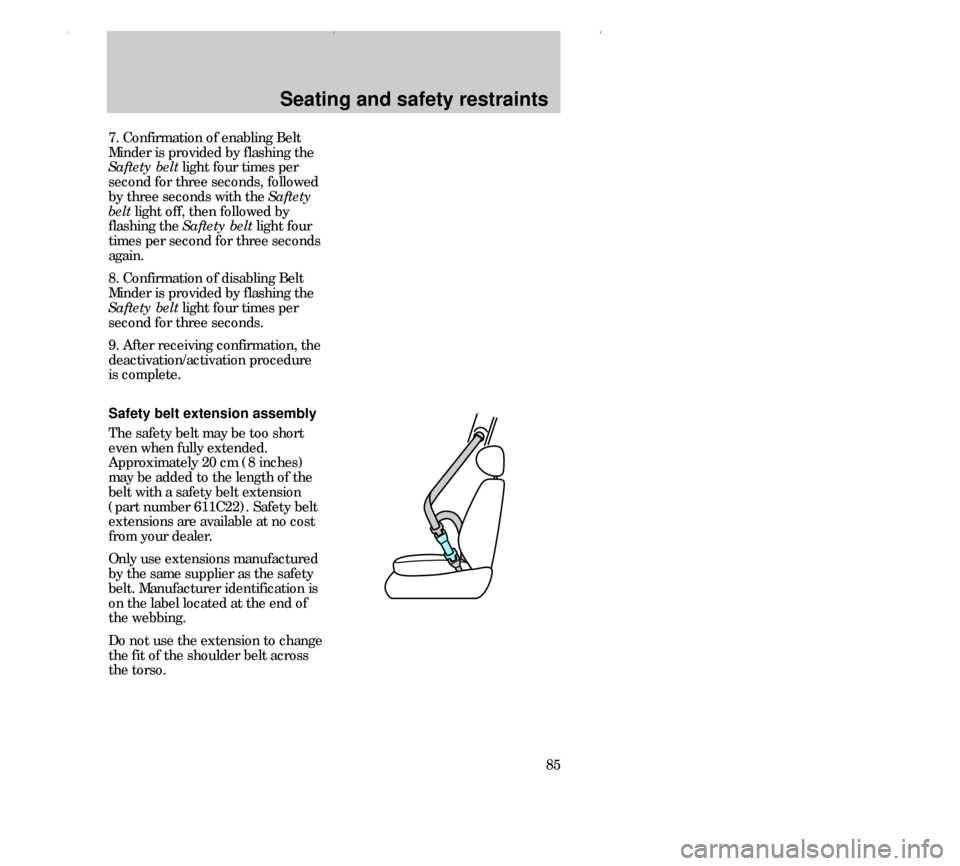
Safety belt extension assembly
The safety belt may be too short
even when fully extended.
Approximately 20 cm (8 inches)
may be added to the length of the
belt with a safety belt extension
(part number 611C22). Safety belt
extensions are available at no cost
from your dealer.
Only use extensions manufactured
by the same supplier as the safety
belt. Manufacturer identification is
on the label located at the end of
the webbing.
Do not use the extension to change
the fit of the shoulder belt across
the torso. 7. Confirmation of enabling Belt
Minder is provided by flashing the
Saftety beltlight four times per
second for three seconds, followed
by three seconds with the Saftety
beltlight off, then followed by
flashing the Saftety beltlight four
times per second for three seconds
again.
8. Confirmation of disabling Belt
Minder is provided by flashing the
Saftety beltlight four times per
second for three seconds.
9. After receiving confirmation, the
deactivation/activation procedure
is complete.
14CSSen 17.6.99 11:00 Uhr Seite 85
Page 86 of 248
Seating and safety restraints
86Care of safety belts
Periodically check the belts for
damage or fraying. Check the
security of the anchorage points
and the locking action of the inertia
reels by giving each belt a sharp
tug.
Belts subjected to strain, as in the
result of an accident, should be
replaced and the anchorages
checked by your dealer or a
qualified technician.
Failure to follow these
instructions will affect the
performance of the safety belts
and increase the risk of personal
injury.
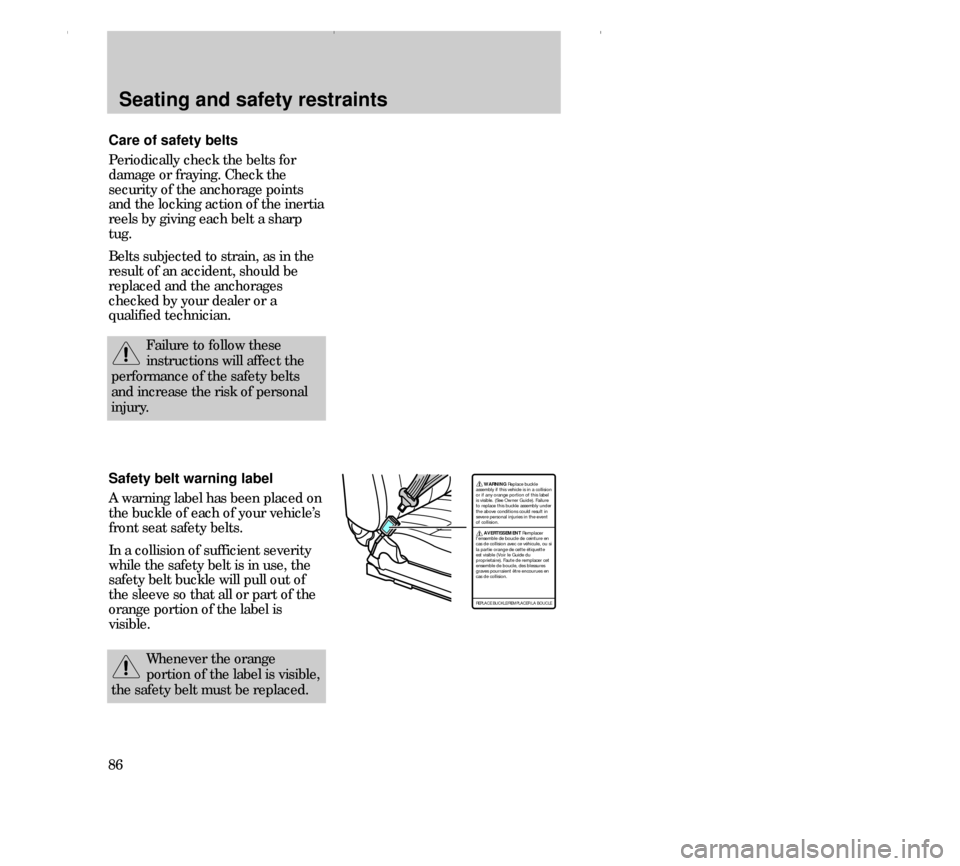
Safety belt warning label
A warning label has been placed on
the buckle of each of your vehicle’s
front seat safety belts.
In a collision of sufficient severity
while the safety belt is in use, the
safety belt buckle will pull out of
the sleeve so that all or part of the
orange portion of the label is
visible.
Whenever the orange
portion of the label is visible,
the safety belt must be replaced.
WARNING Replace buckle
assembly if this vehicle is in a collision
or if any orange portion of this label
is visible. (See Owner Guide). Failure
to replace this buckle assembly under
the above conditions could result in
severe personal injuries in the event
of collision.
AVERTISSEMENT Remplacer
l'ensemble de boucle de ceinture en
cas de collision avec ce véhicule, ou si
la partie orange de cette étiquette
est visible (Voir le Guide du
proprietaire). Faute de remplacer cet
ensemble de boucle, des blessures
graves pourraient être encourues en
cas de collision.
REPLACE BUCKLE/REMPLACER LA BOUCLE
14CSSen 17.6.99 11:00 Uhr Seite 86
Page 87 of 248
Seating and safety restraints
87 Important supplemental
restraint system (SRS)
precautions
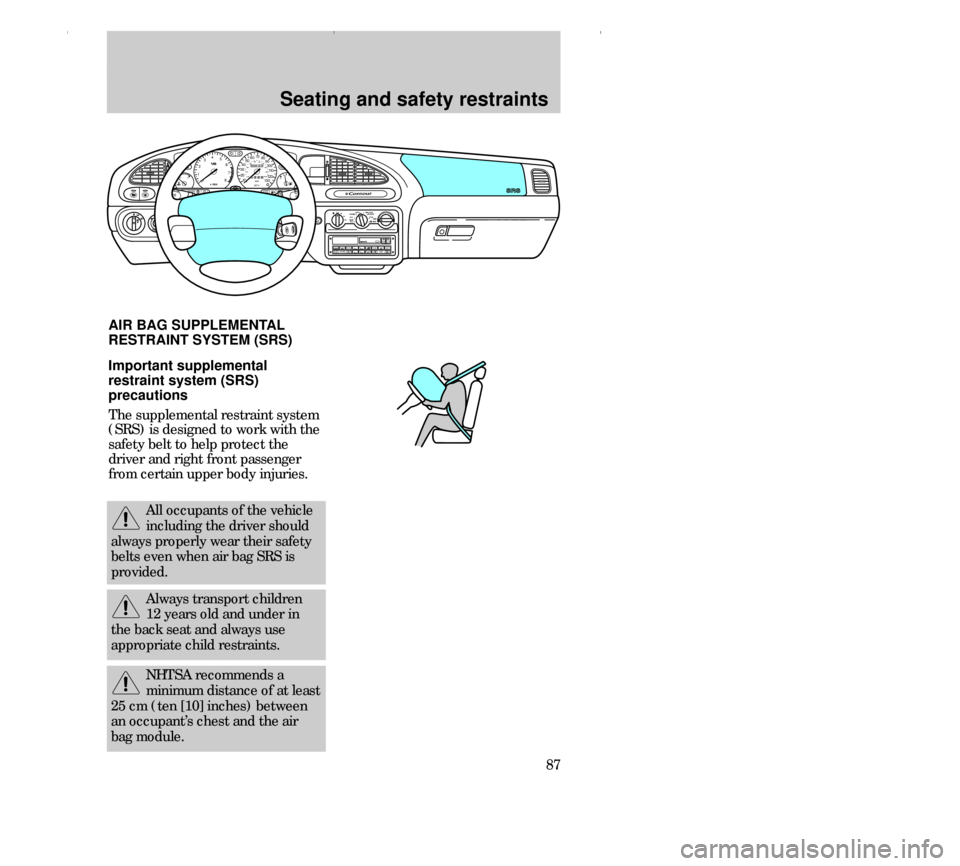
The supplemental restraint system
(SRS) is designed to work with the
safety belt to help protect the
driver and right front passenger
from certain upper body injuries.
AIR BAG SUPPLEMENTAL
RESTRAINT SYSTEM (SRS)
MIRRORS
OFF LO PNL/FLR
PANEL
A/CFLOOR
DEF FLR
DEF
MAX
A/C HI/
POWER AUDIO AM/FM
SCAN
SEEK 31245ANSSIDE 1-2EJECTVOLUME
000123000010 20 3040506070
80
90
10 0
110
120
13 0MPH20 406055
80120 10 0
14 0
160
18 0
200EF12
03x 1000
4
5
6
7
8BRAKE
CHECK
ENGINEO/D
OFF
CLOCK
TRACTION
TROLCH
Always transport children
12 years old and under in
the back seat and always use
appropriate child restraints.
All occupants of the vehicle
including the driver should
always properly wear their safety
belts even when air bag SRS is
provided.
NHTSA recommends a
minimum distance of at least
25 cm (ten [10] inches) between
an occupant’s chest and the air
bag module.
14CSSen 17.6.99 11:00 Uhr Seite 87
Page 88 of 248
Seating and safety restraints
88
Do not attempt to service,
repair, or modify the air bag
Supplemental Restraint System
(SRS) or its fuses. See your Ford
or Lincoln-Mercury dealer.
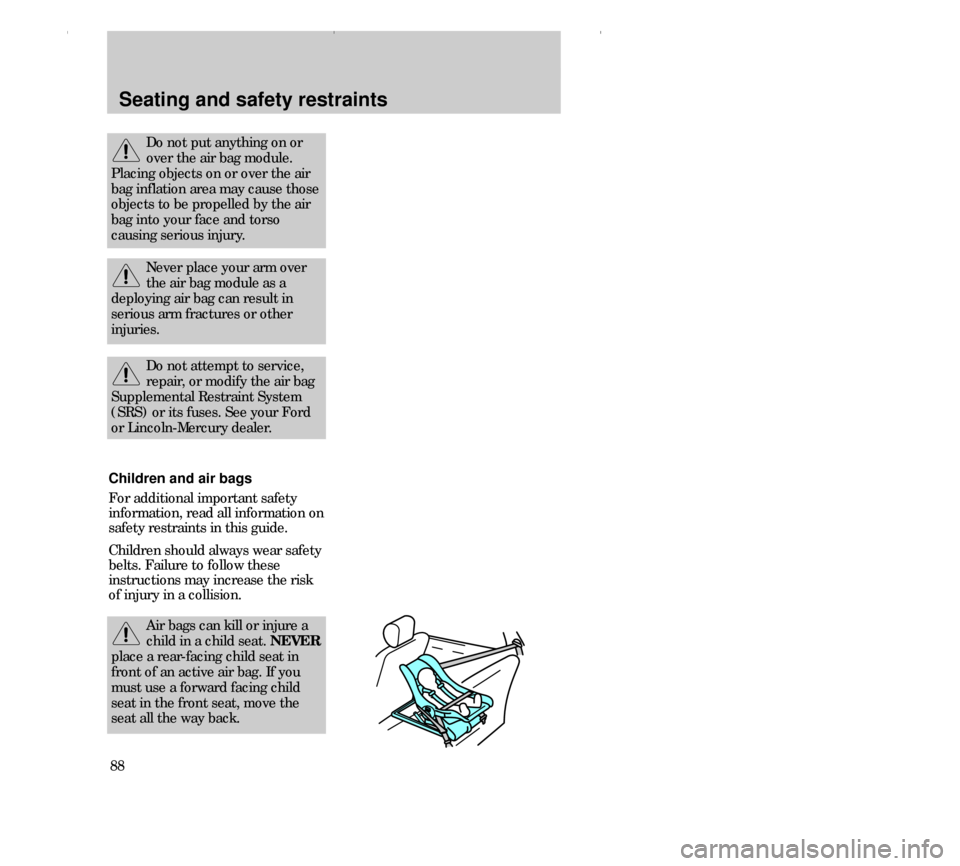
Air bags can kill or injure a
child in a child seat.
NEVER
place a rear-facing child seat in
front of an active air bag. If you
must use a forward facing child
seat in the front seat, move the
seat all the way back.
Children and air bags
For additional important safety
information, read all information on
safety restraints in this guide.
Children should always wear safety
belts. Failure to follow these
instructions may increase the risk
of injury in a collision.
Do not put anything on or
over the air bag module.
Placing objects on or over the air
bag inflation area may cause those
objects to be propelled by the air
bag into your face and torso
causing serious injury.
Never place your arm over
the air bag module as a
deploying air bag can result in
serious arm fractures or other
injuries.
14CSSen 17.6.99 11:00 Uhr Seite 88
Page 93 of 248
Seating and safety restraints
93
Safety belts and seats can
become hot in a vehicle that
has been closed up in sunny
weather; they could burn a small
child. Check seat covers and
buckles before you place a child
anywhere near them.
Do not leave children,
unreliable adults, or pets
unattended in your vehicle.
To prevent the risk of injury,
make sure children sit where
they can be properly restrained.
CHILDREN AND SAFETY
RESTRAINTS
It is extremely dangerous to
ride in a cargo area, inside or
outside of a vehicle. In a collision,
people riding in these areas are
more likely to be seriously injured
or killed. Do not allow people to
ride in any area of your vehicle
that is not equipped with seats
and safety belts. Be sure everyone
in your vehicle is in a seat and
using a safety belt properly.
Whenever possible, put
children in one of the rear
seats in your vehicle. Accident
statistics indicate that children are
safer when properly restrained in
the rear seats than in the front
seats.
14CSSen 17.6.99 11:00 Uhr Seite 93
Page 95 of 248
Seating and safety restraints
95 Children and safety belts
Children who are too large for child
safety seats (as specified by the
child safety seat manufacturer)
should always wear safety belts.
Follow all the important safety
restraints and air bag precautions
that apply to adult passengers in
your vehicle.
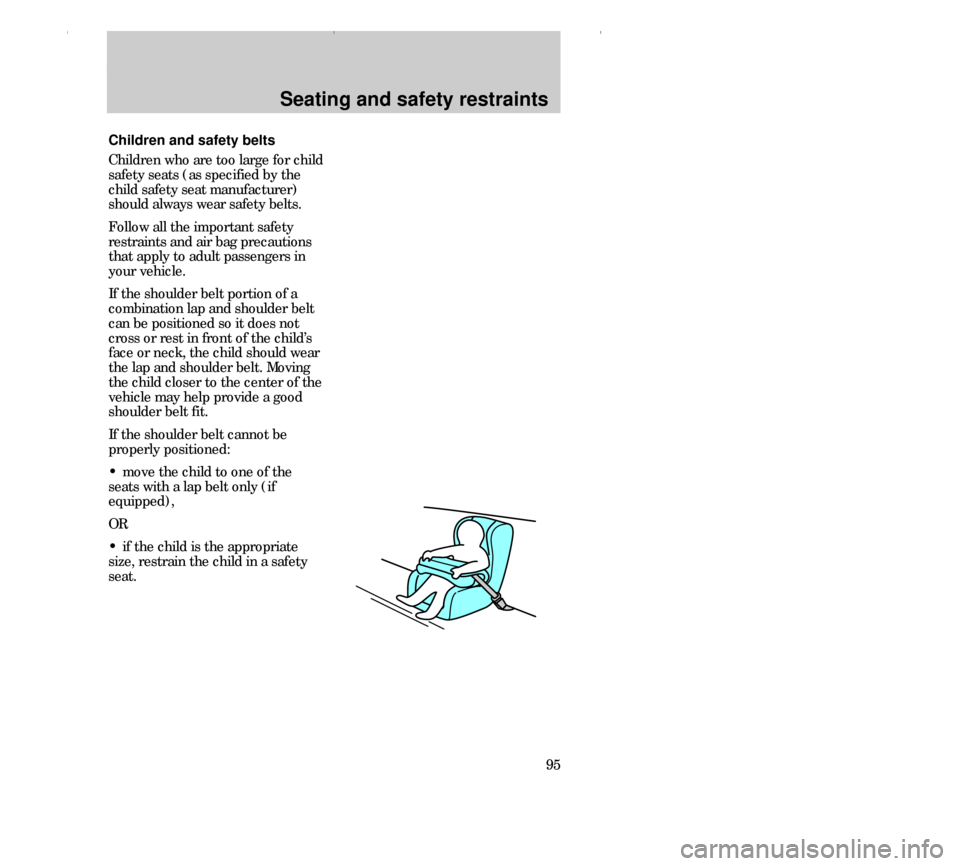
If the shoulder belt portion of a
combination lap and shoulder belt
can be positioned so it does not
cross or rest in front of the child’s
face or neck, the child should wear
the lap and shoulder belt. Moving
the child closer to the center of the
vehicle may help provide a good
shoulder belt fit.
If the shoulder belt cannot be
properly positioned:
• move the child to one of the
seats with a lap belt only (if
equipped),
OR
• if the child is the appropriate
size, restrain the child in a safety
seat.
14CSSen 17.6.99 11:00 Uhr Seite 95
Page 96 of 248
Seating and safety restraints
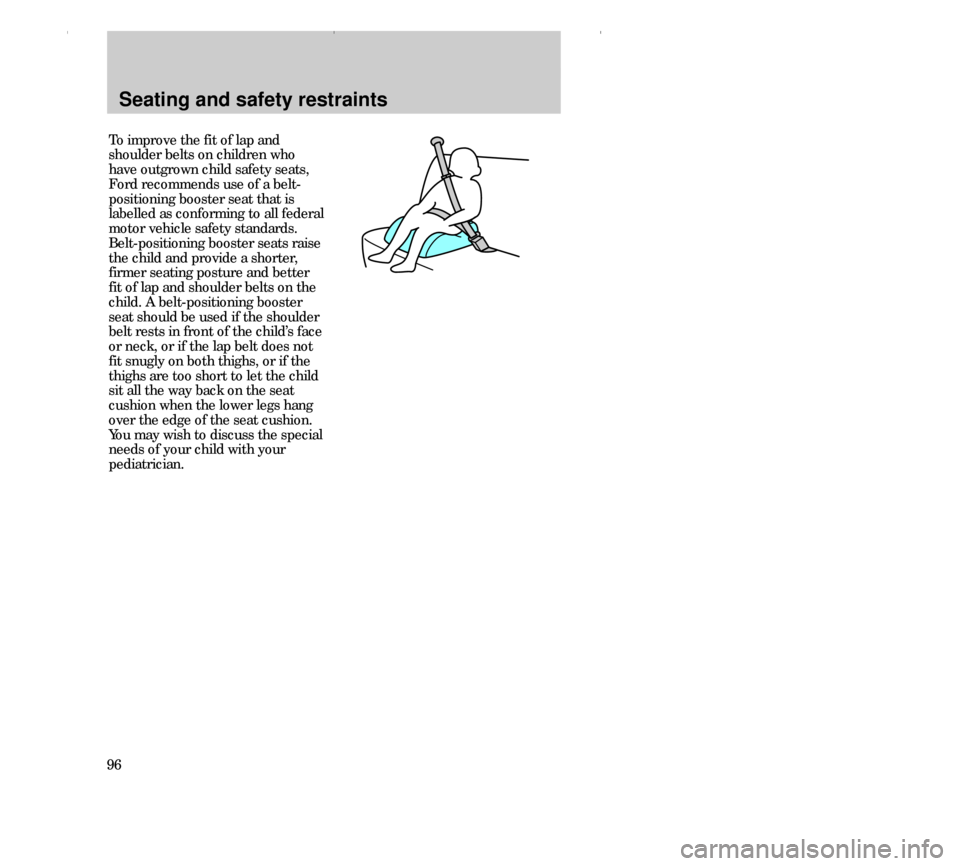
96To improve the fit of lap and
shoulder belts on children who
have outgrown child safety seats,
Ford recommends use of a belt-
positioning booster seat that is
labelled as conforming to all federal
motor vehicle safety standards.
Belt-positioning booster seats raise
the child and provide a shorter,
firmer seating posture and better
fit of lap and shoulder belts on the
child. A belt-positioning booster
seat should be used if the shoulder
belt rests in front of the child’s face
or neck, or if the lap belt does not
fit snugly on both thighs, or if the
thighs are too short to let the child
sit all the way back on the seat
cushion when the lower legs hang
over the edge of the seat cushion.
You may wish to discuss the special
needs of your child with your
pediatrician.
14CSSen 17.6.99 11:00 Uhr Seite 96
Page 97 of 248
Seating and safety restraints
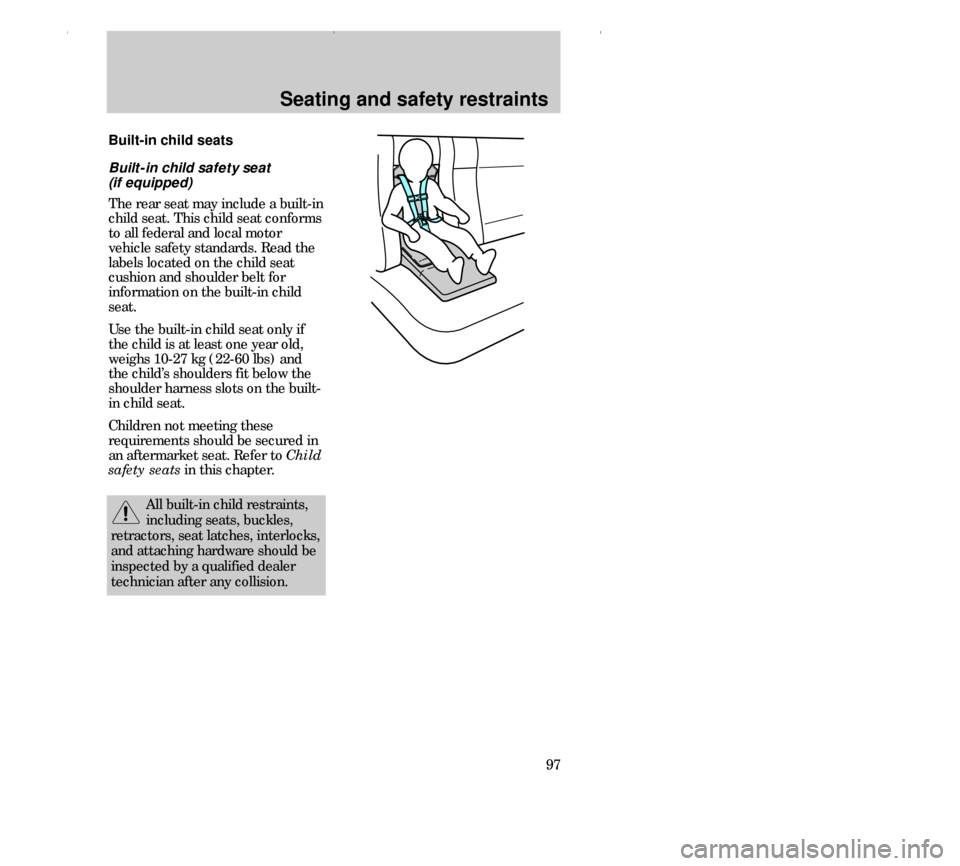
97 Built-in child safety seat
(if equipped)
The rear seat may include a built-in
child seat. This child seat conforms
to all federal and local motor
vehicle safety standards. Read the
labels located on the child seat
cushion and shoulder belt for
information on the built-in child
seat.
Use the built-in child seat only if
the child is at least one year old,
weighs 10-27 kg (22-60 lbs) and
the child’s shoulders fit below the
shoulder harness slots on the built-
in child seat.
Children not meeting these
requirements should be secured in
an aftermarket seat. Refer to Child
safety seatsin this chapter. Built-in child seats
All built-in child restraints,
including seats, buckles,
retractors, seat latches, interlocks,
and attaching hardware should be
inspected by a qualified dealer
technician after any collision.
14CSSen 17.6.99 11:00 Uhr Seite 97