brake light FORD CONTOUR 2000 2.G User Guide
[x] Cancel search | Manufacturer: FORD, Model Year: 2000, Model line: CONTOUR, Model: FORD CONTOUR 2000 2.GPages: 248, PDF Size: 2.23 MB
Page 113 of 248
Starting
113 3. Turn the key to the on position
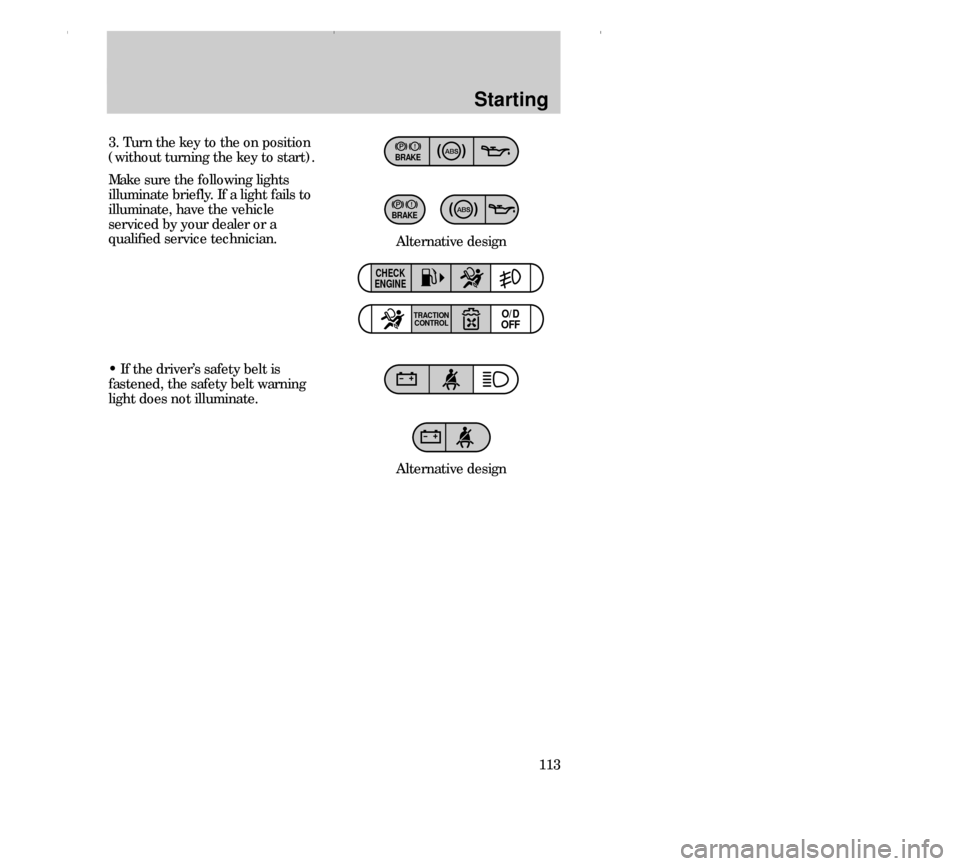
(without turning the key to start).
Make sure the following lights
illuminate briefly. If a light fails to
illuminate, have the vehicle
serviced by your dealer or a
qualified service technician.
BRAKE
BRAKE
CHECK
ENGINE
• If the driver’s safety belt is
fastened, the safety belt warning
light does not illuminate.Alternative design
Alternative design
O/D
OFFTRACTION
CONTROL
21CSten 17.6.99 11:06 Uhr Seite 113
Page 119 of 248
Driving
119 TRACTION CONTROL
(if equipped)
This system prevents wheel spin at
all speeds. The control will toggle
this function on and off, but the
feature defaults to on after each
cycle of the ignition key.
The traction control system
controls excessive wheel spin by
automatically applying and
releasing the brakes in conjunction
with engine torque reductions.
This can occur when accelerating
on a slippery road, a loose surface
or when pulling away on a hill. The
traction control lamp flashes on the
instrument panel when the system
is functioning to regulate tire
traction.
When the ignition is turned to the
on position, the traction control
system light comes on for
approximately three (3) seconds. If
the light does not come on when
the ignition is turned to the on
position or if it remains on
continuously when the traction
control system is turned on, have
the system serviced by your dealer
or a qualified service technician.
You can continue to drive and do
not need to have the vehicle towed
in.
You should not take unnecessary
driving risks because of the
system’s safety potential.
22CDren 17.6.99 11:08 Uhr Seite 119
Page 121 of 248
Driving
121 TRANSAXLE OPERATION
Automatic transaxle
(if equipped)
Your 2.5 l V6 automatic transaxle
electronically controls the shift feel
by using an adaptive learning
strategy. This feature is designed to
optimize shift smoothness. It is
normal for your transaxle to adjust
during the first few hundred
kilometers (miles) of operation
until the adaptive strategy has
been learned. The adaptive
learning strategy is maintained by
power from the battery. When the
battery is disconnected or a new
battery is installed, the transaxle
must relearn its adaptive strategy.
Optimal shifting will resume within
a few hundred kilometers (miles)
of operation.
Vehicles equipped with an
automatic transaxle are equipped
with a brake-shift interlock feature
that prevents the gearshift lever
from being moved from the P
(Park) position unless the brake
pedal is depressed.
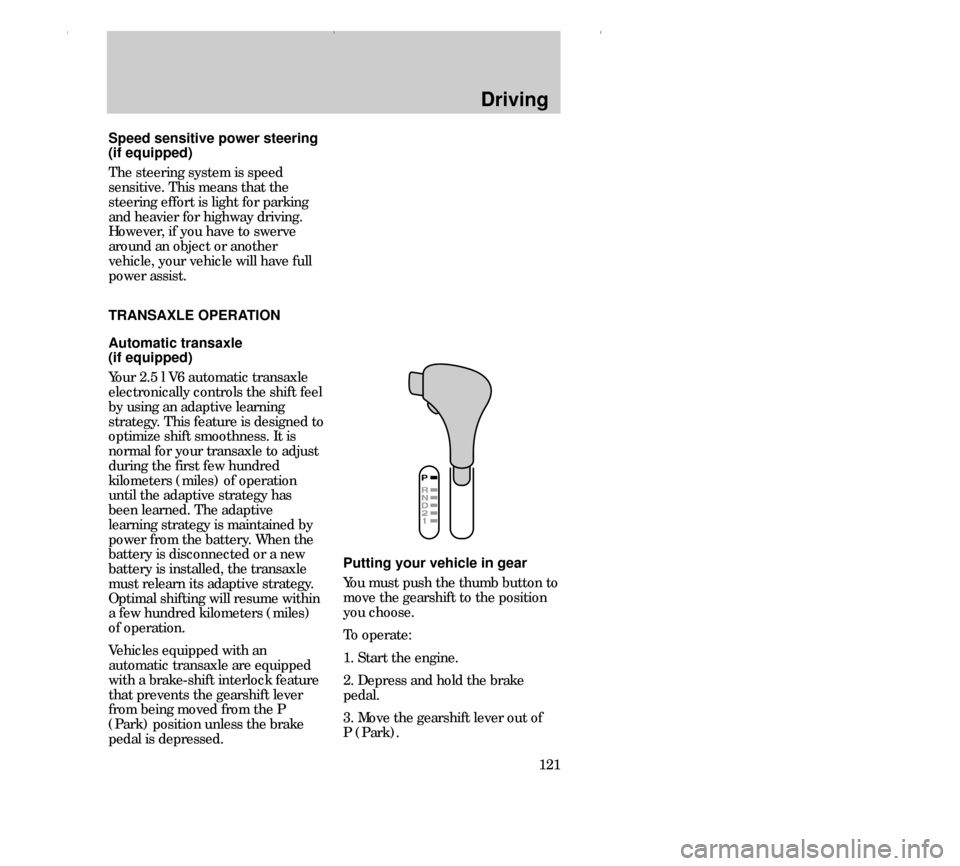
Putting your vehicle in gear
You must push the thumb button to
move the gearshift to the position
you choose.
To operate:
1. Start the engine.
2. Depress and hold the brake
pedal.
3. Move the gearshift lever out of
P (Park). Speed sensitive power steering
(if equipped)
The steering system is speed
sensitive. This means that the
steering effort is light for parking
and heavier for highway driving.
However, if you have to swerve
around an object or another
vehicle, your vehicle will have full
power assist.
22CDren 17.6.99 11:08 Uhr Seite 121
Page 124 of 248
Driving
124•D (Overdrive)
Note that the vehicle’s gearshift is
console-mounted on the floor. The
transaxle control switch (TCS) is
located on the gearshift handle.
The transaxle control indicator
light (O/D light) is located on the
instrument panel.
Overdrive is not shown on the
display, but is the default mode for
the D gearshift position. This is the
normal driving mode for the best
fuel economy. The transaxle
operates in gears one through four.
The O/D light is off (not
illuminated) during normal vehicle
operation.
Overdrive can be deactivated by
pressing the transaxle control
switch (TCS) located on the
gearshift handle. The O/D OFF
indicator light will illuminate in the
instrument cluster. •N(Neutral)
The wheels of the transaxle are not
locked. Your vehicle will roll freely,
even on the slightest incline, unless
the parking brake or brakes are on.
22CDren 17.6.99 11:09 Uhr Seite 124
Page 148 of 248
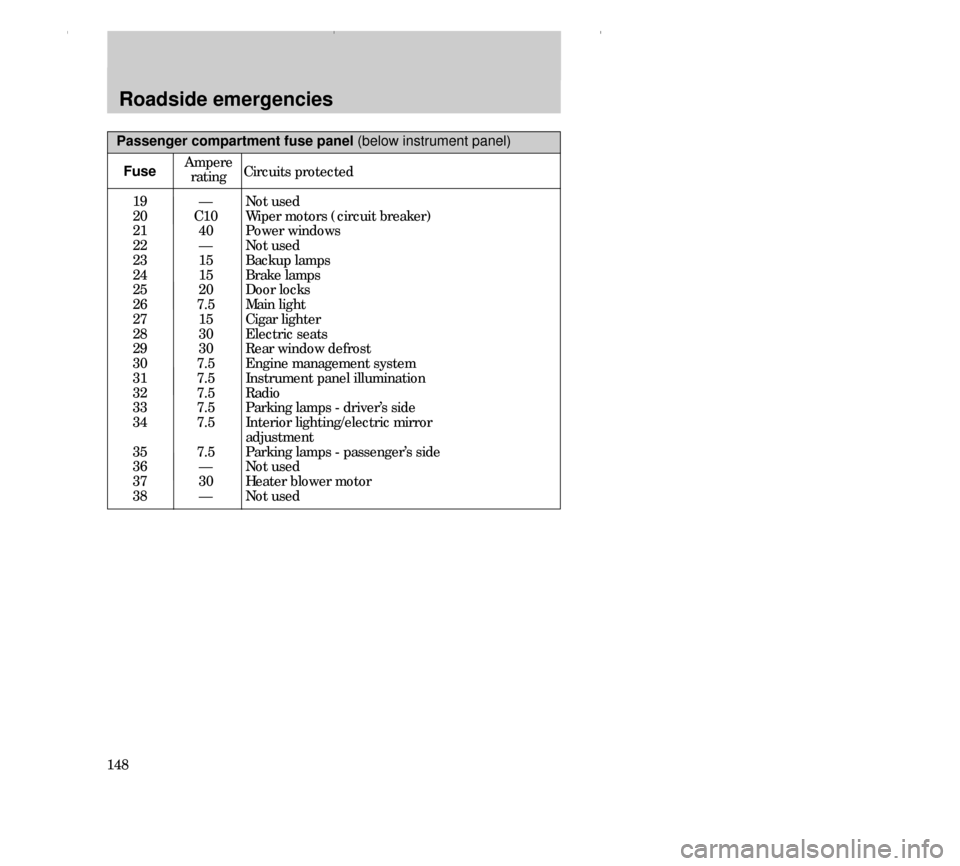
Roadside emergencies
148
19
20
21
22
23
24
25
26
27
28
29
30
31
32
33
34
35
36
37
38—
C10
40
—
15
15
20
7.5
15
30
30
7.5
7.5
7.5
7.5
7.5
7.5
—
30
—Not used
Wiper motors (circuit breaker)
Power windows
Not used
Backup lamps
Brake lamps
Door locks
Main light
Cigar lighter
Electric seats
Rear window defrost
Engine management system
Instrument panel illumination
Radio
Parking lamps - driver’s side
Interior lighting/electric mirror
adjustment
Parking lamps - passenger’s side
Not used
Heater blower motor
Not used
Passenger compartment fuse panel (below instrument panel)
FuseAmpere
ratingCircuits protected
23CREen 17.6.99 11:11 Uhr Seite 148
Page 150 of 248
Roadside emergencies
150
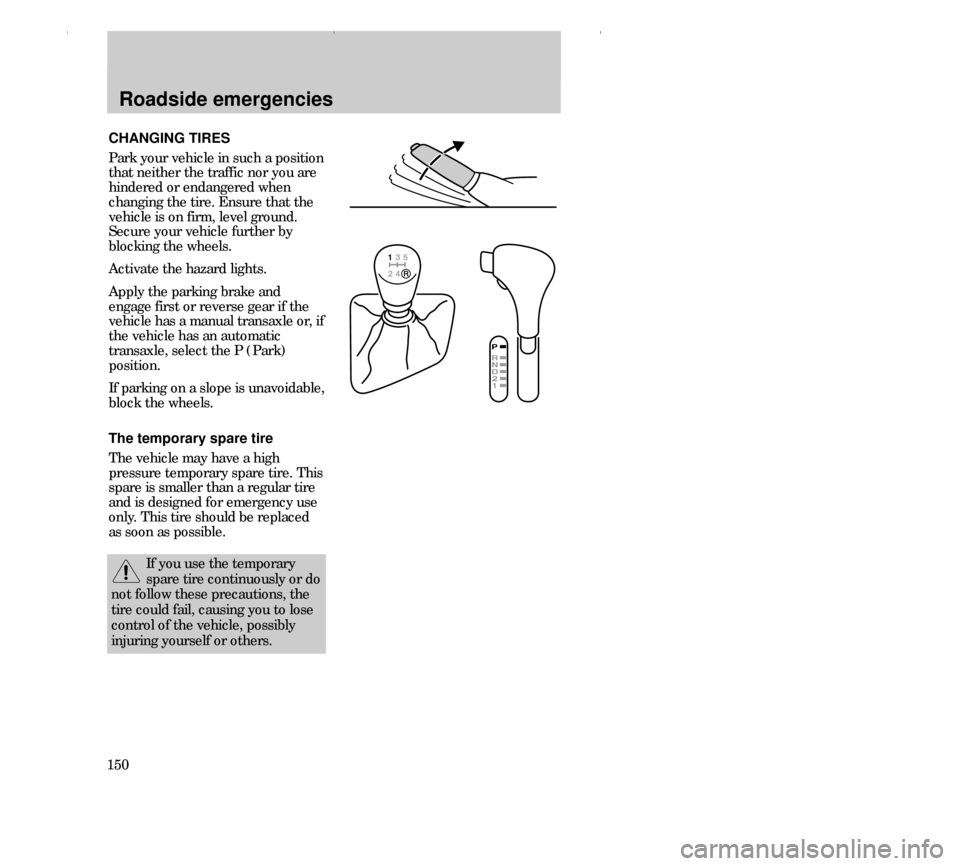
CHANGING TIRES
Park your vehicle in such a position
that neither the traffic nor you are
hindered or endangered when
changing the tire. Ensure that the
vehicle is on firm, level ground.
Secure your vehicle further by
blocking the wheels.
Activate the hazard lights.
Apply the parking brake and
engage first or reverse gear if the
vehicle has a manual transaxle or, if
the vehicle has an automatic
transaxle, select the P (Park)
position.
If parking on a slope is unavoidable,
block the wheels.
The temporary spare tire
The vehicle may have a high
pressure temporary spare tire. This
spare is smaller than a regular tire
and is designed for emergency use
only. This tire should be replaced
as soon as possible.
If you use the temporary
spare tire continuously or do
not follow these precautions, the
tire could fail, causing you to lose
control of the vehicle, possibly
injuring yourself or others.
23CREen 17.6.99 11:11 Uhr Seite 150
Page 152 of 248
Roadside emergencies
152
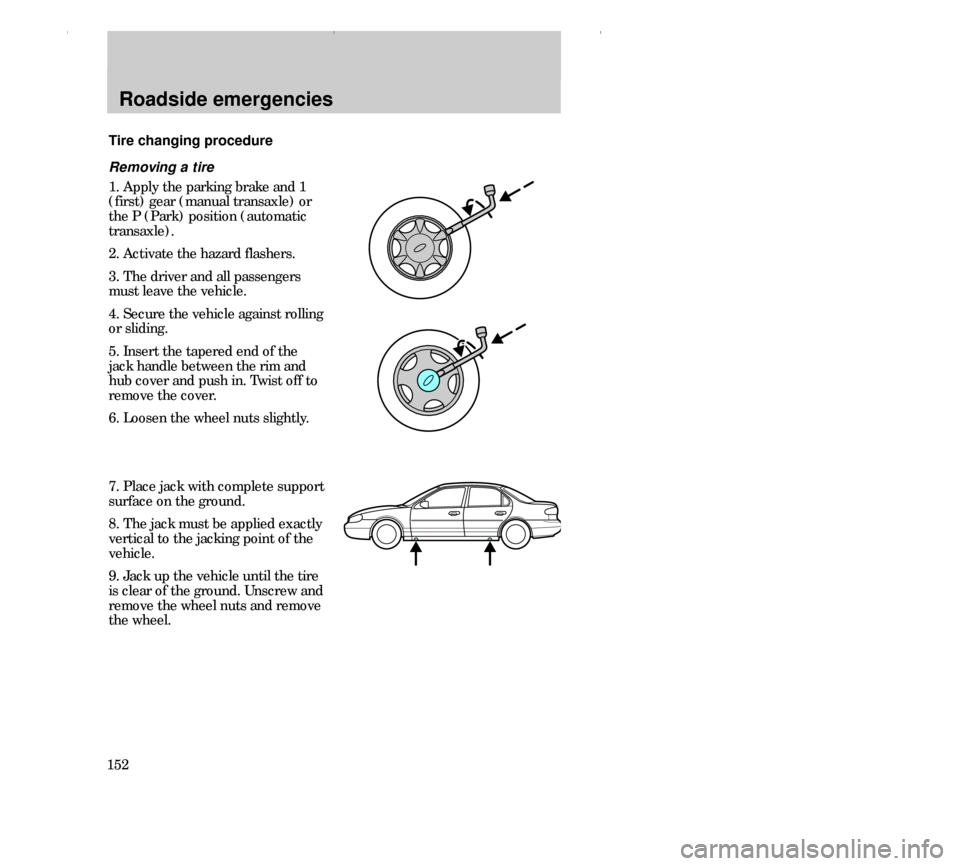
Removing a tire
1. Apply the parking brake and 1
(first) gear (manual transaxle) or
the P (Park) position (automatic
transaxle).
2. Activate the hazard flashers.
3. The driver and all passengers
must leave the vehicle.
4. Secure the vehicle against rolling
or sliding.
5. Insert the tapered end of the
jack handle between the rim and
hub cover and push in. Twist off to
remove the cover.
6. Loosen the wheel nuts slightly.
Tire changing procedure
7. Place jack with complete support
surface on the ground.
8. The jack must be applied exactly
vertical to the jacking point of the
vehicle.
9. Jack up the vehicle until the tire
is clear of the ground. Unscrew and
remove the wheel nuts and remove
the wheel.
23CREen 17.6.99 11:11 Uhr Seite 152
Page 155 of 248
Roadside emergencies
155
3. Park the booster vehicle close to
the hood of the disabled vehicle,
making sure the two vehicles do
nottouch. Set the parking brake
on both vehicles and stay clear of
the engine cooling fan and other
moving parts.
4. Check all battery terminals and
remove any excessive corrosion
before you attach the battery
cables. Ensure that vent caps are
tight and level.
5. Turn the heater fan on in both
vehicles to protect from any
electrical surges. Turn all other
accessories off.
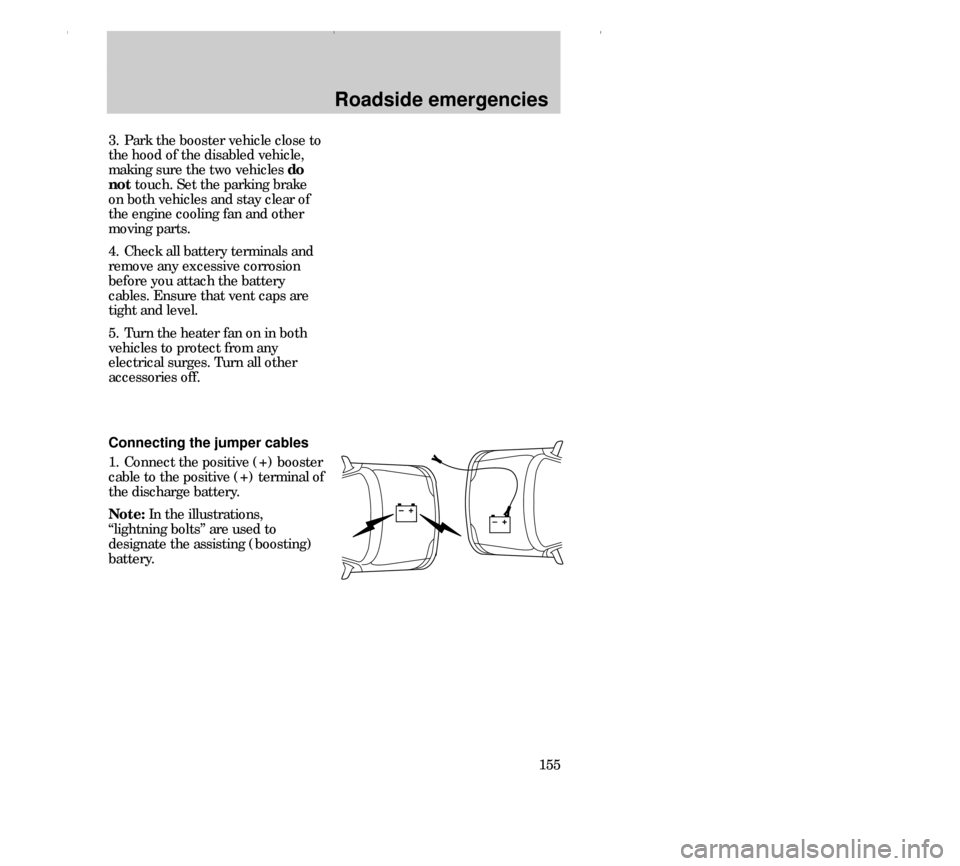
Connecting the jumper cables
1. Connect the positive (+) booster
cable to the positive (+) terminal of
the discharge battery.
Note:In the illustrations,
“lightning bolts” are used to
designate the assisting (boosting)
battery.
23CREen 17.6.99 11:11 Uhr Seite 155
Page 172 of 248
Maintenance and care
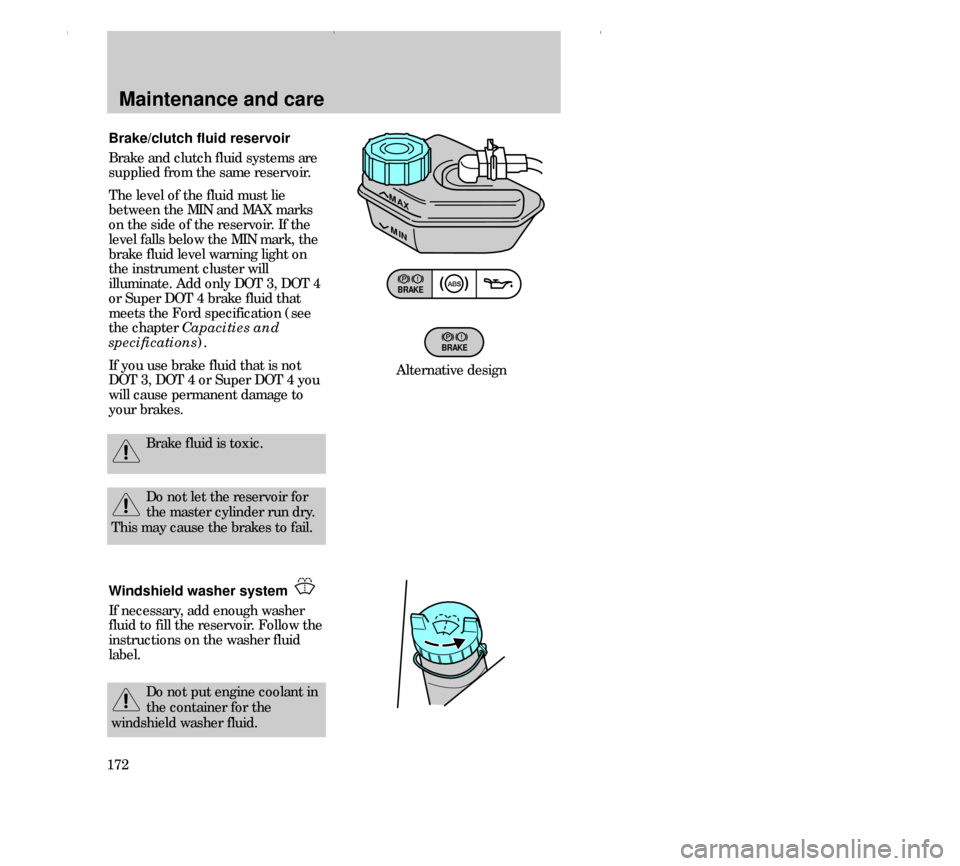
172Brake/clutch fluid reservoir
Brake and clutch fluid systems are
supplied from the same reservoir.
The level of the fluid must lie
between the MIN and MAX marks
on the side of the reservoir. If the
level falls below the MIN mark, the
brake fluid level warning light on
the instrument cluster will
illuminate. Add only DOT 3, DOT 4
or Super DOT 4 brake fluid that
meets the Ford specification (see
the chapter Capacities and
specifications).
If you use brake fluid that is not
DOT 3, DOT 4 or Super DOT 4 you
will cause permanent damage to
your brakes.
MAX
MIN
Brake fluid is toxic.
BRAKE
BRAKE
Do not let the reservoir for
the master cylinder run dry.
This may cause the brakes to fail.
Windshield washer system
If necessary, add enough washer
fluid to fill the reservoir. Follow the
instructions on the washer fluid
label.
Alternative design
Do not put engine coolant in
the container for the
windshield washer fluid.
31CMCen 17.6.99 11:15 Uhr Seite 172
Page 203 of 248
Maintenance and care
203
BRAKE
O/D
OFFTRACTION
CONTROL
Alternative design Alternative design
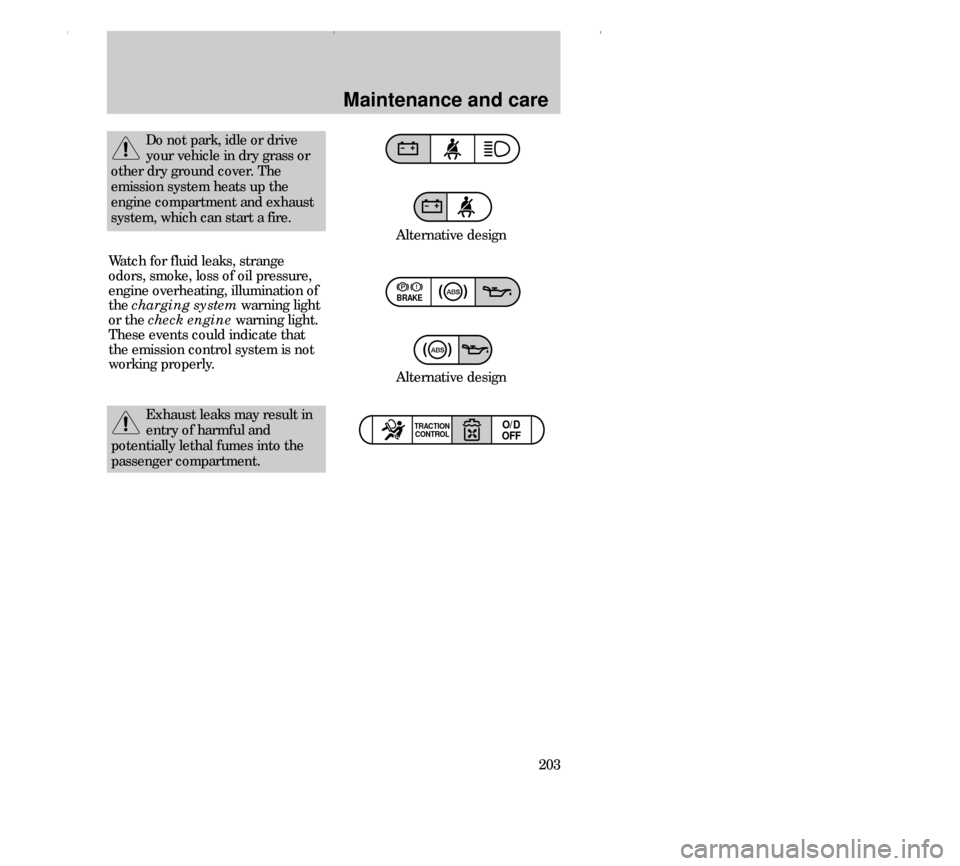
Watch for fluid leaks, strange
odors, smoke, loss of oil pressure,
engine overheating, illumination of
the
charging systemwarning light
or the check enginewarning light.
These events could indicate that
the emission control system is not
working properly.
Exhaust leaks may result in
entry of harmful and
potentially lethal fumes into the
passenger compartment.
Do not park, idle or drive
your vehicle in dry grass or
other dry ground cover. The
emission system heats up the
engine compartment and exhaust
system, which can start a fire.
31CMCen 17.6.99 11:15 Uhr Seite 203